Strategic Defense,
From First DUI to Death Penalty
From First DUI to Death Penalty






| Short answer: A Tampa internet crimes attorney defends charges built on online activity and digital evidence, including online solicitation of a minor, traveling to meet a minor, possession or transmission of child sexual abuse material, cyberstalking, sexual cyberharassment, unauthorized computer access, and identity theft. Florida increased several of these penalties on July 1, 2026: possession of child sexual abuse material is now a second-degree felony, and each image can be charged as a separate count. The Brancato Law Firm, P.A. challenges how the evidence was obtained, whether the client knew what was on a device, and whether police crossed the line into entrapment. |
Internet crime cases often start long before an arrest, with a cyber tip, a warrant to a technology company, or an undercover chat. Rocky Brancato, founder of The Brancato Law Firm, P.A., has tried more than 150 jury trials to verdict and has been brought onto defense teams for his experience with sex crime and entrapment cases. Our attorneys at this Tampa criminal defense firm review the forensic report, the chat logs, and the warrants line by line, because these cases are won or lost on the details of the digital evidence. Many internet crimes are also sex offenses; our Tampa sex crimes lawyer page covers registration and related charges.
Maximum penalties for each level are set by § 775.082: 1 year for a first-degree misdemeanor, 5 years for a third-degree felony, 15 years for a second-degree felony, and 30 years for a first-degree felony.
| Charge | Florida law | Level |
|---|---|---|
| Online solicitation of a minor (computer or device) | § 847.0135(3) | Third-degree felony; second-degree if the person misrepresents his or her age |
| Traveling to meet a minor after online solicitation | § 847.0135(4) | Second-degree felony |
| Possession or intentional viewing of child sexual abuse material | § 827.071(5)(a) | Second-degree felony (since July 1, 2026); each image is a separate count |
| Possession with intent to promote (3 or more copies is evidence of intent) | § 827.071(4) | Second-degree felony |
| Transmission of child sexual abuse material | § 847.0137 | Second-degree felony with a 5-year minimum for adults (since July 1, 2026) |
| Possession of computer-generated (AI) sexual images of minors | § 827.072 | Third-degree felony |
| Cyberstalking | § 784.048(2) | First-degree misdemeanor |
| Aggravated stalking (credible threat, injunction, or victim under 16) | § 784.048(3)-(5) | Third-degree felony |
| Sexual cyberharassment (“revenge porn”) | § 784.049 | First-degree misdemeanor; third-degree felony with a prior or for financial gain |
| Altered sexual depictions (“deepfakes”) | § 836.13 | Third-degree felony |
| Extortion, including sextortion | § 836.05 | Second-degree felony |
| Unauthorized access to a computer or network | § 815.06 | Third-degree felony; second or first degree with damage, fraud, or danger to life |
| Criminal use of personal identification information | § 817.568 | Third-degree felony; up to a first-degree felony with 3-, 5-, or 10-year minimums by amount or number of victims |
Registration as a sex offender follows convictions under § 847.0135 (online solicitation and traveling), § 827.071, and § 847.0137. Sexual cyberharassment, altered sexual depictions, and computer-generated image possession are not on the registration list. That difference often shapes the negotiation. Florida is one of the busiest states for online crime reports: in 2025, Floridians filed 71,843 complaints with the FBI’s Internet Crime Complaint Center, third in the nation (FBI IC3 2025 Internet Crime Report), and in 2023 the National Center for Missing and Exploited Children received 66,861 CyberTipline reports tied to Florida (NCMEC).
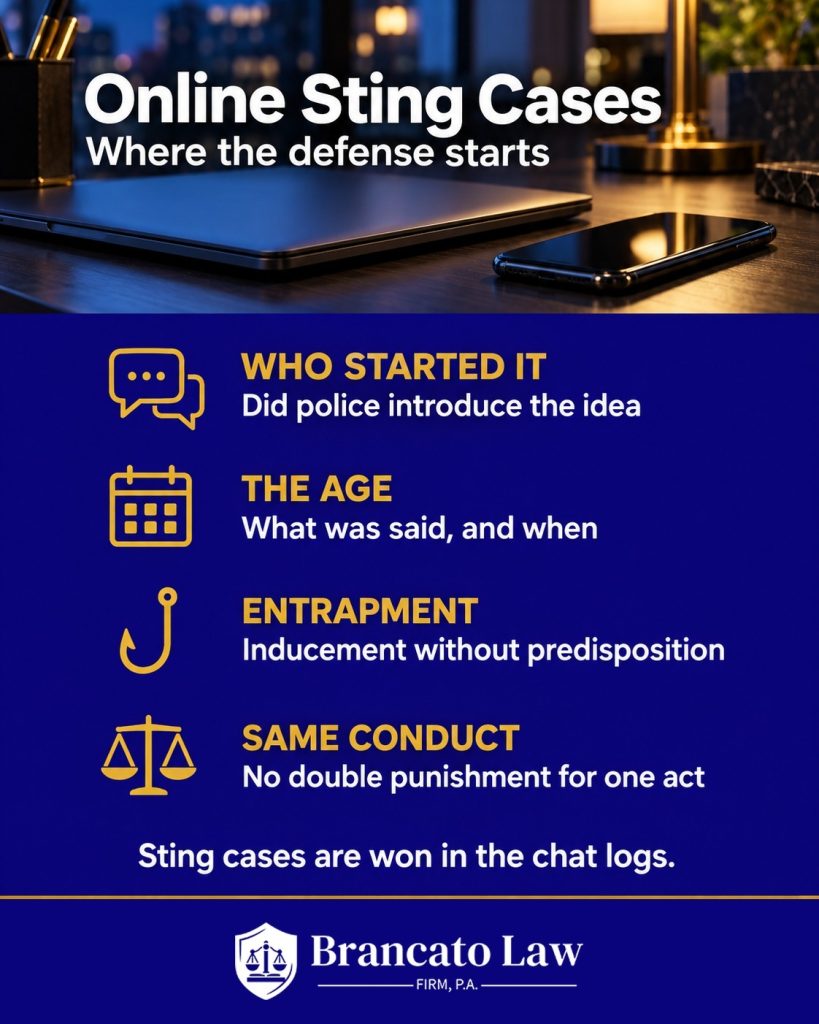
In an online sting, an officer poses as a minor or as a parent offering a minor on a dating app or social media site, and the person is arrested when he arrives at a meeting place. These cases are often charged as online solicitation and traveling to meet a minor, and sometimes as attempted human trafficking. The defense starts with the chat logs. Our attorneys look at who raised sexual topics first, what age was represented and when, whether the person tried to back out, and whether the officer pushed past a refusal.
Read more about Tampa sex stings, solicitation of a child using a computer, and traveling to meet a minor.
Digital evidence is challenged at three points: how police got it, what it actually shows, and who put it there. The Fourth Amendment requires a warrant for most digital searches. In Riley v. California, 573 U.S. 373 (2014), the U.S. Supreme Court held that police need a warrant to search a phone seized during an arrest. In Carpenter v. United States, 585 U.S. 296 (2018), it held that historical cell-site location records require a warrant. And in Chatrie v. United States, No. 25-112 (U.S. June 29, 2026), it held that getting Google location history through a geofence warrant is a Fourth Amendment search.

Read our articles on a conviction reversed for a stale warrant and child sexual abuse material enhancements in Tampa.
If a detective calls, police take your devices, or a technology company notifies you about a legal request for your account, the investigation is already underway. Do not give a statement, do not unlock or delete anything, and do not contact anyone involved. In our experience, a lawyer who contacts the detective early can sometimes end the investigation without an arrest. See our guides on what to do after a Google legal request notice, what to do after messaging a minor online, and pre-file defense.
These are results our firm has obtained. Every case is different, and past results do not guarantee future outcomes.
See more on our case results page.
Yes. Internet crime charges are dropped or reduced when the warrant was defective, the State cannot prove the person knew about the files, the chat logs show entrapment, or mitigation persuades the prosecutor. The Brancato Law Firm has had internet crime investigations closed without charges and has reduced charges to offenses that do not require registration; see our case results.
Yes. Since July 1, 2026, possession or intentional viewing is a second-degree felony punishable by up to 15 years per image, and it requires sex offender registration. The Brancato Law Firm challenges the search, the forensic findings, and whether the client knew the files were on the device.
Entrapment occurs when police induce a person to commit a crime the person was not already inclined to commit. The Brancato Law Firm analyzes every message in a sting case to show who introduced the illegal idea and whether the officer pressured the client.
You can be charged, but the State must prove you knew the material was on the device and could control it. Shared devices and shared accounts are a common defense, and our attorneys at The Brancato Law Firm often retain a defense forensic examiner to show who actually used the device.
Do not give a password or a statement, and call a lawyer before speaking with the detective. Police generally need a warrant to search the phone, and The Brancato Law Firm can communicate with the detective for you; read our pre-file defense page.
No. Sexual cyberharassment under § 784.049 is not a registration offense, though it can be a felony with a prior conviction or when done for money. The Brancato Law Firm defends these cases and the related injunctions.
Internet crime investigations move quickly once police have a warrant, and what you say before you have a lawyer can become the State’s best evidence. Our attorneys at The Brancato Law Firm, P.A., founded by Tampa Criminal Defense Attorney Rocky Brancato, can step in with the detective today. Call (813) 727-7159 for a confidential consultation. We also defend sex crimes and white collar and fraud charges across Hillsborough, Pinellas, and Pasco Counties.
The Brancato Law Firm, P.A.
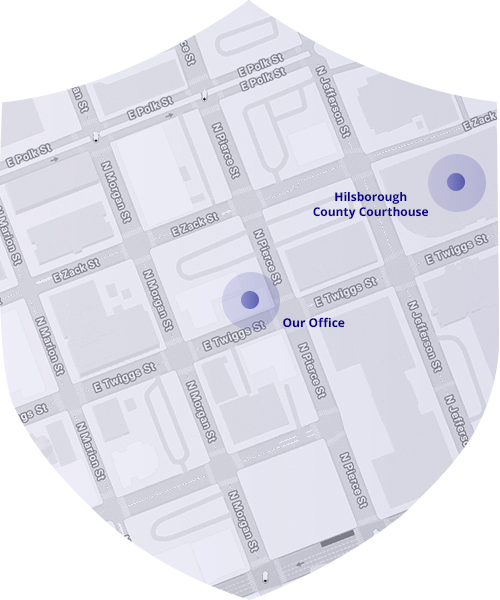
620 E. Twiggs Street, Suite 205, Tampa, FL 33602
(813) 727-7159
Serving Hillsborough, Pinellas, and Pasco Counties
The Brancato Law Firm, P.A. is a Tampa-based criminal defense practice. We are not affiliated with any other Brancato-named law firms.
This page is for informational purposes only and does not constitute legal advice. Each case is unique, and outcomes depend on the individual facts and circumstances involved. Past results do not guarantee future outcomes.

Tampa, FL 33602
Free Legal Consultation (813) 727-7159