- Free Consultation 24/7: (813) 727-7159 Tap Here To Call Us


From First DUI to Death Penalty



How to Fight an Identity Theft Charge in Florida (2026)


Updated October 22, 2026
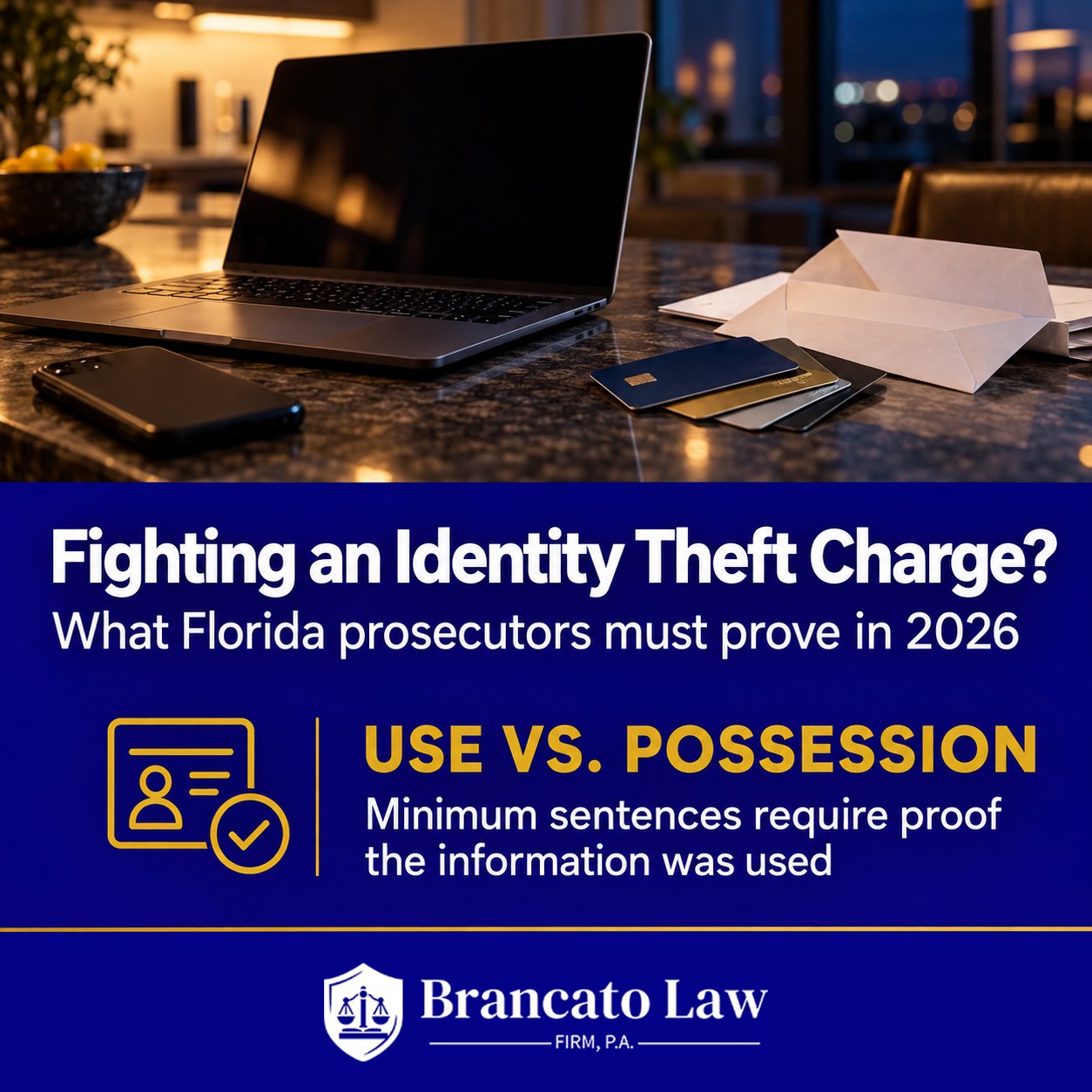
To fight an identity theft charge in Florida, make the State prove each part of section 817.568: that you willfully and without authorization used another person’s personal identification information fraudulently, or possessed it intending to use it fraudulently, without that person’s consent. The base offense is a third-degree felony with no mandatory minimum. The 3-, 5-, and 10-year mandatory minimums apply only when the State proves actual fraudulent use plus a dollar amount ($5,000, $50,000, or $100,000) or a number of victims (10, 20, or 30), and that amount must be charged and found by the jury. Consent, authorization, and proof of who actually used the information are the core defenses.
To convict someone of identity theft under Florida’s main statute, a prosecutor must prove more than that another person’s card number or Social Security number turned up in a phone or wallet. The State must prove the use, or the intended use, was willful, fraudulent, and without consent, and the heaviest penalties depend on numbers a jury has to find. I’m Rocky Brancato, founder of The Brancato Law Firm, P.A., a Tampa criminal defense firm, and former Chief Operations Officer of the Hillsborough County Public Defender’s Office, where I oversaw a staff of over 100 attorneys. Our attorneys defend identity theft, unlawful possession of personal identification information, and related fraud charges in Hillsborough, Pinellas, and Pasco Counties, often while the case is still an investigation.
What does the State have to prove in a Florida identity theft case?
The State must prove that you used, or possessed with intent to use, another person’s identifying information fraudulently, willfully, without authorization, and without consent. Under section 817.568(2)(a), Florida Statutes, a person commits the offense if he or she “willfully and without authorization fraudulently uses, or possesses with intent to fraudulently use, personal identification information concerning another person without first obtaining that person’s consent.”
The definition of personal identification information is broad. It means “any name or number that may be used, alone or in conjunction with any other information, to identify a specific person,” including a name, address, phone number, Social Security number, date of birth, driver license number, bank account, credit or debit card number, PIN, biometric data, and medical records. “Authorization” means “empowerment, permission, or competence to act.” Each element is a separate fight, and our Tampa white collar crime attorney team tests them one at a time.
What are the penalties for identity theft in Florida?
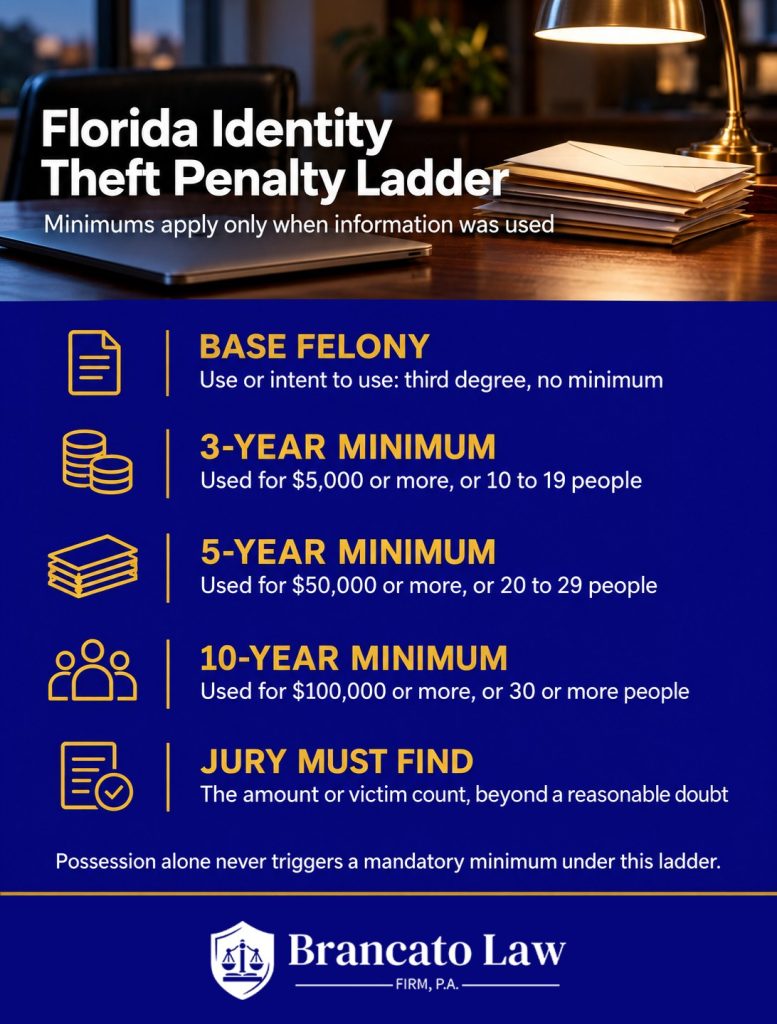
The degree depends on the dollar amount involved or the number of people whose information was used. Section 817.568(2) sets this ladder:
| Amount or number of victims | Charge | Mandatory minimum |
|---|---|---|
| Use, or possession with intent to use, at any amount | Third-degree felony (up to 5 years) | None |
| Fraudulent use of $5,000 or more, or of 10 to 19 people’s information | Second-degree felony (up to 15 years) | 3 years |
| Fraudulent use of $50,000 or more, or of 20 to 29 people’s information | First-degree felony (up to 30 years) | 5 years |
| Fraudulent use of $100,000 or more, or of 30 or more people’s information | First-degree felony (up to 30 years) | 10 years |
The maximums come from section 775.082, Florida Statutes. The dollar amount can be “the pecuniary benefit, the value of the services received, the payment sought to be avoided, or the amount of the injury or fraud perpetrated.” Under subsection (3), if a mandatory minimum is longer than the maximum the law otherwise allows, “the mandatory minimum sentence must be imposed.” The statute’s text has not changed since 2021. Our post on felony degrees in Florida explains how these levels interact with the sentencing scoresheet.
Do the mandatory minimums apply if I only possessed the information?
No. The 3-, 5-, and 10-year minimums in section 817.568(2)(b) and (2)(c) apply only when the person “fraudulently uses” the information. Possession with intent to use stays at subsection (2)(a), a third-degree felony with no minimum. That one word, uses, is often the most important line in the case.
When the minimum applies, the judge cannot skip it. In State v. Barnhart, 310 So. 3d 132 (Fla. 1st DCA 2020), a Leon County jury found fraud of $5,000 or more, and the trial judge held the three-year minimum “in abeyance.” The First District reversed: “As the Legislature has prescribed a three-year mandatory minimum, the trial court had no authority to do otherwise.”
The State must also charge the threshold and prove it to the jury. In Roodbergen v. State, No. 2D19-3250 (Fla. 2d DCA Nov. 5, 2021), a Manatee County case involving a victim 60 or older, the Second District held the three-year minimum applied “because the information charged and the jury, by special verdict, specifically found beyond a reasonable doubt that both of those counts involved a pecuniary benefit of $5,000 or more.” The Second District hears appeals from Hillsborough, Pinellas, and Pasco Counties. Our attorneys at The Brancato Law Firm read the charging document and the proposed verdict form for exactly this point, because a dollar figure the jury never found cannot support a minimum.
Subsection (13) gives the prosecutor one more tool: the State may move to “reduce or suspend the sentence” of a person who provides “substantial assistance,” and the motion may be heard in camera.
Which victims make identity theft a more serious charge?
Several victim categories and methods create separate second-degree felonies or raise the degree. Section 817.568 lists them in separate subsections:
| Subsection | Conduct | Result |
|---|---|---|
| (6) | Fraudulent use of the information of a person under 18 or 60 or older, without consent | Second-degree felony |
| (7) | A parent, legal guardian, or person exercising custodial authority who fraudulently uses the information of a person under 18 or 60 or older in that person’s custody | Second-degree felony |
| (11) | Fraudulent use of the information of a person 60 or older, a disabled adult, a public servant, a veteran, a first responder, or a state or federal employee | Second-degree felony |
| (8) | Use of the information of a deceased person or a dissolved business | Same ladder and minimums as (2) |
| (9) | Creating or using counterfeit or fictitious identification information to commit a fraud | Third-degree felony |
| (10) | Posing as a police officer or a bank, credit card, or credit reporting employee | Raised one degree; a first-degree felony becomes a life felony |
| (5) | Using a public record to commit the offense | Raised one degree |
| (4) | Using another person’s information to harass them | First-degree misdemeanor |
The statute states no mandatory minimum for subsections (6), (7), and (11). In Roodbergen, the Second District expressly left open whether (2)(b) and (6) “prescribe separate enhancements or separate offenses.” The Brancato Law Firm checks which subsection the State actually charged, because the wrong one changes the sentencing range.
What is unlawful possession of personal identification information?
It is a separate, lesser crime that requires no intent to defraud. Section 817.5685, Florida Statutes, makes it unlawful “to intentionally or knowingly possess, without authorization, the personal identification information of another person in any form, including, but not limited to, mail, physical documents, identification cards, or information stored in digital form.” This is often the charge when someone is found holding other people’s cards or mail.
The number of people decides the degree. Possessing the information of “four or fewer persons” is a first-degree misdemeanor. Five or more is a third-degree felony, and possession of five or more people’s information, “unless satisfactorily explained, gives rise to an inference” that it was knowing and unauthorized. The statute gives two affirmative defenses: a “reasonable belief that such possession was authorized by law or by the consent of the other person,” and information obtained from a source “open or available to the general public or from a public record.” Parents, guardians, government employees, and lawful businesses acting in the ordinary course are excluded.
Juries return this lesser charge. In King v. State, No. 4D2024-1060 (Fla. 4th DCA Oct. 29, 2025), a Broward jury convicted on the misdemeanor possession lesser, finding information of “at most, two individuals,” yet the trial court imposed 3 years in prison and 2 years of probation. The State conceded he “was adjudicated guilty and sentenced under the wrong statute,” and the Fourth District reversed for resentencing. Our attorneys at The Brancato Law Firm count the victims the State can actually prove, because that count sets the ceiling.
Can the State charge one act as several counts?
Not if the counts rest on a single act. In Fravel v. State, 188 So. 3d 969 (Fla. 4th DCA 2016), the Fourth District held that “section 817.568(2)(a) is a lesser included offense, which would be subsumed by the greater offense of section 817.568(2)(b) if they were directed at a single act.” The two counts in that case survived only because the State proved “two distinct acts,” opening a Chase card and a Capital One card, and tied each count to one account.
Identity theft cases can be charged with many counts drawn from one bank statement. The Brancato Law Firm makes the State identify the specific act behind each count, and counts that duplicate one act can be challenged. Our post on how criminal charges are dropped or dismissed in Florida explains the motion practice.
What costs come with an identity theft conviction?
A plea or verdict brings a $1,001 surcharge that the judge cannot waive. Under section 817.568(12), the surcharge applies “regardless of adjudication,” so it attaches even with a withhold of adjudication. Restitution can include “attorney’s fees incurred by the victim in clearing the victim’s credit history or credit rating,” and the court may order public records corrected.
Those costs sit on top of any restitution for the money itself. Our attorneys at The Brancato Law Firm look at the restitution figure as closely as the criminal charge, because the same dollar amount often drives both.
Where is an identity theft case prosecuted?
It can be prosecuted in any county where an element of the offense happened, including the county where the victim generally resides. For the consent element, section 817.568 presumes the place of consent is the county “where the victim generally resides.” A person who never set foot in Hillsborough County can be charged there if the victim lives there.
In Hillsborough County, felony charges are filed by the State Attorney’s Office for the 13th Judicial Circuit, and an arrest means a first appearance within 24 hours, usually from the Orient Road Jail. Our firm defends these cases in Hillsborough, Pinellas, and Pasco Counties, and our Hillsborough County criminal defense attorney page explains the local court process.
How common is identity theft in Florida?
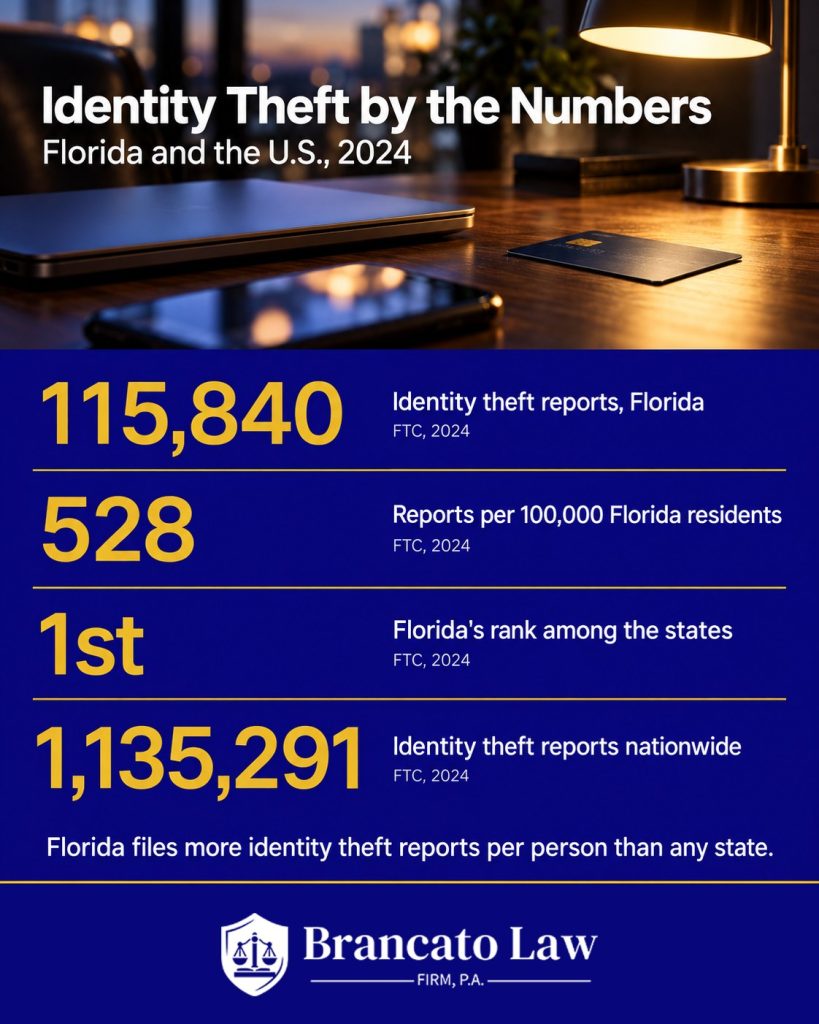
Florida leads the country in identity theft reports per person. In 2024, Florida consumers filed 115,840 identity theft reports with the Federal Trade Commission, or 528 per 100,000 residents, ranking Florida 1st among the states, according to the FTC’s Consumer Sentinel Network Data Book 2024. Nationally, the FTC received 1,135,291 identity theft reports in 2024. These are consumer reports to the FTC, not arrests or proven crimes.
Most victims never call the police. The Bureau of Justice Statistics report Victims of Identity Theft, 2021 (released 2023) estimated that about 23.9 million people age 16 or older experienced identity theft in the prior 12 months, and only about 7% of victims reported it to police. Because so few victims report, the cases that do reach police can begin with a bank’s fraud department or a personal dispute, and our attorneys at The Brancato Law Firm look closely at who reported it and why.
How do our attorneys fight an identity theft charge?
We start with consent and authorization, then make the State prove every number. Our attorneys work through six questions:
- Was there consent or authorization? A spouse, roommate, employee, or business partner who had permission to use an account was not acting without consent, and a later falling-out does not change what was agreed at the time.
- Who actually used the information? Shared devices, shared accounts, and shared addresses make the identity of the user a real question. Login records, IP addresses, store video, and delivery records must point to the client.
- Was the information used or only possessed? Possession with intent is a third-degree felony with no minimum.
- Can the State prove the amount and the victim count? The 3-, 5-, and 10-year minimums require proof of the threshold to the jury, as Roodbergen holds.
- Do the counts duplicate one act? Under Fravel, one act cannot support stacked counts.
- Does a section 817.5685 defense apply? A reasonable belief in consent, or information taken from a public source, is an affirmative defense to the possession charge.
Related charges often travel with identity theft, including grand theft and scheme to defraud. Our guide on how to fight a theft charge in Florida covers how value is proven in those counts.
What should you do if you are under investigation for identity theft?
Stop talking and get a lawyer involved before the State files charges. Identity theft cases are often built from bank records, subpoenas, and interviews over weeks or months, and the investigation is the best time to correct a mistaken assumption about consent or who used an account.
- Do not explain the transactions to a detective or bank investigator. A statement about permission can be turned into an admission of use.
- Do not contact the alleged victim. Messages about money or permission become evidence.
- Save your own records. Texts granting permission, shared account details, and work authorizations can prove consent.
- Ask about pre-file representation. Our firm’s pre-file advocacy puts the defense’s evidence in front of the prosecutor before the filing decision.
If an arrest has already happened, our guide on what to do after being arrested in Tampa covers the first steps.
Frequently asked questions about identity theft charges in Florida
Can identity theft charges be dropped in Florida?
Yes. Identity theft charges can be dropped or reduced when the evidence shows consent, when the State cannot prove who used the information, or when the dollar amount or victim count falls below a threshold. The Brancato Law Firm brings those records to the prosecutor early, and our post on getting charges dropped or dismissed in Florida explains the process.
Is having someone else’s credit card numbers a crime in Florida?
It can be, even without any use. Under section 817.5685, knowingly possessing another person’s card or account number without authorization is a first-degree misdemeanor for four or fewer people and a third-degree felony for five or more, and The Brancato Law Firm looks first at the statute’s defenses for consent and public sources.
Is there a mandatory minimum sentence for identity theft in Florida?
Only at the higher tiers. Fraudulent use of $5,000 or more, or of 10 or more people’s information, carries a 3-year minimum, rising to 5 and 10 years at $50,000 and $100,000 or 20 and 30 people. Our attorneys at The Brancato Law Firm challenge the amount and the count, as described on our Tampa white collar crime defense page.
What if the person gave me permission to use their information?
Then it is not identity theft under section 817.568, which requires use “without first obtaining that person’s consent.” The Brancato Law Firm gathers the texts, emails, and account records that show permission, because the alleged victim’s memory of the arrangement often changes after a falling-out.
Can a parent be charged with identity theft for using a child’s information in Florida?
Yes. Under section 817.568(7), a parent, legal guardian, or person exercising custodial authority over someone under 18 or 60 or older who willfully and fraudulently uses that person’s information commits a second-degree felony. Our attorneys at The Brancato Law Firm examine whether the use was authorized for the family member’s benefit, and our Tampa white collar crime lawyer page covers related fraud charges.
What should I do if a bank or detective contacts me about identity theft?
Do not give a statement until you have spoken with a lawyer. The Brancato Law Firm provides representation before charges are filed and can respond to the investigator for you.
Call before the investigation becomes a charge
Account logs, login records, and store video are kept for limited periods, and an identity theft investigation can run for months before an arrest. The Brancato Law Firm, P.A., founded by Tampa Criminal Defense Attorney Rocky Brancato, will collect the records that show consent, test who used the information, and speak with the investigator or prosecutor before the filing decision. Call (813) 727-7159 for a free, confidential consultation; you can call us at any hour. Our firm has Spanish-speaking staff, and attorney Jean-Luc Adrien speaks Spanish, Haitian Creole, and French. Read about our Spanish and Haitian Creole criminal defense services.
For more about our defense strategies, visit our Tampa White Collar Crime Attorney page.
The Brancato Law Firm, P.A.
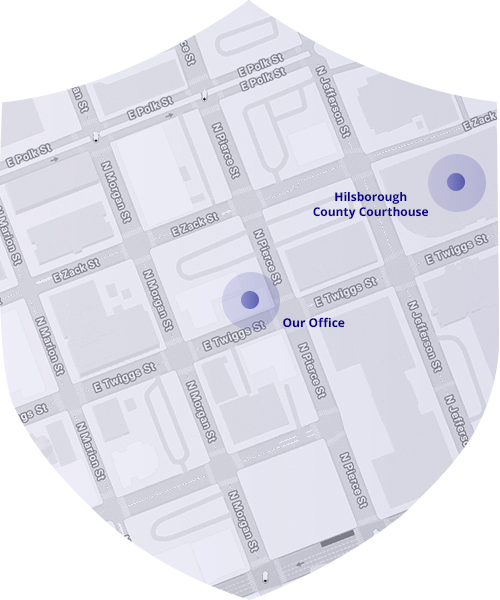
620 E. Twiggs Street, Suite 205, Tampa, FL 33602
(813) 727-7159
Serving Hillsborough, Pinellas, and Pasco Counties
The Brancato Law Firm, P.A. is a Tampa-based criminal defense practice. We are not affiliated with any other Brancato-named law firms.
Visit Us

Tampa, FL 33602
Contact Us Now
Free Legal Consultation (813) 727-7159