- Free Consultation 24/7: (813) 727-7159 Tap Here To Call Us


From First DUI to Death Penalty



What Is Florida’s 10-Day Search Warrant Rule? (2026)


Fully rewritten and updated October 26, 2026.
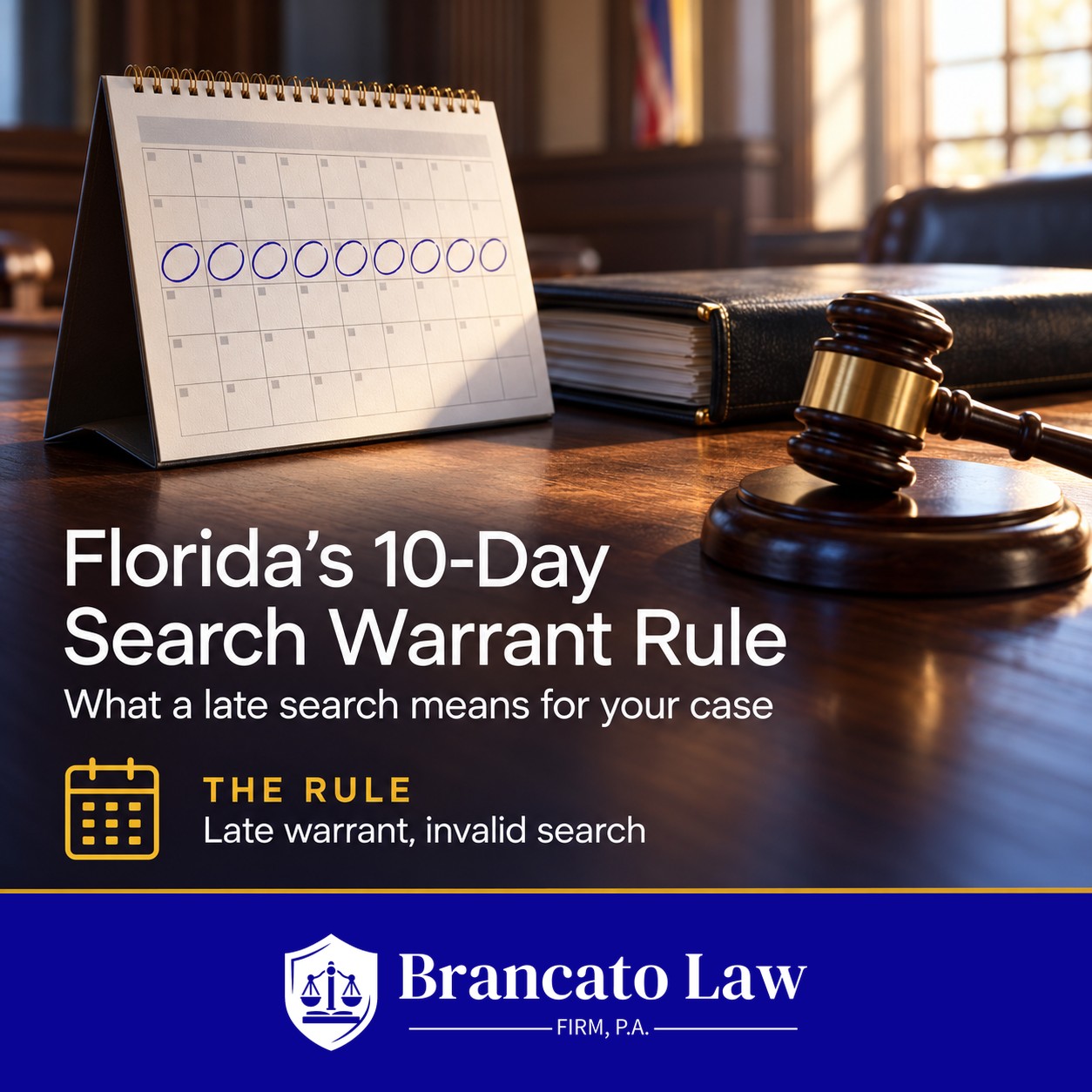
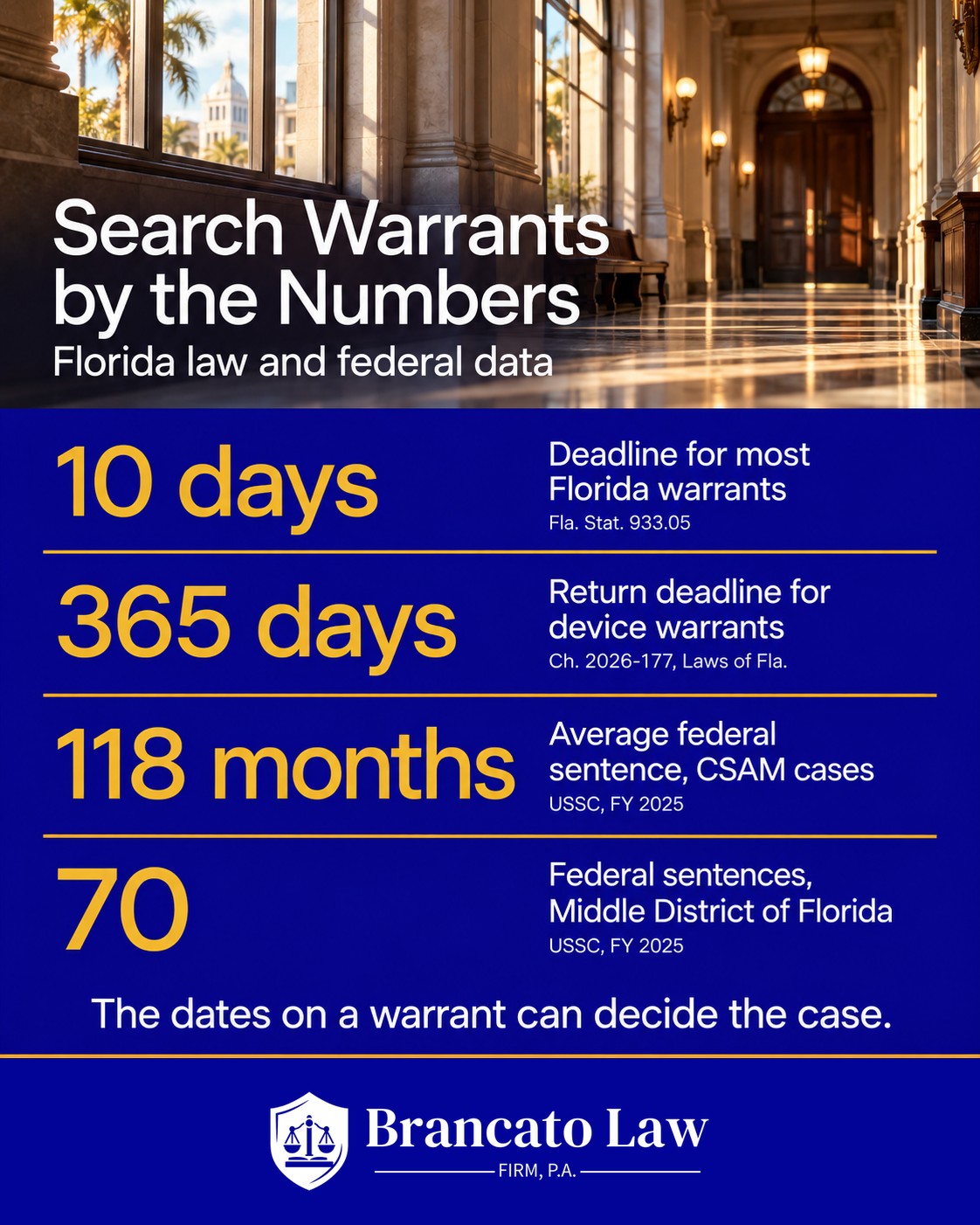
Florida’s 10-day search warrant rule, found in section 933.05, Florida Statutes, requires most search warrants to be executed and returned within 10 days after they are issued. A warrant executed late is stale, the search is invalid, and the evidence must be suppressed without any showing of prejudice, as the Second District held in Moschella v. State (2025) when it ordered child pornography charges dismissed. For phones and computers, a 2026 law now treats the warrant as timely if police seize the device within 10 days and gives them up to 365 days to return it, so the defense must check which version of the statute applied when the warrant issued.
A Florida search warrant comes with a clock, and the date stamped on it can decide a case before anyone looks at the evidence. As a former police academy instructor, I trained officers on how to do things by the book, and as founder of The Brancato Law Firm, P.A., a Tampa criminal defense firm, I have spent more than 25 years in Hillsborough County courtrooms holding them to it. Our attorneys compare the issuance date, the execution date, and the return on every warrant in every case, because a late search can end the prosecution.
What Is Florida’s 10-Day Search Warrant Rule?
The rule is a deadline set by statute. Under section 933.05, Florida Statutes, a search warrant “must be returned within 10 days after issuance, not including the date of issuance.” Courts read that return deadline as an execution deadline: police have to carry out the search within the same 10 days.
The deadline dates back to 1923, and Florida courts enforce it strictly. In Spera v. State, 467 So. 2d 329 (Fla. 2d DCA 1985), officers searched a home for drugs 13 days after the warrant issued and found cocaine. The Second District held that “a search warrant in Florida becomes stale ten days after its issuance” and that a stale warrant “requires suppression of any evidence seized as a consequence of the search.”
The 10-day rule still governs warrants for homes, cars, and most physical evidence. The Legislature has carved out longer periods for a few kinds of warrants:
| Type of warrant | Deadline under current section 933.05 |
|---|---|
| Most warrants (homes, vehicles, physical items) | Returned within 10 days after issuance |
| Out-of-state provider for electronic communications data | Returned within 20 days |
| DNA specimens (blood, saliva, database samples) | Returned within 30 days |
| Computers, computer systems, and electronic devices | Timely if the device is seized within 10 days; returned within 365 days |
What Happened in Moschella v. State?
In Moschella v. State, 413 So. 3d 851 (Fla. 2d DCA 2025), the Second District reversed a child pornography conviction because a forensic search warrant was executed weeks late. Detectives from the Manatee County Sheriff’s Office seized two phones, a tablet, and a laptop. A judge issued a warrant to search the devices on July 27, 2020, but the detective admitted the search did not happen until “sometime in September.”
James Moschella pleaded no contest and reserved the right to appeal the denial of his motion to suppress. The State stipulated that the suppression issue was dispositive, meaning the case could not go forward without the evidence. The trial court had denied suppression because the delay did not prejudice him.
The Second District disagreed. Quoting Spera, it said “the legislature has decided that ten days is a reasonable time,” and it refused to add a prejudice requirement to “the firmly established statutory time limit.” Because the State’s stipulation was binding, the court reversed the judgment and sentences and remanded for dismissal of the charges.
| Issue | What the court held |
|---|---|
| Deadline | The warrant had to be executed within 10 days of July 27, 2020 |
| Late execution | A search in September made the warrant stale and the search invalid |
| Prejudice | The defendant did not have to show the delay harmed him |
| Dispositive stipulation | The State’s agreement was binding, so the charges were dismissed |
Moschella matters in Tampa Bay for a specific reason. The Second District Court of Appeal hears appeals from Hillsborough, Pinellas, and Pasco Counties, so its rulings bind the trial judges our clients appear before.
Did Florida Change the Search Warrant Rule for Phones and Computers?
Yes, twice. A 2025 law gave police 45 days to return a warrant for a computer or electronic device already in police possession. Then the Legislature passed CS/HB 359, signed June 26, 2026 and effective July 1, 2026 as chapter 2026-177, Laws of Florida. Under the current statute, a device warrant is “considered timely executed” if police seize the device within 10 days, the return is due within 365 days, and the agency does not have to finish its forensic analysis within the return period.
The House Criminal Justice Subcommittee’s staff analysis of HB 359 discussed Moschella directly, and the bill responds to the problem the case exposed: forensic exams of phones and computers take longer than 10 days.
The change does not make device warrants deadline-free. The device still has to be seized within 10 days of the warrant, and the return still has a deadline. It also leaves open which version of the statute applies to a warrant issued before July 1, 2026. Our attorneys check the issuance date against the version of section 933.05 in effect that day, and we raise Moschella wherever the older rule governed.
Why Do Warrant Deadlines Matter So Much in Child Pornography Cases?
They matter because these cases usually rest entirely on what a forensic examiner finds on a seized device. Under section 827.071, Florida Statutes, knowingly possessing child sexual abuse material is a second-degree felony, and each image, and each child in each image, is a separate offense. A single phone can produce dozens of counts, each punishable by up to 15 years in prison.
Federal numbers show how heavily these cases are prosecuted. The U.S. Sentencing Commission’s Quick Facts on child pornography offenses report that 1,432 people were sentenced for these offenses in federal court in fiscal year 2025, with an average sentence of 118 months. The Middle District of Florida, which includes Tampa, sentenced 70 of them, among the most of any district in the country.
When the search that found the files was invalid, the files cannot be used. That is why a warrant timing problem can end a case that looks unbeatable. Our Tampa internet crimes attorney team treats the warrant file as the first piece of evidence to examine.
How Do Defense Attorneys Find a Late Warrant?
They line up the dates in the paperwork. The warrant shows when a judge signed it. The return and inventory show when officers executed it and what they took. Forensic reports, property receipts, and lab request forms often show when the device search actually started. Moschella’s case turned on a detective’s admission at the suppression hearing, so depositions matter too.
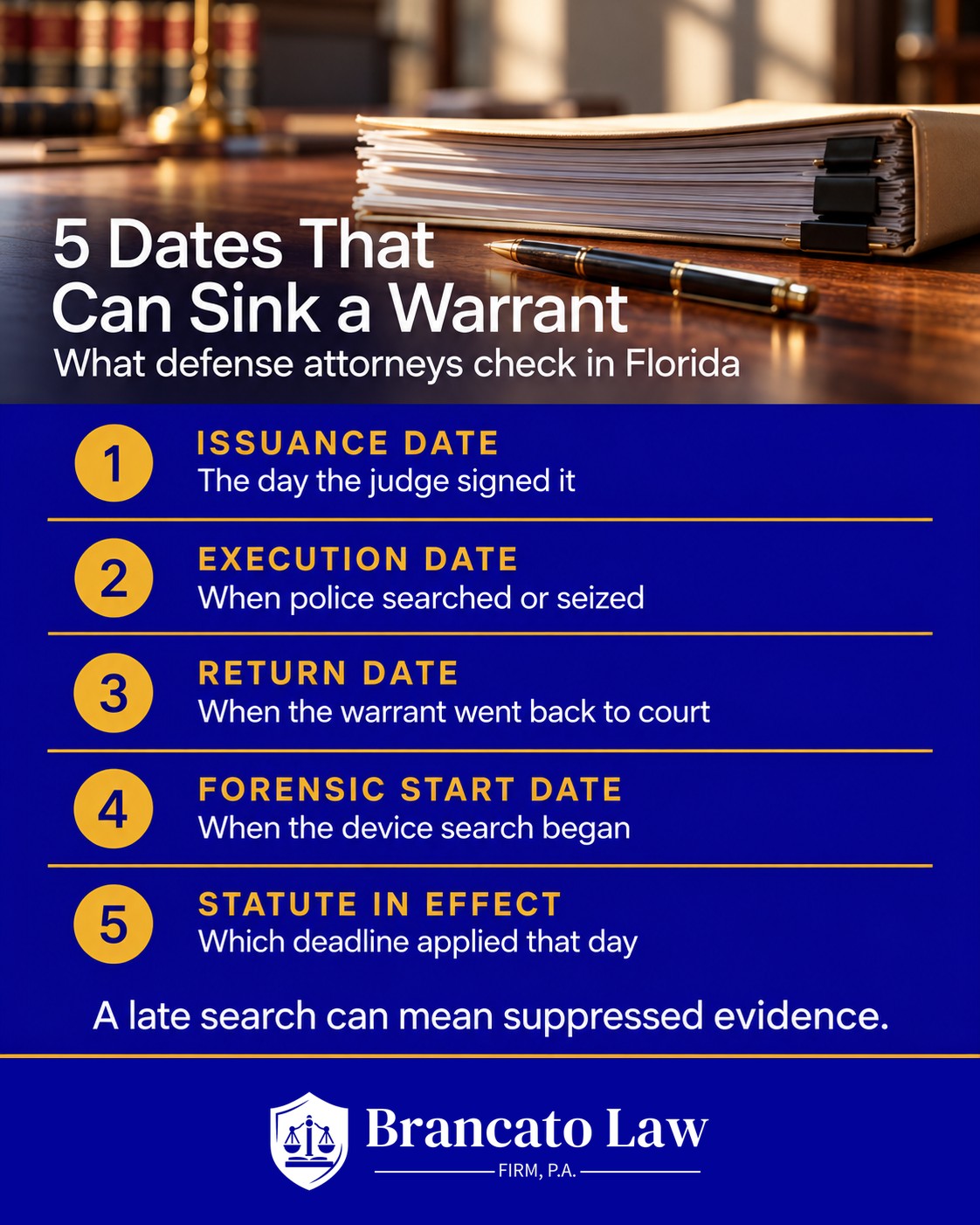
Our attorneys check these points in every case involving a search warrant:
- Issuance date. The day the judge signed the warrant, which starts the clock the next day.
- Execution date. When officers searched the place or seized the device.
- Return date. When the warrant and inventory went back to the court.
- Forensic start date. When the examiner began the device search, from lab logs and reports.
- Applicable statute. Which version of section 933.05 was in effect on the issuance date.
Do Other Warrant Problems Lead to Suppression?
Yes. A late warrant is only one of several grounds for a motion to suppress in a digital evidence case. A warrant may lack probable cause, describe the place or files too broadly, or be searched beyond its scope. In Smallwood v. State, 113 So. 3d 724 (Fla. 2013), a Jacksonville robbery case, the Florida Supreme Court held that police could take a phone during an arrest but needed a warrant before searching its data, and it ordered a new trial because the photos found on the phone should have been excluded.
Many child exploitation investigations begin before any warrant, with a tip from a tech company and a subpoena for account records. Our guide to a Google account legal request in Florida explains that stage. If you suspect an investigation, representation before charges are filed can keep you from consenting to a search that no warrant would have allowed.
How Soon Should You Talk to a Lawyer After a Device Seizure?
Talk to a lawyer right away, ideally before the forensic exam is finished. Dates and chain-of-custody records are easiest to pin down early, and a lawyer can demand the warrant, the return, and the lab paperwork through discovery and take depositions before memories fade. For the charges and sentencing exposure in these cases, see our pages on child pornography defense in Tampa and child pornography sentencing enhancements.
Frequently Asked Questions
Does a late search warrant always get a case dismissed in Florida?
No. A late warrant leads to suppression of the evidence from that search, and dismissal follows only when the State cannot prove the case without it, as happened when the State stipulated in Moschella. The Brancato Law Firm evaluates what evidence would remain after suppression before advising a client on a plea or trial, as explained on our Tampa sex crimes lawyer page.
Do I have to prove the delay hurt my case?
No. The Second District held in Moschella that a defendant does not have to show prejudice from a late warrant, because the Legislature already decided what a reasonable time is. Our attorneys at The Brancato Law Firm raise the deadline issue on its own terms rather than trying to show harm.
How many days do police have to search my phone under a warrant in Florida?
Under the current section 933.05, police must seize the phone within 10 days of the warrant, and the return is due within 365 days. The Brancato Law Firm checks whether an older version of the statute, with a shorter deadline, applied to your warrant, using the statute itself on Online Sunshine.
What is a dispositive plea, and why did it matter in Moschella?
A dispositive plea is a no contest plea that reserves the right to appeal a pretrial ruling the parties agree will decide the case, so a win on appeal ends in dismissal instead of a new trial. Our team at The Brancato Law Firm uses this tool when a suppression ruling is strong enough to carry an appeal.
Can child pornography charges be dropped in Florida?
Yes. Charges can be dropped or dismissed when key evidence is suppressed, when the State cannot prove the person knowingly possessed the files, or when the files were on a device others used. The Brancato Law Firm attacks each of those points, and our Tampa internet crime lawyer attorneys handle these cases in Hillsborough, Pinellas, and Pasco Counties.
Does the 10-day rule apply to search warrants for my house or car?
Yes. Warrants for homes, vehicles, and physical items still must be executed and returned within 10 days, as in Spera, where a home search on day 13 required suppression. The Brancato Law Firm reviews every warrant in a case, not only the device warrant, because one late search can taint the evidence that followed.
Talk to a Tampa Defense Attorney About a Search Warrant
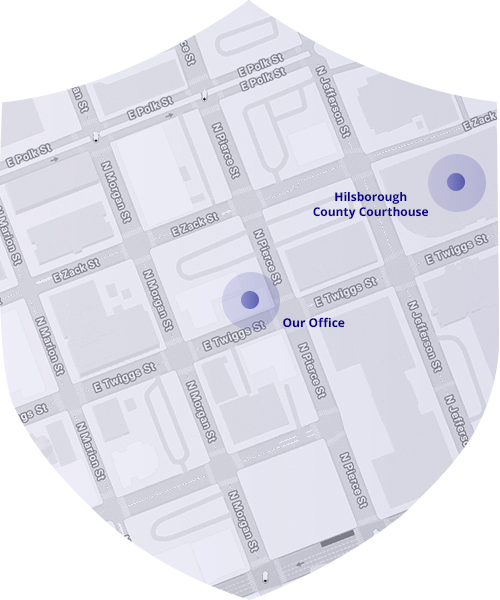
The dates on a warrant do not change, but the chance to use them can slip away once a plea is entered. Our attorneys at The Brancato Law Firm, P.A., founded by Tampa Criminal Defense Attorney Rocky Brancato, will review every warrant, return, and forensic report in your case for timing and scope problems. Call (813) 727-7159; you can call us at any hour, and our office is two blocks from the courthouse. Our firm has Spanish-speaking staff, and attorney Jean-Luc Adrien speaks Spanish, Haitian Creole, and French. Read our guide for criminal defense in Spanish and Haitian Creole in Tampa.
For more about our defense strategies, visit our Tampa Internet Crimes Attorney page.
The Brancato Law Firm, P.A.
620 E. Twiggs Street, Suite 205, Tampa, FL 33602
(813) 727-7159
Serving Hillsborough, Pinellas, and Pasco Counties
The Brancato Law Firm, P.A. is a Tampa-based criminal defense practice. We are not affiliated with any other Brancato-named law firms.
Visit Us
Tampa, FL 33602
Contact Us Now
Free Legal Consultation (813) 727-7159