- Free Consultation 24/7: (813) 727-7159 Tap Here To Call Us


From First DUI to Death Penalty



What Are Child Pornography Penalties in Florida? (2026)


Updated November 2026
Short answer: Child pornography penalties in Florida are charged image by image. For offenses on or after July 1, 2026, knowingly possessing, controlling, or intentionally viewing each image is a separate second-degree felony punishable by up to 15 years under section 827.071(5). Under section 775.0847, a case involving 10 or more images, at least one showing a child under 12, sexual battery, sadomasochistic abuse, bestiality, or any video, is reclassified one degree higher and scored one level higher, which turns a 15-year count into a 30-year count.
If detectives took a phone or laptop from your home, the number of files on it will drive the sentencing exposure more than almost any other fact. I learned how these cases are built in the Major Crimes Unit, and as founder of The Brancato Law Firm, P.A., a Tampa criminal defense firm, I have tried more than 150 jury trials to verdict. Our attorneys attack the count, the reclassification, and the scoresheet before any plea offer is discussed, because each of those numbers can move.
What are Florida’s child pornography penalties after July 1, 2026?
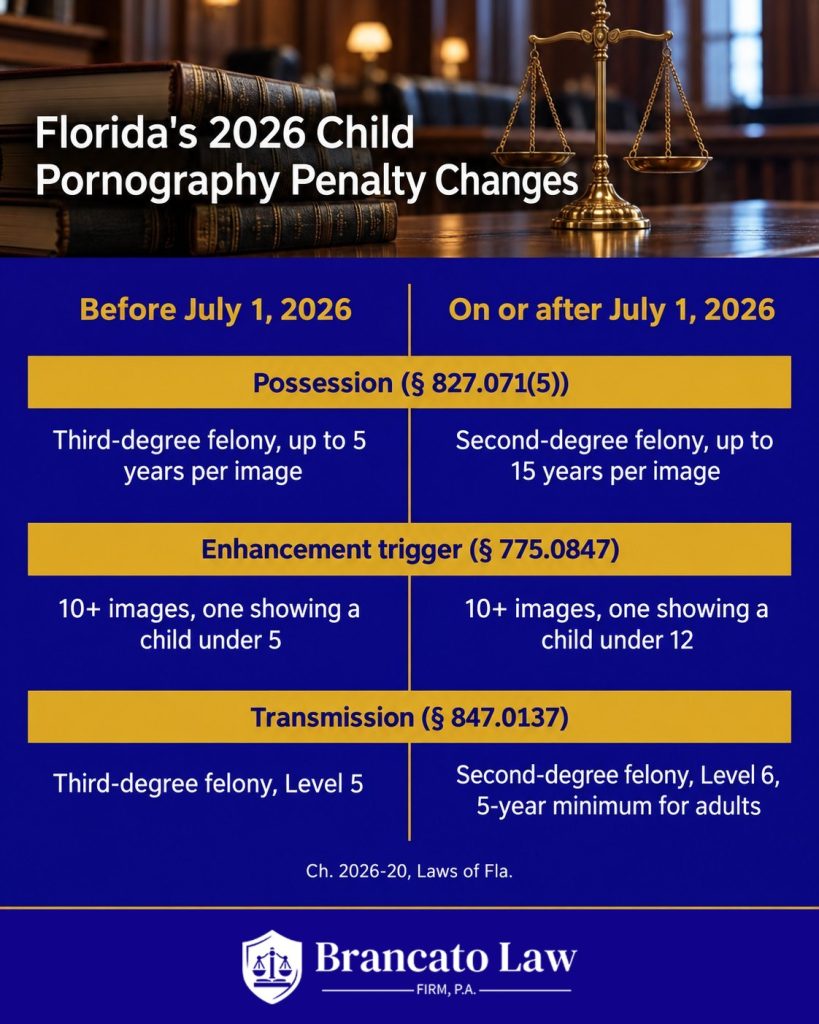
Florida’s child pornography penalties rose on July 1, 2026. CS/CS/HB 1159, signed March 31, 2026 as Chapter 2026-20, Laws of Florida, renamed “child pornography” as “child sexual abuse material” (CSAM) throughout the statutes and made these changes, according to the House Criminal Justice Subcommittee analysis:
| Offense | Before July 1, 2026 | On or after July 1, 2026 |
|---|---|---|
| Possess, control, or intentionally view CSAM, § 827.071(5) | Third-degree felony, up to 5 years per image | Second-degree felony, up to 15 years per image |
| Reclassification trigger, § 775.0847 | 10+ images and at least one showing a child under 5 (or other listed content) | 10+ images and at least one showing a child under 12 (or other listed content) |
| Transmit CSAM, § 847.0137 | Third-degree felony, Level 5 | Second-degree felony, Level 6, 5-year mandatory minimum for adults unless the court makes written findings |
| Use of a child in a sexual performance, § 827.071(2) | Second-degree felony | First-degree felony, 15-year mandatory minimum for adults |
| Promote a sexual performance by a child, § 827.071(3) | Second-degree felony | Second-degree felony, 5-year mandatory minimum for adults |
The age change matters most. Because the content trigger rose from a child under 5 to a child under 12, far more collections now meet the reclassification test. The law in effect on the date of the offense generally controls the sentence, so the date files were downloaded or viewed can decide which version of the statute applies. Our attorneys examine the forensic timeline for that reason.
How does Florida count child pornography charges?
Florida counts each image as a separate crime. Section 827.071(5) states that possessing, controlling, or intentionally viewing each photograph, video, image, or data file is a separate offense, and if one image shows more than one child, each child in that image is a separate offense. A single device can produce dozens or hundreds of felony counts. Our Tampa internet crimes attorney page explains how these investigations usually begin.
The Second District Court of Appeal, whose decisions bind Hillsborough, Pinellas, and Pasco courts, showed how far this goes in Walsh v. State, 198 So. 3d 783 (Fla. 2d DCA 2016). Officers found more than 3,000 images on a Sarasota County man’s home computer. The State selected 170 images, sorted them into groups of ten with each group containing an image of sexual battery on a child, and charged one reclassified count per group. He entered an open plea to 17 second-degree counts and received a total of 63.5 years in prison.
On appeal, Walsh argued that all the images from one episode should be one offense. The court disagreed. Because the statute makes each image a separate offense, the State could have charged all 170 images as separate counts, and section 775.0847 does not limit the State’s charging discretion. The lesson is that the prosecutor, not the device, decides how many counts appear on the information. That is why early defense work on the charging decision matters.
What triggers the section 775.0847 enhancement?
Section 775.0847 reclassifies a child pornography offense one degree higher when two conditions are both met. The enhancement applies to violations of sections 827.071, 847.0135, 847.0137, and 847.0138.
| Requirement | What the State must show |
|---|---|
| Volume | The offender possesses 10 or more images of any form of child sexual abuse material, regardless of content |
| Content (at least one image) | A child younger than 12; sadomasochistic abuse involving a child; sexual battery involving a child; sexual bestiality involving a child; or any video or computer-generated video involving a child, of any length, with or without sound |
| Effect on degree | Third-degree becomes second-degree; second-degree becomes first-degree |
| Effect on scoresheet | The offense is ranked one level above its normal level on the offense severity chart |
Reclassification is a fact the State must prove. In Jenrette-Smith v. State, 114 So. 3d 427 (Fla. 2d DCA 2013), a man who identified himself only as “James” handed an envelope of photographs to a Tampa police officer, which led to charges against the defendant on 14 counts of promoting a sexual performance by a child, one per photograph. The jury found he possessed 10 or more images, at least one depicting sexual battery, and all 14 counts were reclassified to first-degree felonies. The majority affirmed, relying on evidence that he possessed the camera, the film, and the developed prints. A dissenting judge argued that the enhancement depends on possessing 10 images when each offense is committed, so no more than four of the counts could be reclassified.
The dissent did not carry the day, but the question it raised remains a live defense issue: when each file arrived on the device, and whether the State can prove possession of 10 images at that time. Our attorneys work with independent forensic examiners on file dates, download paths, and whether files were ever opened.
How is a child pornography case scored on the Florida scoresheet?
Florida sentences felonies with a Criminal Punishment Code scoresheet. Under the 2026 offense severity chart in section 921.0022, possession under section 827.071(5) is a Level 6 offense and possession with intent to promote under section 827.071(4) is Level 7. A reclassified offense moves up one level. Under section 921.0024, the primary offense earns 36 points at Level 6 and 56 at Level 7, and each additional count earns 18 points at Level 6 and 28 at Level 7. When the total exceeds 44 points, the lowest permissible prison sentence in months is the total minus 28, multiplied by 0.75.
Here is how that math plays out for a person with no prior record and no other points. These examples are simplified; real scoresheets include prior record, legal status, and other factors.
| Example | Points | Lowest permissible sentence | Statutory maximum if consecutive |
|---|---|---|---|
| 10 possession counts, not reclassified (Level 6, second degree) | 36 + (9 × 18) = 198 | 127.5 months (about 10.6 years) | 150 years |
| 10 possession counts, all reclassified (Level 7, first degree) | 56 + (9 × 28) = 308 | 210 months (17.5 years) | 300 years |
The gap between those rows is the reclassification fight. Every count the defense removes, and every count that is not reclassified, lowers the floor. A judge can sentence anywhere from the lowest permissible sentence up to the statutory maximum for every count, served concurrently or consecutively.
How often do Florida possession cases end in prison?
Most Florida possession convictions end in prison. In fiscal year 2024-25, Florida Department of Corrections data showed 316 new prison commitments and 134 supervision sentences for knowingly soliciting, possessing, controlling, or intentionally viewing child pornography, according to the Florida Legislature’s Office of Economic and Demographic Research Criminal Justice Impact Conference review of SB 1750 (2026). The same review reported 654 new prison commitments in FY 2024-25 under statutes potentially subject to section 775.0847 reclassification.
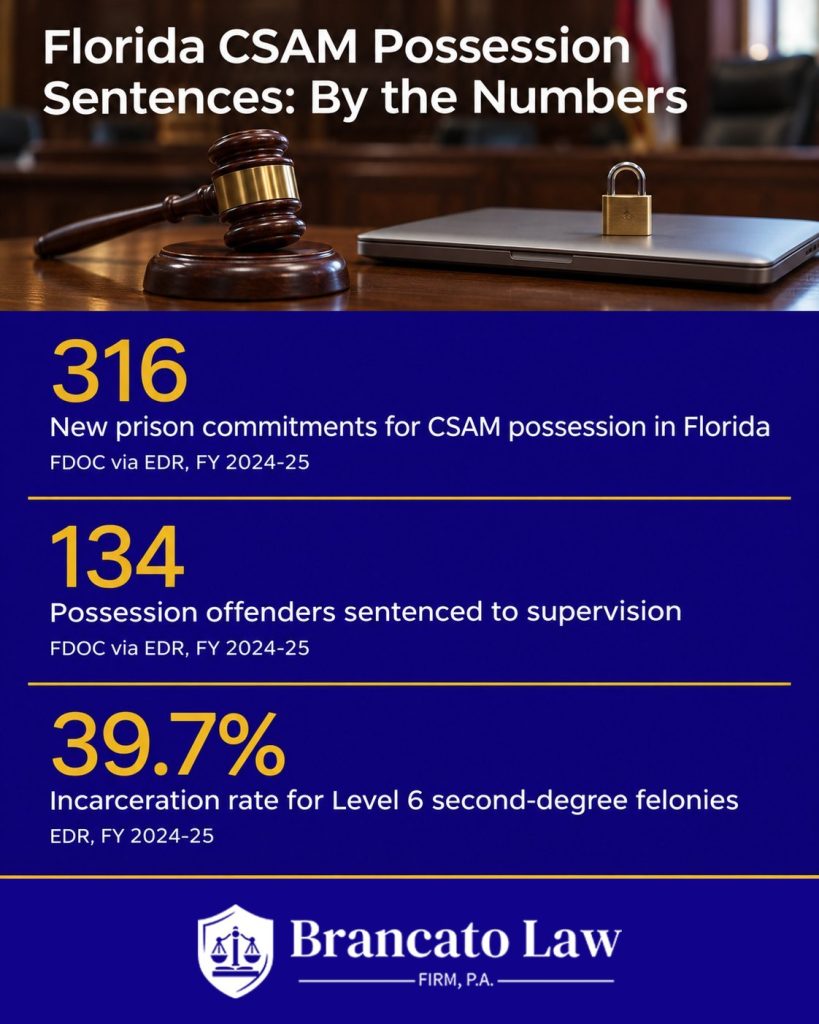
The review also shows why the July 2026 change matters. It reported a 26 percent incarceration rate for Level 6 third-degree felonies and 39.7 percent for Level 6 second-degree felonies. Possession moved from the first group to the second.
Can a child pornography sentence go below the scoresheet?
Yes. A Florida judge may impose a downward departure below the lowest permissible sentence when the defense proves a legal reason under section 921.0026. Two reasons come up often in these cases: the defendant requires specialized treatment for a mental disorder unrelated to substance abuse and is amenable to treatment, and the offense was committed in an unsophisticated manner, was an isolated incident, and the defendant has shown remorse. Substance abuse or intoxication alone is not a valid reason.
Departure arguments rest on evidence about risk. A U.S. Department of Justice SMART Office research brief, Internet-Facilitated Sexual Offending (2015), summarizes a review by Michael Seto and colleagues of nine samples totaling 2,630 internet offenders followed for slightly more than three years: 4.6 percent committed a new sexual offense, 2 percent a contact sexual offense, and 3.4 percent a new child pornography offense. Our attorneys pair research like this with a psychosexual evaluation from a qualified expert, treatment records, and family testimony.
Mandatory minimums have a narrow exception. Under section 827.071(7), a court is not required to impose a mandatory minimum under that section if it finds in writing that the depicted child was 14 or older, the image was created with the child’s permission, the offender was not more than 4 years older, and the offender did not share it with anyone else. This exception fits teen sexting cases.
What other consequences follow a conviction?
A conviction for possessing or promoting child sexual abuse material in Florida requires registration as a sexual offender, which carries reporting duties, residence limits, and public listing. Many cases also bring sex offender probation conditions, limits on internet use, and immigration consequences for noncitizens. Our post on whether a withhold of adjudication avoids the sex offender registry explains why a withhold does not solve the registration problem.
For a full look at defenses, including search warrant challenges like the one in our post on Florida’s 10-day search warrant rule, see our guide to defending CSAM charges in Florida.
What should you do if you are under investigation?
Call a lawyer before you talk to detectives or consent to a device search. Many cases begin with a tip to law enforcement and a search warrant, and the charging decision, including how many images to file and whether to seek reclassification, is made after the forensic report. That window is when our pre-file advocacy can affect the number of counts.
- Do not discuss the case with officers, family, or coworkers.
- Do not delete files or reset devices. Destroying evidence is a separate crime.
- Do not consent to searches of other devices or accounts.
- Write down when officers arrived, what they took, and what they said.
- Contact a defense attorney the same day.
Frequently asked questions about child pornography penalties in Florida
Is possession of child pornography a felony in Florida in 2026?
Yes. For offenses on or after July 1, 2026, each image is a separate second-degree felony punishable by up to 15 years in prison under section 827.071(5). The Brancato Law Firm reviews the offense dates in the forensic report to determine whether the older third-degree version applies.
Is there a mandatory minimum sentence for possessing child pornography in Florida?
Section 827.071(5) does not set a mandatory minimum for simple possession, but with 10 counts and no prior record the scoresheet floor is about 10.6 years in prison. Our attorneys at The Brancato Law Firm calculate the scoresheet at the start of the case so clients understand the real floor and the departure options.
Can prosecutors charge every image as a separate count?
Yes. Florida law makes each image, and each child in each image, a separate offense, and the Second District held in Walsh that reclassification does not limit how many counts the State may file. The Brancato Law Firm challenges duplicate files, unopened files, and images that do not meet the legal definition before the information is filed or amended.
Does the July 2026 law apply to a case from before July 1, 2026?
The law in effect on the date of the offense generally controls the penalty, so files possessed only before July 1, 2026 are usually scored under the older third-degree statute. Our attorneys at The Brancato Law Firm press the State to prove when each file was possessed, since that date can cut the maximum by two-thirds.
What is the difference between possession and possession with intent to promote?
Possession with intent to promote under section 827.071(4) is a second-degree Level 7 offense, and possessing three or more copies of an image is prima facie evidence of intent to promote. The Brancato Law Firm contests the intent element when file copies come from automatic backups or sync software rather than sharing; learn more on our internet crimes defense page.
Can a child pornography sentence be reduced below the scoresheet in Florida?
Yes, through a downward departure when the defense proves a statutory reason such as treatable mental health needs or an isolated, unsophisticated offense with remorse. The Brancato Law Firm builds departure motions with expert evaluations and treatment plans rather than character letters alone.
For more about our defense strategies, visit our Internet Crimes page.
For how The Brancato Law Firm, P.A. defends these cases, see our Tampa sex crimes defense practice.
Get a scoresheet review before the State files
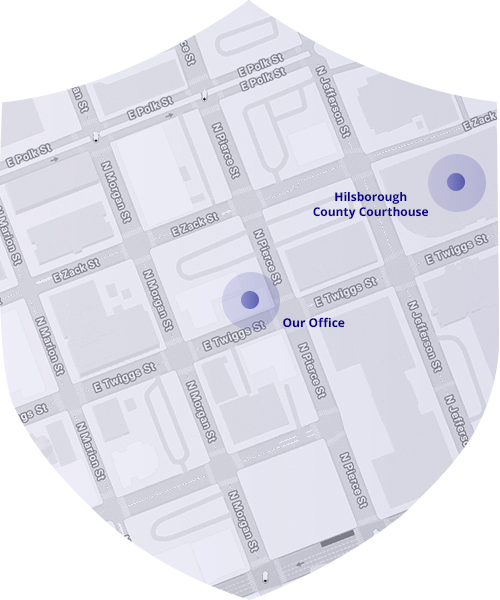
The charging decision in a CSAM case often follows the forensic review of the seized devices, and that window closes fast. Our attorneys will review the warrant, the device seizure, and your likely scoresheet, so call The Brancato Law Firm, P.A., founded by Tampa Criminal Defense Attorney Rocky Brancato, at (813) 727-7159. We are two blocks from the courthouse, and you can call us at any hour. Our firm has Spanish-speaking staff, and attorney Jean-Luc Adrien speaks Spanish, Haitian Creole, and French. Read our guide for Spanish and Haitian Creole speakers facing criminal charges.
The Brancato Law Firm, P.A.
620 E. Twiggs Street, Suite 205, Tampa, FL 33602
(813) 727-7159
Serving Hillsborough, Pinellas, and Pasco Counties
The Brancato Law Firm, P.A. is a Tampa-based criminal defense practice. We are not affiliated with any other Brancato-named law firms.
Visit Us
Tampa, FL 33602
Contact Us Now
Free Legal Consultation (813) 727-7159