- Free Consultation 24/7: (813) 727-7159 Tap Here To Call Us


From First DUI to Death Penalty



What Is Solicitation of a Child Using a Computer in Florida? (2026)



Fully rewritten and updated October 26, 2026.
Solicitation of a child using a computer is a crime under section 847.0135(3), Florida Statutes. It covers using a phone, computer, app, or any other electronic device to seduce, solicit, lure, or entice a child, or a person believed to be a child, to engage in unlawful sexual conduct, or to solicit a parent or guardian, or a person believed to be one, to consent to a child’s sexual conduct. It is a third-degree felony punishable by up to five years in prison, and a second-degree felony punishable by up to 15 years if the person misrepresented his or her age. A conviction requires sex offender registration. Because most cases come from police stings with no real child, entrapment and double jeopardy are often the central defenses.
If you were arrested after an online conversation that turned out to be with a detective, the chat log is now the State’s whole case, and how that conversation started matters as much as how it ended. I’m Rocky Brancato, founder of The Brancato Law Firm, P.A., a Tampa criminal defense firm, and before private practice I handled sex crimes and child abuse cases in the Major Crimes Unit of the Hillsborough County Public Defender’s Office, where I later served as Chief Operations Officer overseeing a staff of over 100 attorneys. Our attorneys are currently litigating entrapment motions in Hillsborough County Sheriff’s Office sting cases, and we read every message in the chat before deciding how to fight the charge.
What Is Solicitation of a Child Using a Computer in Florida?
It is knowingly using an electronic device to try to get a child, or someone you believe is a child, into unlawful sexual conduct. Section 847.0135(3), Florida Statutes, covers “a computer online service, Internet service, local bulletin board service, or any other device capable of electronic data storage or transmission,” which includes phones, texting, and dating or social media apps. The statute creates two versions of the offense:
| Element | Section 847.0135(3)(a): soliciting the child | Section 847.0135(3)(b): soliciting the parent or guardian |
|---|---|---|
| Who was contacted | A child, or a person believed to be a child | A parent, legal guardian, or custodian, or a person believed to be one |
| What the State must prove | The defendant tried to “seduce, solicit, lure, or entice” that person to commit an illegal act under chapter 794, 800, or 827, or other unlawful sexual conduct | The defendant tried to “solicit, lure, or entice” the adult to consent to the child’s participation in sexual conduct |
| Typical sting | A detective poses as a teenager on an app or chat site | A detective poses as a mother, aunt, or other adult offering access to a child |
| Real child required? | No | No |
The statute states that “the fact that an undercover operative or law enforcement officer was involved in the detection and investigation of an offense under this section shall not constitute a defense.” That sentence does not eliminate entrapment. It means the use of a decoy is not a defense by itself, and the defense must show how the decoy acted. Our Tampa internet crimes attorney page explains how these investigations are run.
What Are the Penalties for Solicitation of a Child Using a Computer?
The base offense is a third-degree felony, and the penalties grow with the facts and the number of charges. The statute also says that “each separate use” of a device in which an offense is committed “may be charged as a separate offense,” so a multi-day chat can become several counts.
| Charge | Statute | Degree | Maximum penalty |
|---|---|---|---|
| Solicitation of a child or parent using a computer | s. 847.0135(3) | Third-degree felony | 5 years in prison and a $5,000 fine |
| Same offense, with the defendant misrepresenting his or her age | s. 847.0135(3) | Second-degree felony | 15 years in prison and a $10,000 fine |
| Traveling to meet a minor after solicitation | s. 847.0135(4) | Second-degree felony | 15 years in prison and a $10,000 fine |
| Unlawful use of a two-way communications device | s. 934.215 | Third-degree felony | 5 years in prison and a $5,000 fine |
A conviction under section 847.0135, other than subsection (6), makes a person a “sexual offender” who must register under section 943.0435. The two-way communications device offense under section 934.215 is not on that registration list. In negotiated cases, whether a plea is entered to the solicitation charge as filed or to an amended charge can decide whether a client registers for life, so our attorneys check the registration consequence of every offer. Our guide to sex offender registration in Florida covers what registration requires.
How Do Online Sex Stings Work in Tampa Bay?
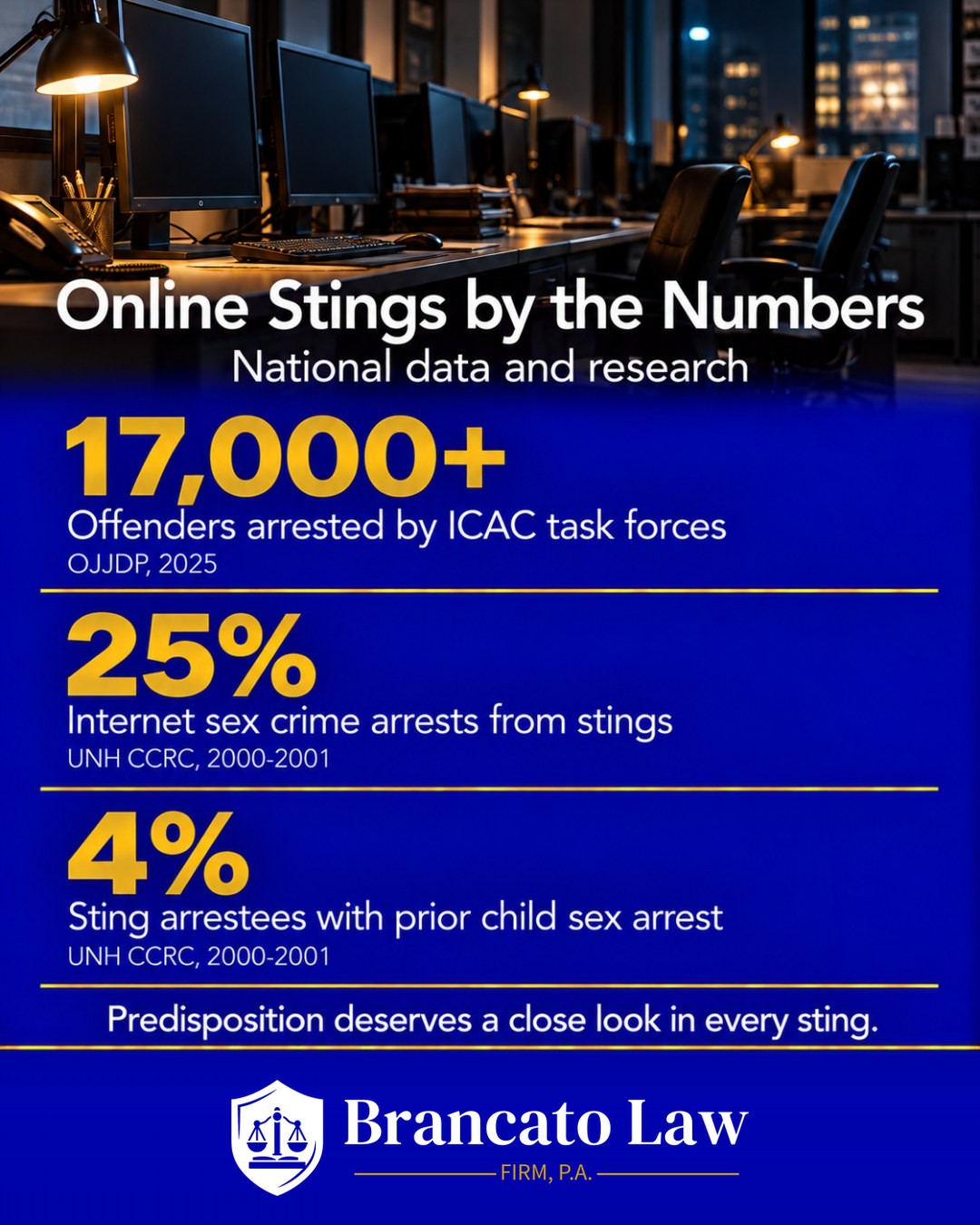
Most solicitation cases in Hillsborough, Pinellas, and Pasco Counties come from proactive stings, and the volume is large. Internet Crimes Against Children task forces nationwide conducted nearly 347,000 investigations and arrested more than 17,000 offenders in 2025, according to the U.S. Office of Juvenile Justice and Delinquency Prevention, which funds 61 task forces.
In our practice, Hillsborough County Sheriff’s Office stings follow two patterns. In decoy-profile stings, a deputy posts or answers an ad as an adult, then reveals a teenage age once the conversation is under way. In reverse stings, a deputy plays an adult, such as a mother or aunt, who offers access to a child, and those cases often add a human trafficking solicitation count. The leading Florida Supreme Court case on these charges began the same way: in State v. Shelley, 176 So. 3d 914 (Fla. 2015), Dean Shelley answered a Craigslist ad in Hillsborough County posted by an officer posing as a single mother, arranged over several days to meet her and her fictitious ten-year-old daughter, and was arrested when he arrived.
Research suggests sting arrestees differ from offenders who target real children. A study of arrests from July 2000 to June 2001, Police Posing as Juveniles Online to Catch Sex Offenders: Is It Working? by Kimberly Mitchell, Janis Wolak, and David Finkelhor of the University of New Hampshire’s Crimes Against Children Research Center, published in Sexual Abuse: A Journal of Research and Treatment in 2005, found that undercover investigations accounted for 25 percent of arrests for internet sex crimes against minors. Only 4 percent of offenders caught posing as juveniles had a prior arrest for a sexual offense against a minor, compared with 11 percent of offenders who met real victims online. Those numbers are a reason to examine predisposition closely in every sting case.
Can You Use Entrapment as a Defense to Online Solicitation in Florida?
Yes. Florida’s entrapment statute, section 777.201, applies when law enforcement induces a crime using methods that “create a substantial risk that such crime will be committed by a person other than one who is ready to commit it.” Once the defendant presents evidence of a lack of predisposition, the State must rebut it beyond a reasonable doubt. When the chat itself is undisputed, a judge can decide entrapment as a matter of law on a sworn motion to dismiss.
The Second District Court of Appeal, which hears appeals from Hillsborough, Pinellas, and Pasco Counties, did exactly that in DeMare v. State, 298 So. 3d 1269 (Fla. 2d DCA 2020). A detective created an 18-year-old profile named “Amber” on the dating site Meetme.com, chatted with Jason DeMare as an adult for four days, and revealed she was 14 only when plans became concrete. DeMare “immediately tried to end the relationship,” told her sex would be illegal, and was then repeatedly pressed by the detective. The court found that “his reluctance to violate the law was overcome by law enforcement inducement,” reversed his traveling conviction, and ordered him discharged.
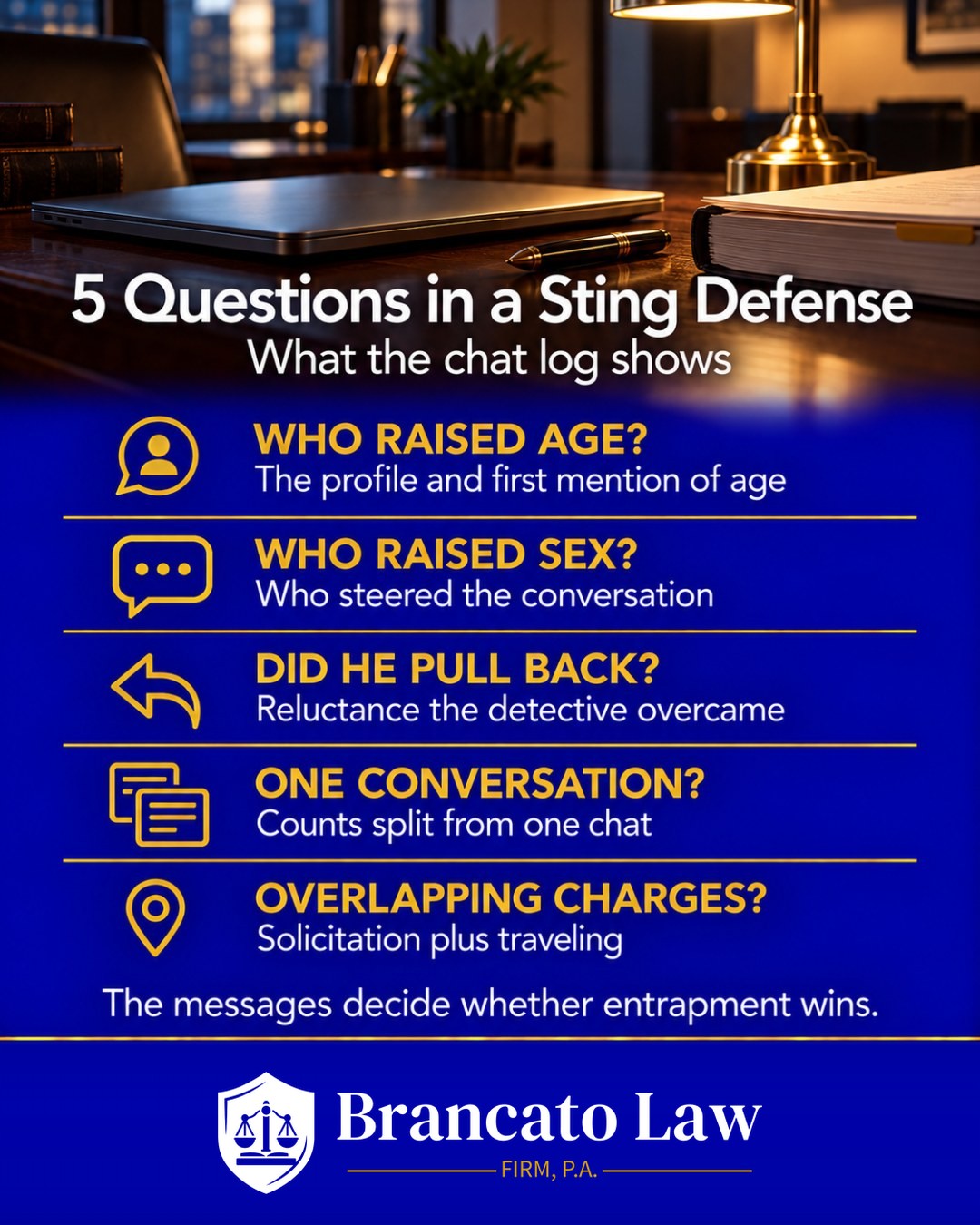
Entrapment does not win every sting case. In State v. Panebianco, 370 So. 3d 345 (Fla. 2d DCA 2023), a Sarasota County judge dismissed solicitation and traveling charges on entrapment grounds, but the Second District reversed. The decoy there said she was 14 early and repeatedly, and Ernest Panebianco “readily engaged in sexual discussions”; his worries about police reflected “a fear of being caught rather than an unwillingness,” so predisposition was a question for a jury. The difference between the two cases is in the messages, which is why our attorneys build a timeline of who raised age, sex, and meeting first.
Can You Be Convicted of Both Solicitation and Traveling to Meet a Minor?
Usually not, when both charges rest on the same conduct. In Shelley, the Florida Supreme Court held that the Legislature did not authorize separate punishments for solicitation and traveling after solicitation, and because the elements of solicitation “are entirely subsumed” by traveling, “double jeopardy principles prohibit separate convictions based upon the same conduct.” The court approved vacating Shelley’s solicitation conviction.
In Lee v. State, 258 So. 3d 1297 (Fla. 2018), the court added that, to decide whether solicitation, unlawful use of a two-way communications device, and traveling convictions rest on the same conduct, “the reviewing court should consider only the charging document—not the entire evidentiary record.” In Dettle v. State, 395 So. 3d 1054 (Fla. 2024), the court held that Lee does not apply retroactively to cases already final in 2018, which makes raising the issue at trial and on direct appeal essential. Our attorneys read the charging information count by count for this problem.
What Other Defenses Apply to Computer Solicitation Charges?
Beyond entrapment and double jeopardy, the defense depends on what the messages show and who sent them. Our attorneys look at these issues in every case:
- No solicitation in the words used. The State must show an attempt to seduce, solicit, lure, or entice, not just sexual talk or fantasy.
- Belief about age. The State must prove the defendant believed he was talking with a child; an adult profile and an adult photo can undercut that belief.
- Identity of the sender. Shared phones, shared accounts, and incomplete extractions can leave doubt about who typed the messages.
- Missing messages. Detectives sometimes preserve screenshots instead of full exports; our forensic review looks for gaps in the conversation.
- Objective entrapment. Police conduct so outrageous that it violates due process bars prosecution, though courts apply this narrowly.
- Charge stacking. Separate counts for one continuous conversation, and solicitation plus traveling for the same conduct, can be challenged before trial.
For the related travel charge and vigilante cases, see our posts on what to do if you messaged a minor online, Tampa sex sting defense, and vigilante predator catchers.
What Should You Do If You Are Under Investigation for Online Solicitation?
Stop all contact, preserve your devices, and talk to a lawyer before talking to police. These steps protect the defenses described above:
- Do not delete anything. Deleting messages or apps can look like consciousness of guilt and can destroy messages that support entrapment.
- Do not contact the other account again. Every new message is new evidence and may be a separate count.
- Do not consent to a phone search or interview. Politely decline and ask for a lawyer.
- Write down the timeline of how the conversation began, which site or app was used, and what the profile said about age.
- Call counsel immediately. Representation before charges are filed can shape how the State Attorney’s Office views the case.
Frequently Asked Questions About Solicitation of a Child Using a Computer
Is solicitation of a minor a felony if no real child was involved?
Yes, because the statute covers “a person believed by the person to be a child,” and the use of an undercover officer is not a defense by itself. The Brancato Law Firm focuses on how the detective presented the decoy’s age and who pushed the conversation toward sex.
Do I have to register as a sex offender for a computer solicitation conviction?
Yes, a conviction under section 847.0135(3) is a qualifying offense under section 943.0435. Our attorneys at The Brancato Law Firm review whether any plea offer includes an amended charge that avoids registration; see our internet crimes defense page.
Can computer solicitation charges be dropped in Florida?
Yes, charges can be dismissed on a successful entrapment motion, reduced through negotiation, or dropped when the evidence does not prove solicitation. The Brancato Law Firm files sworn motions to dismiss when the chat shows a detective overcame a client’s reluctance, as happened in DeMare.
What if the profile said the person was 18?
An adult profile does not end the case if the decoy later claimed to be a minor, but it is strong evidence on belief and predisposition. Our attorneys at The Brancato Law Firm build the defense around the exact point where age was introduced; our entrapment guide explains why that timing matters.
Can I be charged with traveling to meet a minor if I never got out of my car?
Yes, the traveling statute covers anyone who “travels any distance” or “attempts to do so” after a prohibited solicitation, so driving to the meeting place can be enough. The Brancato Law Firm examines whether the travel was for the purpose the statute requires and whether the solicitation count must be vacated under Shelley.
Can I be charged for each message I sent?
The statute allows each separate use of a device in which an offense is committed to be charged as a separate offense, though one conversation is usually not charged message by message. Our attorneys at The Brancato Law Firm challenge counts that split one continuous conversation into multiple crimes.
For how The Brancato Law Firm, P.A. defends these cases, see our Tampa sex crimes defense practice.
Talk to a Tampa Defense Attorney About a Computer Solicitation Charge
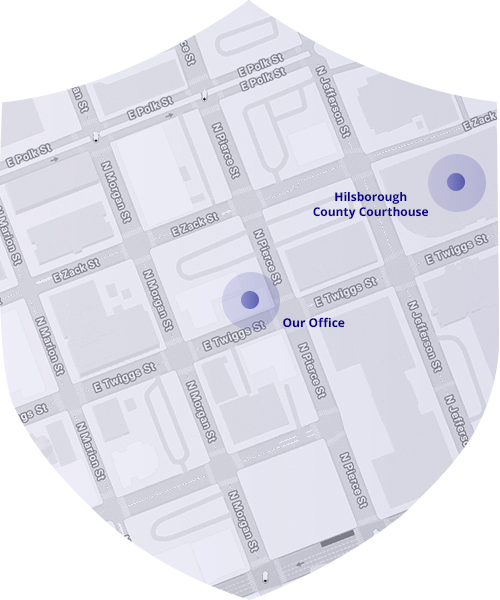
The first decision in these cases, whether to file an entrapment motion or negotiate, depends on the full chat, so getting it reviewed early matters. Call The Brancato Law Firm, P.A., founded by Tampa Criminal Defense Attorney Rocky Brancato, at (813) 727-7159, and our attorneys will start with the complete conversation and the profile that began it. You can call us at any hour, and our office is two blocks from the courthouse. Our firm has Spanish-speaking staff, and attorney Jean-Luc Adrien speaks Spanish, Haitian Creole, and French. Read our guide for Spanish-speaking and Haitian Creole-speaking clients.
For more about our defense strategies, visit our Tampa Internet Crimes Attorney page.
The Brancato Law Firm, P.A.
620 E. Twiggs Street, Suite 205, Tampa, FL 33602
(813) 727-7159
Serving Hillsborough, Pinellas, and Pasco Counties
The Brancato Law Firm, P.A. is a Tampa-based criminal defense practice. We are not affiliated with any other Brancato-named law firms.
Visit Us

Tampa, FL 33602
Contact Us Now
Free Legal Consultation (813) 727-7159