- Free Consultation 24/7: (813) 727-7159 Tap Here To Call Us


From First DUI to Death Penalty



Is Porn Legal in Florida? What the Age Verification Law Means for You (2026)


Fully rewritten and updated October 23, 2026.
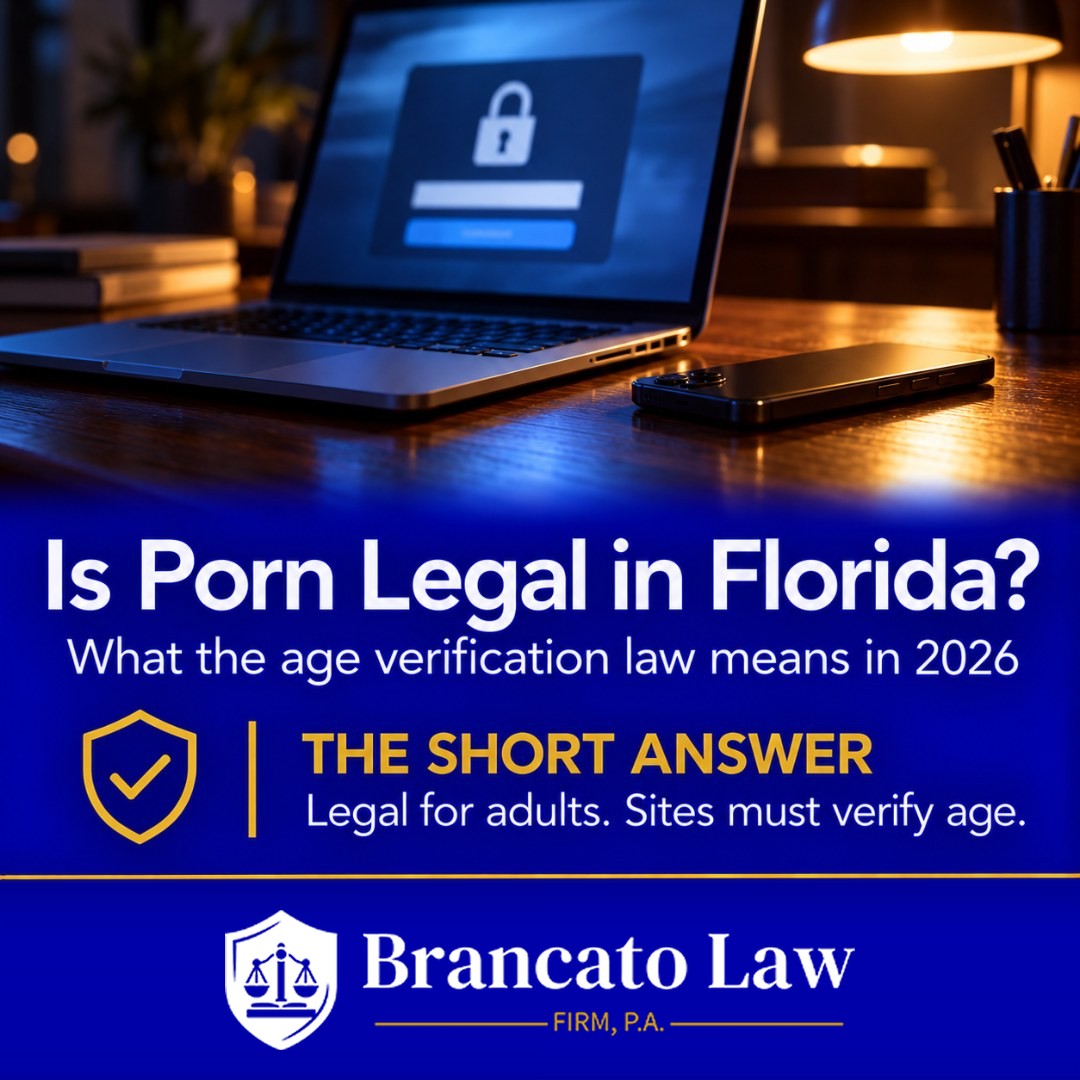
Yes. Porn is legal in Florida for adults 18 and older when everyone shown is an adult who consented and the material is not legally obscene. Porn is not banned in Florida, but since January 1, 2025, Florida’s age verification law (HB 3, section 501.1737) requires adult websites to verify that each visitor is at least 18, which is why some sites now ask for an age check and others block Florida. The law puts its penalties on websites, not on adult viewers. Child sexual abuse material, sending sexual material to a minor, obscenity offenses, and posting someone’s intimate images without consent remain crimes, and possessing child sexual abuse material became a second-degree felony on July 1, 2026.
If you hit an age-check screen on an adult site, found that a site you used now blocks Florida, or got a call from a detective about something on your account, you probably want to know exactly where Florida draws the line. I’m Rocky Brancato, founder of The Brancato Law Firm, P.A., a Tampa criminal defense firm. I defended sex crimes cases in the Major Crimes Unit of the Hillsborough County Public Defender’s Office, and I am the former Chief Operations Officer of that office, where I oversaw a staff of over 100 attorneys. Our attorneys defend internet and child pornography investigations across Hillsborough, Pinellas, and Pasco Counties, often before any charge is filed.
Is porn legal in Florida in 2026?
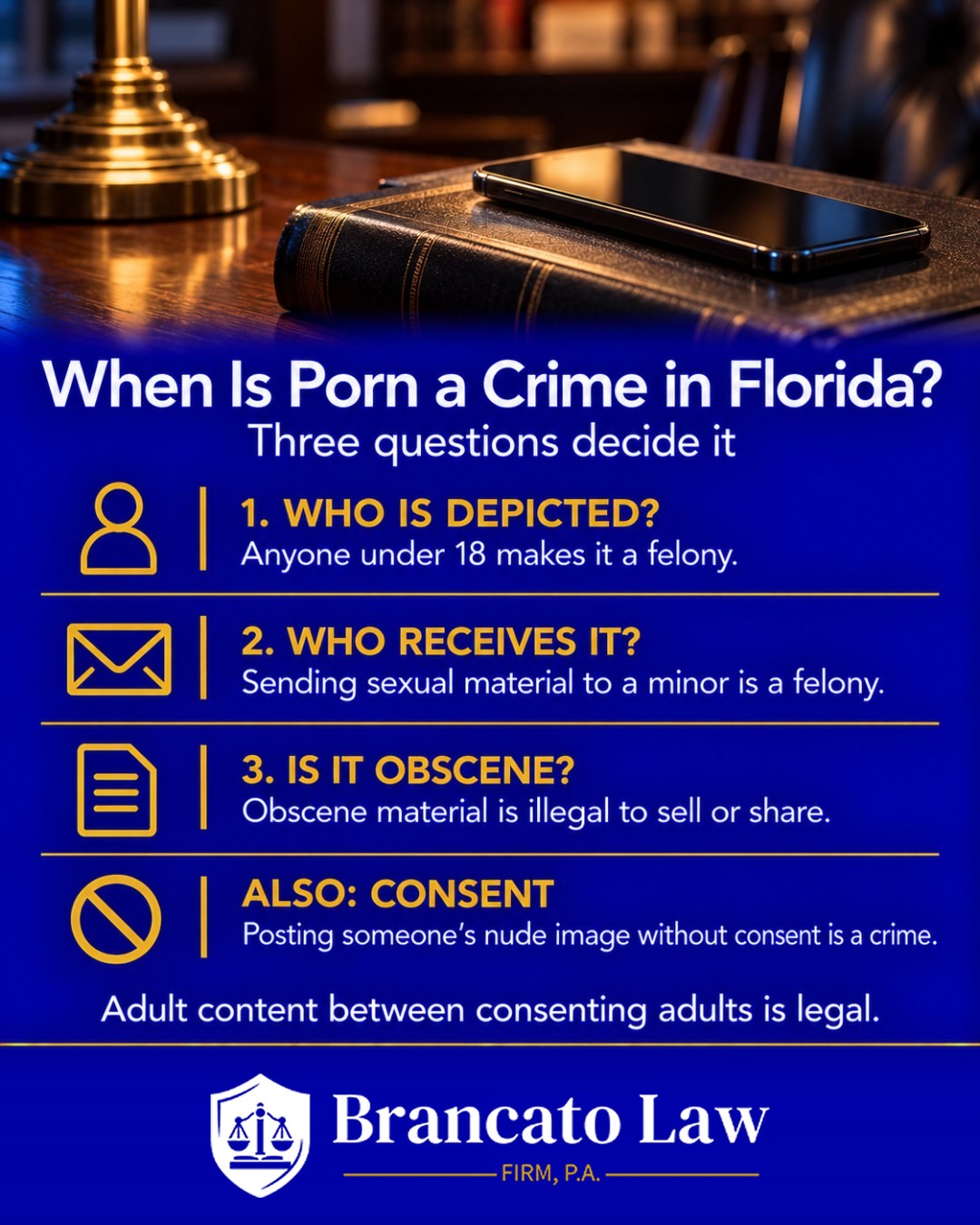
Yes, watching, buying, or owning adult pornography is legal in Florida for anyone 18 or older. No Florida statute makes it a crime for an adult to view lawful adult content, and the 2024 age verification law does not change that. Three things decide whether sexual material crosses into criminal territory: who is depicted, who receives it, and whether it is legally obscene.
- Who is depicted. Any image of a person under 18 engaged in sexual conduct is child sexual abuse material under section 827.071, Florida Statutes, no matter who made it or why.
- Who receives it. Showing, giving, or sending sexual material to a minor is a felony.
- Whether it is obscene. Material that meets the legal test for obscenity can be prosecuted when it is sold, distributed, or shown, even between adults.
Consent also matters for adults. Publishing a sexually explicit image of a real person without that person’s consent can be a crime under Florida’s sexual cyberharassment law, covered below. Nearly every question our attorneys hear about Florida porn law turns on one of these three facts.
Is porn banned in Florida? What the age verification law requires
No, porn is not banned in Florida. HB 3, signed in March 2024 as chapter 2024-42, Laws of Florida, created section 501.1737, Florida Statutes, which took effect on January 1, 2025. It requires adult websites to verify a visitor’s age before showing sexual material. The law regulates the businesses that publish the content. It does not punish the adult who views it.
| Question | What section 501.1737 says |
|---|---|
| Who must comply? | A commercial entity that knowingly and intentionally publishes material harmful to minors on a website or app where more than 33.3 percent of the material is harmful to minors |
| What must the site do? | Verify that each person trying to access the material is 18 or older, and block anyone younger |
| How is age verified? | The site must offer both “anonymous” and “standard” age verification, and the visitor chooses which one to use |
| What happens to my ID data? | Under section 501.1738, an anonymous verifier must be an independent U.S.-based company and may not keep or share your identifying information after verifying your age |
| Who enforces it? | The Florida Department of Legal Affairs (the Attorney General), as an unfair and deceptive trade practice |
| What is the penalty? | A civil penalty of up to $50,000 per violation, plus attorney fees and costs; punitive damages for a consistent pattern of violations |
| Can a minor sue? | Yes, if the site failed to block the minor after a report of unlawful access; damages up to $10,000, filed within 1 year |
| Who is exempt? | Bona fide news reporting, and internet service providers, search engines, and cloud services that did not create the content |
| Is the viewer liable? | No. The statute sets no penalty for an adult who views lawful content |
“Material harmful to minors” has a specific meaning under section 847.001, Florida Statutes: sexual content that predominantly appeals to a prurient interest, is patently offensive under adult community standards for what is suitable for minors, and lacks serious literary, artistic, political, or scientific value for minors. Mainstream adult video sites fall squarely within that definition, which is why they are the main target of the law, as our attorneys explain to clients who worry that their own browsing puts them at risk.
Why do some porn sites block Florida?
Some adult sites block Florida because their owners chose not to collect age verification from Florida users. Aylo, the company that owns Pornhub, cut off Florida access on January 1, 2025, the day the law took effect. Other large sites stayed open and added an age check. A blocked site is a business decision by the company, and it does not mean Florida made adult content illegal.
Florida has gone after sites that did neither. In August 2025, Attorney General James Uthmeier sued the operators of XVideos, XNXX, BangBros, and Girls Gone Wild for failing to verify ages, and in September 2025 his office filed two more complaints, including one against Aylo entities over sites such as SpiceVids and Nutaku. The State seeks injunctions and penalties of up to $50,000 per violation. We have not found a reported final judgment in those cases as of this update. None of these lawsuits targets individual viewers, and our attorneys give clients the same answer: the law’s penalties fall on the companies.
Is Florida’s age verification law constitutional after Free Speech Coalition v. Paxton?
Yes, as things stand, Florida’s law is in force and no court has blocked it. In Free Speech Coalition, Inc. v. Paxton, 606 U.S. 461 (2025), an adult-industry trade group challenged Texas’s nearly identical age verification law. On June 27, 2025, the U.S. Supreme Court upheld the Texas law by a 6-3 vote. The Court applied intermediate scrutiny, recognized that adults have a right to view sexual material that is obscene only for minors, and held that “adults have no First Amendment right to avoid age verification.”
The same trade group had sued Florida in federal court in December 2024. After Paxton, the plaintiffs voluntarily dismissed the Florida case in July 2025. The practical lesson for Florida residents is simple: age checks on adult sites are here to stay, and the legal fight has shifted to whether particular sites are complying. The Brancato Law Firm follows these rulings because the same First Amendment principles shape obscenity and harmful-to-minors prosecutions.
Is it illegal to use a VPN to watch porn in Florida?
No, using a VPN is legal in Florida, and no Florida law punishes an adult for using one to reach lawful adult content. Section 501.1737 does not mention VPNs, and its duties fall on the website. Florida has not passed any law that restricts VPN use.
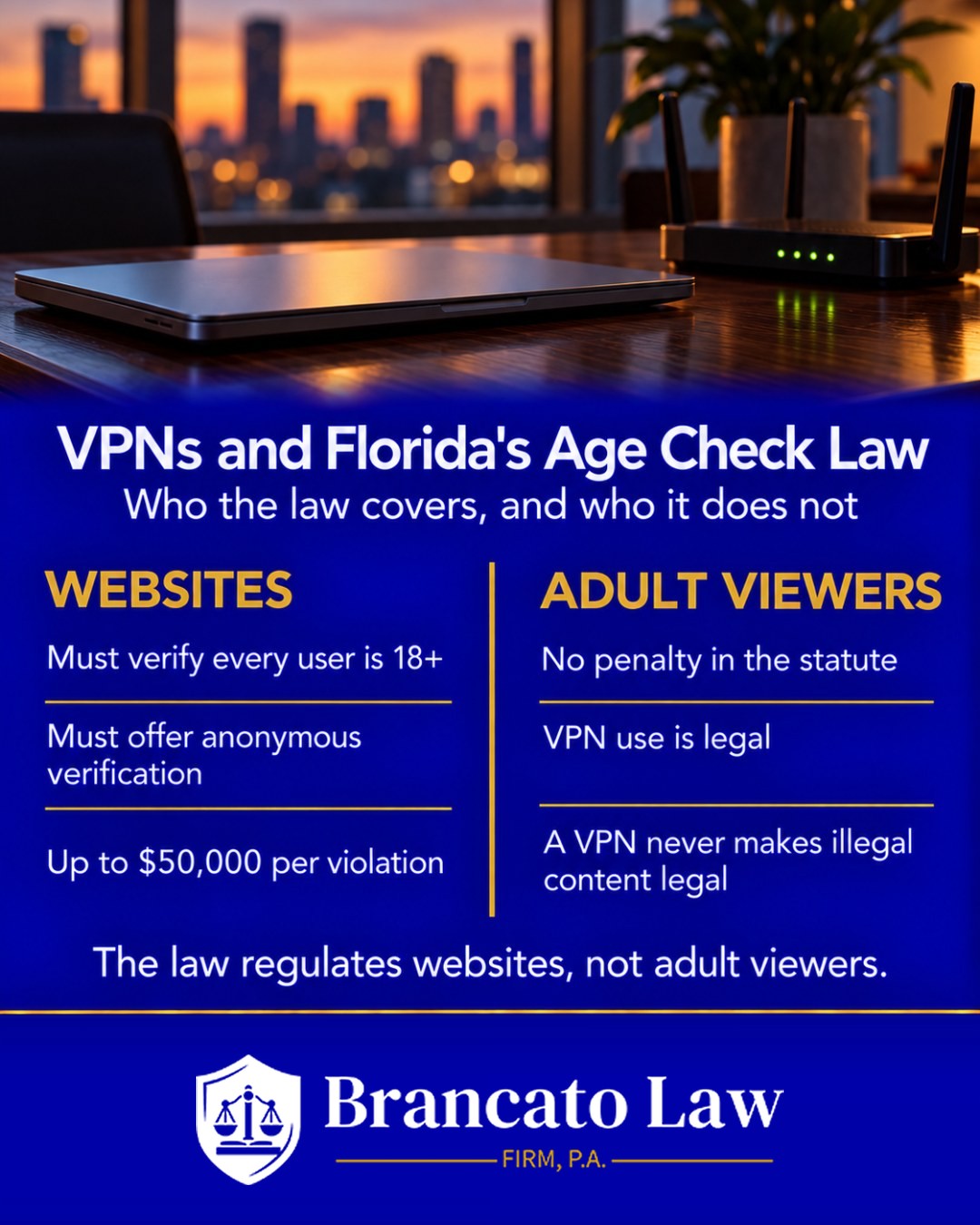
Research shows many people respond to these laws by changing how they get to adult content. A study by David Lang and colleagues at NYU’s Center for Social Media, AI, and Politics, published in the Journal of Law & Empirical Analysis in 2026, found that in the three months after age verification laws took effect, Google searches for VPN services rose 23.6%, searches for the leading site that complied fell about 51%, and searches for the leading site that did not comply rose 48.1%.
A VPN changes your apparent location. It does not change the legality of the content. If the material involves a minor, a VPN is no defense, and it does not erase what is stored on your phone, laptop, or cloud account. In our experience, the evidence in these cases usually comes from the devices and accounts themselves, plus records from the companies that run them.
When does pornography become a crime in Florida?
Pornography becomes a crime in Florida when it involves a minor, when it is legally obscene and distributed, or when it is published without the depicted person’s consent. The table below lists the offenses our attorneys see most, with current classifications, and our Tampa internet crimes attorney page explains how we defend each charge. Felony maximums come from section 775.082, Florida Statutes: 5 years for a third-degree felony, 15 years for a second-degree felony, and 30 years for a first-degree felony.
| Conduct | Florida law | Classification | Maximum |
|---|---|---|---|
| Adult viewing lawful adult content | None | Legal | None |
| Adult using a VPN to reach an adult site | § 501.1737 regulates sites only | Legal | None |
| Adult site failing to verify age | § 501.1737 | Civil violation | $50,000 per violation |
| Selling, distributing, or showing obscene material | § 847.011(1)(a) | First-degree misdemeanor; third-degree felony after a prior conviction | 1 year |
| Showing or giving obscene material to a minor | § 847.0133 | Third-degree felony | 5 years |
| Sending material harmful to minors to a person known to be a minor | § 847.0138 | Third-degree felony | 5 years |
| Minor sending or keeping a nude image of another minor (first violation) | § 847.0141 | Noncriminal violation | 8 hours of community service, a $60 civil penalty, or a cyber-safety program |
| Posting someone’s sexually explicit image without consent | § 784.049 | First-degree misdemeanor; third-degree felony for a second offense | 1 year (5 years for a second offense) |
| Possessing or intentionally viewing AI-generated child sexual abuse material | § 827.072(2)(a) | Third-degree felony, each image | 5 years per count |
| Possessing or intentionally viewing child sexual abuse material | § 827.071(5) | Second-degree felony, each image (third-degree before July 1, 2026) | 15 years per count |
| Sending child sexual abuse material to another person | § 847.0137 | Second-degree felony; 5-year mandatory minimum for adults | 15 years |
| Creating AI-generated child sexual abuse material | § 827.072(2)(c) | Second-degree felony | 15 years |
| Using a child in a sexual performance | § 827.071(2)(a) | First-degree felony; 15-year mandatory minimum for adults | 30 years |
What makes porn “obscene” under Florida law?
Material is obscene only if it meets all three parts of the test from Miller v. California, 413 U.S. 15 (1973), the U.S. Supreme Court case about a man prosecuted for mailing sexually explicit advertising brochures. Florida copies that test into section 847.001: the average person, applying contemporary community standards, would find the work as a whole appeals to the prurient interest; it depicts sexual conduct in a patently offensive way; and, taken as a whole, it lacks serious literary, artistic, political, or scientific value. Most mainstream adult content is not prosecuted as obscene.
Under section 847.011, Florida Statutes, selling, distributing, or showing obscene material is a first-degree misdemeanor, and the statute still lists simple knowing possession as a second-degree misdemeanor. Private possession has constitutional protection, though. In Stanley v. Georgia, 394 U.S. 557 (1969), police searching a Georgia man’s home for bookmaking evidence found obscene films, and the Supreme Court held that a state cannot make “mere private possession of obscene material” in the home a crime. That protection stops at material involving children, as explained below.
Is it a crime to show or send porn to someone under 18?
Yes, and it is a felony. Knowingly showing, giving, or transmitting obscene material to a minor is a third-degree felony under section 847.0133. Sending an image or data that is harmful to minors to a specific person you know or believe is a minor is also a third-degree felony under section 847.0138, and that statute reaches senders outside Florida. The “believed” language is why undercover officers posing as teenagers can bring this charge even when no real child was involved.
Both offenses are on the list in section 943.0435, Florida Statutes that requires sex offender registration, which generally lasts for life. Questions about lawful sexual activity between people of different ages are a separate topic, covered in our guide to the age of consent in Florida.
What are the penalties for child pornography in Florida after July 1, 2026?
Knowingly possessing, controlling, or intentionally viewing child sexual abuse material is now a second-degree felony, punishable by up to 15 years in prison for each image. Chapter 2026-20, Laws of Florida (HB 1159), raised the offense from a third-degree felony for conduct on or after July 1, 2026, and renamed “child pornography” as “child sexual abuse material” throughout the statutes. Under section 827.071(5), each image is a separate offense, and an image showing more than one child counts once for each child. “Intentionally view” requires proof of more than a single image.
Sentences can climb further. Under section 775.0847, Florida Statutes, the charge is reclassified one degree higher when a person possesses 10 or more images and at least one shows a child under 12, sadomasochistic abuse, sexual battery, bestiality, or any video of a child. Transmitting the material to another person now carries a 5-year mandatory minimum for adults under section 847.0137, and that statute’s definition of “transmit” covers sharing a cloud link or login. A conviction under section 827.071 requires sex offender registration. For how the reclassification math works on a scoresheet, see our post on child pornography enhancements in Florida.
The constitutional rule behind these laws is settled. In Osborne v. Ohio, 495 U.S. 103 (1990), an Ohio man was convicted for possessing nude photographs of a boy in his home, and the Supreme Court held that states may ban private possession and viewing of child pornography because of their compelling interest in protecting children, distinguishing Stanley.
Is AI-generated child pornography illegal in Florida?
Yes. Section 827.072, Florida Statutes makes it a third-degree felony to knowingly possess or intentionally view “generated child sexual abuse material,” meaning computer-created images of a fictitious person a reasonable person would regard as a real minor engaged in sexual conduct. Creating that material, or sending it to another person, is a second-degree felony. An image altered to show an identifiable real child, such as a face swapped onto another body, falls under section 827.071 and its higher penalties.
Is revenge porn illegal in Florida?
Yes. Under section 784.049, Florida Statutes, publishing or electronically sending a sexually explicit image of a person without consent, together with information that identifies the person, is sexual cyberharassment. A first offense is a first-degree misdemeanor, a second is a third-degree felony, and the person shown can sue for the greater of $10,000 or actual damages. Sending an image to a partner does not, by itself, give up that person’s expectation of privacy.
How do child pornography investigations start in Florida?
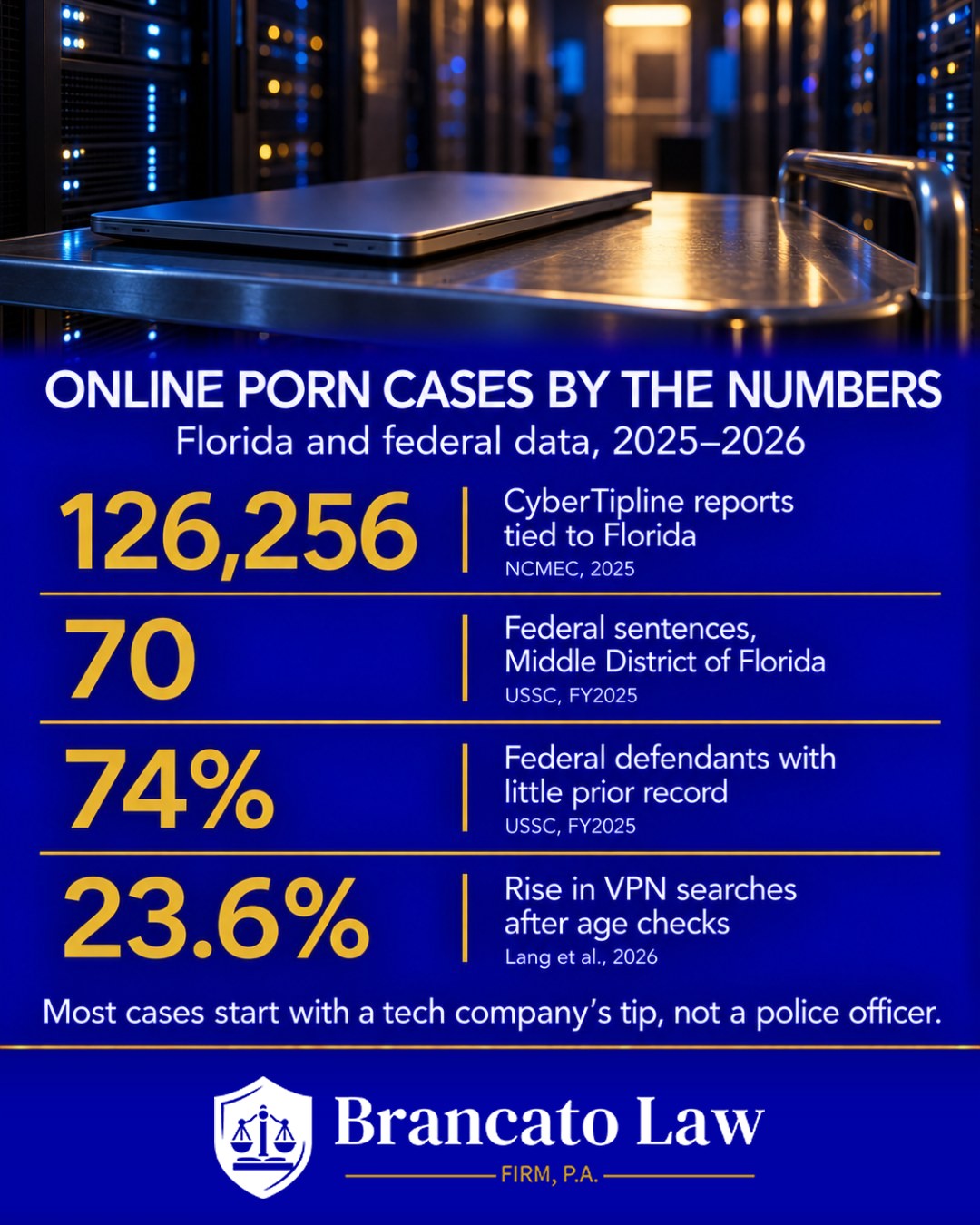
Most child pornography investigations in Florida start with a tip from a tech company, not a police officer. Platforms that detect suspected child sexual abuse material report it to the CyberTipline run by the National Center for Missing & Exploited Children (NCMEC). In 2025, the CyberTipline received 21.3 million reports nationwide, and 126,256 of them were tied to Florida, according to NCMEC’s 2025 CyberTipline reports by state. NCMEC sends those reports to Internet Crimes Against Children task forces and local agencies, which subpoena account records, identify the internet subscriber, and apply for search warrants.
The same conduct can also be charged in federal court, and the federal district that includes Tampa sentences more of these cases than any other. In fiscal year 2025, the Middle District of Florida, which includes Tampa, sentenced 70 people for federal child pornography offenses, more than any other federal district, according to the U.S. Sentencing Commission’s fiscal year 2025 Quick Facts. The same report found that 74% of people sentenced for federal child pornography offenses that year had little or no prior criminal history.
That pattern matches what we see: many of the people who call us have never been arrested. The account holder is the first person investigators look at, even when someone else in the home did the searching. A teenager who searches for explicit content involving “kids my age” can trigger the same automated report as an adult, and the subpoenas and warrants usually point to the parent who pays for the internet service. Parental controls such as Apple Screen Time and Google Family Link can help prevent that situation, and activity logs from those tools can later help show who was using a device.
Can you be charged for images you did not know were on your device?
The State must prove you knew the material was there, and that element is often where these cases are won. In Strouse v. State, 932 So. 2d 326 (Fla. 4th DCA 2006), a man was charged with seven counts after his girlfriend found images on his laptop. Six counts were dismissed because those images were old temporary internet files or composite images from website banners. The conviction on the remaining count was affirmed because his girlfriend had seen that image appear as a new icon on his screen, which showed it was more than a file the computer stored automatically. A 2008 Florida Law Review note examined the same problem: whether a person should be convicted for files a browser cache saved on its own. Knowledge is tested twice, first in a motion to dismiss or a forensic challenge before trial and again in front of the jury.
What should you do if police contact you about images online?
Do not talk to the detective, do not consent to a device search, and do not delete anything. Call a lawyer before you respond. Deleting files after you know about an investigation can lead to a separate tampering charge, and forensic examiners can often recover deleted data anyway. A detective’s request to “clear this up” is usually an attempt to get the admission that proves knowledge.
- Day 1: Decline the interview politely and ask for the detective’s name, agency, and case number.
- Day 1: Do not unlock, wipe, reset, or hand over phones, computers, or cloud passwords without a warrant.
- Days 1 to 3: Have a lawyer contact the agency, invoke your rights, and route all communication through counsel.
- First weeks: Build the defense and mitigation record before the State decides what to file.
The weeks before an arrest are the best chance to shape the outcome, which is why our firm offers representation before charges are filed. Our attorneys review the actual files in person at the law enforcement agency rather than relying on a detective’s description, and we bring in forensic experts to test how each file got onto the device. If Google or another provider has notified you that police requested your account records, our guide on what to do after a Google account legal request walks through the first steps. When an investigation involves an in-person sex offense allegation as well, see our Tampa sex crimes lawyer page.
What results has our firm obtained in these cases?
Our attorneys have resolved internet and child pornography investigations without a registrable conviction, and in some cases without any charge. These results are published on our case results page.
| Year | Situation | Result |
|---|---|---|
| 2026 | Client contacted us after a police visit and before arrest, facing four child pornography possession felonies. Rocky reviewed the files himself at the law enforcement station and identified three as “age-difficult,” and the defense built a treatment and mitigation record. | Reduced to four counts of obscenity under § 847.011(1)(a), which does not require registration; withheld adjudication and three years of probation |
| 2026 | A family’s child was accused of possessing an explicit video of another minor. We contacted the detective, invoked the right to counsel, and handled all communication. | Investigation closed without an arrest |
| 2025 | Client learned from Google that police had a search warrant for her online records after someone in her home chatted with a minor. We spoke with the detective and invoked her rights. | No charges filed |
Past results do not guarantee future outcomes.
Frequently asked questions about Florida porn laws
Is it illegal for a minor to watch porn in Florida?
Florida’s pornography laws target the websites and people who provide sexual material to minors, and no statute makes a minor’s viewing alone a crime. When teenagers trade nude images with each other, though, Florida’s sexting statute applies, starting with a noncriminal citation. The Brancato Law Firm represents families when a school or detective gets involved and works to keep a teenager’s mistake in juvenile court or out of court entirely.
Can I get in trouble for using a VPN to watch porn in Florida?
No, an adult using a VPN to reach lawful adult content does not violate Florida law, because section 501.1737 regulates websites, not viewers. Our attorneys at The Brancato Law Firm remind clients that a VPN offers no protection when the content involves a minor, since the evidence comes from the device and the accounts.
Is OnlyFans legal in Florida?
Yes, subscribing to or selling adult content on platforms like OnlyFans is legal in Florida when everyone involved is 18 or older and consented. The Brancato Law Firm advises adult creators that the legal risks come from content involving anyone under 18, posting another person’s images without consent, and material that meets the obscenity test.
What happens if my child searched for illegal content on my internet account?
Investigators usually start with the account holder, so a parent can become the first suspect when a child’s search triggers a report. The Brancato Law Firm steps in at that stage through pre-file advocacy, contacting the detective and helping show who actually used the device.
Is sending a nude photo to a 17-year-old a crime in Florida?
Yes, an adult who sends sexual images to someone known or believed to be a minor commits a third-degree felony under section 847.0138, and a conviction requires sex offender registration. The Brancato Law Firm defends these charges, including cases that come from undercover chats, as explained in our post on solicitation of a child using a computer.
Can child pornography charges be dropped in Florida?
Yes, prosecutors can drop or reduce these charges when the evidence of knowledge, age, or identity is weak or when the defense presents strong mitigation. In a 2026 case, The Brancato Law Firm obtained a reduction from four child pornography felonies to obscenity counts that do not require registration; learn more from our internet crimes defense team.
Do you have to register as a sex offender for possessing child pornography in Florida?
Yes, a conviction under section 827.071 requires sex offender registration under section 943.0435, generally for life, with a petition for removal possible only after 25 years in limited cases. The Brancato Law Firm looks for lawful resolutions that avoid a registrable offense, such as the obscenity reduction described above. Our guide to Florida child sexual abuse material charges covers the defenses in more detail.
Can police search my phone if they say they found porn on my account?
Police generally need a search warrant or your consent to search your phone, and you can refuse consent. The Brancato Law Firm reviews every warrant in these cases for problems with the probable cause, the scope of the search, and the timing of the forensic exam.
Talk to a lawyer before you talk to a detective
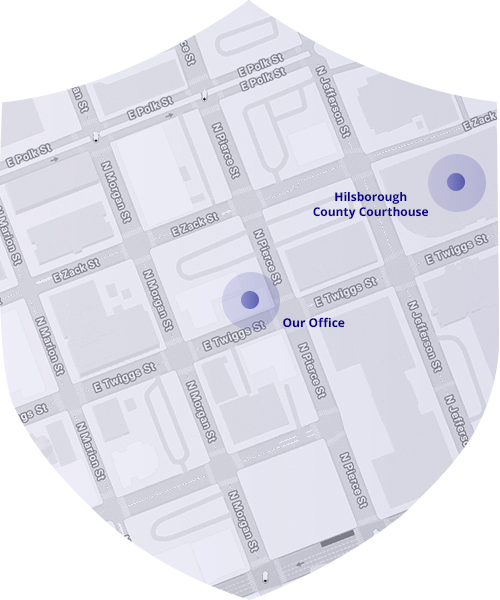
Your next step, if a detective has called, knocked, or sent a provider notice, is to say nothing about the images and call us first. The Brancato Law Firm, P.A., founded by Tampa Criminal Defense Attorney Rocky Brancato, will contact the agency for you, protect your devices and accounts from a consent search, and start building the defense before the State decides what to charge. Call (813) 727-7159 for a free, confidential consultation. You can call us at any hour, and our office is two blocks from the courthouse. Our firm has Spanish-speaking staff, and attorney Jean-Luc Adrien speaks Spanish, Haitian Creole, and French. Read about our Spanish and Haitian Creole criminal defense services.
For more about our defense strategies, visit our Tampa Internet Crimes Attorney page.
The Brancato Law Firm, P.A.
620 E. Twiggs Street, Suite 205, Tampa, FL 33602
(813) 727-7159
Serving Hillsborough, Pinellas, and Pasco Counties
The Brancato Law Firm, P.A. is a Tampa-based criminal defense practice. We are not affiliated with any other Brancato-named law firms.
Visit Us
Tampa, FL 33602
Contact Us Now
Free Legal Consultation (813) 727-7159