- Free Consultation 24/7: (813) 727-7159 Tap Here To Call Us


From First DUI to Death Penalty



Caught by a Vigilante Predator Catcher in Florida? Your Rights and Defenses (2026)



Fully rewritten and updated October 24, 2026.
Yes, you can be charged in Florida after a vigilante predator catcher sting, even though no police officer was involved in the chat. Florida’s solicitation and traveling-to-meet-a-minor laws cover “a child or another person believed by the person to be a child,” so a fake profile run by a private citizen can support a felony. Florida’s entrapment statute, however, applies only to law enforcement and people working with or for them, so entrapment is usually available only when police were involved. The strongest defenses are often the evidence itself: edited or missing chats, unreliable video, and proof of what you actually intended.
As founder of The Brancato Law Firm, P.A., a Tampa criminal defense firm, and a former Major Crimes Unit attorney who handled sex crime cases, I have watched vigilante sting videos become the opening exhibit in criminal cases, often before anyone has called a lawyer. I’m Rocky Brancato, and in more than 25 years in Hillsborough County courtrooms and 150+ jury trials to verdict, I have learned that a video built for views is not the same as evidence built for court. Our attorneys defend people targeted by these groups across Hillsborough, Pinellas, and Pasco Counties, and the earliest calls give us the most to work with.
What Is a Vigilante Predator Catcher?
A vigilante predator catcher is a private person or group that poses as a minor online, steers the conversation toward sex, arranges a meeting, and then confronts the target on camera, often for a livestream or a monetized video. These groups are not police. They have no training in preserving evidence, no duty to give Miranda warnings, and often a financial reason to make the encounter as dramatic as possible.
Our attorneys have seen at least two kinds of groups working in the Tampa Bay area, both from out of state. One has physically confronted targets on camera and used edited photos to make its decoys look younger in chats. The other avoids violence and works closely with law enforcement. Both report to police, both post footage online, and both are active on dating apps, including apps used by gay men.
Can You Be Charged After a Vigilante Sting in Florida?
Yes. Florida’s internet solicitation law, section 847.0135(3), Florida Statutes, makes it a crime to use a computer or device to “seduce, solicit, lure, or entice” “a child or another person believed by the person to be a child” to commit an illegal sexual act. The traveling-to-meet-a-minor provision in section 847.0135(4) uses the same “believed by the person to be a child” language. Because the statute turns on what the accused believed, it does not matter that the “child” was an adult volunteer.
| Charge | Statute | Degree | Maximum penalty |
|---|---|---|---|
| Using a computer to solicit a child or a person believed to be a child | s. 847.0135(3)(a) | Third-degree felony | 5 years in prison, $5,000 fine |
| The same offense while misrepresenting your own age | s. 847.0135(3) | Second-degree felony | 15 years in prison, $10,000 fine |
| Traveling to meet a minor after soliciting online | s. 847.0135(4) | Second-degree felony | 15 years in prison, $10,000 fine |
Maximum terms come from section 775.082 and section 775.083, Florida Statutes. Our post on traveling to meet a minor in Tampa explains that charge in detail, and our guide to what to do after messaging a minor online covers the first steps.
Can You Use Entrapment as a Defense Against a Vigilante?
Usually not, unless police were involved. Florida’s entrapment statute, section 777.201, Florida Statutes, applies when “A law enforcement officer, a person engaged in cooperation with a law enforcement officer, or a person acting as an agent of a law enforcement officer” induces the crime. A private group acting entirely on its own is none of those. The defense must prove entrapment by a preponderance of the evidence.
Federal courts say the same. In United States v. Morris, 549 F.3d 548 (7th Cir. 2008), where the first person to pose online as the girl was her mother, a private citizen, the court wrote: “There is no defense of private entrapment.” That opinion quoted University of Florida Journal of Law and Public Policy scholarship warning that cheap online stings allow “private entrapment to become rampant” (Dru Stevenson, Entrapment by Numbers, 16 U. Fla. J.L. & Pub. Pol’y 1 (2005)).
The answer changes when the group is not really acting alone. If officers asked the group to run the sting, fed it information, coordinated the meeting, or kept using its methods while knowing how it worked, the group may be “engaged in cooperation with” or “acting as an agent of” law enforcement under section 777.201. Our attorneys subpoena the communications between the group and the agency to find out which side of that line the case falls on.
There is also a due process route. In Munoz v. State, 629 So. 2d 90 (Fla. 1993), the Florida Supreme Court held that section 777.201’s subjective test governs “in the absence of egregious law enforcement conduct,” but that when the conduct is egregious, entrapment “is to be evaluated under the due process provision of article I, section 9, of the Florida Constitution.” Our post on understanding entrapment explains both tests.
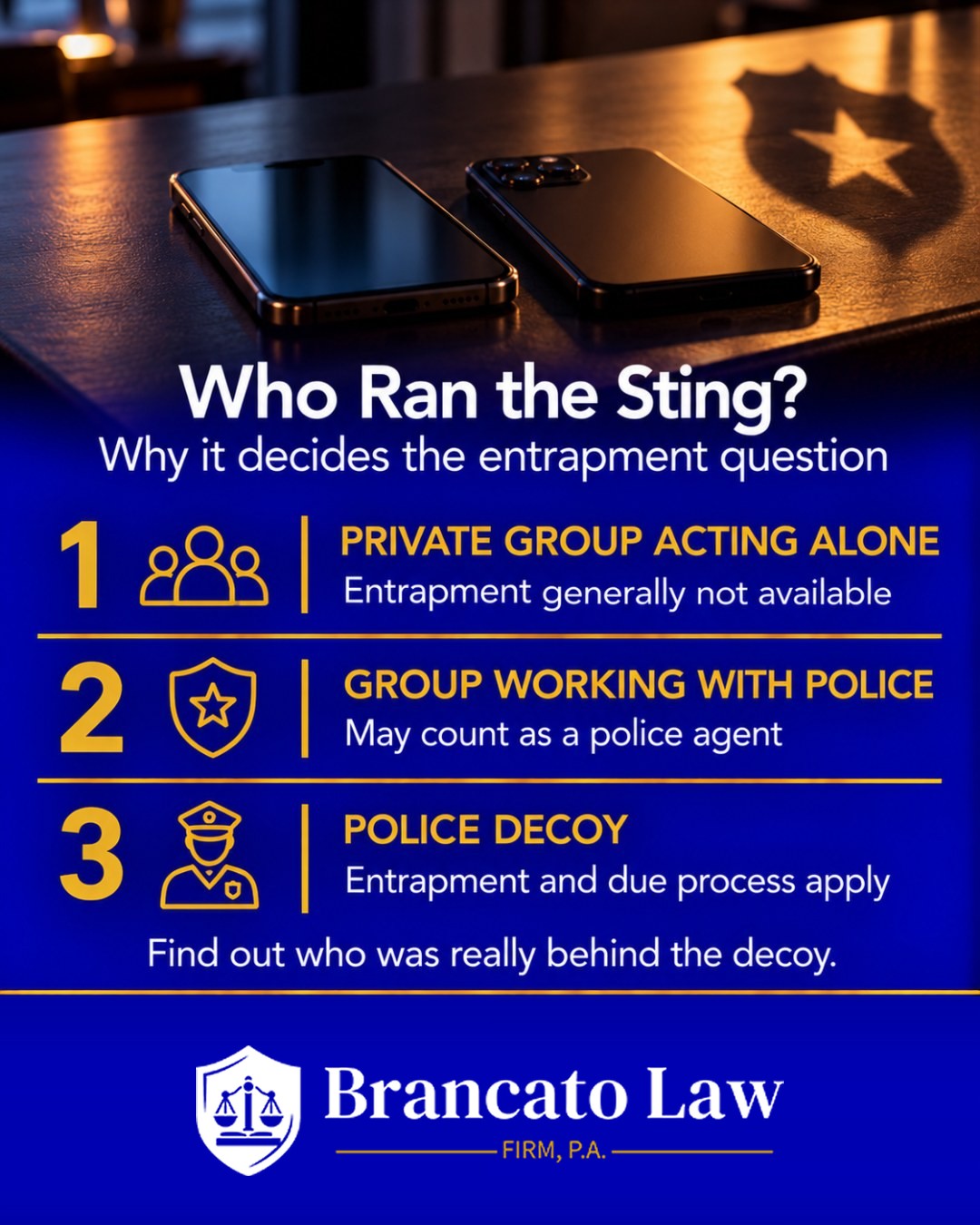
| Who ran the sting | Statutory entrapment (s. 777.201) | Constitutional limits |
|---|---|---|
| Private group acting alone | Generally not available | Generally do not apply to private conduct |
| Private group working with or for police | May be available as a cooperating person or agent | May apply; evidence can be challenged |
| Police officers posing as a minor | Available if inducement and lack of predisposition are shown | Apply; egregious conduct can violate due process |
What Defenses Work When Police Were Not Involved?
The evidence itself. A vigilante group decides what to save, what to post, and what to cut, and the State usually inherits whatever the group chose to keep. Our attorneys focus on these points:
- Missing or edited chats. We demand the complete message history from the platform, not screenshots, and compare it line by line with what the group posted.
- Who raised sex and age first. The full thread often shows the decoy steering the conversation, which matters to intent even when entrapment is unavailable.
- Authentication. The State must prove the messages came from the accused and the decoy account was what it claimed to be.
- Intent and belief. The statute requires proof the person believed he was dealing with a child; adult-only platforms, adult photos, and role-play cues can undercut that.
- Video reliability. Edited livestreams, missing raw footage, and statements obtained through threats or force are open to challenge.
- The group’s own conduct. Payments, monetization, and prior violence go to bias and credibility.
Our Tampa internet crimes attorney page explains how we handle digital evidence, and our Tampa sex sting guide covers police-run operations.
Can Vigilante Groups Commit Crimes Themselves?
Yes. Private citizens have no special legal protection when they confront someone. Holding a person in place against his will can support a false imprisonment charge under section 787.02, Florida Statutes, and physical contact can be battery under section 784.03. Under section 836.05, Florida Statutes, anyone who “maliciously threatens to expose another to disgrace” with intent “to extort money or any pecuniary advantage” commits a second-degree felony.
If a group demanded money to keep a video offline, or held you in place to film you, write down what happened and keep every message. That conduct can affect the credibility of the group’s evidence, and it may be a crime in its own right.
How Much Online Exploitation Reporting Comes From Florida?
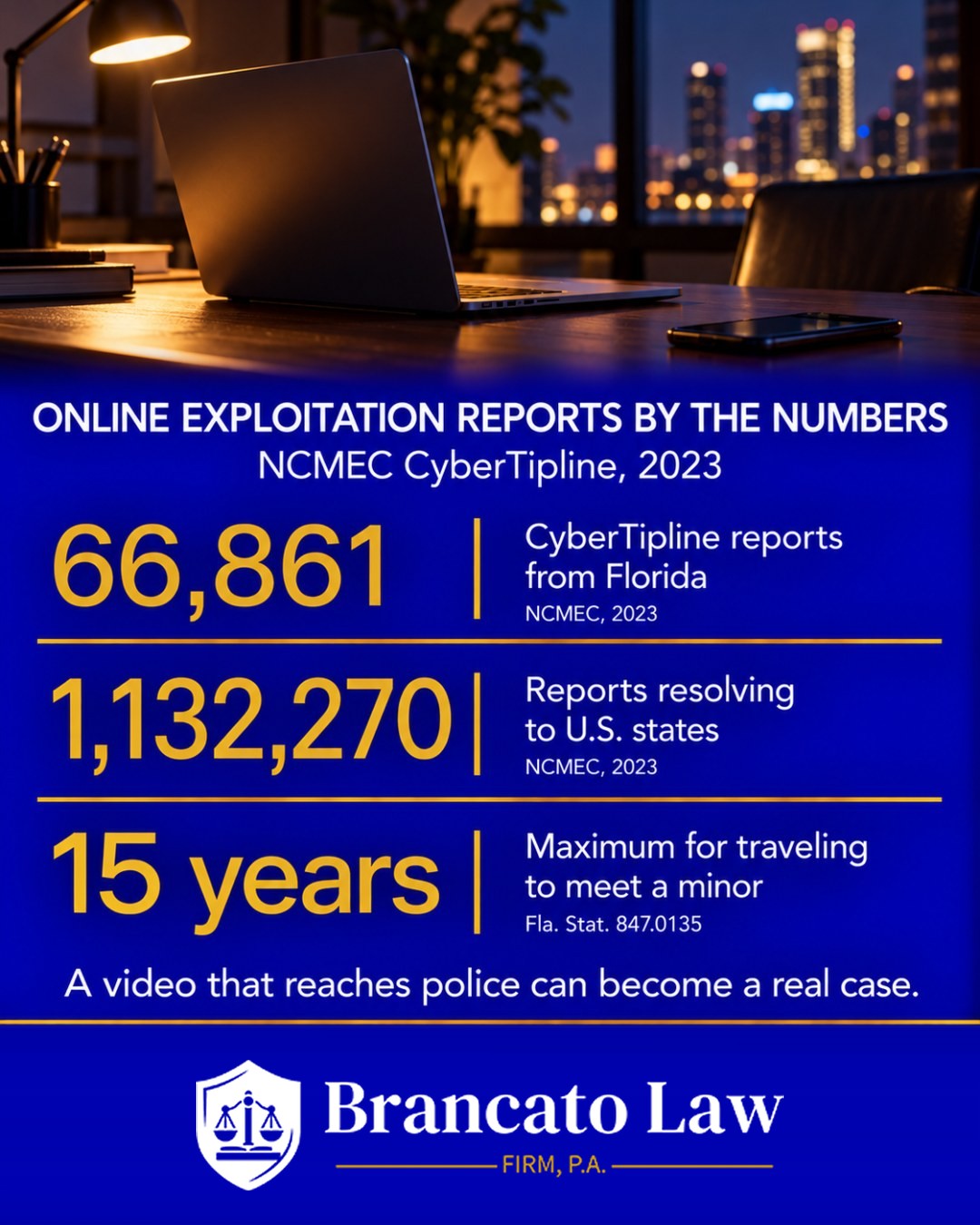
A great deal. Florida generated 66,861 CyberTipline reports to the National Center for Missing & Exploited Children in 2023, third among the states behind California and Texas, out of 1,132,270 reports resolving to U.S. states, according to NCMEC’s 2023 CyberTipline Reports by State. NCMEC makes those reports available to Internet Crimes Against Children task forces and other law enforcement.
That volume is why police in Tampa Bay run their own online stings, and why a vigilante video that reaches a detective can turn into a real investigation weeks after the confrontation.
What Should You Do If a Predator Catcher Group Confronted You?
- Do not argue on camera or explain. Anything you say becomes part of the video and can reach a prosecutor.
- Do not contact the group or pay anyone. Payment does not make a video disappear, and contact creates new evidence.
- Preserve your own records. Keep your phone, the app, and the full message history; do not delete accounts.
- Write down what happened during the confrontation, including any force, threats, or demands for money.
- Call a defense lawyer before police call you. Many of these cases are still investigations when people reach us.
Our representation before charges are filed can include contacting the detective and presenting the missing context to the State Attorney’s Office before a charging decision. In Hillsborough County, those decisions are made by the State Attorney’s Office for the 13th Judicial Circuit; our Hillsborough County criminal defense attorney page explains the local process.
Frequently Asked Questions About Vigilante Predator Catchers in Florida
Can I be arrested based on a predator catcher video?
Yes. Police can investigate and file charges based on footage, chat logs, or a tip from a group, and the State can use that material if it can authenticate it. The Brancato Law Firm demands the complete records behind the video; see our Tampa sex crimes lawyer page.
What if the group never called the police?
You are not necessarily in the clear, because a viral video or a viewer’s tip can start an investigation later. Our attorneys at The Brancato Law Firm often step in during that window, before any arrest.
Is it a crime if the “child” was really an adult?
It can be, because sections 847.0135(3) and (4) cover “another person believed by the person to be a child.” The Brancato Law Firm focuses on what the accused actually believed, using the full chat record; our traveling to meet a minor guide has more.
Can vigilantes record me without my consent in Florida?
Often yes, because Florida’s wiretap law protects an oral communication only when it is made with an expectation of privacy “under circumstances justifying such expectation” under section 934.02(2), Florida Statutes, so video in a public parking lot is rarely barred, although force, threats, and extortion can still be crimes. Our attorneys at The Brancato Law Firm review how every recording was made and what was cut from it.
Do these groups have to preserve the evidence?
No, private groups have no duty to preserve evidence the way police do, which is why missing messages and edited footage are often the heart of the defense. The Brancato Law Firm subpoenas platform records directly; our internet crimes defense page explains how.
Can a predator catcher sting lead to human trafficking charges?
Usually not, since most of these cases are charged as solicitation or traveling to meet a minor, but the charge depends on what was said about money and other people. The Brancato Law Firm reviews the exact allegations; see our human trafficking defense guide.
Talk to a Tampa Defense Attorney Before the Video Becomes a Case
If a group confronted you, posted a video of you, or demanded money, call The Brancato Law Firm, P.A., founded by Tampa Criminal Defense Attorney Rocky Brancato, at (813) 727-7159 before you speak with anyone else. We may be able to keep the matter from becoming an arrest, and if charges come, we start building the defense from the full record. You can call us at any hour, confidentially. Our firm has Spanish-speaking staff, and attorney Jean-Luc Adrien speaks Spanish, Haitian Creole, and French. Read our guide for Spanish-speaking criminal defense clients in Tampa.
For more about our defense strategies, visit our Tampa Sex Crimes Lawyer page.
The Brancato Law Firm, P.A.
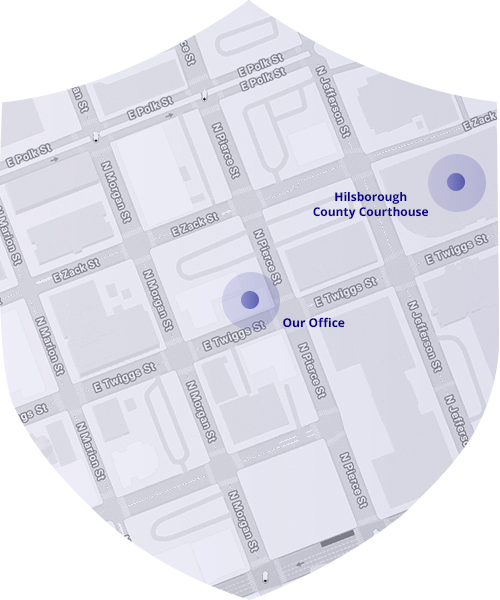
620 E. Twiggs Street, Suite 205, Tampa, FL 33602
(813) 727-7159
Serving Hillsborough, Pinellas, and Pasco Counties
The Brancato Law Firm, P.A. is a Tampa-based criminal defense practice. We are not affiliated with any other Brancato-named law firms.
Visit Us

Tampa, FL 33602
Contact Us Now
Free Legal Consultation (813) 727-7159