- Free Consultation 24/7: (813) 727-7159 Tap Here To Call Us


From First DUI to Death Penalty



Google Account Legal Request in Florida: What to Do (2026)



Fully rewritten and updated October 26, 2026.
A Google account legal request notice means a police agency or prosecutor used a subpoena, court order, or search warrant to get information about your account, and Google has already responded or is about to. These notices are usually real, not phishing, and they often arrive weeks or months after the data was handed over because a court delayed the notice. Do not contact the agency, delete anything, or talk about the notice with anyone but a lawyer. A defense attorney can identify the agency and case, find out whether you are a target or a witness, and try to stop charges before they are filed.
If you opened an email from Google saying it received legal process about your account, an investigation has already reached your data, and what you do in the next few days matters. I’m Rocky Brancato, founder of The Brancato Law Firm, P.A., a Tampa criminal defense firm, and in more than 25 years in Hillsborough County courtrooms, including my years in the Major Crimes Unit, I have seen how many serious cases begin with a subpoena to a tech company. Today our attorneys take these notices from the other side: we call the agency, learn what it wants, and work to keep the case from ever being filed.
What Does a Google Legal Process Notice Mean?
It means a government agency served Google with legal process for information tied to your account, and Google is telling you about it. Google’s published policy on how it handles government requests for user information says it emails the user before disclosing information unless the law prohibits notice, the account is disabled or hijacked, or an emergency, such as a threat to a child’s safety, justifies waiting. When the gag order or emergency ends, Google sends the notice.
That last point explains why many notices arrive late. The data may have been produced long before you heard about it. Other companies, including Apple, Microsoft, Meta, and Amazon, send similar notices under their own policies.
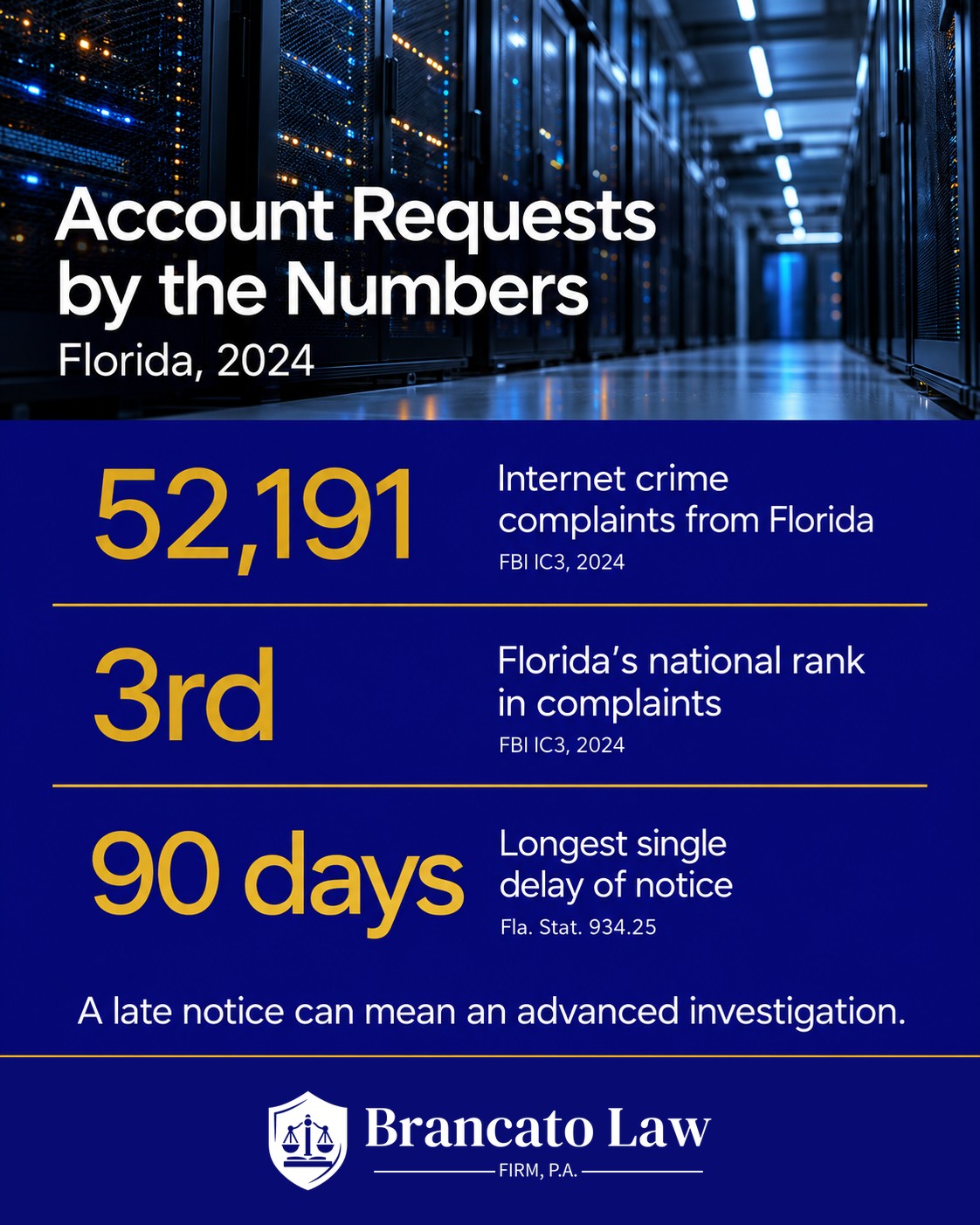
Florida law follows the same pattern. Under section 934.25, Florida Statutes, officers can delay notice to a subscriber for up to 90 days at a time, with 90-day extensions, if notice might lead to flight, destroyed evidence, witness intimidation, danger to someone’s safety, or a seriously jeopardized investigation. A court can also order the provider not to tell anyone for “such period as the court deems appropriate.” The federal version, 18 U.S.C. § 2705, works the same way for federal agencies.
| What the notice says or suggests | What it usually means |
|---|---|
| Google “received” a request | Legal process was served; Google may not have produced data yet |
| Google “responded” or disclosed information | Data has already been turned over |
| A court order previously barred notice | A judge delayed notice, often for 90 days or more |
| An agency name and case number | The investigating agency and its internal case file |
| No agency named | Federal or sealed process; the attorney has to find the source |
Is a Google Legal Request Email a Scam?
Usually not, but verify it without clicking anything. Real notices come from Google’s own domain and name an agency or court, while fake ones ask for passwords, payment, or a phone call to a number in the email. Sign in to your Google account directly through a browser, not through a link, and do not reply to the message. Then forward the notice to your attorney, who can confirm it with the agency.
What Legal Process Can Police Use to Get Your Google Data?
The type of legal process depends on what the government wants. Under section 934.23, Florida Statutes, a Florida officer can get basic subscriber records with a subpoena: your name, address, session times, length of service, payment method, and assigned IP addresses. Officers who get records this way do not have to notify you at all. Recent stored content, such as emails held 180 days or less, requires a warrant from a judge.
Google’s policy tracks the same tiers for U.S. requests: a subpoena for basic subscriber information and certain IP addresses, a court order for other non-content records in criminal cases, and a search warrant for content. Professor Orin Kerr’s widely cited article, “A User’s Guide to the Stored Communications Act, and a Legislator’s Guide to Amending It,” 72 Geo. Wash. L. Rev. 1208 (2004), explains how this tiered system lets the government get more data with less judicial review when it asks for records instead of content.
| Legal process | Who approves it | What it can reach |
|---|---|---|
| Subpoena | Prosecutor or agency, no judge | Name, address, IP and session logs, payment method |
| Court order (section 934.23(5) or 18 U.S.C. § 2703(d)) | Judge, on “specific and articulable facts” | Non-content records such as login history and contacts |
| Search warrant | Judge, on probable cause | Emails, photos, Drive files, location history, messages |
| Preservation request | Agency, no judge | Freezes your data for later legal process |
Courts have pushed the warrant line outward. In United States v. Warshak, 631 F.3d 266 (6th Cir. 2010), a federal fraud case, the Sixth Circuit held that the government “may not compel a commercial ISP to turn over the contents of a subscriber’s emails without first obtaining a warrant based on probable cause.” In Carpenter v. United States, 585 U.S. 296 (2018), the U.S. Supreme Court required a warrant for historical cell site location records. When the State skipped a required warrant, our attorneys file a motion to suppress.
Why Would Police Want Your Google Account?
Police want an account because it holds evidence about someone, and that someone is not always the account owner. Account requests usually fall into a few groups:
- Child exploitation tips. Providers scan uploads and report suspected child sexual abuse material to the National Center for Missing and Exploited Children, which routes the tip to local police.
- Fraud and scams. Account, payment, and login records are central to wire fraud, identity theft, and investment fraud cases.
- Threats, stalking, and harassment. Messages, posts, and IP logs can identify who sent them.
- Drug cases. Messages and location history can show transactions and meetings.
- Someone else’s conduct. A family member on your Wi-Fi, a hacked account, or contact with a suspect can put your account in the file.
Internet crime reports are heavy in Florida. The FBI Internet Crime Complaint Center 2024 report counted 52,191 complaints from Florida in 2024, the 3rd most of any state, with reported losses of $1,071,909,632. Each complaint is a possible subpoena to a tech company.
How Does an Account Request Turn Into an Arrest?
It usually follows a set path: a tip or complaint, a subpoena for subscriber information, a visit to the home, and then a search warrant. A Second District case from nearby Manatee County shows each step. In State v. McNeela, No. 2D2022-1418 (Fla. 2d DCA June 21, 2023), Microsoft reported suspected child pornography uploaded from a Sarasota IP address. A detective subpoenaed the internet provider, which returned the account holder’s name, phone number, and address. Officers went to the house, the man told them he was the computer’s primary user, and he consented to a search. The court reversed an order suppressing the evidence and held that those facts were enough for a search warrant.
The lesson is about the knock on the door. The subpoena gave police a name and address. The conversation and the consent gave them the rest. A lawyer who is already on the case before that visit can tell the agency that you will not be interviewed and will not consent to a search.
What Should You Do After Getting a Google Legal Request Notice?
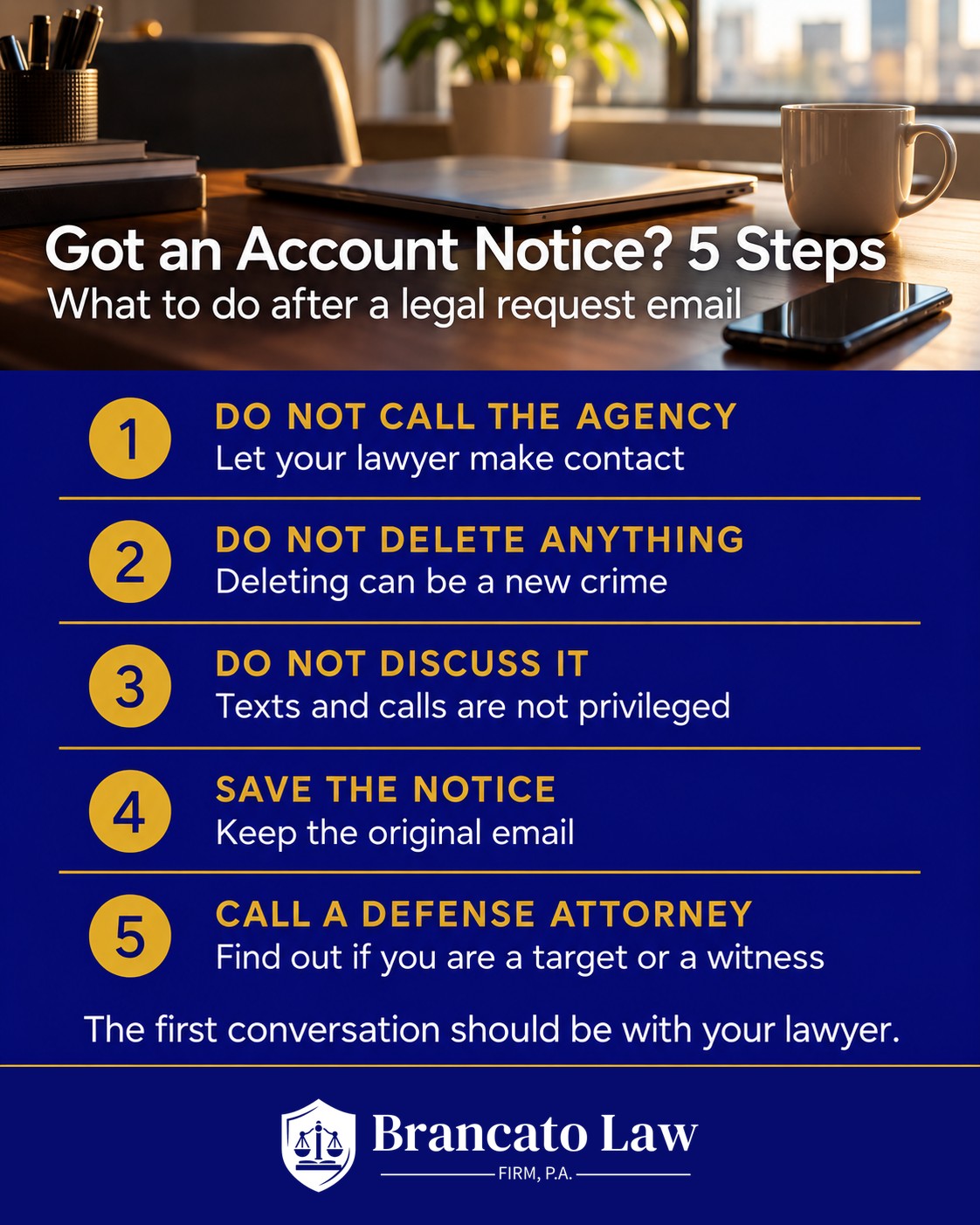
Take five steps, in this order:
- Do not contact the agency yourself. Anything you say can be used to build probable cause, and calling to “clear it up” is how many cases are made.
- Do not delete data or the account. Deleting can be charged as tampering with evidence, and the provider has often preserved a copy already.
- Do not discuss the notice. Texts, emails, and calls with friends or family are not privileged and can be subpoenaed too.
- Save the notice and secure your devices. Keep the original email, change passwords on shared devices, and note who else uses your Wi-Fi or accounts.
- Call a defense attorney. Your lawyer can contact the agency, learn whether you are a target or a witness, and speak for you from that point forward.
How Can a Lawyer Help Before Charges Are Filed?
A lawyer can often learn what the investigation is about and stop it from growing. Our attorneys contact the investigating agency directly and tell it that you are represented, so detectives must go through us and cannot question you on your doorstep. We work to find out which agency served the process, what data it got, whether the case is open or closed, and whether you are a suspect or a witness. Some clients learn they were only a witness, and that answer alone ends weeks of worry.
When the risk is real, we advocate with investigators and the prosecutor before a filing decision is made. Our firm offers this representation before charges are filed for a separate flat fee, and that fee is credited toward the full defense fee if a case is later filed and you keep us on it. If the request involves an online sex offense, our Tampa internet crimes attorney page explains how we defend those cases.
How Soon Should You Act on an Account Notice?
Act right away, within days. Because notice can be delayed for months, the investigation may be far along when the email arrives, and the next step could be a search warrant for your home. In Hillsborough, Pinellas, and Pasco Counties, our attorneys contact the investigating detective as soon as we know the agency, because an early call is the best chance to shape what happens next. Our Hillsborough County criminal defense attorneys handle these calls with HCSO, Tampa PD, and federal agencies.
For more on how digital evidence is gathered and challenged, see our posts on social media evidence in Tampa criminal cases and cell phone location evidence, and our guide to geofence warrants and the Chatrie case.
Frequently Asked Questions
Does a Google legal process notice mean I am being charged with a crime?
No. A notice means an agency obtained or sought your data, not that a charge has been filed, and many people who get one are witnesses or account holders whose network someone else used. The Brancato Law Firm contacts the agency to find out where you stand, as described on our pre-file advocacy page.
Why did I get the notice months after Google gave police my data?
A court or a supervising officer probably delayed the notice, which Florida’s section 934.25 allows for up to 90 days at a time with extensions. Our attorneys at The Brancato Law Firm treat a late notice as a sign the investigation is advanced, because Google sends it only after the delay ends.
Can I ask Google or a court to stop the disclosure?
Sometimes, if the data has not yet been produced, a lawyer can ask the agency to narrow the request or move to quash process that is overbroad or lacks the required approval. The Brancato Law Firm reviews the process itself to see whether it met the requirements of section 934.23.
Should I delete my Google account after getting the notice?
No. Deleting data after you know about an investigation can lead to a separate charge for tampering with evidence, and the provider may have preserved a copy anyway. Our team at The Brancato Law Firm advises clients on what to keep and how to protect their devices without creating new problems.
What if someone else used my account or Wi-Fi?
Tell your lawyer, not the police. Shared devices, hacked accounts, and open networks are real explanations, but they must be supported with evidence such as login records and device data before they are raised. The Brancato Law Firm gathers that proof, and our Tampa internet crime defense attorneys use it when an account is wrongly tied to a client.
Can Google account charges be dropped in Florida if a case is filed?
Yes, a filed case can still be dropped. The State Attorney’s Office can decline to prosecute or later dismiss the case (a nolle prosequi) when the account evidence does not prove who used the account, or when the data was obtained without required legal process. The Brancato Law Firm presses those weaknesses with prosecutors and in a motion to suppress when the facts support it.
For how this fits into the rest of a case, see our guide to each stage of a Florida criminal case.
Talk to a Tampa Defense Attorney About an Account Notice
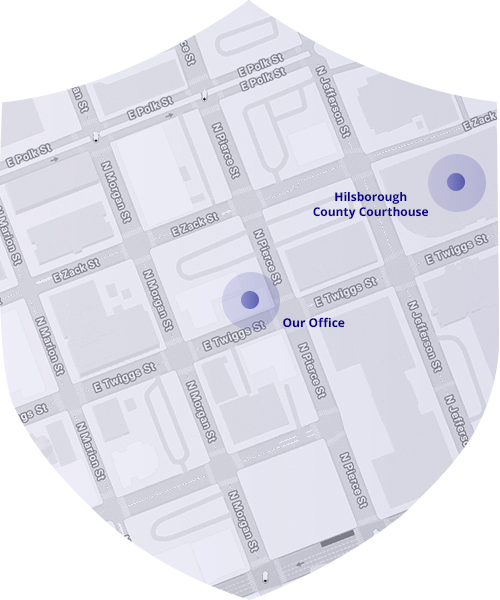
Before a detective knocks on your door, put a lawyer between you and the investigation. Our attorneys at The Brancato Law Firm, P.A., founded by Tampa Criminal Defense Attorney Rocky Brancato, will contact the agency, find out what it has, and speak for you from that point on. Call (813) 727-7159; you can call us at any hour, and our office is two blocks from the courthouse. Our firm has Spanish-speaking staff, and attorney Jean-Luc Adrien speaks Spanish, Haitian Creole, and French. Read our guide for Spanish-speaking criminal defense clients in Tampa.
For more about our defense strategies, visit our Tampa Internet Crimes Attorney page.
The Brancato Law Firm, P.A.
620 E. Twiggs Street, Suite 205, Tampa, FL 33602
(813) 727-7159
Serving Hillsborough, Pinellas, and Pasco Counties
The Brancato Law Firm, P.A. is a Tampa-based criminal defense practice. We are not affiliated with any other Brancato-named law firms.
This article is not affiliated with or endorsed by Google, Apple, Microsoft, Meta, or any law enforcement agency.
Visit Us

Tampa, FL 33602
Contact Us Now
Free Legal Consultation (813) 727-7159