- Free Consultation 24/7: (813) 727-7159 Tap Here To Call Us


From First DUI to Death Penalty



What Are Flock Cameras and License Plate Readers in Tampa? (2026 Florida Guide)


Updated November 7, 2026. Fully rewritten and updated October 23, 2026.
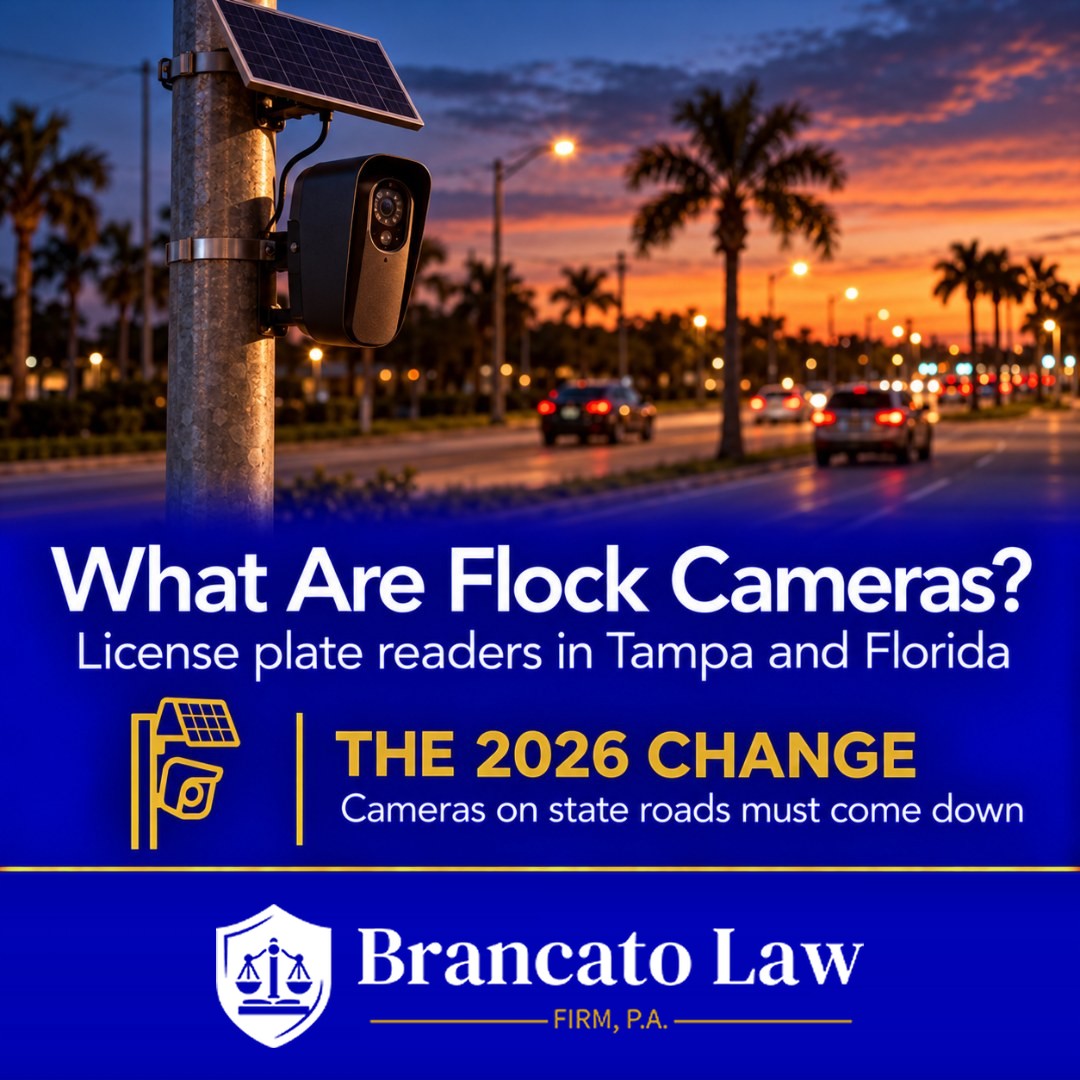
Flock cameras are automated license plate readers (ALPRs): small, usually solar-powered cameras that photograph passing vehicles, convert the license plate into searchable data, and record the car’s make, color, and other features. Police use the data two ways: real-time alerts when a plate matches a hotlist, and searches of where a car has been. Florida law allows ALPRs, but on August 31, 2026, the Florida Department of Transportation revoked every permit for law enforcement ALPRs on state highway rights-of-way, so cameras on state roads in Tampa Bay are coming down while cameras on city, county, and private property remain. A plate-reader hit can lead to a traffic stop, and that stop can be challenged.
If an officer stopped you in Tampa and mentioned a “hit” on your plate, a camera on a pole may have made the first decision in your case before any person did. I’m Rocky Brancato, founder of The Brancato Law Firm, P.A., a Tampa criminal defense firm, and a former police academy instructor who has spent more than 25 years in Hillsborough County courtrooms. I taught officers how stops are supposed to work, and our attorneys now use that training to test whether a plate-reader alert gave police a lawful reason to pull a car over.
What Is a Flock Camera?
A Flock camera is an automated license plate reader sold by Flock Safety, an Atlanta-based company that is one of the largest ALPR vendors in the country. Florida law, in section 316.0777, Florida Statutes, defines an automated license plate recognition system as one or more mobile or fixed high-speed cameras combined with computer algorithms that convert images of license plates into computer-readable data. Flock’s version also records the vehicle’s make, color, and distinguishing features such as roof racks or bumper stickers, which Flock markets as a “Vehicle Fingerprint.”
The cameras take still photographs of the rear of passing cars, not continuous video of drivers. Each read is time-stamped and stored in a database that the agency that owns the camera can search, and agencies can choose to share access with other agencies. The Brancato Law Firm treats every ALPR read in a case as evidence with a source, a time stamp, and an error rate that can be tested.
| Feature | What it means for drivers |
|---|---|
| Plate read | The camera converts the plate into text and checks it against hotlists |
| Vehicle description | Make, color, and visible features are recorded with the plate |
| Real-time alert | A match to a stolen-car, warrant, or BOLO list can notify nearby officers |
| Historical search | Investigators can look up where and when a car passed earlier |
| Retention | Florida caps storage through a state retention schedule; agencies set shorter periods |
| Speed | Flock ALPRs do not measure speed; school-zone speed cameras are separate systems |
Does Florida Have Flock Cameras, and Are They Legal?
Yes. ALPRs, including Flock cameras, are legal in Florida, and law enforcement agencies, cities, homeowners associations, and businesses across Tampa Bay use them. Section 316.0777(2)(b) lets the Department of Transportation, at its discretion, allow a law enforcement agency to install an ALPR in the right-of-way of a state highway for the purpose of collecting active criminal intelligence or investigative information. The same statute says an ALPR may not be used to issue a traffic citation or notice of violation, and that a camera must come down within 30 days after the department tells the agency to remove it.
The department used that power on August 31, 2026. FDOT Engineering and Operations Memorandum No. 26-01 revoked every approval for law enforcement ALPRs on state highway rights-of-way, gave agencies 30 days to remove them, and stopped issuing new permits. The memo cited “the recent exponential increase in deployments” and “concerning reports of misuse, data privacy concerns, and surveillance schemes.” The order does not reach cameras on city or county roads, private property, or HOA entrances, so many Flock cameras in Hillsborough, Pinellas, and Pasco Counties remain in place. Our attorneys at The Brancato Law Firm check where the camera in a client’s case was mounted and whether its permit was valid on the date of the read.
Are There Flock Cameras in Tampa, Hillsborough, Pinellas, and Pasco?
Yes. All three counties’ largest law enforcement agencies have used license plate readers, and each responded differently to the state order. In September 2026, the Tampa Police Department said it would remove 17 cameras on the State Highway System and reported that its readers had aided in 622 arrests, recovered 485 vehicles and 68 firearms, and helped in 14 missing persons cases, according to WUSF reporting on the removals. The Pasco County Sheriff’s Office said it was removing all 70 of its Flock cameras in county and state rights-of-way. The Hillsborough County Sheriff’s Office declined to say how many cameras had to come down, citing a public records exemption.
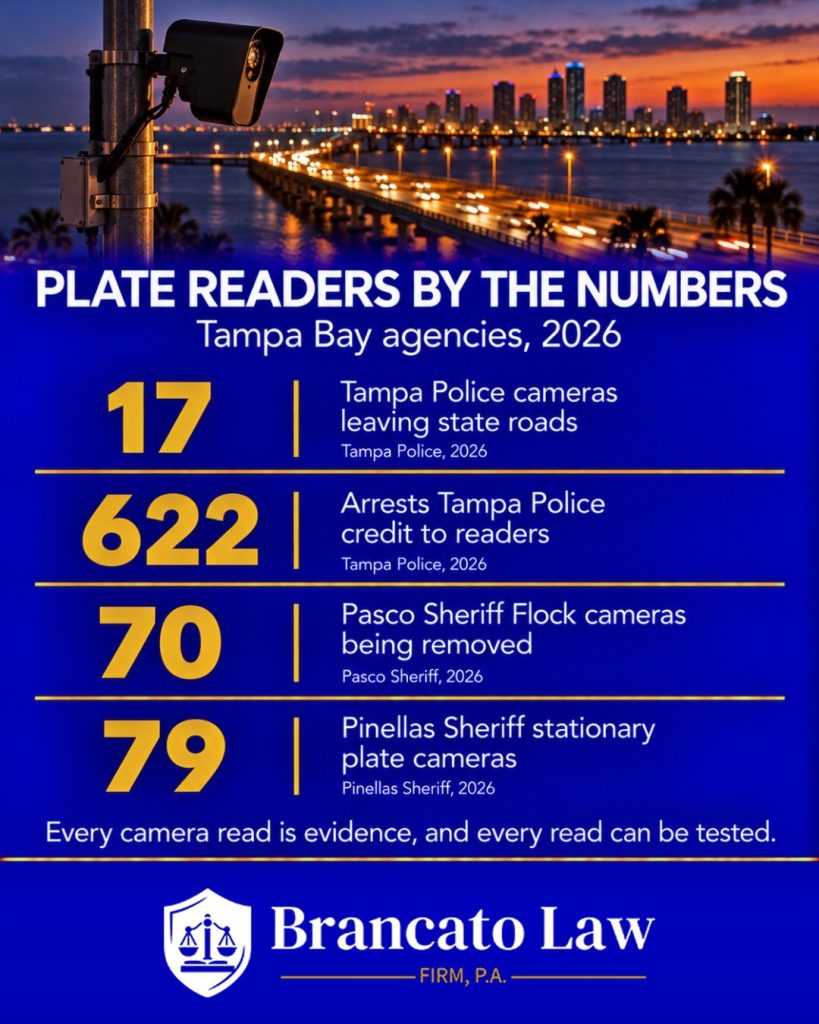
In Pinellas County, Sheriff Bob Gualtieri told county commissioners in October 2026 that his office runs 79 stationary cameras under a Flock contract costing $287,000 a year, according to Bay News 9. That presentation came about a week after a former Pinellas deputy was arrested on felony charges for allegedly running a license plate reader database about 300 times to track a woman. Prosecutors dropped that deputy’s charges on October 29, 2026, and on November 5, 2026, a third former Pinellas deputy, Ronald Scott, was arrested after an agency audit found more than 100 unauthorized Flock and driver’s license searches on his estranged wife and her circle. Our separate guide on whether police can be charged for misusing Flock cameras in Florida covers that side of the issue.
These agency figures describe what the cameras find, and they leave out what defense lawyers see. In a 2019 study published in Police Quarterly, George Mason University researchers Christopher Koper and Cynthia Lum examined a city that installed nearly 100 fixed readers and found that clearances for auto theft and robbery improved, but the improvements were not statistically significant once other factors were controlled (National Criminal Justice Reference Service abstract). A camera network produces many reads; each read still has to be connected to the right car, the right driver, and the right moment.
Can a Flock Camera Hit Lead to a Traffic Stop and Arrest in Tampa?
Yes. A plate-reader alert can lead to a stop, but the officer must still have reasonable suspicion that the specific car or driver is involved in a crime or traffic violation. Florida’s stop law, section 901.151, Florida Statutes, and the Fourth Amendment both require it. The usual sequence in Hillsborough County looks like this:
- The camera reads a plate and the system matches it to a hotlist entry, such as a stolen vehicle, a warrant, or a be-on-the-lookout alert.
- Nearby officers receive the alert with the read’s location, time, and photo.
- An officer finds the car and decides whether to stop it.
- During the stop, the officer may find a suspended license, drugs, a weapon, or a warrant, and that is where most criminal cases start.
Kansas v. Glover: what a database check can and cannot justify
In Kansas v. Glover, 589 U.S. 376 (2020), a Kansas deputy ran a pickup’s plate, learned the registered owner’s license was revoked, and stopped the truck without seeing any traffic violation. The U.S. Supreme Court held the stop was lawful because it was reasonable to infer that the owner was driving, and the deputy had no information suggesting otherwise. The Court stressed that its holding was narrow: if the officer knows facts that undercut the inference, such as an owner in his mid-sixties and a driver who looks to be in her mid-twenties, the database result alone does not justify the stop. Our attorneys look for those facts in the body-camera video.
State v. Teamer: a mismatch in the database is not enough by itself
In State v. Teamer, 151 So. 3d 421 (Fla. 2014), a deputy ran a plate and saw that the registration listed a different color than the car in front of him. The Florida Supreme Court held that the color discrepancy alone did not give reasonable suspicion for a stop, because it is not illegal in Florida to repaint a car without telling the state, and ordered the defendant discharged. Flock’s “Vehicle Fingerprint” records the same kind of color and feature data, so Teamer gives our attorneys a Florida Supreme Court rule for stops based on a description mismatch in the system.
These cases matter at more than one stage. A stop that lacked reasonable suspicion can be challenged with a motion to suppress before trial, and if the motion succeeds, the drugs, weapon, or statements found after the stop can be excluded. For impaired-driving arrests that began with a plate-reader alert, our Tampa DUI lawyer page explains how the stop is evaluated with the rest of the case.
Is a License Plate Scan a Search Under the Fourth Amendment?
Usually not. Courts have generally held that photographing a license plate on a public road is not a Fourth Amendment search, because the plate is displayed for anyone to see. The harder question is what happens when police search weeks of stored reads to reconstruct where a person drove, and no Florida appellate decision we have found resolves that question for ALPR databases.
The guidepost is Carpenter v. United States, 585 U.S. 296 (2018). The Supreme Court held that obtaining 127 days of historical cell-site location records was a search that generally requires a warrant, because the records gave an all-encompassing picture of the person’s movements. The Court called its decision narrow and said it was not calling into question conventional surveillance tools such as security cameras. Defense lawyers nationwide argue that a dense ALPR network can approach the tracking Carpenter described; prosecutors answer that scattered plate photos are closer to a security camera. The Brancato Law Firm raises the argument when the State’s case depends on a long history of reads rather than a single alert.
Historical searches are already being used as trial evidence in Florida. In Mathis v. State, No. 4D2024-1543 (Fla. 4th DCA Apr. 8, 2026), a Broward County second-degree murder case, license plate readers in Lighthouse Point captured the defendant’s car following the victim’s van into the city and leaving about six minutes later, and the reader database showed the car had never been in Lighthouse Point before. The Fourth District affirmed the conviction, relying on that evidence along with DNA, video, and phone records. The case shows how an ALPR history becomes part of a circumstantial case, which is why our attorneys demand the full search log, not just the reads the State chose to print.
Who Can See Flock Camera Data, and How Long Is It Kept?
In Florida, ALPR images and data that contain personal identifying information are confidential and exempt from public records requests under section 316.0777(3). The statute allows the information to be shared with criminal justice agencies performing their official duties, and it gives one important right to drivers: information relating to a license plate registered to you may be disclosed to you, unless it is active criminal intelligence or active criminal investigative information. The Brancato Law Firm uses that provision, along with criminal discovery, to obtain the reads of a client’s own plate.
Retention is capped by section 316.0778, Florida Statutes, which directs the Department of State, in consultation with the Florida Department of Law Enforcement, to set a maximum retention period by schedule. Agencies often keep data for much less. Flock’s long-standing default was 30 days, and on August 13, 2026, Flock’s CEO announced that the company recommends agencies cut retention to seven days, according to WECT reporting. A shorter retention period means a defense request has to go out fast, before the reads that help a client are deleted.
| Question | Florida answer |
|---|---|
| Can the public get ALPR records? | Images and data with personal identifying information are confidential and exempt (s. 316.0777(3)) |
| Can police share the data? | Yes, with criminal justice agencies performing official duties (s. 316.0777(4)(a)) |
| Can I get the reads of my own plate? | Yes, unless the information is active criminal intelligence or investigative information (s. 316.0777(4)(b)) |
| How long can it be kept? | No longer than the maximum in the state retention schedule (ss. 316.0777(2)(d), 316.0778) |
| Can an ALPR issue a traffic ticket? | No, an ALPR on a state highway may not be used to issue a citation or notice of violation (s. 316.0777(2)(b)) |
Do Flock Cameras Record Speed or Share Data With ICE?
Flock license plate readers do not measure speed. School-zone speed cameras are a separate system governed by section 316.1896, Florida Statutes, which bars using those cameras for remote surveillance, limits their photos and video to school-zone speeding enforcement and incidents captured along the way, and requires the images to be destroyed within 90 days after final disposition. Tampa’s school-zone program uses RedSpeed cameras, and Tampa police told the City Council in July 2026 that the cameras will not include license plate readers or share data with Flock, according to the Pineapple Report.
On immigration, Flock says it does not contract directly with U.S. Immigration and Customs Enforcement, but local agencies can share the data they collect. Suncoast Searchlight reported in 2025 that the Florida Highway Patrol ran more than 250 immigration-related searches of the Flock network between March 13 and May 5, 2025 (WUSF republication). If a family member was stopped and questioned about immigration status, our attorneys defend the criminal case and coordinate with immigration counsel on the immigration side. Our firm has Spanish-speaking staff, and attorney Jean-Luc Adrien speaks Spanish, Haitian Creole, and French, so families can talk through what happened in their own language.
How Do Our Attorneys Challenge License Plate Reader Evidence?
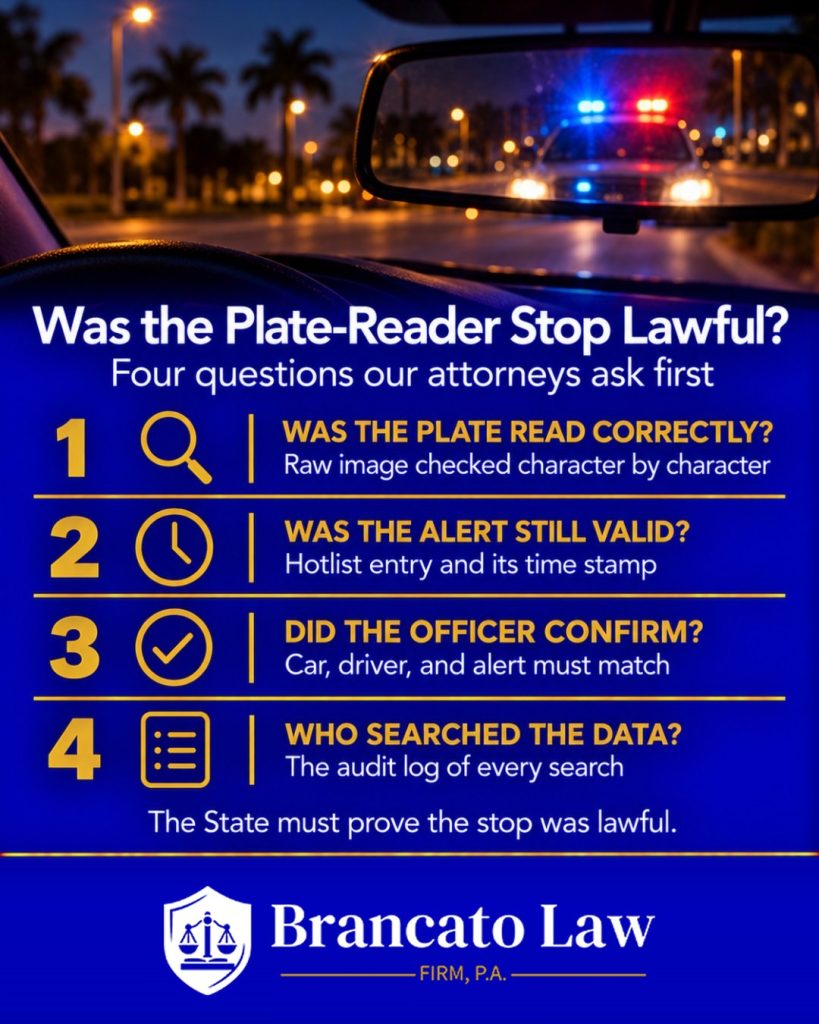
Our attorneys challenge ALPR evidence by testing the read, the alert, the stop, and the data trail, in that order. These are the questions we answer first:
- Was the plate read correctly? We obtain the raw image and compare every character. Plate-reading software can confuse similar characters, and a misread can send officers after the wrong car.
- Was the alert still valid? We obtain the hotlist entry and its time stamp. A stolen car that was recovered or a warrant that was cleared can stay on a list after it should have been removed.
- Did the officer confirm before stopping? Under Glover and Teamer, we look at what the officer saw: whether the car, the driver, and the alert actually matched.
- Was the camera lawfully placed? After FDOT Memorandum No. 26-01, a camera still operating on a state right-of-way after the removal deadline is a fact worth litigating.
- Who searched the data, and why? We request the audit log of searches on the client’s plate, which can reveal fishing expeditions or misuse.
- Was the data preserved? We send preservation requests early, because short retention periods can erase reads that support the defense.
Drug, weapon, and stolen-vehicle cases often begin with a plate-reader stop, and our Tampa drug crimes attorney page describes how we defend the charges that follow. When someone learns that investigators are pulling plate-reader history before any arrest, our representation before charges are filed can address the investigation directly.
What Should You Do If Police Stop You Because of a License Plate Reader?
Stay calm, do not argue about the camera at the roadside, and protect the record. The stop itself is where the strongest defenses are built, so details matter:
- Ask, calmly, why you were stopped, and remember the officer’s exact words about a “hit” or “alert.”
- Do not consent to a search of your car; you can say so politely.
- Do not answer questions about where you have been; the reads already tell police where the car went.
- Write down the time, the street, and the direction you were driving as soon as you can.
- Call a defense attorney quickly so preservation requests go out before the data is deleted.
Frequently Asked Questions About Flock Cameras in Florida
Are Flock cameras being removed from Florida roads?
Yes, Flock and other law enforcement license plate readers on state highway rights-of-way had to come down within 30 days of the FDOT memorandum issued August 31, 2026. The Brancato Law Firm checks whether the camera in a client’s case sat on a state, county, city, or private site, because only state rights-of-way were covered.
Who pays for Flock cameras in Tampa Bay?
Taxpayers pay for law enforcement cameras through agency contracts, and HOAs or businesses pay for the cameras they buy. Our attorneys at The Brancato Law Firm request the contract and sharing settings in cases where a private camera fed an alert to police, as with the Pinellas Sheriff’s $287,000-a-year Flock contract reported in October 2026.
Can police use a Flock camera to give me a speeding or red-light ticket?
No, an ALPR installed on a state highway may not be used to issue a traffic citation or notice of violation under section 316.0777. The Brancato Law Firm separates camera-based school-zone and red-light tickets, which have their own statutes, from criminal stops that start with a plate-reader alert; see our Hillsborough County criminal defense attorney page for the criminal side.
Can I find out whether a Flock camera recorded my car?
Often yes, because section 316.0777(4)(b) allows information about a plate registered to you to be disclosed to you unless it is active criminal intelligence or investigative information. When a client is charged, The Brancato Law Firm obtains those reads through discovery, which reaches more than a public records request.
Can a license plate reader stop be thrown out in Florida?
Yes, if the officer lacked reasonable suspicion for the specific car and driver, the evidence from the stop can be suppressed. Our attorneys at The Brancato Law Firm build those motions around the raw image, the hotlist time stamp, and the body-camera video, using Teamer and Glover as the framework, including in St. Petersburg and Clearwater cases covered on our Pinellas County criminal defense page.
Are Flock cameras the same as police misusing the database?
No, using the cameras is legal, but searching the database for personal reasons can be a crime for the officer who does it. The Brancato Law Firm explains those charges in our guide to police misuse of Flock cameras in Florida.
For how The Brancato Law Firm, P.A. defends these cases, see our Tampa internet crimes defense practice.
Talk to a Tampa Defense Attorney About a License Plate Reader Stop
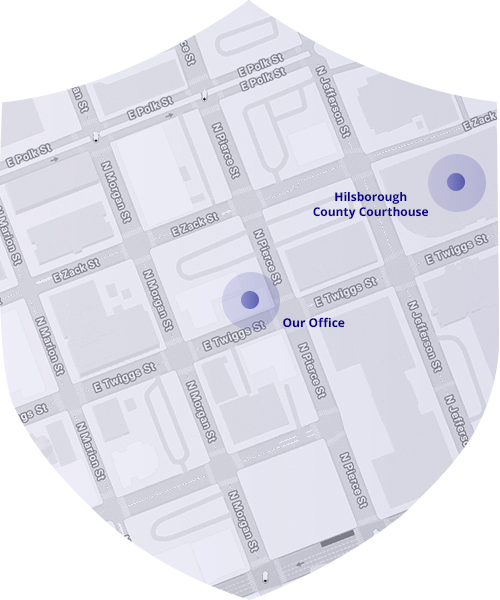
Write down where and when you were stopped, then call us before the reads are deleted. The Brancato Law Firm, P.A., founded by Tampa Criminal Defense Attorney Rocky Brancato, can be reached at (813) 727-7159, and our attorneys will start by requesting the raw image, the alert record, and the search log for your plate. Call us at any hour; our office is two blocks from the courthouse. Our firm has Spanish-speaking staff, and attorney Jean-Luc Adrien speaks Spanish, Haitian Creole, and French.
For more about our defense strategies, visit our Tampa DUI Lawyer page.
The Brancato Law Firm, P.A.
620 E. Twiggs Street, Suite 205, Tampa, FL 33602
(813) 727-7159
Serving Hillsborough, Pinellas, and Pasco Counties
The Brancato Law Firm, P.A. is a Tampa-based criminal defense practice. We are not affiliated with any other Brancato-named law firms.
Visit Us
Tampa, FL 33602
Contact Us Now
Free Legal Consultation (813) 727-7159