Strategic Defense,
From First DUI to Death Penalty
From First DUI to Death Penalty





| Short answer: A Tampa drug crimes attorney defends charges for drug possession, possession with intent, sale and delivery, prescription fraud, and drug trafficking. In Florida, simple possession of most controlled substances is a third-degree felony with no mandatory prison, but trafficking is charged by weight alone and carries mandatory minimum prison terms from 3 years to life. The Brancato Law Firm, P.A. attacks the search, the proof of possession, and the lab weight, and pursues pretrial intervention and drug court when the case fits. |
Drug cases are won or lost on how the evidence was found. Rocky Brancato, founder of The Brancato Law Firm, P.A., has tried more than 150 jury trials to verdict, including not guilty verdicts on cocaine trafficking and on sale of cocaine near a church. Our attorneys at this Tampa criminal defense firm start every drug case with the stop, the search, and the lab report, because a suppressed search or a short weight can change a mandatory prison case into a dismissal.
Florida drug crimes are graded by the type of drug, the amount, and whether the State says it was for sale, under § 893.13. Maximum penalties for each level come from § 775.082.
| Charge | Florida law | Level | Maximum penalty |
|---|---|---|---|
| Possession of cannabis, 20 grams or less | § 893.13(6)(b) | First-degree misdemeanor | 1 year in jail |
| Possession of a controlled substance (cocaine, fentanyl, pills without a prescription, cannabis over 20 grams) | § 893.13(6)(a) | Third-degree felony | 5 years in prison |
| Possession of drug paraphernalia | § 893.147 | First-degree misdemeanor | 1 year in jail |
| Sale, delivery, or possession with intent: cocaine, heroin, fentanyl, and similar drugs | § 893.13(1)(a)1 | Second-degree felony | 15 years in prison |
| Sale, delivery, or possession with intent: cannabis and most other drugs | § 893.13(1)(a)2 | Third-degree felony | 5 years in prison |
| Sale or possession with intent within 1,000 feet of a school, park, church, or other listed place | § 893.13(1)(c), (e) | First-degree felony for cocaine, heroin, fentanyl, and similar drugs, with a 3-year minimum near a school or park | 30 years in prison |
| Obtaining a controlled substance by fraud or a forged prescription | § 893.13(7)(a) | Third-degree felony | 5 years in prison |
| Trafficking | § 893.135 | First-degree felony (life felony at the top tiers) | Mandatory minimum by weight; see the next table |
The 1,000-foot enhancement applies only during certain hours for schools and to specific listed places, and the State has to prove the distance. In one of our cases, a client charged with sale of a controlled substance near a church had the enhancement dropped. Our article on when marijuana possession is a felony in Florida covers cannabis charges in more detail.
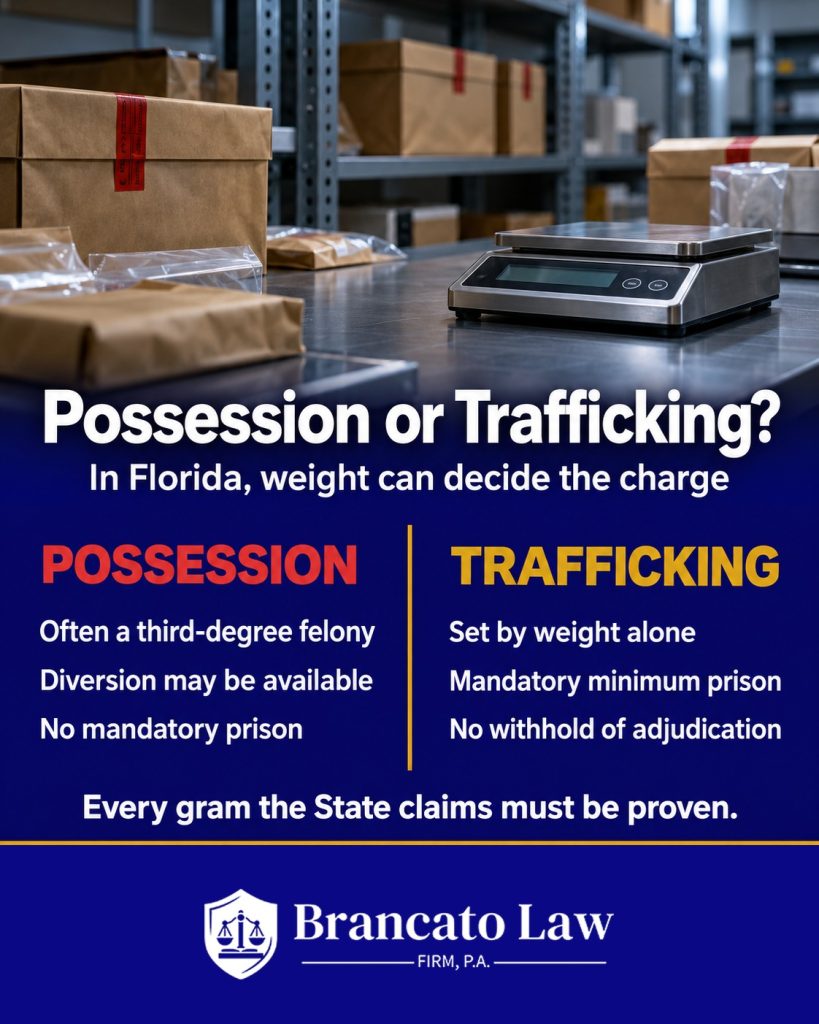
The difference between drug possession and drug trafficking in Florida is weight. Under § 893.135, a person who possesses, sells, buys, manufactures, or brings into Florida a listed drug above a set weight is charged with trafficking, even with no evidence of sales. The weight includes the entire mixture, not just the pure drug, so cutting agents and packaging residue can push a case over a threshold. Trafficking carries mandatory minimum prison terms and fines, and the judge cannot withhold adjudication or go below the minimum unless the prosecutor moves for a reduction based on substantial assistance.
| Drug | Weight | Mandatory minimum | Mandatory fine |
|---|---|---|---|
| Cannabis | Over 25 lb (or 300 plants) to under 2,000 lb | 3 years | $25,000 |
| Cannabis | 2,000 lb to under 10,000 lb | 7 years | $50,000 |
| Cannabis | 10,000 lb or more | 15 years | $200,000 |
| Cocaine | 28 g to under 200 g | 3 years | $50,000 |
| Cocaine | 200 g to under 400 g | 7 years | $100,000 |
| Cocaine | 400 g to under 150 kg | 15 years | $250,000 |
| Fentanyl | 4 g to under 14 g | 7 years | $50,000 |
| Fentanyl | 14 g to under 28 g | 20 years | $100,000 |
| Fentanyl | 28 g or more | 25 years | $500,000 |
| Heroin, morphine, or opium | 4 g to under 14 g | 3 years | $50,000 |
| Heroin, morphine, or opium | 14 g to under 28 g | 15 years | $100,000 |
| Heroin, morphine, or opium | 28 g to under 30 kg | 25 years | $500,000 |
| Oxycodone | 7 g to under 14 g | 3 years | $50,000 |
| Oxycodone | 14 g to under 25 g | 7 years | $100,000 |
| Oxycodone | 25 g to under 100 g | 15 years | $500,000 |
| Oxycodone | 100 g to under 30 kg | 25 years | $750,000 |
| Hydrocodone | 28 g to under 50 g | 3 years | $50,000 |
| Hydrocodone | 50 g to under 100 g | 7 years | $100,000 |
| Hydrocodone | 100 g to under 300 g | 15 years | $500,000 |
| Methamphetamine | 14 g to under 28 g | 3 years | $50,000 |
| Methamphetamine | 28 g to under 200 g | 7 years | $100,000 |
| Methamphetamine | 200 g or more | 15 years | $250,000 |
| MDMA (ecstasy) | 10 g to under 200 g | 3 years | $50,000 |
| MDMA (ecstasy) | 200 g to under 400 g | 7 years | $100,000 |
| MDMA (ecstasy) | 400 g or more | 15 years | $250,000 |
| Xylazine (effective October 1, 2026) | 28 g to under 100 g | 3 years | $50,000 |
| Xylazine (effective October 1, 2026) | 100 g to under 200 g | 7 years | $100,000 |
| Xylazine (effective October 1, 2026) | 200 g or more | 25 years | $500,000 |
Larger amounts carry higher minimums, up to life in prison for 150 kilograms or more of cocaine or 30 kilograms or more of heroin. Fentanyl is a leading cause of overdose deaths in our area: the Medical Examiner for Hillsborough County reported 236 deaths caused by fentanyl in 2024, according to the FDLE Medical Examiners Commission 2024 drug report. Read our guides to drug trafficking in Florida and how to defend against a fentanyl trafficking charge.
Florida drug cases are usually won at one of four points: the search, the proof of possession, the lab testing, or the proof that the person knew what the substance was. Our attorneys look at all four in every case.
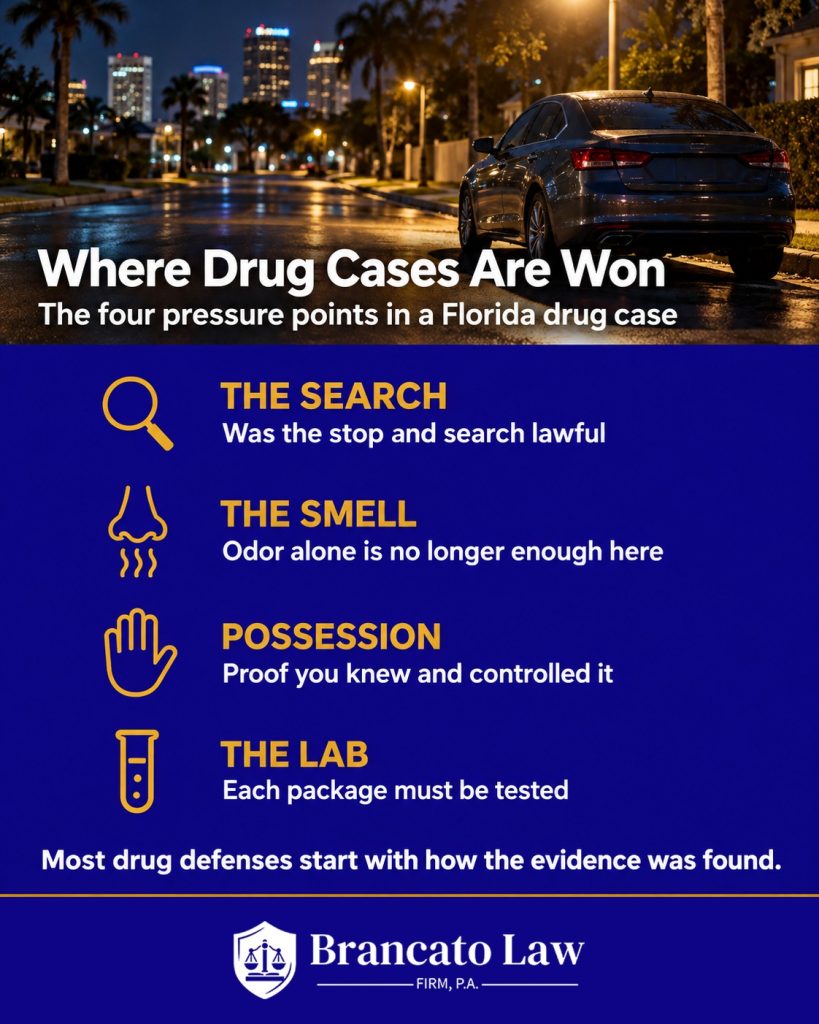
Most drug evidence comes from a traffic stop or a search, and evidence found in an unlawful search can be suppressed. The smell of marijuana used to be enough for police to search a car. In Williams v. State, 421 So. 3d 809 (Fla. 2d DCA 2025) (en banc), the appeals court that covers Hillsborough, Pinellas, and Pasco Counties held that the odor of cannabis alone no longer gives police probable cause to search, because hemp and medical marijuana smell the same as illegal cannabis. The court certified the question to the Florida Supreme Court, so the law could change, but for now it applies in our courts. See our articles on the plain-smell decision and motions to suppress evidence.
When drugs are found in a shared car or home rather than in someone’s hand or pocket, the State must prove constructive possession: that the person knew the drugs were there and had the ability and intent to control them. Being near drugs is not enough. In Melton v. State, 317 So. 3d 292 (Fla. 2d DCA 2021), the court explained that when a place is jointly occupied, the State needs independent proof of knowledge and control beyond the person’s presence. Read more about constructive possession in Florida.
The State must prove the substance is what it says it is and weighs what it says. Field tests used at the roadside are not reliable proof. A 2024 report by the Quattrone Center for the Fair Administration of Justice at the University of Pennsylvania estimated that roughly 30,000 people a year are arrested in the United States based in part on false positive field drug tests. For trafficking, each package counted toward the weight generally must be tested. In Greenwade v. State, 124 So. 3d 215 (Fla. 2013), the Florida Supreme Court held that the State could not prove trafficking weight when the lab tested only some of the packets, and in Campbell v. State, 407 So. 3d 558 (Fla. 2d DCA 2025), the court applied the same rule to cannabis. See what happens when you are charged with the wrong drug. Our guide on how to fight a drug charge in Florida before it is filed walks through each of these lab problems, the 2025 deadlines for filing charges, and real Florida cases where vitamins and doughnut glaze tested positive on a field kit.
Under § 893.101, lack of knowledge of the illicit nature of a substance is an affirmative defense. When the defense raises it, the jury is told it may infer knowledge from possession, but the defense can present evidence that the person did not know what the substance was, such as a package delivered for someone else or a pill bottle that belonged to a family member.
Yes, many first-time and low-level drug cases can be resolved without a conviction through pretrial intervention or drug court. Under § 948.08(6), a person charged with a felony for drug possession or purchase who has no more than 2 prior nonviolent felony convictions can be admitted to a drug pretrial intervention program, and when the program is completed the charges are dismissed. Misdemeanor drug charges can be diverted under § 948.16. In Hillsborough County, felony drug court is handled in a dedicated division under Thirteenth Judicial Circuit Administrative Order S-2026-002. Charges that allege sales are generally not eligible, which is why the defense often has to show the facts point to personal use. Read more about mitigation reports and downward departures for cases that do not qualify.
Medical marijuana is legal in Florida only for registered patients buying from a licensed treatment center, under § 381.986, and only in the form and amount the patient is allowed. Smoking it in public, giving it to someone else, or carrying it outside its original packaging can still lead to a charge. Hemp products with no more than 0.3 percent delta-9 THC are regulated under § 581.217. A change in federal law that narrows the definition of hemp takes effect November 12, 2026, and may affect delta-8 and other THC products sold in Florida. A medical marijuana card also does not protect gun ownership under federal law. See medical marijuana transportation laws and whether you can own a gun if you use marijuana.
These are results our firm has obtained. Every case is different, and past results do not guarantee future outcomes.
See more on our case results page.
Yes. Drug charges are dropped when the search was unlawful, the State cannot prove possession, the lab results do not match the charge, or the person completes pretrial intervention. The Brancato Law Firm has had fentanyl trafficking, cocaine, and possession charges dropped or never filed; see our case results.
Fentanyl trafficking carries a 7-year minimum for 4 to 14 grams, 20 years for 14 to 28 grams, and 25 years for 28 grams or more, under § 893.135(1)(c)4. Our attorneys at The Brancato Law Firm challenge the weight, the lab testing, and the search in every fentanyl case.
Yes. Possession of any amount of cocaine is a third-degree felony under § 893.13(6)(a), with a maximum of 5 years in prison and no mandatory minimum. The Brancato Law Firm often resolves first-time possession cases through drug pretrial intervention, which ends in a dismissal.
Not based on smell alone. Under Williams v. State, decided by the Second District Court of Appeal in 2025, the odor of cannabis by itself does not give police probable cause to search a car in Hillsborough, Pinellas, or Pasco County, though the question is pending in the Florida Supreme Court. The Brancato Law Firm files motions to suppress when a search rests on odor; read about the plain-smell decision.
Constructive possession means the State says you controlled drugs that were not on your person, such as drugs in a car console or a bedroom. The State must prove you knew the drugs were there and could control them, and the attorneys at The Brancato Law Firm often win these cases by showing others had equal access.
Often yes. A person charged with drug possession who has no more than 2 prior nonviolent felonies can usually be admitted to drug pretrial intervention under § 948.08(6), and the charges are dismissed after the program is completed. The Brancato Law Firm evaluates eligibility early, because sales allegations and prior records can affect admission.
A drug charge, especially a trafficking charge, can carry years of mandatory prison, and the first decisions in the case are often the most important. Our attorneys at The Brancato Law Firm, P.A., founded by Tampa Criminal Defense Attorney Rocky Brancato, can review the arrest and the search today. Call (813) 727-7159 for a confidential consultation. Our firm also defends gun charges that often come with drug cases, and drug DUI cases across Hillsborough, Pinellas, and Pasco Counties.
Trial attorney Jean-Luc Adrien speaks Spanish, Haitian Creole, and French, and our office has Spanish-speaking staff, so clients and families can talk through a drug charge in their own language. See our guide for Spanish and Haitian Creole speakers facing criminal charges in Tampa.
The Brancato Law Firm, P.A.
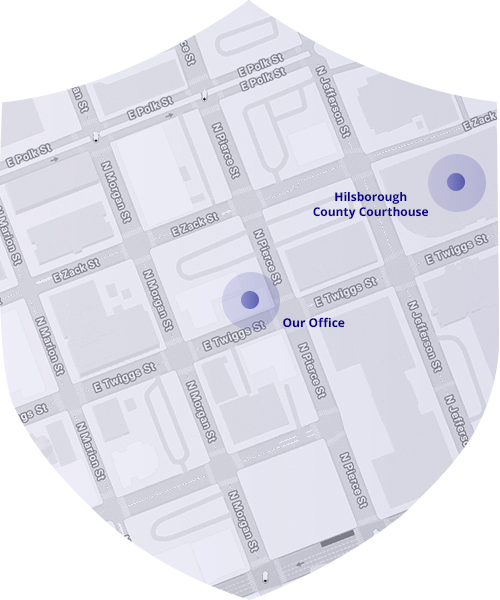
620 E. Twiggs Street, Suite 205, Tampa, FL 33602
(813) 727-7159
Serving Hillsborough, Pinellas, and Pasco Counties

The Brancato Law Firm, P.A. is a Tampa-based criminal defense practice. We are not affiliated with any other Brancato-named law firms.
This page is for informational purposes only and does not constitute legal advice. Each case is unique, and outcomes depend on the individual facts and circumstances involved. Past results do not guarantee future outcomes.
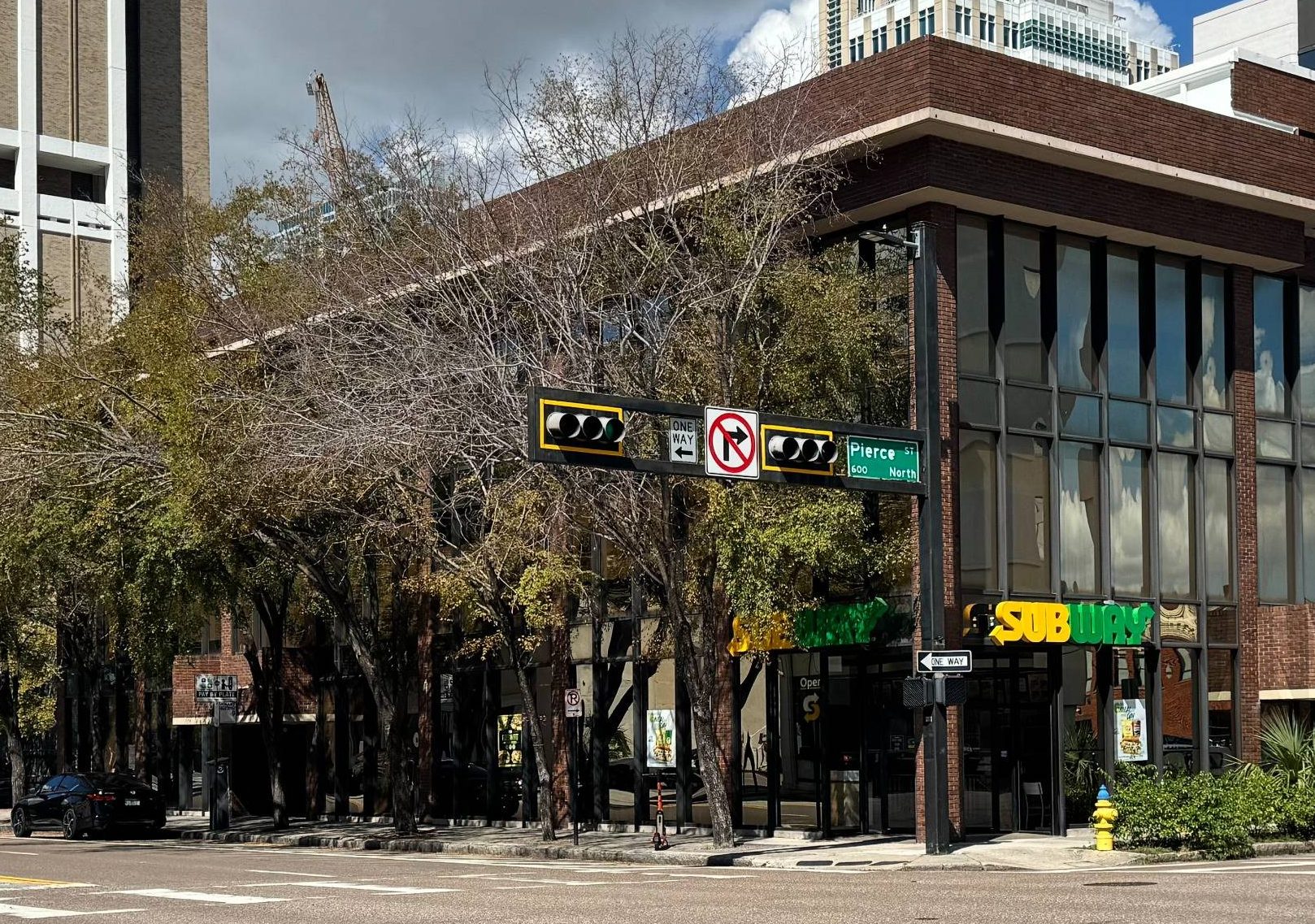
Tampa, FL 33602
Free Legal Consultation (813) 727-7159