- Free Consultation 24/7: (813) 727-7159 Tap Here To Call Us


From First DUI to Death Penalty



How Much Weed Is a Felony in Florida? Marijuana and THC Possession Laws (2026)


Fully rewritten and updated October 23, 2026.
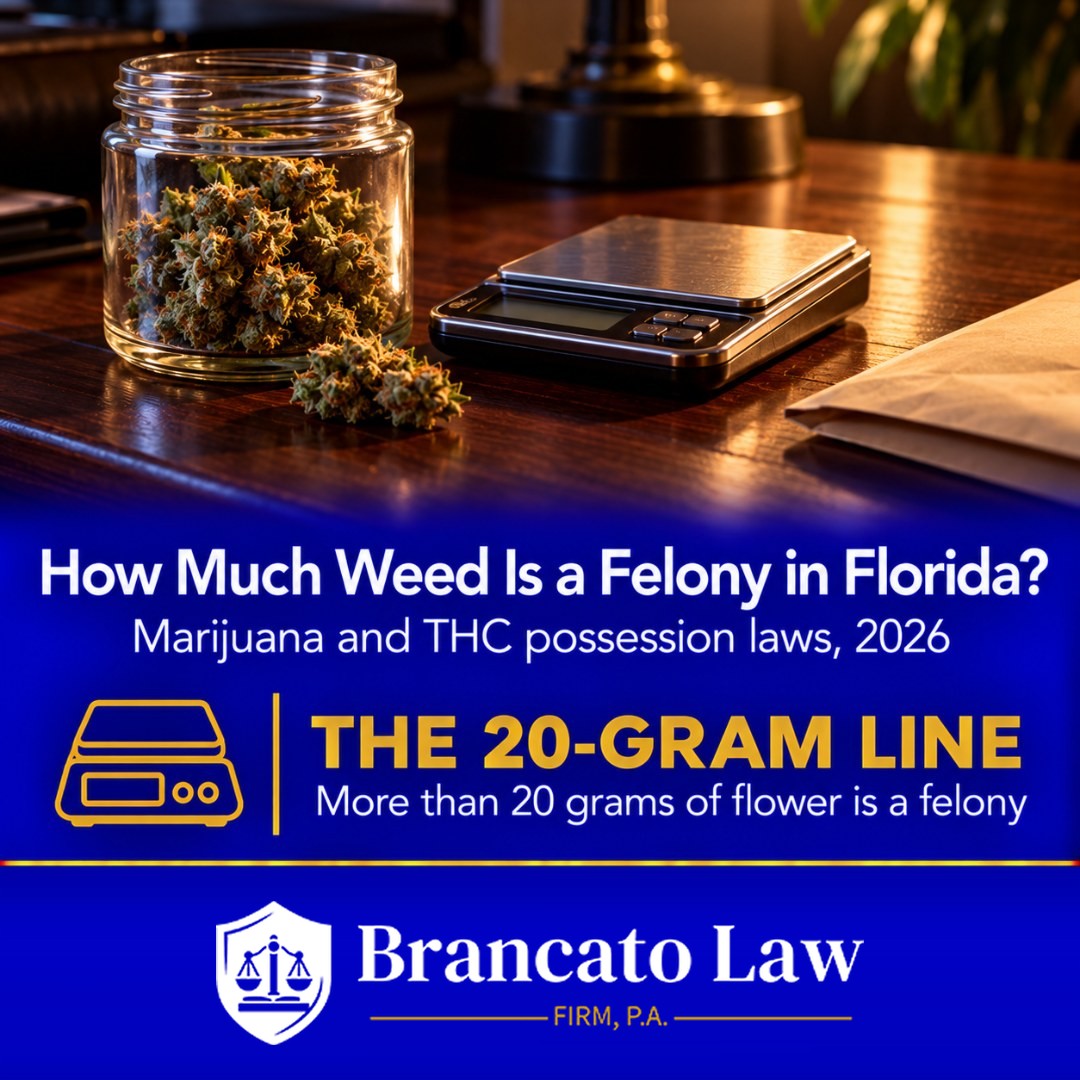
In Florida, possessing more than 20 grams of marijuana flower is a third-degree felony, punishable by up to 5 years in prison and a $5,000 fine. Twenty grams or less is a first-degree misdemeanor, up to 1 year in jail and a $1,000 fine. THC concentrates such as wax, hash, and many vape oils are felonies at any weight, and more than 25 pounds is trafficking with a mandatory prison term. Recreational marijuana remains illegal in 2026, and in Hillsborough, Pinellas, and Pasco Counties the odor of cannabis alone no longer gives police probable cause to search.
If officers found marijuana in your car, your bag, or your apartment, the charge on your paperwork turns on details most people never think about: the weight, whether it was flower or concentrate, and whether a lab ever proved it was marijuana and not hemp. I’m Rocky Brancato, founder of The Brancato Law Firm, P.A., a Tampa criminal defense firm, and a former Chief Operations Officer of the Hillsborough County Public Defender’s Office, where I oversaw a staff of over 100 attorneys. Our attorneys defend marijuana and THC cases across Hillsborough, Pinellas, and Pasco Counties, and in many of them the most useful work happens before the State Attorney’s Office decides what to file.
How Much Weed Is a Felony in Florida?
More than 20 grams of cannabis flower is a felony. Under section 893.13(6)(b), Florida Statutes, “If the offense is the possession of 20 grams or less of cannabis, as defined in this chapter, the person commits a misdemeanor of the first degree.” Anything above that falls under section 893.13(6)(a), which makes unauthorized possession of a controlled substance a third-degree felony. Twenty grams is about seven-tenths of an ounce, so the exact lab weight matters.
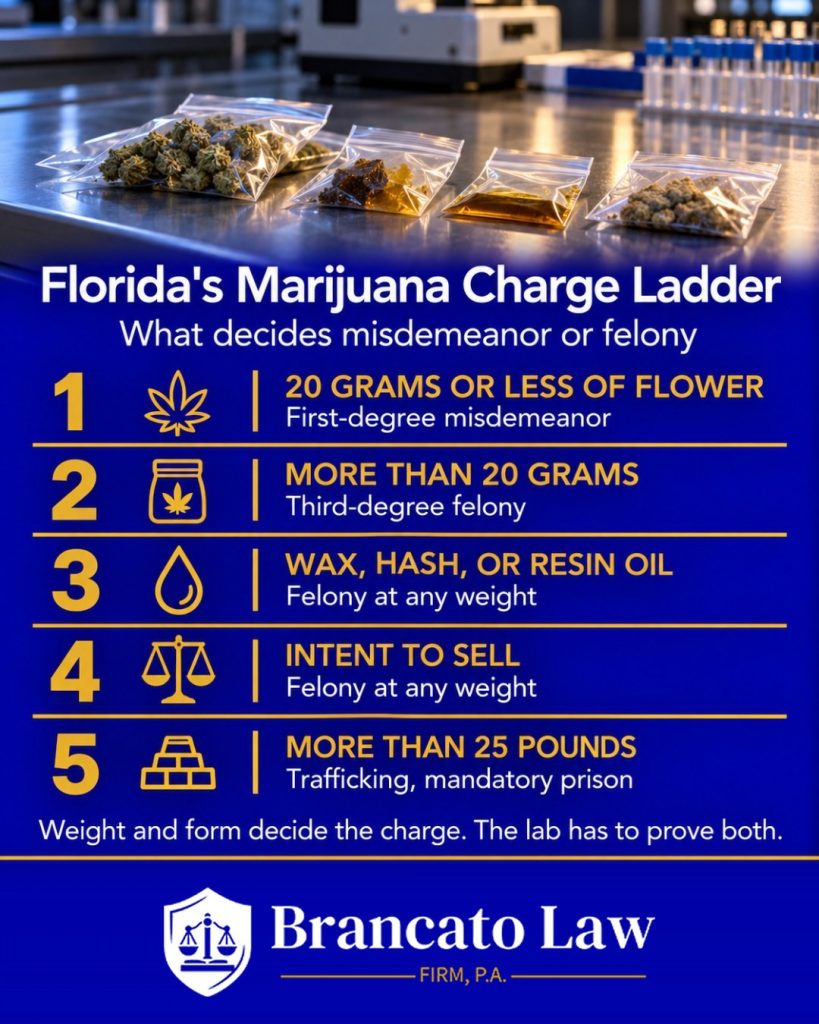
The charge climbs in steps, from a misdemeanor for a small amount of flower to trafficking above 25 pounds.
| What was found | Charge | Maximum penalty |
|---|---|---|
| 20 grams or less of cannabis flower | First-degree misdemeanor | 1 year in jail, $1,000 fine |
| Giving away 20 grams or less, with no payment | First-degree misdemeanor | 1 year in jail, $1,000 fine |
| More than 20 grams of flower | Third-degree felony | 5 years in prison, $5,000 fine |
| Resin, hash, wax, or oil made from resin, any amount | Third-degree felony | 5 years in prison, $5,000 fine |
| Any amount with intent to sell, manufacture, or deliver | Third-degree felony | 5 years in prison, $5,000 fine |
| More than 25 pounds, or 300 or more plants | Trafficking, first-degree felony | 3-year mandatory minimum and $25,000 fine, up to 30 years |
Maximum terms come from section 775.082 and section 775.083, Florida Statutes. Our Tampa drug crimes attorney team first checks whether the State charged the right step.
Is THC Illegal in Florida?
THC from marijuana is illegal without a medical marijuana card, while THC within the legal hemp limit is not. Cannabis is a Schedule I substance under section 893.03(1)(c), Florida Statutes, which also lists tetrahydrocannabinols separately. Section 893.02(3) defines cannabis to include “the resin extracted from any part of the plant,” but excludes marijuana dispensed in conformance with the medical marijuana law and “hemp as defined in s. 581.217.”
That is why “possession of tetrahydrocannabinols” or “possession of THC” is such a common charge description. It is the charge prosecutors use for vape cartridges, oils, edibles, and concentrates, and it is usually filed as a third-degree felony under section 893.13(6)(a).
Why Is a THC Vape or Concentrate Usually Charged as a Felony?
Because the 20-gram misdemeanor does not cover resin. Section 893.13(6)(b) states that for the misdemeanor, “the term ‘cannabis’ does not include the resin extracted from the plants of the genus Cannabis, or any compound manufacture, salt, derivative, mixture, or preparation of such resin.” Wax, shatter, hash, and resin oils are therefore felonies at any weight.
The State still has to prove where the THC came from. In State v. Stevenson, 307 So. 3d 784 (Fla. 4th DCA 2020), a Broward County man was charged with a felony for three THC vape cartridges with a total gross weight of 14.04 grams. The State’s chemist could not say whether the THC was resin-derived or synthetic. The Fourth District held he “could be charged with a felony only if the State could make a prima facie showing that the source of the THC substance possessed by the defendant was either artificially produced, cannabis resin, or ‘any compound manufacture, salt, derivative, mixture, or preparation of such resin,'” and affirmed dismissal of the felony with leave to refile it as a misdemeanor. Our attorneys at The Brancato Law Firm raise Stevenson in vape and edible cases where the lab report is silent about the source.
Can the State Prove It Was Marijuana and Not Hemp?
Only with chemical testing. Under section 581.217, Florida Statutes, hemp is cannabis with “a total delta-9-tetrahydrocannabinol concentration that does not exceed 0.3 percent on a dry-weight basis,” and hemp-derived cannabinoids “are not controlled substances or adulterants” when they comply with the section.
The Second District applied that rule to a Hillsborough County case in Campbell v. State, 407 So. 3d 558 (Fla. 2d DCA 2025). Detectives at Tampa International Airport seized two duffle bags holding 50 vacuum-sealed bundles, and the FDLE analyst tested one 24.47-gram sample. The court held that “Legal hemp and illegal cannabis are indistinguishable by appearance, texture, and odor, such that chemical testing to determine the THC content is now needed to avoid misidentification.” When the State counts several packages toward a trafficking weight, it “must chemically test each packet.” The court reversed the trafficking conviction and ordered entry of felony possession instead.
An officer’s description of “green leafy material” is not proof of THC concentration. Our attorneys at The Brancato Law Firm demand the lab report and check exactly which items were tested.
Can Police Search Your Car Because They Smell Marijuana?
Not on odor alone in Hillsborough, Pinellas, or Pasco County. In Williams v. State, 421 So. 3d 809 (Fla. 2d DCA 2025) (en banc), a Hillsborough County passenger was searched after officers stopped the car for an obstructed tag and a rolling stop and smelled cannabis. The full Second District held that “the plain smell doctrine can no longer establish probable cause based solely on the odor of cannabis,” though odor remains a factor in the totality of the circumstances. It receded from its own 2021 precedent to the extent that precedent held smell alone was enough.
Williams himself lost on the good-faith exception, because the officers had relied on the earlier precedent, and the court certified this question to the Florida Supreme Court: “DOES THE PLAIN SMELL DOCTRINE CONTINUE TO APPLY TO ESTABLISH PROBABLE CAUSE BASED ONLY ON THE ODOR OF CANNABIS?” The Fifth District reached a similar result first in Baxter v. State, 389 So. 3d 803 (Fla. 5th DCA 2024) (en banc), holding that “Unless and until the State demonstrates that illegal cannabis has an odor that is distinct from legal cannabis,” the justification for an odor-only detention “no longer exists.” The Sixth District, which covers Polk and southwest Florida, noted the debate in 2026 but did not decide it.
The issue comes up twice: in a motion to suppress before trial, and in the Campbell testing question at trial. Our post on the Second DCA limits on the plain smell doctrine covers the search issue in more depth.
Does a Medical Marijuana Card Protect You From a Possession Charge?
Only when you follow the rules. Under section 381.986, Florida Statutes, a qualified patient “may not possess more than a 70-day supply of marijuana, or the greater of 4 ounces of marijuana in a form for smoking” or an amount the department approves, and “all marijuana purchased must remain in its original packaging.”
The protection also ends outside “medical use.” A patient who buys from anyone other than a licensed medical marijuana treatment center “violates s. 893.13” under section 381.986(12)(d), and using marijuana other than low-THC cannabis in a vehicle or in public is a separate offense under section 381.986(12)(c). Carrying dispensary product in the car is allowed; using it there is not.
| Situation | Protected by the card? |
|---|---|
| Dispensary product in original packaging, within the supply limit | Yes |
| Marijuana bought from a friend or an unlicensed seller | No |
| Product moved into a different container | No |
| Smoking in a parked or moving car | No, and a separate offense |
Our attorneys at The Brancato Law Firm bring the patient’s certification, receipts, and packaging to the prosecutor early. Patients also face a federal firearm question, covered in our post on whether you can own a gun if you use marijuana in Florida, and the card is no defense to impaired driving, as our guide to marijuana DUI in Florida explains.
What If the Marijuana Was Not in Your Pocket?
Then the State has to prove constructive possession. Section 893.13(6)(a) reaches “actual or constructive possession,” which is how passengers, roommates, and drivers of borrowed cars end up charged. Our post on constructive possession in Florida explains how courts decide whether the State has tied the item to you, and our attorneys look closely at who else had access.
When Does Possession Become Intent to Sell or Trafficking?
Intent to sell is a third-degree felony at any weight. Under section 893.13(1)(a), a person “may not sell, manufacture, or deliver, or possess with intent to sell, manufacture, or deliver, a controlled substance,” and cannabis is in the third-degree group. Giving away 20 grams or less with no payment is a first-degree misdemeanor under section 893.13(3).
Trafficking starts above 25 pounds. Under section 893.135(1)(a), Florida Statutes, possession of “in excess of 25 pounds of cannabis, or 300 or more cannabis plants” is a first-degree felony with mandatory minimums.
| Amount | Mandatory minimum prison | Mandatory fine |
|---|---|---|
| More than 25 pounds to less than 2,000 pounds, or 300 to 2,000 plants | 3 years | $25,000 |
| 2,000 to less than 10,000 pounds, or 2,000 to 10,000 plants | 7 years | $50,000 |
| 10,000 pounds or more, or 10,000 or more plants | 15 calendar years | $200,000 |
A plant counts only if it has “some readily observable evidence of root formation, such as root hairs.” After Campbell, the State must also test each package it counts, so our attorneys attack the trafficking weight first.
Did Florida Legalize Recreational Marijuana?
No. Amendment 3, the 2024 adult personal use measure, received 5,950,589 yes votes, or 55.9%, according to the Florida Division of Elections official results. Constitutional amendments in Florida need 60%, so it failed. Hillsborough County voters approved it 382,243 to 277,062, but the statewide total controls.
A follow-up measure will not reach the 2026 ballot. After the Secretary of State directed county election officials to strike about 70,600 petition signatures, the First District upheld that direction and the Florida Supreme Court declined review in March 2026, Insurance Journal reported. Possession without a medical card is still a crime in 2026.
What Changes for Hemp on November 12, 2026?
The federal definition of hemp narrows on November 12, 2026. According to the Congressional Research Service report Change to Federal Definition of Hemp and Implications for Federal Enforcement (December 3, 2025), Public Law 119-37 moves the federal limit to a total THC concentration, excludes final hemp-derived cannabinoid products with “more than 0.4 milligrams of THC per container,” and excludes cannabinoids synthesized or manufactured outside the plant. “The new definition will take effect November 12, 2026.”
Florida’s hemp statute was last amended in 2023 and does not adopt the federal text, so state charges still turn on section 581.217 and its 0.3% delta-9 limit. Our attorneys at The Brancato Law Firm treat a hemp product’s label and certificate of analysis as evidence from the first day.
How Many Drug Arrests Happen in Hillsborough County?
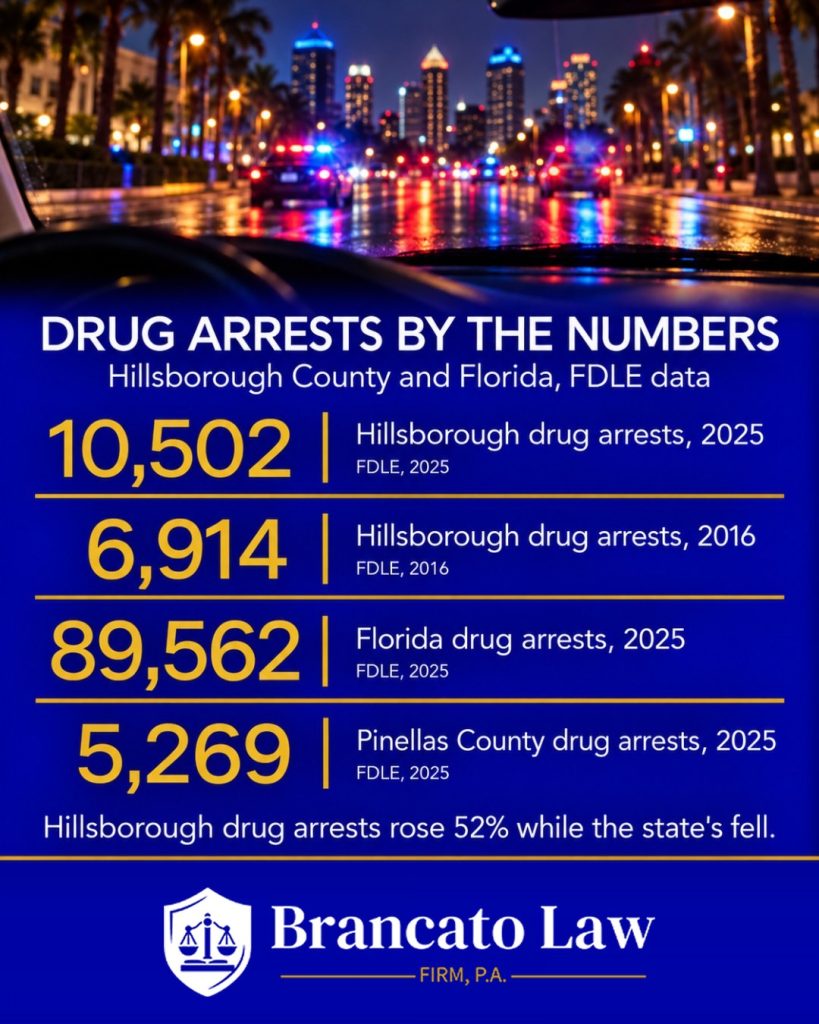
More than ten thousand a year. In 2025, Hillsborough County recorded 10,502 drug arrests, a rate of 666.5 per 100,000 residents, according to FDLE arrest data published by Florida Health CHARTS. That is up from 8,124 in 2024 and 6,914 in 2016, a 52% increase over nine years, while Florida’s statewide total fell from 103,461 in 2016 to 89,562 in 2025.
Pinellas County recorded 5,269 drug arrests and Pasco County 1,817 in 2025. These figures count arrests for all drug categories, since CHARTS does not separate marijuana, and they are arrests, not convictions.
How Do Our Attorneys Fight a Marijuana or THC Charge?
One element at a time:
- Challenge the search. If the stop or search rested on odor, we file a motion to suppress under Williams and Baxter.
- Demand lab proof. Under Campbell, the State needs chemical testing of THC content to tell marijuana from hemp, and it must test each package it counts toward a trafficking weight.
- Test the felony label. For vapes, edibles, and oils, we hold the State to Stevenson’s requirement that it prove a resin or synthetic source.
- Check the weight. A few grams decide whether the case is a misdemeanor or a felony.
- Contest possession. In shared cars and homes, we press the State to prove knowledge and control.
- Show medical compliance. A card, a receipt, and original packaging can end a case.
- Push for diversion or a no-file decision. Completing a program, or persuading the prosecutor not to file, ends the case without a conviction.
What Diversion Programs Are Available for Marijuana Charges in Hillsborough County?
Several, run through the State Attorney’s Office for the 13th Judicial Circuit, which lists them on its programs page. Its Drug Education and Treatment Reducing Recidivism program (DETRR) “is limited to drug possession cases for low-risk, non-violent offenders,” and a participant who completes the assigned treatment or education and stays arrest-free for six months has the possession charge dismissed.
The office also lists the Adult Pre-Arrest Diversion Program, established in Hillsborough County in July 2017 for people with minimal or no record who commit an eligible misdemeanor, under which no charges are filed if the program is completed; a Misdemeanor Intervention Program for first-time offenders; and Pretrial Intervention for “certain first-time felony offenders.” Our Hillsborough County criminal defense attorney team negotiates entry into these programs, and our representation before charges are filed can put the lab issues and the client’s record in front of the prosecutor before a charging decision.
What Should You Do After a Marijuana Arrest in Tampa?
Act before the first court date. A person arrested in Hillsborough County sees a judge at first appearance within 24 hours and is held at the Orient Road Jail until release, and the State Attorney’s Office then decides what to file. Four steps protect the case:
- Do not explain. Statements about whose bag it was are the State’s best evidence of possession.
- Do not consent to searches. Say so plainly to preserve the suppression issue.
- Keep your records. Save your medical card, receipts, hemp labels, and certificates of analysis.
- Call a lawyer early. Diversion and pre-file options are easiest to reach before the charging decision.
Frequently Asked Questions About Marijuana Possession in Florida
What happens for a first-time marijuana possession offense in Florida?
For 20 grams or less, a first offense is a first-degree misdemeanor punishable by up to a year in jail and a $1,000 fine, and in Hillsborough County many first-time cases qualify for diversion. The Brancato Law Firm checks eligibility for DETRR, pre-arrest diversion, and the Misdemeanor Intervention Program before anything else; see our drug crimes defense page.
Can marijuana possession charges be dropped in Florida?
Yes, through suppression, failed lab proof, or completion of a diversion program such as DETRR. The Brancato Law Firm often contacts the prosecutor before the filing decision through our pre-file advocacy work.
Is a THC vape cartridge a felony in Florida?
It is usually charged as one, because resin-derived THC is excluded from the 20-gram misdemeanor. Under State v. Stevenson, the State must show the THC came from resin or was synthetic, and our attorneys at The Brancato Law Firm hold the lab to that showing in every vape case.
Can police search my car in Florida if they smell weed?
Not on odor alone in Hillsborough, Pinellas, or Pasco County after Williams v. State, though odor can still count with other facts. The Brancato Law Firm reviews the body camera video to see what else the officers claimed, as our plain smell doctrine post explains.
Can I be charged with possession if I have a medical marijuana card?
Yes, if the marijuana did not come from a licensed treatment center, was out of its original packaging, or exceeded the supply limit. Our attorneys at The Brancato Law Firm gather the certification and receipts that show compliance and present them to the prosecutor.
Is hemp flower or delta-8 legal to carry in Florida in 2026?
Under Florida law, hemp within section 581.217’s 0.3% delta-9 THC limit is legal, though the federal definition narrows on November 12, 2026. The Brancato Law Firm treats the product’s label and certificate of analysis as defense evidence, and the Congressional Research Service report explains the federal change.
Talk to a Tampa Marijuana Defense Attorney
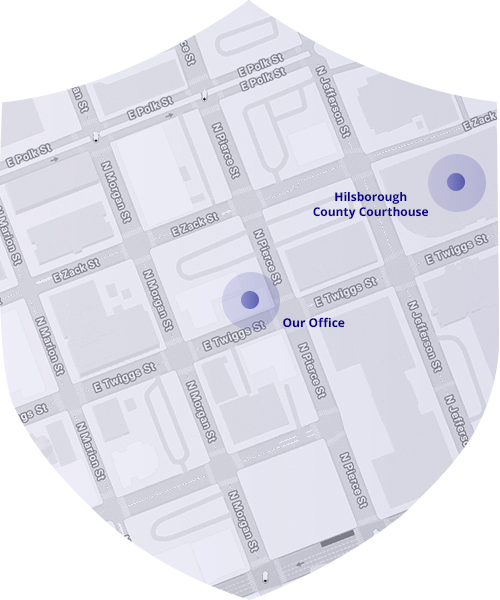
The best time to call is before the lab report comes back and the State makes its filing decision. The Brancato Law Firm, P.A., founded by Tampa Criminal Defense Attorney Rocky Brancato, will review the search, demand the lab testing, and press for diversion or dismissal. Call (813) 727-7159 for a free, confidential consultation; you can reach us at any hour, and our office is two blocks from the courthouse. Our firm has Spanish-speaking staff, and attorney Jean-Luc Adrien speaks Spanish, Haitian Creole, and French. Read our guide for criminal defense in Spanish and Haitian Creole in Tampa.
For more about our defense strategies, visit our Tampa Drug Crimes Defense page.
The Brancato Law Firm, P.A.
620 E. Twiggs Street, Suite 205, Tampa, FL 33602
(813) 727-7159
Serving Hillsborough, Pinellas, and Pasco Counties
The Brancato Law Firm, P.A. is a Tampa-based criminal defense practice. We are not affiliated with any other Brancato-named law firms.
Visit Us
Tampa, FL 33602
Contact Us Now
Free Legal Consultation (813) 727-7159