- Free Consultation 24/7: (813) 727-7159 Tap Here To Call Us


From First DUI to Death Penalty



Arrested as a Nurse in Florida: What Happens to Your License? (2026)


Updated November 5, 2026
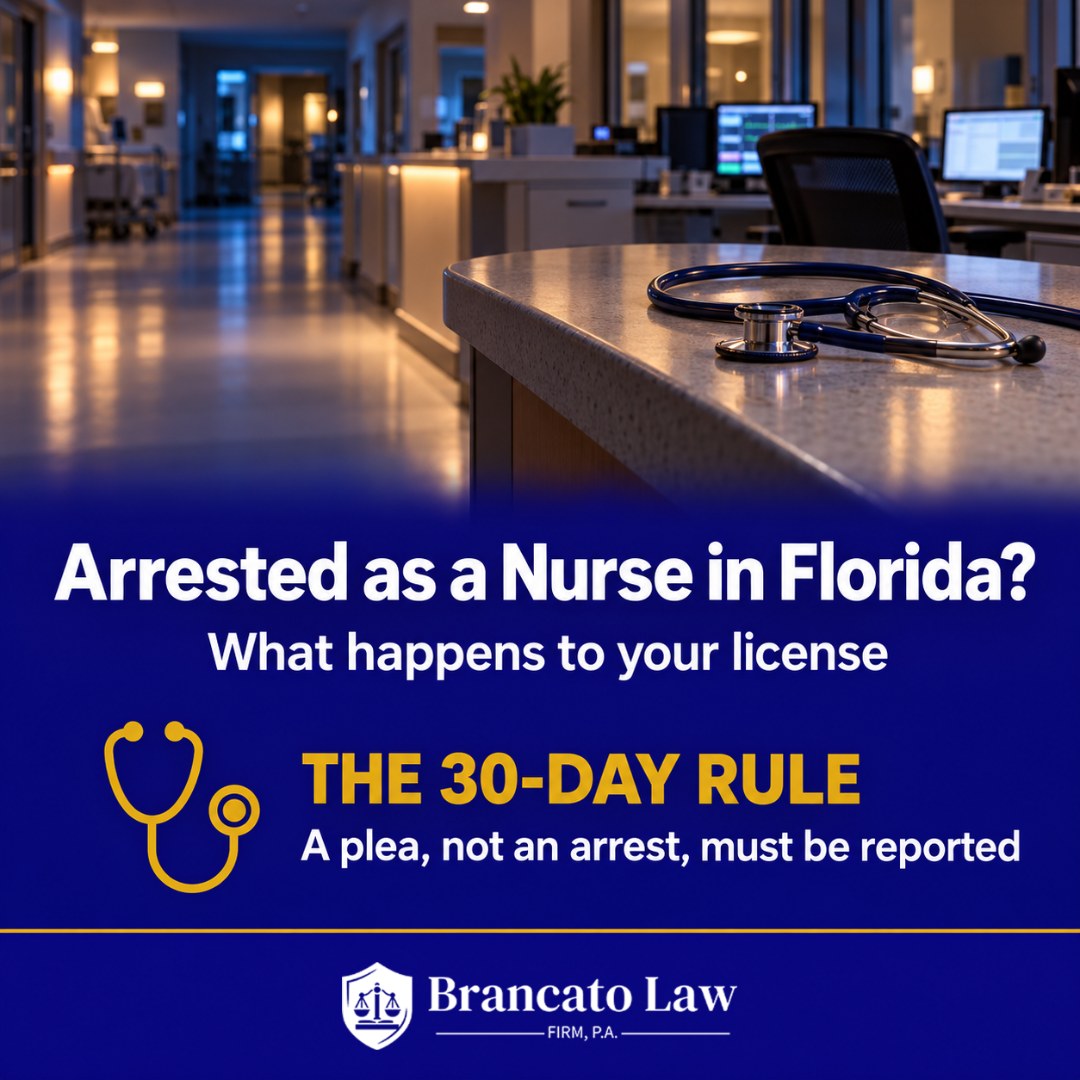
No Florida statute requires a nurse to self-report an arrest to the Board of Nursing. The reporting duty in section 456.072(1)(x), Florida Statutes, starts when a nurse is convicted, found guilty, or enters a plea of nolo contendere, regardless of adjudication, and the written report is due within 30 days. The arrest can still reach the Department of Health through retained fingerprints, and a felony drug plea requires an emergency license suspension under section 456.074. The outcome of the criminal case, ideally a no-file decision, a dismissal, or diversion completed without a plea, is the strongest protection a nurse’s license has.
As the founder of The Brancato Law Firm, P.A., a Tampa criminal defense firm, and the former Chief Operations Officer of the Hillsborough County Public Defender’s Office, where I oversaw a staff of over 100 attorneys, I have seen how often a healthcare worker’s license turns on the plea entered in the criminal case. I have tried more than 150 jury trials to verdict in over 25 years in Hillsborough County courtrooms. Our attorneys defend the criminal case with the Board of Nursing’s rules in view from the first day, and when a license matter is open, we coordinate with the client’s license counsel so the two cases move together.
This guide starts with nurses (RNs, LPNs, and APRNs). It then covers physicians, physician assistants, pharmacists, EMTs and paramedics, and certified nursing assistants.
Do nurses have to report an arrest to the Florida Board of Nursing?
No Florida statute requires a nurse to self-report an arrest by itself. Section 456.072(1)(x) makes it a disciplinary violation to fail to report, in writing within 30 days, a conviction, a finding of guilt, or a plea of nolo contendere to a crime in any jurisdiction, regardless of adjudication. A pending charge with no plea does not start that clock. The nursing practice act, section 464.018, also ties its criminal grounds for discipline to pleas and findings of guilt.
The arrest does not stay private, though. Under section 456.0135, a nurse who applied for a Florida license on or after January 1, 2013 submitted fingerprints that the Florida Department of Law Enforcement retains. Section 943.05 requires FDLE to report an arrest matched to retained prints to the appropriate agency. Nurses screened through the Care Provider Background Screening Clearinghouse have their arrest notifications reported to the Agency for Health Care Administration under section 435.12. Employer policies may separately require you to disclose an arrest, so read your handbook before your next shift. Our firm plans every healthcare client’s defense on the assumption that the Department of Health and the employer will learn of the arrest.
What must a Florida nurse report, and by when?
A Florida nurse must report a conviction, a finding of guilt, or a nolo contendere plea in writing within 30 days, and the arrest itself carries no statutory deadline. Other deadlines and automatic consequences follow from the type of charge and the type of job.
| Event | Florida rule | Deadline or effect |
|---|---|---|
| Arrest or charge, no plea yet | No statutory self-report duty to the Board | No statutory deadline; check employer policy |
| Plea of guilty or nolo contendere, or a finding of guilt, to any crime, with or without adjudication | s. 456.072(1)(x) | Written report to the Board within 30 days |
| Same event, physician (MD or DO) | s. 456.039(1)(a)7. and s. 456.042 | Practitioner profile update within 15 days |
| Felony plea under chapter 893 (drugs), 817 (fraud), or 409 (Medicaid), or a chapter 782 homicide felony | s. 456.074(1) | Department of Health must issue an emergency suspension order |
| Felony plea under chapter 893, 817, or 409 at renewal | s. 456.0635(3) | Renewal refused for a waiting period, unless enrolled in diversion or drug court that allows the plea to be withdrawn |
| Arrest awaiting final disposition for a listed offense or for domestic violence | s. 435.04(2)-(3) | Disqualifies from jobs that require level 2 screening while the case is pending |
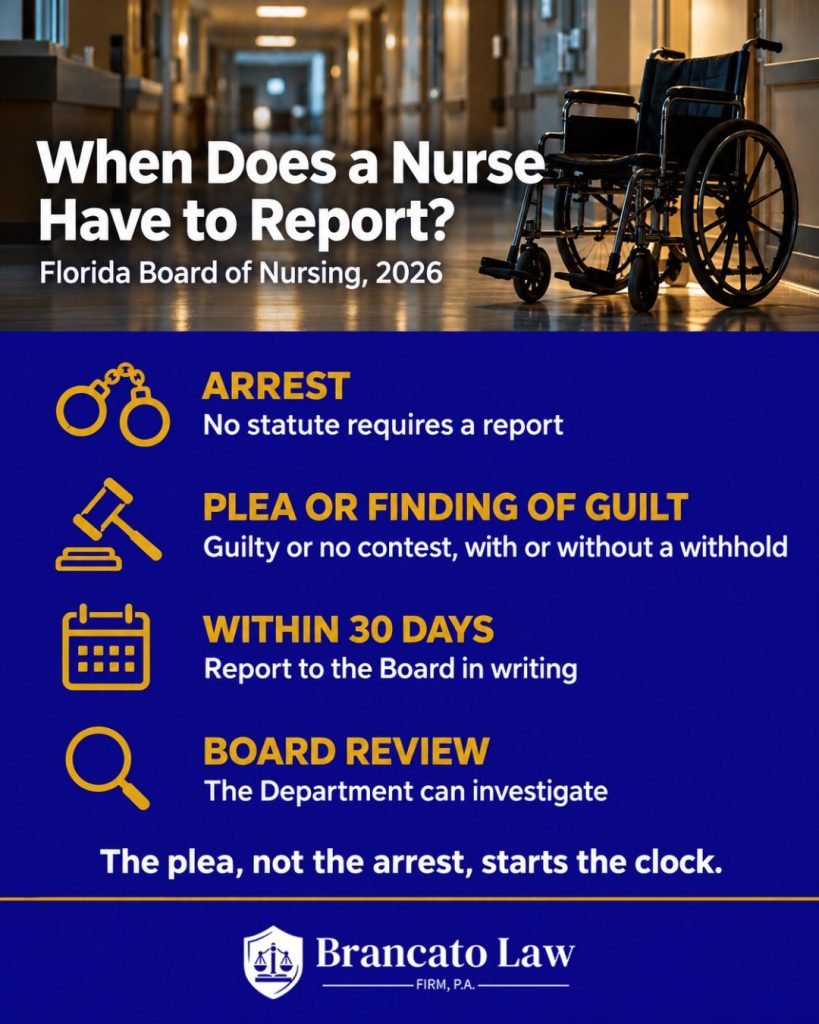
The 30-day report goes to the Board in writing. Physicians licensed under chapters 458 and 459 also must update their public practitioner profile within 15 days under section 456.042. Our attorneys flag the 30-day reporting deadline before any plea is entered.
Does a withhold of adjudication or a no contest plea still count against a nurse’s license?
Yes. Florida’s licensing statutes apply “regardless of adjudication,” so a withhold of adjudication (a judge’s decision not to formally convict) or a plea of nolo contendere (no contest) counts the same as a conviction for licensing purposes. Section 464.018(1)(c) covers any crime that directly relates to the practice of nursing or the ability to practice nursing.
Section 464.018(1)(d) goes further. It lists offenses that are grounds for nursing discipline whether or not they relate to nursing:
- A forcible felony
- Any theft or robbery offense under chapter 812
- Fraud under chapter 817
- Lewdness and indecent exposure under chapter 800
- Assault, battery, and culpable negligence under chapter 784
- Child abuse under chapters 827 and 39, and abuse of vulnerable adults under chapter 415
- For a nurse with a multistate (compact) license, any felony under Florida or federal law
That list means a misdemeanor petit theft plea or a simple battery plea with a withhold can open a Board of Nursing case. Section 464.018(1)(e) adds any offense listed in the level 2 screening statute, section 435.04, and any act of domestic violence. Our attorneys check every proposed plea against these lists before advising a nurse to accept it.
A withhold of adjudication did not stop the Board
In Brewer v. Florida Department of Health, Board of Nursing, 268 So. 3d 871 (Fla. 1st DCA 2019), a licensed practical nurse pleaded nolo contendere to burglary of an unoccupied dwelling. Adjudication was withheld, and she was sentenced to 90 days in the county jail. The Department of Health charged her with pleading to an offense listed in section 435.04 and with failing to report the plea within 30 days. The Board of Nursing permanently revoked her license.
The First District Court of Appeal reversed the revocation. The Board’s own guidelines set a range from a reprimand up to a $10,000 fine and suspension for a first offense, and the record held no clear and convincing evidence to justify going past that range. The withhold did not prevent discipline. What limited the damage was a thin record, and the criminal file is the record the Board reads. That is why our attorneys pay close attention to what goes into a plea form, a factual basis, and a sentencing order.
A DUI reduced to reckless driving still had to be reported
In Schaffner v. Florida Department of Health, No. 1D2022-2829 (Fla. 1st DCA May 8, 2024), a University of South Florida College of Pharmacy student held a pharmacy student intern registration when he was arrested for DUI. He pleaded nolo contendere to reckless driving. To stay in school he was evaluated by the Professionals Resource Network, did not comply with its monitoring plan, and was dismissed from the program. The Department of Health then charged him with failing to report the nolo plea within 30 days. The First District affirmed, holding that the Department could proceed because he was a licensee when he entered the plea.
A charge reduction that looks like a win in criminal court still produces a reportable plea. Our attorneys explain that trade-off to every licensed client before a reduced plea is accepted.
Which criminal charges put a Florida nursing license most at risk?
Felony drug charges, theft or drug diversion from an employer, health care fraud, and battery or domestic violence carry the most license risk, because Florida law names them. DUI and lesser misdemeanors are reportable on any plea, and the discipline that follows depends more on the facts.
| Charge | Why it threatens the license | Key statutes |
|---|---|---|
| Felony drug possession or obtaining a controlled substance by fraud | A plea, even with a withhold, requires an emergency suspension and can block renewal for years | s. 893.13; s. 456.074(1)(a); s. 456.0635 |
| Theft of medication or property from an employer (drug diversion) | Any chapter 812 theft plea is a listed nursing ground; felony theft and felony drug offenses are level 2 disqualifiers | s. 464.018(1)(d)2.; s. 435.04(2) |
| Health care or Medicaid fraud | Listed ground; a felony plea requires an emergency suspension and bars licensure | s. 456.072(1)(ll); s. 456.074; s. 456.0635 |
| Battery, assault, or domestic violence | Any chapter 784 plea is a listed nursing ground; a pending domestic violence arrest disqualifies under level 2 screening | s. 464.018(1)(d)5. and (1)(e); s. 435.04(3) |
| DUI | Reportable on any plea; the Department can argue an alcohol offense relates to the ability to practice, and impairment concerns can lead to an IPN evaluation | s. 316.193; s. 464.018(1)(c) and (1)(j) |
| Other misdemeanors (trespass, disorderly conduct) | Reportable on any plea; discipline turns on whether the crime relates to nursing | s. 456.072(1)(x); s. 464.018(1)(c) |
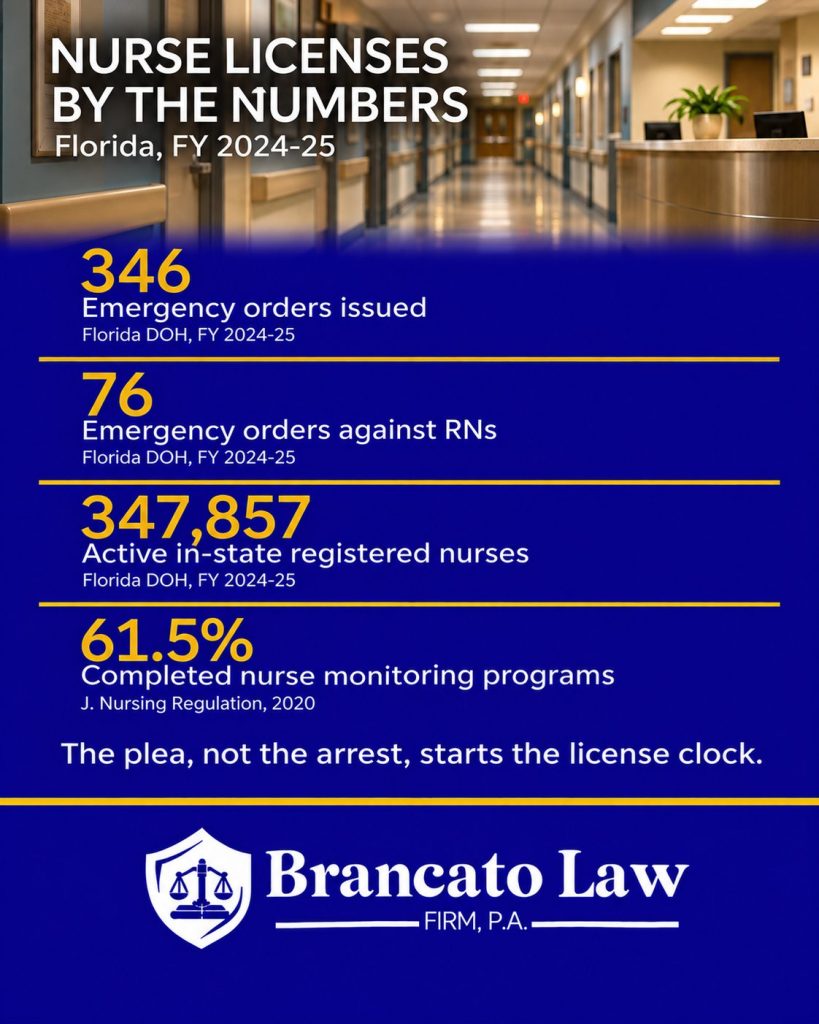
Florida’s own enforcement numbers show how often nurses face emergency action. In fiscal year 2024-25, the Florida Department of Health issued 346 emergency orders, and registered nurses drew more than any other license type (76), with certified nursing assistants at 66 and licensed practical nurses at 25, according to the Division of Medical Quality Assurance FY 2024-25 Annual Report. The same report counts 347,857 active in-state registered nurses. Our attorneys treat any charge on this table as a license case from the first phone call.
What happens to a nurse’s license after a DUI or drug arrest?
A DUI or drug arrest does not suspend a nursing license on its own, but the plea that ends the case can. These two charges also raise impairment questions, which can bring the Intervention Project for Nurses into the picture.
DUI arrests
A first DUI under section 316.193 is a misdemeanor, and any plea to it, or to a reduced charge such as reckless driving, must be reported within 30 days. Our Tampa DUI lawyer team attacks the stop, the field sobriety exercises, and the breath or blood result first, because a suppressed test can mean no plea at all. As a former police academy instructor and a member of the National College for DUI Defense and the DUI Defense Lawyers Association, I know how officers are trained to build these cases. The driver license has its own 10-day deadline, explained in our post on protecting your Florida driver’s license after a DUI arrest.
Drug possession and prescription drug charges
Possession of a controlled substance without a valid prescription under section 893.13(6)(a) is a third-degree felony, and obtaining a controlled substance by misrepresentation or fraud under section 893.13(7)(a)9. is also a third-degree felony. A plea to either, with or without a withhold, requires an emergency suspension under section 456.074(1)(a). At renewal, section 456.0635 requires the Department to refuse renewal until the sentence and any probation ended more than 5 years earlier for a section 893.13(6)(a) felony, 10 years for other third-degree felonies, and 15 years for first- and second-degree felonies. The exception is a nurse currently enrolled in a pretrial diversion or drug court program that allows the plea to be withdrawn on completion. Our Tampa drug crimes attorney page explains the possession defenses we raise first.
Drug diversion investigations at the hospital
A medication discrepancy at work often becomes an investigation before anyone is arrested. That window is the time for representation before charges are filed. Do not give a written or recorded statement to hospital security, a pharmacy investigator, or a detective before speaking with a defense attorney. Our post on the signs you are being investigated for a crime in Florida lists the warning signs, and our attorneys can contact the detective and the State Attorney’s Office for you.
What are IPN and PRN, and how do they affect the criminal case?
IPN and PRN are Florida’s impaired practitioner programs under section 456.076, which evaluate and monitor licensees with alcohol, drug, or mental health conditions. The Intervention Project for Nurses (IPN) serves nurses. The Professionals Resource Network (PRN) is the other designated program and serves physicians and other licensed professionals. IPN accepts referrals from employers, treatment providers, attorneys, the Department of Health, and the Board of Nursing, and nurses may self-refer.
The statute gives the program real weight. When the Department receives a complaint alleging only impairment, it refers the licensee to the program, and the impairment is not grounds for discipline if the licensee acknowledges it, enters the program, and completes the participant contract. For a licensee who self-refers before any Department investigation exists, the program may not report to the Department while the licensee stays compliant. A licensee terminated for noncompliance is reported, and that report becomes a complaint.
Monitoring is a long commitment. A 2020 study in the Journal of Nursing Regulation, Smiley and Reneau, “Outcomes of Substance Use Disorder Monitoring Programs for Nurses”, followed 7,737 nurses in 13 monitoring programs and found that about 61.5% completed them; the authors recommend at least three years of monitoring. Whether and when to self-refer is a licensing decision to make with license counsel. Our attorneys coordinate the timing so the evaluation, any treatment, and the criminal case support each other.
How does the criminal case outcome protect a nurse’s license?
A nurse’s license is safest when the criminal case ends without a plea. A no-file decision, a dismissal, a not guilty verdict, or diversion completed without a plea leaves nothing to report under section 456.072(1)(x).
| Criminal outcome | Plea to report within 30 days? | What can still follow |
|---|---|---|
| No charges filed (no-file) | No | The arrest record; the underlying conduct can still be investigated |
| Dismissal or nolle prosequi | No | Same as above |
| Diversion completed with no plea | No | The arrest record; s. 456.0635 carves out completed diversion |
| Not guilty at trial | No | The arrest record |
| Plea with adjudication withheld | Yes | Counts “regardless of adjudication” |
| Plea with adjudication (conviction) | Yes | Same, plus a permanent conviction |
Under section 948.08, first offenders charged with a misdemeanor or third-degree felony can be considered for pretrial intervention with the State Attorney’s consent, and defendants charged with nonviolent felonies who complete the drug treatment track have their charges dismissed.
In Hillsborough County, the State Attorney’s Office for the 13th Judicial Circuit runs several programs that matter to healthcare workers. RIDR (Reducing Impaired Driving Recidivism) covers first-time, non-aggravated DUI cases with enhanced sanctions such as alcohol monitoring and DUI education, and in our experience it may result in a reduction to reckless driving. DETRR (Drug Education and Treatment Reducing Recidivism) is limited to drug possession cases for low-risk, non-violent defendants, and the charge is dismissed after treatment or education and six months without a new arrest. The Misdemeanor Intervention Program is a diversion program for first-time offenders that requires the State Attorney’s consent.
One question decides the licensing effect of each program: does it require a plea? A plea entered to get into a program can itself be the event the Board must hear about within 30 days, as Schaffner v. Florida Department of Health, No. 1D2022-2829 (Fla. 1st DCA May 8, 2024) shows. Our attorneys answer that question before a nurse signs anything. Pinellas and Pasco cases are handled by a different State Attorney’s Office with its own programs; see our Pinellas County and Pasco County pages.
The best outcome is often reached before the State Attorney decides whether to file. Through pre-file advocacy, our attorneys present the mitigation a prosecutor needs to decline or divert: treatment records, a clean license history, employer support, and the weaknesses in the State’s evidence.
I’m a nurse arrested for a misdemeanor in Tampa. What should I do in the next 30 days?
Protect the criminal case first, because the criminal outcome decides what the Board will see. These steps apply in Hillsborough, where arrestees are booked at the Orient Road Jail and appear at first appearance by video, and in Pinellas and Pasco.
- Say nothing about the facts at first appearance. The judge sets release conditions; the facts come later.
- Do not give statements to police, your employer’s investigators, or a Department of Health investigator before speaking with counsel.
- If the arrest was for DUI, act within 10 days to request the driver license review hearing.
- Hire a criminal defense attorney before arraignment, while the State Attorney is still deciding what to file.
- Read your employer’s policy on reporting arrests, and ask license counsel whether to contact IPN.
- Map every plea offer to the licensing rules: the 30-day report, emergency suspension, renewal bars, and level 2 screening.
- If a plea is entered, calendar day 30 and make sure the written report reaches the Board on time.
Our attorneys can walk you through this list at a free consultation.
How do the rules differ for physicians, pharmacists, PAs, EMTs, and CNAs?
Every Florida healthcare license reaches pleas “regardless of adjudication,” but the details differ by profession. The 30-day report under section 456.072(1)(x) applies to licensees regulated under chapter 456.
- Physicians (MD and DO). Section 458.331(1)(c) covers a crime that directly relates to the practice of medicine or the ability to practice. Physicians also have the 15-day profile update, and PRN is their impaired practitioner program.
- Physician assistants. PAs are disciplined under section 456.072 and section 458.331, and a PA sits on the probable cause panel in PA cases.
- Pharmacists. Under section 465.016(1)(f), a plea of nolo contendere counts as a conviction, and violating chapter 893 is a separate ground for discipline under section 465.016(1)(e).
- EMTs and paramedics. These certificates fall under chapter 401. Section 401.411 allows discipline for a guilty or nolo plea to a crime related to EMS practice, for possession of a controlled substance outside legitimate duties, and for a felony conviction unless civil rights have been restored.
- Certified nursing assistants. CNAs are certified by the Board of Nursing, and section 464.204 makes any chapter 456 violation a ground for discipline. Most CNA jobs require level 2 screening, and the Board can grant an exemption from disqualification.
Teachers and law enforcement officers answer to their own licensing systems. See our posts on criminal defense for teachers in Tampa and criminal defense for law enforcement officers. The criminal defense approach in this guide applies to each of them.
What results has our firm obtained for licensed professionals and drug charges?
Our firm’s published results include outcomes that ended without a conviction and protected careers.
| Charge | Result |
|---|---|
| Domestic violence battery, second offense (felony); client a medical doctor | Charges not filed (July 2026) |
| DUI; client an airline pilot | Reduced to reckless driving (July 2026) |
| Drug possession, multiple counts | Diversion; dismissal on completion, eligible for expungement (October 2026) |
| Felony drug possession (husband and wife) | Charges never filed (March 2026) |
| Cocaine possession and firearm | Both charges dismissed (January 2025) |
| Environmental violation | Dismissed through diversion, career preserved (June 2026) |
For a nurse, a reduction like the airline pilot’s still produces a plea that must be reported within 30 days, which is why our attorneys push for a no-file, a dismissal, or diversion without a plea first. More outcomes are on our case results page. Past results do not guarantee future outcomes.
Why do nurses and healthcare workers call The Brancato Law Firm?
Our practice is devoted entirely to criminal defense, from misdemeanors to capital cases. That focus is what a licensed professional needs, because the license depends on the criminal disposition.
- Experience you can measure. Over 150 jury trials to verdict, 25+ years in Hillsborough County, former Major Crimes Unit attorney, and former Chief Operations Officer of the Hillsborough County Public Defender’s Office overseeing a staff of over 100 attorneys. Rocky Brancato holds an AV Preeminent rating, Super Lawyers selection, and National Trial Lawyers Top 100 recognition, and wrote “How to Choose a Major Crimes Attorney – or Any Criminal Defense Attorney for That Matter.”
- The license in view. Our attorneys handle the criminal case and coordinate with your license counsel when a Board matter is open.
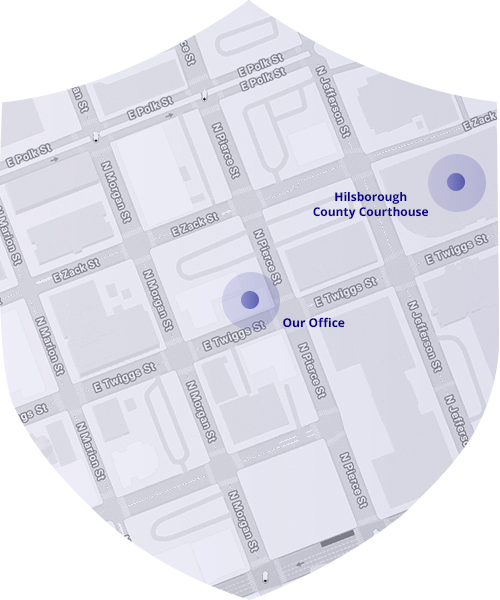
- Three counties. We defend clients in Hillsborough, Pinellas, and Pasco Counties, two blocks from the Hillsborough County Courthouse.
- Reachable. Call us at any hour. Clients get case updates through our client portal, and calls are returned within 24 hours. Our firm has Spanish-speaking staff, and attorney Jean-Luc Adrien speaks Spanish, Haitian Creole, and French.
- Clear fees. We quote a flat fee for the whole case, including trial, based on the facts and intricacy of the case. At least half is due up front, with a payment plan for the balance while the case is pending. We are neither the most nor the least expensive firm in Tampa, and consultations are free. Our post on what a criminal defense attorney costs in Tampa explains why a separate trial fee creates a financial incentive to settle before trial preparation.
For more about our defense strategies, visit our DUI defense and drug charge defense pages.
Frequently Asked Questions
Do I have to tell my hospital I was arrested in Florida?
No Florida statute requires a nurse to tell an employer about an arrest, but your employer’s policy may. Our attorneys at The Brancato Law Firm can review your employer’s disclosure rule with you before you respond to it. Hospitals and other employers that screen through the Care Provider Background Screening Clearinghouse can learn of the arrest through retained fingerprints under section 435.12.
Can a nurse lose her license for a first DUI in Florida?
A first DUI does not automatically suspend a nursing license, but any plea must be reported within 30 days and can lead to discipline or an IPN evaluation. Our attorneys at The Brancato Law Firm challenge the stop and the test results first, because a case that ends without a plea leaves nothing to report. Our Tampa DUI defense page explains the defenses we raise.
Will a withhold of adjudication protect my nursing license?
No, because Florida’s nursing discipline statute applies “regardless of adjudication.” The Brancato Law Firm treats a withhold as a fallback and works first for a no-file, a dismissal, or diversion without a plea. In Brewer v. Florida Department of Health, Board of Nursing, 268 So. 3d 871 (Fla. 1st DCA 2019), an LPN with a withhold of adjudication still had her license revoked by the Board before the appeals court reversed the penalty.
Is a reckless driving plea reportable to the Florida Board of Nursing?
Yes, a plea of guilty or nolo contendere to reckless driving is a plea to a crime, and it must be reported in writing within 30 days. Our attorneys at The Brancato Law Firm explain this before any DUI reduction is accepted, so the client and license counsel can meet the deadline.
Can criminal charges against a nurse be dropped in Florida?
Yes, charges can be dropped through a no-file decision, a nolle prosequi, a dismissal after a successful motion, or completion of a diversion program. The Brancato Law Firm pursues those outcomes first through pre-file advocacy with the State Attorney’s Office before a filing decision is made.
Can I seal my record so the Department of Health never sees it?
No, because section 943.059 bars a person with a sealed record from denying it when seeking employment or licensure with the Department of Health or when screened through the Care Provider Background Screening Clearinghouse. The Brancato Law Firm advises healthcare clients on sealing eligibility and is clear that sealing does not hide the record from licensing agencies.
What kind of lawyer should a Tampa nurse arrested for a misdemeanor hire?
Start with a criminal defense attorney, because the criminal outcome decides what the Board of Nursing will see. The Brancato Law Firm defends the criminal case and coordinates with license counsel when the Department of Health opens a file. Our Tampa drug crimes defense and DUI teams handle the charges nurses most often face.
Your license clock starts with the plea
Your license clock starts the day you enter a plea, and the best chance to keep that clock from ever starting is right now, before the State Attorney decides what to file. The Brancato Law Firm, P.A., founded by Tampa Criminal Defense Attorney Rocky Brancato, defends nurses, physicians, pharmacists, EMTs, and other licensed healthcare workers across Hillsborough, Pinellas, and Pasco Counties. Our attorneys will review the arrest report, identify every route that ends without a plea, and coordinate with your license counsel. Call (813) 727-7159 at any hour for a free consultation.
The Brancato Law Firm, P.A.
620 E. Twiggs Street, Suite 205, Tampa, FL 33602
(813) 727-7159
Serving Hillsborough, Pinellas, and Pasco Counties
The Brancato Law Firm, P.A. is a Tampa-based criminal defense practice. We are not affiliated with any other Brancato-named law firms.
Visit Us
Tampa, FL 33602
Contact Us Now
Free Legal Consultation (813) 727-7159