- Free Consultation 24/7: (813) 727-7159 Tap Here To Call Us


From First DUI to Death Penalty



How Does a Motion to Suppress Work in Florida? (2026)


Updated October 2026
| A motion to suppress asks a Florida judge to keep evidence out of a criminal case because police obtained it through an unlawful stop, search, seizure, or interrogation. Since July 13, 2026, Florida Rule of Criminal Procedure 3.190(g) governs motions to suppress both physical evidence and a defendant’s statements. The judge decides the motion at a pretrial evidentiary hearing, where officers testify and the defense cross-examines them. If the motion is granted, the State cannot use that evidence to prove guilt, and the case can be reduced or dismissed as a result. |
A Florida judge grants a motion to suppress only when the defense proves, with testimony and records, that police broke a specific legal rule and that the evidence came from that violation. My name is Rocky Brancato, and I am the founder of The Brancato Law Firm, P.A., a Tampa criminal defense firm. I taught criminal procedure and courtroom testimony as a police academy instructor, and I have spent more than 25 years testing police testimony in Hillsborough County courtrooms. When a stop, search, or interrogation is in question, our attorneys obtain the body camera video, dashcam footage, dispatch logs, and computer-aided dispatch timestamps, and we build the motion around what those records show.
What Is a Motion to Suppress in Florida?
A motion to suppress is a written request asking the court to exclude evidence the State obtained in violation of the defendant’s constitutional rights. The evidence can be physical, such as drugs found in a car, or verbal, such as a confession given without Miranda warnings. The remedy is called the exclusionary rule: unlawfully obtained evidence cannot be used to prove guilt.
The rule also reaches evidence police found by exploiting the first violation. In Wong Sun v. United States, 371 U.S. 471 (1963), federal agents broke into a man’s home without probable cause, and his statements in the bedroom led them to heroin held by another person. The Supreme Court excluded both the statements and the heroin against him because police reached the drugs by exploiting the illegal entry. Lawyers call this “fruit of the poisonous tree.”
Suppression motions come up most often in drug and gun cases, because those charges usually depend on what police found during a search. For possession and trafficking charges, our Tampa drug crimes attorney page explains how The Brancato Law Firm attacks the search itself.
Does Florida’s Constitution Protect More Than the Fourth Amendment?
Florida’s search-and-seizure protection is tied to the federal standard. Article I, section 12 of the Florida Constitution protects against unreasonable searches and seizures, and it says that right “shall be construed in conformity with the 4th Amendment to the United States Constitution, as interpreted by the United States Supreme Court.” It also bars evidence only when the U.S. Supreme Court’s Fourth Amendment decisions would bar it.
The Florida Supreme Court applied that conformity clause in Bernie v. State, 524 So. 2d 988 (Fla. 1988). That case began with an air freight package of cocaine that broke open in transit, and one of the defendants later asked about it at the carrier’s Tampa office. The court held that Florida courts are bound by every U.S. Supreme Court Fourth Amendment decision, including later ones, and cannot give greater protection. In practice, a Florida search motion rises or falls on federal precedent plus Florida statutes and rules, and the Second District Court of Appeal’s decisions bind trial courts in Hillsborough, Pinellas, and Pasco Counties. The Brancato Law Firm builds every search motion on that combination of federal precedent and Second District case law.
What Are the Most Common Grounds for Suppression in Florida?
Most suppression motions in Florida fall into four groups: stops held too long, warrantless entries into a home, statements taken in violation of Miranda, and evidence that flowed from one of those violations. Each ground has its own legal test, and the defense must name the specific evidence and the specific reason in the motion. The table below shows how The Brancato Law Firm sorts the issues at the start of a case.
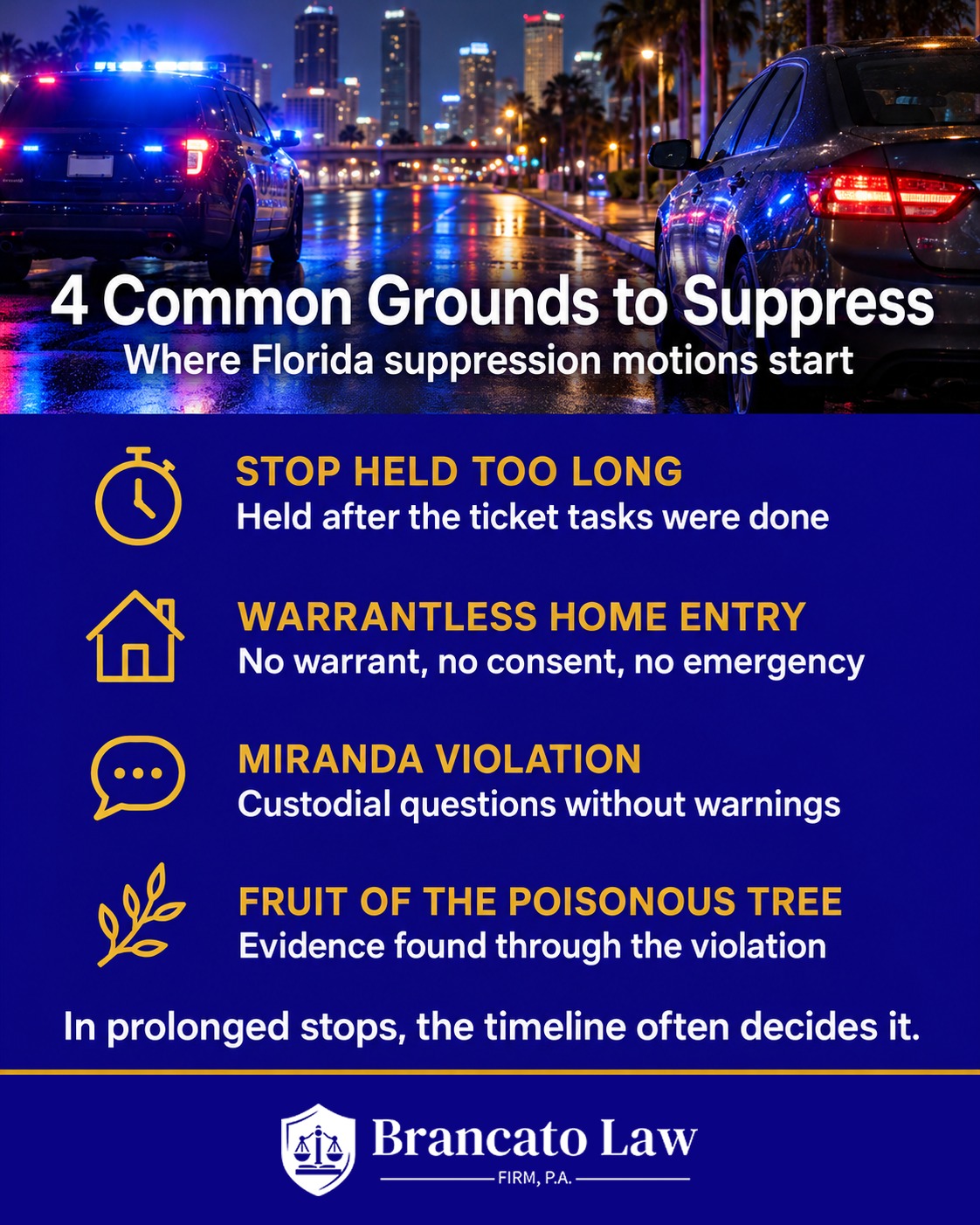
| Ground | What it looks like | Key authority |
|---|---|---|
| Traffic stop held too long | The officer finishes the ticket tasks, then keeps the driver for a drug dog or more questions | Rodriguez v. United States; section 901.151(3) |
| Warrantless home entry | Police enter a home with no warrant, no valid consent, and no true emergency | Payton v. New York; section 933.18 |
| Miranda violation | Custodial questioning with no warnings or no valid waiver | Miranda v. Arizona; Ramirez v. State |
| Fruit of the poisonous tree | Later evidence found by exploiting the first illegality | Wong Sun v. United States |
Traffic stops held too long
A traffic stop can last only as long as the tasks tied to the traffic violation. In Rodriguez v. United States, 575 U.S. 348 (2015), an officer issued a written warning, returned the driver’s documents, and then held him seven or eight minutes until a drug dog alerted. The Supreme Court held that police may not prolong a completed stop for a dog sniff without reasonable suspicion of another crime. Florida’s Stop and Frisk Law, section 901.151(3), Florida Statutes, likewise limits a temporary detention to the time reasonably necessary for its purpose.
Our post on how long a traffic stop can last in Florida covers the 2026 Florida decisions on dog sniffs and lane-drift stops. The same timing analysis drives many DUI suppression motions, which our Tampa DUI lawyer page discusses along with field sobriety exercises and breath testing.
Warrantless entry into a home
Police generally need a warrant, valid consent, or a true emergency to enter a home. In Payton v. New York, 445 U.S. 573 (1980), officers forced their way into an apartment without a warrant to make a routine felony arrest, and the Supreme Court held the Fourth Amendment forbids that absent exigent circumstances. Florida adds a statutory layer: section 933.18, Florida Statutes, allows a search warrant for a private dwelling only in listed situations and only on a sworn affidavit setting out the facts.
When the State relies on a warrantless search, the State carries the burden of proving it was legal. In Ross v. State, 319 So. 3d 807 (Fla. 2d DCA 2021), a Charlotte County deputy impounded and inventoried a locked car parked at a public park and found drugs. The Second District reversed the denial of suppression because the State offered no evidence of a standard governing the decision to impound. Our post on whether police can enter your home without a warrant in Florida covers welfare checks, knock-and-announce, and the 2026 decisions on home entries.
Statements taken in violation of Miranda
Police must give Miranda warnings before custodial interrogation, and unwarned answers cannot be used to prove guilt. Miranda v. Arizona, 384 U.S. 436 (1966) requires warnings of the right to remain silent, that statements can be used in court, and the right to an attorney, appointed if needed. The prosecution must show the warnings were given and the rights were knowingly waived.
Custody is often the fight. In Ramirez v. State, 739 So. 2d 568 (Fla. 1999), detectives questioned a 17-year-old in a small station-house room, told him they knew he was involved, and never told him he could leave. The Florida Supreme Court used four factors to find he was in custody: how police summoned him, the purpose, place, and manner of questioning, how far he was confronted with evidence of guilt, and whether he was told he was free to leave. The court held the confession should have been suppressed and ordered a new trial. For interrogation tactics that produce unreliable statements, see our post on false confessions in Florida.
What Does Florida Rule 3.190(g) Require After the 2026 Amendment?
Since July 13, 2026, one subdivision of Florida’s pretrial-motion rule governs both kinds of suppression motion. In In re Amendments to Florida Rule of Criminal Procedure 3.190, 421 So. 3d 424 (Fla. 2025), the Florida Supreme Court combined the subdivisions on suppressing evidence and suppressing statements into Rule 3.190(g). The former confession subdivision, 3.190(h), no longer exists in that form, and subdivision (h) now covers depositions to perpetuate testimony.
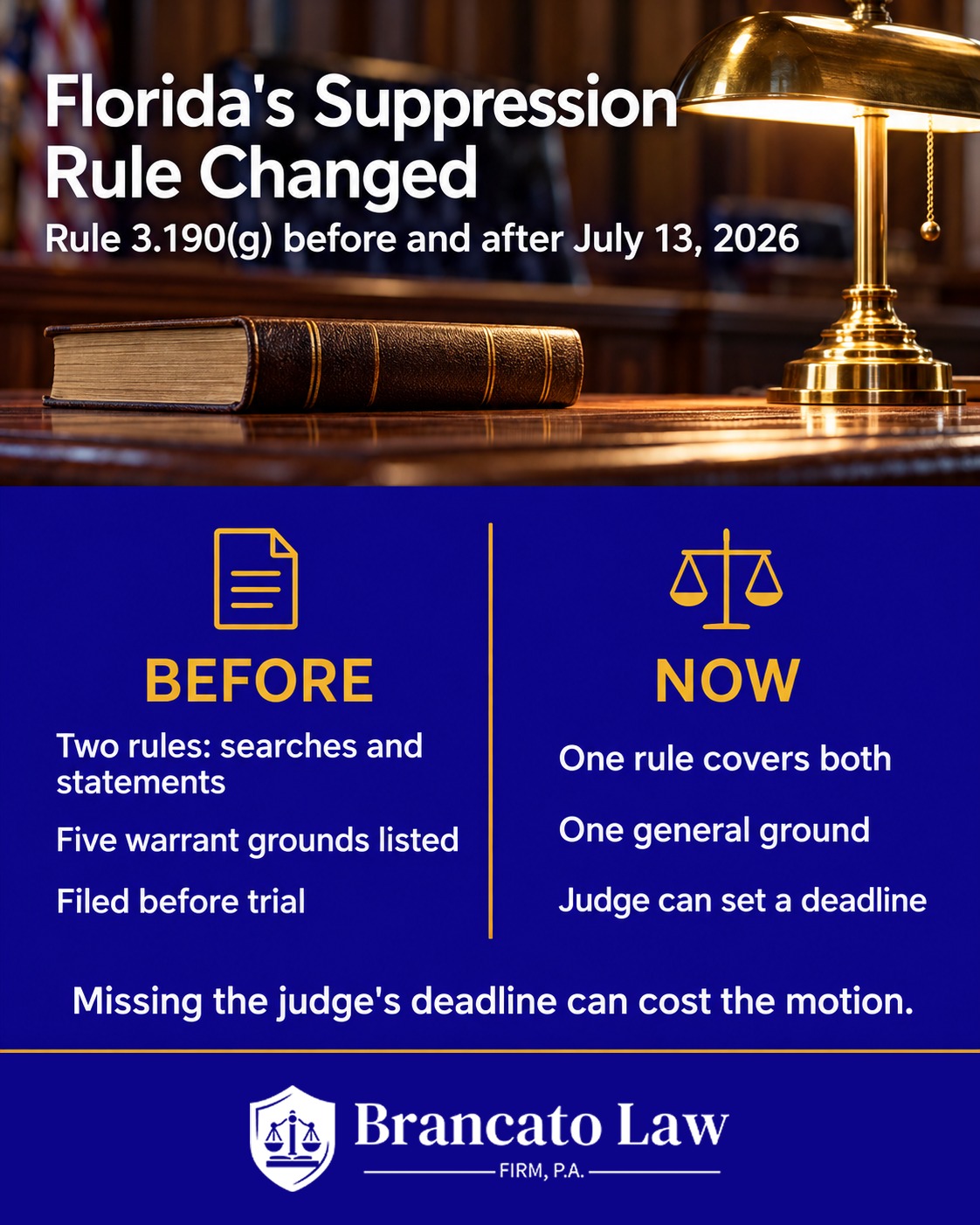
The amended rule also removed the old list of five warrant defects from the rule text. Those arguments, such as a warrant that is defective on its face or lacks probable cause, remain available under the Fourth Amendment and Article I, section 12. The rule now states the ground generally: evidence the State obtained through an unlawful search or seizure by a government agent, or statements the State obtained unlawfully from the defendant.
| Issue | Before July 13, 2026 | Since July 13, 2026 |
|---|---|---|
| Where the rule lives | 3.190(g) for searches; 3.190(h) for confessions and admissions | 3.190(g) covers evidence and statements |
| Grounds in the rule | Five listed warrant-related grounds | One general ground: unlawful search or seizure, or statements obtained unlawfully |
| What the motion must state | The evidence or statement, the reasons, and a general statement of facts | The particular evidence or statements, the reasons, and a general statement of facts |
| Filing deadline | Before trial, unless there was no opportunity or the defendant did not know the grounds | Before trial or before a deadline set by the trial judge, unless there is good cause for the delay or the State does not object |
| Written order | No provision | If the motion is granted, either side can request a written order with findings of fact and conclusions of law before jeopardy attaches |
The deadline change matters most. A motion to suppress must now be filed before trial or before the deadline the trial judge sets. A late motion survives only if there is good cause for the delay or the State does not object, so The Brancato Law Firm treats the judge’s scheduling order as the real deadline in every case.
What Happens at a Suppression Hearing in Florida?
A suppression hearing is a pretrial evidentiary hearing in front of a judge, with no jury. Under Rule 3.190(g)(3), the judge first decides whether the written motion is legally sufficient and denies it if it is not. If the judge reaches the merits, the defense presents evidence, the State may offer rebuttal, and the judge may take evidence on any factual issue needed to rule.
The arresting officer is usually the key witness. I taught criminal procedure and courtroom testimony at the police academy, and our attorneys build the cross-examination around three sources: the officer’s written report, the body camera and dashcam video, and the dispatch timestamps. A gap between the report and the video is the kind of concrete fact a judge can rely on in a written order. In prolonged-stop cases, the minute-by-minute timeline often decides the motion.
Judges rule on the evidence presented. That is why our attorneys at The Brancato Law Firm subpoena the records early, compare every timestamp, and decide before the hearing whether the client should testify.
How Often Are Motions to Suppress Filed and Granted?
Motions to suppress are filed in a minority of criminal cases, and they succeed when the records support them. A study funded by the National Institute of Justice reviewed 7,500 criminal cases in nine medium-sized counties in Illinois, Michigan, and Pennsylvania. Peter F. Nardulli reported in the American Bar Foundation Research Journal in 1983 that motions to suppress physical evidence were filed in fewer than five percent of those cases, and that those cases primarily involved drugs and weapons. The same study found that unsuccessful motions to exclude confessions were the only motions that produced real sentencing concessions.
Searches start with police contact, and most police-initiated contact happens in a car. In 2022, about 10.1 million U.S. residents age 16 or older said their most recent contact with police was as a driver in a traffic stop, 58 percent of all police-initiated contacts, according to the Bureau of Justice Statistics report Contacts Between Police and the Public, 2022. About 4.0 percent of those drivers reported being searched or arrested. Those numbers explain why traffic stops supply so many of the suppression issues The Brancato Law Firm litigates.
What Happens After the Judge Rules?
A granted motion removes the evidence from the State’s case, and the State then decides whether it can still prove the charge. If the suppressed drugs, gun, or confession was the heart of the case, prosecutors may reduce or dismiss the charge. Florida law also lets the State appeal certain pretrial orders and orders suppressing evidence at trial under section 924.07, Florida Statutes, which is why The Brancato Law Firm asks for the written findings the new rule allows.
A denied motion does not end the issue. The officer’s credibility and the gaps in the video remain fair game at trial in front of the jury. A defendant who chooses to plead can preserve the suppression issue for appeal only by expressly reserving the right to appeal a legally dispositive issue, as section 924.051(4), Florida Statutes requires.
Suppression of a statement has one important limit. In Harris v. New York, 401 U.S. 222 (1971), the defendant’s unwarned statement was kept out of the prosecution’s main case, but he testified differently at trial, and the Supreme Court allowed the statement to impeach him. He had not claimed the statement was coerced. That rule shapes whether our attorneys advise a client to testify after a Miranda suppression.
Our Suppression Results
The Brancato Law Firm has published these results involving challenges to searches and statements. Past results do not guarantee future outcomes.
| Charge | What we challenged | Result |
|---|---|---|
| Fentanyl trafficking | The legality of the vehicle search | Charges dismissed |
| Serious sex crime charges after a marathon interrogation | The confession, through a motion to suppress and expert testimony on interrogation contamination | Charges dismissed by the State |
How Soon Should You Raise a Suppression Issue?
Raise it within days of the arrest. In Hillsborough County, felony cases move from arrest to the State Attorney’s filing decision in a matter of weeks, and the amended rule now lets the trial judge set a suppression deadline before trial. Video, dispatch audio, and timestamp records are easiest to obtain and compare early in the case.
If no charge has been filed yet, the investigation stage is the best time to protect your rights. Our representation before charges are filed lets The Brancato Law Firm deal with investigators and prosecutors before the filing decision is made.
Frequently Asked Questions About Motions to Suppress in Florida
Can charges be dropped in Florida if a motion to suppress is granted?
Yes. When the suppressed evidence was the core of the State’s proof, prosecutors may have nothing left to prove and can dismiss or reduce the charge. In a fentanyl trafficking case, The Brancato Law Firm obtained a dismissal after challenging the legality of the vehicle search, a result described on our drug crimes defense page.
Does a judge or a jury decide a motion to suppress?
A judge decides it, at a pretrial evidentiary hearing with no jury present. Our attorneys at The Brancato Law Firm prepare for that hearing with subpoenaed officers, video exhibits, and a minute-by-minute timeline of the stop or search.
Do police have to read Miranda rights during a DUI traffic stop?
Usually not during routine roadside questioning, because a driver in an ordinary traffic stop is not in custody under Berkemer v. McCarty, 468 U.S. 420 (1984). The Brancato Law Firm looks for the moment a DUI stop turned into custody, since questions asked after that point without warnings can be suppressed.
Can the State appeal if a judge suppresses evidence in Florida?
Yes. Section 924.07, Florida Statutes, lists the orders the State may appeal, including pretrial orders and orders suppressing evidence at trial. When our attorneys at The Brancato Law Firm win a motion, we request the written findings of fact Rule 3.190(g)(5) now allows, because appellate courts defer to factual findings supported by competent, substantial evidence.
Can I still appeal a denied motion to suppress if I take a plea?
Only if you expressly reserve the right to appeal a legally dispositive issue before the plea is entered, under section 924.051(4), Florida Statutes. The Brancato Law Firm puts that reservation on the record in plain terms when a client decides to plead after losing a dispositive suppression ruling.
Should I answer police questions if I think I am under investigation?
You are not required to answer investigative questions, and anything you say can be used against you. The Brancato Law Firm can communicate with investigators for you through pre-file advocacy, which keeps your own words from becoming the State’s best evidence.
Is evidence found after an illegal stop always thrown out?
Not always. Under Wong Sun, evidence is excluded when police reached it by exploiting the illegality, and courts can admit evidence that came from an independent source or whose link to the violation became too weak. Our attorneys at The Brancato Law Firm trace each piece of evidence back to the stop or entry to show the court exactly how police found it.
For how this fits into the rest of a case, see our step-by-step guide to what happens in a Florida criminal case.
Talk to a Tampa Suppression Lawyer About Your Case
Our attorneys start by pulling the body camera video, dispatch records, and timestamps from your stop or search and comparing them line by line against the officer’s report. The Brancato Law Firm, P.A. was founded by Tampa Criminal Defense Attorney Rocky Brancato, and we handle suppression motions in Hillsborough, Pinellas, and Pasco Counties. Under Florida’s amended rule, a motion to suppress must be filed before trial or before the deadline your judge sets, so call (813) 727-7159 now. You can call us at any hour.
For more about our defense strategies, visit our Drug Crimes page, or our DUI defense page if your case began with a traffic stop.
The Brancato Law Firm, P.A.
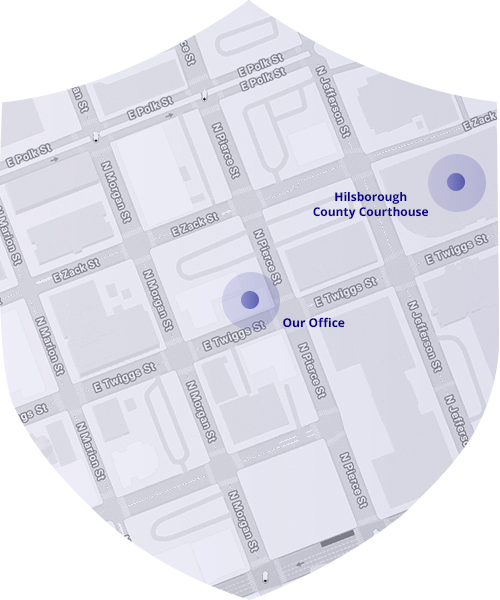
620 E. Twiggs Street, Suite 205, Tampa, FL 33602
(813) 727-7159
Serving Hillsborough, Pinellas, and Pasco Counties
The Brancato Law Firm, P.A. is a Tampa-based criminal defense practice. We are not affiliated with any other Brancato-named law firms.
Visit Us
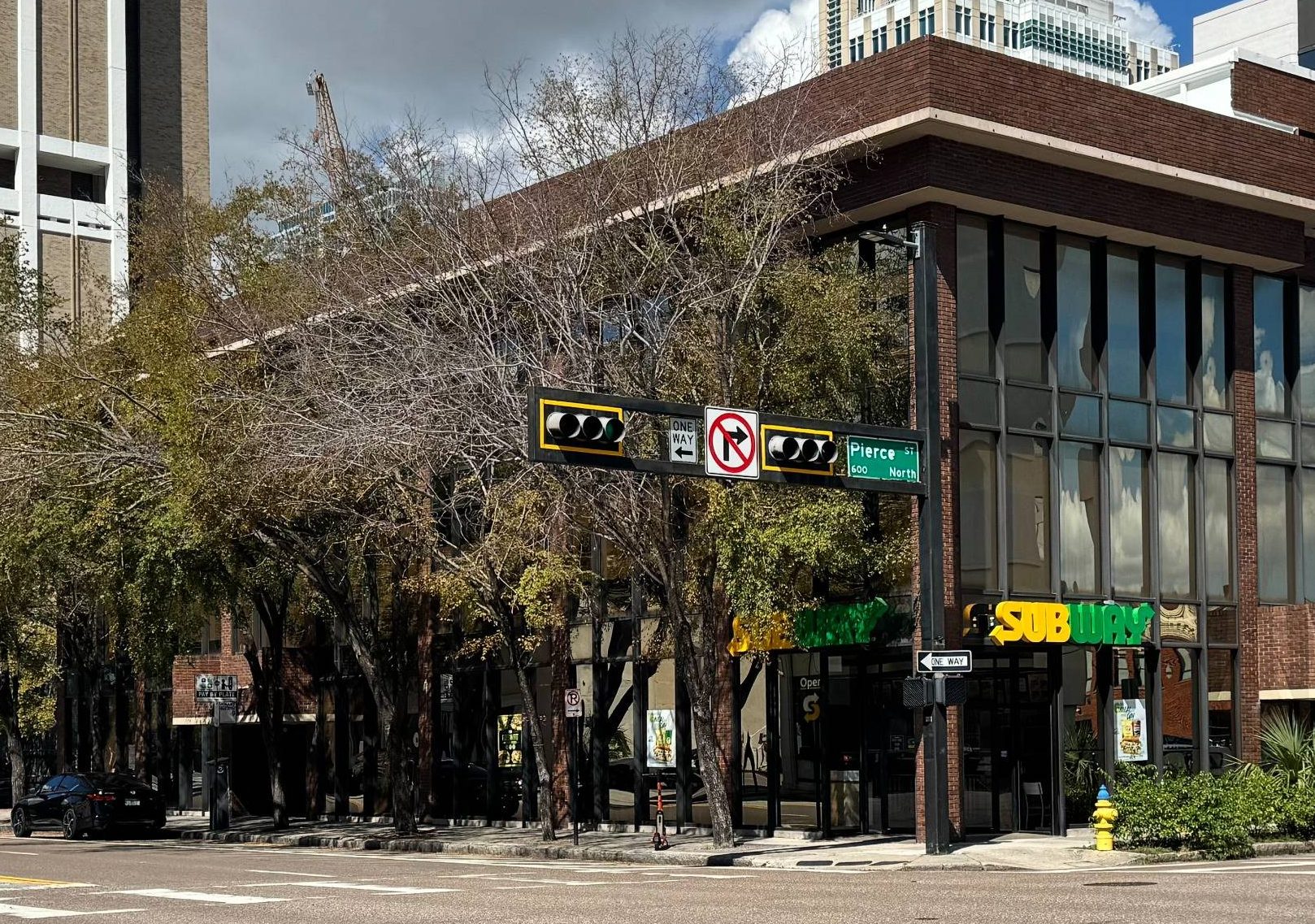
Tampa, FL 33602
Contact Us Now
Free Legal Consultation (813) 727-7159