- Free Consultation 24/7: (813) 727-7159 Tap Here To Call Us


From First DUI to Death Penalty



What Is a Mitigation Report in a Criminal Case? (2026)



Fully rewritten and updated October 27, 2026.
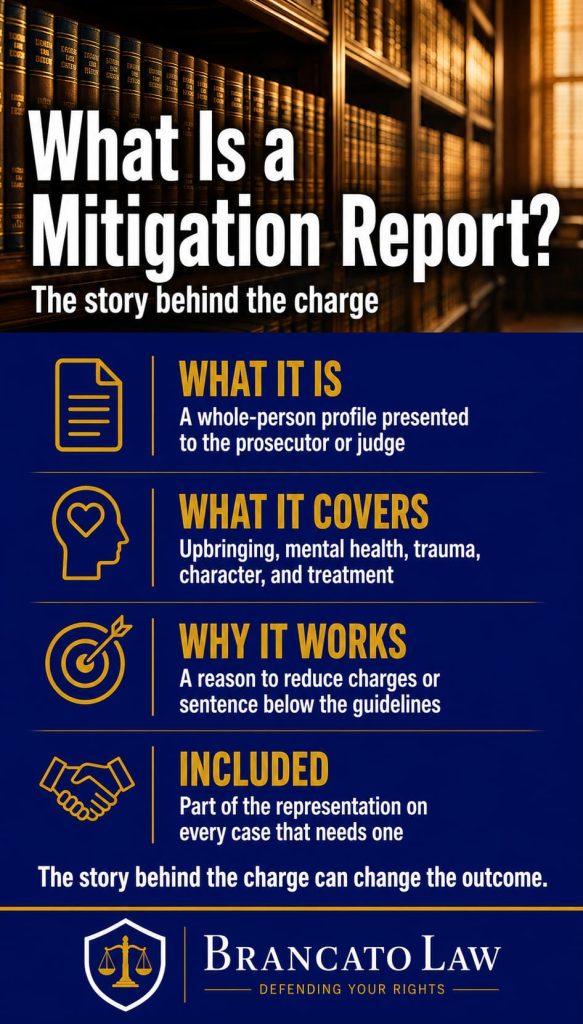
A mitigation report is a written, documented profile of the person behind a criminal charge, covering family history, trauma, mental and physical health, work, character, and the treatment the person has started since the arrest. Defense lawyers give it to prosecutors and judges to support a reduced charge, a diversion offer, or a sentence below the Florida Criminal Punishment Code minimum, called a downward departure. The Brancato Law Firm, P.A. prepares a full mitigation report as part of the representation, at no separate charge, on every case that needs one.
A Florida judge can sentence below the scoresheet only when the defense proves a legal reason for it with evidence, and most of that evidence lives in the client’s own life story. I have made that argument for more than 25 years in Hillsborough County courtrooms, including as former Chief Operations Officer of the Hillsborough County Public Defender’s Office, where I oversaw a staff of over 100 attorneys. I’m Rocky Brancato, founder of The Brancato Law Firm, P.A., a Tampa criminal defense firm, and our attorneys build mitigation into the case from the first week rather than waiting for a sentencing date.
What is a mitigation report in a criminal case?
A mitigation report is an organized, evidence-backed presentation of everything a prosecutor or judge should weigh before deciding what a case is worth. It answers the question behind most plea offers and sentences in Hillsborough, Pinellas, and Pasco courtrooms: who is this person, and what outcome actually protects the community? A one-page character letter does not do that job. A mitigation report is a full social history, with records attached, written so a busy prosecutor can absorb it in one sitting.
Mitigation matters because most criminal cases are decided at the charging and sentencing stages, not at trial. Our firm uses the report in three places: before charges are filed, during plea negotiations, and at a sentencing hearing where we ask the judge for a sentence below the guidelines. Because mental health so often drives mitigation, it is also central to the work on our Tampa criminal mental health lawyer page.
What goes into a mitigation report?
A strong mitigation report covers the client’s whole life, and each point is backed by a record, a witness, or an expert. Our reports typically run many pages and are organized by the areas a Florida court weighs.
| Section of the report | What it covers | Typical supporting records |
|---|---|---|
| Upbringing and family | Childhood, family stability, caregiving duties, and losses | Family interviews, school records, DCF records when relevant |
| Trauma and abuse history | Events that shaped the client’s behavior | Counseling records, medical records, police reports |
| Mental and physical health | Diagnoses, symptoms, disabilities, and treatment history | Treatment records, psychological evaluations, prescriptions |
| Education and work | Schooling, jobs, military service, licenses | Transcripts, employment records, DD-214, supervisor letters |
| Community and family ties | Who depends on the client and who supports them | Letters from employers, clergy, and family members |
| Response to the case | Treatment, counseling, restitution, and remorse since the arrest | Enrollment letters, attendance logs, restitution receipts |
The report takes several hours to prepare, and it requires real time from the client, who has to talk honestly about difficult parts of their life. That effort is what makes it persuasive. Prosecutors see form letters every day, and a report with records behind every sentence stands out.
How does a mitigation report support a downward departure in Florida?
A mitigation report supports a downward departure by proving, with evidence, one of the legal reasons Florida allows a judge to sentence below the lowest permissible sentence. Under section 921.0026, Florida Statutes, a departure is prohibited unless circumstances “reasonably justify” it, and the statute lists mitigating circumstances that do.
The Florida Supreme Court described the process in Banks v. State, 732 So. 2d 1065 (Fla. 1999), an aggravated assault case where the victim suffered a permanent eye injury and the trial judge imposed probation and restitution instead of prison. The court reinstated that departure and explained the two steps: first, the judge decides whether a valid legal ground exists and whether the facts supporting it are proved by a preponderance of the evidence; second, the judge decides whether a departure is the best sentence after weighing all the circumstances. A mitigation report is built to win both steps.
| Mitigator in section 921.0026(2) | What the defense must show | What the mitigation report supplies |
|---|---|---|
| (a) Legitimate, uncoerced plea bargain | The State agreed to the departure | The reasons that persuaded the prosecutor to agree |
| (c) Substantially impaired capacity | The client could not appreciate the conduct or conform to the law | Medical and psychological records from the time of the offense |
| (d) Mental disorder or physical disability requiring specialized treatment | A disorder unrelated to substance abuse, a need for specialized treatment, and amenability to it | Diagnosis, treatment plan, and proof the client is already in treatment |
| (e) Restitution outweighs prison | The victim’s need for payment outweighs a prison sentence | Employment records and a payment plan |
| (j) Unsophisticated, isolated incident with remorse | All three facts | Criminal history, the facts of the offense, and the client’s own statement |
The mental health mitigator is the one we prove most often. In State v. Chubbuck, 141 So. 3d 1163 (Fla. 2014), a cocaine trafficking case, the Florida Supreme Court held that a defendant seeking a departure under paragraph (2)(d) must prove three things by a preponderance of the evidence: a qualifying mental disorder or physical disability, a need for specialized treatment, and amenability to that treatment. The court also held that the defendant does not have to prove the Department of Corrections cannot provide the treatment, though the State may offer evidence that it can. A mitigation report is where those three elements are proved.
Is addiction a mitigating factor for a downward departure in Florida?
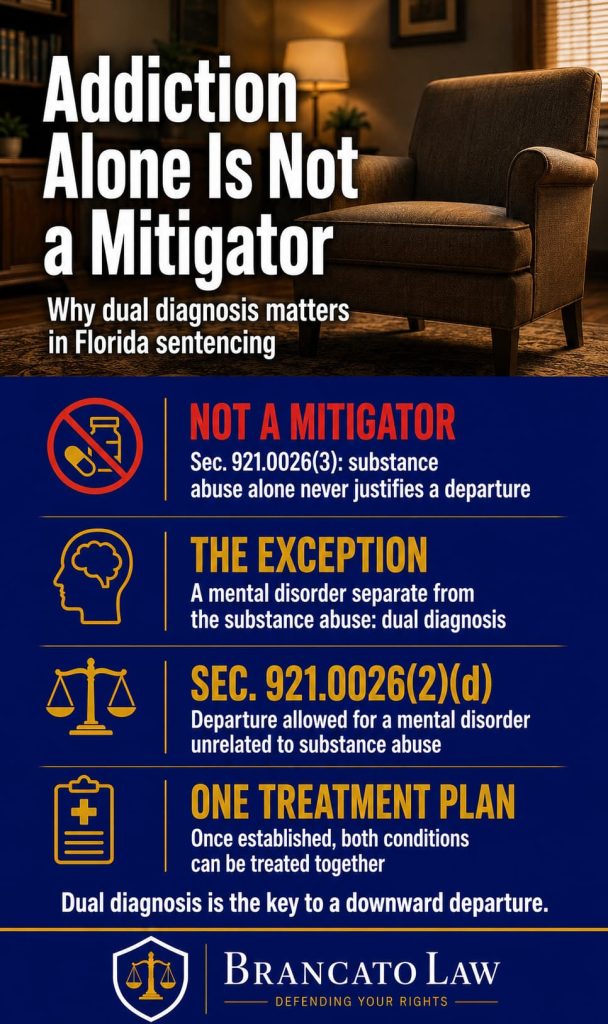
No, not by itself. Section 921.0026(3) says a defendant’s substance abuse or addiction, including intoxication at the time of the offense, “does not, under any circumstances, justify a downward departure,” with one exception: paragraph (2)(m) allows a departure for a nonviolent felony scoring 60 points or fewer when the defendant qualifies for a postadjudicatory drug court program.
That is why dual diagnosis matters. The paragraph (2)(d) mitigator requires a mental disorder “unrelated to substance abuse or addiction.” When a client struggles with addiction and also has a separate condition, such as depression, PTSD, or a bipolar disorder, the mitigation report documents that separate diagnosis. Once it is established, both conditions can be addressed together in one treatment plan, and the departure rests on the separate disorder. Our guide to how to get a downward departure in Florida covers every statutory mitigator in more detail.
The Legislature considered narrowing this mitigator in 2026. CS/SB 1326 would have limited the mental health mitigator to severe conditions and barred its use for certain offenses, but the bill died in committee on March 13, 2026, so section 921.0026(2)(d) remains in force as written.
How often do Hillsborough County felony cases end below the prison threshold?
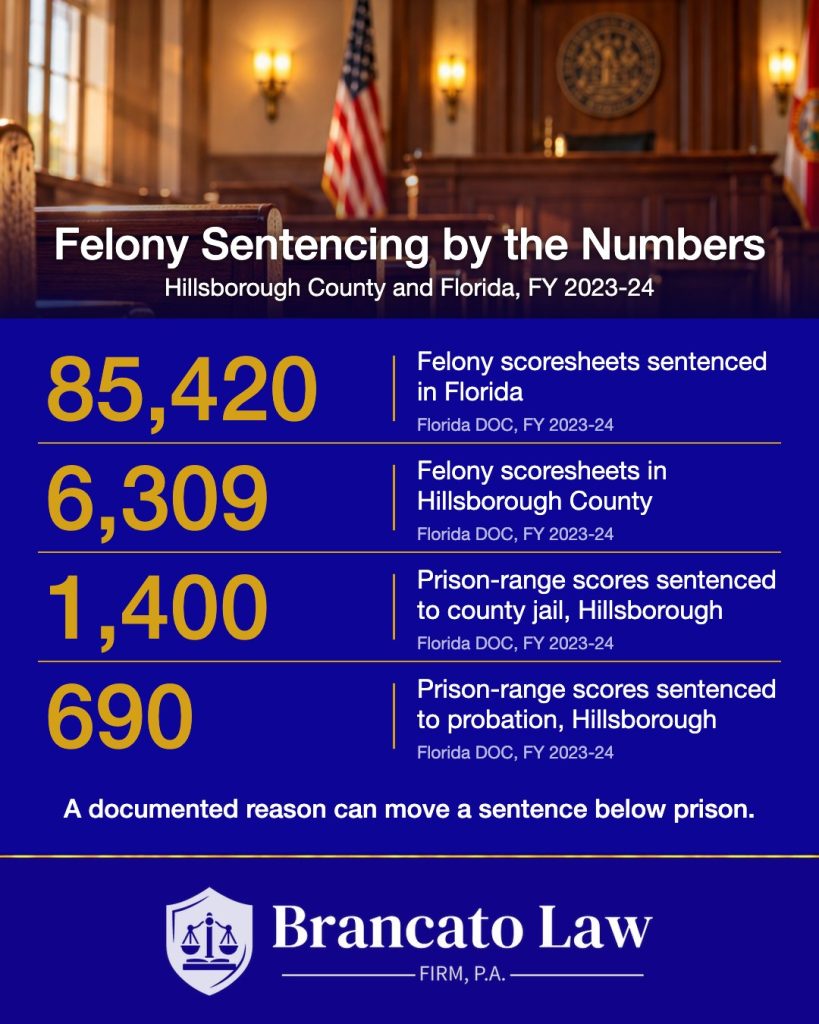
Often enough that mitigation is worth doing in nearly every serious case. According to the Florida Department of Corrections’ Criminal Punishment Code report for FY 2023-24, Florida courts sentenced on 85,420 felony scoresheets that year, and 6,309 of them came from the 13th Judicial Circuit in Hillsborough County.
Under the Code, a scoresheet totaling more than 44 points makes state prison the lowest permissible sentence unless the judge departs or another sentencing law applies. Yet in FY 2023-24, 1,400 Hillsborough County scoresheets that scored more than 44 points ended in a county jail sentence, and another 690 ended in probation, according to the same Department of Corrections report. Those outcomes do not happen by accident. They come from plea negotiations and sentencing hearings where the defense gave the State or the judge a documented reason to go lower.
Research backs up what we see in court. In Modern Sentencing Mitigation, 116 Northwestern University Law Review 1395 (2022), Professor John B. Meixner Jr. coded defense sentencing memoranda from federal felony cases and found that mitigating evidence was a central predictor of the sentences judges imposed, with science-based arguments about mental and physical health among the most persuasive. A well-documented report gives the judge the same kind of evidence in a Florida courtroom. Our county work is described on our Hillsborough County criminal defense attorney page.
Why does our firm include the mitigation report in the representation?
Our firm includes the mitigation report because meaningful mitigation is often either missed or sold as an extra. Some attorneys have never prepared one and do not recognize the moments when it would change the result. Others charge a separate fee before anyone builds the client’s story. On the cases that need it, The Brancato Law Firm includes a comprehensive mitigation report as part of the representation, so the work that most often moves a prosecutor is neither overlooked nor gated behind another invoice.
Sometimes a case needs more than our report. A psychosexual evaluation, a forensic risk assessment, or a neuropsychological workup can supply the formal diagnosis or scored risk level a departure requires. When that adds real value, we bring in the right expert, the expert’s fee is paid directly to the expert, and we tell the client up front why we think it is warranted.
| Feature | Our in-house mitigation report | Paid expert evaluation |
|---|---|---|
| Cost to client | Included in the representation | Paid directly to the expert, only when needed |
| Depth | Full social history, typically many pages | Formal clinical diagnosis or validated risk score |
| Best for | Most cases, from pre-file negotiations to sentencing | Proving a dual diagnosis or a scored risk level |
| When we use it | Every case that needs one | Only when it adds provable value |
When does a case need a mitigation report?
A case needs a mitigation report whenever the outcome depends on the prosecutor’s or judge’s view of the client as a person, which is most felony cases. We prepare one on every case where the client will need it. If we can resolve a case quickly, for example through a pretrial diversion program, a full report may be unnecessary, and we will not ask a client to spend hours on work the case does not require.
Knowing the difference is a skill. My years leading the Public Defender’s Office and handling homicide, sex crime, and child abuse cases in the Major Crimes Unit taught me when a mitigation report is the tool that changes the outcome and when the case can be won another way.
Can a mitigation report stop charges before they are filed?
Yes, sometimes. The State Attorney’s Office reviews a case before deciding what to charge, and during that window our attorneys can present mitigation directly to the assigned prosecutor. In our experience, early mitigation has persuaded prosecutors to file a lesser charge or to decline a case. The earlier we start, the more room we have, which is why we explain the process on our page on representation before charges are filed.
Real results where mitigation made the difference
These are actual outcomes from our office. They show what disciplined mitigation, sometimes ours alone and sometimes paired with an expert and the client’s own treatment, can accomplish.
Child pornography charges reduced to a non-registerable offense (June 2026). Our client faced four counts of possession of child pornography, felonies that would have required lifetime sex offender registration. He contacted the firm after law enforcement visited his home but before any arrest. We moved immediately on mitigation, referring him to treatment and building an extensive mitigation packet that included an independent risk assessment. That mitigation, combined with Rocky Brancato’s review of the files, convinced the prosecutor to reduce the charges to four counts of obscenity, an offense that requires no sex offender registration. The client received a withhold of adjudication and three years of probation.
Below-guidelines probation after a trafficking conviction (July 2025). In a solicitation to commit human trafficking case tried to a jury, the client was convicted. The mitigation work and the treatment he completed before trial led the judge to depart from the guidelines and sentence him to probation. Because of that treatment, he kept contact with his child and was allowed to use the internet on probation, relief that rarely comes with such a conviction.
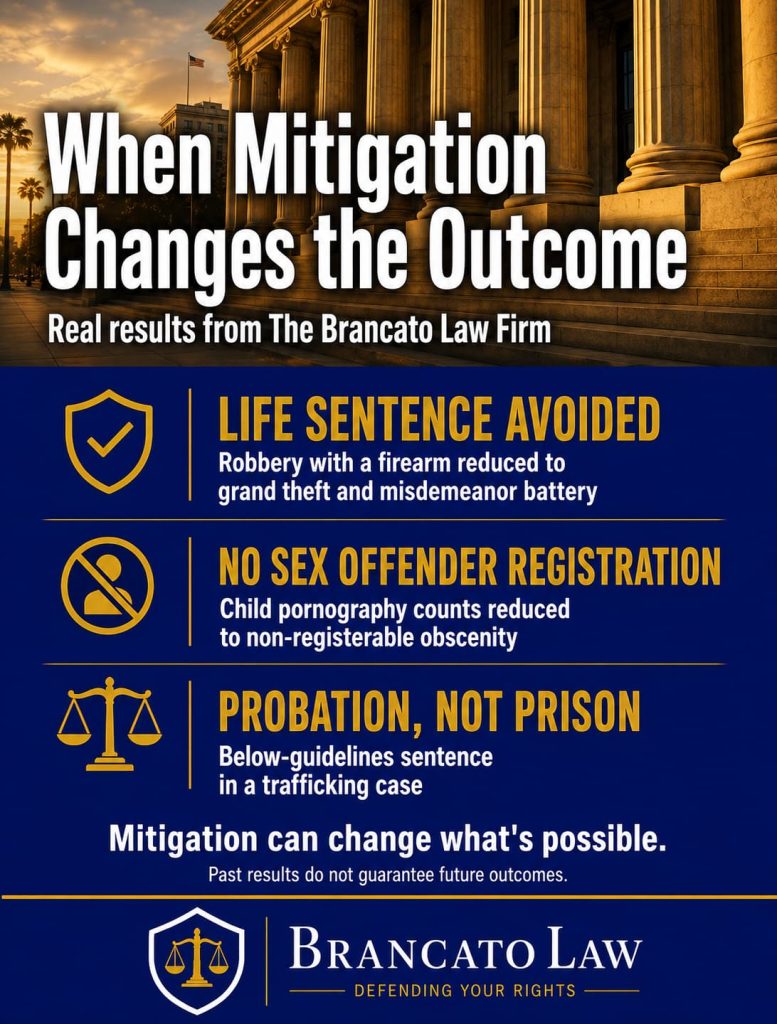
| Original exposure | Outcome | How mitigation helped |
|---|---|---|
| Robbery with a firearm (up to life) | Reduced to grand theft and misdemeanor battery | Deposition work plus a mitigation presentation showed a minor role |
| Four counts of possession of child pornography (lifetime registration) | Reduced to non-registerable obscenity; withhold of adjudication | Treatment referral and a mitigation packet with an independent risk assessment |
| Solicitation to commit human trafficking | Below-guidelines probation; contact with child preserved | Mitigation and pretrial treatment supported a downward departure |
Past results do not guarantee future outcomes.
Frequently asked questions
Who writes the mitigation report in a Florida criminal case?
The defense team writes it, using interviews, records, and when needed an expert’s evaluation. At The Brancato Law Firm, our attorneys and staff prepare the report in-house and present it to the prosecutor or judge ourselves, so the person arguing the case knows every page of it.
Is a mitigation report the same as a presentence investigation report?
No. A presentence investigation (PSI) is prepared by the Department of Corrections at the judge’s request, while a mitigation report is prepared by the defense to advocate for the client. The Brancato Law Firm reviews any PSI for errors and uses our own report to fill in what the PSI leaves out, as described on our criminal mental health defense page.
How long does it take to prepare a mitigation report?
A thorough report takes several hours of client interviews plus the time needed to collect records, which can mean weeks for medical or school files. The Brancato Law Firm starts gathering records early so the report is ready before the plea deadline or sentencing date.
Does a mitigation report help in a sex crime or child pornography case?
Yes. In sex offense cases, treatment, a psychosexual evaluation, and a documented risk assessment can persuade a prosecutor to reduce a charge or a judge to depart, as our June 2026 result shows. The Brancato Law Firm often pairs our report with an independent evaluation in these cases, and our page on pre-file advocacy explains how early that work can start.
Can a mitigation report be used if I already lost at trial?
Yes. A conviction at trial does not prevent a downward departure, and the judge can still weigh mitigation at the sentencing hearing, as happened in our July 2025 trafficking case. The Brancato Law Firm prepares the sentencing presentation while the trial is still being prepared, so nothing is lost if the verdict goes the wrong way.
Does a mitigation report cost extra at The Brancato Law Firm?
No. The report is included in the representation on every case that needs one, and only an outside expert, when one is warranted, is paid separately and directly. The Brancato Law Firm tells clients before any expert is retained what the evaluation will add and why we recommend it.
For how this fits into the rest of a case, see our step-by-step guide to what happens in a Florida criminal case.
Talk to us before the State builds its case
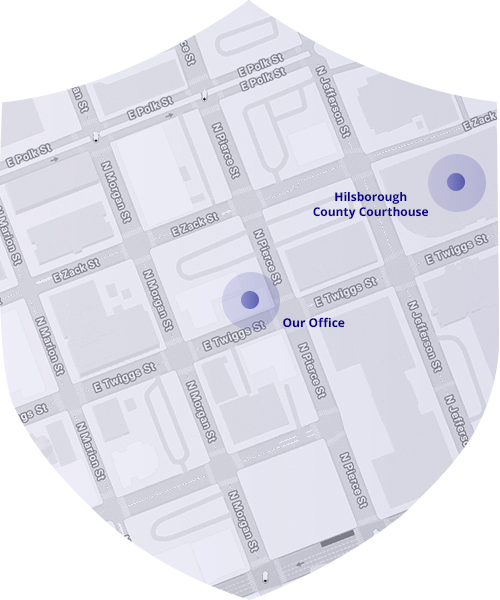
The best time to start a mitigation report is the week of the arrest, or before charges are filed, while records are easy to collect and the prosecutor has not yet made up their mind. Call The Brancato Law Firm, P.A., founded by Tampa Criminal Defense Attorney Rocky Brancato, at (813) 727-7159. You can call us at any hour, and our office is two blocks from the courthouse. Our firm has Spanish-speaking staff, and attorney Jean-Luc Adrien speaks Spanish, Haitian Creole, and French. Read our guide for Spanish-speaking criminal defense clients in Tampa.
For more about our defense strategies, visit our Criminal Mental Health page.
The Brancato Law Firm, P.A.
620 E. Twiggs Street, Suite 205, Tampa, FL 33602
(813) 727-7159
Serving Hillsborough, Pinellas, and Pasco Counties
The Brancato Law Firm, P.A. is a Tampa-based criminal defense practice. We are not affiliated with any other Brancato-named law firms.
Visit Us

Tampa, FL 33602
Contact Us Now
Free Legal Consultation (813) 727-7159