- Free Consultation 24/7: (813) 727-7159 Tap Here To Call Us


From First DUI to Death Penalty



Does the State Have to Reveal a Confidential Informant in Florida? (2026)


Fully rewritten and updated October 26, 2026.
Usually not. In Florida, prosecutors do not have to reveal a confidential informant’s identity unless the informant will testify at a hearing or trial, or unless keeping the identity secret would violate the defendant’s constitutional rights. Under Florida Rule of Criminal Procedure 3.220(g)(2) and Roviaro v. United States, the defense earns disclosure by filing a sworn motion showing that the informant’s testimony would help a specific defense, such as entrapment or misidentification. An informant who only gave police a tip is almost never disclosed. An informant who set up or took part in the deal often is, and when the State refuses a court order to disclose, the charge can be dismissed.
Drug cases built on a confidential informant are usually won or lost at a pretrial hearing most people never hear about: the motion to disclose the informant. I learned how these cases are built from the inside, first in the Major Crimes Unit and then as a former Chief Operations Officer of the Hillsborough County Public Defender’s Office, where I oversaw a staff of over 100 attorneys. I’m Rocky Brancato, founder of The Brancato Law Firm, P.A., a Tampa criminal defense firm, and in more than 25 years in Hillsborough County courtrooms I have seen informant cases fall apart once the defense forces the State to choose between naming its source and keeping its case. Our attorneys file these motions in Hillsborough, Pinellas, and Pasco Counties.
What Is a Confidential Informant in Florida?
A confidential informant is a person who secretly works with police, usually to avoid arrest or reduce a sentence, and who can make controlled buys or report on people he or she knows. Florida defines the term in section 914.28, Florida Statutes: a person who cooperates confidentially with law enforcement, “seeks to avoid arrest or prosecution for a crime, or mitigate punishment,” and can “make a controlled buy or controlled sale” or supply regular information about criminal activity.
That definition matters to the defense. Most informants are working off their own charges, which gives them a reason to deliver an arrest. In trafficking cases, section 893.135(4) lets the state attorney ask the sentencing court to reduce or suspend the sentence of a person who provides “substantial assistance” in the arrest or conviction of others. That incentive is why informant cases deserve close scrutiny, and our Tampa drug crimes attorney page explains how these prosecutions usually begin.
| Type of source | What the person does | Usual disclosure rule |
|---|---|---|
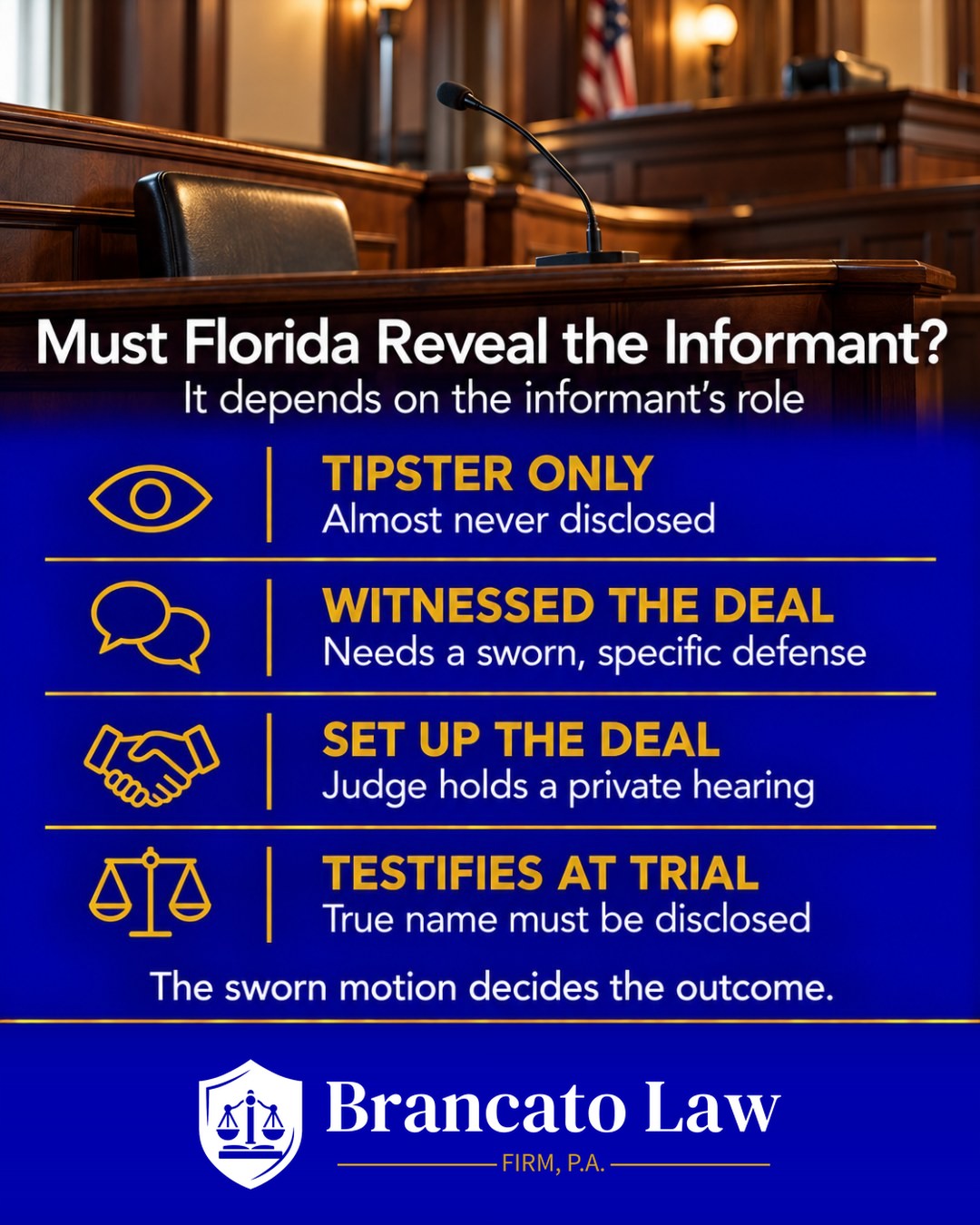
| Tipster | Gives police information that starts an investigation or supports a warrant | Almost never disclosed |
| Confidential informant (participant) | Sets up, witnesses, or takes part in a controlled buy or sale | Disclosure possible on a sworn showing that the testimony helps a specific defense |
| Informant who testifies | Is called by the State at a hearing or trial | Must be disclosed by true name |
| Undercover officer | A sworn officer posing as a buyer or seller | Identified as a State witness; not an informant privilege issue |
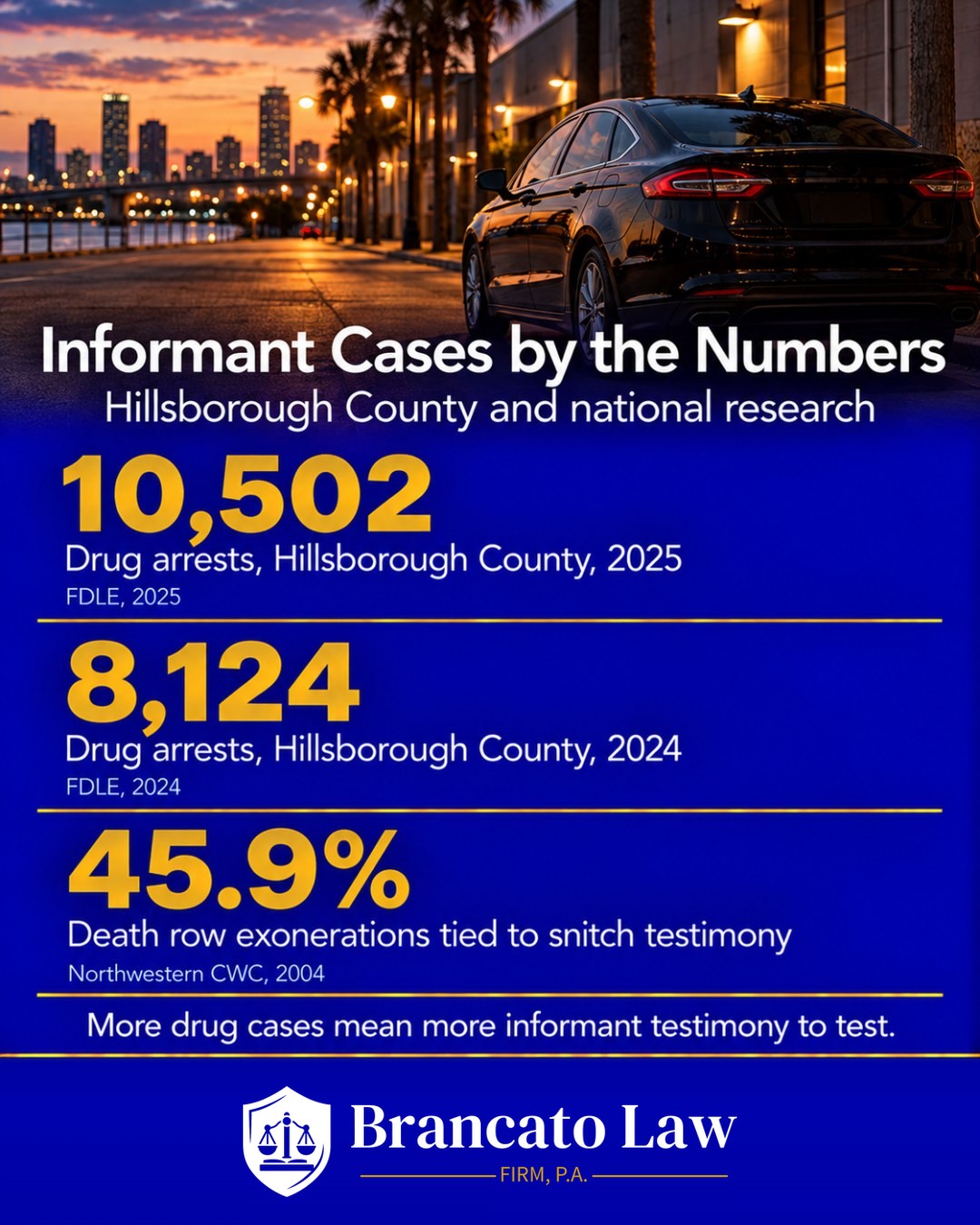
Confidential informants are most common in drug investigations, and drug arrests are rising locally. Hillsborough County recorded 10,502 drug arrests in 2025, up from 8,124 in 2024 and 7,151 in 2023, according to Florida Department of Law Enforcement arrest data published by Florida Health CHARTS. Many of those cases start with a controlled buy arranged through an informant.
Does the State Have to Reveal a Confidential Informant’s Identity?
Only in two situations. Florida Rule of Criminal Procedure 3.220(g)(2) says disclosure of a confidential informant is not required unless the informant “is to be produced at a hearing or trial” or a failure to disclose “will infringe the constitutional rights of the defendant.” Outside those two situations, the State holds a privilege to keep the informant’s name secret, and the defense carries the burden of showing why an exception applies.
When the informant testifies
If the State calls the informant as a witness, the true name must be disclosed. In State v. Hassberger, 350 So. 2d 1 (Fla. 1977), two men were arrested by Orlando police after delivering cannabis to an informant, and the trial court let the informant testify under the name “Ed” without disclosing his real name or address. The Florida Supreme Court held that “the use of a ‘John Doe’ witness is clearly prohibited, and the correct name of the witness must be supplied.” It allowed only an “exceedingly narrow” exception for a current address when the State proves an actual threat to the witness, and it said “all doubts must be resolved in favor of the accused’s sixth and fourteenth amendment right to confront the witnesses against him.”
When keeping the secret would make the trial unfair
The constitutional exception comes from Roviaro v. United States, 353 U.S. 53 (1957), a federal heroin case in which the informant, known only as “John Doe,” set up the sale and was the only other person present. The U.S. Supreme Court held that when the informant’s identity “is relevant and helpful to the defense of an accused, or is essential to a fair determination of a cause, the privilege must give way,” and that if the government still refuses, the court may dismiss the case. The Court rejected any fixed rule and required judges to weigh “the crime charged, the possible defenses, the possible significance of the informer’s testimony, and other relevant factors.”
How Do You Force the State to Disclose a Confidential Informant?
You file a sworn motion that ties the informant to a specific, legally recognized defense. Florida courts do not accept a general claim that the defense needs the name to prepare. Our attorneys follow these steps:
- Identify the informant’s role. Depositions of the case agent and the controlled-buy paperwork usually show whether the informant was a tipster, a witness, or the person who arranged the deal.
- Name a specific defense. Entrapment, misidentification, lack of knowledge of what was in a package, and a fabricated buy are the defenses that most often justify disclosure.
- Support it with sworn facts. The motion or an attached affidavit must allege facts that, if true, make the defense possible.
- Ask for an in-camera hearing. The judge questions the informant privately, outside the defendant’s presence, to decide whether the testimony would help the defense.
- Hold the State to the result. If the judge orders disclosure and the State refuses, the remedy can be dismissal, as Roviaro recognized.
The Second District Court of Appeal, which hears appeals from Hillsborough, Pinellas, and Pasco Counties, has set out that standard several times. In Bailey v. State, 994 So. 2d 1256 (Fla. 2d DCA 2008), a homeless man in Charlotte County swore that a stranger offered him $50 to deliver a container he never looked inside; the stranger was a paid informant and the recipient was an undercover officer. The court held that “when a defendant files a sworn motion or affidavit alleging facts regarding the informant’s involvement that, if true, would support the possibility of a specific defense, the trial court is required to conduct an in-camera hearing,” reversed the conviction, and sent the case back for that hearing. The court added that a defendant does not have to allege every element of entrapment; the defense only has to be possible on the facts alleged.
Hill v. State, 198 So. 3d 830 (Fla. 2d DCA 2016) reached the same result. Kenneth Hill swore that an informant he knew had repeatedly urged him to buy cocaine, and that the earlier calls between them were never recorded. Because Hill showed the informant “was more than a mere tipster but was the sole moving force in arranging the buy,” the Second District reversed his conviction and required an in-camera hearing. A new trial follows if the judge orders disclosure.
What If the Informant Was Only a Tipster?
A tipster is almost never disclosed. The Second District held in State v. Burgos, 985 So. 2d 642 (Fla. 2d DCA 2008) that “an informant’s identity need not be disclosed when the informant’s sole role is to provide probable cause in support of a search warrant.” Burgos wanted the informant’s name to test whether the controlled buy described in a detective’s warrant affidavit really happened, but he offered no evidence that it did not, and the court quashed the trial judge’s disclosure order. The court called a bare claim that the defense cannot prepare without the name insufficient.
Burgos also shows where the opening is. The court left room for a revised motion “supported by evidence sufficient to justify” an in-camera hearing, and it noted that proof the affidavit was false would support a motion to suppress under Franks v. Delaware. When the informant is the only basis for a warrant, our attorneys look for evidence that the buy did not happen as described, and we raise it through a motion to suppress.
Being present is not enough on its own either. In State v. Zamora, 534 So. 2d 864 (Fla. 3d DCA 1988), a Miami-Dade trial judge dismissed cocaine trafficking charges when the State could not produce an informant who allegedly introduced an undercover officer to the sellers and witnessed the sale. The Third District reversed, holding that “merely because a confidential informant is a witness to relevant events in a criminal case does not, without more, require the confidential informant’s production,” because the defendants had not supported a specific defense with sworn facts. The lesson for defendants is that the quality of the motion decides the issue.
| Informant’s role | Typical defense | What courts have held |
|---|---|---|
| Gave a tip or supported a search warrant | Challenge to the warrant | No disclosure without evidence the information was false (Burgos) |
| Witnessed the deal, with no sworn defense | None identified | No disclosure or in-camera hearing (Zamora) |
| Arranged the deal and pressured the defendant | Entrapment | In-camera hearing required (Bailey, Hill) |
| Was the only other participant in the sale | Misidentification or lack of knowledge | Disclosure required or the charge may be dismissed (Roviaro) |
| Testifies for the State | Cross-examination | True name must be disclosed (Hassberger) |
Can a Confidential Informant Entrap You in Florida?
Yes. Florida’s entrapment statute, section 777.201, applies to “a person engaged in cooperation with a law enforcement officer,” which includes a confidential informant. Entrapment occurs when that person induces or encourages someone to commit a crime using methods that “create a substantial risk that such crime will be committed by a person other than one who is ready to commit it.” The defendant must prove entrapment by a preponderance of the evidence, and the issue goes to the trier of fact.
That is why the informant’s identity is so often the whole case. Only the informant can confirm the repeated calls, the pressure, or the offer that came before the recorded buy, and police usually record only the final transaction. Our guide to the entrapment defense in Florida explains the subjective and objective tests in more detail.
Why Is Informant Testimony Treated With Suspicion?
Because informants are paid in leniency, cash, or both, and research has tied their testimony to wrongful convictions. A 2004 study by Northwestern University School of Law’s Center on Wrongful Convictions, The Snitch System, found that of 111 death row exonerations since the 1970s, 51 involved snitch testimony, or 45.9 percent.
Florida responded in 2014. On the recommendation of the Florida Innocence Commission, the Florida Supreme Court amended Rule 3.220 so that prosecutors must disclose informant witnesses, “whether in custody or not,” along with the informant’s criminal history, any statement the informant attributes to the defendant, and anything the informant received or expects to receive in exchange, as reported by The Florida Bar News. Our post on fighting jailhouse informant testimony covers that rule in detail.
Does Rachel’s Law Help a Defendant?
Only indirectly. Section 914.28, known as Rachel’s Law, was passed after Rachel Hoffman, a 23-year-old Tallahassee Police Department informant, was murdered during a 2008 controlled buy. It requires agencies that use informants to tell each recruit that the agency “cannot promise inducements such as a grant of immunity, dropped or reduced charges, or reduced sentences,” to offer a chance to consult a lawyer on request, to screen informants for reliability and criminal history, and to keep secure records on each one.
The statute also says a violation “may not be relied upon to create any additional right, substantive or procedural, enforceable at law by a defendant in a criminal proceeding.” A Rachel’s Law violation will not get a case dismissed by itself. What the agency’s informant file shows, such as payments, prior false information, or deals made off the books, can still matter to credibility and to the in-camera hearing, and our attorneys ask for it.
What Should You Do If You Think an Informant Set You Up?
Talk to a defense lawyer before you talk to anyone else, and do not try to find or contact the informant. These steps protect the defense:
- Do not discuss the case on a jail phone or by text. Those calls and messages are recorded and often end up in discovery.
- Do not contact the person you suspect. Contact can lead to a witness tampering charge and gives the State a new recording.
- Write down the history of every call, message, and meeting with that person, including who brought up drugs first.
- Keep your phone records. Call logs and messages showing repeated requests from the informant are the sworn facts a disclosure motion needs.
- Get counsel involved early. If you are still under investigation, representation before charges are filed can shape what the State does next.
In our experience in Hillsborough County, informant drug cases usually show their weaknesses in discovery, when the controlled-buy paperwork and the agent’s deposition reveal how the deal was arranged. Our Hillsborough County criminal defense attorney page explains how felony cases move through the 13th Judicial Circuit, and our post on signs you are being investigated covers what to watch for before an arrest.
Frequently Asked Questions About Confidential Informants in Florida
What is the difference between a confidential informant and an undercover officer?
An undercover officer is a sworn police officer posing as a buyer or seller, while a confidential informant is a civilian working with police, usually to reduce his or her own charges. The Brancato Law Firm treats the difference as important, because an undercover officer is a disclosed State witness who can be deposed, while an informant’s identity must be won through a disclosure motion.
Can charges be dropped if the State refuses to reveal the informant?
Yes. If a judge orders disclosure and the State refuses, the court may dismiss the charge, and prosecutors sometimes dismiss on their own to protect a valuable informant. Our attorneys at The Brancato Law Firm file disclosure motions early so the State has to make that choice before trial; see our drug crimes defense page.
Do I get to be present at the in-camera hearing with the informant?
Usually not, because the judge questions the informant privately to protect the identity while deciding whether the testimony would help the defense. The Brancato Law Firm prepares the judge for that hearing by spelling out in the sworn motion exactly what the informant should be asked.
Can a confidential informant testify against me without my lawyer knowing who they are?
No. Under State v. Hassberger, a testifying informant’s true name must be disclosed, and only a current address can be withheld on proof of an actual threat. Our attorneys at The Brancato Law Firm use that name to pull the informant’s criminal history and any deals made for the testimony.
Can I be charged based only on a controlled buy with an informant?
Yes, a controlled buy watched by officers can support a sale or delivery charge even if the informant never testifies. The Brancato Law Firm examines whether the informant was searched before and after the buy, whether the money was recorded, and whether the recording actually shows the exchange.
I was arrested after a reverse sting where an informant sold to me. Is that entrapment?
It can be, if the informant pressured or induced you and you were not already ready to commit the crime, as section 777.201 describes. Our attorneys at The Brancato Law Firm build that defense from the messages and calls that came before the recorded deal; our entrapment guide explains the standard.
For how this fits into the rest of a case, see our overview of how a Florida criminal case moves from investigation to appeal.
Talk to a Tampa Defense Attorney About an Informant Case
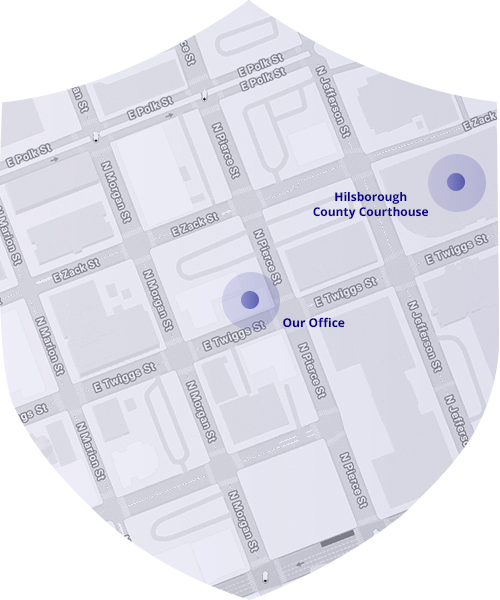
The disclosure motion has to be built before trial, and the phone records that support it can disappear. Call The Brancato Law Firm, P.A., founded by Tampa Criminal Defense Attorney Rocky Brancato, at (813) 727-7159, and our attorneys will start by finding out exactly what the informant did in your case. You can call us at any hour, and our office is two blocks from the courthouse. Our firm has Spanish-speaking staff, and attorney Jean-Luc Adrien speaks Spanish, Haitian Creole, and French. Read our guide for Spanish and Haitian Creole speakers facing criminal charges.
For more about our defense strategies, visit our Tampa Drug Crimes Attorney page.
The Brancato Law Firm, P.A.
620 E. Twiggs Street, Suite 205, Tampa, FL 33602
(813) 727-7159
Serving Hillsborough, Pinellas, and Pasco Counties
The Brancato Law Firm, P.A. is a Tampa-based criminal defense practice. We are not affiliated with any other Brancato-named law firms.
Visit Us
Tampa, FL 33602
Contact Us Now
Free Legal Consultation (813) 727-7159