- Free Consultation 24/7: (813) 727-7159 Tap Here To Call Us


From First DUI to Death Penalty



My College Student Was Arrested in Tampa: What Should Parents Do? (2026)


Updated October 21, 2026
A college student arrested in Tampa who is 18 or older is prosecuted as an adult in Hillsborough County, sees a judge at first appearance within 24 hours, and usually faces a separate campus conduct case at the same time. Parents can hire and pay for a defense lawyer, but the student is the client, so the lawyer’s loyalty and confidentiality run to the student. The steps that matter most in the first days are keeping your student from discussing the facts with police, the school, or friends; getting a lawyer involved before the State Attorney decides what to file; and asking whether a first-offender diversion program can end the case in a dismissal.
The call usually comes after midnight. Your son or daughter has been booked into the Orient Road Jail, every jail call is recorded, and you may be hours away trying to learn what happens next. I’m Rocky Brancato, founder of The Brancato Law Firm, P.A., a Tampa criminal defense firm, and I have practiced in Hillsborough County courtrooms for more than 25 years, including as Chief Operations Officer of the Hillsborough County Public Defender’s Office, overseeing a staff of over 100 attorneys. Our attorneys defend USF, University of Tampa, and Hillsborough Community College students on both tracks at once: the criminal case in the 13th Judicial Circuit and the student conduct case on campus.
Is a college student charged as an adult in Florida?
Yes. A student who is 18 or older is charged as an adult, because section 743.07, Florida Statutes, removes the “disability of nonage” for every person 18 and older. The case goes to adult county court (misdemeanors) or circuit court (felonies), and the arrest record is public. A 17-year-old dual-enrollment or early-admission student starts in the juvenile system instead, which our guides on teen takeover arrests and juvenile expungement in Florida explain.
Age still matters after 18. A student who commits a felony before turning 21 may be sentenced as a youthful offender under section 958.04, which caps the combined sanction at six years, and our parent’s guide to youthful offender sentencing explains who qualifies. At The Brancato Law Firm, we raise youthful offender eligibility during plea negotiations, not only at sentencing.
What happens in the first 48 hours after a student is arrested in Tampa?
The student is booked, sees a judge at first appearance within 24 hours, and is either released or held. In Hillsborough County, the student appears by video from the jail while the judge and lawyers appear from downtown. Hillsborough County does not offer pretrial services supervision as a release option, even though neighboring counties do, so release turns on the bond amount and conditions such as a no-contact order. Students arrested near USF St. Petersburg or Eckerd College go through Pinellas County, and students arrested near Saint Leo University go through Pasco County, where the procedures differ.
After first appearance, the State Attorney’s Office reviews the arrest report and decides what to file, a process that can take weeks. That window is when representation before charges are filed can change the outcome. In January 2026, a mother called our firm because her college-age son had an active warrant for domestic violence battery after the family called police only to get him mental health help. Our firm prepared affidavits from both parents and presented them to the intake prosecutor, and the State ended the prosecution within 24 hours of her call, before he was ever arrested. Our Hillsborough County criminal defense attorney page explains each later stage of a local case.
What are the most common charges against college students in Tampa?
Most student arrests in Tampa involve alcohol, fake IDs, marijuana or THC products, DUI, battery after a bar or party fight, and trespass. The table shows the statute, the maximum penalty, and the paths our attorneys usually pursue for a first offense. Every diversion program requires the State Attorney’s consent, so none is automatic.
| Charge | Florida law | Maximum penalty (first offense) | Paths our attorneys pursue |
|---|---|---|---|
| Possession of alcohol under 21 | s. 562.111 | Second-degree misdemeanor: up to 60 days under s. 775.082 | Pre-arrest diversion or the Misdemeanor Intervention Program, ending in no charges or a dismissal |
| Lying about age to buy alcohol | s. 562.11(2) | Second-degree misdemeanor; up to 40 hours of community service if a state license or ID was used | Misdemeanor Intervention Program |
| Fake or counterfeit ID | s. 322.212 | Third-degree felony: up to 5 years. A real ID with an altered birth date is a second-degree misdemeanor | Reduction to a misdemeanor, or Pretrial Intervention |
| Marijuana flower, 20 grams or less | s. 893.13(6)(b) | First-degree misdemeanor: up to 1 year | Misdemeanor Intervention Program or DETRR drug diversion |
| THC vape cartridge, wax, or edible | s. 893.13(6)(a) | Can be charged as a third-degree felony: up to 5 years | DETRR drug diversion or Pretrial Intervention |
| DUI | s. 316.193 | Up to 6 months and a $500 to $1,000 fine | Challenge the stop and testing; reduction to reckless driving where the evidence is weak |
| Driving under 21 at .02 or higher | s. 322.2616 | Not a crime; 6-month license suspension (1 year for a refusal) | Request a review within 10 days |
| Battery | s. 784.03 | First-degree misdemeanor: up to 1 year | Dismissal on video or self-defense evidence; Misdemeanor Intervention Program |
| Trespass | s. 810.08 and s. 810.09 | Second-degree misdemeanor in a structure; first-degree misdemeanor on posted or warned property | Misdemeanor Intervention Program |
Alcohol and fake ID charges
A fake ID is the charge that most often surprises parents, because possessing a counterfeit license is a third-degree felony under section 322.212, even when it was only used to get into a bar. Our firm works to keep a felony finding off the record, for the scholarship reasons covered below, and our post on Florida alcohol offenses covers the related charges in more detail.
Florida’s overdose protection has a gap. Under section 893.21, a person who calls for help during an alcohol or drug overdose cannot be prosecuted for drug possession discovered because of that call, but the statute does not cover the underage alcohol charge itself.
Marijuana, THC, and drug charges
Florida treats marijuana flower and THC concentrates differently. Twenty grams or less of flower is a misdemeanor, but section 893.13(6)(b) excludes resin and its derivatives, so a THC vape cartridge or wax can be charged as a felony. Whether a product is illegal cannabis or legal hemp often turns on lab testing, and our Tampa drug crimes attorney page explains how our attorneys challenge that testing.
DUI and under-21 drivers
A student under 21 can face two separate cases from one traffic stop: a criminal DUI at .08 under section 316.193, and an administrative suspension at .02 under section 322.2616. The license review must be requested within 10 days after the notice of suspension, so that deadline comes before almost anything else in the case. Our Tampa DUI lawyer page explains how our attorneys challenge the stop and the testing. Our post on what happens after a DUI arrest in Hillsborough County walks through each deadline and court date.
Battery and fights
Bar and party fights are usually charged as simple battery, a first-degree misdemeanor, and video is often the deciding evidence. Our Tampa violent crime lawyer page covers aggravated battery and self-defense cases. Our post on battery charges in Florida explains when a fight becomes aggravated battery.
Which diversion programs can keep a first arrest off a student’s record in Hillsborough County?
The Hillsborough County State Attorney’s Office runs several diversion programs that end in no charges or a dismissal for eligible first-time offenders. According to the State Attorney’s Office program list, the programs a student is most likely to see are:
- Adult Pre-Arrest Diversion Program (APAD): for people with minimal or no criminal history who commit an eligible misdemeanor. No charges are filed on completion.
- Misdemeanor Intervention Program (MIP): for first-time offenders, only with the State Attorney’s consent, requested by defense counsel through the assigned prosecutor.
- Drug Education and Treatment Reducing Recidivism (DETRR): for low-risk people charged only with drug possession. The charge is dismissed after treatment or education and six months without a new arrest.
- Pretrial Intervention: for certain first-time felony offenders, supervised by the Department of Corrections, under section 948.08.
The DUI program, Reducing Impaired Driving Recidivism (RIDR), adds sanctions such as alcohol monitoring and is not a dismissal program.
Diversion matters for students because of what comes after it. A dismissed case can usually be expunged under section 943.0585, and a withhold of adjudication can be sealed under section 943.059 if the student has never been adjudicated guilty. Even an expunged arrest must still be disclosed to The Florida Bar, to education licensing agencies, and to several health care agencies under section 943.0585(6)(b). Future lawyers, teachers, and nurses benefit most from a case that is never filed, which is why our firm pushes for a no-file outcome first.
Can parents get information about an adult student’s arrest or school records?
Parents can see the criminal case, because Florida court records are public, but the school’s disciplinary file belongs to the student. Under the federal privacy law known as FERPA, 20 U.S.C. § 1232g, rights over education records transfer to the student once the student turns 18 or attends a college. The Brancato Law Firm keeps parents informed within those limits, with the student’s written consent.
There are two exceptions parents should know. A school may share records with the parents of a student who is their tax dependent, under 34 C.F.R. § 99.31(a)(8). A college may also tell parents when a student under 21 has committed a disciplinary violation involving alcohol or drugs, under section 1232g(i). Both are permissions, not requirements, so the simplest path is for your student to sign the school’s release form.
Who is the client when parents pay for the lawyer?
The student is the client, even when parents sign the fee agreement and write the check. Florida’s ethics rule on third-party payment, Rule 4-1.8(f) of the Rules Regulating The Florida Bar, allows a lawyer to accept payment from someone other than the client only if the client gives informed consent, the payer does not interfere with the lawyer’s judgment, and the client’s information stays confidential.
Privilege is the second issue. Under section 90.502, a lawyer-client communication stays confidential only if third persons present are furthering the legal services or are reasonably necessary to transmit it. In Gerheiser v. Stephens, 712 So. 2d 1252 (Fla. 4th DCA 1998), a mother met with a lawyer to hire him for her jailed son, and the court held that conversation privileged because she was acting as her son’s agent. In Witte v. Witte, 126 So. 3d 1076 (Fla. 4th DCA 2012), the appeals court reversed a ruling that a client waived privilege by talking with her lawyer in front of her daughter, holding that a family member’s presence does not decide waiver by itself.
Your first call to find a lawyer is protected, but a parent who sits in on every fact discussion invites a fight over privilege. Our attorneys at The Brancato Law Firm meet with the student alone about the facts and bring parents in for strategy, cost, and scheduling, with the student’s consent. Anything your student tells you directly, outside a meeting with the lawyer, is not covered by the attorney-client privilege.
How does the campus conduct case work, and can it hurt the criminal case?
The school runs its own disciplinary case on its own timeline, and what your student says there can reach the prosecutor. USF’s Student Code of Conduct, Regulation USF6.0021, applies to student behavior “regardless of location or forum,” and it states that the conduct process “may be carried out prior to, concurrently with, or following civil or criminal proceedings.” USF can also impose an interim suspension, an immediate temporary separation from the university, while the case is pending.
Florida law gives students at public institutions such as USF and HCC specific rights. Under section 1006.60(3), the student gets written notice at least 7 business days before a proceeding, a witness list and the known evidence at least 5 business days before it, a presumption of no violation, the right to remain silent, and an advisor or lawyer who may directly participate and question witnesses. The University of Tampa is a private university, so section 1006.60 does not govern it, and its own Student Code of Conduct sets the procedure.
In Gabrilowitz v. Newman, 582 F.2d 100 (1st Cir. 1978), a University of Rhode Island senior charged with assault with intent to commit rape faced a campus hearing on the same facts. The federal appeals court held that his testimony at the hearing would be “entirely voluntary and subsequently admissible at the criminal case,” and it ruled that due process required letting a lawyer advise him during the hearing. Florida’s statute now guarantees that help at public colleges.
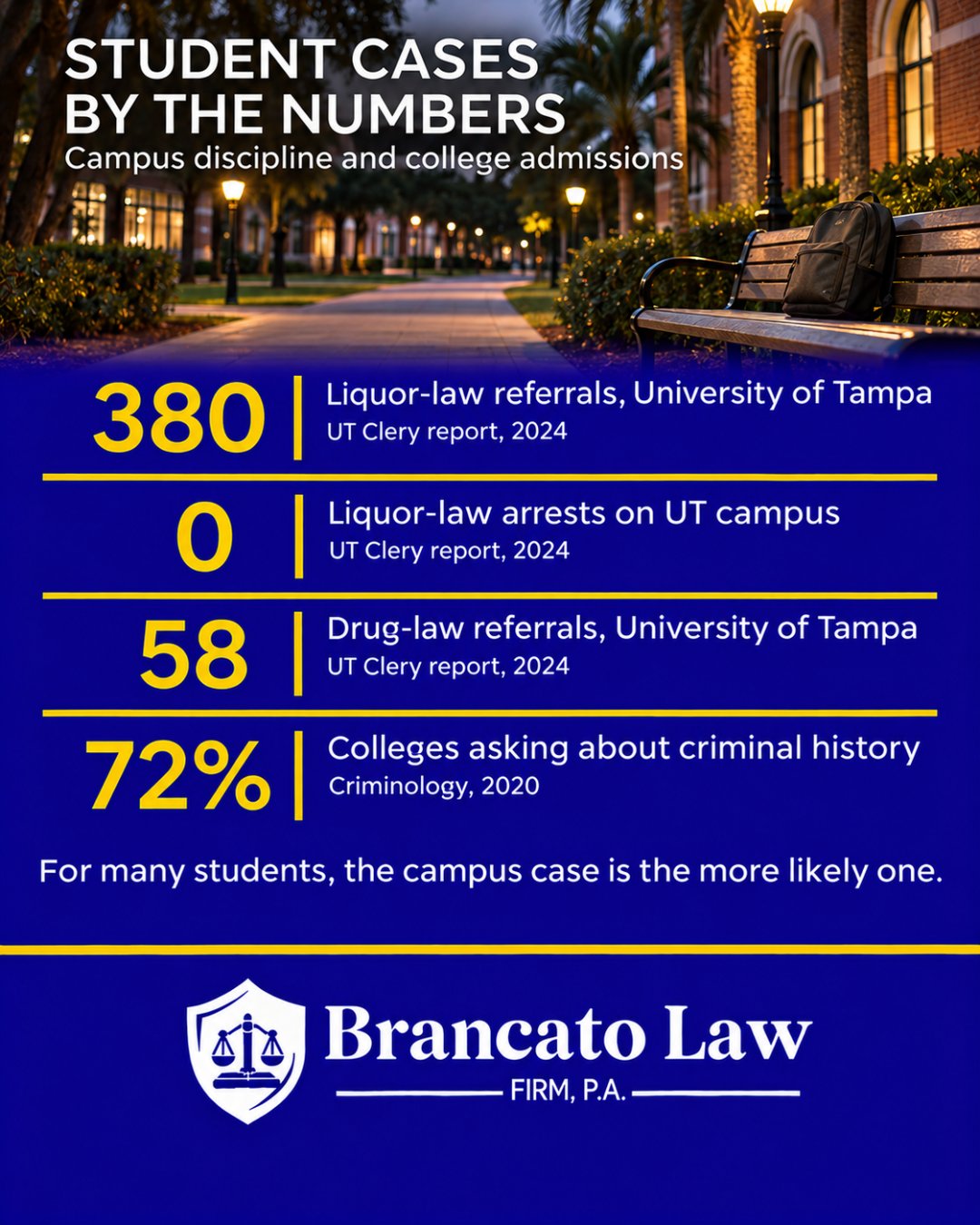
For many students, the campus case is the more likely one. In 2024, the University of Tampa reported 380 liquor-law disciplinary referrals and zero liquor-law arrests on campus, plus 58 drug-law referrals and zero drug arrests, in its federally required Clery Act crime statistics. In May 2025, a parent hired our firm for a USF student facing a conduct hearing after an off-campus arrest. Our firm prepared the student with written materials and a mock hearing, and USF resolved the matter informally with no disciplinary record.
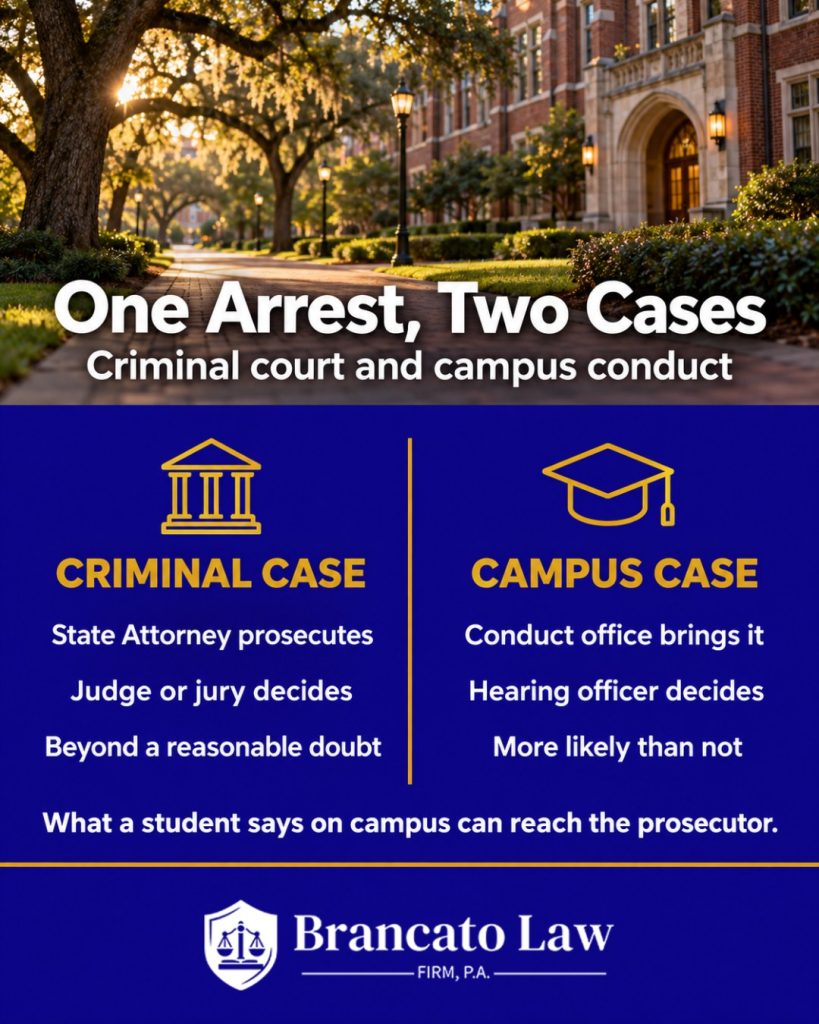
| Issue | Criminal case | Campus conduct case |
|---|---|---|
| Who brings it | State Attorney’s Office, 13th Judicial Circuit | Student conduct office or Title IX office |
| Who decides | Judge or jury | Hearing officer or panel |
| Standard of proof | Beyond a reasonable doubt | Preponderance of the evidence (“more likely than not”) at public institutions |
| Role of the lawyer | Full representation in court | At USF and HCC, the lawyer may directly participate and question witnesses; at UT, the school’s own code controls |
| Right to remain silent | Fifth Amendment | Guaranteed at public institutions by section 1006.60(3)(d) |
| Timing | Weeks to months; filing decision first | Notice at least 7 business days before a proceeding at public institutions; interim suspension can be immediate |
| Possible outcomes | Jail, probation, fines, a criminal record | Interim suspension, suspension, expulsion, housing removal |
| Who can see it | Public court record | Education record protected by FERPA |
| Cross-over risk | Statements to the school can be used by prosecutors | A dismissed criminal case does not end the campus case |
My son was accused of a sex offense at college in Tampa. What happens next?
A sexual misconduct accusation at college usually starts two cases at once: a Title IX or conduct case at the school and a criminal investigation by campus or city police, often weeks before any arrest. The detective may try to interview your son, or ask the accuser to make a recorded call to him, before he knows he is a suspect. That pre-arrest stage is where pre-file advocacy matters most. In January 2026, our firm represented a client in a lewd or lascivious conduct investigation that closed with no arrest and no charges.
On the school side, the U.S. Department of Education formally restored the 2020 Title IX regulations on September 29, 2026. Under 34 C.F.R. § 106.45, a college’s grievance process must presume the respondent is not responsible, and a postsecondary school must hold a live hearing where each party’s advisor can cross-examine the other party and witnesses. USF handles these cases under its Sex Discrimination Policy 0-004.
Our firm’s sex crime defense draws on my years in the Major Crimes Unit, where I handled homicide, sex crime, and child abuse cases. Our attorneys coordinate the Title IX advisor role with the criminal defense, so the student does not hand the prosecutor evidence at the campus hearing. Your son should not contact the accuser or delete any messages, and our post on what to do if falsely accused of a sex crime lists the mistakes to avoid, and our Tampa sex crimes lawyer page explains how we defend these charges. For a student under 18, see our parent’s guide to juvenile sex offender registration.
How can an arrest affect financial aid, Bright Futures, and graduate school?
A drug conviction no longer affects federal student aid, but a felony can cost a Bright Futures award, and any record can follow a student into graduate school applications. The Brancato Law Firm weighs every plea offer against the student’s scholarship and career plans.
Federal aid. The FAFSA Simplification Act removed the drug-conviction penalty. The U.S. Department of Education announced in a June 17, 2021 Federal Register notice that a drug conviction would “no longer impact a student’s Title IV aid eligibility” and that the drug conviction question would be removed from the FAFSA starting with the 2023-2024 form.
Bright Futures. To be eligible for an initial Bright Futures award, a student must not have been found guilty of, or pleaded no contest to, a felony, under section 1009.531(1)(e). A no contest plea counts even when the judge withholds adjudication. The renewal statute, section 1009.532, does not mention criminal charges, but it requires at least 24 semester hours a year, so a suspension or jail time can cost the award indirectly.
Graduate and professional school. In a study published in Criminology in 2020, Robert Stewart and Christopher Uggen found that about 72% of colleges ask about criminal history and that applicants who disclosed a felony were rejected at nearly 2.5 times the rate of matched applicants. Earlier research by David Kirk and Robert Sampson in Sociology of Education (2013) found that arrested youth enrolled in four-year colleges at significantly lower rates than otherwise similar youth.
What if my child is an international student?
An international student should get advice from an immigration lawyer before accepting any plea or diversion offer, because immigration law counts some Florida outcomes as convictions. The USCIS Policy Manual states that a conviction exists for immigration purposes when adjudication is withheld, if the person pleaded guilty or no contest and the judge imposed some penalty. Drug offenses carry the most risk, because 8 U.S.C. § 1182(a)(2)(A)(i)(II) makes a noncitizen inadmissible for a controlled substance violation, even one the person only admits.
The Brancato Law Firm does not practice immigration law, so our attorneys coordinate with the student’s immigration counsel before any plea. In September 2026, our firm obtained diversion for a client charged with possessing a short-barreled rifle, cannabis, and paraphernalia, and deportation was avoided.
How do parents choose a criminal defense lawyer for a college student in Tampa?
Choose a lawyer who practices only criminal defense, appears in the Hillsborough County courthouse every week, and will handle the campus conduct case alongside the criminal case. I wrote a book on this question, “How to Choose a Major Crimes Attorney – or Any Criminal Defense Attorney for That Matter,” and its checklist applies to a student case:
- A practice devoted entirely to criminal defense. The Brancato Law Firm handles only criminal cases, from misdemeanors to capital cases, in Hillsborough, Pinellas, and Pasco Counties.
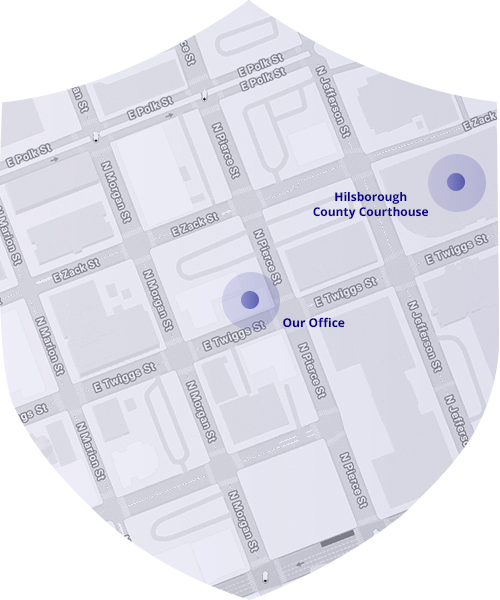
- Local knowledge. Diversion depends on knowing how the State Attorney’s Office decides. Our office is two blocks from the Hillsborough County Courthouse.
- A trial record. I have tried more than 150 jury trials to verdict.
- Conduct-hearing experience. Ask whether the lawyer will prepare your student and attend the campus hearing as the advisor.
- Communication. You can call us at any hour. Clients get case updates through our client portal, and we return calls within 24 hours.
- A clear fee. We quote a flat fee based on the facts and how involved the case is, and it covers the whole case including trial. A separate trial fee gives a lawyer a financial incentive to settle before trial preparation. We ask for at least half up front, with a payment plan for the balance while the case is pending. We are neither the most nor the least expensive firm in Tampa, consultations are free, and our post on how much a criminal defense attorney costs in Tampa explains the range.
What should parents do in the first 72 hours?
Act before the school schedules a meeting and before the State Attorney makes a filing decision:
- Tell your student to stop talking about the facts with police, school officials, roommates, group chats, and social media. Jail calls are recorded.
- Do not let your student attend a conduct meeting alone. Read the notice for the date and the deadline to respond.
- Do not contact the alleged victim or witnesses, directly or through friends.
- Preserve evidence: texts, photos, rideshare receipts, bank records, and the names of any bar or apartment with security cameras, before video is overwritten.
- Write a timeline of the night while memories are fresh, and give it only to the lawyer.
- Follow every release condition, including no-contact orders and any curfew.
- For a DUI or under-21 stop, mark the 10-day deadline to request a license review.
- Call a defense lawyer before the filing decision, while diversion and a no-file outcome are still on the table.
Our attorneys at The Brancato Law Firm can begin on the conduct notice, evidence preservation, and the State Attorney’s filing review the same day you call.
Recent results for students and young adults
| Case | Result | What our firm did |
|---|---|---|
| USF student conduct hearing after an off-campus arrest (May 2025) | No disciplinary record | Prepared the student with written materials and a mock hearing; USF resolved the matter informally |
| Domestic violence battery warrant, college-age son (January 2026) | Prosecution ended within 24 hours; never arrested | Presented affidavits from both parents to the intake prosecutor |
| Drug possession, multiple counts (October 2026) | Dismissed after diversion; eligible for expungement | Negotiated a diversion program leading to dismissal |
| Disorderly intoxication and harassing a first responder, Ybor City (January 2026) | No charges filed | Showed the video did not support the intoxication charge; presented mitigation |
| Marijuana DUI (September 2025) | Reduced to reckless driving | Negotiated the reduction |
| Battery (January 2026) | Dismissed | Frame-by-frame video review showed the client was the actual victim |
Past results do not guarantee future outcomes. Every case depends on its own facts.
For how this fits into the rest of a case, see our overview of how a Florida criminal case moves from investigation to appeal.
Frequently asked questions
My college-age son was arrested in Tampa. Can you recommend a criminal defense lawyer?
Look for a lawyer whose practice is entirely criminal defense, who works in the Hillsborough County courthouse every week, and who will handle the campus conduct case along with the criminal charge. The Brancato Law Firm defends college students in both forums, and our founder has tried more than 150 jury trials to verdict. Our page on defending cases in Hillsborough County courts describes how we handle local cases from first appearance through trial.
What lawyers handle sex offense accusations against college students in Tampa?
Criminal defense lawyers with sex crime trial experience handle these cases, ideally ones who can also serve as the student’s advisor in the Title IX hearing. Our attorneys at The Brancato Law Firm defend sex crime accusations at the investigation stage, in Title IX proceedings, and at trial. Our sex crimes defense page explains how we approach these cases.
Can a fake ID charge be dropped in Florida?
Yes, a fake ID charge can be dropped, reduced to a misdemeanor, or resolved through diversion, depending on the facts and the student’s record. The Brancato Law Firm asks the State Attorney’s Office for Pretrial Intervention or a reduction in first-offense fake ID cases so the student avoids a felony finding. Avoiding that finding protects Bright Futures eligibility under section 1009.531.
Will USF tell me if my child gets in trouble for drinking?
USF may notify parents when a student under 21 commits a disciplinary violation involving alcohol or drugs, because federal law permits that disclosure but does not require it. When The Brancato Law Firm represents a student in a conduct case, we ask the student to sign the school’s release so the parents and our attorneys can stay informed.
Should my child go to a student conduct meeting before the criminal case is over?
Your child should not go without a lawyer’s advice, because statements at a conduct meeting can be used in the criminal case. Our attorneys at The Brancato Law Firm prepare students for conduct meetings and, at USF and HCC, can participate directly under section 1006.60(3). When police are still investigating, we start with help before charges are filed so the criminal and campus strategies match.
Does a misdemeanor marijuana charge affect my student’s financial aid in 2026?
No, a drug conviction no longer affects federal student aid eligibility. The Brancato Law Firm still pushes for diversion in marijuana cases, because a dismissed case can be expunged and keeps the arrest out of most background checks. A THC vape charge is different, because a felony plea can cost an initial Bright Futures award.
For more about our defense strategies, visit our Hillsborough County Criminal Defense page.
Parents who call us in the first few days give their student the most options, because the State Attorney’s filing decision and the school’s conduct notice usually arrive within weeks of the arrest. The Brancato Law Firm, P.A., founded by Tampa Criminal Defense Attorney Rocky Brancato, will review the arrest report, the conduct notice, and every diversion option, and tell you plainly what we would do next. Call (813) 727-7159 for a free consultation; you can call us at any hour. Our firm has Spanish-speaking staff, and attorney Jean-Luc Adrien speaks Spanish, Haitian Creole, and French.
The Brancato Law Firm, P.A.
620 E. Twiggs Street, Suite 205, Tampa, FL 33602
(813) 727-7159
Serving Hillsborough, Pinellas, and Pasco Counties
The Brancato Law Firm, P.A. is a Tampa-based criminal defense practice. We are not affiliated with any other Brancato-named law firms.
Visit Us
Tampa, FL 33602
Contact Us Now
Free Legal Consultation (813) 727-7159