- Free Consultation 24/7: (813) 727-7159 Tap Here To Call Us


From First DUI to Death Penalty



Can You Get a DUI for Prescription Drugs in Florida? (2026)


Rewrite/update date: November 3, 2026. Originally published in April 2025.
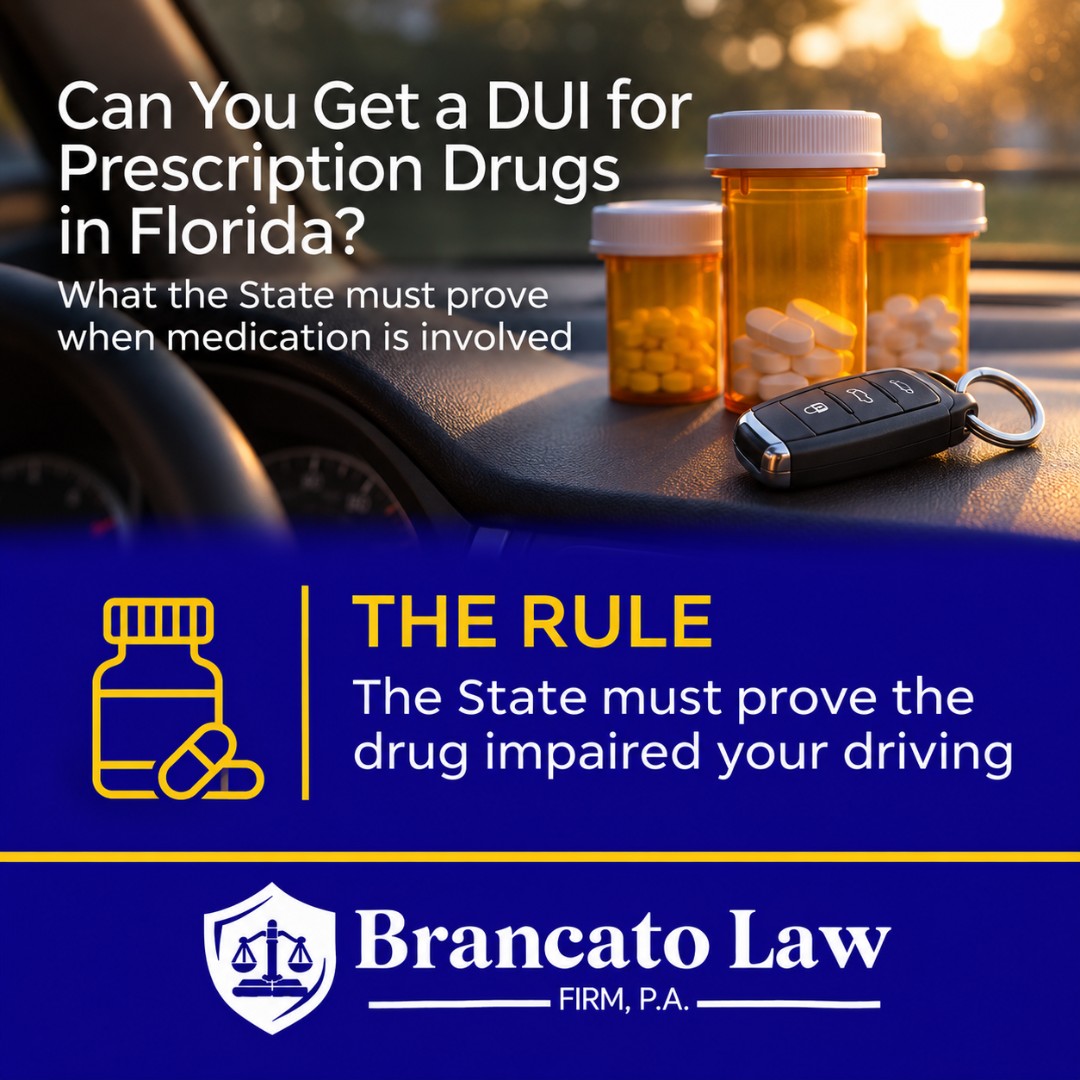
Yes. You can be charged with DUI in Florida for a prescription drug if the drug is a controlled substance under chapter 893 and it impaired your normal faculties while you were driving or in actual physical control of a vehicle, under section 316.193, Florida Statutes. A valid prescription is not a defense by itself. Florida has no legal limit for prescription drugs, so the State must prove actual impairment, and a test showing the drug was in your body does not prove that on its own.
If you were arrested for DUI after taking a medication exactly as your doctor prescribed, the first thing to know is that the State has a harder case to prove than it does with alcohol. I am Rocky Brancato, founder of The Brancato Law Firm, P.A., a Tampa criminal defense firm; I am a member of the National College for DUI Defense and a former police academy instructor who trained officers, and I have spent more than 25 years in Hillsborough County courtrooms. In prescription drug DUI cases, our attorneys start with the toxicology report, the prescription records, and the officer’s video, because the gap between a drug being present and a driver being impaired is where these cases are won.
Can you get a DUI for prescription drugs in Florida?
Yes. Section 316.193(1)(a), Florida Statutes, makes it a crime to drive or be in actual physical control of a vehicle while “under the influence of alcoholic beverages, any chemical substance set forth in s. 877.111, or any substance controlled under chapter 893, when affected to the extent that the person’s normal faculties are impaired.” The statute does not exempt drugs taken with a prescription. The penalties for a prescription drug DUI are the same as for an alcohol DUI, which our guide to Florida DUI penalties lays out.
Which prescription drugs can lead to a DUI charge in Florida?
The drugs that most often lead to DUI arrests are the sedating and stimulant medications listed on Florida’s controlled substance schedules in section 893.03, Florida Statutes. The table shows common examples and where each appears.
| Drug class | Common examples | Florida schedule (section 893.03) |
|---|---|---|
| Opioid pain medications | Oxycodone (Percocet, OxyContin), hydrocodone (Norco) | Schedule II |
| ADHD stimulants | Amphetamine (Adderall), methylphenidate (Ritalin) | Schedule II |
| Benzodiazepines (anxiety) | Alprazolam (Xanax), diazepam (Valium), lorazepam (Ativan), clonazepam (Klonopin) | Schedule IV |
| Sleep medications | Zolpidem (Ambien), eszopiclone (Lunesta) | Schedule IV |
| Other pain and muscle medications | Tramadol, carisoprodol (Soma) | Schedule IV |
Some widely prescribed medications that can cause drowsiness, including gabapentin, the muscle relaxer cyclobenzaprine, the antihistamine diphenhydramine, and the antidepressant amitriptyline, do not appear in section 893.03. When the toxicology report shows only a drug of that kind, our attorneys at The Brancato Law Firm question whether the substance fits the statute at all before the case reaches a jury.
Is a valid prescription a defense to DUI in Florida?
A prescription alone is not a defense. If the State proves the medication impaired your normal faculties, the fact that a doctor prescribed it does not change the verdict. A prescription still matters to the defense in three ways: it explains why the drug was in your system, it shows the dose you were supposed to take, and it can support the argument that a therapeutic dose did not impair you.
Florida law also recognizes involuntary intoxication in DUI cases. In Carter v. State, 710 So. 2d 110 (Fla. 4th DCA 1998), a driver testified he took four tablets a friend handed him as ibuprofen; the friend testified she kept her prescribed amitriptyline in the same container and realized the next day she had given him the wrong pills. The trial court refused to instruct the jury on involuntary intoxication. The Fourth District reversed his conviction and ordered a new trial, holding that when there is evidence a driver unknowingly ingested a substance that impaired him and drove without knowing he was or would become impaired, the jury must be instructed on involuntary intoxication. The lesson today: a mistaken pill, a pharmacy error, or an unexpected drug reaction can raise a real defense, but only if the evidence is gathered and presented.
How do police investigate a prescription drug DUI in Florida?
Police build a drug DUI case from driving behavior, field sobriety exercises, statements about medication, and a urine or blood test. When drugs are suspected, the arresting officer may call a drug recognition expert, an officer trained in a 12-step evaluation protocol. Our post on drug recognition experts in Florida explains that protocol in detail.
Florida courts allow drug recognition testimony, but it does not settle the case. In Williams v. State, 710 So. 2d 24 (Fla. 3d DCA 1998), a driver blew 0.07 at a checkpoint, two officers trained as drug recognition experts concluded he was under the influence of alcohol, a stimulant, and cannabis, and his urine tested positive for cocaine and marijuana metabolite. The Third District held that the drug recognition evidence was admissible, but stressed that “the State is still required to prove beyond a reasonable doubt that the defendant is impaired by a chemical or controlled substances.” The weight of that testimony is for the jury, and our attorneys cross-examine the evaluator on every step of the protocol.
Testing also has limits. A urine test can show a drug or its metabolite was present, but not how much was affecting the driver at the time of driving. A blood test generally requires a warrant or valid consent, because the U.S. Supreme Court held in Birchfield v. North Dakota, 579 U.S. 438 (2016), that police may require a breath test without a warrant after a DUI arrest but not a blood test. Breath tests detect alcohol, not drugs.
How often are drugs involved in Florida crashes?
Florida recorded 553 drug-confirmed crashes and 325 drug-confirmed traffic deaths in 2023, according to the Florida Department of Highway Safety and Motor Vehicles’ Impaired Driving Annual Report (January 2025). Prescription-type drugs show up in national data as well. In a 2022 National Highway Traffic Safety Administration study of 7,279 seriously or fatally injured road users at seven Level 1 trauma centers, including one in Jacksonville, 9.3% tested positive for opioids, 10.8% for stimulants, and 7.5% for sedatives, according to Alcohol and Drug Prevalence Among Seriously or Fatally Injured Road Users (DOT HS 813 400).
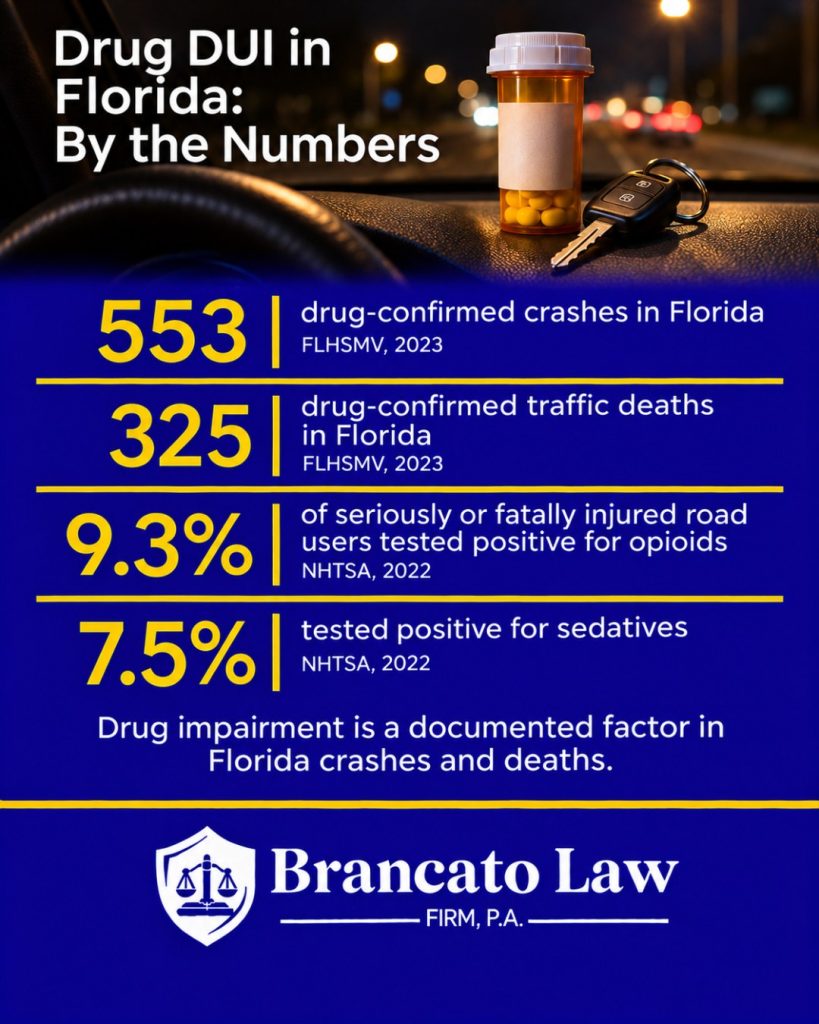
Those numbers measure presence, not impairment. A person who takes a daily prescription can test positive for weeks, which is why our attorneys at The Brancato Law Firm treat a positive result as the starting point of the analysis.
Why is a drug DUI harder for the State to prove than an alcohol DUI?
A drug DUI is harder to prove because Florida has no per se drug limit. For alcohol, a 0.08 result is itself a crime and is prima facie evidence of impairment under section 316.1934. No statute sets a comparable number for oxycodone, alprazolam, or zolpidem, so the State must connect the drug to the driver’s impairment with other evidence.
Florida legal writers identified the problem decades ago. In a 1998 Florida Bar Journal article, “The Drugged Driver and the Need for a Per Se Law” (Vol. 72, No. 7), Betty J. Buchan and Mark F. Lewis explained that urine results show whether a drug was present but not how much, and that drug recognition testimony needs other evidence of impairment behind it. The Legislature has not adopted a per se drug limit, so those weaknesses remain in the State’s case today.
How do our attorneys fight a prescription drug DUI in Florida?
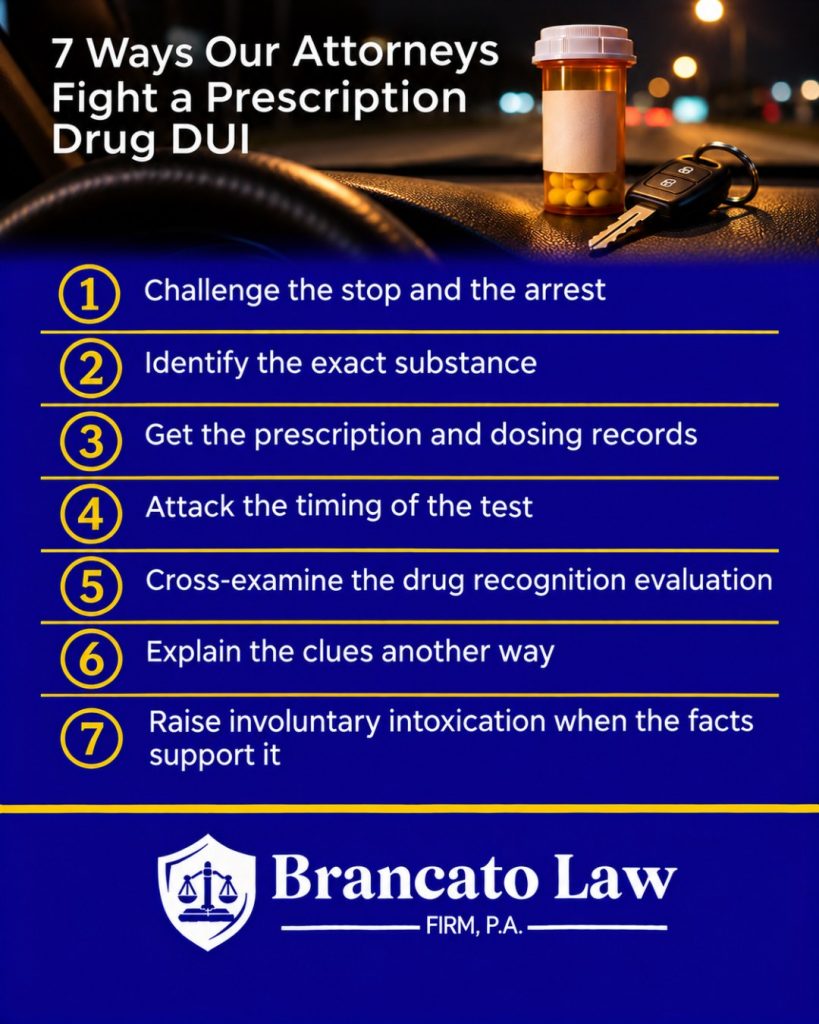
Our attorneys fight a prescription drug DUI by separating presence from impairment at every step. This is the framework we use:
- Challenge the stop and the arrest. If the officer lacked a lawful reason to stop the car or probable cause to arrest, a motion to suppress can remove the test results and the observations.
- Identify the exact substance. We confirm what the lab found and whether that drug is a controlled substance under chapter 893 or a chemical listed in section 877.111.
- Get the prescription and dosing records. A therapeutic dose taken as directed is strong evidence that the driver was functioning normally.
- Attack the timing. Urine results and many blood results cannot show when a drug was taken or whether it was active while the person was driving.
- Cross-examine the drug recognition evaluation. We check each step of the protocol against the video and the evaluator’s training records.
- Explain the clues another way. Fatigue, diabetes, inner-ear problems, injuries, and anxiety can produce the same signs officers attribute to drugs.
- Raise involuntary intoxication when the facts support it. A pharmacy error, a mislabeled container, or an unexpected interaction can support the instruction approved in Carter.
Prescription drug DUI cases often turn on toxicology, and our forensic science defense work includes consulting independent toxicologists. In Hillsborough County, the State Attorney’s RIDR diversion program has a separate track for drug-related DUI, with 50 community service hours and 3 months of a drug-detection sweat patch in place of an ignition interlock, and our attorneys screen every first-time client for it. Our Hillsborough County criminal defense page explains how these cases move through county court. Our Tampa DUI defense attorney page describes the rest of our DUI work.
What results has our firm obtained in drug DUI cases?
| Charge | Result |
|---|---|
| DUI of an airline pilot with unlawful drugs in his system (July 2026) | Reduced to reckless driving |
| Marijuana DUI (September 2025) | Reduced to reckless driving |
Past results do not guarantee future outcomes.
Frequently asked questions about prescription drug DUI in Florida
Can you get a DUI for taking Xanax as prescribed in Florida?
Yes, if the State proves the alprazolam impaired your normal faculties while you were driving. The Brancato Law Firm uses the prescription, the dose, and the timing to show the jury that a therapeutic dose did not impair your driving.
Is there a legal limit for prescription drugs while driving in Florida?
No. Florida has a 0.08 limit for alcohol but no numeric limit for any prescription drug, so the State must prove actual impairment. Our attorneys at The Brancato Law Firm press that point in every drug DUI case, because without a per se number the officer’s observations carry the State’s case.
Can a prescription drug DUI be dropped in Florida?
Yes. Drug DUI charges can be dropped or reduced when the stop was unlawful, the lab cannot tie the drug to impairment, or the substance does not fit the statute. The Brancato Law Firm pursues those arguments before trial and negotiates reductions to reckless driving when the evidence supports it, as described on our DUI lawyer in Tampa page.
Does a positive urine test prove I was impaired by my medication?
No. A urine test shows that a drug or its metabolite was present, not how much was active when you were driving. The Brancato Law Firm works with independent toxicologists to explain that limit to prosecutors and juries.
Should I tell the officer what medications I take?
You have the right to remain silent, and statements about medication are often the State’s best evidence of what drug was involved. Our attorneys at The Brancato Law Firm advise clients to give identification and documents the law requires and to decline other questions until they have spoken with a lawyer, as our guide on what happens after a DUI arrest explains.
Can a prescription drug DUI affect my commercial driver’s license?
Yes. A DUI conviction for a controlled substance disqualifies a CDL holder from commercial driving for at least one year, even if it happened in a personal car. The Brancato Law Firm explains the rules in our guide on what happens to a CDL after a DUI in Florida.
For how The Brancato Law Firm, P.A. defends these cases, see our Tampa drug crimes defense practice.
Talk to our attorneys about a prescription drug DUI
The toxicology report, the video, and your prescription records are the core of a drug DUI defense, and the 10-day license deadline started at your arrest. Call The Brancato Law Firm, P.A., founded by Tampa Criminal Defense Attorney Rocky Brancato, at (813) 727-7159, and our attorneys will request your license review and begin gathering those records. You can call us at any hour. Our firm has Spanish-speaking staff, and attorney Jean-Luc Adrien speaks Spanish, Haitian Creole, and French. For more about our defense strategies, visit our DUI defense page.
The Brancato Law Firm, P.A.
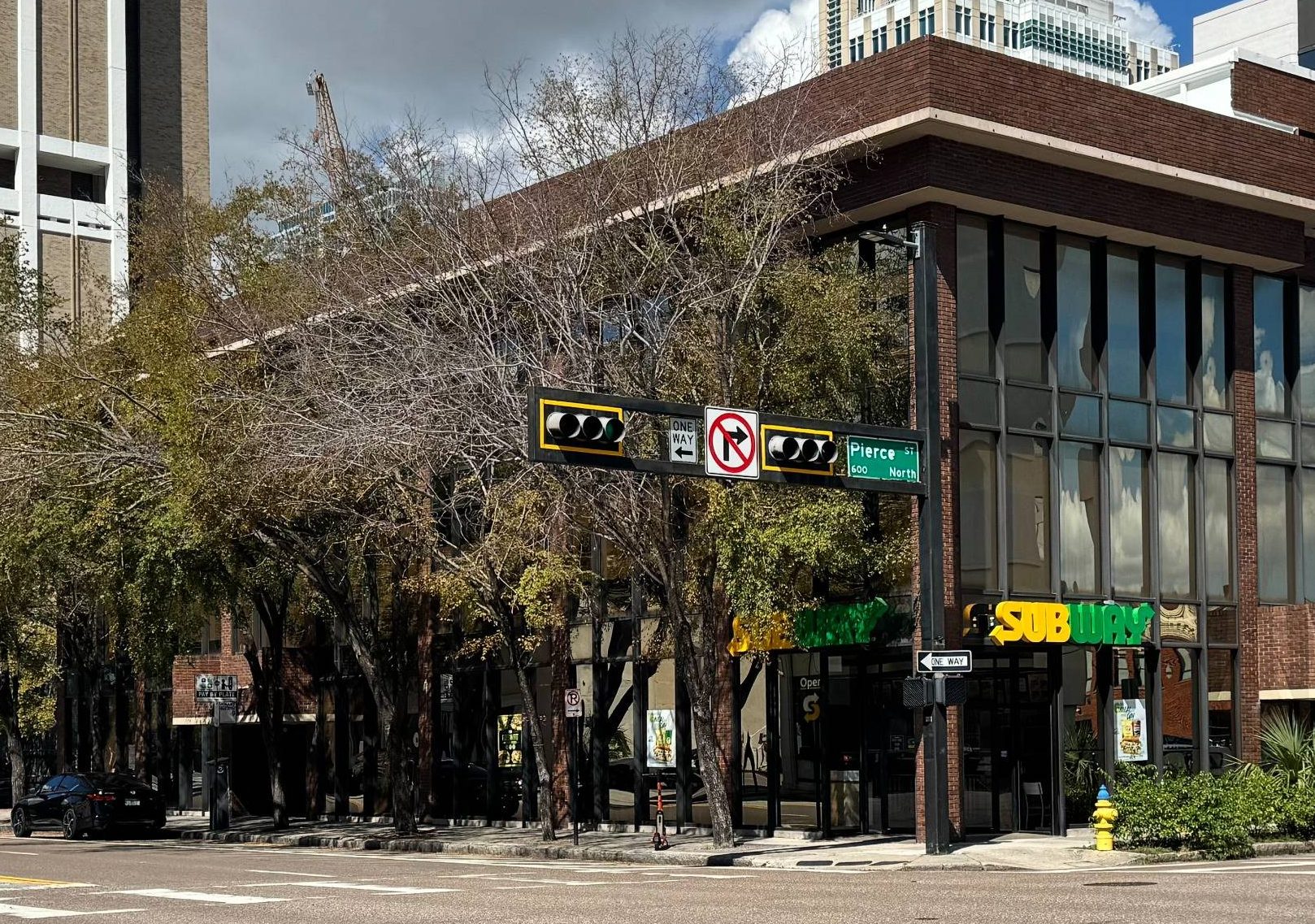
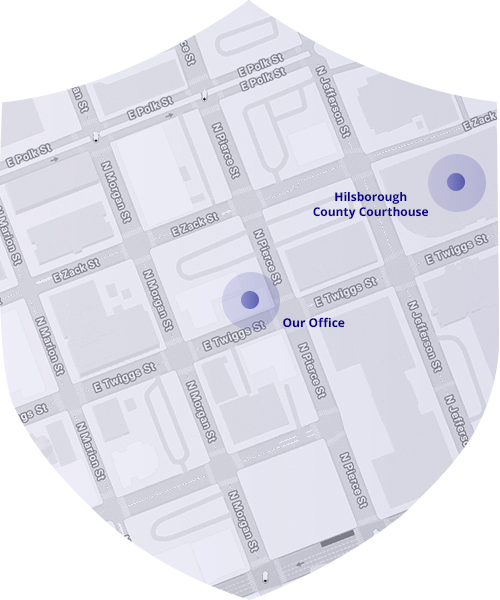
620 E. Twiggs Street, Suite 205, Tampa, FL 33602
(813) 727-7159
Serving Hillsborough, Pinellas, and Pasco Counties
The Brancato Law Firm, P.A. is a Tampa-based criminal defense practice. We are not affiliated with any other Brancato-named law firms.
Visit Us
Tampa, FL 33602
Contact Us Now
Free Legal Consultation (813) 727-7159