- Free Consultation 24/7: (813) 727-7159 Tap Here To Call Us


From First DUI to Death Penalty


Need a Spanish-Speaking Criminal Defense Lawyer in Tampa? (2026)


Updated October 22, 2026
The Brancato Law Firm, P.A. offers criminal defense in Spanish, Haitian Creole, French, and English in Hillsborough, Pinellas, and Pasco Counties. Attorney Jean-Luc Adrien speaks Spanish, Haitian Creole, and French, and the firm has Spanish-speaking staff. Florida courts must appoint an interpreter for a defendant who cannot understand English under Rule 2.560, but a court interpreter only translates what is said in court. A lawyer who speaks your language can explain the evidence, the plea offer, and the immigration consequences directly to you and your family, with no one in between.
In Hillsborough County, almost one in three residents speaks a language other than English at home. For many of them, an arrest means trying to understand bond, charges, and deadlines through a stranger’s translation. I’m Rocky Brancato, founder of The Brancato Law Firm, P.A., a Tampa criminal defense firm. I have spent more than 25 years in Hillsborough County courtrooms, and I have watched language barriers cost people their best options. That is why our firm offers representation in Spanish and Haitian Creole as well as English.
Who at The Brancato Law Firm speaks Spanish and Haitian Creole?
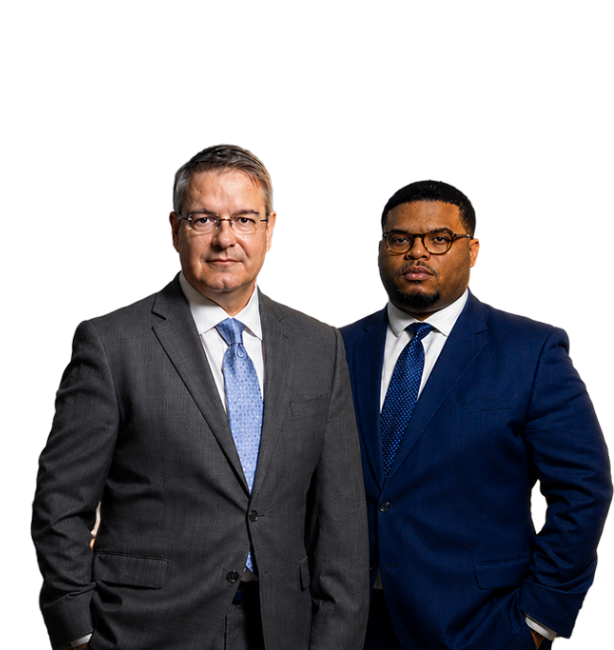
Attorney Jean-Luc Adrien speaks Spanish, Haitian Creole, and French, and he joined The Brancato Law Firm in May 2026. Our firm also has Spanish-speaking staff, so families can call in Spanish from the first contact.
Jean-Luc earned his law degree at New York University School of Law, where he was a Root-Tilden-Kern Public Interest Scholar, and he worked at The Bronx Defenders in New York City. At the Hillsborough County Public Defender’s Office, he rose to Division Chief, supervising a division of attorneys while handling serious cases himself. He has defended charges ranging from DUI to homicide.
Our phone line includes a language prompt, so callers can choose Spanish when they reach us at (813) 727-7159. Consultations can be held in Spanish, Haitian Creole, French, or English.
Do I have the right to an interpreter in a Florida criminal case?
Yes. Under Florida Rule of General Practice and Judicial Administration 2.560(b), “The court must appoint an interpreter in any criminal or juvenile delinquency proceeding in which the accused, the parent or legal guardian of the accused juvenile, the victim, or the alleged victim cannot understand or has limited understanding of English, or cannot be sufficiently understood in English.” The rule appears in the Florida Rules of General Practice and Judicial Administration. For witnesses, section 90.606, Florida Statutes requires a qualified interpreter to be sworn when a witness cannot understand or speak English well enough to be understood.
In the 13th Judicial Circuit, the Court Interpreter Center provides interpreters for due-process hearings such as first appearance, arraignment, and trial. Its staff interpreters cover Spanish, and freelance interpreters cover more than 20 other languages and dialects. Interpreters can be requested at (813) 272-5947.
When a lawyer hires an interpreter for work outside the courtroom, such as a jail visit or a witness interview, Rule 2.565 requires the lawyer to use a certified, language-skilled, or provisionally approved interpreter whenever possible. That rule exists because translation quality matters.
Is a Spanish-speaking lawyer better than using an interpreter?
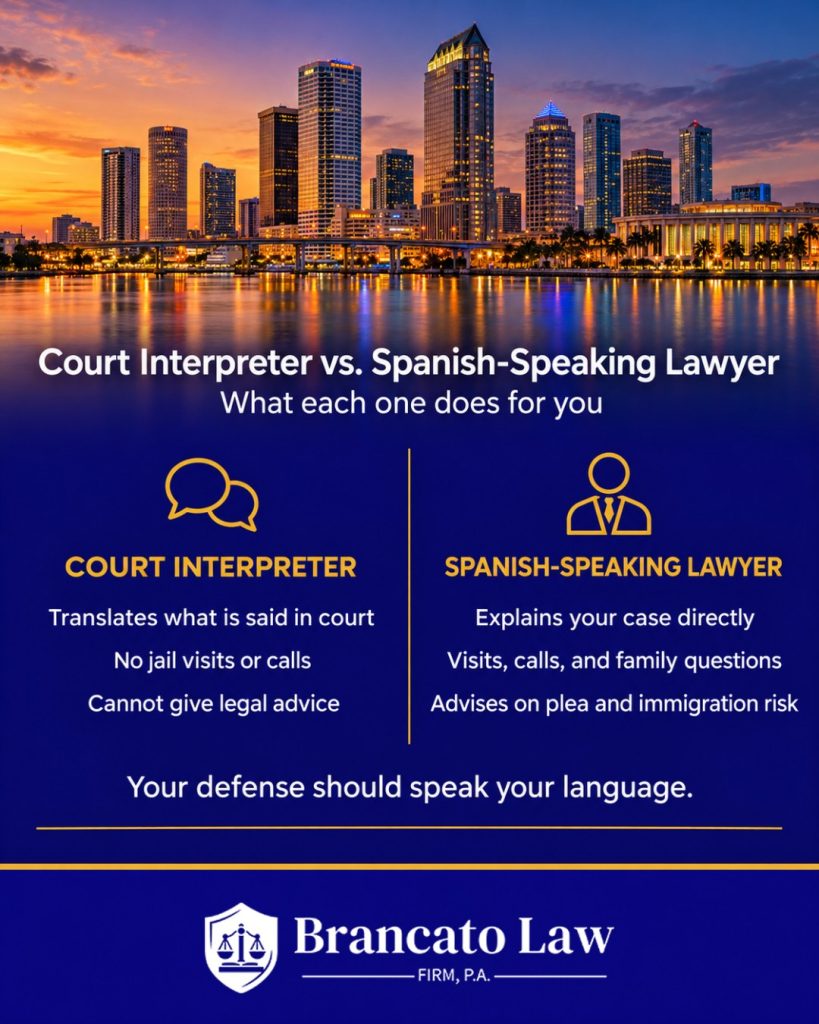
For most clients, yes. A court interpreter translates what is said in the courtroom. A lawyer who speaks your language can do the work that happens outside it: explaining the police report, reviewing body camera video with you, walking through the scoresheet, and answering your family’s questions about bond.
| Task | Court interpreter | Spanish-speaking defense lawyer |
|---|---|---|
| First appearance and court hearings | Translates what is said | Speaks for you and explains it to you |
| Jail visits and phone calls | Not provided by the court | Direct, confidential conversation |
| Reviewing evidence and video | Not provided by the court | Explains each piece in your language |
| Plea offers | Translates the judge’s questions | Explains the offer, the alternatives, and the consequences first |
| Immigration questions | Cannot give advice | Identifies the risk and works to avoid it |
| Family questions | Not provided by the court | Family can call the firm directly |
Language errors have real consequences. The Brennan Center for Justice’s report Language Access in State Courts (2009) described a Florida case in which an interpreter who had never been assessed for competency worked thousands of cases, and one defendant pleaded guilty to a felony while believing he was pleading to a misdemeanor. Florida’s interpreter rules have been strengthened since then, but the lesson is the same: what you understand before you plead matters more than what is translated at the plea.
Can a Miranda warning given in Spanish be challenged?
Yes, when the translation or the questioning breaks down. In Cuervo v. State, 967 So. 2d 155 (Fla. 2007), a Spanish-speaking suspect told detectives, “No quiero declarar nada,” meaning he did not want to make any statement. The trial court translated it differently and admitted his confession. The Florida Supreme Court held that he had clearly invoked his right to remain silent, that continued questioning violated Miranda, and that he was entitled to a new trial.
In State v. Soto, 954 So. 2d 686 (Fla. 4th DCA 2007), the court upheld suppression where the defendant had “manifest language difficulties,” and an officer told him to answer only in English. Florida courts do not throw out every imperfect translation. They look at whether the person actually understood the rights and whether a request to stop or to have a lawyer was honored. A lawyer who speaks the language can spot those problems in the recording that an English-only lawyer may miss.
How can a criminal case affect my immigration status?
A criminal case can affect immigration status even when the charge seems minor. In Padilla v. Kentucky, 559 U.S. 356 (2010), the U.S. Supreme Court held that “counsel must inform her client whether his plea carries a risk of deportation.” Florida judges must also warn every defendant at a plea, under Florida Rule of Criminal Procedure 3.172(c)(8), that a plea “regardless of whether adjudication of guilt has been withheld, may have the additional consequence of changing his or her immigration status, including deportation or removal from the United States.”
Notice that a withhold of adjudication does not protect a noncitizen. Our attorneys work to resolve cases in ways that avoid immigration consequences. In September 2026, a client charged with possessing a short-barreled rifle, cannabis, and paraphernalia was accepted into diversion after a mitigation report and a possession motion, avoiding a felony and likely deportation. In April 2025, a motion to suppress gave the defense the bargaining power to obtain diversion in a corruption by threat and resisting case, giving the client a path to avoid deportation. See our case results page. Past results do not guarantee future outcomes. When a case carries immigration risk, we also recommend that the client consult an immigration attorney.
How many people in Hillsborough County need language access?
Many. According to the U.S. Census Bureau’s QuickFacts for Hillsborough County, 30.7% of residents age 5 and older spoke a language other than English at home in the 2020 to 2024 American Community Survey, 32.1% of residents are Hispanic or Latino, and 19.7% were born outside the United States.
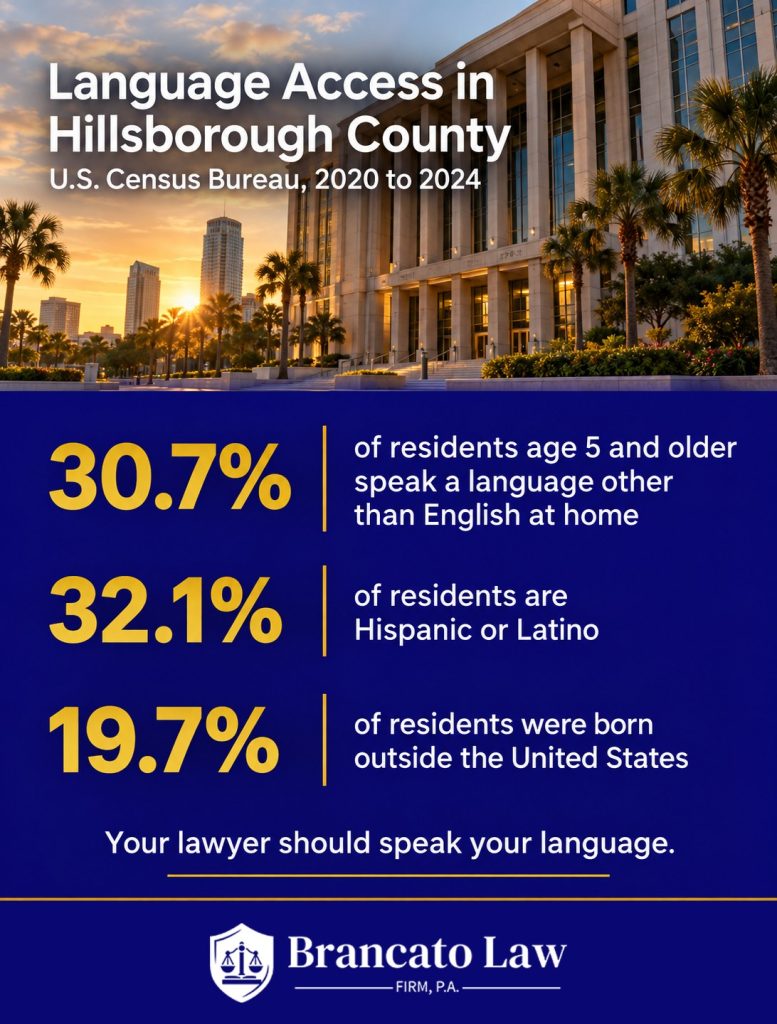
That is a large share of the people who appear in Hillsborough County courtrooms every day. At first appearance in Hillsborough, the person appears by video from the jail while the judge and the lawyers appear from downtown. For someone who does not speak English well, that video hearing can be confusing. A lawyer who can speak with the family beforehand, in their language, can bring the information that helps a judge set a reasonable bond.
What cases does our firm handle in Spanish and Haitian Creole?
Our attorneys handle the full range of criminal cases in Spanish and Haitian Creole, including:
- DUI and criminal traffic offenses
- Drug possession and trafficking
- Domestic violence and battery
- Violent crimes, robbery, and burglary
- Weapons charges
- Sex crimes
- Homicide and manslaughter
- Probation violations
- Juvenile cases
- Investigations before charges are filed, through our pre-file advocacy
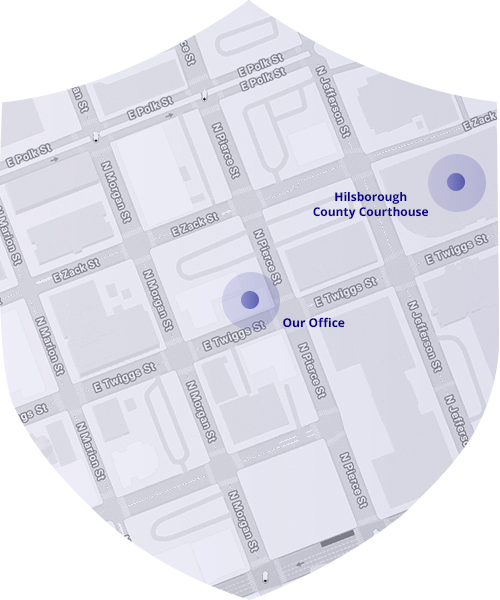
Cases are heard at the Hillsborough County Courthouse in Tampa, the Pinellas County Criminal Justice Center, and the West and East Pasco judicial centers. Learn more on our Hillsborough County criminal defense attorney page and our practice areas page. For more about your rights in court, read our post on the right to an interpreter in court.
Resumen en español
The Brancato Law Firm, P.A. ofrece defensa criminal en español en los condados de Hillsborough, Pinellas y Pasco. El abogado Jean-Luc Adrien habla español, criollo haitiano y francés, y nuestro equipo incluye personal que habla español. Si usted o un familiar ha sido arrestado, llame al (813) 727-7159 y seleccione español. Le explicaremos los cargos, la fianza y las consecuencias migratorias en su idioma, sin intermediarios.
Frequently asked questions about Spanish-speaking criminal defense in Tampa
Does The Brancato Law Firm have a Spanish-speaking criminal defense lawyer?
Yes. Attorney Jean-Luc Adrien speaks Spanish, Haitian Creole, and French, and The Brancato Law Firm also has Spanish-speaking staff who can take calls from clients and families.
Is there a Haitian Creole-speaking criminal lawyer in Tampa?
Yes. Jean-Luc Adrien of The Brancato Law Firm speaks Haitian Creole and handles criminal cases in Hillsborough, Pinellas, and Pasco Counties. Haitian Creole is not among the languages covered by the 13th Circuit’s staff interpreters, so having a lawyer who speaks it directly can make a real difference.
Will the court give me an interpreter for free in a criminal case?
Yes. Rule 2.560(b) requires the court to appoint an interpreter in any criminal proceeding when the accused cannot understand or has limited understanding of English. The Brancato Law Firm makes sure interpreters are requested for every hearing, and our attorneys explain each hearing to clients beforehand in their language.
Can my family call the firm in Spanish?
Yes. Families can call (813) 727-7159 and choose Spanish at the language prompt, and you can call us at any hour. The Brancato Law Firm often speaks with families before first appearance, when information about work, family, and ties to the community can help with bond. Learn more on our Hillsborough County criminal defense page.
Can a plea deal get me deported if I am not a citizen?
It can. Under Padilla v. Kentucky, 559 U.S. 356 (2010), defense counsel must advise a noncitizen whether a plea carries a risk of deportation, and Florida’s plea colloquy warns that even a withhold of adjudication may affect immigration status. Our attorneys at The Brancato Law Firm look for resolutions such as diversion that reduce that risk, and we recommend that clients also consult an immigration attorney.
What if police questioned me in English when I speak Spanish?
Your statement may be challengeable. Under Cuervo v. State, 967 So. 2d 155 (Fla. 2007), and State v. Soto, 954 So. 2d 686 (Fla. 4th DCA 2007), Florida courts suppress statements when language problems prevented a person from understanding or invoking their rights. The Brancato Law Firm reviews the recording of the interrogation in the language it was conducted in.
For how this fits into the rest of a case, see our stage-by-stage guide to the Florida criminal case process.
Call a Spanish-speaking defense lawyer in Tampa
The first days after an arrest decide bond, the no-contact conditions, and whether a case is filed at all. The Brancato Law Firm, P.A. was founded by Tampa Criminal Defense Attorney Rocky Brancato, and our attorneys can speak with you and your family in Spanish, Haitian Creole, French, or English. Call (813) 727-7159 and choose your language. You can call us at any hour. Our firm has Spanish-speaking staff, and attorney Jean-Luc Adrien speaks Spanish, Haitian Creole, and French.
For more about our defense strategies, visit our Hillsborough County Criminal Defense page.
The Brancato Law Firm, P.A.
620 E. Twiggs Street, Suite 205, Tampa, FL 33602
(813) 727-7159
Serving Hillsborough, Pinellas, and Pasco Counties
The Brancato Law Firm, P.A. is a Tampa-based criminal defense practice. We are not affiliated with any other Brancato-named law firms.
Each case is unique, and past results do not guarantee future outcomes. This article is general information, not legal advice.
Visit Us
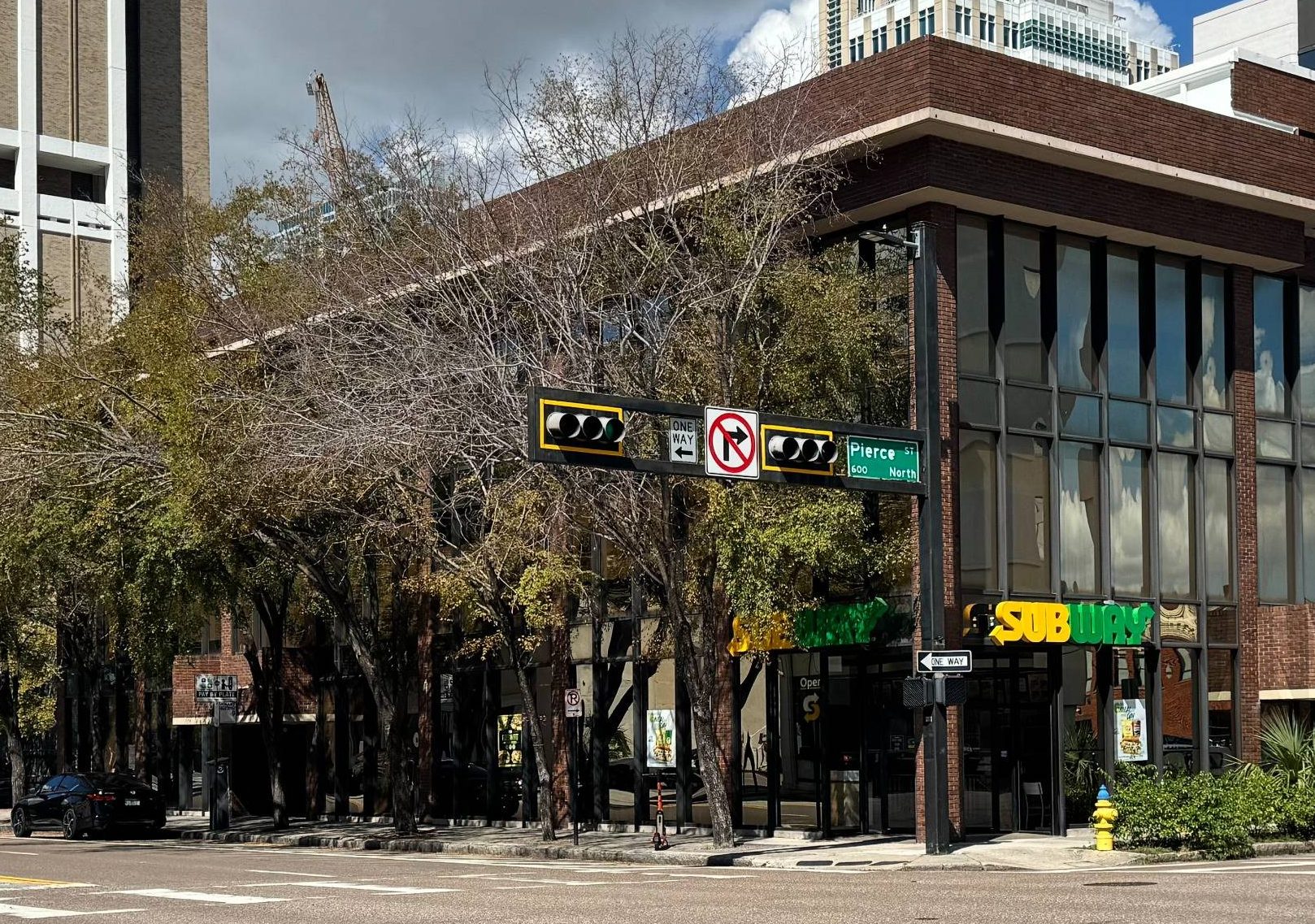
Tampa, FL 33602
Contact Us Now
Free Legal Consultation (813) 727-7159