Strategic Defense,
From First DUI to Death Penalty
From First DUI to Death Penalty






| Short answer: A Tampa violent crimes attorney defends charges such as battery, aggravated assault, aggravated battery, robbery, and kidnapping, which range in Florida from a second-degree misdemeanor to a first-degree felony punishable by life in prison. When a firearm is involved, Florida’s 10-20-Life law can require a 10-year, 20-year, or 25-years-to-life minimum sentence if the jury finds the firearm facts. The Brancato Law Firm, P.A. moves fast to preserve video and witnesses, raises Stand Your Ground immunity when the facts support it, and challenges eyewitness identifications and firearm findings. |
Violent crime cases are often decided by evidence that disappears within days: store surveillance video, a 911 recording, a neighbor’s doorbell camera, a witness who moves away. Rocky Brancato, founder of The Brancato Law Firm, P.A., has tried more than 150 jury trials to verdict and won not guilty verdicts on armed robbery, kidnapping, and a second-degree murder charge defended on self-defense. Our attorneys at this Tampa criminal defense firm start the investigation the day we are hired, because the State’s version of events becomes the only version unless someone gathers the rest.
Florida grades violent crimes by whether a weapon was used, how badly someone was hurt, and the defendant’s record. The maximum penalties below come from § 775.082 and § 775.083. Actual sentences depend on the Criminal Punishment Code scoresheet and any mandatory minimums.
| Charge | Florida law | Level | Maximum penalty |
|---|---|---|---|
| Assault | § 784.011 | Second-degree misdemeanor | 60 days in jail, $500 fine |
| Aggravated assault (deadly weapon, or intent to commit a felony) | § 784.021 | Third-degree felony | 5 years in prison, $5,000 fine |
| Battery | § 784.03(1) | First-degree misdemeanor | 1 year in jail, $1,000 fine |
| Battery with one prior battery-type conviction | § 784.03(2) | Third-degree felony | 5 years in prison, $5,000 fine |
| Felony battery (great bodily harm, permanent disability, or disfigurement) | § 784.041(1) | Third-degree felony | 5 years in prison, $5,000 fine |
| Aggravated battery | § 784.045 | Second-degree felony | 15 years in prison, $10,000 fine |
| Robbery with no weapon | § 812.13(2)(c) | Second-degree felony | 15 years in prison, $10,000 fine |
| Robbery with a weapon | § 812.13(2)(b) | First-degree felony | 30 years in prison, $10,000 fine |
| Robbery with a firearm or deadly weapon | § 812.13(2)(a) | First-degree felony punishable by life | Life in prison |
| Home-invasion robbery | § 812.135 | First-degree felony (life with a firearm or deadly weapon) | 30 years to life in prison |
| Kidnapping | § 787.01 | First-degree felony punishable by life | Life in prison |
| False imprisonment | § 787.02 | Third-degree felony | 5 years in prison, $5,000 fine |
Two rules raise these levels. Under § 784.07, an assault or battery on a law enforcement officer, firefighter, emergency medical provider, or other protected worker moves up one level, and aggravated assault or aggravated battery on an officer carries a mandatory minimum of 3 or 5 years. Under § 775.087(1), a felony committed with a weapon is generally reclassified one degree higher unless the weapon is already an element of the crime. Whether an object counts as a “deadly weapon” is a question for the jury: in Dale v. State, 703 So. 2d 1045 (Fla. 1997), the Florida Supreme Court held that a BB gun is not automatically a deadly weapon, and the jury decides based on how it was used. Read more about assault charges in Florida and battery charges in Florida.
Violent crime is charged often in Tampa Bay. In 2020, law enforcement agencies in Hillsborough County reported 3,201 aggravated assaults and 650 robberies, according to the Florida Department of Law Enforcement’s Crime in Florida county report. Those are reported offenses, not convictions, and many reported cases are reduced or dismissed once the defense investigates.
Florida’s 10-20-Life law, § 775.087(2), sets mandatory minimum prison terms when a person actually possesses or fires a firearm during certain felonies. The listed felonies include robbery, home-invasion robbery, carjacking, kidnapping, aggravated battery, burglary, sexual battery, murder, aggravated child abuse, and drug trafficking. Aggravated assault, false imprisonment, battery, and felony battery are not on the current list.
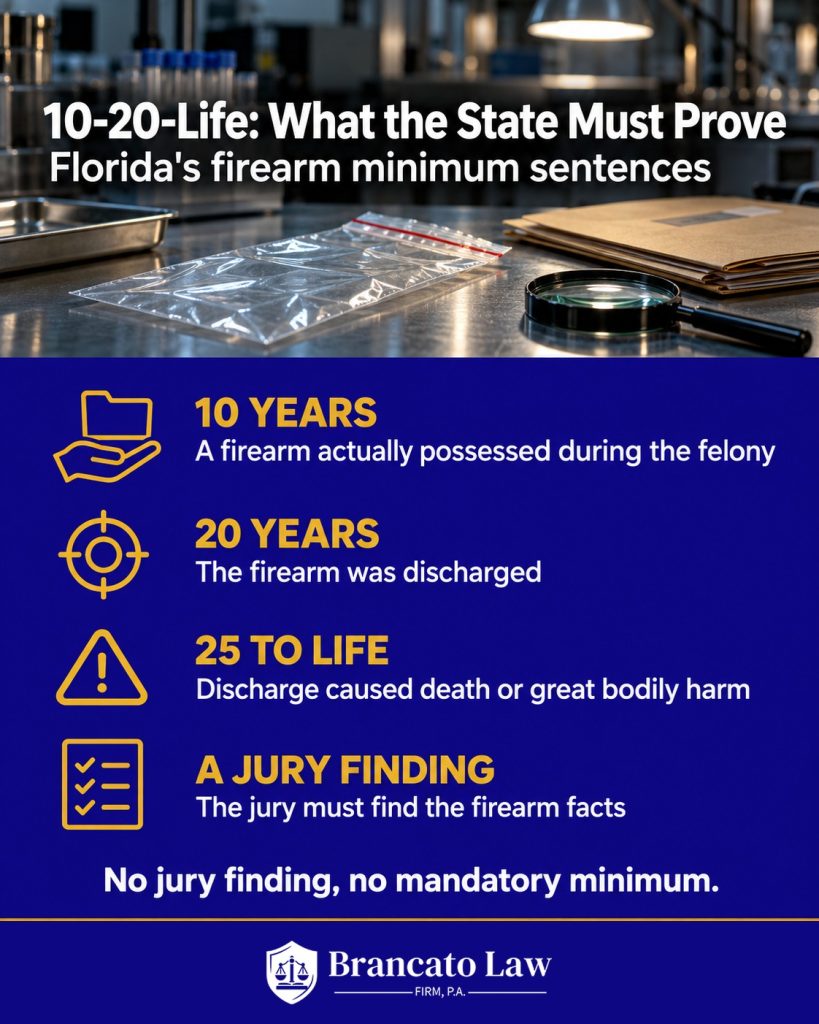
These sentences cannot be reduced by a withhold of adjudication, gain time, or early release, and minimums for separate qualifying offenses can run consecutively. “Possession” has a specific meaning: carrying the firearm on the person, or having it within immediate physical reach with ready access and the intent to use it. The jury, not the judge, has to find those facts. In State v. Overfelt, 457 So. 2d 1385 (Fla. 1984) and State v. Hargrove, 694 So. 2d 729 (Fla. 1997), the Florida Supreme Court held that a firearm minimum requires a specific jury finding, even when the evidence of a gun is undisputed. Our attorneys challenge whether a firearm was actually possessed, whether it was a real and operable firearm, and whether the verdict form supports the minimum. Our article on Florida’s 10-20-Life law and our Tampa gun crimes lawyer page cover firearm charges in more detail.
Stand Your Ground immunity lets a judge dismiss a case before trial when the person used force in lawful self-defense. Under § 776.012, a person may use deadly force to prevent imminent death, great bodily harm, or a forcible felony and has no duty to retreat if not engaged in criminal activity and in a place where he or she has a right to be. Under § 776.013, a person in a home or occupied vehicle is presumed to have a reasonable fear when someone unlawfully and forcibly enters. Under § 776.032, a person who used justified force is immune from arrest, detention, charging, and prosecution.
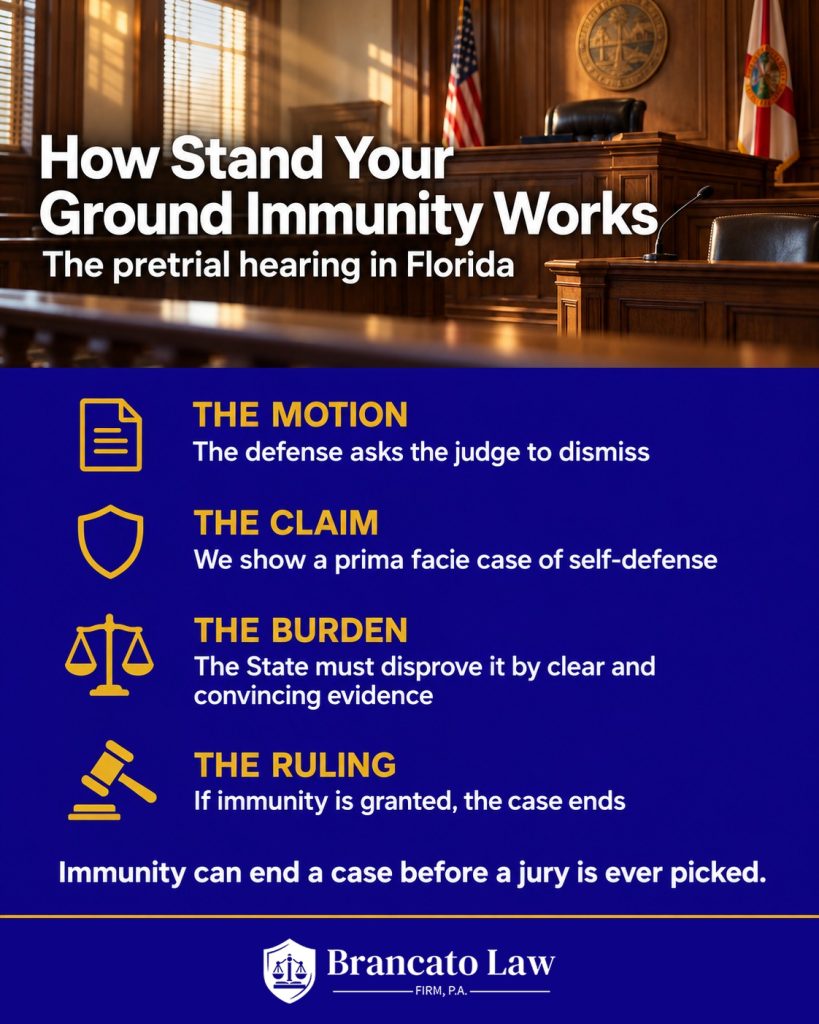
The defense raises immunity with a motion to dismiss, and the judge decides the facts at a pretrial evidentiary hearing, as the Florida Supreme Court explained in Dennis v. State, 51 So. 3d 456 (Fla. 2010). Since 2017, once the defense presents a prima facie claim of self-defense, the State must overcome it by clear and convincing evidence. In Love v. State, 286 So. 3d 177 (Fla. 2019), the court held that this burden applies to every immunity hearing held after the 2017 amendment, no matter when the incident happened. If immunity is denied, self-defense remains a defense at trial, where the State must disprove it beyond a reasonable doubt. See our articles on Stand Your Ground vs. self-defense in Florida and how to claim self-defense in a Florida criminal case.
Defense lawyers challenge eyewitness identifications because a confident witness can still be wrong. The National Academy of Sciences report Identifying the Culprit: Assessing Eyewitness Identification (2014) found that memories are “forgotten, reconstructed, updated, and distorted,” and that a witness’s confidence can be powerfully swayed by what happens after the event. Our attorneys examine how the lineup or photo array was run, what the witness first told police, and what the witness could actually see. Mistaken identity has won several of our firm’s trials, including an armed robbery acquittal where the victim never mentioned the client’s distinctive arm tattoo. Read our guide on how to defend against an armed robbery charge in Florida.
After a violent crime arrest in Hillsborough County, the person sees a judge at first appearance within 24 hours, as required by Florida Rule of Criminal Procedure 3.130, and the judge sets bond or holds the person for a detention hearing. For serious violent felonies, prosecutors often file a motion for pretrial detention. Hillsborough County does not have a supervised release program that takes the place of a money bond, as Pinellas County does, so the bond argument has to stand on the facts and the person’s ties to the community. Supervision here, such as GPS or alcohol monitoring run by the Sheriff’s Office, is usually added on top of a bond.
In one of our cases, a client charged with first-degree murder and armed burglary with a firearm was held without bond on a pretrial detention motion. After reviewing discovery, our firm showed there was no burglary and that the facts were consistent with self-defense, and the judge set bond at $75,000.
A prison releasee reoffender is a person charged with a listed violent felony within 3 years of release from a Florida prison, and the label requires the statutory maximum sentence. Under § 775.082(9), listed offenses include robbery, home-invasion robbery, carjacking, kidnapping, aggravated assault with a deadly weapon, aggravated battery, and any felony involving the use or threat of physical force. A designated reoffender must receive life for a life felony, 30 years for a first-degree felony, 15 years for a second-degree felony, or 5 years for a third-degree felony, and must serve 100 percent. The prosecutor decides whether to seek the designation, which makes early negotiation critical. Our guide to prison releasee reoffender sentencing explains the options.
No. In Florida the State Attorney’s Office decides whether to file or dismiss charges, not the alleged victim. A victim’s wishes still matter, and a sworn affidavit explaining that the person does not want prosecution can change the prosecutor’s decision. In one of our aggravated assault cases, the alleged victim’s affidavit and supporting background information led the State to decline charges and issue a letter of release 24 days after the arrest. Our victim’s guide to dropping domestic violence charges in Florida explains how this works when the parties know each other.
These are results our firm has obtained. Every case is different, and past results do not guarantee future outcomes.
See more on our case results page.
Yes. Prosecutors drop or reduce violent crime charges when video contradicts the accuser, the identification is unreliable, the force was justified, or the alleged victim does not want to proceed. The Brancato Law Firm has had aggravated assault and robbery charges dismissed or reduced after its own review of body camera footage and witness depositions; see our case results.
No. Aggravated assault is not on the current 10-20-Life list in § 775.087(2); it is a third-degree felony with a 5-year maximum, though aggravated assault on a law enforcement officer carries a 3-year minimum. Our attorneys at The Brancato Law Firm check every firearm and officer enhancement the State adds to the charging document.
The State does. Once the defense presents a prima facie claim of self-defense, the State must overcome immunity by clear and convincing evidence under § 776.032(4). The Brancato Law Firm prepares immunity hearings like a trial, with witnesses, video, and scene evidence; read more about a recent Stand Your Ground immunity ruling.
Assault is an intentional threat of violence that creates a well-founded fear of imminent harm, while battery is an intentional touching or striking against the person’s will, or intentionally causing bodily harm. The Brancato Law Firm defends both, and either one can become a felony when a weapon, an injury, or a prior conviction is involved.
Usually yes, but prosecutors often seek pretrial detention for serious violent charges, and Hillsborough County does not have a supervised release program that replaces a money bond. The Brancato Law Firm has won bond for clients held on pretrial detention motions by presenting the weaknesses in the State’s case at the hearing.
Yes. Under § 784.03(2), a battery after one prior conviction for battery, aggravated battery, felony battery, or resisting with violence is a third-degree felony, and a prior plea with a withhold of adjudication counts. Our attorneys at The Brancato Law Firm review the prior case to see whether it truly qualifies.
A battery becomes aggravated battery when the person intentionally causes great bodily harm, permanent disability, or permanent disfigurement, uses a deadly weapon, or knew the victim was pregnant. The Brancato Law Firm often challenges the injury evidence and whether an object was a deadly weapon; learn more on our violent crime defense page.
Video gets overwritten and witnesses scatter within days of a violent crime arrest, so the first call matters. Our attorneys at The Brancato Law Firm, P.A., founded by Tampa Criminal Defense Attorney Rocky Brancato, can begin preserving evidence and preparing for first appearance today. Call (813) 727-7159 for a confidential consultation. Our firm also defends domestic violence charges and homicide cases across Hillsborough, Pinellas, and Pasco Counties.
Trial attorney Jean-Luc Adrien speaks Spanish, Haitian Creole, and French, and our office has Spanish-speaking staff, so you and your family can understand every step of the case in your own language. Learn how we help Spanish-speaking and Haitian Creole-speaking clients in Tampa.
The Brancato Law Firm, P.A.
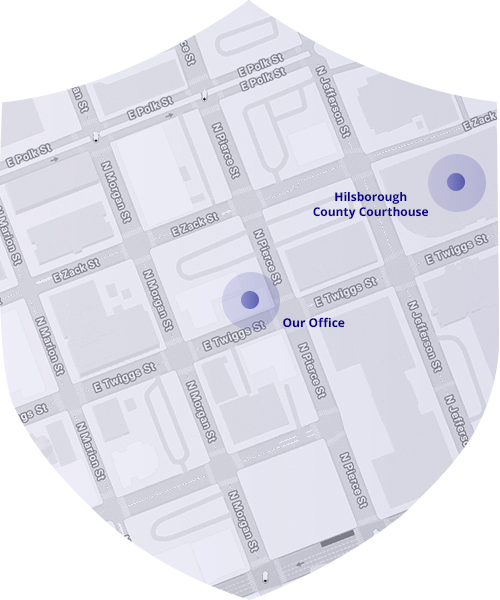
620 E. Twiggs Street, Suite 205, Tampa, FL 33602
(813) 727-7159
Serving Hillsborough, Pinellas, and Pasco Counties

The Brancato Law Firm, P.A. is a Tampa-based criminal defense practice. We are not affiliated with any other Brancato-named law firms.
This page is for informational purposes only and does not constitute legal advice. Each case is unique, and outcomes depend on the individual facts and circumstances involved. Past results do not guarantee future outcomes.
Tampa, FL 33602
Free Legal Consultation (813) 727-7159