- Free Consultation 24/7: (813) 727-7159 Tap Here To Call Us


From First DUI to Death Penalty



Is a Porch a Dwelling Under Florida Burglary Law? (2026)


Rewrite/update date: October 27, 2026. Originally published in June 2025; updated January 2026.
| Yes, often. Florida’s burglary statute defines a “dwelling” to include “any attached porch,” so taking a package from a covered front porch can be charged as burglary rather than theft. In Krasner v. State (Fla. 4th DCA 2025), the court held that a porch covered by the same roof as the house, touching the front door, and holding the residents’ belongings was part of the dwelling. An open yard, driveway, or uncovered concrete pad usually does not qualify, and burglary of a dwelling without a weapon or battery is a second-degree felony, not a life felony. |
Porch cases are usually won or lost on the photographs, long before a jury hears anything about intent. I’m Rocky Brancato, founder of The Brancato Law Firm, P.A., a Tampa criminal defense firm, and I learned that over more than 25 years in Hillsborough County courtrooms, including as a former Chief Operations Officer of the Hillsborough County Public Defender’s Office, where I oversaw a staff of over 100 attorneys. Our attorneys examine the scene, the roofline, and every photo the State intends to use before deciding how to fight a porch burglary charge.
Is a Porch Part of a Dwelling Under Florida Law?
Yes, if the porch is attached. Section 810.011(2), Florida Statutes, defines a “dwelling” as “a building or conveyance of any kind, including any attached porch,” that “has a roof over it and is designed to be occupied by people lodging therein at night, together with the curtilage thereof.” The same section defines a “structure” as any roofed building “together with the curtilage thereof.”
The statute does not define “attached porch,” so Florida courts decide each case from its photographs and testimony. The key questions are whether the area shares the home’s roof, whether it touches an entrance, whether it is physically set apart from the yard, and whether the residents use it as part of their living space. Burglary is defined in section 810.02, Florida Statutes, as entering a dwelling, structure, or conveyance with intent to commit an offense inside, unless the premises are open to the public or the person was invited.
What Happened in Krasner v. State?
The Fourth District Court of Appeal held that a covered front porch was part of the dwelling and affirmed a package thief’s burglary conviction. In Krasner v. State, No. 4D2024-0355 (Fla. 4th DCA June 11, 2025), Jennifer Liza Krasner was charged with burglary of an occupied dwelling after she took delivered packages from the front of the victims’ home.
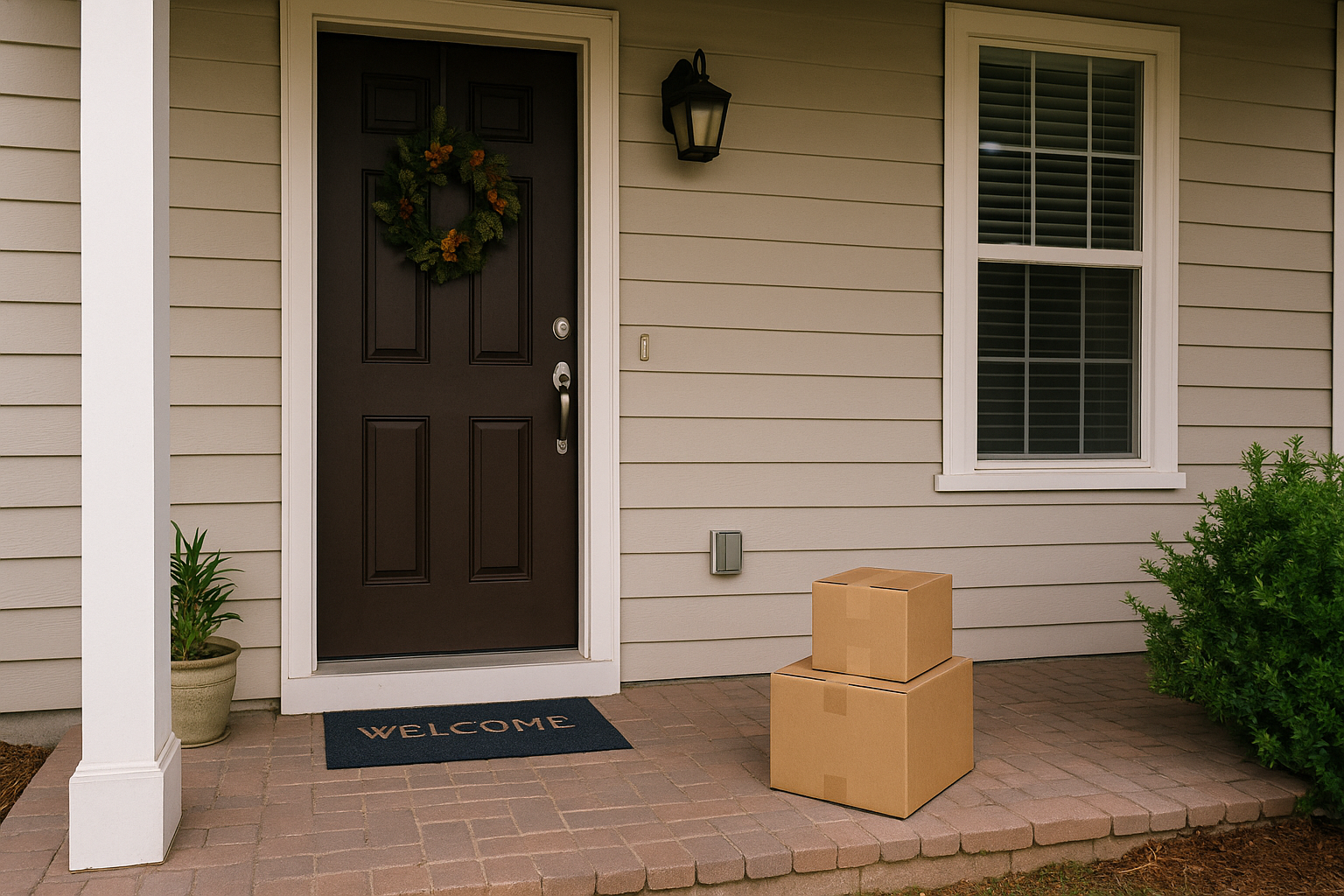
The jury convicted her of a lesser offense, burglary of an unoccupied structure. On appeal she argued the area was not a porch at all. The court rejected that argument, describing the area this way: it “is covered by the same roof that covers the rest of the house,” it “is adjacent to and touching the front door,” and it held several of the residents’ belongings, “including a ‘welcome’ rug.” The court concluded, “In short, the area constitutes a porch.”
The court also rejected Krasner’s claim to a twelve-person jury, following its earlier decision that six-person juries are constitutional in non-capital cases. It remanded only to fix two clerical errors in the judgment, which listed the wrong offense and said she pleaded guilty when she went to trial. At the time of this update the opinion had not been assigned a Southern Reporter citation.
When Is a Porch Not Part of a Dwelling in Florida?
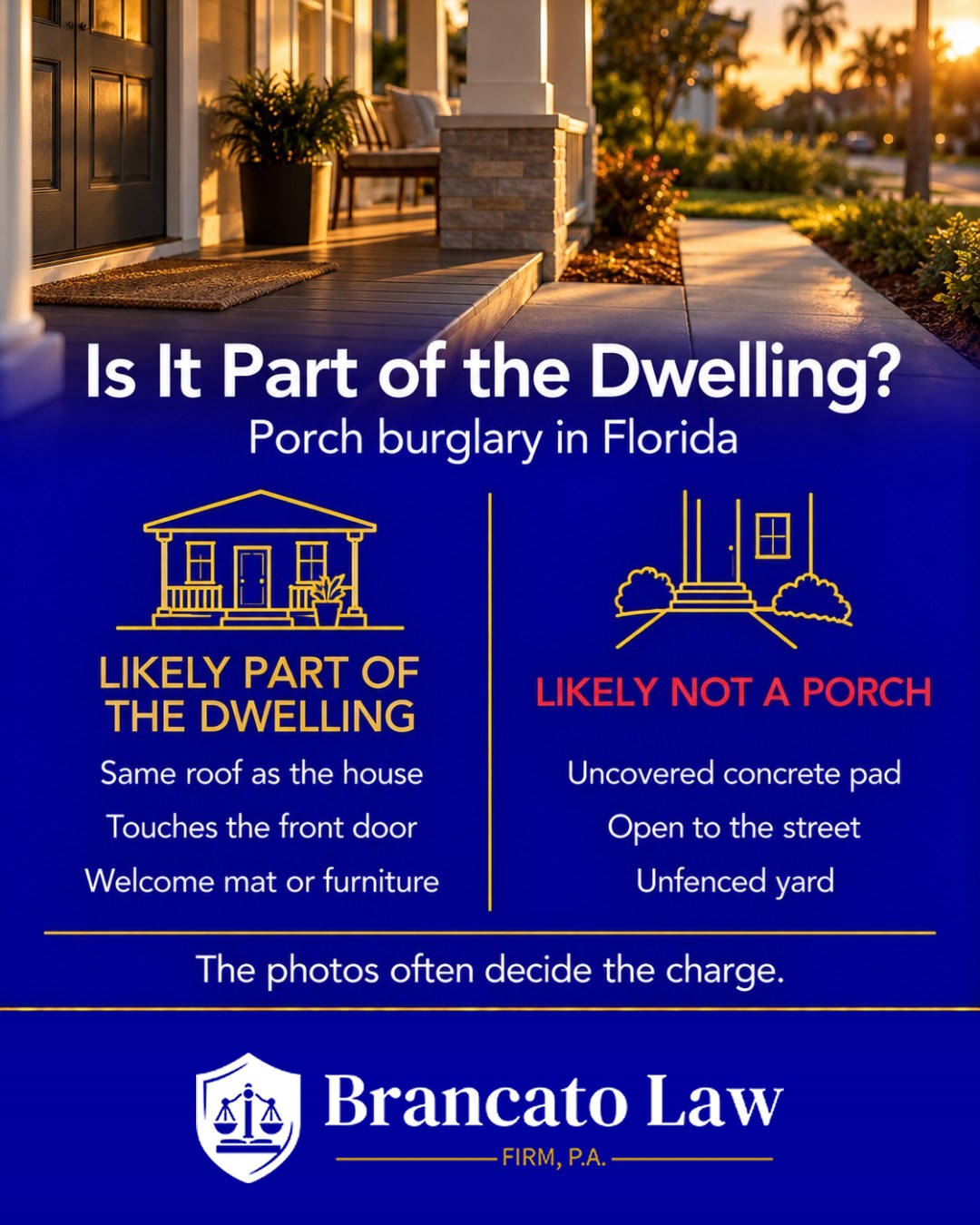
A porch-like area that is open to the street, uncovered, or unconnected to an entrance usually is not part of a dwelling. The Krasner court compared two lines of cases:
- Not a porch: In Colbert v. State, 78 So. 3d 111 (Fla. 1st DCA 2012), a man took a bicycle from a mulch area beside a townhouse’s concrete entry pad. The First District held the area, “both visually and physically open to the general public,” was “not a logical extension of one’s dwelling in a way that comports with the concept of an ‘attached porch.'”
- A porch: In Morlas v. State, 211 So. 3d 286 (Fla. 4th DCA 2017), men tried to break into a home and entered only an elevated, cemented front patio. The Fourth District held the patio was an “attached porch” because it was “directly adjacent to and touching the home,” it “shares a common roof with the home,” and the homeowner kept personal items there.
The curtilage rule adds another limit. In State v. Hamilton, 660 So. 2d 1038 (Fla. 1995), two men took boat motors from an unfenced backyard, and the homeowner shot and killed one of them. The Florida Supreme Court held that the yard around a home counts as “curtilage” only if there is “some form of an enclosure,” and it reversed the surviving man’s burglary and felony murder convictions because the yard was open.
| Feature | Points toward part of the dwelling | Points away from the dwelling |
|---|---|---|
| Roof | Same roof or eave as the house | Uncovered, or only partly covered by a balcony |
| Connection | Touches the front or back door | Separate pad, walkway, or yard |
| Access | Set off by walls, rails, bushes, or screening | Open to the street and the public |
| Use | Welcome mat, furniture, plants, or stored items | No personal property in the area |
| Yard areas | Enclosed by a fence or hedge | Unfenced yard, as in Hamilton |
The table reflects the factors Florida courts have used; no single factor controls. Our attorneys at The Brancato Law Firm photograph the property ourselves, because the State’s photos are usually taken to make the area look as enclosed as possible.
Why Did the Legislature Add “Attached Porch” to the Burglary Statute?
The Legislature added “attached porch” to the dwelling definition in 1996, after Hamilton made the boundaries of burglary a live issue. A Florida Senate Criminal Justice Committee staff analysis of CS/SB 590 (February 18, 1998) explains that the 1996 changes responded to the Hamilton decision, and it quotes the court’s observation that a definition “is crucial to comprehending the full scope of the crime of burglary.”
That history matters for defense arguments. The porch language expanded burglary to a specific, named area, but it did not erase the line between a porch and an open yard. Courts still apply Hamilton’s enclosure requirement to curtilage, as the Fifth District did in J.L. v. State, 57 So. 3d 924 (Fla. 5th DCA 2011), a juvenile case in which a go-cart, a four-wheeler, and a skateboard leaning against the side of a house were held to be outside its curtilage.
What Are the Penalties for Porch Burglary in Florida?
Burglary of a dwelling without an assault, battery, or weapon is a second-degree felony punishable by up to 15 years in prison, whether or not anyone is home. That correction matters, because many websites say burglary of an occupied dwelling carries life. Under section 810.02, burglary becomes a first-degree felony punishable by life only if the offender commits an assault or battery, is or becomes armed with explosives or a dangerous weapon, uses a motor vehicle to damage the building, or causes more than $1,000 in damage.
| Charge | Degree | Maximum prison |
|---|---|---|
| Burglary with assault, battery, or a weapon (s. 810.02(2)) | First-degree felony | Life |
| Burglary of a dwelling, occupied or unoccupied (s. 810.02(3)(a)-(b)) | Second-degree felony | 15 years |
| Burglary of an occupied structure (s. 810.02(3)(c)) | Second-degree felony | 15 years |
| Burglary of an unoccupied structure (s. 810.02(4)(a)) | Third-degree felony | 5 years |
| Theft of $40 to under $750 from a dwelling or its unenclosed curtilage (s. 812.014(2)(d)) | Third-degree felony | 5 years |
| Petit theft of $100 to under $750, elsewhere (s. 812.014(2)(f)) | First-degree misdemeanor | 1 year |
The maximums come from section 775.082, Florida Statutes. Actual sentences depend on the Criminal Punishment Code scoresheet, the person’s prior record, and the facts of the case.
Is Stealing a Package From a Porch a Felony in Florida Even Without Burglary?
Often, yes. Since October 1, 2024, section 812.014(2)(d), Florida Statutes, makes theft of property “valued at $40 or more, but less than $750” a third-degree felony when it is “taken from a dwelling” or from the unenclosed curtilage of a dwelling. Before that change, the threshold was $100.
The Florida Senate’s summary of HB 549 (2024) also describes a second-degree felony for taking property from more than 20 dwellings or their curtilages, and a misdemeanor for property under $40 unless the person has prior theft convictions. In practice, prosecutors can charge a single package theft as felony theft, burglary, or both, so our attorneys look at the value evidence as closely as the porch itself.
How Common Are Burglary and Theft Arrests in Florida?
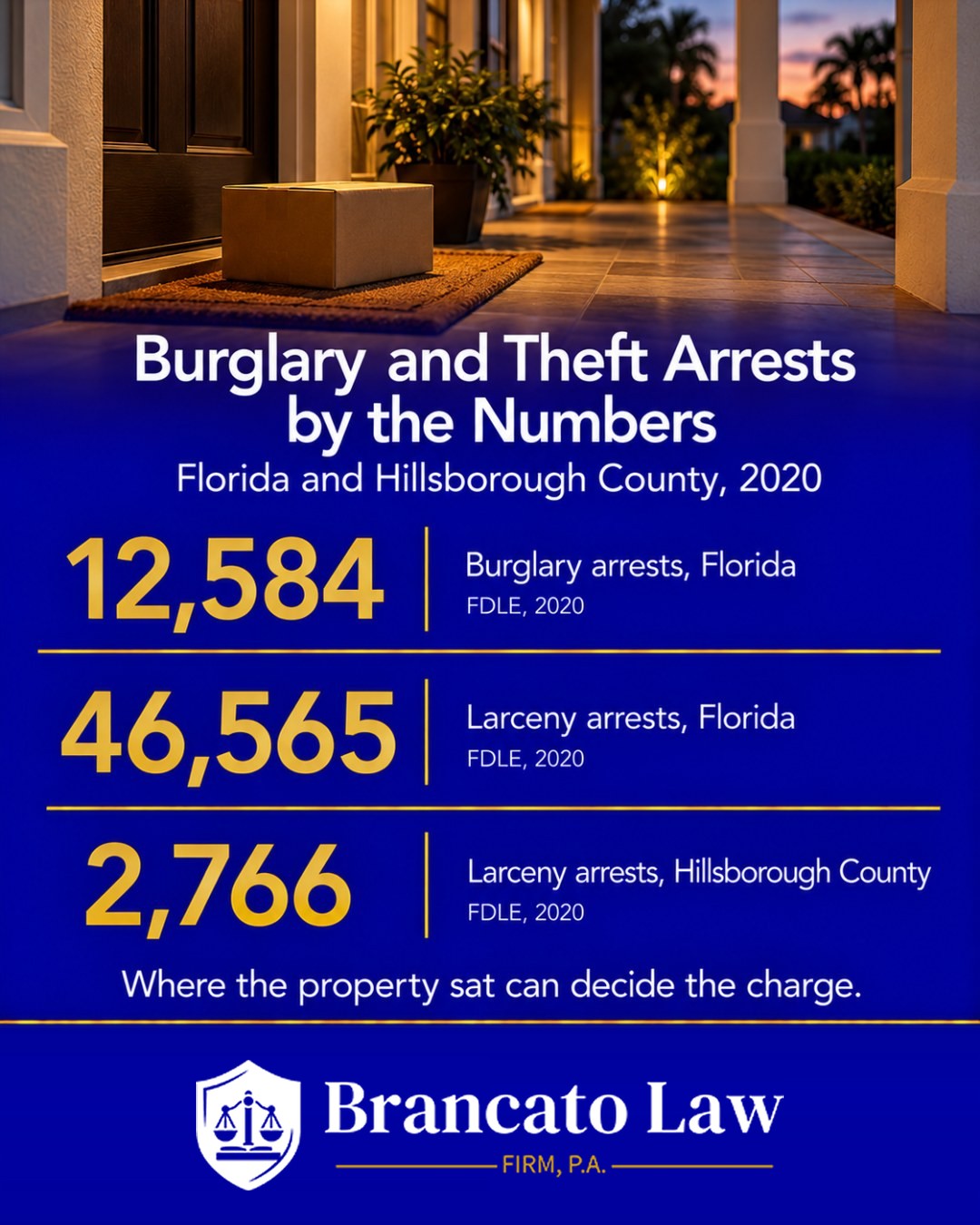
Florida law enforcement agencies made 12,584 burglary arrests and 46,565 larceny arrests statewide in 2020, according to FDLE’s Uniform Crime Report arrest tables, the most recent year FDLE published in that county format. Hillsborough County agencies made 2,766 larceny arrests that year.
Every one of those cases turns on facts like the ones in Krasner: where the property was, what it was worth, and whether the person entered a protected area. For a full breakdown of how burglary charges are built and defended, see our guide How to Fight a Burglary Charge in Florida.
How Do You Fight a Porch Burglary Charge in Florida?
The defense attacks the elements the State must prove: that the area is a dwelling or structure, that the person entered it, and that the person intended to commit a crime inside at the moment of entry. These are the arguments our attorneys raise most often:
- The area is not an attached porch. Photos, measurements, and the roofline can show an open pad, walkway, or yard, as in Colbert.
- The yard is not enclosed curtilage. Under Hamilton, an unfenced yard is not curtilage, so taking an item from it is not burglary.
- No entry occurred. Reaching from a walkway or picking up an item at the edge of a step may not be an entry into the porch at all.
- No intent at entry. A person who stepped onto a porch to knock or deliver something did not enter with intent to steal.
- Identification. Doorbell video is often grainy or partial, and photo lineups can be suggestive.
- Value. For felony theft from a dwelling, the State must prove the property was worth at least $40, with competent evidence of value.
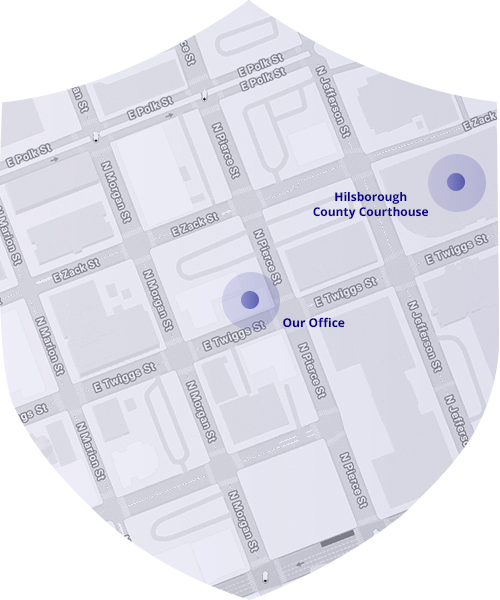
Burglary and theft cases in Hillsborough County are prosecuted by the State Attorney’s Office for the 13th Judicial Circuit and heard at the courthouse on Twiggs Street, two blocks from our office. Our Hillsborough County criminal defense attorney page explains how felony cases move from first appearance to trial.
Frequently Asked Questions About Porch Burglary in Florida
Is a screened porch part of a dwelling for burglary in Florida?
Usually, yes, because a screened porch is typically attached, covered, and enclosed, which fits the “attached porch” language in section 810.011(2). The Brancato Law Firm still examines who had the right to occupy the porch, since a landlord or guest situation can change the analysis.
Can I be charged with burglary for taking a package from a front step with no roof?
It is harder for the State, because courts like the Colbert court have refused to treat open, uncovered areas as an attached porch. Our attorneys at The Brancato Law Firm use photographs and site measurements to show when a step or walkway is not part of the dwelling, though felony theft from the curtilage may still be charged.
Is burglary of an occupied dwelling a life felony in Florida?
No, not by itself. Burglary of an occupied dwelling is a second-degree felony punishable by up to 15 years, and it becomes a first-degree life felony only with an assault, battery, weapon, vehicle damage, or more than $1,000 in damage. The Brancato Law Firm reviews the charging document to make sure the degree matches the facts alleged.
What is the difference between burglary of a dwelling and burglary of a structure in Florida?
A dwelling is a building designed for people to sleep in at night, plus any attached porch, while a structure is any roofed building, such as a store or shed. The Brancato Law Firm often argues that an area is at most a structure or curtilage, which can lower the degree of the charge; see our burglary defense guide.
Can a porch burglary charge be reduced to trespass or petit theft in Florida?
Sometimes, if the evidence on entry, intent, or the nature of the area is weak. Our attorneys at The Brancato Law Firm negotiate reductions based on those weaknesses and take the case to trial when the State will not move; our trespass guide explains the lesser charge.
What should I do if police want to talk to me about a package theft in Tampa?
Decline to answer questions and call a defense attorney, because statements about where you stood or what you intended are often the State’s best evidence of entry and intent. The Brancato Law Firm offers representation before charges are filed for people contacted by detectives.
For how The Brancato Law Firm, P.A. defends these cases, see our Tampa violent crimes defense practice.
Talk to a Tampa Burglary Defense Attorney About the Porch in Your Case
Photographs of a porch, doorbell video, and the property itself can change within weeks, so the defense needs to document the scene early. Call The Brancato Law Firm, P.A., founded by Tampa Criminal Defense Attorney Rocky Brancato, at (813) 727-7159, and our attorneys will review whether the area in your case is truly part of a dwelling. Call us at any hour. Our firm has Spanish-speaking staff, and attorney Jean-Luc Adrien speaks Spanish, Haitian Creole, and French. Read our guide for Spanish and Haitian Creole speakers facing criminal charges.

For more about our defense strategies, visit our Hillsborough County Criminal Defense Attorney page.
The Brancato Law Firm, P.A.
620 E. Twiggs Street, Suite 205, Tampa, FL 33602
(813) 727-7159
Serving Hillsborough, Pinellas, and Pasco Counties
The Brancato Law Firm, P.A. is a Tampa-based criminal defense practice. We are not affiliated with any other Brancato-named law firms.
Visit Us
Tampa, FL 33602
Contact Us Now
Free Legal Consultation (813) 727-7159