- Free Consultation 24/7: (813) 727-7159 Tap Here To Call Us


From First DUI to Death Penalty



How Do You Prove an Alibi Defense in Florida? (2026)


Updated November 5, 2026
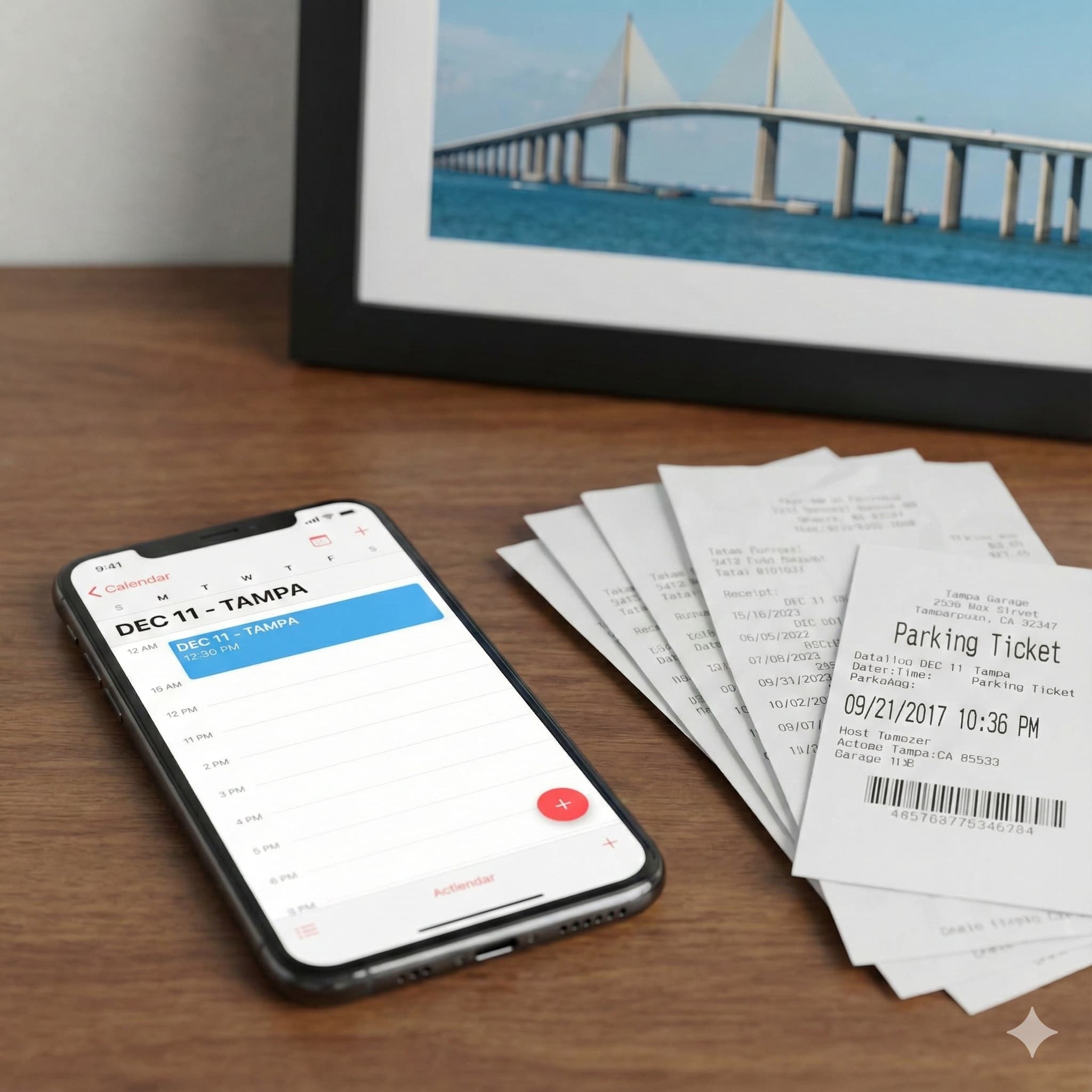
An alibi defense in Florida is evidence that you were somewhere else when the crime happened, so you could not have committed it. You do not have to prove an alibi beyond a reasonable doubt; it is enough if the evidence raises a reasonable doubt that you were present. If the prosecutor files a written demand, Florida Rule of Criminal Procedure 3.200 requires a written notice of alibi, with witness names and addresses, at least 10 days before trial, or the judge may exclude every alibi witness except you.
If you were charged with a crime you know you did not commit because you were somewhere else, the most important evidence in your case may already be disappearing: a receipt, a phone record, a security video that overwrites itself in days. I’m Rocky Brancato, founder of The Brancato Law Firm, P.A., a Tampa criminal defense firm, and I have tried more than 150 jury trials to verdict over more than 25 years in Hillsborough County courtrooms. Our attorneys build alibi defenses from records first and witnesses second, because that is the order in which juries tend to believe them.
What is an alibi defense in Florida?
An alibi is proof that the accused was at a different place when the crime was committed. The word is Latin for “elsewhere.” An alibi is a direct denial that you were there, so it attacks the State’s proof of identity.
An alibi is not an affirmative defense like self-defense or insanity. You are not admitting the act and offering a legal excuse. You are saying the State has the wrong person, and the State keeps the full burden of proving you were the one who did it.
Do you have to prove your alibi beyond a reasonable doubt?
No. The defense only needs to raise a reasonable doubt that you were present. Sanders v. State, 779 So. 2d 522 (Fla. 2d DCA 2000), shows how seriously Florida courts take this rule. Bryant Sanders was charged with robbing two men at gunpoint at a St. Petersburg car wash. Five witnesses testified he was at a family barbecue at the time. In closing, prosecutors told the jury four times that the defense had to prove the alibi beyond a reasonable doubt.
The Second District reversed the conviction. It held that “the proof of an alibi is sufficient if it raises a reasonable doubt in the minds of the jury” that the defendant was present, and that shifting the burden deprived Sanders of due process. The court noted that the eyewitnesses saw the robber’s face for only a few seconds and that no physical evidence tied Sanders to the robbery. The Second District hears appeals from Hillsborough, Pinellas, and Pasco Counties, which makes Sanders a decision local prosecutors and judges know well.
What is Florida’s notice of alibi rule?
Florida Rule of Criminal Procedure 3.200 requires the defense to disclose an alibi after the prosecutor makes a written demand. The demand must state, as particularly as the prosecutor knows, the place, date, and time of the alleged crime. The defense then must file and serve a written notice not less than 10 days before trial, or at another time the court sets. The notice must state where the defendant claims to have been and give the names and addresses of the alibi witnesses.
The rule runs both ways. Within 5 days after receiving the defense witness list, the prosecutor must disclose the witnesses the State will call to rebut the alibi. Both sides have a continuing duty to disclose new witnesses.
| Step | Who acts | Deadline or requirement |
|---|---|---|
| Written demand | Prosecutor | Must specify place, date, and time of the crime as particularly as known |
| Notice of alibi | Defense | At least 10 days before trial (or as the court directs), with the claimed location and witness names and addresses |
| Rebuttal witness list | Prosecutor | Not more than 5 days after receiving the defense witness list (or as the court directs) |
| New witnesses | Both sides | Continuing duty to disclose promptly |
| Penalty for defense noncompliance | Court | May exclude alibi evidence, except the defendant’s own testimony |
| Penalty for State noncompliance | Court | May exclude the State’s rebuttal evidence |
| Waiver | Court | Requirements may be waived for good cause |
What happens if the notice of alibi deadline is missed?
The judge may exclude the alibi witnesses, but not your own testimony. Rule 3.200 says the court may exclude alibi evidence “except the defendant’s own testimony,” and it allows the court to waive the rule for good cause.
Small v. State, 630 So. 2d 1087 (Fla. 1994), explains why judges treat this rule strictly. Small was tried for robbery, and his lawyer never filed the notice for an alibi witness, even after a first trial ended in a mistrial. The Florida Supreme Court held that a notice violation “inherently prejudices the prosecution” because the State loses the chance to investigate the alibi. Unlike ordinary discovery violations, the remedy is limited to excluding the evidence or waiving the rule for good cause, and a missing good-cause hearing is reviewed for harm. The lesson for anyone with an alibi is simple: file early, and list every witness.
What makes an alibi convincing to a jury?
Records beat relatives. Juries tend to discount an alibi supported only by family or close friends, because those witnesses have a reason to help. Research supports that instinct. In What Makes a Good Alibi? A Proposed Taxonomy, 28 Law and Human Behavior 157 (2004), psychologists Elizabeth Olson and Gary Wells sorted alibi support into physical evidence and person evidence and found that physical evidence, when present, tended to overwhelm person evidence. They also found that people evaluating alibis did not consider that a stranger who corroborates an alibi might be mistaken about who they saw.
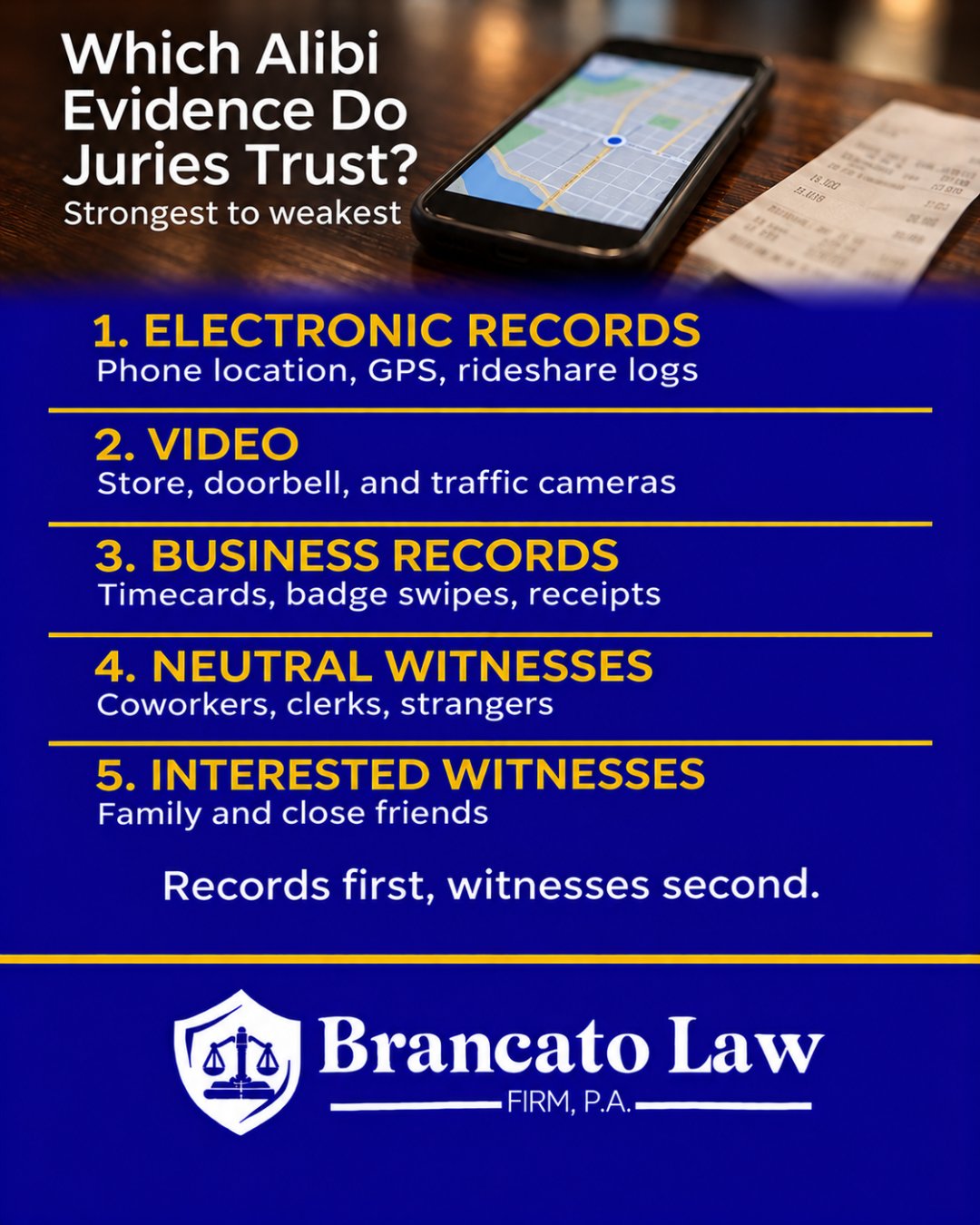
| Type of evidence | Examples | Strength and weak points |
|---|---|---|
| Electronic records | Cell phone location data, app activity, GPS, rideshare logs | Strong if the phone is tied to the person, not just the device |
| Video | Store, doorbell, or traffic cameras | Very strong, but many systems overwrite footage within days |
| Business records | Timecards, badge swipes, receipts, bank transactions | Strong; admissible as business records under section 90.803(6) |
| Neutral witnesses | Coworkers, clerks, strangers | Credible, but memory of faces and times can be wrong |
| Interested witnesses | Spouse, parents, close friends | Admissible, but jurors discount them; best when backed by records |
Business records are often the backbone of an alibi. Under section 90.803(6), Florida Statutes, records made at or near the time and kept in the regular course of business are an exception to the hearsay rule, and under section 90.902(11) they can be authenticated by a custodian’s certification instead of live testimony. Phone location evidence has its own strengths and limits, covered in our guide on whether cell phone location evidence can prove your alibi.
Why are alibi cases usually eyewitness cases?
Most alibi defenses answer an identification. If the State had fingerprints, DNA, or video of the accused, an alibi would be hard to raise. The cases where an alibi matters most are the ones built on a witness who picked a face. In 2024, 38 of the 147 exonerations recorded by the National Registry of Exonerations (26%) involved mistaken witness identification, according to the Registry’s 2024 Annual Report.
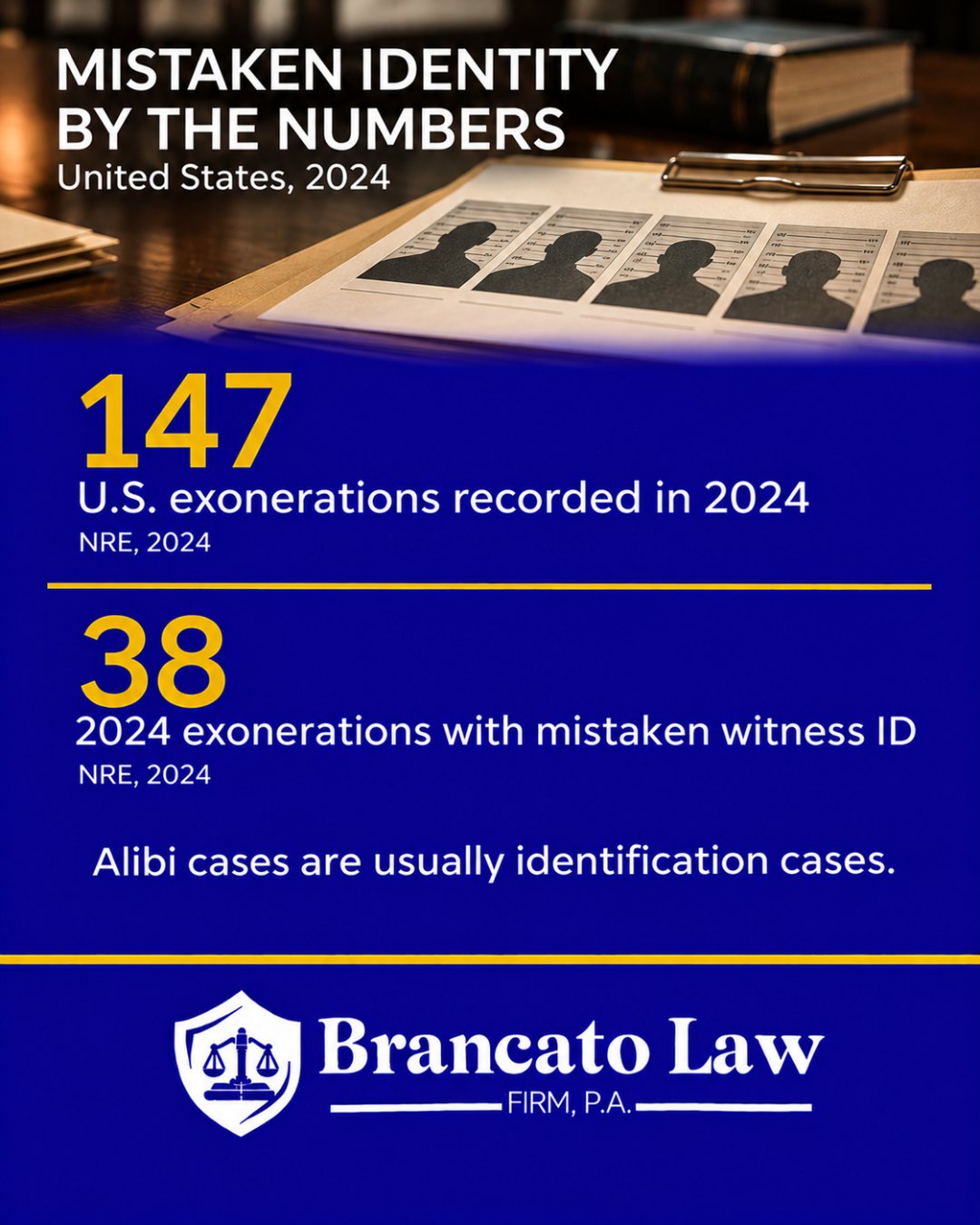
That is why our attorneys pair an alibi with an attack on the identification itself: how long the witness saw the person, lighting and distance, stress and weapon focus, and how the photo lineup was run. In Sanders, the court specifically noted that the eyewitnesses saw the robber for only seconds. Our Tampa violent crime lawyer page covers how we defend robbery, battery, and other cases that often turn on identification.
Do you have to testify to raise an alibi?
No. You have a constitutional right not to testify, and an alibi can be proven entirely through other witnesses and records. Rule 3.200 also protects your own testimony from exclusion if the notice was missed. Whether you should testify is a strategic decision made with your lawyer after seeing how the State’s case comes in.
What can hurt an alibi defense?
A weak alibi can be worse than none. If the State rebuts an alibi witness, jurors may hold it against the whole defense. Common problems include:
- Inconsistent statements: telling police one location and later claiming another.
- Timing gaps: an alibi that covers 8:00 p.m. when the crime happened at 8:40 p.m.
- Device versus person: a phone’s location proves where the phone was, not who had it.
- Late disclosure: an alibi first raised on the eve of trial invites suspicion and a Rule 3.200 fight.
- Coached witnesses: witnesses who talk to each other before giving statements become easy to impeach.
When should you start building an alibi?
Immediately, because the best proof disappears first. Security video is often recorded over within days, and businesses do not keep every record forever. Our firm sends preservation requests, subpoenas records, and interviews witnesses while memories are fresh. If you are under investigation and have not been charged, our representation before charges are filed can put alibi evidence in front of prosecutors before a filing decision is made.
Frequently asked questions
Can my spouse or parent be my alibi witness in Florida?
Yes. Family members can testify to an alibi, but jurors often weigh their testimony against their interest in protecting you. The Brancato Law Firm looks for records and neutral witnesses that confirm what family members say, so the alibi does not rest on relatives alone.
What if I filed my notice of alibi late?
The judge can still allow the evidence if there is good cause, and your own testimony cannot be excluded under Rule 3.200. The Brancato Law Firm files alibi notices early and complete, and when a deadline problem exists, we ask the court for a good-cause hearing as Small v. State contemplates.
Can cell phone records prove where I was?
They can show where your phone connected to the network or recorded location data, which is strong evidence if other proof ties the phone to you. Our attorneys at The Brancato Law Firm work with records custodians and, when needed, experts to read location data correctly; our post on cell phone alibi evidence explains the limits.
Does the State have to disprove my alibi?
The State must prove beyond a reasonable doubt that you were the person who committed the crime, and an alibi only needs to raise a reasonable doubt about your presence. The Brancato Law Firm objects when a prosecutor suggests otherwise, because Sanders v. State treats that kind of burden shifting as reversible error.
What if I do not remember where I was on the date of the crime?
Start with records rather than memory: bank and card statements, phone history, work schedules, and social media activity can rebuild a day. The Brancato Law Firm helps clients reconstruct timelines before anyone gives a statement, and our violent crime defense work often starts with that timeline.
Can I be charged with a crime if I have an alibi?
Yes. Police can arrest on probable cause, often based on an identification, without checking an alibi first. The Brancato Law Firm can present alibi proof to the State Attorney’s Office early, which can lead prosecutors to drop or decline charges.
Get your alibi evidence secured now
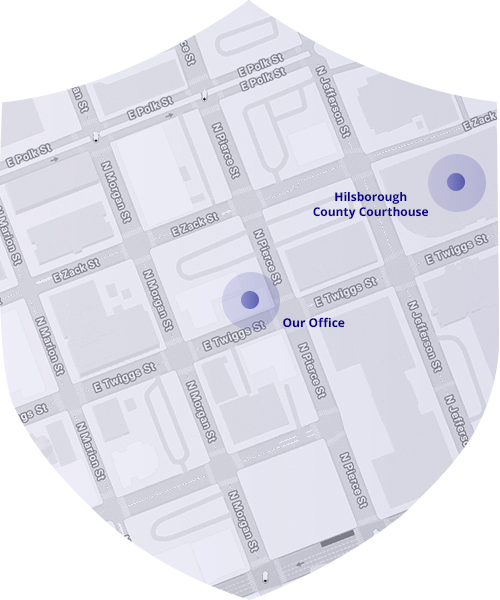
Video and records do not wait for a trial date. Call (813) 727-7159 to have our attorneys start preserving your alibi evidence this week. The Brancato Law Firm, P.A. was founded by Tampa Criminal Defense Attorney Rocky Brancato, and you can call us at any hour; our office is two blocks from the courthouse. Our firm has Spanish-speaking staff, and attorney Jean-Luc Adrien speaks Spanish, Haitian Creole, and French. Read our guide for Spanish-speaking and Haitian Creole-speaking clients. For more about our defense strategies, visit our Violent Crimes page.
The Brancato Law Firm, P.A.
620 E. Twiggs Street, Suite 205, Tampa, FL 33602
(813) 727-7159
Serving Hillsborough, Pinellas, and Pasco Counties
The Brancato Law Firm, P.A. is a Tampa-based criminal defense practice. We are not affiliated with any other Brancato-named law firms.
Visit Us
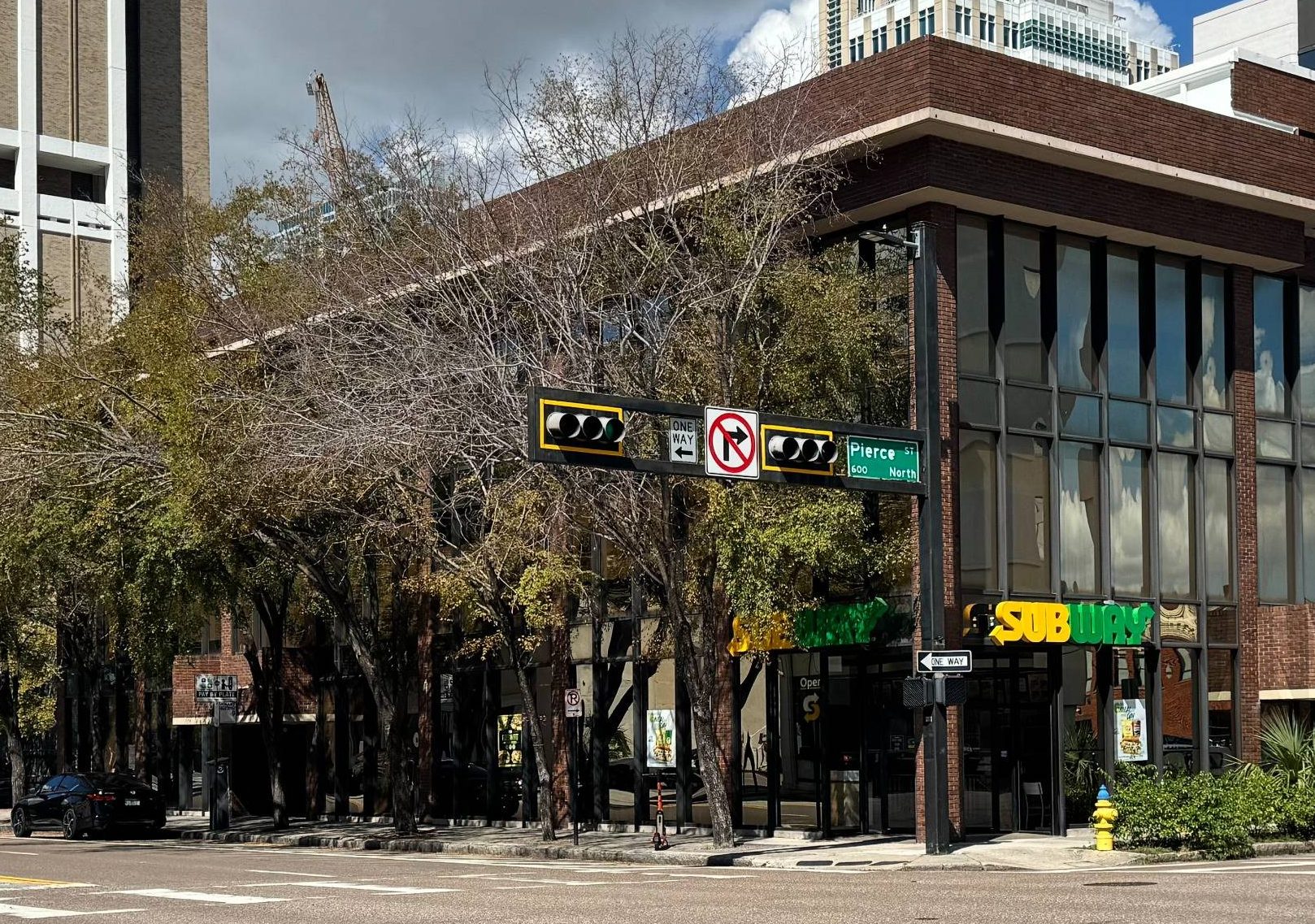
Tampa, FL 33602
Contact Us Now
Free Legal Consultation (813) 727-7159