Strategic Defense,
From First DUI to Death Penalty
From First DUI to Death Penalty






| Charged with murder, or under investigation for a death in Tampa? The Brancato Law Firm, P.A. defends first-degree murder, second-degree murder, manslaughter, vehicular homicide, and DUI manslaughter cases in Hillsborough, Pinellas, and Pasco Counties. Our attorneys start the defense investigation before the State decides what to charge or whether to seek death, retain independent forensic experts, and fight for bond, immunity, and acquittal. Call (813) 727-7159 for a free, confidential consultation. |
Most homicide cases are shaped in the weeks before an indictment, while witnesses can still be found, video still exists, and the medical examiner’s file is still open. Rocky Brancato learned that in the Major Crimes Unit, where he defended homicide, sex crime, and child abuse cases, and he built The Brancato Law Firm, P.A., a Tampa criminal defense firm, to start that work on the day a family calls.
Rocky meets the Florida Rule of Criminal Procedure 3.112 qualifications for capital cases, has tried more than 150 cases to a jury verdict, and served as Chief Operations Officer of the Hillsborough County Public Defender’s Office, overseeing a staff of over 100 attorneys. Our attorneys work with independent forensic pathologists, DNA analysts, firearms examiners, accident reconstructionists, and digital forensic examiners, because homicide cases are usually decided by what the forensic evidence actually shows.
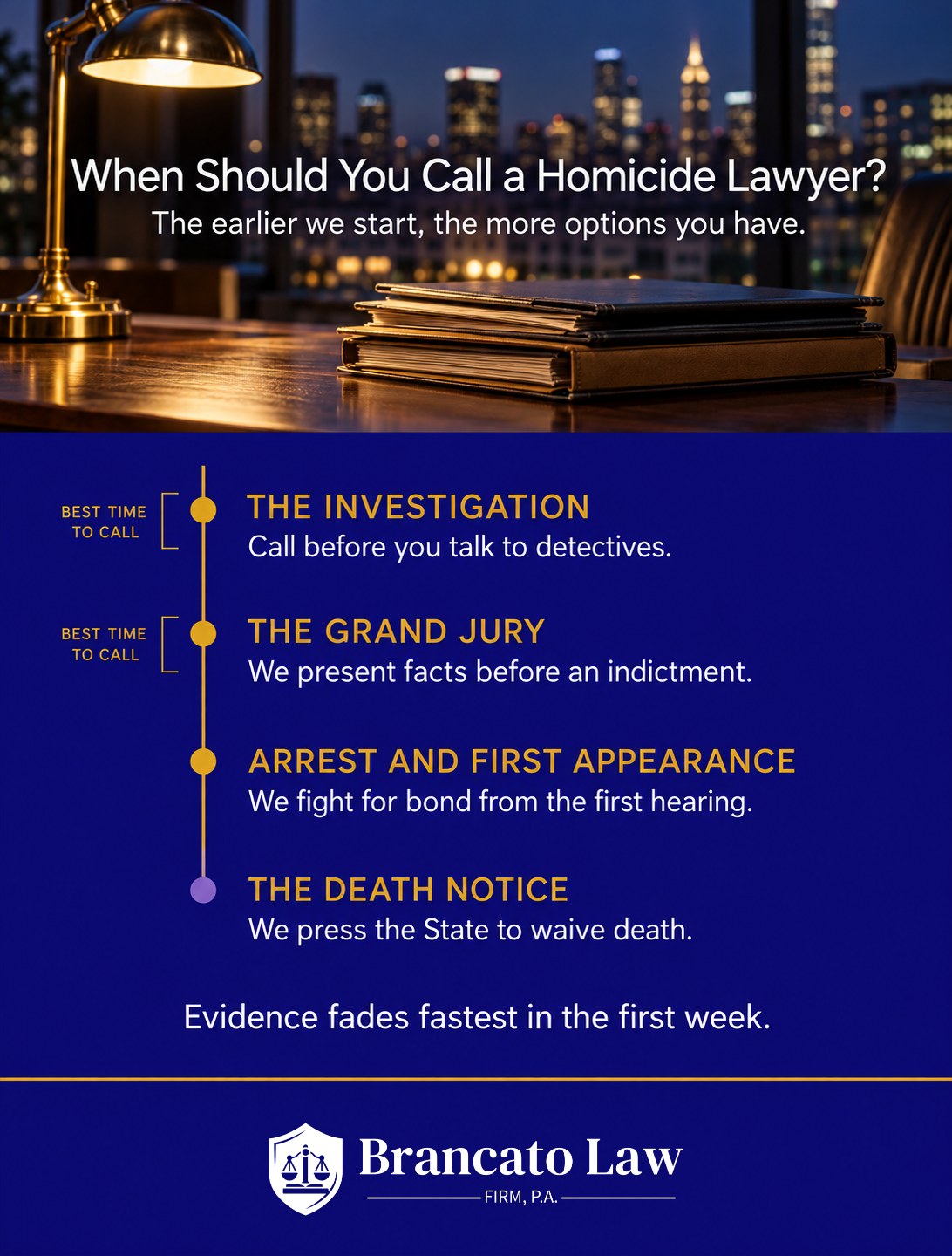
Tell the detective you want a lawyer, end the conversation, and call a defense attorney before any interview. Detectives often describe a person as a “witness” or a “person of interest” while they decide whether that person is a suspect, and every word of the interview is recorded. A detailed account given to help can become the timeline the State uses to argue premeditation.
Until you have a lawyer, follow these rules:
When The Brancato Law Firm is hired during an investigation, our attorneys take over communication with detectives, begin the defense investigation, and present information to the State Attorney’s Office before the charging decision through our representation before charges are filed. In a first-degree murder case, the State needs a grand jury indictment under Article I, section 15 of the Florida Constitution, which gives the defense time to act before the case is charged.
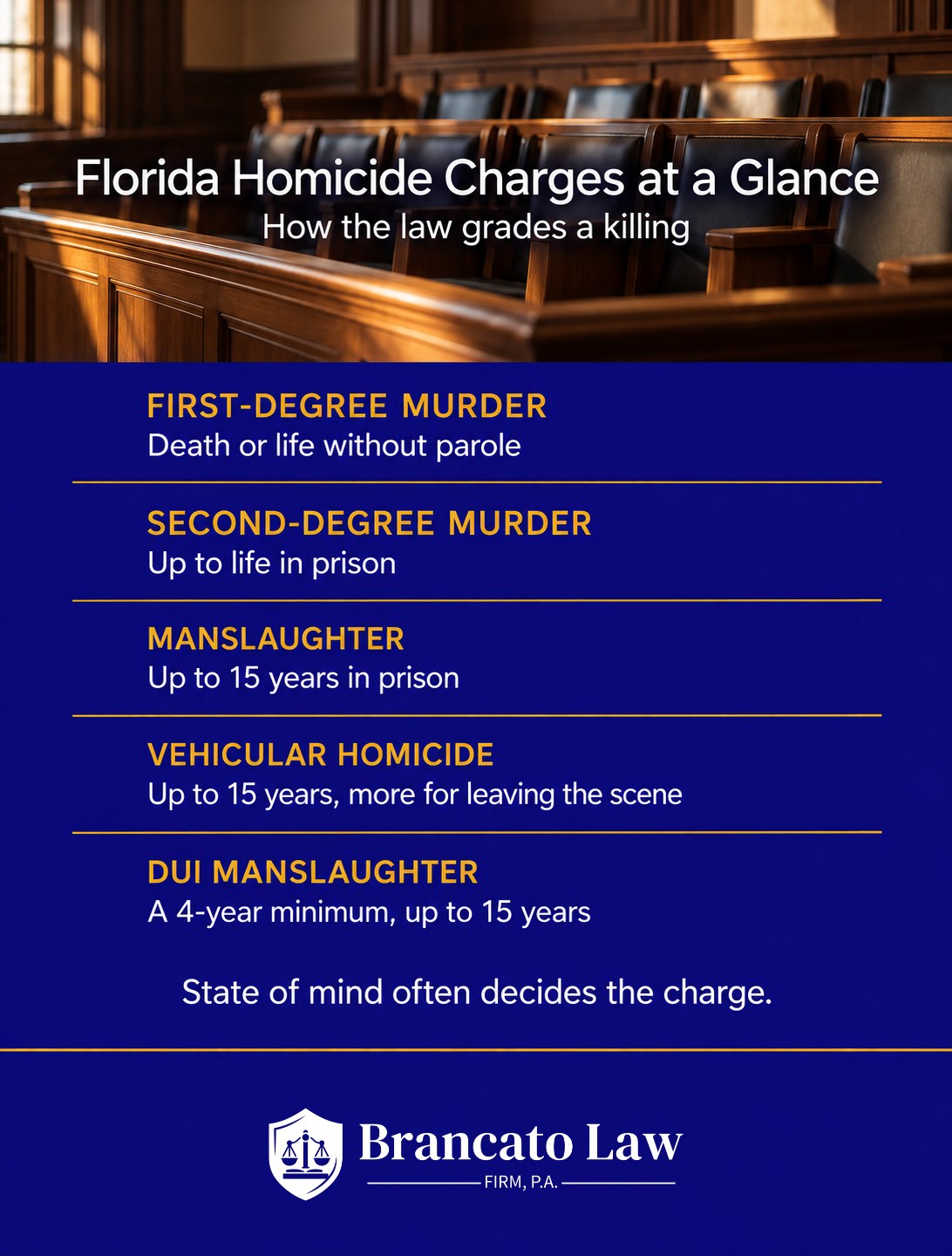
Florida grades a killing by the person’s intent, the circumstances, and whether the death happened during another felony. First-degree murder is a capital felony punishable by death or life without parole, and every other homicide charge carries a long prison term. The table lists the charges our attorneys see most often in the 13th Judicial Circuit and the surrounding counties.
| Charge | Florida statute | Degree | Maximum penalty |
|---|---|---|---|
| First-degree murder: premeditated, felony murder, or a death caused by distributing fentanyl and other listed drugs | 782.04(1) | Capital felony | Death, or life without parole |
| Second-degree murder: an act imminently dangerous to another and showing a depraved mind | 782.04(2) | First-degree felony | Life |
| Second-degree felony murder: a killing by someone else during a listed felony | 782.04(3) | First-degree felony | Life |
| Third-degree murder: an unintended killing during a felony that is not listed | 782.04(4) | Second-degree felony | 15 years |
| Manslaughter: a killing by act, procurement, or culpable negligence | 782.07(1) | Second-degree felony | 15 years |
| Aggravated manslaughter of a child, an elderly person or disabled adult, or an officer, firefighter, EMT, or paramedic | 782.07(2) to (4) | First-degree felony | 30 years |
| Vehicular homicide | 782.071 | Second-degree felony (first-degree if the driver failed to give information and render aid) | 15 years (30 years) |
| DUI manslaughter | 316.193(3)(c)3. | Second-degree felony (first-degree if the driver left the scene) | 15 years (30 years), with a 4-year minimum mandatory term |
These are maximums, and several charges carry minimums. When the State does not seek death, a first-degree murder conviction carries mandatory life without parole under section 775.082, Florida Statutes. A murder involving a firearm that was discharged and caused death carries a minimum of 25 years and up to life under section 775.087, Florida Statutes. Our complete guide to homicide charges in Florida explains each charge in more detail.
Our defense starts with an independent investigation of the death itself: how it happened, when, and who was there. The State’s theory is built early, often from one witness and a preliminary autopsy, and our attorneys test each piece of it with our own experts before the trial date is set.
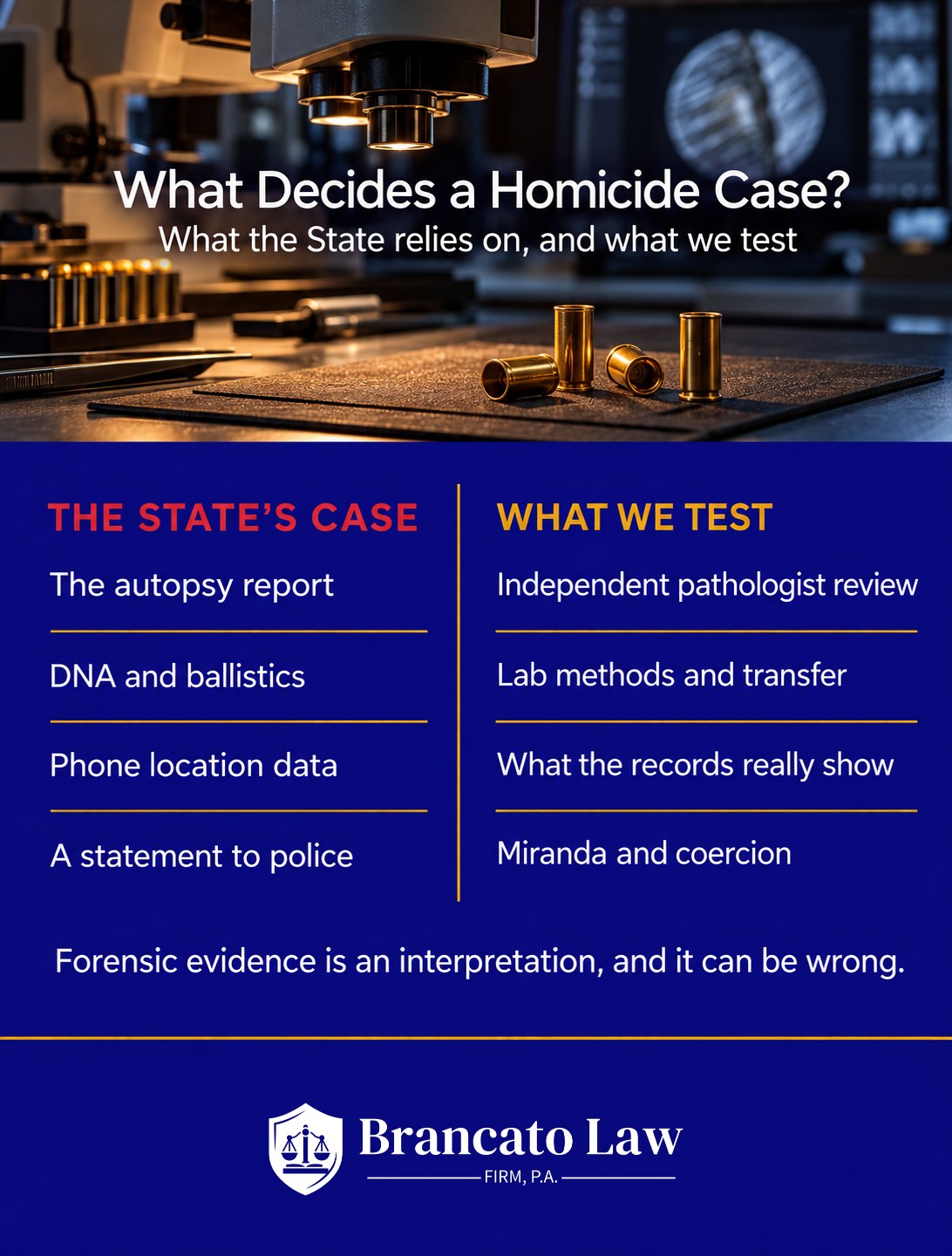
Forensic evidence in a homicide case is an interpretation, and interpretations can be wrong. Our attorneys retain independent forensic pathologists, DNA analysts, firearms examiners, and digital examiners through our Tampa forensic science defense practice. In one case, a grandmother was charged with first-degree murder and aggravated child abuse after her granddaughter died. A forensic pathologist we retained showed that the child drowned and that the liver injury came from CPR, and the homicide charge was dropped. Our forensic pathologist case study tells that story.
Official error is a documented cause of wrongful murder convictions. The National Registry of Exonerations report Government Misconduct and Convicting the Innocent (2020) found official misconduct in 54 percent of the exonerations it studied and in 72 percent of exonerations of people who had been sentenced to death. Our case studies on a firearms expert who kept prejudicial evidence out of a murder trial and a data recovery expert who proved police mishandled evidence show how our firm uses experts at trial.
A statement taken in violation of Miranda, or obtained through coercion, can be suppressed. Rocky taught criminal procedure and courtroom testimony at the police academy, so our attorneys know the interview techniques detectives use, including the minimization that invites a suspect to describe a killing as an accident or as self-defense. We review every recording for the point where questioning should have stopped. Our post on a murder conviction reversed because police ignored Miranda rights shows why that review matters.
The line between first-degree murder, second-degree murder, and manslaughter is the person’s state of mind, and the State must prove it beyond a reasonable doubt. Premeditation requires a conscious decision to kill formed before the act. Second-degree murder requires an act showing ill will, hatred, spite, or an evil intent. When the evidence shows a sudden fight, a heat-of-passion response, or culpable negligence, our attorneys build the case for a lesser charge or acquittal. Our post on the difference between second-degree murder and manslaughter in Florida explains how juries are instructed.
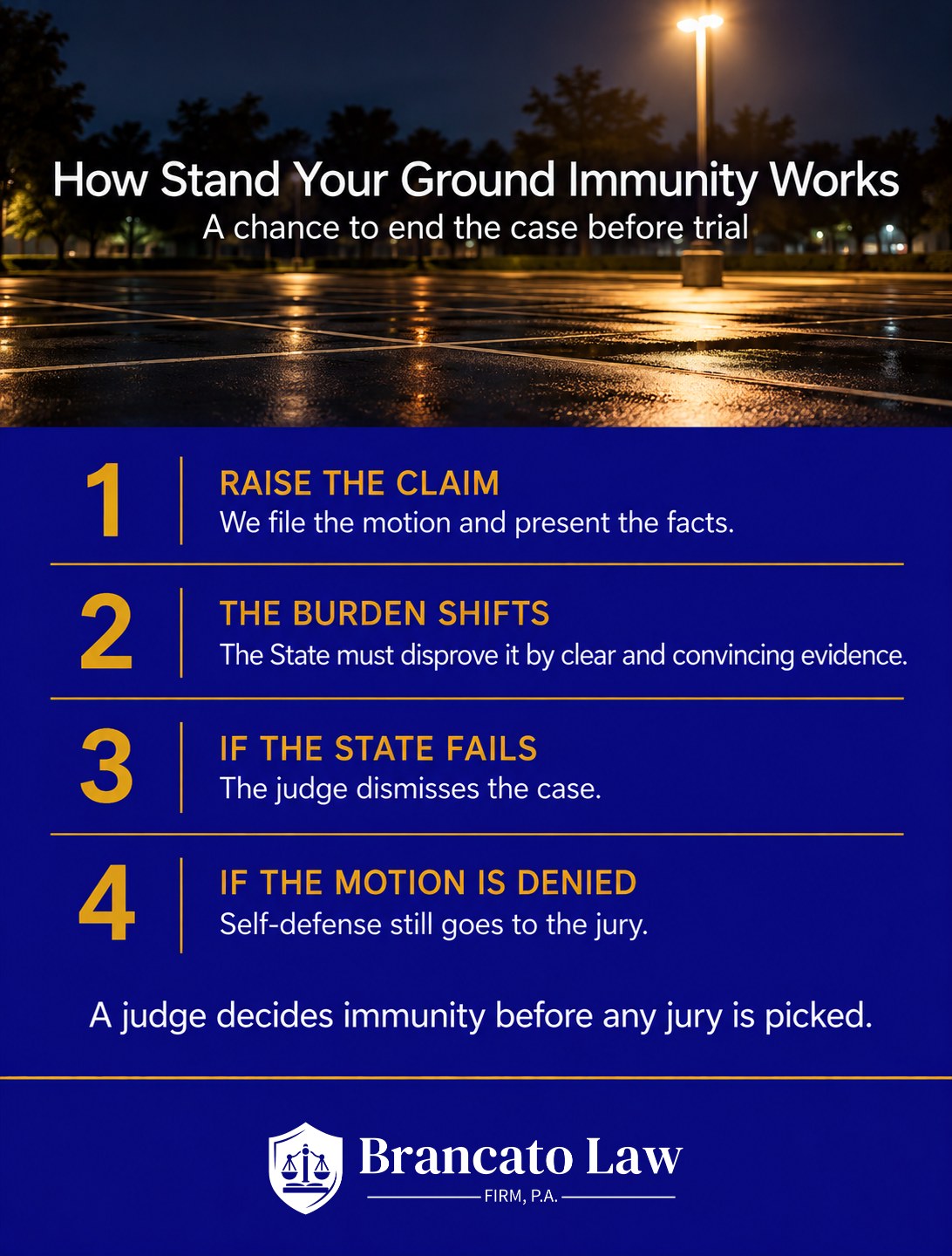
Florida law allows deadly force when a person reasonably believes it is necessary to prevent imminent death or great bodily harm, or the imminent commission of a forcible felony, under section 776.012, Florida Statutes. A person who used force the law permits is immune from prosecution under section 776.032, Florida Statutes, and the defense can ask the judge to decide immunity at a pretrial hearing.
The burden at that hearing favors the defense. Once the defense raises a prima facie claim of self-defense immunity, the State must overcome it by clear and convincing evidence under section 776.032(4). The Florida Supreme Court applied that rule in Love v. State, 286 So. 3d 177 (Fla. 2019). Tashara Love shot a man outside a Miami-Dade nightclub as he was about to hit her daughter, and she was charged with attempted second-degree murder. Her immunity hearing was held after the 2017 amendment took effect, but the trial court still put the burden on her, while noting that under the new statute she would have been entitled to immunity. The Court quashed the decision and held that the amendment governs every immunity hearing held on or after its effective date. The lesson for the defense is that an immunity hearing is a chance to win the case before trial, and losing it does not prevent a self-defense case in front of the jury.
Self-defense evidence has driven results in our homicide cases. A Tampa jury found our client not guilty of second-degree murder after a fatal shooting involving his roommate, and in a first-degree murder and armed burglary case, our review of discovery showed no burglary and a state of mind consistent with justifiable use of deadly force, which led the judge to set bond on rehearing. Our posts on Stand Your Ground versus self-defense in Florida and how to claim self-defense in a Florida criminal case go further, and our Tampa violent crime lawyer page covers non-fatal force cases.
Not every fatal crash is a crime. Vehicular homicide requires driving in a reckless manner likely to cause death or great bodily harm, and DUI manslaughter requires impairment plus proof that the driver caused or contributed to the death. Our attorneys work with accident reconstructionists, toxicologists, and vehicle data experts on speed, causation, and mechanical failure. In one Tampa case, a reconstruction expert we retained focused on the vehicle’s braking system, and a vehicular homicide charge was reduced to reckless driving with serious bodily injury with no prison sentence. Read our posts on what vehicular homicide is in Florida, when the car, not the driver, caused the crash, and how DUI manslaughter cases are defended, and see our Tampa DUI defense lawyer page for the impairment side of these cases.
| Evidence the State relies on | What our attorneys test |
|---|---|
| Autopsy and cause of death | Independent review by a forensic pathologist of the cause, manner, and timing of death |
| DNA and trace evidence | Lab methods, mixture interpretation, and how the evidence could have been transferred |
| Firearms and ballistics | Whether the identification method is reliable and admissible |
| Cell phone and location data | What the records actually show about where a phone was and who had it |
| Eyewitness identification | Lighting, distance, stress, and how the identification procedure was run |
| The client’s statements | Miranda compliance, coercion, and what was left out of the recording |
A capital murder case moves through an indictment, a death notice, and, if the State does not waive death, a separate penalty phase. Under Florida Rule of Criminal Procedure 3.181, a prosecutor who intends to seek death must give notice within 45 days of arraignment and list the aggravating factors. At the penalty phase, the jury must unanimously find at least one aggravating factor beyond a reasonable doubt, and at least 8 of 12 jurors must vote for death before the judge can impose it under section 921.141, Florida Statutes. The Florida Supreme Court upheld the 8-vote rule in Hunt v. State, 428 So. 3d 43 (Fla. 2025), so the defense must reach at least five of the twelve jurors to prevent a death recommendation.
These cases end in executions. Florida carried out 19 executions in 2025, the most in any year since 1976, and 17 more from January through mid-October 2026, according to the Florida Department of Corrections execution list. National standards call for the defense investigation to begin immediately: the ABA Guidelines for the Appointment and Performance of Defense Counsel in Death Penalty Cases, 31 Hofstra L. Rev. 913 (2003) state that investigation should start as soon as counsel enters the case, even before the prosecution announces it will seek death, with an investigator and a mitigation specialist on the team.
Rule 3.112 sets the minimum experience for lawyers who try capital cases, and a retained lawyer files a notice of appearance certifying that he or she meets it. Florida has no death penalty certification. Our post on what a death penalty qualified lawyer is in Florida explains the rule, and our post on proving intellectual disability in a Florida death penalty case covers one issue capital counsel must raise early.
Sometimes. Under Article I, section 14 of the Florida Constitution, a person charged with a capital or life offense can be held without bond when the proof of guilt is evident or the presumption is great, and the State can also move for pretrial detention. Those standards leave room for a defense lawyer who knows the evidence. In our first-degree murder and armed burglary case, the client was held without bond on a pretrial detention motion until our attorneys reviewed discovery and showed the judge the evidence against a burglary, and the judge set bond at $75,000 on rehearing.
Hillsborough County does not offer pretrial services supervision as a release option, though some nearby counties do, so the bond argument has to stand on its own facts. Our Tampa bond hearing attorney post explains how bond is handled after arrest and at the hearing itself.
Our attorneys have won acquittals, ended homicide charges before trial, had the death penalty withdrawn, and kept clients out of prison in fatal crash cases. Representative results:
| Outcome | Charge | How our firm handled it |
|---|---|---|
| Not guilty | Second-degree murder | Presented justifiable use of deadly force at trial in a fatal shooting involving the client’s roommate |
| Homicide charge dropped; aggravated child abuse reduced to child neglect | First-degree murder and aggravated child abuse | Our forensic pathologist showed the child drowned and the liver injury came from CPR |
| Death penalty withdrawn | First-degree murder (capital) | A Daubert motion exposed critical flaws in how the DNA evidence was collected and stored, leading to a 50-year sentence instead of the death penalty |
| Reduced to manslaughter | Second-degree murder | Proved at trial imperfect self-defense and the lack of a depraved mind; the client avoided a life sentence |
| Bond set after pretrial detention | First-degree murder and armed burglary with a firearm | Showed from discovery that there was no burglary and that the client’s state of mind was consistent with justifiable use of deadly force |
| Reduced to reckless driving with serious bodily injury; probation | Vehicular homicide | An accident reconstruction expert focused on the vehicle’s braking system |
Each case is unique. Past results do not guarantee future outcomes. More outcomes are on our case results page.
Clients hire our firm because homicide cases are won on trial experience, forensic depth, and an early start. These credentials stand behind our homicide practice:
| Credential | Why it matters in a homicide case |
|---|---|
| Meets the Rule 3.112 qualifications for capital cases | Can try a case in which the State seeks death |
| Former Major Crimes Unit attorney (homicide, sex crimes, child abuse) | Years of defending the most serious charges the State brings |
| More than 150 jury trials to verdict | Prosecutors know the case is ready for trial |
| Former Chief Operations Officer, Hillsborough County Public Defender’s Office, overseeing a staff of over 100 attorneys | Inside knowledge of how the 13th Judicial Circuit charges and resolves cases |
| Former police academy instructor in criminal procedure and courtroom testimony | Knows how detectives are trained to interview suspects and testify |
| AV Preeminent (Martindale-Hubbell), Super Lawyers selection, 10.0 Avvo rating, National Trial Lawyers Top 100 | Peer and independent recognition of legal ability and ethics |
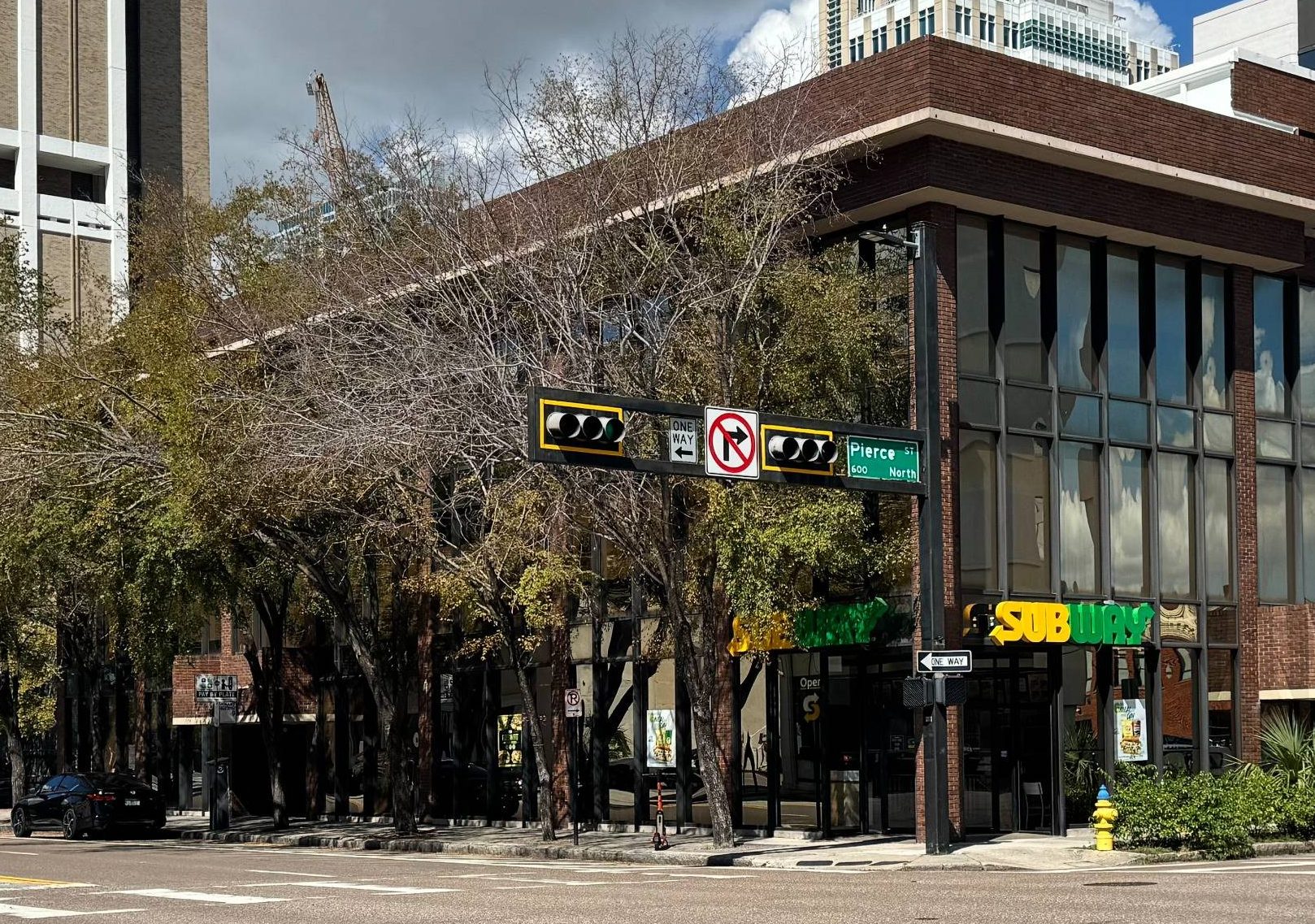
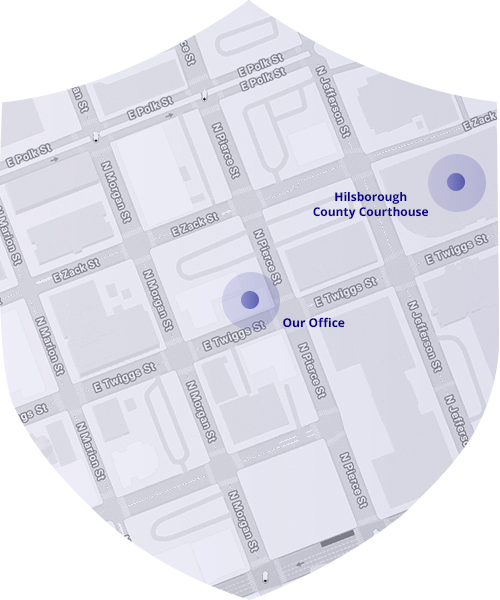
Our attorneys defend homicide cases in the circuit courts of Hillsborough County, Pinellas County, and Pasco County, from our office two blocks from the Hillsborough County Courthouse. Capital cases are assigned to both of our attorneys, Rocky Brancato and Jean-Luc Adrien. Jean-Luc speaks Spanish, Haitian Creole, and French, and our office has Spanish-speaking staff, so families can follow a homicide case in their own language (see our guide for Spanish-speaking and Haitian Creole-speaking clients). Our firm charges a flat fee quoted on the charge and the complexity of the case. We generally do not ask the court to declare a private client indigent for costs, because experts paid through the state must work at a much lower rate, and that limits which experts the defense can use. Our posts on how to choose a homicide attorney in Florida and why expert witnesses are not optional in major crimes cases explain what to ask.
Hire a lawyer before you speak with detectives, and no later than first appearance if there has been an arrest. After an arrest in Hillsborough County, the accused is booked at the Orient Road Jail and sees a judge at first appearance within 24 hours under Florida Rule of Criminal Procedure 3.130. Witnesses move, surveillance video is overwritten, and the scene changes within days, so our attorneys send preservation requests and begin interviewing witnesses in the first week. In a capital case, the 45-day death notice deadline runs from arraignment, and the mitigation work our attorneys do before that date can persuade the State to waive death.
Yes, the State Attorney’s Office can drop or reduce a murder charge when the evidence does not support it, and a judge can dismiss it on a successful Stand Your Ground immunity motion. The Brancato Law Firm has ended homicide charges before trial with independent forensic review, as in our case where a forensic pathologist showed a child’s injuries came from CPR.
No, a prosecution for a capital felony, a life felony, or any felony that resulted in a death may be started at any time under section 775.15, Florida Statutes. Our attorneys at The Brancato Law Firm defend cold case homicide charges, where the age of the evidence and lost witnesses often become central defense issues.
No, say you want a lawyer and end the interview, because a person of interest is often a suspect the police have not yet charged. The Brancato Law Firm takes over communication with detectives through our pre-file advocacy practice so the defense can reach the prosecutor without a client statement.
Second-degree murder requires an act imminently dangerous to another and showing a depraved mind, while manslaughter requires only an act, procurement, or culpable negligence. Our attorneys at The Brancato Law Firm use that difference to push for a manslaughter verdict or plea, which lowers the maximum from life to 15 years; see our guide to second-degree murder versus manslaughter.
Yes, under Florida’s felony murder statute a participant in certain felonies can be charged with murder when a death occurs, even if another person caused it. The Brancato Law Firm challenges the underlying felony, the participant’s role, and whether the death happened during the felony, because each is an element the State must prove.
No, at least 8 of 12 jurors must vote for death, although the jury must still find at least one aggravating factor unanimously. The Brancato Law Firm builds jury selection and the penalty phase around reaching the five jurors whose votes prevent a death recommendation, as our post on death penalty qualified lawyers in Florida explains.
Homicide defense is charged as a flat fee set by the charge, whether the State seeks death, and the experts the case needs, so published ranges are only a starting point. The Brancato Law Firm offers free, confidential consultations to people under investigation and to their families, and our guide to how much a criminal defense attorney costs in Tampa explains how fees are set.
What happens before an indictment or a death notice can change the whole case. Call The Brancato Law Firm, P.A., founded by Tampa Criminal Defense Attorney Rocky Brancato, at (813) 727-7159. Call us at any hour, and our attorneys will tell your family what to say to detectives, what not to say, and what we will do first.
The Brancato Law Firm, P.A.
620 E. Twiggs Street, Suite 205, Tampa, FL 33602
(813) 727-7159
Serving Hillsborough, Pinellas, and Pasco Counties
The Brancato Law Firm, P.A. is a Tampa-based criminal defense practice. We are not affiliated with any other Brancato-named law firms.
This page is for informational purposes only and does not constitute legal advice. Each case is unique, and outcomes depend on the individual facts and circumstances involved. Past results do not guarantee future outcomes.

Tampa, FL 33602
Free Legal Consultation (813) 727-7159