- Free Consultation 24/7: (813) 727-7159 Tap Here To Call Us


From First DUI to Death Penalty



What Is a Death Penalty Qualified Lawyer in Florida? (2026)


Updated October 2026
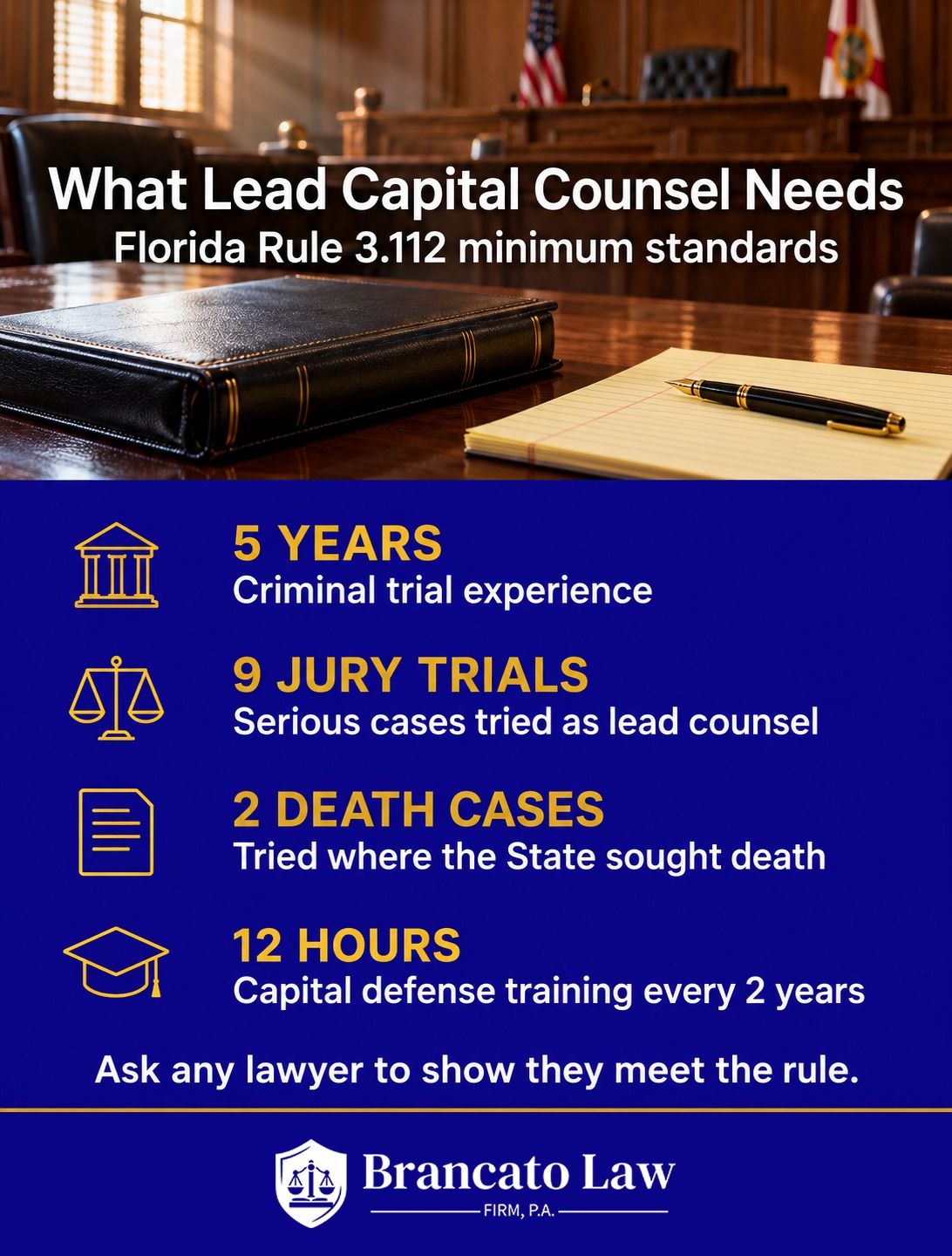
| A death penalty qualified lawyer in Florida is an attorney who meets the minimum standards for capital cases in Florida Rule of Criminal Procedure 3.112. For lead trial counsel, the rule calls for at least 5 years of criminal litigation experience, lead counsel in at least 9 serious jury trials tried to completion, experience in at least 2 cases where the State sought death, and 12 hours of capital-defense training in the last 2 years. Florida has no death penalty certification. Instead, a lawyer retained for a capital case files a notice of appearance certifying that he or she meets the rule. |
In a Florida capital case, the State has 45 days after arraignment to decide whether to seek death, and the defense work done in that window can shape everything that follows. I learned that in the Major Crimes Unit, where I tried homicide and death penalty cases, and I have tried more than 150 jury trials to verdict. I’m Rocky Brancato, founder of The Brancato Law Firm, P.A., a Tampa criminal defense firm; I meet the Rule 3.112 qualifications for capital cases, and our attorneys begin the defense investigation in first-degree murder and other capital cases on the day we are retained.
What does Florida Rule 3.112 require of a capital defense lawyer?
Florida Rule of Criminal Procedure 3.112 sets the minimum standards for lawyers who handle capital trials and capital appeals. The current rule text published by The Florida Bar, updated through October 1, 2026, lists separate standards for lead trial counsel and for co-counsel. The rule covers every defense lawyer in a capital trial appointed or retained on or after July 1, 2002.
| Requirement | Lead trial counsel, Rule 3.112(f) | Co-counsel, Rule 3.112(g) |
|---|---|---|
| Bar admission | Member of The Florida Bar or admitted pro hac vice | Same |
| Criminal litigation experience | At least 5 years | At least 3 years |
| Jury trials tried to completion | Lead counsel in at least 9 serious and complex jury trials | Lead counsel or co-counsel in at least 3 serious and complex jury trials |
| Murder trials | At least 3 of the 9 as lead counsel, or at least 1 murder trial plus 5 other felony jury trials | At least 2 of the 3, or 1 murder trial plus 1 other felony jury trial |
| Death penalty cases | Lead or co-counsel in at least 2 cases tried to completion in which the State sought death | No separate requirement |
| Experts and evidence | Experience with expert witnesses, including psychiatric and forensic evidence | No separate requirement |
| Mitigation | Proficiency in investigating and presenting mitigation evidence | Demonstrated proficiency and commitment |
| Local practice | Familiar with the practice and procedure of the local criminal courts | Same |
| Capital training | At least 12 hours of capital-defense continuing legal education in the last 2 years | Same |
The qualification lists in Rule 3.112 use the word “should.” Under Rule 3.112(l), a trial court can use counsel who falls short only after a written order that explains the exceptional circumstances and finds the lawyer will still provide competent representation. The numbers set a minimum. A lawyer who meets them has tried enough serious cases to know how jurors hear forensic and medical evidence, and the remaining question is how that experience is used on your case. At The Brancato Law Firm, capital cases are assigned to both of our attorneys, Rocky Brancato and Jean-Luc Adrien, and we retain the forensic and mitigation experts each case requires.
Is there a death penalty certification for Florida lawyers?
No. Florida has no death penalty certification, and no court or agency issues a “death qualified” credential to lawyers. Under Rule 3.112(i), a lawyer retained or appointed in place of a public defender’s office must immediately file a notice of appearance certifying that he or she meets the rule’s qualifications, and must serve that notice on the defendant. Each judicial circuit also keeps lists of qualified conflict counsel under Rule 3.112(d), and those lists apply to court-appointed lawyers only.
The phrase “death qualified” also has a second meaning that confuses families. During jury selection in a capital trial, a “death-qualified” jury is one whose members have said they could consider a death sentence. When a lawyer describes himself as death penalty qualified, the accurate legal meaning is that he meets Rule 3.112.
The rule also reaches more cases than it used to. In November 2025, the Florida Supreme Court amended Rule 3.112 so that a capital trial now means any trial in which the defendant is charged with a crime punishable by death, unless the State waives the death penalty on the record, according to The Florida Bar’s publication notice of the amendment. The earlier definition was tied to first-degree murder. When families ask our firm how to check a lawyer’s capital qualifications, we tell them to ask for that notice of appearance and read it.
Which Florida crimes can carry the death penalty in 2026?
Four groups of capital felonies can carry a death sentence in Florida in 2026, and each has its own sentencing statute. In every group, when the defendant has not waived a sentencing jury, the jury must first convict, then unanimously find the required aggravating factors, and then at least 8 of 12 jurors must vote for death before the judge can impose it.
| Capital offense | Sentencing statute | Aggravating factors the jury must find unanimously | Jurors needed to recommend death |
|---|---|---|---|
| First-degree murder under section 782.04, Florida Statutes, and other capital felonies | Section 921.141 | At least 1 | 8 of 12 |
| Sexual battery by an adult on a child under 12 under section 794.011(2)(a), for offenses on or after October 1, 2023 | Section 921.1425 | At least 2 | 8 of 12 |
| Capital human trafficking of a child under 12 or a mentally incapacitated person for sexual exploitation, section 787.06(5), for offenses on or after October 1, 2025 | Section 921.1427 | At least 2 | 8 of 12 |
| Capital drug trafficking under section 893.135 | Section 921.142 | At least 1 | 8 of 12 |
The child sexual battery and trafficking statutes conflict with Kennedy v. Louisiana, 554 U.S. 407 (2008). In Kennedy, the U.S. Supreme Court held that the Eighth Amendment bars a death sentence for raping a child when the crime did not cause, and was not intended to cause, the child’s death. Florida’s Legislature wrote into section 921.1425 its finding that Kennedy was wrongly decided, so these prosecutions are designed to test that ruling. A person charged under either statute faces a case that may be litigated all the way to the U.S. Supreme Court.
Age also matters. Section 775.082 sets a separate sentencing process for capital murder committed before age 18, and death is not one of the available sentences. For anyone facing first-degree murder in Tampa Bay, our Tampa homicide attorney page explains how our firm builds the defense from the first day.
How does Florida’s 8-of-12 death jury law work?
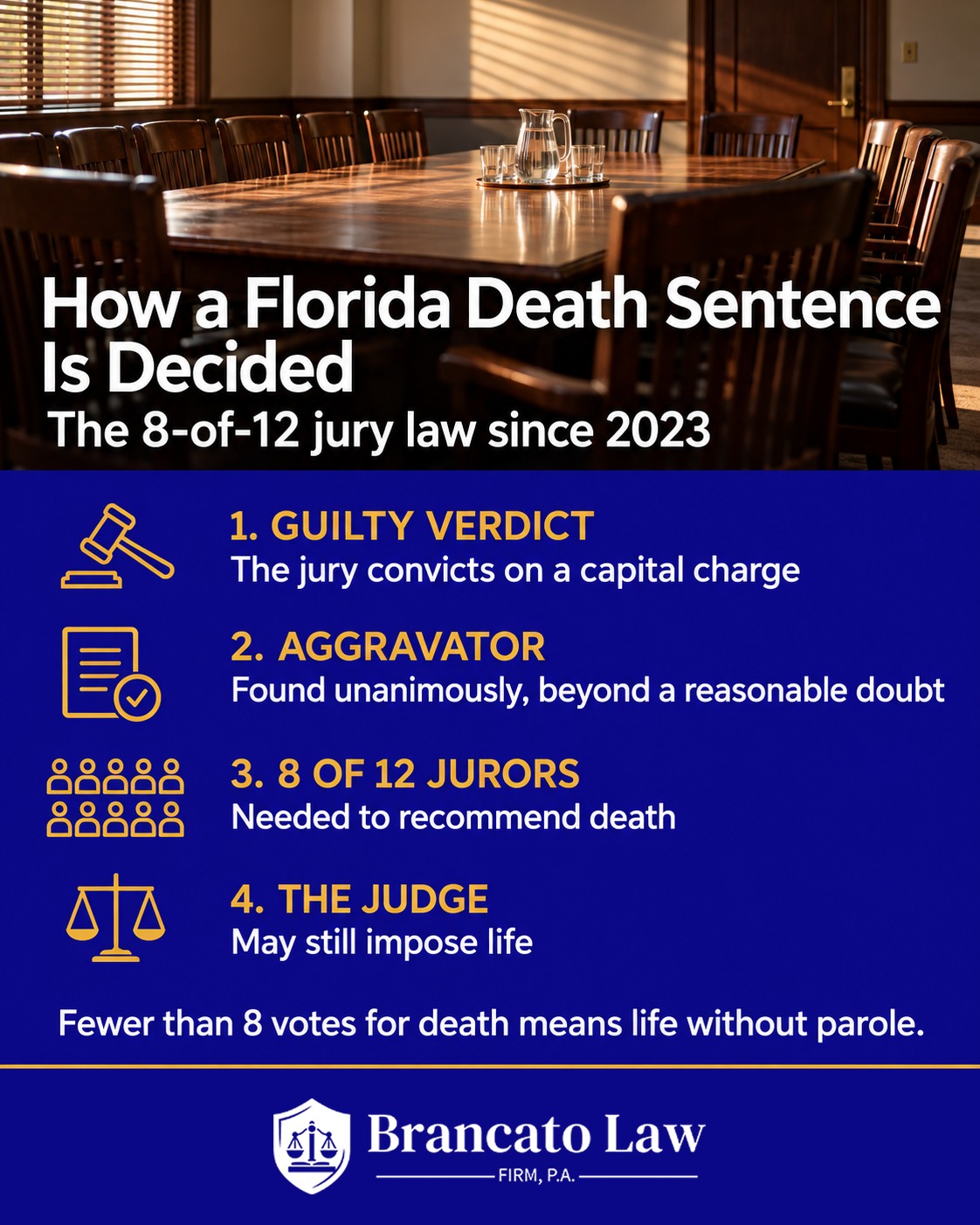
Since 2023, a Florida jury can recommend death when at least 8 of 12 jurors vote for it, after the jury unanimously finds at least one aggravating factor beyond a reasonable doubt under section 921.141(2). If fewer than 8 jurors vote for death, the recommendation must be life without parole, and the judge must impose life. If the jury recommends death, the judge may still impose life after weighing the aggravating factors against the mitigating circumstances under section 921.141(3).
The 8-vote rule grew out of a decade of litigation. In Hurst v. Florida, 577 U.S. 92 (2016), the U.S. Supreme Court struck down Florida’s old system because the judge alone found the facts that made a defendant eligible for death. In State v. Poole, 297 So. 3d 487 (Fla. 2020), the Florida Supreme Court held that the jury must unanimously find an aggravating factor, but that the Constitution does not require a unanimous death recommendation. The Legislature then passed chapter 2023-23, Laws of Florida, which set the 8-vote threshold.
The Florida Supreme Court upheld that threshold in Hunt v. State, 428 So. 3d 43 (Fla. 2025). Michael Hunt was convicted of first-degree murder in Bay County. His jury unanimously found five aggravating factors and then voted 10 to 2 for death. On appeal, he argued that a non-unanimous death recommendation violates the Sixth and Eighth Amendments. The court rejected both arguments, reasoning that the recommendation is not a verdict and that the unanimous finding of an aggravating factor is the verdict-like step the Constitution requires. Justice Labarga concurred only in the result and wrote that Florida’s 8-vote requirement is the least demanding among the states with a death penalty. The lesson for anyone charged today: four jurors can no longer prevent a death recommendation, so the defense must reach at least five of the twelve.
The Legislature has also widened the list of aggravating factors. In 2025 it added a capital felony against a victim gathered for a school activity, religious activity, or public government meeting, and a capital felony committed against a head of state. Our firm explained the head-of-state factor in our post on Florida SB 653 and the new aggravating factor, and our attorneys contest every aggravating factor the State lists.
How often does Florida carry out death sentences?
Florida carried out 19 executions in 2025, the most in any year since 1976, according to the Florida Department of Corrections execution list. Two of the people executed in 2025 had been convicted of murders in Hillsborough County, and 251 people remained on Florida’s death row as of December 2025, as reported by the Tampa Bay Times. A death notice filed in a Tampa Bay courtroom today carries real consequences. Our attorneys treat every first-degree murder case as a potential death case until the State waives death on the record.
Why does capital defense work start before the State files a death notice?
Defense work starts early because the State’s decision to seek death comes early. Under Rule 3.181, a prosecutor who intends to seek the death penalty must give notice within 45 days of arraignment and list the aggravating factors the State intends to prove. Before that, the case needs a grand jury: Article I, section 15 of the Florida Constitution bars trying anyone for a capital crime without a grand jury indictment. In our experience in Hillsborough County, the State Attorney’s Office presents first-degree murder cases to the county grand jury, and the indictment starts the clock toward arraignment and the 45-day notice deadline.
National practice standards point the same direction. The ABA Guidelines for the Appointment and Performance of Defense Counsel in Death Penalty Cases, 31 Hofstra L. Rev. 913 (2003) state that investigation should begin as soon as counsel enters the case, even before the prosecution announces it will seek death, and that counsel should secure at least a professional investigator and a mitigation specialist. The committee comments to Rule 3.112 say Florida’s standards drew in part on ABA standards. The U.S. Supreme Court relied on the ABA guidelines in Wiggins v. Smith, 539 U.S. 510 (2003), where Kevin Wiggins’s lawyers stopped investigating his background after reading a presentence report and social services records. The Court held that ending the mitigation investigation at that point was ineffective assistance of counsel.
Expert funding is a practical issue at this stage. In our experience, when a privately represented client is declared indigent for costs, experts paid through the state’s Justice Administrative Commission work at much lower rates, which limits which experts will take the case. Our firm usually does not ask the court to declare a private client indigent for costs, so we can retain the forensic pathologists, mitigation specialists, and other experts a capital case needs. When a homicide investigation is still open and no one has been charged, our representation before charges are filed can put information in front of the State Attorney’s Office before the charging decision.
Does capital case experience matter when the State is not seeking death?
Yes. A first-degree murder conviction still carries mandatory life without parole under section 775.082 when the State does not seek death, so every first-degree murder trial is a life case. The skills Rule 3.112 measures, including expert witnesses, forensic and psychiatric evidence, and mitigation, are the same skills that decide second-degree murder, manslaughter, and other serious felony trials.
Our firm’s homicide work shows how those skills apply. In one case, a grandmother was charged with first-degree murder and aggravated child abuse after her granddaughter died, and a former state medical examiner we retained showed that the child drowned and that the liver injury came from resuscitation efforts. We describe that case in our forensic pathologist case study, and our post on why expert witnesses are not optional in major crimes cases explains how our firm builds an expert team. For a broader overview of murder, manslaughter, and related charges, see our complete guide to homicide charges in Florida.
What should you ask a lawyer about capital case experience?
Ask for specifics you can verify. These six questions show whether a lawyer meets Rule 3.112 and how that lawyer would handle your case:
- Do you meet Rule 3.112 as lead trial counsel, and will you file the notice of appearance certifying it?
- How many jury trials have you tried to verdict, and how many were murder trials?
- Have you tried a case in which the State sought the death penalty?
- Who will be on the defense team, including co-counsel, an investigator, and a mitigation specialist?
- Which experts will this case need, and when will you retain them?
- What will you do before the State’s 45-day death notice deadline?
As former Chief Operations Officer of the Hillsborough County Public Defender’s Office, I oversaw a staff of over 100 attorneys, and these are the questions I used to measure trial readiness. My book, How to Choose a Major Crimes Attorney – or Any Criminal Defense Attorney for That Matter, covers them in more depth and is free from our firm. Our post on how to choose a homicide attorney in Florida adds more detail.
What homicide results has our firm achieved?
The Brancato Law Firm has published the following homicide results, each built on defense experts retained early in the case.
| Case | Charge | Defense work | Result |
|---|---|---|---|
| Grandmother charged after her granddaughter’s death | First-degree murder and aggravated child abuse | A former state medical examiner showed the child drowned and the liver injury came from resuscitation | Homicide charge dropped; aggravated child abuse charge reduced; she pleaded to child neglect |
| Client charged with homicide | Homicide | A retired ATF firearms expert showed the gun in social media photos was not the murder weapon | Photos excluded; jury found the client not guilty of homicide and convicted on a lesser offense |
Past results do not guarantee future outcomes.
What happens in the first weeks after a capital arrest in Florida?
The first weeks set the course of a capital case. This timeline shows the deadlines that matter most and what our attorneys do at each stage.
| Stage | Timing | What our attorneys do |
|---|---|---|
| Arrest and first appearance | Within 24 hours of arrest under Rule 3.130 | Appear at first appearance and address bond; on a capital charge, bond can be denied when the proof of guilt is evident or the presumption great |
| Grand jury indictment | Required before trial on any capital charge | Investigate, preserve evidence, and present mitigating information to the State |
| Arraignment | After the indictment | Enter a plea and demand discovery |
| State’s death notice | Within 45 days of arraignment under Rule 3.181 | Press the State to waive death and begin the mitigation investigation |
| Penalty phase | After a capital conviction | Contest each aggravating factor and present mitigation to the jury |
Witnesses, video, and phone records are easiest to secure in the first weeks. Our post on the bond walkthrough process in Hillsborough County explains how Florida’s capital and life-offense bond exception works. Our firm is available 24/7, so call us at any hour.
Frequently asked questions
Can a privately hired lawyer take a Florida death penalty case without meeting Rule 3.112?
Rule 3.112 applies to defense lawyers in capital trials whether they are appointed or retained, and a retained lawyer must file a notice of appearance certifying that he or she meets the rule. The Brancato Law Firm files that notice at the start of a capital representation, so the client can see the qualification in the court file. Our post on Florida’s intellectual disability bar to the death penalty shows another issue capital counsel must raise early.
How can I check whether a Florida lawyer meets the capital case standards?
Ask the lawyer for the Rule 3.112 notice of appearance and for specific numbers: jury trials to verdict, murder trials, and death penalty cases tried. Our attorneys at The Brancato Law Firm answer those questions in the first consultation, and our complete guide to choosing a criminal defense attorney in Tampa lists more questions to ask.
Does Florida still require a unanimous jury to recommend the death penalty?
No. Under section 921.141, 8 of 12 jurors can recommend death, although the jury must still find at least one aggravating factor unanimously. The Brancato Law Firm builds jury selection and the penalty phase around reaching the five jurors whose votes block a death recommendation.
Can a teenager be sentenced to death in Florida?
No. Florida law sets a separate sentencing process for capital murder committed before age 18, and death is not an available sentence. In those cases, The Brancato Law Firm develops the youth, family, and mental health evidence the judge must weigh at the sentencing hearing.
Can the State drop the death penalty after filing a death notice?
Yes. The State can waive the death penalty on the record, and once it does, Rule 3.112 no longer treats the case as a capital trial. Persuading the State to waive death is one of the first goals our attorneys at The Brancato Law Firm set, using mitigation evidence and the weak points in the State’s case, as our first-degree murder defense page explains.
What does a mitigation specialist do in a Florida capital case?
A mitigation specialist gathers the life history records, family interviews, and professional evaluations that the defense presents at the penalty phase to argue for a life sentence. The Brancato Law Firm brings mitigation and forensic experts into a capital case early, as described in our post on what a forensic defense lawyer does.
Should I hire a lawyer if police want to talk to me about a homicide but I have not been charged?
Yes. The decision to charge first-degree murder and present the case to a grand jury is made before any arrest, so the time to hire counsel is before you answer questions. The Brancato Law Firm offers pre-file advocacy to protect you during the investigation and to present information to the State Attorney’s Office before a charging decision.
For more about our defense strategies, visit our Homicide Defense page.
The State has 45 days after arraignment to decide whether to seek death, and the work done before that deadline can change the answer. Call The Brancato Law Firm, P.A., founded by Tampa Criminal Defense Attorney Rocky Brancato, at (813) 727-7159 so our attorneys can begin that work now. We are available 24/7, so call us at any hour; attorney Jean-Luc Adrien speaks Spanish, Haitian Creole, and French, and our firm has Spanish-speaking staff.
The Brancato Law Firm, P.A.
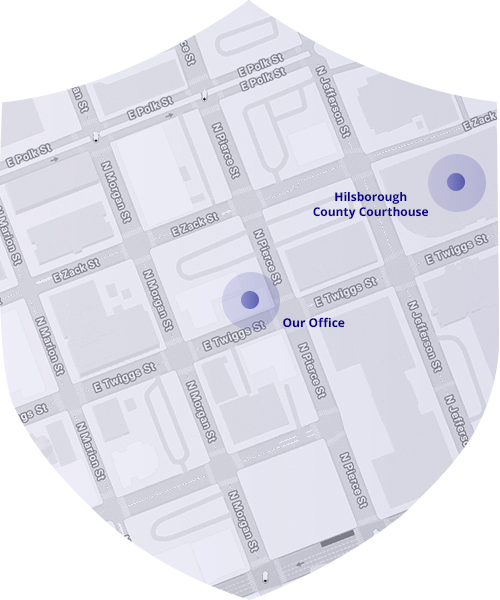
620 E. Twiggs Street, Suite 205, Tampa, FL 33602
(813) 727-7159
Serving Hillsborough, Pinellas, and Pasco Counties
The Brancato Law Firm, P.A. is a Tampa-based criminal defense practice. We are not affiliated with any other Brancato-named law firms.
Visit Us

Tampa, FL 33602
Contact Us Now
Free Legal Consultation (813) 727-7159