Strategic Defense,
From First DUI to Death Penalty
From First DUI to Death Penalty




| Short answer: A Tampa criminal forensic science attorney challenges the scientific evidence in a criminal case, including DNA, fingerprints, firearms comparisons, toxicology, cell phone location data, digital forensics, and medical examiner findings. In Florida, a judge must decide whether expert testimony is reliable under the Daubert standard in § 90.702, which the Florida Supreme Court adopted in 2019. National scientific reviews have found that, apart from DNA, most forensic comparison methods have never been rigorously validated. The Brancato Law Firm, P.A. works with independent experts to test the State’s science before it reaches the jury. |
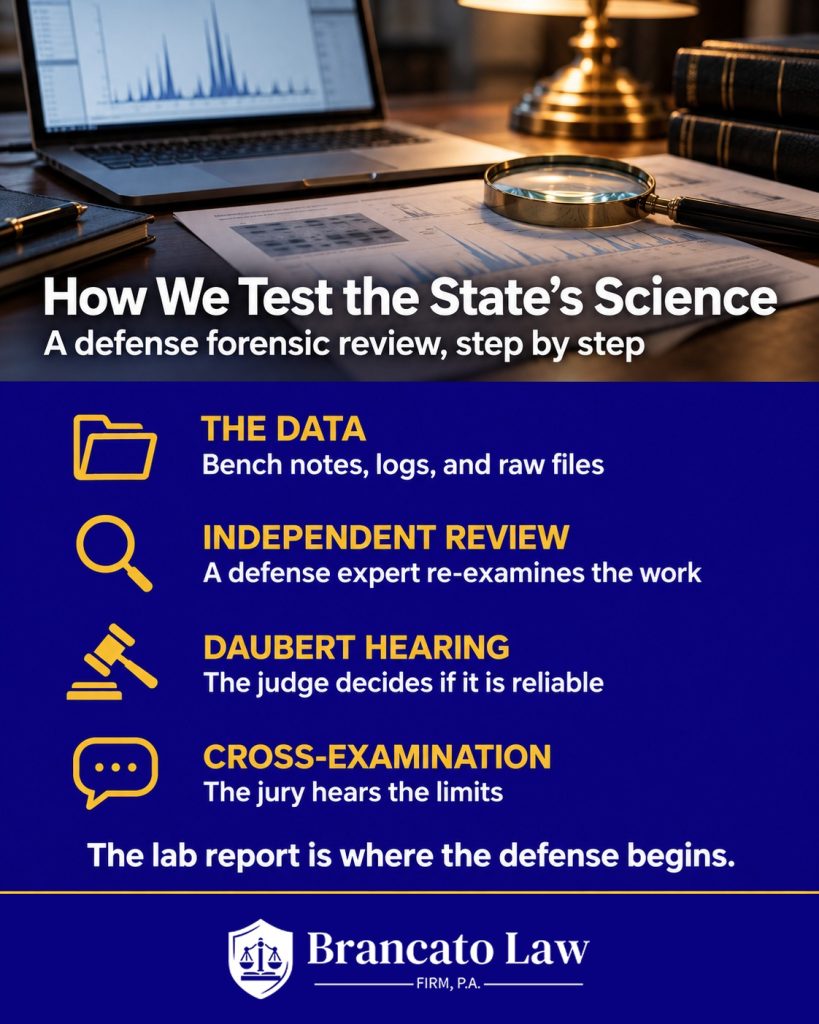
Forensic evidence often sounds certain in a courtroom even when the science behind it is not. Rocky Brancato, founder of The Brancato Law Firm, P.A., has tried more than 150 jury trials to verdict, including cases decided by DNA, fingerprint, and medical evidence. Our attorneys at this Tampa criminal defense firm retain forensic pathologists, toxicologists, DNA analysts, fingerprint examiners, firearms specialists, cell phone location experts, crash reconstructionists, forensic psychologists, and digital forensics examiners, and we use their work to challenge the State’s experts before and during trial.
Forensic evidence is challenged first by asking the judge to keep it out. Under § 90.702, an expert may testify only if the opinion is based on sufficient facts or data, is the product of reliable principles and methods, and applies those methods reliably to the facts of the case. Florida took a long road to this standard. In DeLisle v. Crane Co., 258 So. 3d 1219 (Fla. 2018), the Florida Supreme Court rejected the Legislature’s 2013 adoption of Daubert, and then in In re Amendments to the Florida Evidence Code, 278 So. 3d 551 (Fla. 2019), the court adopted Daubert as a court rule. Any source that says Florida still uses the older Frye test is out of date.
The judge acts as the gatekeeper and considers whether the method has been tested, whether it has been peer reviewed, its known error rate and standards, and whether it is generally accepted. Under § 90.705, the defense can question the expert about the basis for the opinion before it is admitted. These hearings can change a case. In Kemp v. State, 280 So. 3d 81 (Fla. 4th DCA 2019), the appeals court reversed a conviction because a crash reconstruction opinion based on a visual look at vehicle damage did not meet the Daubert standard. Read our article on why expert witnesses matter in criminal defense.
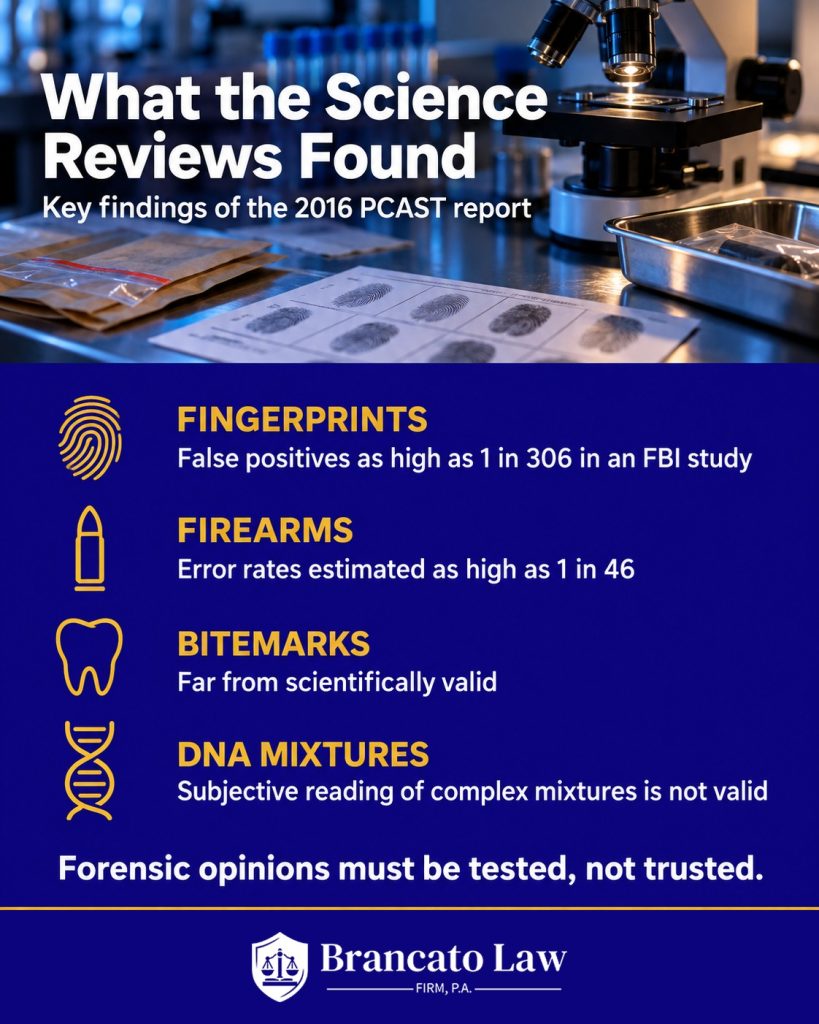
Less reliable than most jurors assume. In 2009, the National Academy of Sciences found that “with the exception of nuclear DNA analysis,” no forensic method had been rigorously shown to consistently connect evidence to a specific person or source (Strengthening Forensic Science in the United States). In 2016, the President’s Council of Advisors on Science and Technology reported that fingerprint false positive rates could be as high as 1 in 306 in an FBI study and 1 in 18 in another lab’s study, that firearms comparison error rates could be as high as 1 in 46, and that bitemark analysis was far from scientifically valid (PCAST, Forensic Science in Criminal Courts). The consequences are real: in 2024, false or misleading forensic evidence played a role in 42 of 147 exonerations, or 29 percent, according to the National Registry of Exonerations.
| Evidence | What our attorneys and experts examine |
|---|---|
| DNA | Collection and chain of custody, contamination, mixture interpretation, probabilistic genotyping software, and the statistics presented to the jury |
| Fingerprints | Print quality, the subjective comparison process, verification practices, and error rates |
| Firearms and toolmarks | Whether a “match” opinion has a scientific basis and how the examiner reached it |
| Toxicology | Breath testing under Florida Administrative Code Chapter 11D-8, blood collection and storage, and retrograde extrapolation |
| Cell phone location | Tower coverage, how location records were interpreted, and whether the witness is qualified to give the opinion |
| Digital forensics | Extraction methods, file creation and access dates, and who actually used the device |
| Medical examiner and injury evidence | Cause and manner of death, timing of injuries, and medical conditions that mimic trauma |
| Crash reconstruction | Speed and braking calculations, vehicle data, and the reconstruction method |
Florida courts have admitted newer methods while leaving room for challenges to how they were used. In Daniels v. State, 312 So. 3d 926 (Fla. 4th DCA 2021), the court upheld the use of TrueAllele DNA software. In Walker v. State, 308 So. 3d 193 (Fla. 4th DCA 2020), the court allowed a detective’s cell site mapping. In our own district, State v. Bethley, No. 2D18-4143 (Fla. 2d DCA Apr. 12, 2019), a Hillsborough County case, held that a DNA analyst can present database statistics without being a statistician. Those rulings show that a general objection rarely works. The challenge must be specific to the method, the data, and the analyst in the case. See our articles on DNA evidence, fingerprint evidence, cell phone location evidence, and retrograde extrapolation in DUI cases.
Local labs matter. Most evidence in Hillsborough County is analyzed at the FDLE Tampa Bay Regional Operations Center lab, which handles DNA, fingerprints, firearms, seized drugs, and digital evidence. Pinellas County has its own Pinellas County Forensic Laboratory, operated under the District Six Medical Examiner, which serves Pinellas and Pasco. Hillsborough County is Medical Examiner District 13. Knowing which lab, which analyst, and which protocols were used shapes the challenge.
When the State loses evidence that might have helped the defense, the defense must usually show bad faith to get the case dismissed. The U.S. Supreme Court set that rule in Arizona v. Youngblood, 488 U.S. 51 (1988), and the Florida Supreme Court applied it in Guzman v. State, 868 So. 2d 498 (Fla. 2003). Lost evidence can still support a jury instruction, cross-examination, or exclusion of related testimony, which is why we send preservation requests at the start of a case. Read about recovering evidence police destroyed and inspecting the physical evidence.
Sometimes. Under § 27.52(5), a person with private counsel can ask to be declared indigent for costs, and the state then pays certain due process costs, including court-approved experts, under § 29.007. Fees paid to private counsel above set amounts create a presumption that the person is not indigent. The state also pays experts at much lower rates than they charge privately, which can limit which experts will take the case, so when a family can plan for expert costs privately, the defense usually has a wider choice. Our attorneys discuss expert costs at the start of the case.
Yes. Under § 925.11 and Florida Rule of Criminal Procedure 3.853, a person convicted of a felony at trial can ask for postconviction DNA testing when identity was genuinely disputed and testing could create a reasonable probability of acquittal or a lesser sentence. In Duckett v. State, 431 So. 3d 990 (Fla. 2026), the Florida Supreme Court held that the testing “results” a defendant receives include the underlying data an expert needs to analyze them.
These are results our firm has obtained. Every case is different, and past results do not guarantee future outcomes.
Read our forensic pathologist case study and see more on our case results page.
Florida uses Daubert. The Florida Supreme Court adopted the Daubert standard in § 90.702 as a court rule in 2019, so a judge must find expert testimony reliable before the jury hears it. The Brancato Law Firm files Daubert motions when the State’s forensic method or its application is unreliable.
Yes. DNA testing is the most validated forensic method, but errors happen in collection, contamination, mixture interpretation, and the statistics presented in court. The Brancato Law Firm retains independent DNA experts, and in one case a defense expert showed the client was excluded, leading to dismissal of all charges.
Fingerprint comparison is subjective, and a 2016 federal scientific review reported false positive rates as high as 1 in 306 in one study and 1 in 18 in another. The Brancato Law Firm challenges how the examiner reached a “match” opinion and whether it was independently verified.
In any serious case where the State relies on scientific evidence, a defense expert is usually essential to evaluate and, if needed, challenge it. Our attorneys at The Brancato Law Firm decide early which experts the case needs and how to fund them.
Lost evidence can lead to dismissal if the State acted in bad faith, and even without bad faith it can support cross-examination and other remedies. The Brancato Law Firm sends preservation requests at the start of every serious case.
Yes. The Brancato Law Firm works with other defense attorneys and families on forensic challenges and trial preparation; see our trial strategy and litigation support page.
If the State’s case depends on science, the defense needs its own. Our attorneys at The Brancato Law Firm, P.A., founded by Tampa Criminal Defense Attorney Rocky Brancato, can review the forensic evidence and bring in the right experts. Call (813) 727-7159 for a confidential consultation. We defend homicide, sex crimes, and DUI cases built on forensic evidence across Hillsborough, Pinellas, and Pasco Counties.
The Brancato Law Firm, P.A.
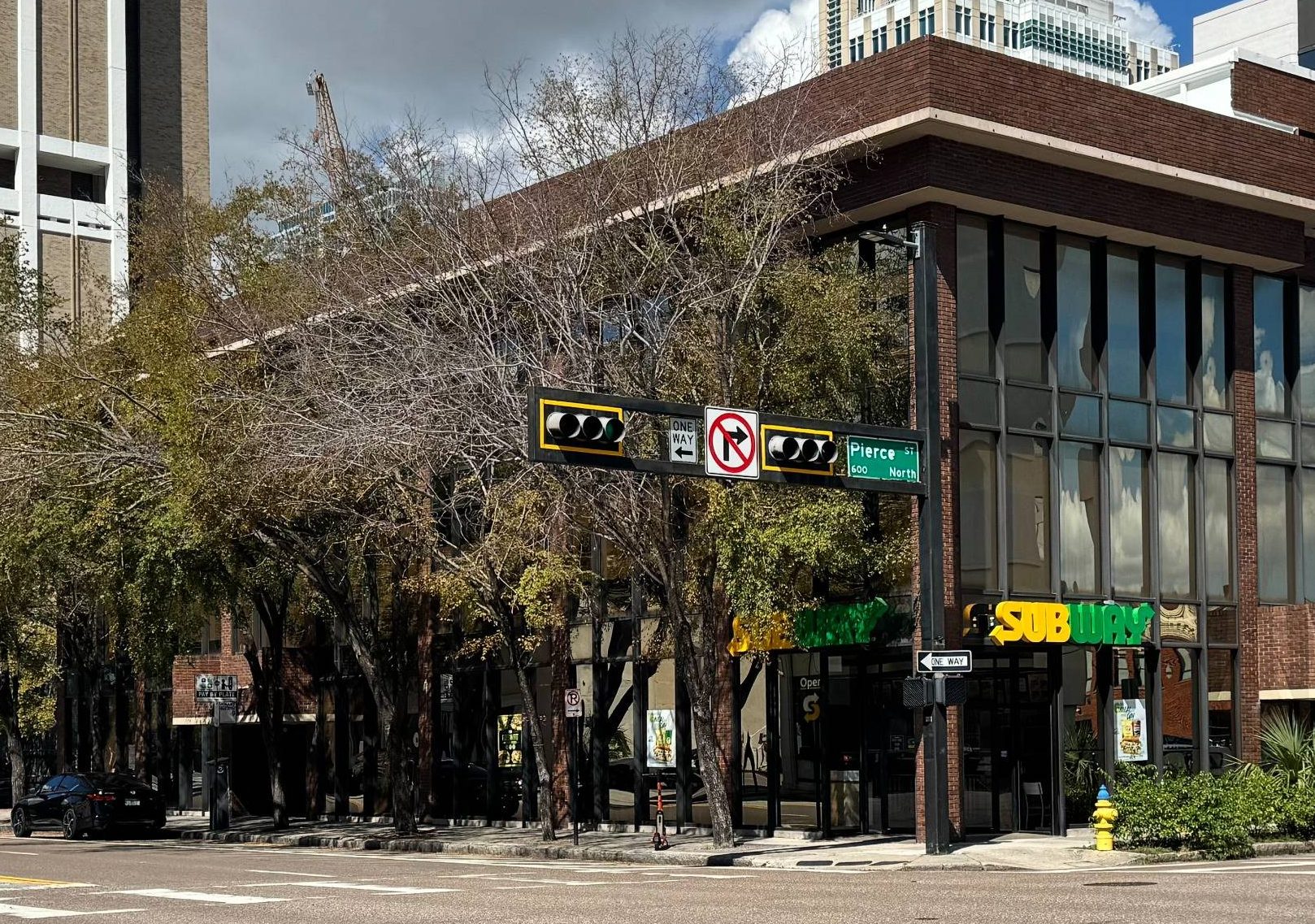
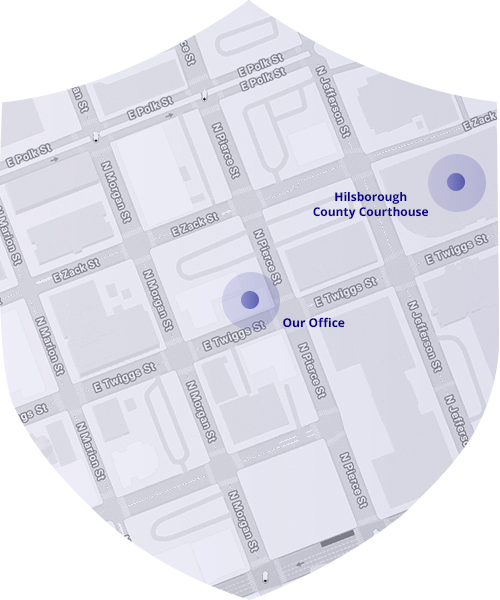
620 E. Twiggs Street, Suite 205, Tampa, FL 33602
(813) 727-7159
Serving Hillsborough, Pinellas, and Pasco Counties

The Brancato Law Firm, P.A. is a Tampa-based criminal defense practice. We are not affiliated with any other Brancato-named law firms.
This page is for informational purposes only and does not constitute legal advice. Each case is unique, and outcomes depend on the individual facts and circumstances involved. Past results do not guarantee future outcomes.
Tampa, FL 33602
Free Legal Consultation (813) 727-7159