- Free Consultation 24/7: (813) 727-7159 Tap Here To Call Us


From First DUI to Death Penalty



What Does a Firearms Expert Do in a Florida Criminal Case? (2026)


Rewrite/update date: November 4, 2026. Originally published in December 2025.
A firearms expert identifies guns, ammunition, and tool marks and explains to a judge or jury whether a particular weapon is connected to a crime. In Florida, the State can use evidence of a gun, including a photo of the defendant holding one, only if it shows “a sufficient link between the weapon and the crime,” under Agatheas v. State, 77 So. 3d 1232 (Fla. 2011). An expert who can prove the gun in the evidence is a different make or model from the weapon used breaks that link. In one of our firm’s homicide trials, that testimony kept a damaging social media photo away from the jury.
A Florida judge will keep a gun out of a trial when the State cannot tie it to the crime, but the judge needs facts, not argument, to make that call. As founder of The Brancato Law Firm, P.A., a Tampa criminal defense firm, and a veteran of the Major Crimes Unit with more than 150 jury trials to verdict, I have seen how a single photo can change the way jurors look at a defendant. Our attorneys work with a network of forensic experts, including firearms examiners, who can give the court the facts it needs.
What does a firearms expert do in a criminal case?
A firearms expert identifies the make and model of guns, examines bullets, cartridge cases, and tool marks, and testifies about whether a weapon can be connected to a crime. The best experts have handled thousands of firearms and know how each manufacturer designs and builds its guns. Their testimony must meet the reliability standard in section 90.702, Florida Statutes: sufficient facts or data, reliable principles and methods, and a reliable application of those methods to the case.
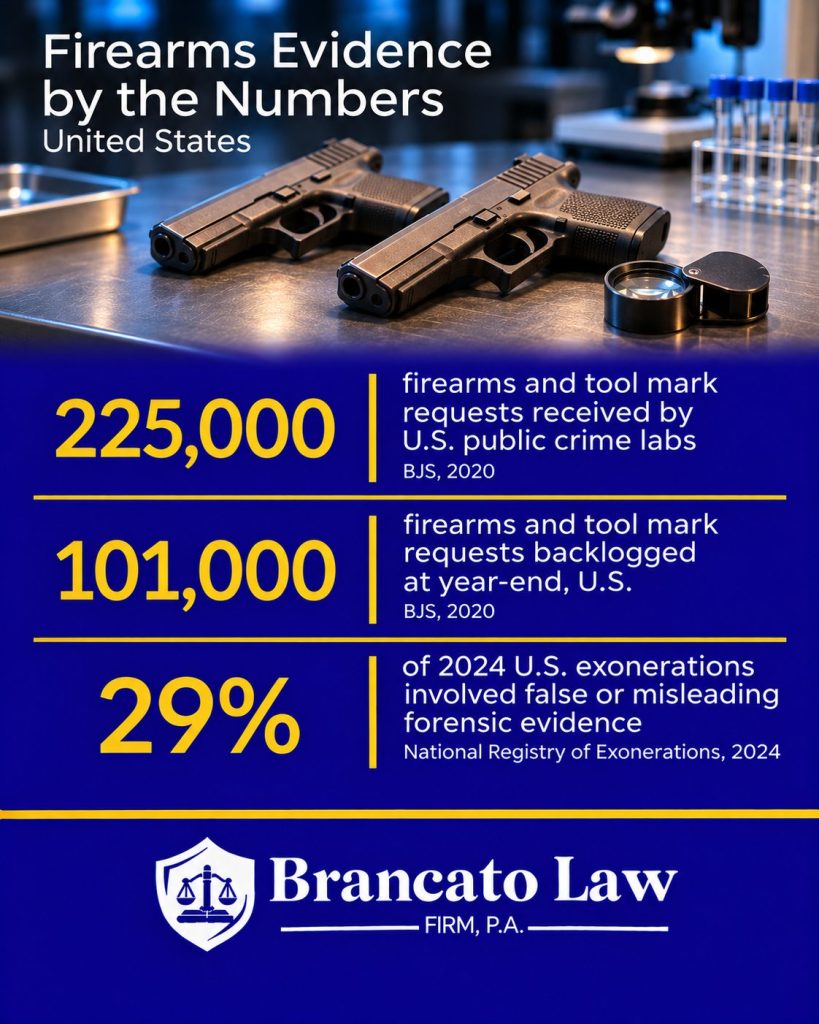
Firearms work is in heavy demand at crime labs. In 2020, publicly funded crime laboratories in the United States received about 225,000 firearms and tool mark requests and ended the year with about 101,000 still backlogged, a backlog 97% larger than in 2014, according to the Bureau of Justice Statistics report Publicly Funded Forensic Crime Laboratories, 2020. A defense expert gives the jury an independent check on work done under that pressure.
When can prosecutors use a photo of you holding a gun?
Prosecutors can use a photo of a defendant holding a gun only when the State shows a sufficient link between that gun and the crime charged. Under section 90.401, Florida Statutes, relevant evidence is evidence “tending to prove or disprove a material fact.” A gun with no connection to the crime proves nothing about the crime and shows only that the defendant had a gun.
In Agatheas v. State, 77 So. 3d 1232 (Fla. 2011), the State introduced a .45-caliber revolver found in the defendant’s backpack when he was arrested five years after a murder, even though it was undisputed that the revolver was not the murder weapon. The Florida Supreme Court held the gun inadmissible because “the State must show a sufficient link between the weapon and the crime,” and it added that the gun’s confusing and misleading effect substantially outweighed any value under section 90.403, Florida Statutes.
Why does “similar” matter so much?
Similarity matters because Florida courts allow the State to build the link out of similarities. In Jeanbart v. State, 299 So. 3d 3 (Fla. 4th DCA 2020), a Palm Beach County case, the Fourth District explained that a trial court can consider “distinct similarities” between the crime weapon and the gun offered at trial, and that the State does not have to prove the gun is definitively the one used. The court still reversed Jeanbart’s convictions and ordered a new trial, because nothing linked the 9mm pistol found near his car to the shooting.
That rule is why a defense expert matters. If the State says the gun in a photo looks like the murder weapon, the defense needs someone who can show, feature by feature, that it is a different make or model. Without that testimony, “looks like” may be enough to get the photo in front of the jury.
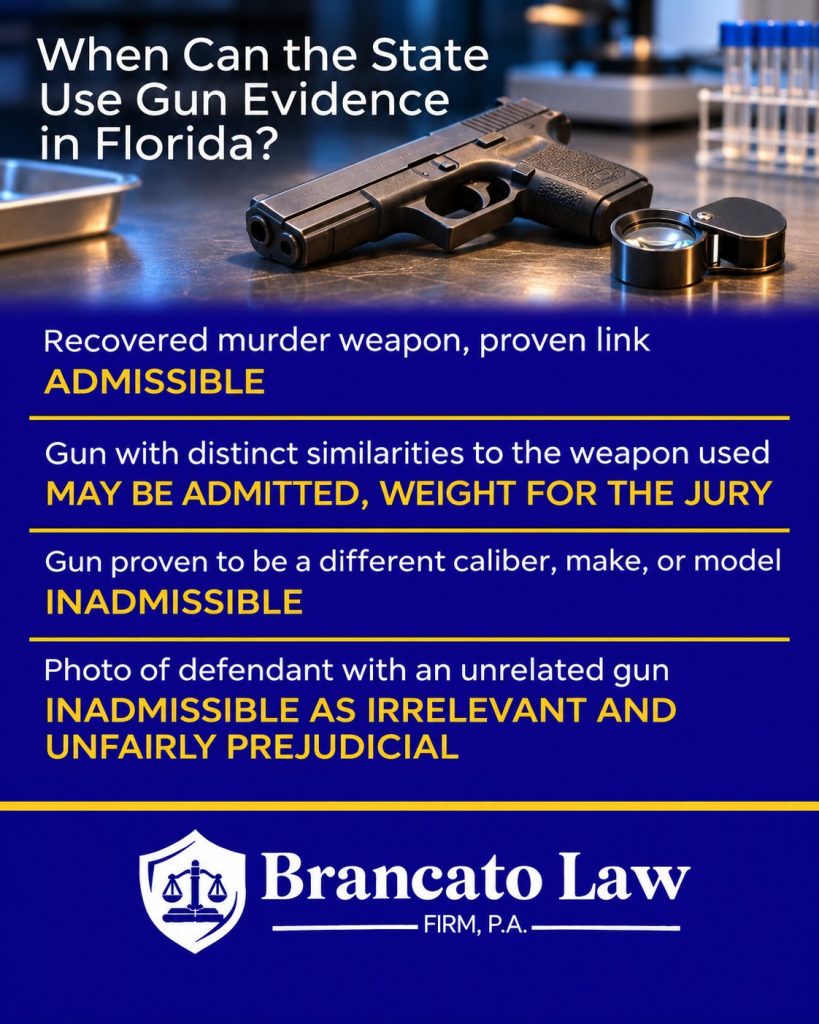
| Evidence offered | Link to the crime | Likely ruling |
|---|---|---|
| The recovered murder weapon | Ballistics or other proof it fired the fatal shots | Admissible |
| A gun the State shows has distinct similarities to the weapon used | Testimony about shared distinctive features | May be admitted; weight is for the jury |
| A gun proven to be a different caliber, make, or model | None | Inadmissible under Agatheas |
| A photo of the defendant with a gun that is not the crime weapon | None | Inadmissible as irrelevant and unfairly prejudicial |
Case study: the social media photo in a homicide trial
Our firm defended a young man charged with homicide. The State had recovered the murder weapon. It also had photos from my client’s social media showing him holding a gun, and to a casual observer the gun in the photos looked like the murder weapon. The prosecution wanted the jury to see those photos.
When I studied the photos, certain features of the gun looked different from the murder weapon. If the two guns were different models, the State had no link, and the photos would show the jury nothing but a young man holding a gun.
The expert
I retained a firearms expert whose qualifications were unusual. He grew up handling firearms, worked for a local police department, and retired from the Bureau of Alcohol, Tobacco, Firearms and Explosives (ATF). Over his career he toured nearly every major firearms factory in the world, which gave him firsthand knowledge of how manufacturers design guns that look alike.
The analysis
We gave the expert the social media photos and access to the murder weapon in evidence. He studied the visible features of the gun in the photos and identified its precise make and model. His conclusion was definitive: the gun in the photos was not the same model as the murder weapon.
| Feature | Why it matters for identification |
|---|---|
| Slide shape | Manufacturers use distinctive slide profiles; small curves or angles can identify the maker |
| Grip | Grip angle, texture, and finger grooves vary between models |
| Control placement | Safety, slide release, and magazine release locations differ by model |
| Trigger guard | Rounded and squared trigger guards separate firearm families |
| Sights | Front and rear sight designs vary by manufacturer and model |
| Barrel length and profile | Visible length and profile separate compact, full-size, and specific variants |
The motion
I moved to exclude the photos. Without a link between the gun in the photos and the murder weapon, the photos had no relevance, and showing a young defendant holding an unrelated gun would invite the jury to convict on character. The expert’s identification made the argument concrete: the State could not show a link because the gun was a different model.
Case result: social media photos excluded; not guilty of homicide. A defense firearms expert identified the gun in the client’s social media photos as a different model from the murder weapon, and the court excluded the photos. The jury acquitted the client of homicide. He was convicted of attempted homicide on a separate count involving a different person. Past results do not guarantee future outcomes.
How reliable is firearms identification evidence?
Firearms identification is less settled science than many jurors assume. In September 2016, the President’s Council of Advisors on Science and Technology concluded in Forensic Science in Criminal Courts: Ensuring Scientific Validity of Feature-Comparison Methods that firearms analysis had only one appropriately designed black-box study and still fell short of the scientific criteria for foundational validity. That report gives the defense a basis to question how certain a State examiner can be when matching a bullet to a gun.
Forensic error shows up in wrongful convictions. Of the 147 exonerations recorded nationwide in 2024, 42, or 29%, involved false or misleading forensic evidence, according to the National Registry of Exonerations 2024 Annual Report. Our firm’s posts on challenging fingerprint evidence and on what a forensic pathologist expert witness does in a murder case show how the same scrutiny applies to other forensic fields.
What should you do about gun photos on your social media?
Do not delete anything from social media after an arrest or once you know you are under investigation without talking to your attorney first. Destroying or concealing a record or item while knowing an investigation or trial is pending can be charged as tampering with evidence, a third-degree felony under section 918.13, Florida Statutes. Tell your attorney what is on your accounts so the defense can prepare to challenge it.
Our attorneys take four steps when the State wants to use gun evidence that may not be connected to the crime:
- Compare the gun in the State’s evidence with the weapon actually used, feature by feature.
- Retain a firearms expert when the identification is disputed.
- File a motion in limine, a pretrial request to exclude evidence, arguing no link and unfair prejudice.
- Prepare the trial defense so it holds up even if the judge admits the evidence.
If you are under investigation and have not been charged, our representation before charges are filed can address social media and other evidence before the State builds its case. For gun charges themselves, see our Tampa gun crimes attorney page.
Frequently asked questions
Can social media photos be used against me in a Florida criminal case?
Yes, if they are relevant, authenticated, and not unfairly prejudicial. Our attorneys at The Brancato Law Firm challenge social media photos that show conduct or objects unconnected to the charge, as our guide to social media evidence in Tampa criminal cases explains.
What does “nexus” mean in Florida evidence law?
Nexus means a connection between the evidence and the crime charged, and for a gun it means a sufficient link between the weapon and the offense. The Brancato Law Firm uses that requirement from Agatheas v. State to keep unrelated weapons and photos out of trial.
Can a firearms expert identify a gun from a photograph?
Often, yes. An experienced expert can identify make and model from visible features such as slide shape, grip, controls, trigger guard, and sights, and The Brancato Law Firm has used that kind of identification to exclude a photo in a homicide trial.
Can the State use a gun that only looks like the murder weapon?
Sometimes. Florida courts let judges consider distinct similarities when deciding whether a gun is linked to the crime, so our attorneys at The Brancato Law Firm bring in an expert when the State’s case rests on resemblance, as described on our Tampa homicide attorney page.
Is ballistics evidence always reliable?
No. A 2016 report by the President’s Council of Advisors on Science and Technology found that firearms comparison had not yet met the criteria for foundational validity, and The Brancato Law Firm uses that research to test the certainty of State examiners.
Talk to our attorneys about gun evidence in your case
The time to challenge a gun photo or weapon is before trial, when a motion in limine can keep it from the jury. The Brancato Law Firm, P.A., founded by Tampa Criminal Defense Attorney Rocky Brancato, works with firearms experts in homicide and gun cases across Hillsborough, Pinellas, and Pasco Counties; call (813) 727-7159 at any hour. Our firm has Spanish-speaking staff, and attorney Jean-Luc Adrien speaks Spanish, Haitian Creole, and French. For more about our defense strategies, visit our Gun Crimes page.
The Brancato Law Firm, P.A.
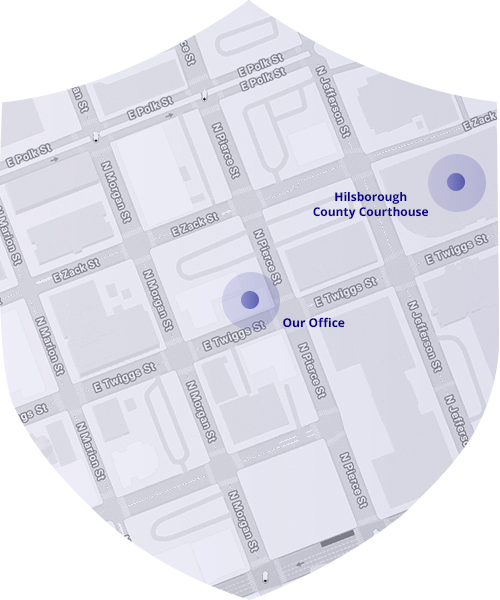
620 E. Twiggs Street, Suite 205, Tampa, FL 33602
(813) 727-7159
Serving Hillsborough, Pinellas, and Pasco Counties
The Brancato Law Firm, P.A. is a Tampa-based criminal defense practice. We are not affiliated with any other Brancato-named law firms.
Visit Us
Tampa, FL 33602
Contact Us Now
Free Legal Consultation (813) 727-7159