- Free Consultation 24/7: (813) 727-7159 Tap Here To Call Us


From First DUI to Death Penalty



What Does a Forensic Pathologist Expert Witness Do in a Murder Case? (2026)


Fully rewritten and updated October 26, 2026.
A forensic pathologist expert witness is a physician who determines cause and manner of death and, when retained by the defense, independently reviews the autopsy report, the microscopic tissue slides, scene photographs, and medical records to test the State’s medical theory. In a Florida child death case, that review can show that injuries blamed on abuse were caused by resuscitation, or that the death had a different cause altogether. In the case described below, a defense forensic pathologist concluded that a child drowned and that her liver injury was consistent with resuscitation efforts, and the State dropped first-degree murder and aggravated child abuse charges against her grandmother.
When the State charges murder based on medical evidence, prosecutors and judges look first at the medical examiner’s conclusion, and few defendants ever see it seriously tested. I have tested those conclusions for more than 25 years in Hillsborough County courtrooms, beginning in the Major Crimes Unit of the Hillsborough County Public Defender’s Office, where I handled homicide and child abuse cases. I’m Rocky Brancato, founder of The Brancato Law Firm, P.A., a Tampa criminal defense firm, and in every death case our attorneys retain the experts needed to check the State’s medical theory against the slides, the photographs, and the records.
What Does a Forensic Pathologist Expert Witness Do?
A forensic pathologist expert witness explains, from the autopsy and the evidence, how and why a person died, and whether the State’s explanation fits the physical findings. A defense forensic pathologist reviews the same material the State’s experts used, and often material they did not use, then gives an independent opinion on cause of death, timing, and mechanism of injury.
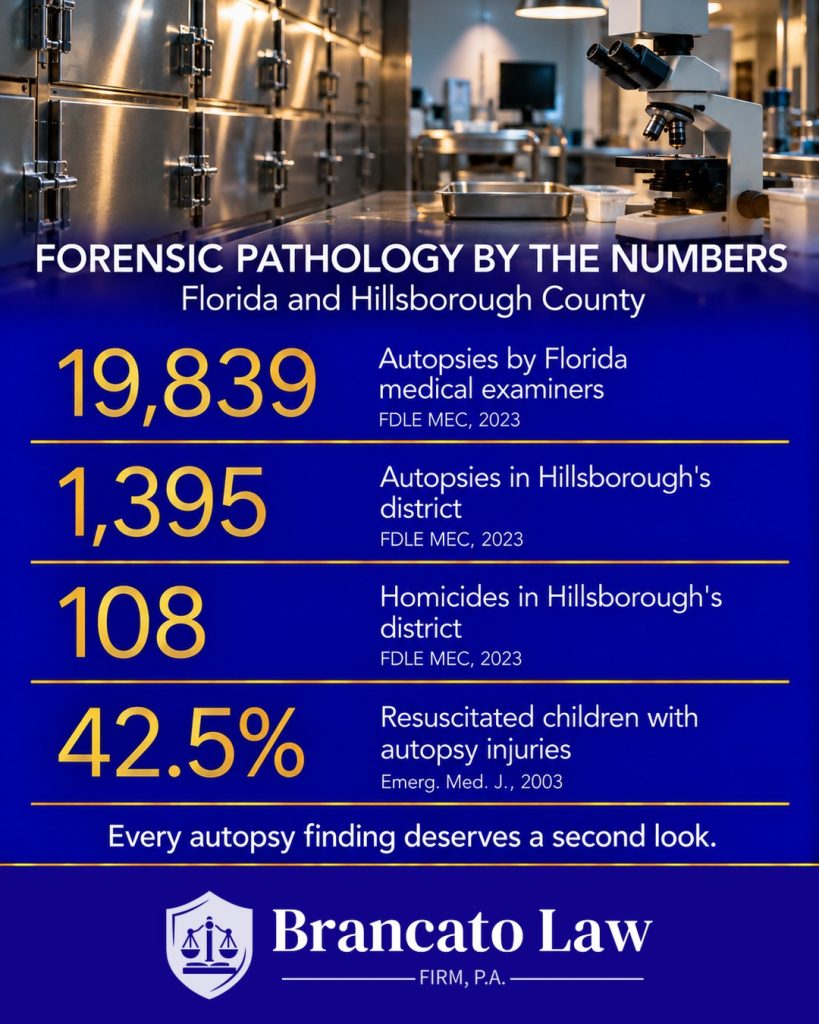
In Florida, the medical examiner decides cause of death in deaths by criminal violence, by accident, suddenly in apparent good health, or “in any suspicious or unusual circumstance” under section 406.11, Florida Statutes. That opinion carries great weight with prosecutors and juries. Medical examiners in Florida performed 19,839 autopsies in 2023, including 1,395 in District 13, which covers Hillsborough County, according to the Florida Department of Law Enforcement’s Medical Examiners Commission 2023 Annual Workload Report. The same report counted 108 homicides in District 13 that year.
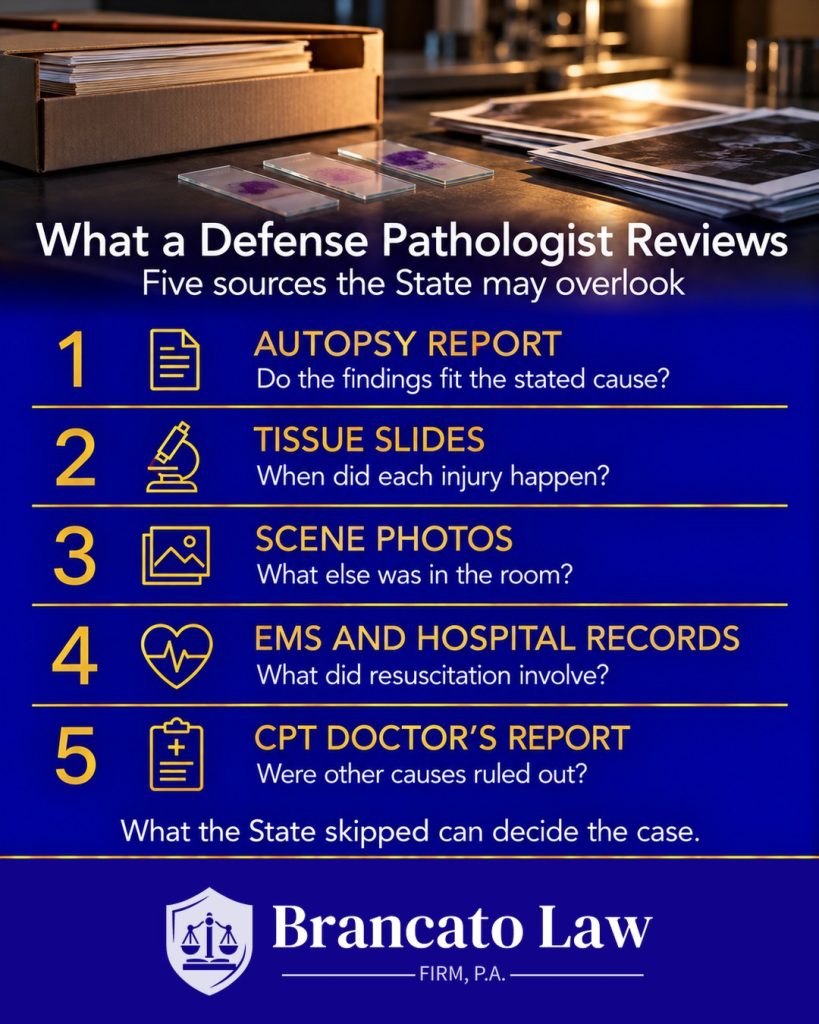
| What the defense expert reviews | What it can show |
|---|---|
| Autopsy report and diagrams | Whether the written findings support the stated cause of death |
| Microscopic tissue slides | Timing of injuries and whether tissue reaction fits the State’s timeline |
| Scene photographs | Medical equipment, the setting, and other explanations the State overlooked |
| EMS and hospital records | What resuscitation was performed, for how long, and by whom |
| Child Protection Team report | Whether the abuse opinion considered other causes |
Why Do Defense Attorneys Need Their Own Forensic Pathologist?
A defense attorney needs an independent forensic pathologist because the State’s medical conclusion is often the whole case, and only another physician can test it credibly. The U.S. Supreme Court made the point in Hinton v. Alabama, 571 U.S. 263 (2014). Anthony Hinton’s lawyer kept a firearms expert he knew was inadequate because he wrongly believed Alabama capped expert funding at $1,000. The Court held that the failure to seek more funding was deficient performance, explaining that “effectively rebutting that case required a competent expert on the defense side.” The Court also noted research finding that “invalid forensic testimony contributed to the convictions in 60% of the cases” in a study of exonerations.
In Florida, expert opinions must meet the reliability standard in section 90.702, Florida Statutes, and a defense expert is often the person who shows the court where a State expert’s method falls short. Our Tampa criminal forensic science attorney page describes the expert network our firm uses.
Case Study: How Did a Forensic Pathologist Change a Child Murder Case?
A grandmother was charged with first-degree murder and aggravated child abuse after the death of her young granddaughter. The prosecution’s theory was that she had beaten the child so badly that the child died of internal injuries, including a lacerated liver. A Child Protection Team doctor concluded early and firmly that the injuries could only have come from intentional, inflicted trauma, and the case was built on that opinion.
The charges were as serious as Florida law allows. Under section 782.04, Florida Statutes, a killing committed during “aggravated child abuse” is first-degree murder and a capital felony, and aggravated child abuse alone is a first-degree felony under section 827.03.
I retained a former state medical examiner, a forensic pathologist who had performed thousands of autopsies and testified in courts across Florida. His first instruction was to get the slides. We obtained the microscopic tissue slides, the scene photographs, the hospital records, and the original autopsy report.
What did the defense expert find that the State missed?
Reviewing the scene photographs, the expert noticed medical waste in the family’s home: airways, suction devices, and other equipment used to try to revive the child. The State’s experts had focused on the injuries. Our expert asked what caused them.
After his review, he concluded that the child had drowned in the bathtub while her grandmother was briefly out of the room, and that the liver injury was consistent with aggressive resuscitation efforts, not a beating. Chest compressions on a child that small can cause internal trauma that is later misread as inflicted abuse.
The grandmother had been negligent. She was moving between the bathroom and the kitchen, where she was making dinner, and she was not watching closely enough. She was not a murderer or a child abuser. We took the expert’s findings to the prosecution.
Result: murder and aggravated child abuse charges dropped. The client pled to child neglect and received probation. She avoided a life sentence and was not branded a murderer. Past results do not guarantee future outcomes.
| Charge | Classification under Florida law | Outcome |
|---|---|---|
| First-degree murder (killing during aggravated child abuse) | Capital felony, s. 782.04 | Dropped |
| Aggravated child abuse | First-degree felony, s. 827.03 | Dropped |
| Child neglect | Felony, s. 827.03 | Plea; probation |
Can CPR Cause Injuries That Look Like Child Abuse?
Yes, resuscitation can cause bruises, rib fractures, and in some cases internal injuries such as liver and spleen lacerations, and a forensic pathologist has to separate those injuries from inflicted trauma. In a study of child deaths from 1994 to 1996, M.P. Ryan, S.J. Young, and D.L. Wells found injuries at autopsy in 65 of 153 children who received resuscitation (42.5 percent), compared with 6 of 51 children who did not (11.7 percent). Most were minor bruises or abrasions, and longer resuscitation produced more injuries. The study, “Do resuscitation attempts in children who die, cause injury?,” appeared in the Emergency Medicine Journal in 2003.
Forensic pathologist John Plunkett documented two child death cases in the Journal of Forensic Sciences in 2006, “Resuscitation Injuries Complicating the Interpretation of Premortem Trauma and Natural Disease in Children.” In the first, independent experts concluded that liver and spleen lacerations came from resuscitation, and the prosecutor dropped first-degree murder charges. The pattern in our case was the same one Plunkett described: resuscitation injuries read as abuse until a pathologist looked at the full record.
What Are Autopsy Slides and Why Do They Matter?
Autopsy slides are thin samples of tissue preserved on glass and examined under a microscope, and they can show the age of an injury and the body’s reaction to it in ways the naked eye cannot. A bruise or laceration with no inflammatory response may have occurred near or after the time of death, which matters when the question is whether an injury came from a beating or from resuscitation. Many defense lawyers never request the slides. Our firm requests them in every death case, along with the photographs taken during the autopsy.
When Should You Hire a Forensic Pathologist?
You should consider a forensic pathologist whenever the State’s case depends on a medical opinion about how a person died or how an injury happened. That includes:
- Child death and serious child injury cases, especially where a Child Protection Team doctor has diagnosed abuse.
- Homicide cases with a disputed cause or timing of death, including overdose, positional asphyxia, and in-custody deaths.
- Manslaughter and vehicular homicide cases where the mechanism of injury is contested.
- Investigations before charges are filed, when an early expert opinion can change the State’s charging decision.
Early review matters. When our attorneys are retained during an investigation, we can request evidence and consult an expert before the State’s theory hardens. Our page on representation before charges are filed explains how that work is done.
How Do You Challenge a Child Protection Team Doctor’s Opinion?
You challenge a Child Protection Team doctor’s opinion with an independent expert who reviews everything the doctor saw, plus what the doctor did not see. The CPT doctor in our case reached a conclusion before the full record had been reviewed. Our expert looked at the scene photographs and the resuscitation history and found a different explanation that fit the physical evidence. Our Tampa child abuse attorney page and our case study on an aggravated child abuse case that was dismissed show how this work plays out in other cases. For a broader view of how forensic experts fit into a defense, see what a forensic defense lawyer does.
Frequently Asked Questions About Forensic Pathologist Expert Witnesses
How much does a forensic pathologist expert witness cost in a criminal case?
The cost depends on the volume of records, the need for slide review, and whether the expert must testify, and it is usually billed separately from attorney fees. The Brancato Law Firm discusses expected expert costs at the start of a homicide or child death case so families can plan; our post on homicide defense attorney costs in Tampa covers how these costs fit in.
Can a defense forensic pathologist get murder charges dropped in Florida?
Yes, an independent pathologist’s findings can lead prosecutors to reduce or drop charges, as happened in our case when the State dropped murder and aggravated child abuse charges. The Brancato Law Firm presents expert findings to the State Attorney’s Office when they show the charged crime did not happen as alleged. Past results do not guarantee future outcomes.
Why hire a former state medical examiner as a defense expert?
A former state medical examiner has done the same work as the State’s experts, so prosecutors and jurors find it harder to dismiss the opinion as biased. Our attorneys at The Brancato Law Firm look for experts with that experience in death cases; our forensic science defense page describes how we choose them.
Can a forensic pathologist tell if CPR caused a liver laceration in a child?
A forensic pathologist can often determine whether an injury is consistent with resuscitation by comparing it with the resuscitation records, the scene evidence, and the microscopic findings. The Brancato Law Firm obtains EMS and hospital records in every child death case so the expert can compare the timing of each intervention with each injury.
Is child neglect a felony in Florida?
Yes, child neglect is a third-degree felony under section 827.03, and a second-degree felony when it causes great bodily harm, permanent disability, or permanent disfigurement. Our attorneys at The Brancato Law Firm evaluate whether the facts fit neglect rather than abuse when the State’s medical theory is wrong.
When should a forensic pathologist be retained in a death investigation?
As early as possible, ideally before charges are filed, because early review can preserve evidence and shape the charging decision. The Brancato Law Firm can be reached at any hour when a family learns that a death is under investigation; see our pre-file advocacy page.
Facing Charges Based on Medical Evidence?
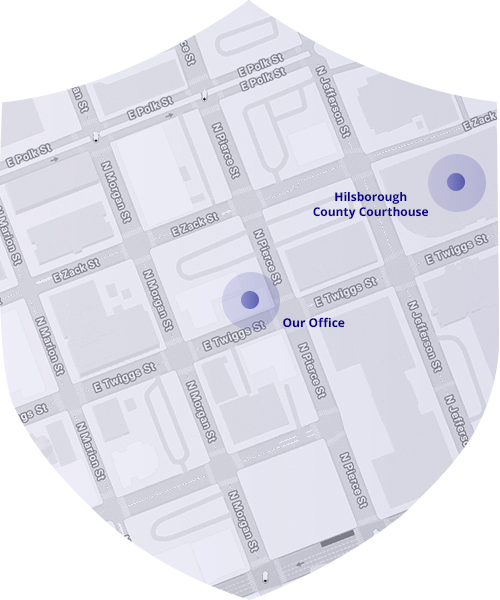
The State’s medical opinion is usually formed in the first days of an investigation, so the defense review should start just as fast. Our attorneys at The Brancato Law Firm, P.A., founded by Tampa Criminal Defense Attorney Rocky Brancato, will obtain the autopsy materials and retain the right expert to test them. Call (813) 727-7159; you can call us at any hour, and our office is two blocks from the courthouse. Our firm has Spanish-speaking staff, and attorney Jean-Luc Adrien speaks Spanish, Haitian Creole, and French. Read our guide for Spanish-speaking criminal defense clients in Tampa.
For more about our defense strategies, visit our Tampa Criminal Forensic Science Attorney page, or our Tampa homicide attorney page for murder and manslaughter cases.
The Brancato Law Firm, P.A.
620 E. Twiggs Street, Suite 205, Tampa, FL 33602
(813) 727-7159
Serving Hillsborough, Pinellas, and Pasco Counties
The Brancato Law Firm, P.A. is a Tampa-based criminal defense practice. We are not affiliated with any other Brancato-named law firms.
Visit Us
Tampa, FL 33602
Contact Us Now
Free Legal Consultation (813) 727-7159