- Free Consultation 24/7: (813) 727-7159 Tap Here To Call Us


From First DUI to Death Penalty



What Happens When Police Destroy Evidence in Florida? (2026)


Rewrite/update date: November 4, 2026. Originally published in December 2025.
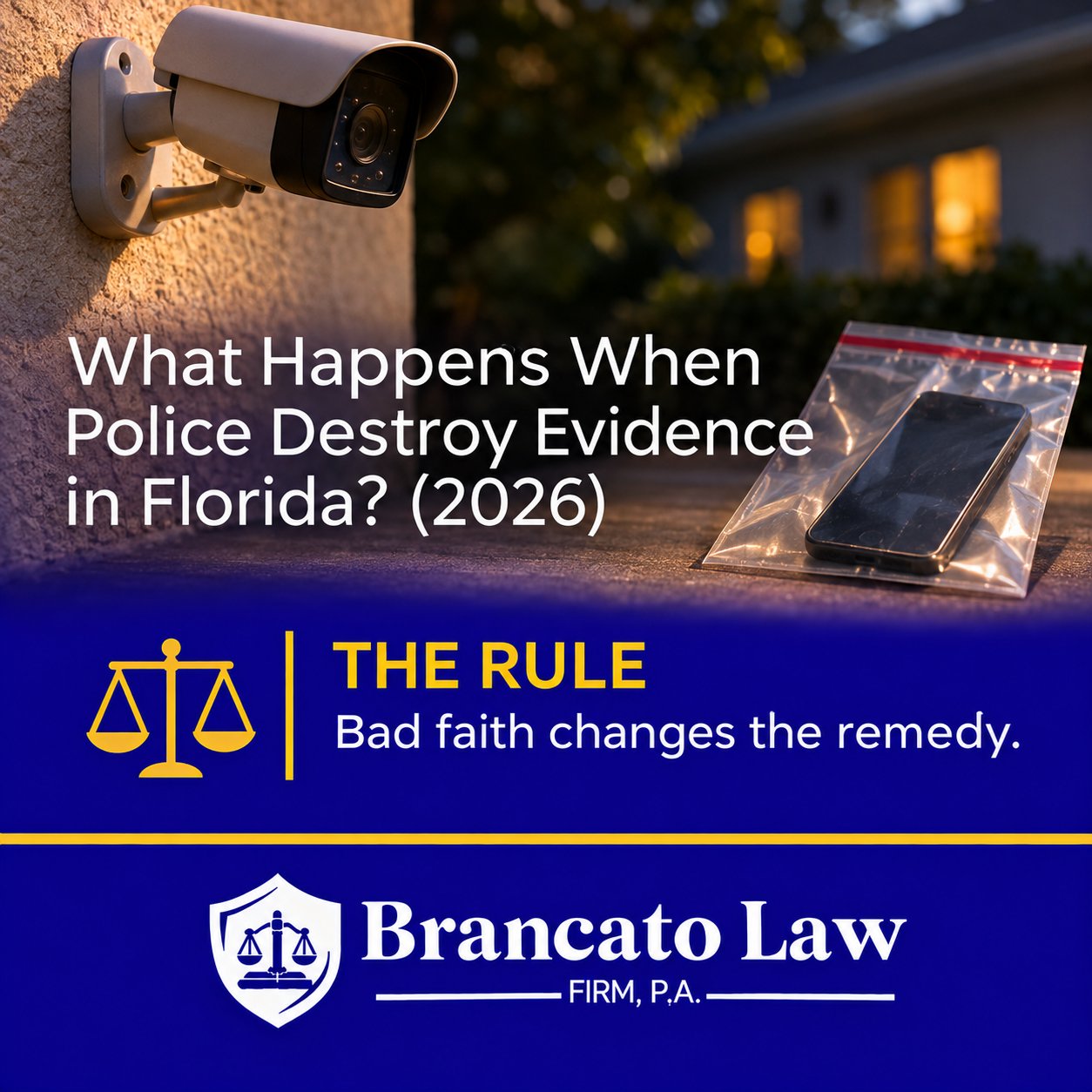
When police destroy or lose evidence in Florida, the charge usually goes forward, but the defense can show the jury what was lost and why. A court will dismiss the case or exclude evidence only if the evidence was clearly exculpatory or the defense proves police acted in bad faith, under Arizona v. Youngblood and the Florida Supreme Court’s decision in Patterson v. State. Without bad faith, the defense can still call a forensic expert to explain how the evidence should have been preserved and argue that the missing evidence creates reasonable doubt. In one of our firm’s murder trials, that approach helped win a not guilty verdict.
If police seized a phone, a camera, or a video system in your case and the data is now gone, you may be wondering whether the case can survive without it. As founder of The Brancato Law Firm, P.A., a Tampa criminal defense firm, and a veteran of the Major Crimes Unit, where I handled homicide cases, I have tried cases where the State’s own mishandling became the center of the defense. Our attorneys work with forensic experts in data recovery, video, and digital devices who can testify about what police should have done and what was lost because they did not.
What happens when police destroy evidence in Florida?
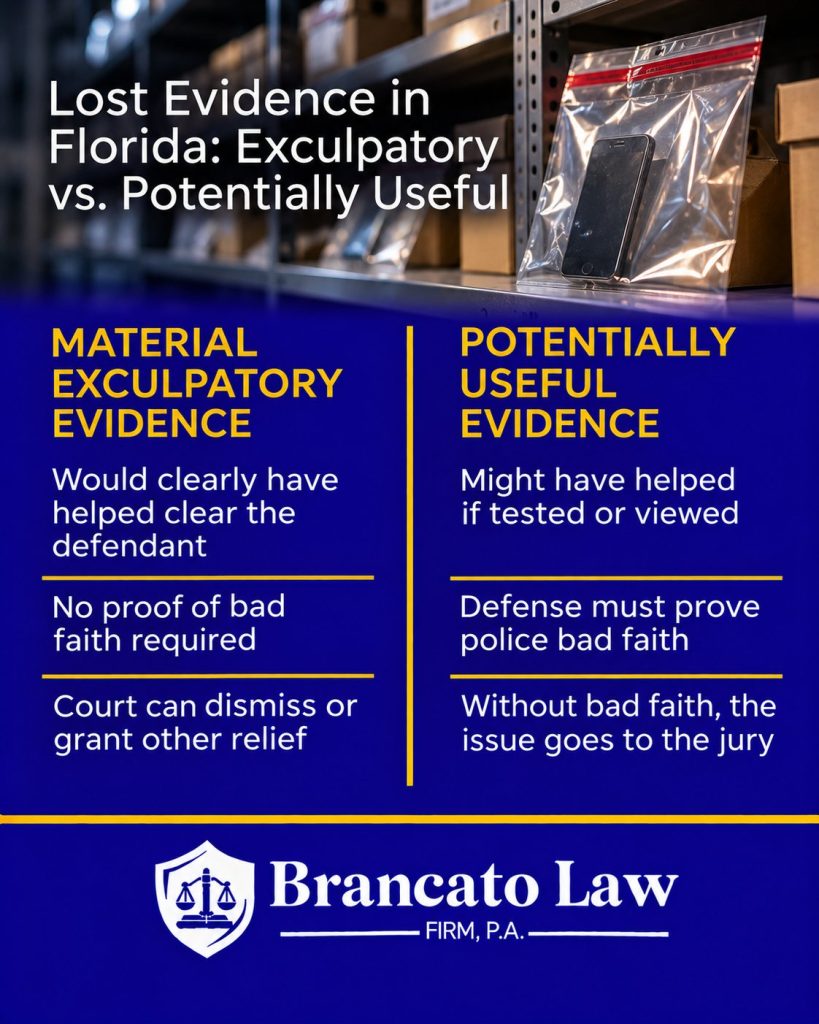
When police destroy evidence, the court first decides whether the evidence was materially exculpatory or only potentially useful. Exculpatory evidence is evidence that would clearly have helped clear the defendant. Potentially useful evidence is evidence that might have helped if it had been tested or viewed. For potentially useful evidence, the defense must prove bad faith to win dismissal or exclusion.
| Type of lost evidence | What the defense must show | Possible court remedy |
|---|---|---|
| Material, exculpatory evidence | The evidence would clearly have helped clear the defendant | Dismissal or other relief without proof of bad faith |
| Potentially useful evidence | Police or the State acted in bad faith in losing or destroying it | Dismissal or exclusion only if bad faith is proven |
| Any lost evidence, no bad faith | Nothing to the court; the issue goes to the jury | Cross-examination, expert testimony, and argument that the gap creates reasonable doubt |
In Arizona v. Youngblood, 488 U.S. 51 (1988), police failed to refrigerate a victim’s clothing and test semen samples in a child sexual assault case. The U.S. Supreme Court held that “unless a criminal defendant can show bad faith on the part of the police, failure to preserve potentially useful evidence does not constitute a denial of due process of law.” The Court also said the defendant “is free to argue to the finder of fact” that a test police never ran might have cleared him.
Florida applies the same rule. In Patterson v. State, 199 So. 3d 253 (Fla. 2016), an arson defendant’s burned truck was destroyed by his insurer after the State released it, before he was ever charged. The Florida Supreme Court held that the bad faith requirement applies even when the defense asks only to exclude evidence rather than dismiss the case, and it found no bad faith on that record.
Can a case be dismissed because police lost a video?
A case can be dismissed for a lost video only in narrow circumstances. In State v. Hampton, 113 So. 3d 109 (Fla. 5th DCA 2013), a trial court dismissed a charge after the State failed to get surveillance video from the store where the defendant was arrested, and the store said any tape would have been erased within 24 hours. The Fifth District reversed, holding that the video was only potentially useful for impeaching the deputy and that the defense had not proven bad faith.
Legal scholars have long debated this standard. Norman C. Bay’s article Old Blood, Bad Blood, and Youngblood: Due Process, Lost Evidence, and the Limits of Bad Faith, 86 Wash. U. L. Rev. 241 (2008) examines the different approaches states have taken in adopting or rejecting Youngblood. Florida has kept the bad faith test, so in most cases the destroyed evidence becomes a trial issue rather than a ground for dismissal.
How can destroyed evidence help the defense at trial?
Destroyed evidence helps the defense when the jury learns that the State had the evidence, understood its value, and failed to keep it. The defense can cross-examine the officers about the protocol they skipped, call an expert to explain how the data should have been preserved, and argue that the missing evidence leaves reasonable doubt. Jurors understand that if the evidence had proven the State’s case, the State would have made sure they saw it.
| Type of mishandling | Defense argument |
|---|---|
| Failure to preserve | Police knew the evidence existed and did not keep it for trial |
| Improper handling | Police worked with a device without following forensic protocol, destroying or altering data |
| Chain of custody gaps | The evidence changed hands without records, raising questions of alteration |
| Selective preservation | Police kept what helped the State and lost what might help the defense |
| Delayed collection | Police waited until video was overwritten or evidence degraded |
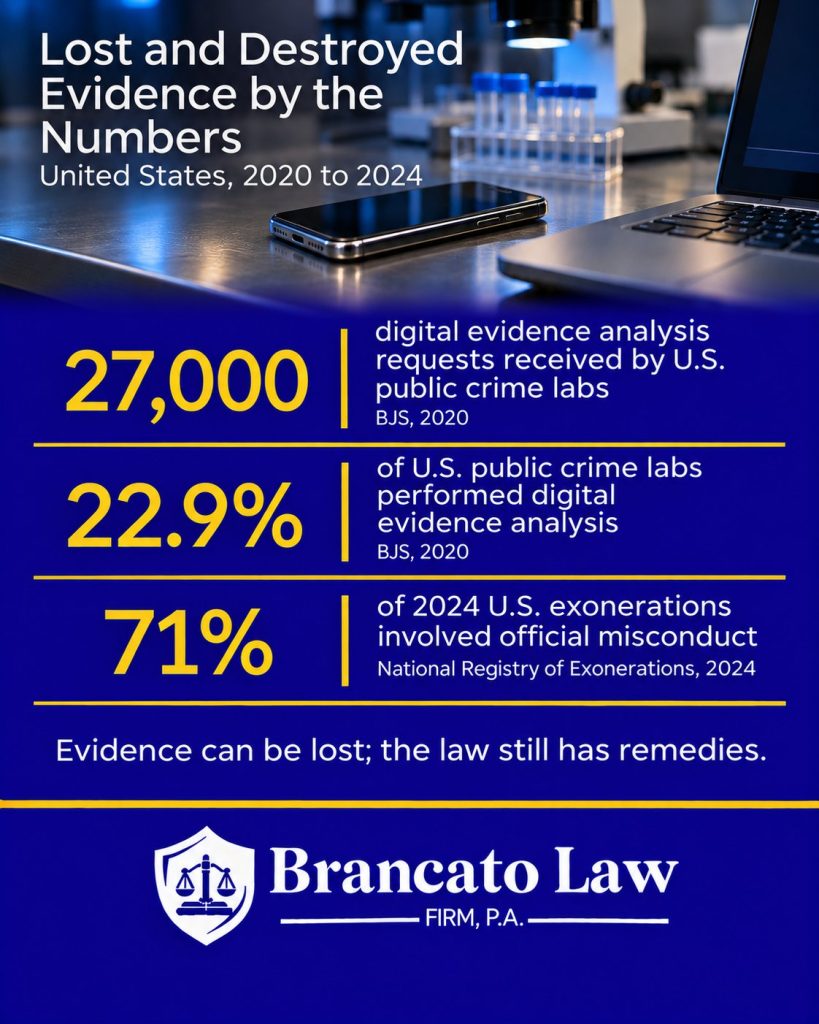
Digital evidence is especially easy to lose. In 2020, publicly funded crime laboratories in the United States received about 27,000 requests for digital evidence analysis, and only 22.9% of labs performed that kind of work, according to the Bureau of Justice Statistics report Publicly Funded Forensic Crime Laboratories, 2020. In many cases, the officer who first handles a phone or camera system is not a trained forensic examiner.
Case study: the destroyed surveillance video in a murder trial
Our firm defended a man charged with second-degree murder after a fatal fight with his roommate inside their shared home. He said he acted in self-defense. A surveillance camera in the home pointed out a window, and based on its angle and field of view it would have captured key moments of the fight.
Police seized the camera, watched part of the footage, and confirmed in their reports that it showed the incident. They did not make a forensic download, which is a complete bit-by-bit copy of the device’s data that preserves the original. Instead, officers worked with the device directly, and the footage was lost.
What the forensic expert found
We retained a forensic data recovery expert and obtained a court order to send the camera to the expert. The expert had two jobs: recover any remaining video, and determine whether the device had been handled according to forensic protocol. His conclusion was clear: no data remained on the device. The video that police confirmed existed was gone.
The expert could not recover the footage, and that was not the point of his testimony. The point was that police had critical evidence, failed to preserve it, and destroyed it through their handling.
Two defenses that supported each other
At trial we presented self-defense and the destruction of evidence together. Under section 776.012, Florida Statutes, a person is justified in using deadly force if he reasonably believes it is necessary to prevent imminent death or great bodily harm. My client testified to the fight as he lived it. The expert, whose testimony had to meet the reliability standard in section 90.702, Florida Statutes, explained the protocol for preserving digital video, that police skipped the forensic download, and that their handling destroyed the footage.
The message to the jury was direct: the State had evidence that could have shown exactly what happened, the State destroyed it, and now it asked the jury to convict without it.
Case result: second-degree murder, not guilty. Police seized a home surveillance camera, confirmed it recorded the fatal fight, and destroyed the footage by handling the device without a forensic download. A defense data recovery expert proved the mishandling, and the jury weighed that evidence alongside the client’s self-defense testimony. The jury returned a verdict of not guilty. Past results do not guarantee future outcomes.
What should you do if evidence in your case was lost or destroyed?
Tell your attorney about every device and camera involved as early as possible, so the defense can trace what police seized and what happened to it. Our attorneys follow five steps in these cases:
- Review every police report for evidence that was seized, viewed, or mentioned but never produced in discovery.
- Demand the evidence in discovery and ask for a court order to examine any device independently.
- Retain a forensic expert even when recovery looks unlikely, because testimony about the lost evidence can matter as much as the evidence.
- Move for dismissal or exclusion when the record shows bad faith.
- Build the destruction into the trial defense, so it supports the client’s own account.
When the case is still under investigation and no charge has been filed, our attorneys can send preservation demands and track devices as part of our representation before charges are filed. In a homicide case, our Tampa homicide attorney page explains how our firm prepares for trial from the first week.
Official misconduct is a recurring factor in wrongful convictions. Of the 147 exonerations recorded nationwide in 2024, at least 104, or 71%, involved official misconduct, according to the National Registry of Exonerations 2024 Annual Report. Mishandled evidence is not always misconduct, but juries take the State’s handling of evidence seriously when the defense shows them the details.
Frequently asked questions
What is spoliation of evidence in a criminal case?
Spoliation is the destruction, alteration, or failure to preserve evidence relevant to a case. In a Florida criminal case, spoliation by the State leads to dismissal or exclusion only with proof of bad faith or clearly exculpatory evidence, and The Brancato Law Firm otherwise uses it at trial through cross-examination and expert testimony.
What is a forensic download?
A forensic download is a complete, bit-by-bit copy of all the data on a device, including deleted files and metadata, made before anyone examines the original. Our attorneys at The Brancato Law Firm ask in every digital evidence case whether police made one, because skipping it is often where data is lost.
Should I hire a data recovery expert if the evidence is already gone?
Often, yes. Even when nothing can be recovered, an expert can testify about proper preservation and how police departed from it, and The Brancato Law Firm retains these experts through the network described on our Tampa forensic science attorney page.
Does the State have to preserve all evidence?
No. Under Arizona v. Youngblood, police do not have a constitutional duty to preserve everything that might conceivably help, only to avoid bad faith destruction of potentially useful evidence. Our attorneys at The Brancato Law Firm send preservation demands early so the record shows exactly what the State was asked to keep.
Can police destroying evidence lead to a not guilty verdict?
It can contribute to one. The Brancato Law Firm won a not guilty verdict in a second-degree murder trial where police destroyed surveillance video, and our post on why expert witnesses matter in major crimes cases explains how experts carry that kind of defense.
What if the evidence was never collected at all?
Evidence police never collected is treated much like lost evidence: the case goes forward, and the defense can show the jury the gap. Our firm’s guide to why a defense attorney should visit the crime scene describes how The Brancato Law Firm finds cameras and witnesses police missed.
For how this fits into the rest of a case, see our step-by-step guide to what happens in a Florida criminal case.
Talk to our attorneys about lost or destroyed evidence
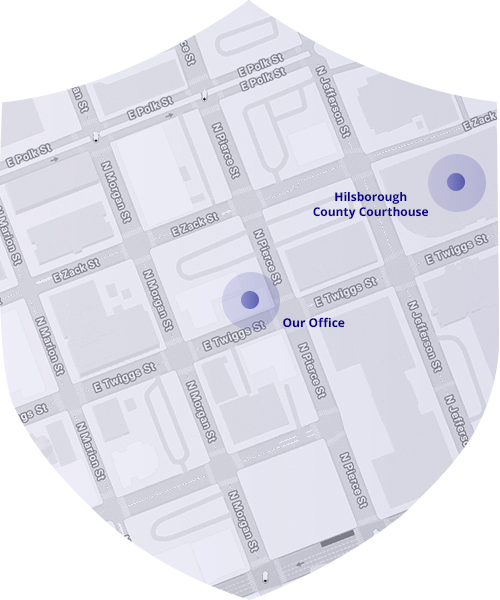
Our attorneys can start by tracing every device and recording police seized in your case and demanding that what remains be preserved. The Brancato Law Firm, P.A., founded by Tampa Criminal Defense Attorney Rocky Brancato, handles murder and other serious felony cases from our office two blocks from the courthouse; call (813) 727-7159 at any hour, because each week can cost evidence. Our firm has Spanish-speaking staff, and attorney Jean-Luc Adrien speaks Spanish, Haitian Creole, and French. For more about our defense strategies, visit our Forensic Science page.
The Brancato Law Firm, P.A.
620 E. Twiggs Street, Suite 205, Tampa, FL 33602
(813) 727-7159
Serving Hillsborough, Pinellas, and Pasco Counties
The Brancato Law Firm, P.A. is a Tampa-based criminal defense practice. We are not affiliated with any other Brancato-named law firms.
Visit Us
Tampa, FL 33602
Contact Us Now
Free Legal Consultation (813) 727-7159