- Free Consultation 24/7: (813) 727-7159 Tap Here To Call Us


From First DUI to Death Penalty



How Do You Challenge Fingerprint Evidence in Florida? (2026)


Rewrite/update date: November 1, 2026. Originally published in December 2025.
| You challenge fingerprint evidence in Florida on three fronts: the science, the examiner, and the timing. Fingerprint comparison is a human judgment with a measured error rate, so the defense can demand the examiner’s notes, test whether the method was applied reliably under section 90.702, Florida Statutes, and cross-examine the analyst point by point. Even a true match only proves you touched the surface at some point. Florida courts have reversed convictions where the State could not show the print was left during the crime. |
If the State’s case against you rests on a fingerprint, the lab report is the beginning of the fight, not the end of it. I’m Rocky Brancato, founder of The Brancato Law Firm, P.A., a Tampa criminal defense firm, and I spent years in the Major Crimes Unit and have tried more than 150 jury trials to verdict over more than 25 years in Hillsborough County courtrooms. Our attorneys work with independent latent print experts, read the examiner’s bench notes, and build the cross-examination long before trial.
Is Fingerprint Evidence Reliable?
Fingerprint evidence is useful but not infallible. Latent print comparison depends on a trained examiner’s judgment, and controlled studies show examiners make measurable errors in both directions. Our attorneys at The Brancato Law Firm treat every fingerprint identification as an expert opinion that has to be tested, because that is exactly what Florida law says it is.
In 2009, the National Academy of Sciences reviewed the state of forensic science in the United States and concluded that, “with the exception of nuclear DNA analysis,” no forensic method had been rigorously shown to consistently connect evidence to a specific individual or source with a high degree of certainty. That finding covered fingerprint comparison.
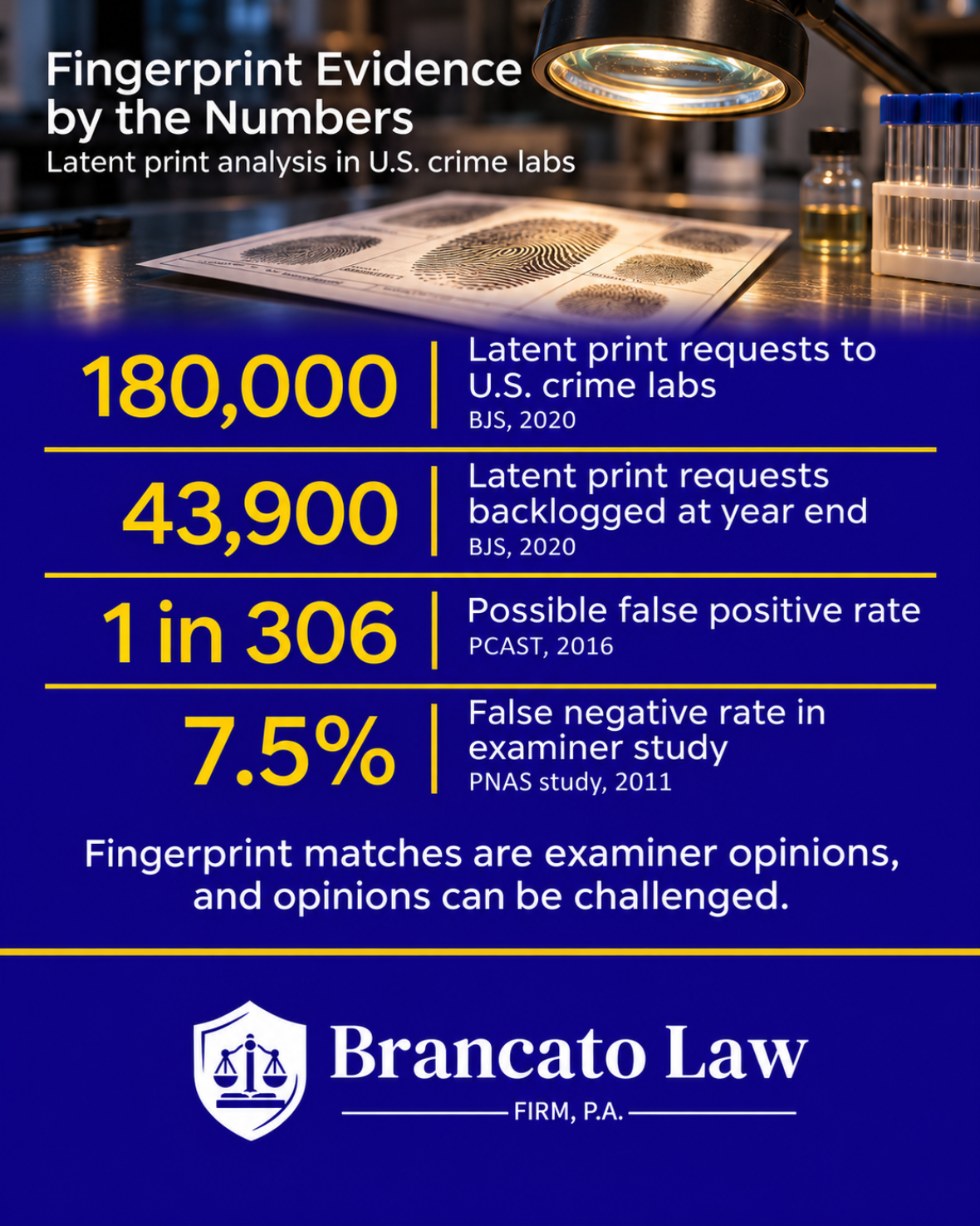
The research since then has put numbers on the problem. In a 2011 study published in the Proceedings of the National Academy of Sciences, 169 latent print examiners each compared about 100 print pairs. The overall false positive rate was 0.1%, and the overall false negative rate was 7.5%, with 85% of the examiners making at least one false negative error. In September 2016, the President’s Council of Advisors on Science and Technology (PCAST) reported that the false positive rate for latent print analysis “could be as high as 1 error in 306.”
Fingerprint work is also high-volume work. In 2020, publicly funded crime labs in the United States received about 180,000 requests for latent print analysis and ended the year with 43,900 latent print requests still backlogged, according to the Bureau of Justice Statistics. Volume and backlog pressure are part of why our attorneys ask how long an examiner spent on a comparison and who checked it.
| Myth | What the record shows |
|---|---|
| Fingerprint matches are certain | The 2009 National Academy of Sciences report found no method except nuclear DNA had been rigorously shown to tie evidence to one person with high certainty. |
| Examiners never get it wrong | A 2011 study of 169 examiners found a 0.1% false positive rate and a 7.5% false negative rate. |
| There is a required number of matching points | Florida has no minimum point standard. The conclusion rests on the examiner’s judgment. |
| A second examiner always catches mistakes | In the 2004 Brandon Mayfield case, an erroneous FBI identification fooled three experienced FBI examiners and a court-appointed expert. |
| A match proves you committed the crime | A match shows you touched the surface at some time. It does not show when. |
How Does a Fingerprint Examiner Reach a “Match”?
An examiner compares a latent print lifted from the scene with a known print taken from a suspect and decides whether the ridge details agree. Most labs follow a four-step process known as ACE-V: analysis, comparison, evaluation, and verification. Each step involves human judgment, and our attorneys at The Brancato Law Firm examine every one of them.
| Step | What the examiner does | Where the defense looks |
|---|---|---|
| Analysis | Decides whether the latent print has enough usable detail to compare | Smudged, partial, or overlapping prints that should have been called “no value” |
| Comparison | Places the latent print beside the known print and marks ridge features | Which features were marked, and whether differences were explained away |
| Evaluation | Concludes identification, exclusion, or inconclusive | Whether the conclusion was reached before or after seeing the suspect’s prints |
| Verification | A second examiner reviews the conclusion | Whether the verifier knew the first result (non-blind review) |
The weak points are usually partial prints, distorted prints from curved or textured surfaces, and contextual bias. The U.S. Department of Justice Office of the Inspector General found that the FBI’s misidentification of Oregon lawyer Brandon Mayfield in the 2004 Madrid bombing investigation came from examiners relying on “extremely tiny details” and rationalizing visible differences that should have excluded him. Our attorneys look for those same patterns in Florida lab files.
Can You Keep Fingerprint Testimony Out Under Florida’s Daubert Rule?
Sometimes, and even when the testimony comes in, the challenge shapes what the examiner can say. Under section 90.702, Florida Statutes, an expert may testify only if the opinion is based on sufficient facts or data, is the product of reliable principles and methods, and reflects a reliable application of those methods to the facts of the case. The Florida Supreme Court adopted that Daubert standard for Florida courts in In re Amendments to the Florida Evidence Code, 278 So. 3d 551 (Fla. 2019).
Courts rarely exclude latent print comparison as a whole discipline. The stronger motion attacks the third requirement: whether this examiner reliably applied the method to this print. Our attorneys at The Brancato Law Firm use a Daubert motion to force the lab to produce its bench notes, marked-up images, verification records, and proficiency testing, and to limit overstated testimony such as “100% certain” or “to the exclusion of all others.”
Does a Fingerprint Prove When You Were There?
No. Fingerprint analysis cannot date a print, so a match proves contact with the surface, not presence during the crime. That gap is often the most powerful defense, and it is the issue our attorneys at The Brancato Law Firm raise first when prints are the State’s main evidence.
The leading Florida case is Jaramillo v. State, 417 So. 2d 257 (Fla. 1982). Jaramillo was convicted of a Dade County double murder based on his prints on a knife, a knife wrapper, and a grocery bag inside the victims’ home. He testified that he had handled those items the day before while helping the victim’s nephew clean the garage, and the print technician admitted he could not tell when the prints were left. The Florida Supreme Court reversed and ordered Jaramillo discharged because the State “failed to establish that Jaramillo’s fingerprints could only have been placed on the items at the time the murder was committed.”
In 2020, Bush v. State, 295 So. 3d 179 (Fla. 2020) discontinued Florida’s special appellate standard for wholly circumstantial cases, the “reasonable hypothesis of innocence” test applied in Jaramillo. The timing argument still matters after Bush. In S.S. v. State, No. 2D19-2572 (Fla. 2d DCA May 7, 2021), a Hillsborough County juvenile case, the State’s only identification evidence was the child’s fingerprints on a damaged door, compared by a Tampa Police Department examiner. The Second District Court of Appeal held that “fingerprints found on an area accessible to the general public are insufficient, alone, to sustain a finding of guilt” and reversed with directions to dismiss the criminal mischief charge.
| Where the print was found | How Florida courts tend to treat it |
|---|---|
| A public or shared surface (store door, car exterior, common area) | Insufficient alone when the State cannot show when the print was left |
| Inside a home or car you had lawful access to | Weak if you have an innocent explanation for being there |
| A place you had no access to (inside a sealed box, a locked safe) | Can be enough on its own, because there is no innocent explanation |
| On the item used in the crime, with other evidence | Treated as one piece of a larger case; timing still matters |
Prints show up most often in burglary cases, where the charge under section 810.02, Florida Statutes depends on proving you entered the structure or conveyance. Our guide on how to fight a burglary charge in Florida explains how a print on the outside of a window or door frame fits into that defense.
How Do Our Attorneys Challenge Fingerprint Evidence?
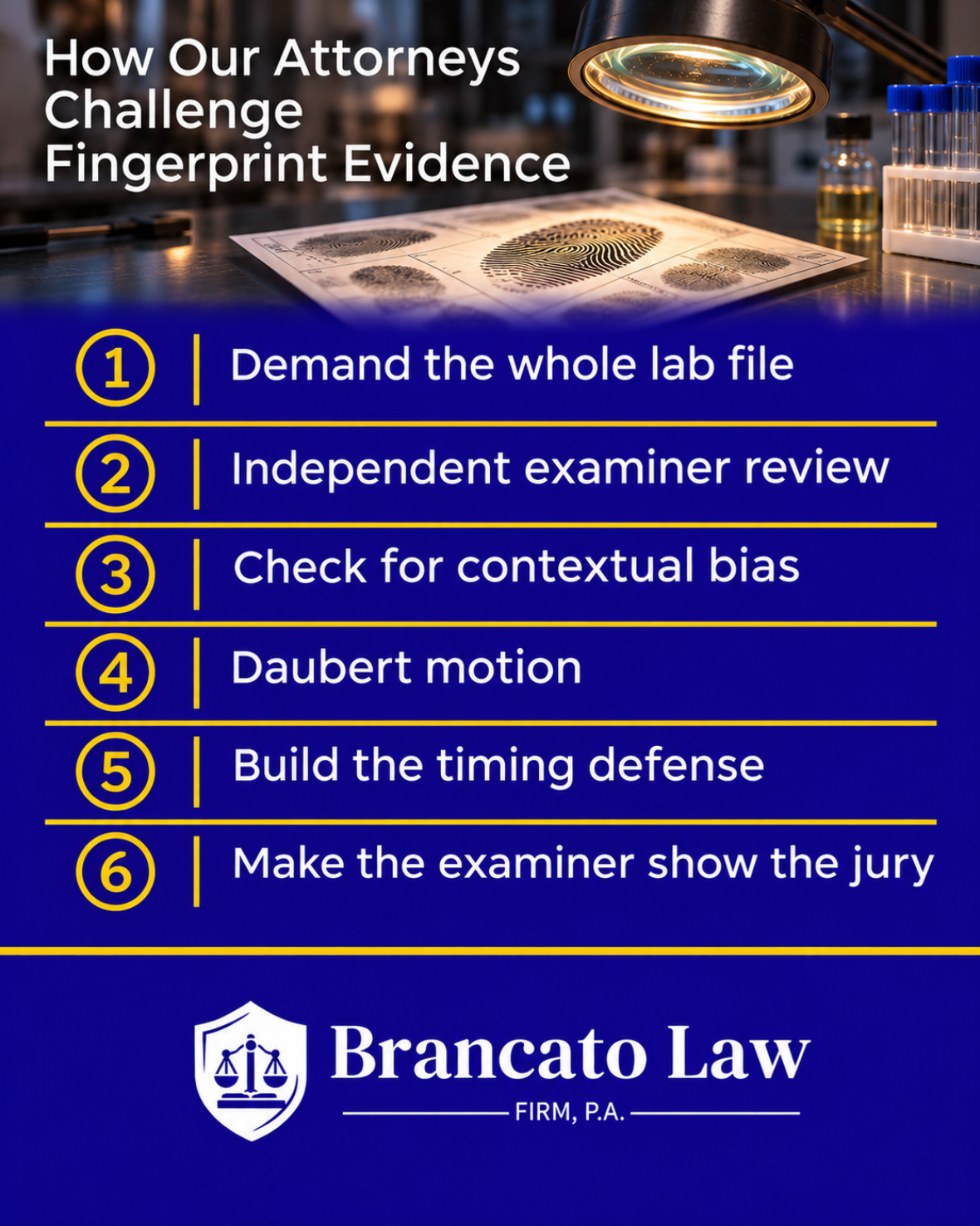
Our attorneys challenge fingerprint evidence with a six-step process that starts at discovery and ends in front of the jury. As a Tampa forensic science defense attorney team, The Brancato Law Firm works through each step before deciding whether to file a motion, retain an expert witness, or attack the examiner on cross-examination.
- Demand the whole lab file. We request the bench notes, the marked comparison images, the verification record, the examiner’s proficiency tests, and the lab’s error and corrective-action logs, not just the one-page report.
- Have an independent examiner review the print. A defense expert tells us whether the latent print had enough usable detail, whether the comparison was done correctly, and whether “inconclusive” was the honest answer.
- Check for contextual bias. We ask what the examiner knew about the suspect before comparing, and whether the verifier knew the first examiner’s conclusion.
- File a Daubert motion where the file supports it. The motion tests whether the method was reliably applied and limits overstated certainty.
- Build the timing defense. We document every lawful, innocent reason your prints could be on that surface.
- Make the examiner show the jury. On cross-examination, we ask the examiner to point to each matching feature on enlarged images. An examiner who cannot demonstrate the match in front of the jury has given the jury its reasonable doubt.
Some of this work starts before an arrest. When detectives say they have “your prints” and want an interview, representation before charges are filed lets our attorneys respond before you say something that fills the timing gap for the State.
What Happened When Our Firm Cross-Examined a Fingerprint Examiner?
The jury acquitted. In one of my cases, the State’s theory depended on a latent fingerprint. Before trial, I retained an independent fingerprint expert to review the latent lift and the known print. He saw similarities but could not call it a match, because the print did not support a conclusive opinion.
I decided not to call him. Defense experts sometimes soften on the stand, and a hedge from our own witness could have given the State’s examiner room to recover. Instead, I relied on what the National Academy of Sciences report says about the limits of fingerprint comparison and prepared to cross-examine the State’s examiner directly.
At trial, the State’s examiner testified flatly that the prints matched. I had enlarged images of the latent lift and the known print ready. I asked her to step down from the witness stand and show the jury, point by point, the features that supported her opinion. She could not do it. She had expected the jury to accept her conclusion because she was the expert, and the jury saw that her opinion had nothing behind it.
| Charge | Key evidence | Our approach | Result |
|---|---|---|---|
| Criminal jury trial | Latent fingerprint identification by the State’s examiner | Independent expert review before trial; point-by-point cross-examination with enlarged images | Not guilty |
Past results do not guarantee future outcomes.
That case is why our attorneys treat expert preparation as a core part of the defense. Our post on why expert witnesses matter in a criminal defense explains how we decide when to call our own expert and when to rely on cross-examination.
When Should You Talk to a Lawyer About Fingerprint Evidence?
Talk to a lawyer as soon as you learn the police have your prints, ideally before any interview. Your explanation for how your prints got there is your defense, and it is strongest when our attorneys can document it early with receipts, work records, photos, and witnesses. The Brancato Law Firm also asks for the original latent lift and images early, before evidence is consumed or lost.
Prints are usually one part of a broader forensic case. Our attorneys apply the same approach to DNA cold hits, cell phone location evidence, and firearms identification.
Frequently Asked Questions About Fingerprint Evidence in Florida
Can you be convicted on fingerprint evidence alone in Florida?
Yes, but only when the print could not have been left innocently, such as inside a place you never had access to. The Brancato Law Firm attacks fingerprint-only cases on timing, relying on decisions like S.S. v. State, No. 2D19-2572 (Fla. 2d DCA May 7, 2021), which reversed where the print was on a publicly accessible door.
How many points of comparison does Florida require for a fingerprint match?
None. Florida has no minimum number of matching points, so the conclusion rests on the individual examiner’s judgment. Our attorneys at The Brancato Law Firm make the examiner identify every feature relied on, because an opinion without a fixed standard has to be demonstrated, not assumed.
Can charges based on fingerprint evidence be dropped in Florida?
Yes. Prosecutors drop or reduce cases when the defense shows the print is unreliable, inconclusive, or explainable by lawful contact. The Brancato Law Firm presents that information to the State Attorney’s Office early, and when the investigation is still open, pre-file advocacy can keep charges from being filed at all.
Can my lawyer get the fingerprint examiner’s notes and images?
Yes. Florida’s criminal discovery rule requires the State to disclose expert reports and the results of scientific tests, and the defense can subpoena the underlying lab records. Our attorneys at The Brancato Law Firm request the full case file, including bench notes, marked images, and verification records, because the summary report rarely shows the weak points.
Do I need my own fingerprint expert?
Usually you need at least a consulting expert, even if that expert never testifies. The Brancato Law Firm uses independent examiners to test the State’s conclusion and prepare cross-examination, and our forensic evidence defense team decides case by case whether calling the expert at trial helps or hurts.
What does “inconclusive” mean on a Florida fingerprint report?
It means the examiner could not identify or exclude you from the print. Our attorneys at The Brancato Law Firm treat an inconclusive result as evidence that does not point to you, and we object when the State tries to describe it as “consistent with” our client.
For how this fits into the rest of a case, see our guide to each stage of a Florida criminal case.
Talk to Our Attorneys About Your Fingerprint Case
The window to document an innocent explanation and preserve the original print images closes quickly once a case is filed. The Brancato Law Firm, P.A. was founded by Tampa Criminal Defense Attorney Rocky Brancato, and our attorneys review the lab file, the scene, and your history with that location before advising you on next steps. Call (813) 727-7159 at any hour. Our firm has Spanish-speaking staff, and attorney Jean-Luc Adrien speaks Spanish, Haitian Creole, and French. Read our guide for Spanish-speaking and Haitian Creole-speaking clients.

For more about our defense strategies, visit our Forensic Science Defense page.
The Brancato Law Firm, P.A.
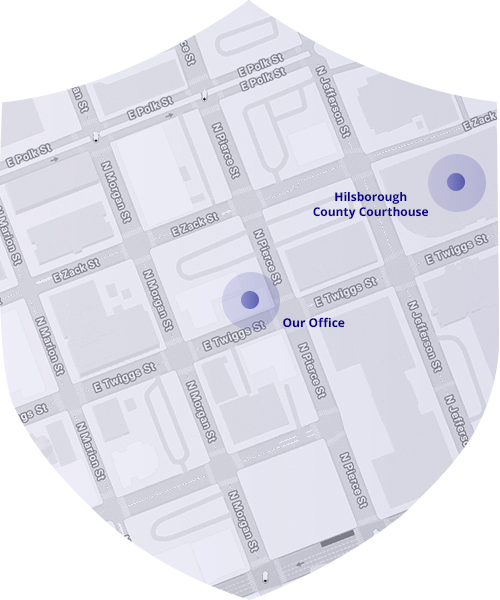
620 E. Twiggs Street, Suite 205, Tampa, FL 33602
(813) 727-7159
Serving Hillsborough, Pinellas, and Pasco Counties
The Brancato Law Firm, P.A. is a Tampa-based criminal defense practice. We are not affiliated with any other Brancato-named law firms.
Visit Us
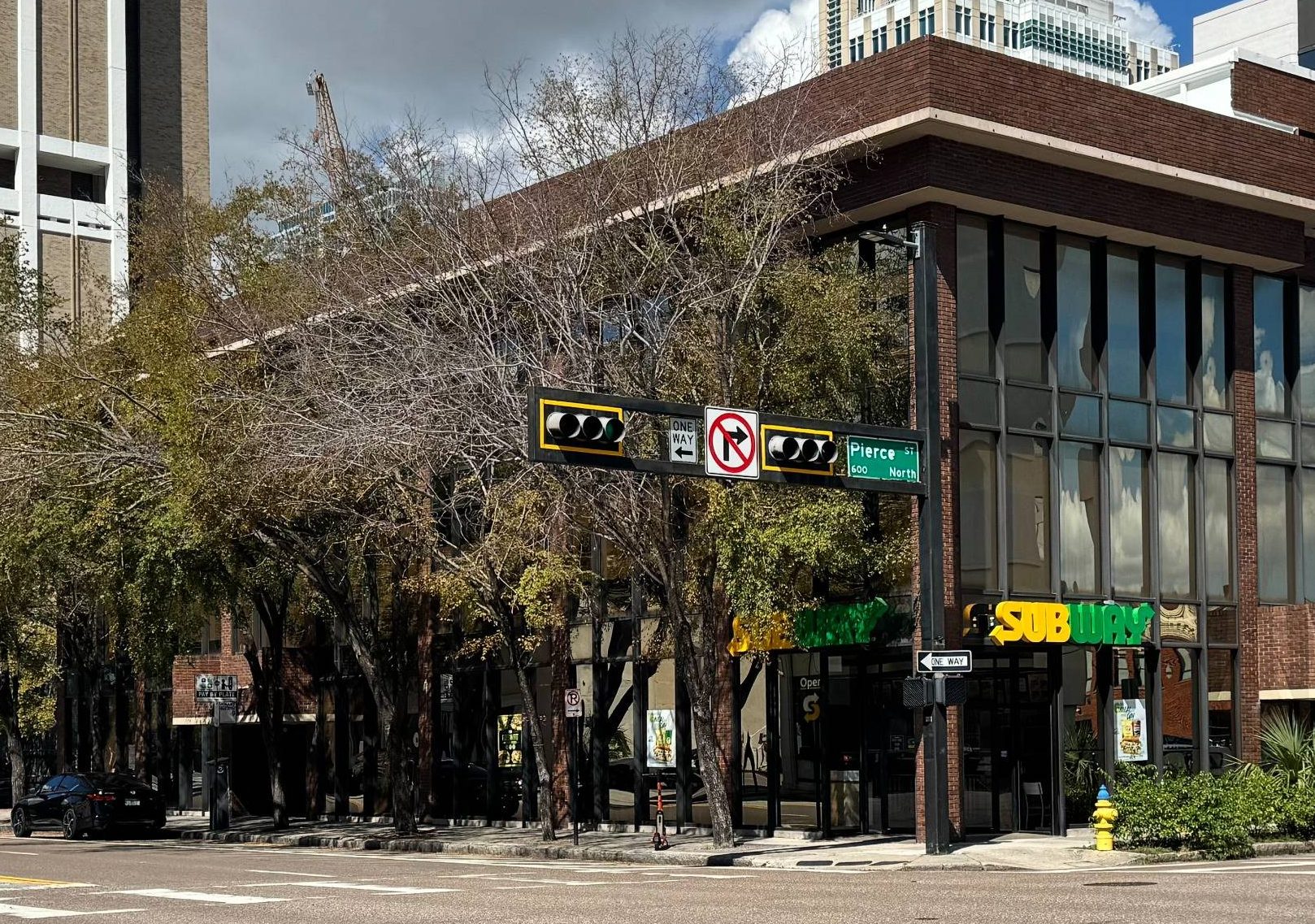
Tampa, FL 33602
Contact Us Now
Free Legal Consultation (813) 727-7159