- Free Consultation 24/7: (813) 727-7159 Tap Here To Call Us


From First DUI to Death Penalty



How Do You Fight a Child Pornography Charge in Florida? (2026)



Rewrite/update date: November 2, 2026. Originally published in April 2025.
| You fight a child pornography charge in Florida, now called child sexual abuse material (CSAM) under the statute, by attacking three things the State must prove: that the search was lawful, that you knowingly possessed or intentionally viewed the files, and that the files were yours and not someone else’s on a shared device or account. Defense attorneys challenge the CyberTip and search warrant, hire a forensic examiner to test how each file got onto the device, and contest every count, because Florida charges each image separately. Since July 1, 2026, possession is a second-degree felony, so these defenses matter more than ever. |
Most child pornography cases in Tampa begin with an automated report from a tech company, months before anyone knocks on a door. I learned how investigators build these cases as a police academy instructor teaching officers search-and-seizure law, and as a Major Crimes Unit attorney handling sex crime and child abuse cases. Today, as founder of The Brancato Law Firm, P.A., a Tampa criminal defense firm, I lead a team that defends people charged in Hillsborough, Pinellas, and Pasco Counties, many of whom had no record before the search warrant. Our attorneys start with the evidence trail: the report, the warrant, and the forensic image of each device.
How do child pornography investigations start in Florida?
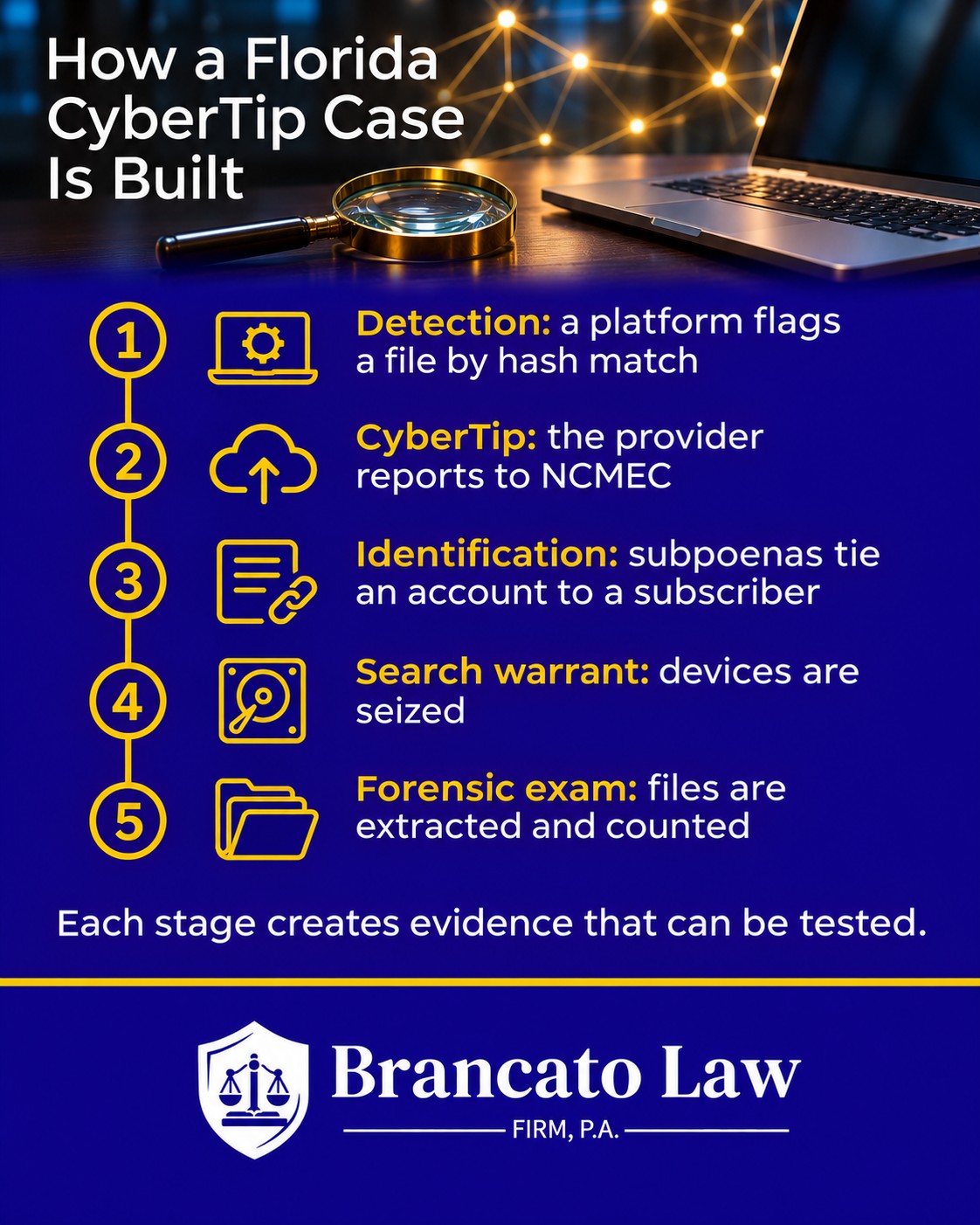
Most cases start with a CyberTipline report from an online platform to the National Center for Missing and Exploited Children (NCMEC), which routes it to law enforcement. Federal law, 18 U.S.C. § 2258A, requires providers to report apparent CSAM once they have actual knowledge of it, but expressly does not require them to monitor users or scan content. Many large platforms scan anyway, usually by comparing a file’s hash value, a digital fingerprint, to a list of known images.
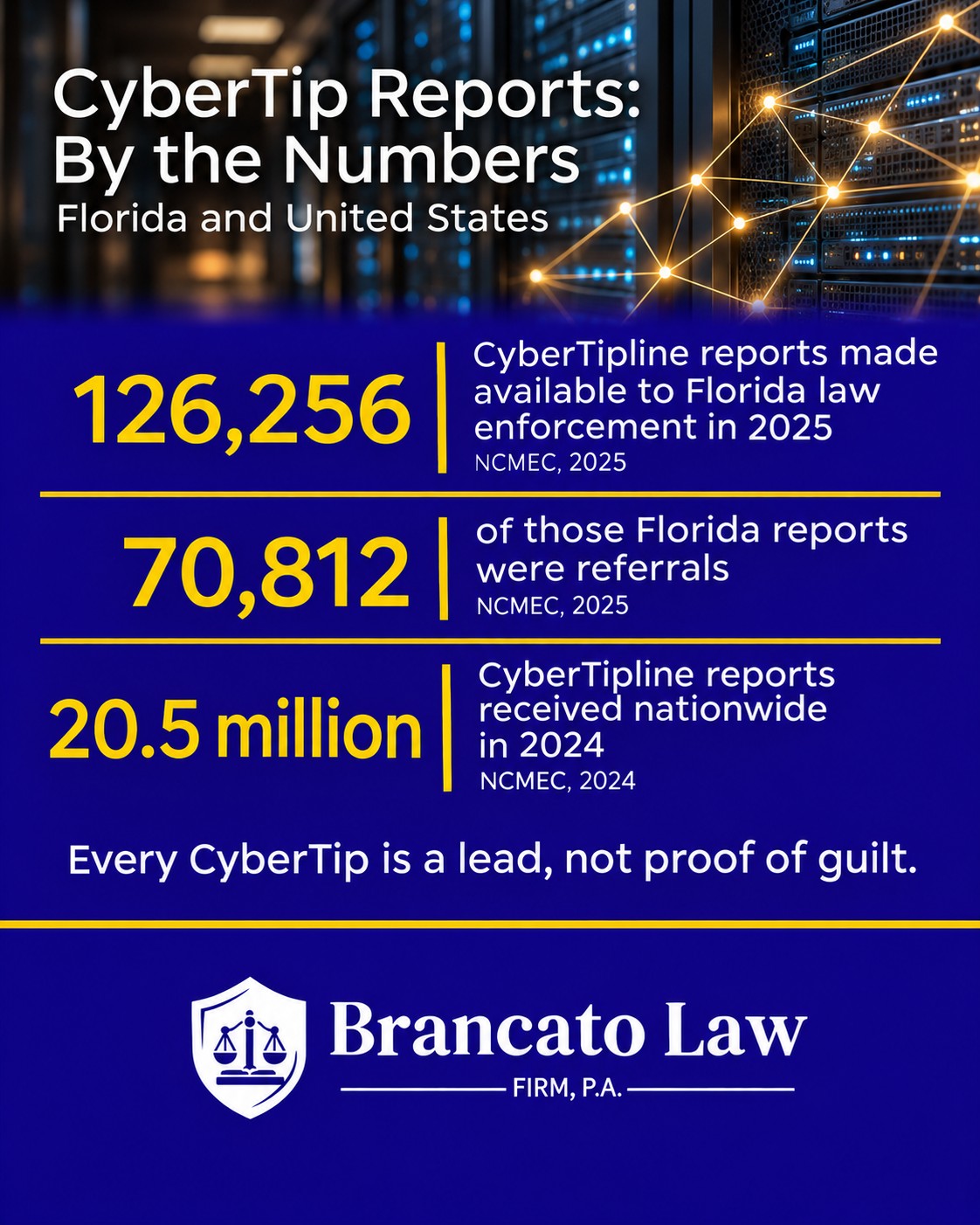
The volume is enormous. In 2025, NCMEC made 126,256 CyberTipline reports available to law enforcement for Florida, including 70,812 referrals, according to NCMEC’s 2025 CyberTipline Reports by State. Nationally, NCMEC received 20.5 million reports in 2024. Each report then has to be traced to a person through subpoenas for subscriber and IP address records, which is where the State’s first assumptions enter the case.
| Stage | What happens | What our attorneys examine |
|---|---|---|
| 1. Detection | A platform’s hash-matching or a user flags a file | Whether any person at the company viewed the file |
| 2. CyberTip | The provider reports to NCMEC, which forwards it to police | What the report actually says, and its date |
| 3. Identification | Subpoenas tie an account or IP address to a subscriber | Whether the subscriber is the user; shared Wi-Fi and households |
| 4. Search warrant | Police seize phones, computers, and drives | Probable cause, staleness, and scope of the warrant |
| 5. Forensic exam | An examiner extracts and counts files | File paths, dates, access history, and who used the device |
Can the search be challenged?
Yes. A search challenge is often the strongest defense, because if the warrant falls, the files usually fall with it. In Burnett v. State, 848 So. 2d 1170 (Fla. 2d DCA 2003), a case investigated by the Polk County Sheriff’s Office, the Second District held that the affidavit supporting the warrant for the defendant’s computer and diskettes was fatally defective and reversed 136 counts of possession that flowed from the seizure. The court affirmed other convictions but threw out every possession count.
Our attorneys look for these warrant problems in every case:
- Thin probable cause. The affidavit must connect the person and the place to be searched to the files, not just repeat that a tip exists.
- Staleness. Months can pass between the tip and the warrant. Our article on the 10-day search warrant rule explains a reversal on timing grounds.
- Scope. A warrant for one device or account does not authorize a search of everything a person owns.
- Account warrants. Warrants to Google, Apple, or other providers raise their own issues, covered in our guide to a Google account legal request.
What is a private search doctrine motion to suppress?
A private search doctrine motion asks the court to suppress evidence because police opened a flagged file without a warrant when no person at the reporting company had looked at that file first. Under the U.S. Supreme Court’s private search cases, police may repeat a search a private party already did, but may not go beyond it without a warrant. When a tech company flags a file only by an automated hash match, the defense argues that no private person ever saw the contents, so the officer who opened the file conducted a new government search. Because police in many CyberTip cases open the files first and get warrants afterward, a win on this motion can take down every warrant built on that first look.
Our firm files these motions in Hillsborough County cases, and we build them from the CyberTip itself. Google’s CyberTips answer a question for each reported file: “Was File Reviewed by Company?” A “No” means no Google reviewer looked at that file for the report; the flag rests on a hash match to a different file someone reviewed in the past. We match every file the detective opened to that answer, and we point out what the State must prove at the hearing. A warrantless search shifts the burden to the State, so the prosecution must show, file by file, that a private person actually viewed what the officer opened.
Where do the courts stand on opening hash-matched files?
The courts are split, and Florida’s state appellate courts have not settled the question for the files a company never viewed. In Morales v. State, 274 So. 3d 1213 (Fla. 1st DCA 2019), a Santa Rosa County defendant uploaded an image to a chatroom whose service matched it to known CSAM through Microsoft’s PhotoDNA. No one at the company or NCMEC opened it before an FDLE agent did, without a warrant. The First District held that the agent’s viewing did not exceed the private search because the hash match identified the image with near certainty.
| Court | Case | Holding on opening a hash-matched file no company employee viewed |
|---|---|---|
| Ninth Circuit | United States v. Wilson, 13 F.4th 961 (9th Cir. 2021) | Violated the Fourth Amendment; conviction vacated |
| Second Circuit | United States v. Maher, 120 F.4th 297 (2d Cir. 2024) | Violated the Fourth Amendment, but evidence admitted under the good-faith exception because the 2020 search came before Wilson |
| Fourth Circuit | United States v. Lowers, No. 24-4546 (4th Cir. Mar. 10, 2026) | Violated the Fourth Amendment, but suppression denied because the defendant’s later interviews, consent, and confession broke the chain |
| Eleventh Circuit (federal courts in Florida) | United States v. Brillhart, 181 F.4th 1181 (11th Cir. 2026) | Permitted, where the hash matched a file a Google employee had already reviewed; the court did not decide whether a fully automated flag is enough |
| Florida First District | Morales v. State, 274 So. 3d 1213 (Fla. 1st DCA 2019) | Permitted; hash match made the contents virtually certain |
In Lowers, Google hash-matched 156 files in a Google Drive account, a reviewer opened 31, and the CyberTip showed which files were opened and which were not. A detective then opened files that neither Google nor NCMEC had viewed. The Fourth Circuit held that was an unconstitutional search. Brillhart, an appeal from the Middle District of Florida, went the other way on its record, but only because the file’s hash traced to a file a human at Google had already confirmed. The Second District, which hears appeals from Hillsborough, Pinellas, and Pasco Counties, has not squarely decided the question in the decisions we have reviewed. In Youngman v. State, 342 So. 3d 770 (Fla. 2d DCA 2022), it held only that police software finding files a defendant shared publicly on BitTorrent was not a search at all.
Legal scholars have questioned how far hash searches should reach. A 2018 Stanford Law Review note, Dennis Martin’s Demystifying Hash Searches, argues that police conduct a Fourth Amendment search whenever they use an algorithm to do what would be a search if done by hand.
How do our attorneys build a private search motion?
Our attorneys build the motion from the State’s own documents, in five steps:
- Pull the per-file review answers. We read the CyberTip’s “Was File Reviewed by Company?” answer for every reported file.
- Match them to what the detective opened. The warrant affidavits usually describe specific files; we check whether each described file was one no company employee viewed.
- Hold the State to its burden. At the evidentiary hearing, the State must prove with competent evidence, not the tip’s own label, that a person reviewed each file the officer opened.
- Excise the tainted descriptions. We ask the court to strike the officer’s descriptions of unlawfully viewed files from each warrant affidavit and test whether probable cause remains.
- Defeat good faith and attenuation. Searches done after the 2021 Wilson decision are harder to excuse as good faith, and a client who invoked the right to counsel and gave no statement leaves the State no break in the chain, unlike the defendant in Lowers.
Lowers carries a practical lesson. The Fourth Circuit found the search unconstitutional and still let the evidence in because the defendant talked to police and consented to searches afterward. A person who stays silent and asks for a lawyer protects the motion as well as the case.
Can a CyberTip be wrong?
Yes. A CyberTip is a report, not proof, and both its labels and its claims about human review can be wrong. The clearest Florida example involves William Lawshe, a Florida Fish and Wildlife Conservation Commission officer who had been named national wildlife officer of the year in 2014. According to News4JAX reporting, a St. Johns County investigation that began with a February 2023 tip led to three counts of possessing child pornography, he left the agency, and the charges were dropped that December after his lawyers produced evidence they said proved his innocence.
Lawshe then sued Verizon and its cloud-storage contractor. In Lawshe v. Verizon Communications, Inc., No. 3:24-cv-137-MMH-LLL (M.D. Fla. Feb. 28, 2025), he alleged that his account held legal images of adult models and that the CyberTip behind his arrest rested on a hash match to an image tagged only “unconfirmed.” He alleged the report still stated that the company “had viewed the entire contents” of the image and that it showed a “pre-pubescent” minor, when the people pictured were plainly adults. Judge Marcia Morales Howard held that federal reporting immunity did not defeat his defamation and Stored Communications Act claims over that report at the pleading stage, writing that the defendants “conflate an intent to immunize mistaken reports with an intent to immunize unfounded reports.” The parties later settled, and in February 2026 the court vacated the order at their request, so it is not precedent. It remains a public record of how an automated flag, and a claim that someone reviewed it, can be wrong.
That is why our attorneys never accept a CyberTip at face value. We check whether each file was actually reviewed, whether it was labeled “apparent” or only “unconfirmed,” and whether an independent examiner agrees the image shows a minor at all. A person who has been falsely flagged has a defense, and the first step is to say nothing to investigators and call a lawyer.
What does the State have to prove about knowledge?
The State must prove you knowingly possessed, controlled, or intentionally viewed material you knew contained CSAM. Under section 827.071, Florida Statutes, the file’s presence on a device is not enough by itself. When the device or home is shared, Florida applies constructive possession rules: the State must show you knew of the files and could exercise control over them through evidence beyond mere proximity, as the Second District explained in Jenrette-Smith v. State, 114 So. 3d 427 (Fla. 2d DCA 2013).
Forensic evidence decides most knowledge disputes. Our attorneys retain independent digital forensic examiners to answer questions the State’s report often skips:
- Who was using the device? Login records, user profiles, and activity at the time of download.
- Were the files ever opened? Access dates, thumbnails, and viewing history.
- Where did the files sit? A deleted file, a cache, or an automatic sync folder tells a different story than an organized collection.
- How did they arrive? Bulk downloads, file-sharing programs, malware, or a synced account a user never opened.
- Are the counts right? Duplicates, thumbnails of the same image, and files of uncertain age inflate the count.
Deleted files raise their own issue. In Burnett, the State’s expert found deleted images on diskettes but could not say when or by whom they were deleted. The Second District resolved the case on the warrant and expressly left open whether deleted images retrievable only by an expert prove knowing possession. Our attorneys press that question when the evidence is deleted or fragmentary. Because constructive possession works the same way across offenses, our guide to constructive possession in Florida is useful background.
What changed in Florida’s CSAM law on July 1, 2026?
On July 1, 2026, Chapter 2026-20, Laws of Florida (CS/CS/HB 1159), renamed “child pornography” as “child sexual abuse material” throughout the statutes and raised several penalties. Possessing, controlling, or intentionally viewing CSAM under section 827.071(5) became a second-degree felony, and each image and each child depicted is still a separate offense. Our post on child pornography penalties in Florida covers sentencing, scoring, and the image-count enhancement in detail. The changes that most affect defense strategy are these:
| Change effective July 1, 2026 | Why it matters to the defense |
|---|---|
| Possession under § 827.071(5) rose from a third-degree to a second-degree felony | Each count now carries up to 15 years, so every count the defense removes matters more |
| “Transmit” under section 847.0137, Florida Statutes now includes sharing a link or access credential to cloud storage | Sharing a folder link can be charged as transmission, a second-degree felony with a 5-year mandatory minimum for adults |
| Courts may skip that mandatory minimum on written findings, including that the child was 14 or older, the image was made with permission, the offender was no more than 4 years older, and the image was not sent to a third party | Teen and young-adult cases need these facts developed early |
| Good-faith exception for sharing a link with police, a prosecutor, or a forensic examiner to report CSAM | Reporting through proper channels is protected |
| The date of the offense controls | Conduct before July 1, 2026 is charged under the old, lower penalties |
The transmission change builds on earlier law about file sharing. Section 847.0137 reaches a person who knew or reasonably should have known he was transmitting CSAM. In Jeror v. State, 313 So. 3d 178 (Fla. 2d DCA 2021), a Sarasota County defendant moved downloaded videos into a folder a BitTorrent program shared automatically. The Second District held the evidence let the jury find he reasonably should have known the files were being shared, and affirmed. With cloud links now included, how a folder was shared, and whether the user knew, is a central fact our attorneys investigate.
Can a child pornography charge be dropped or reduced in Florida?
Yes. Charges can be dismissed, reduced, or resolved for fewer counts when the search is suppressed, the knowledge evidence is weak, or mitigation persuades the prosecutor. Counts tied to unreliable forensics can also be dropped. Early work matters most, and when an investigation is still underway, pre-file advocacy can shape what the State files.
One example from our firm: a young man who had just turned 18 was charged with possession of child pornography and faced prison and sexual offender registration. Our attorneys built a detailed mitigation case and negotiated with the prosecutor, and the case resolved with a plea to a non-registerable offense with treatment. Past results do not guarantee future outcomes. Our guide to a mitigation report explains that work, and our overview of sex offender registration in Florida explains what registration under section 943.0435, Florida Statutes requires.
Charges involving chats with a minor are a different offense with different defenses; see solicitation of a child using a computer and what to do if you messaged a minor online. Our Tampa internet crimes attorney page describes how our firm defends these cases.
What should you do if police contact you about a CSAM investigation?
Do not answer questions, consent to a device search, or delete anything; call a defense attorney first. Deleting files after you learn of an investigation can lead to a separate tampering charge and can be argued as evidence of knowledge. Investigators often arrive with a warrant already signed and ask friendly questions while the search happens. Anything said during that visit can supply the knowledge element the forensic evidence lacks.
- Say you want a lawyer and will not answer questions.
- Do not give passwords or unlock devices without advice from counsel.
- Write down who came, what they took, and what they said.
- Keep the warrant and inventory paperwork.
Frequently asked questions about fighting a child pornography charge in Florida
Is accidentally downloading child pornography a crime in Florida?
Not if it was accidental. Section 827.071(5) requires knowing possession or intentional viewing of material the person knew contained CSAM. The Brancato Law Firm uses forensic evidence, such as whether a file was ever opened, to show what a client did and did not know.
Can I be charged if other people used my computer or Wi-Fi?
You can be charged, but shared access is a real defense. On a shared device or network, the State must prove knowledge and control beyond simple proximity to the files. Our attorneys at The Brancato Law Firm build a timeline of who used each device and account when the files arrived.
Is sharing a Google Drive or Dropbox link a crime under Florida’s 2026 law?
Sharing a link or access credential to cloud storage that contains CSAM can now be charged as transmission under section 847.0137, a second-degree felony. The Brancato Law Firm examines whether the client created the link, knew what it contained, and knew it was shared, which is where these cases are won or lost.
Can a CyberTip search be suppressed if no one at Google viewed the file?
It can, in some courts. Several federal appeals courts have held that police violate the Fourth Amendment by opening a hash-matched file no company employee viewed, while others, including the Eleventh Circuit on a record of prior human review, have allowed it. The Brancato Law Firm files private search doctrine motions built on the CyberTip’s file-by-file review answers, a question Florida’s Second District has not settled.
What if a CyberTip flagged an image of an adult?
Then the State cannot prove a key element, because CSAM must depict a minor. Automated tags such as “unconfirmed” signal that even the reporting system was unsure of the person’s age. The Brancato Law Firm retains independent examiners to test age and origin, and cases like Lawshe v. Verizon Communications, Inc., No. 3:24-cv-137-MMH-LLL (M.D. Fla. Feb. 28, 2025) show that these reports can be wrong.
Can a search warrant based on a CyberTip be thrown out?
Yes, if the affidavit lacks probable cause, the information was stale, or police exceeded the scope of the warrant or the private search. In Burnett v. State, 848 So. 2d 1170 (Fla. 2d DCA 2003), a defective affidavit led to reversal of 136 possession counts. Our attorneys at The Brancato Law Firm file motions to suppress when the warrant or the tip falls short.
Does Florida’s July 2026 law apply to my case if the files were downloaded earlier?
The new penalties apply to offenses committed on or after July 1, 2026. When downloads span that date, The Brancato Law Firm uses the forensic timeline to argue which law applies to each count; our internet crimes defense team reviews the file dates in every case.
Will I be arrested before I know I am being investigated?
Often, yes. Many people first learn of a CSAM investigation when police execute a search warrant, sometimes months after the original tip. If you think an investigation is underway, The Brancato Law Firm can step in before charges are filed through representation before charges are filed.
For how The Brancato Law Firm, P.A. defends these cases, see our Tampa sex crimes defense practice.
Talk to our attorneys before you talk to investigators
The first conversation with police and the first forensic image of a device shape everything that follows. The Brancato Law Firm, P.A. was founded by Tampa Criminal Defense Attorney Rocky Brancato, and our attorneys can step in before an interview, review the warrant and CyberTip, and bring in an independent forensic examiner. Call us at any hour at (813) 727-7159 for a confidential consultation. Our firm has Spanish-speaking staff, and attorney Jean-Luc Adrien speaks Spanish, Haitian Creole, and French. Read our guide for Spanish and Haitian Creole speakers facing criminal charges.

For more about our defense strategies, visit our Internet Crimes page.
The Brancato Law Firm, P.A.
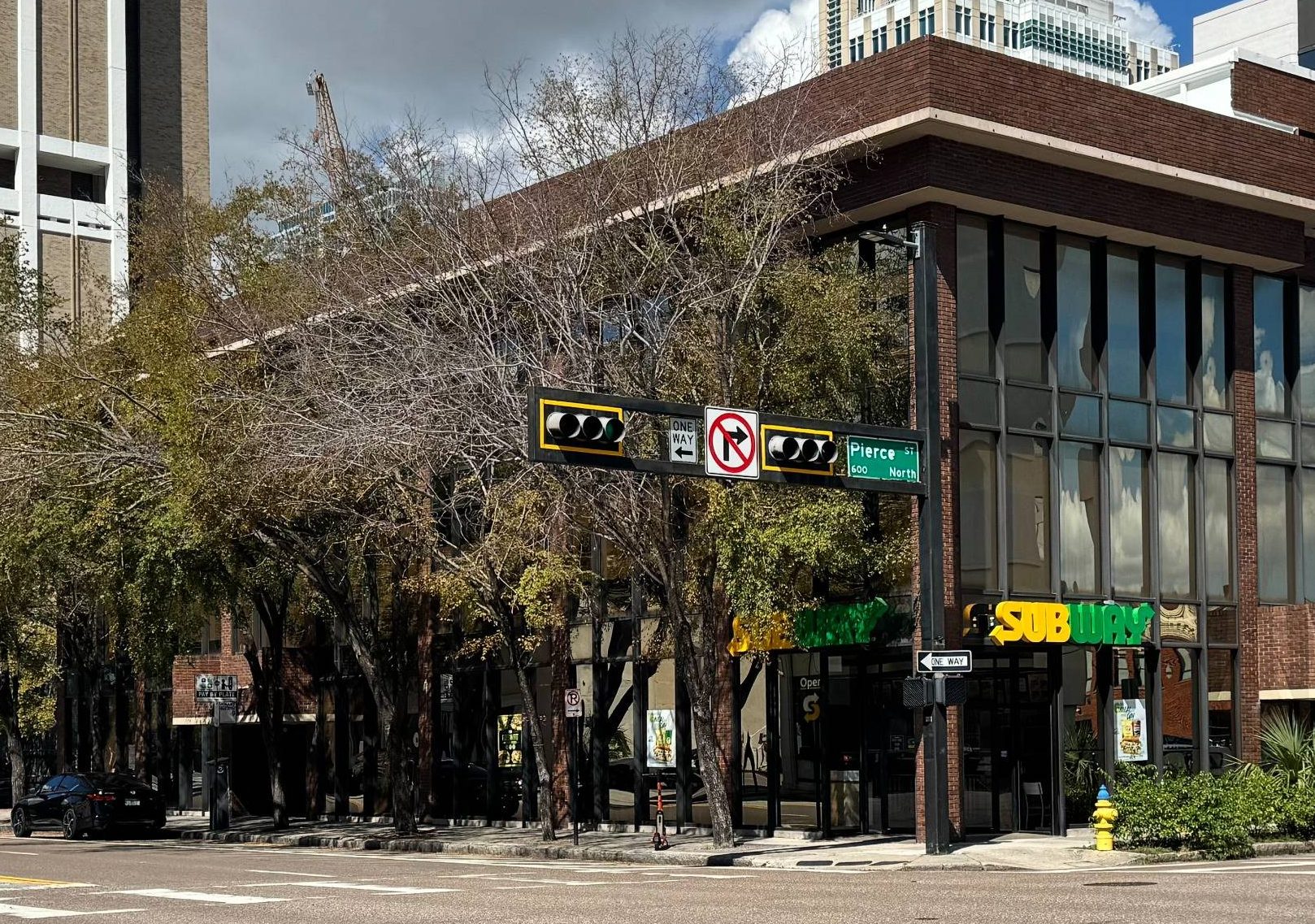
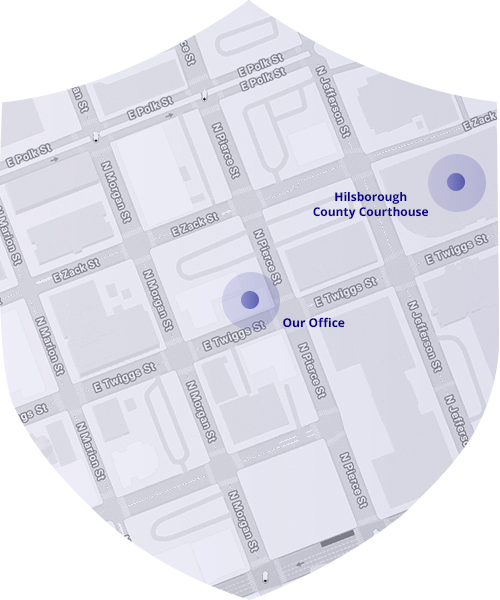
620 E. Twiggs Street, Suite 205, Tampa, FL 33602
(813) 727-7159
Serving Hillsborough, Pinellas, and Pasco Counties
The Brancato Law Firm, P.A. is a Tampa-based criminal defense practice. We are not affiliated with any other Brancato-named law firms.
Visit Us
Tampa, FL 33602
Contact Us Now
Free Legal Consultation (813) 727-7159