- Free Consultation 24/7: (813) 727-7159 Tap Here To Call Us


From First DUI to Death Penalty



What Is the Age of Consent in Florida? (2026 Guide)


Fully rewritten and updated October 23, 2026.
The age of consent in Florida is 18. Under section 794.05, Florida Statutes, a person 24 or older who has sex with a 16- or 17-year-old commits a second-degree felony, so a 16- or 17-year-old and a partner under 24 do not violate that law when both consent. Any sexual activity with a person under 16 is lewd or lascivious battery under section 800.04, whatever the partner’s age, and neither the minor’s consent nor a mistaken belief about age is a defense. Florida’s Romeo and Juliet law, section 943.04354, is not a defense to any charge; it only lets some young offenders ask a court to remove sex offender registration.
In a typical Florida age-of-consent prosecution, the State’s case rests on two birth dates and whatever the accused told a detective, because the younger person’s willingness is not a defense. I saw how these cases are built, and where they come apart, in the Major Crimes Unit of the Hillsborough County Public Defender’s Office, which handled homicide, sex crimes, and child abuse cases. My name is Rocky Brancato, and as founder of The Brancato Law Firm, P.A., a Tampa criminal defense firm, I have tried more than 150 jury trials to verdict. Our attorneys defend people accused of sex offenses involving teenagers across Hillsborough, Pinellas, and Pasco Counties, starting with the first call from a detective.
What is the age of consent in Florida?
The age of consent in Florida is 18, but no single statute says so. The rule comes from three laws read together: section 794.05, Florida Statutes, for 16- and 17-year-olds; section 800.04, Florida Statutes, for anyone under 16; and section 794.011, Florida Statutes, the sexual battery law, for any sexual act without consent. These statutes apply in every Florida county, so the answer is the same in Tampa, Miami, or Orlando.
Two rules apply whenever the younger person is a minor these statutes protect. First, the minor’s agreement does not count: section 800.04(2) states that “[n]either the victim’s lack of chastity nor the victim’s consent is a defense to the crimes proscribed by this section.” Second, a mistake about age does not help. Under section 794.021, Florida Statutes, “ignorance of the age is no defense,” and neither is a lie about age or “a bona fide belief” that the person was older. Section 800.04(3) applies the same rule to children under 16. The table below shows how Florida law treats the most common age combinations.
| Younger person’s age | Older person | Is sexual activity legal? | Statute |
|---|---|---|---|
| Under 12 | Any age | No. Sexual battery, a capital felony if the older person is 18 or older | 794.011(2) |
| 12 to 15 | Any age, including another teenager | No. Lewd or lascivious battery, a second-degree felony | 800.04(4) |
| 16 or 17 | Under 24 | Yes, if both consent and none of the rows below applies | 794.05 |
| 16 or 17 | 24 or older | No. Second-degree felony, up to 15 years in prison | 794.05(1) |
| 12 to 17 | A parent, guardian, or other adult in familial or custodial authority | No. First-degree felony, and consent is not a defense | 794.011(8) |
| Any enrolled student | A school employee, volunteer, or contractor 18 or older | No. Second-degree felony, and a romantic relationship alone is enough | 800.101 |
| 18 or older | 18 or older | Yes, if both consent | 794.011 |
Our attorneys at The Brancato Law Firm start every one of these cases by fixing both people’s ages on the date of each alleged act, because the row that applies decides the charge, the penalty, and whether registration follows.
Can a 16- or 17-year-old legally date someone 18 to 23 in Florida?
Yes. Florida has no law against dating at any age, and section 794.05 makes sexual activity with a 16- or 17-year-old a crime only when the older person is 24 or older. A 16-year-old and an 18-year-old, a 17-year-old and a 19-year-old, or a 17-year-old and a 23-year-old do not violate section 794.05 when both consent.
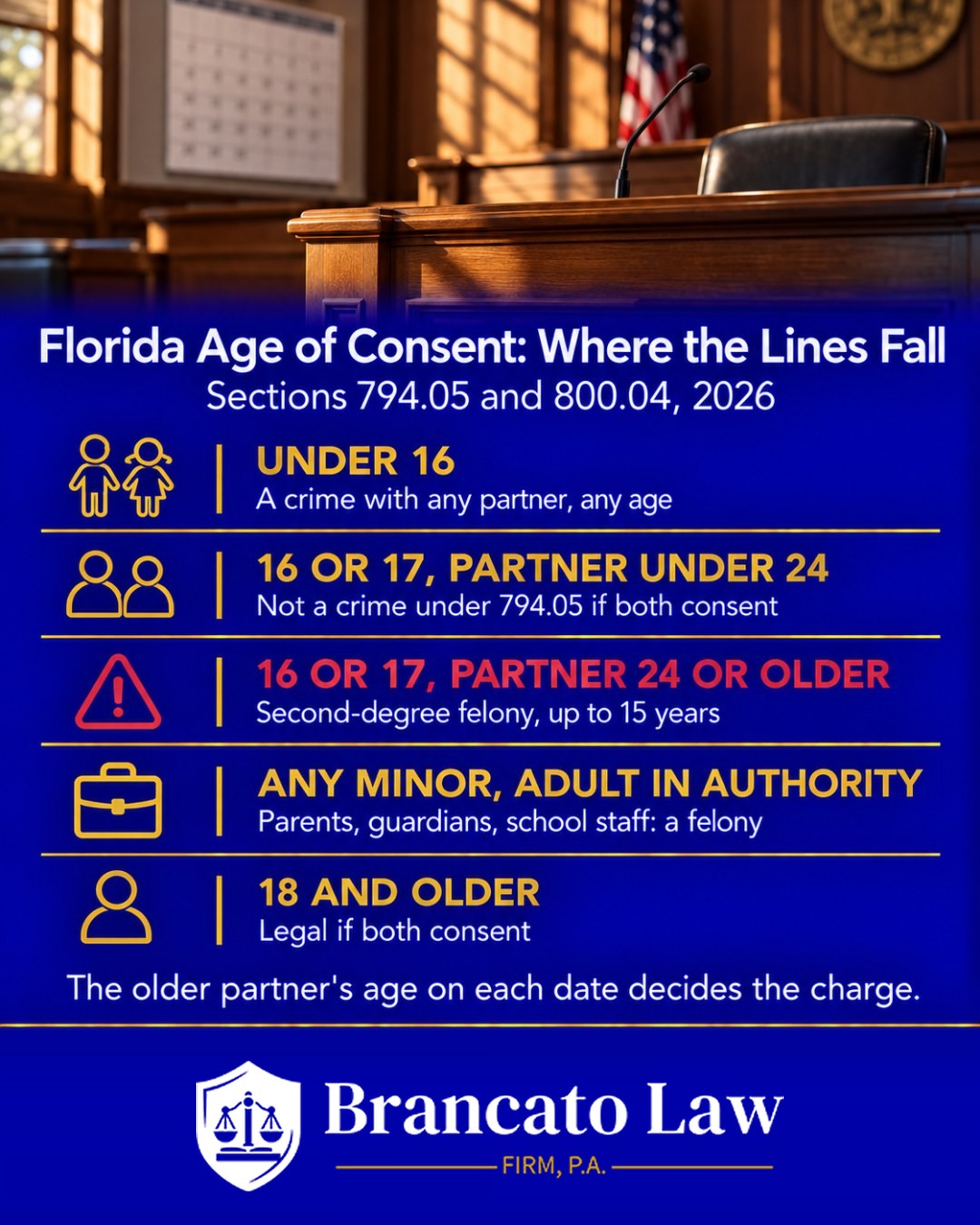
- 16 and 18: not a crime under section 794.05.
- 17 and 19, or 17 and 20: not a crime under section 794.05.
- 16 and 23: not a crime under section 794.05.
- 17 and 24: a second-degree felony for the 24-year-old.
- 15 and any age: a felony under section 800.04, covered below.
The older partner’s birthday can change the answer overnight. A relationship that starts when the older partner is 23 becomes a felony for any sexual activity on or after the older partner’s 24th birthday while the younger partner is still 16 or 17. The State has to prove the date of each act, and The Brancato Law Firm holds prosecutors to that proof.
Section 794.05 also has one narrow exception. Subsection (3) says its provisions “do not apply to a person 16 or 17 years of age who has had the disabilities of nonage removed under chapter 743,” which is Florida’s process for legally emancipating a minor. Being outside section 794.05 does not protect every part of a relationship. Photos, school and family authority, and disputed consent fall under other statutes, explained in the section on what consent does not cover below.
What happens if the older partner is 24 or older?
A person 24 or older who has sexual activity with a 16- or 17-year-old commits unlawful sexual activity with certain minors, a second-degree felony under section 794.05(1). The maximum sentence is 15 years in prison under section 775.082, Florida Statutes, and the maximum fine is $10,000 under section 775.083, Florida Statutes. A conviction requires sex offender registration under section 943.0435, Florida Statutes, which lists section 794.05 as a qualifying offense and counts a plea “regardless of whether adjudication is withheld.”
“Sexual activity” has a specific meaning in section 794.05: oral, anal, or female genital penetration by, or union with, the sexual organ of another, or penetration by any other object. Kissing or touching that does not meet that definition is not a section 794.05 offense. The statute also says the 16- or 17-year-old’s “prior sexual conduct is not a relevant issue,” and if the offense results in a birth, paternity is established under chapter 742 and an offender found to be the father must pay child support. Our full guide to unlawful sexual activity with a minor in Florida covers the elements, penalties, and defenses in detail, and our Tampa sex crimes defense attorney page explains how our firm approaches these charges.
The 24-year line exists because of a Florida Supreme Court case. In B.B. v. State, 659 So. 2d 256 (Fla. 1995), a juvenile case that reached the court from the Second District Court of Appeal, both teenagers were 16, and the State prosecuted one of them under the old version of section 794.05, which applied to “any person.” The court held the statute unconstitutional as applied to a minor, because the State had not shown that prosecuting one 16-year-old for consensual sex with another was the least intrusive way to protect minors. In 1996, the Legislature rewrote section 794.05 so that it applies only to a person 24 or older (chapter 96-409, Laws of Florida).
The Second District, which hears appeals from Hillsborough, Pinellas, and Pasco Counties, then upheld the new age line in State v. Walborn, 729 So. 2d 504 (Fla. 2d DCA 1999). The court held that limiting criminal responsibility to people 24 and older is not arbitrary, because the Legislature could decide that people in that group “were more likely than others to understand the consequences of their actions and to cause harm to minors.” With the age line settled, The Brancato Law Firm focuses these defenses on the facts the State must prove: the act, the dates, and the ages.
Is sex with someone under 16 always a crime in Florida?
Yes. Under section 800.04(4), sexual activity with a person 12 to 15 years old is lewd or lascivious battery, a second-degree felony, no matter how old the other person is. Section 800.04 has no close-in-age exception, so an 18-year-old with a 15-year-old and a 17-year-old with a 14-year-old can both be charged. Touching a person under 16 in a lewd or lascivious manner, without sex, can be charged as lewd or lascivious molestation or lewd or lascivious conduct.
The Florida Supreme Court rejected the argument that a willing teenager changes the result in Jones v. State, 640 So. 2d 1084 (Fla. 1994). One defendant was 18, and in the companion case two men aged 19 and 20 had sex with 14-year-old girls who, the parties agreed, consented. The court upheld section 800.04, holding that “neither the level of intimacy nor the degree of harm are relevant when an adult and a child under the age of sixteen engage in sexual intercourse.”
Teenagers can be charged too. In J.A.S. v. State, 705 So. 2d 1381 (Fla. 1998), two 15-year-old boys were charged after consensual sexual activity with two 12-year-old girls. The court held that section 800.04 could be applied to them in the juvenile system, because the State’s interest in protecting 12-year-olds outweighed the older teens’ privacy interest. Penalties under section 800.04 range from a third-degree felony for some offenders under 18 to a life felony for an adult accused of molesting a child under 12; our guide on how to fight a lewd and lascivious charge in Florida breaks down each tier.
Research shows how often these cases involve people who already know each other. A U.S. Office of Juvenile Justice and Delinquency Prevention bulletin, Statutory Rape Known to Law Enforcement (2005), analyzed 2000 National Incident-Based Reporting System data and found that 95% of statutory rape victims were female and almost 3 of every 5 were 14 or 15 years old. Three in 10 offenders were boyfriends or girlfriends and 6 in 10 were acquaintances, and an arrest occurred in 42% of incidents. Because so many of these cases grow out of an existing relationship, our attorneys at The Brancato Law Firm look closely at the messages and timeline between the two people.
Does Florida have a Romeo and Juliet law?
Yes, but it does not make any relationship legal and it is not a defense to a charge. Florida’s Romeo and Juliet law, section 943.04354, Florida Statutes, lets a person who was close in age to the minor ask a court to remove the requirement to register as a sexual offender after a conviction. The closest thing Florida has to a close-in-age rule for the crime itself is the under-24 line in section 794.05.
| Requirement | What section 943.04354 requires |
|---|---|
| Qualifying conviction | A violation of section 800.04 (lewd or lascivious offenses), 827.071 (sexual performance by a child and child sexual abuse material), or 847.0135(5) (lewd exhibition by computer) |
| No other sex conviction | No other conviction under sections 794.011, 800.04, 827.071, or 847.0135(5) |
| Basis for registration | Registration must rest solely on that one conviction |
| Age of the minor | 13 to 17 at the time of the offense |
| Age gap | Not more than 4 years older than the minor |
| Federal law | Removal must not conflict with federal law requiring that the act was consensual |
| Notice | The State Attorney and FDLE must get notice at least 21 days before the hearing and may oppose the motion |
| Number of tries | One. If the court denies the motion, no second motion is allowed under this section |
Section 794.05 is not on the list. A person convicted of unlawful sexual activity with a 16- or 17-year-old cannot use the Romeo and Juliet law, and a 24-year-old is always more than 4 years older than a 16- or 17-year-old in any event. For that person, the main path off the registry is the general petition under section 943.0435(11), which requires at least 25 years after release from all confinement and supervision with no arrest for any felony or misdemeanor.
Courts apply the statute strictly. In Hurtado v. State, 332 So. 3d 15 (Fla. 2d DCA 2021), a Hillsborough County judge denied a Romeo and Juliet motion without explaining why. The Second District reversed, holding that the current statute allows the motion to be decided at a hearing after sentencing and that a denial without reasons cannot stand, and it noted that “[s]uccessive motions to remove the registration requirement are not authorized.”
A 2026 decision shows the limits. In Maxey v. State, No. 6D2024-1883 (Fla. 6th DCA Mar. 6, 2026), an Orange County judge had granted registry removal to a man who was 28 when he committed an online solicitation offense under section 847.0135(3) involving a person he believed was 14. The judge later vacated that order, and the Sixth District affirmed: his offense was not on the statute’s list and he was more than 4 years older, so the court had no discretion to grant relief. Because the offense of conviction decides whether this relief exists at all, our attorneys at The Brancato Law Firm weigh registration consequences, including Romeo and Juliet eligibility, before any plea.
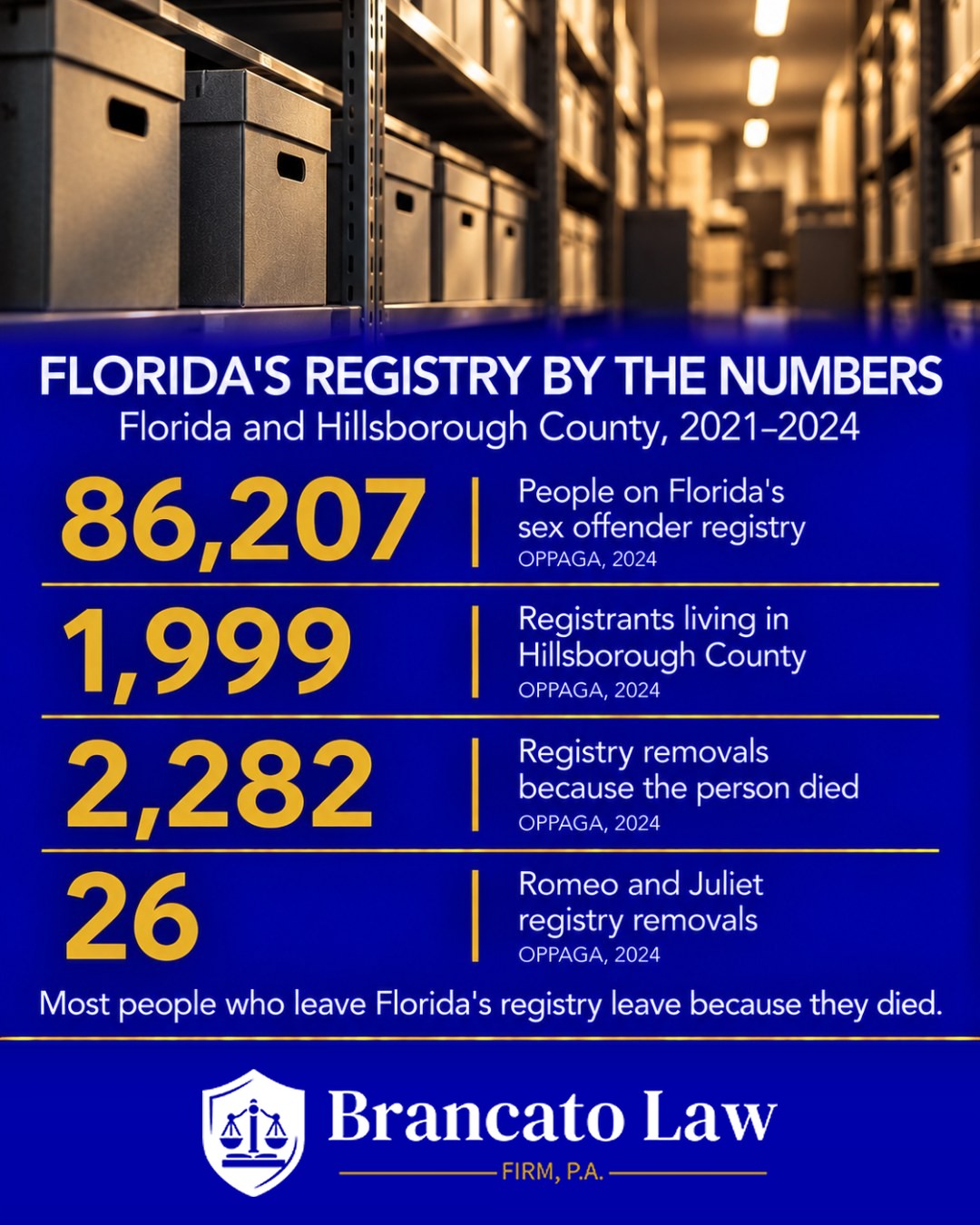
Relief under this law is rare. As of October 2024, Florida’s sex offender registry listed 86,207 people, and 1,999 registered sex offenders lived in Hillsborough County communities, according to the Florida Legislature’s Office of Program Policy Analysis and Government Accountability (OPPAGA) in Report 24-11 (2024). From October 1, 2021, through September 30, 2024, FDLE removed 2,554 people from the registry; 2,282 of them had died, and 26 were removed under the Romeo and Juliet law.
The pattern is older than that report. A Florida Senate Committee on Criminal Justice issue brief, Examine Florida’s “Romeo and Juliet” Law (September 2011), found that as of July 2011 courts had granted 241 petitions, 93% of them for a lewd or lascivious offense, and that the largest share of granted petitions, 24%, came from the 6th Judicial Circuit, which covers Pasco and Pinellas Counties. Our Romeo and Juliet registry removal guide explains how The Brancato Law Firm prepares the motion.
What does consent not cover in Florida?
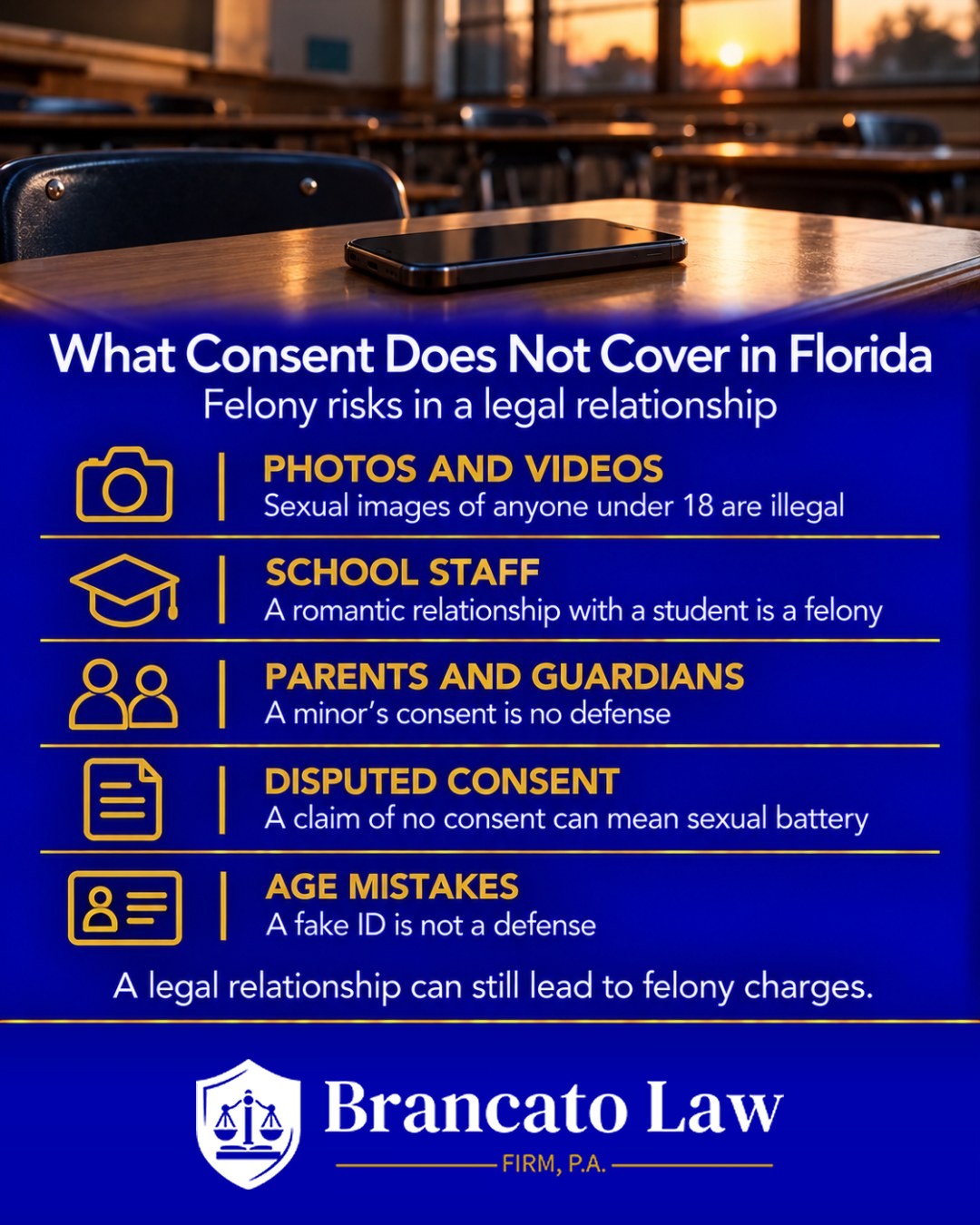
Consent between a 16- or 17-year-old and a partner under 24 answers only one question: whether section 794.05 applies. Six other rules can still lead to felony charges in a relationship that section 794.05 allows.
- Photos and videos. Section 827.071, Florida Statutes, defines a child as anyone under 18, so a sexual image of a 16- or 17-year-old is child sexual abuse material even when the relationship is legal. Possessing it is a second-degree felony, and each image is a separate offense. Our post on Florida pornography and age verification laws covers the image laws in more depth.
- Sending explicit images to a minor. Sending material harmful to minors to someone known to be under 18 can be charged under section 847.0138, Florida Statutes, a third-degree felony. Between two minors, section 847.0141, Florida Statutes, makes a first sexting violation a noncriminal violation, but images showing sexual conduct can still be prosecuted under other laws.
- School employees and volunteers. Under section 800.101, Florida Statutes, an adult employed by, volunteering at, or under contract with a school commits a second-degree felony by engaging in sexual conduct or “a relationship of a romantic nature” with a student. The statute defines a student as a person enrolled at a school, with no age limit. Our post on what happens when a teacher is arrested in Florida covers the career consequences.
- Parents, stepparents, and custodial adults. Under section 794.011(8), a person in “a position of familial or custodial authority” who engages in sexual battery with a 12- to 17-year-old commits a first-degree felony, and the minor’s willingness “is not a defense to prosecution.”
- Disputed consent. Consent in Florida means “intelligent, knowing, and voluntary consent.” If a 16- or 17-year-old says an act was not consensual, the accused can face a sexual battery charge under section 794.011(5)(a), a first-degree felony when the accused is 18 or older. Allegations like this sometimes surface after a parent learns about the relationship.
- Age mistakes. A fake ID or a dating-app profile showing 18 is not a defense under section 794.021 or section 800.04(3).
The Brancato Law Firm checks each of these statutes against the facts at the start of a case, because a relationship that falls outside section 794.05 can still be charged under one of them.
Is there a crime called statutory rape in Florida?
No. Florida’s criminal statutes do not use the term “statutory rape.” People use it to describe sex with someone under the age of consent, and in Florida that usually means one of three charges:
- Unlawful sexual activity with certain minors (section 794.05): a person 24 or older with a 16- or 17-year-old.
- Lewd or lascivious battery (section 800.04(4)): sexual activity with a 12- to 15-year-old, by anyone.
- Sexual battery (section 794.011): any sexual act with a child under 12, or with a person of any age who did not consent.
The label matters less than the statute on the charging document, because each one has different elements, penalties, and registration consequences. When someone tells us a detective mentioned “statutory rape,” our attorneys at The Brancato Law Firm first find out which statute the detective is working under and which dates and ages the State believes it can prove.
What should you do if a detective calls about a relationship with a teenager?
Do not agree to an interview, and call a defense lawyer before you say anything. We have seen the pattern many times: a detective calls and asks you to come in “just to talk,” keeps the tone friendly, and says something like “We know it was consensual. We’re not saying you forced her.” In a section 794.05 or section 800.04 case, consent is not a defense, so an admission that the relationship happened can supply most of the State’s case.
Most of these cases begin with interviews, not physical evidence, and an investigation can run for weeks before anyone is arrested. That window matters. Our representation before charges are filed can include speaking with the detective for you and presenting information to the State Attorney’s Office for the 13th Judicial Circuit before it decides whether to file. In sex cases involving teenagers, The Brancato Law Firm has had the State decline to file charges, as the results below show.
- Do not call, text, or message the other person or their family about the allegation.
- Do not delete anything. Save texts, photos, and records that show dates, because the charge depends on each person’s age on the date of each act.
- Do not post about the relationship or the investigation on social media.
- Write down the detective’s name, agency, and case number, and give them to your lawyer.
If an arrest has already happened in Hillsborough County, first appearance takes place within 24 hours at the Orient Road Jail, where bond and no-contact conditions are set. Our Hillsborough County criminal defense attorney page explains what comes next.
Real results in age-of-consent cases
| Allegation | Result |
|---|---|
| A 27-year-old accused of unlawful sexual contact with a 16-year-old | Dismissed after our social media investigation and the accuser’s inconsistent statements |
| Lewd or lascivious molestation and related charges; the alleged victim was 17 | No charges filed; the State issued a letter of release (2026) |
| A juvenile accused of sex offenses involving a younger child | Treatment-based agreement with a path to dismissal and no sex offender registration (2025) |
Past results do not guarantee future outcomes. More results are on our case results page.
Frequently Asked Questions About the Age of Consent in Florida
Can an unlawful sexual activity with a minor charge be dropped in Florida?
Yes. Prosecutors can drop or dismiss a section 794.05 charge when the proof of the act, the dates, or the ages does not hold up. The Brancato Law Firm had one such charge against a 27-year-old dismissed after a social media investigation exposed the accuser’s conflicting statements, and our sex crimes defense team handles these cases from investigation through trial.
Is it illegal for an 18-year-old to have sex with a 15-year-old in Florida?
Yes. Sexual activity with a 15-year-old is lewd or lascivious battery under section 800.04, a second-degree felony, regardless of consent. The Brancato Law Firm defends these charges by testing the dates and ages the State must prove, as our article on lewd and lascivious charges explains.
Can my parents press charges if I am 17 and my partner is 20?
Parents can report a relationship to police, but the State Attorney’s Office decides whether to file charges, and consensual sex between a 17-year-old and a 20-year-old does not violate section 794.05. The Brancato Law Firm steps in when a report like this turns into a claim that the sex was not consensual, which is a different and more serious charge, and our pre-file advocacy starts before any arrest.
Is it legal to send nude photos to a 17-year-old partner in Florida?
No. A sexual image of anyone under 18 is child sexual abuse material under section 827.071, and sending explicit images to a known minor can be charged under section 847.0138, even when the sexual relationship itself is legal. Our attorneys at The Brancato Law Firm defend image-based charges, which our post Is Porn Legal in Florida? covers further.
Does the Romeo and Juliet law apply to a section 794.05 conviction?
No. Section 943.04354 covers only convictions under sections 800.04, 827.071, and 847.0135(5), and the person must be no more than 4 years older than a minor who was 13 to 17. The Brancato Law Firm reviews whether another path, such as the 25-year petition under section 943.0435(11), is available; our page on Florida Romeo and Juliet registry removal explains who qualifies.
What if a 16-year-old said they were 18?
It is not a defense. Under section 794.021, ignorance of the minor’s age, a misrepresentation of age, or a good-faith belief that the person was older does not excuse the offense. The Brancato Law Firm still documents what the accused was told, because the circumstances can matter in negotiations with the prosecutor, as our post on ignorance of the victim’s age explains.
Can a teacher date an 18-year-old student in Florida?
No. Section 800.101 makes it a second-degree felony for a school employee, volunteer, or contractor 18 or older to engage in sexual conduct or a romantic relationship with a student, and it defines a student as a person enrolled at a school, with no age limit. The Brancato Law Firm defends educators accused under this statute, and our post on a teacher arrested in Florida covers the certification fallout.
Can two 15-year-olds be charged for having sex in Florida?
Yes. Section 800.04 applies to anyone who has sexual activity with a person 12 to 15, including another teenager, and the Florida Supreme Court allowed a juvenile prosecution of 15-year-olds in J.A.S. v. State. The Brancato Law Firm represents teenagers in juvenile court, where we push for outcomes such as treatment-based agreements that avoid sex offender registration.
Call before the first interview
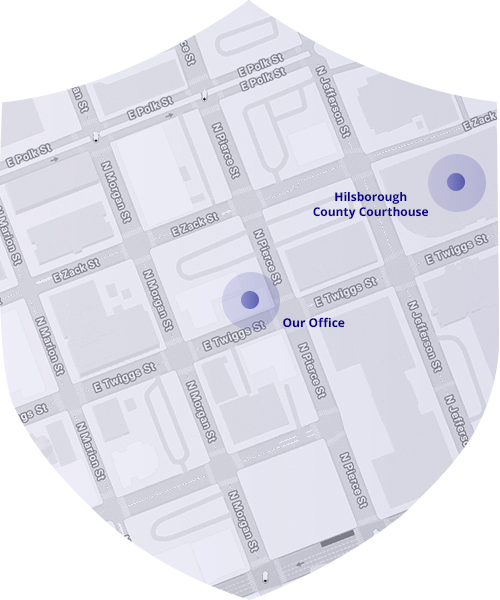
Detectives usually try to get a statement before the accused has a lawyer, so the best time to call is before any interview. The Brancato Law Firm, P.A., founded by Tampa Criminal Defense Attorney Rocky Brancato, can speak with the detective for you, preserve the messages and records that show dates and ages, and start building the defense right away. Call (813) 727-7159 for a free, confidential consultation. You can call us at any hour, and our office is two blocks from the courthouse. Our firm has Spanish-speaking staff, and attorney Jean-Luc Adrien speaks Spanish, Haitian Creole, and French. Read about our Spanish and Haitian Creole criminal defense services.
For more about our defense strategies, visit our Tampa Sex Crimes Lawyer page.
The Brancato Law Firm, P.A.
620 E. Twiggs Street, Suite 205, Tampa, FL 33602
(813) 727-7159
Serving Hillsborough, Pinellas, and Pasco Counties
The Brancato Law Firm, P.A. is a Tampa-based criminal defense practice. We are not affiliated with any other Brancato-named law firms.

Visit Us

Tampa, FL 33602
Contact Us Now
Free Legal Consultation (813) 727-7159