- Free Consultation 24/7: (813) 727-7159 Tap Here To Call Us


From First DUI to Death Penalty



Can a Medical Condition Be Mistaken for Child Abuse in Florida?


Updated October 2026
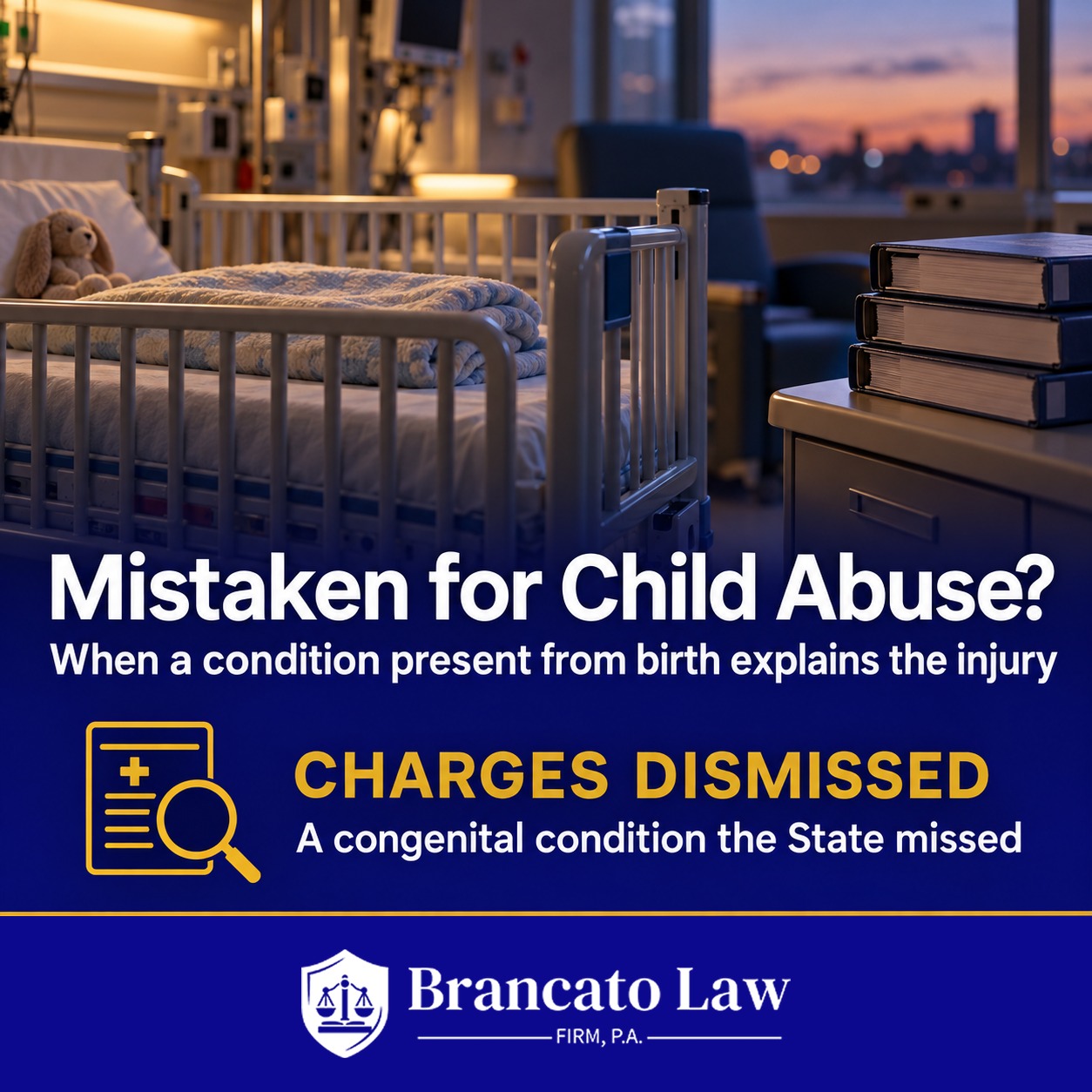
| Yes. Some medical conditions a child is born with, including bone, collagen, bleeding, and bile duct disorders, can produce injuries that look like abuse to a doctor who is seeing the child for the first time. In Florida, a Child Protection Team physician’s opinion that a child was abused is the start of the State’s case, and the defense can test it with the child’s complete medical history and an independent medical expert. Since July 1, 2026, a parent can also request a second medical opinion within 10 days of the exam under section 39.304, Florida Statutes. |
A condition present from birth can leave findings on a scan that look like the result of a blow from an adult. I saw that pattern as a trial attorney in the Major Crimes Unit of the Hillsborough County Public Defender’s Office, where I tried child abuse cases alongside homicide and sex crimes cases, and over my career I have tried more than 150 jury trials to verdict. I’m Rocky Brancato, founder of The Brancato Law Firm, P.A., a Tampa criminal defense firm, and our attorneys answer a Child Protection Team abuse finding with the child’s full medical record and an independent expert. This case study shows how that work ended in the dismissal of a young father’s aggravated child abuse charges.
What does a Child Protection Team do in a Florida child abuse investigation?
A Child Protection Team (CPT) is a medically directed team that evaluates children for the State during abuse and neglect investigations. Under section 39.303, Florida Statutes, the Children’s Medical Services Program in the Florida Department of Health develops and coordinates one or more teams in each Department of Children and Families (DCF) service circuit, and the teams supplement DCF’s investigation. DCF must refer certain reports to a CPT, including any report of fractures, head injuries, or burns in a child of any age and bruises anywhere on a child 5 or younger.
The same statute lists “expert medical, psychological, and related professional testimony in court cases” among the services a CPT provides, and it requires a DCF representative to attend every CPT case staffing involving a child. A parent should expect the CPT physician to be a witness for the State if the case reaches a courtroom. In Tampa, the USF Child Protection Team works out of Mary Lee’s House on North Armenia Avenue. When our firm is retained during an investigation, we read the CPT report as the first draft of the State’s medical case and begin testing it right away.
| Who | What they do | Florida law |
|---|---|---|
| Child Protection Team (Department of Health) | Medical evaluation, consultation, and court testimony | s. 39.303 |
| DCF child protective investigator | Investigates the report and decides on removal until a judge rules | Chapter 39 |
| Tampa PD, HCSO, or another police agency | Runs the criminal investigation | Chapter 827 |
| State Attorney’s Office | Decides whether to file criminal charges | Chapter 827 |
| Dependency court | Decides custody, starting with a shelter hearing | s. 39.402 |
| Criminal court | Decides guilt on charges such as aggravated child abuse | s. 827.03 |
Does a DCF child abuse investigation mean you will be charged?
Most Florida child abuse investigations do not end in a verified finding, and a verified finding is a separate question from a criminal charge. In state fiscal year 2023-24, DCF conducted 185,390 investigations statewide, and 8.3% ended with a most serious finding of “verified,” according to the Florida Department of Children and Families Results-Oriented Accountability 2024 Annual Performance Report. In DCF’s Circuit 13, which covers Hillsborough County, the verified rate was 9.3% that year.
A verified finding is DCF’s administrative conclusion. A criminal charge is a decision the State Attorney’s Office makes on its own, and a prosecutor must prove that charge beyond a reasonable doubt. Our attorneys work in the window between the two systems: the earlier we put medical evidence in front of a prosecutor, the better the chance a charge is never filed. That is the purpose of representation before charges are filed.
How was a young father accused of aggravated child abuse?
My client was a young father. His toddler daughter was hospitalized with a fractured pancreas, and a Child Protection Team doctor immediately concluded that he had caused it. Within hours, DCF removed the child from both parents. Within days, prosecutors opened an aggravated child abuse investigation, and DCF moved to terminate his parental rights. He was facing a criminal case and a dependency case at the same time.
Aggravated child abuse under section 827.03, Florida Statutes, includes knowingly or willfully abusing a child and causing great bodily harm, permanent disability, or permanent disfigurement. It is a first-degree felony, punishable by up to 30 years in prison under section 775.082, Florida Statutes. Our Tampa child abuse attorney page explains the full range of child abuse and neglect charges and how our firm defends them.
Why did the State’s medical theory not fit this family?
The State’s theory did not match anything else in this family’s life. There were no prior incidents, no red flags in the home, and no history of violence. The CPT doctor had reached a conclusion anyway, and the reason is worth understanding.
Pediatric medical literature treats a pancreatic injury in a young child as a warning sign. A 2008 article in Pediatric Emergency Care, Pancreatic Injury: Accidental or Nonaccidental by Muhammad Waseem and Orlando Perales, states that pancreatic and duodenal injuries “are considered specific for abuse.” A doctor trained on that literature who sees a toddler with a damaged pancreas will suspect abuse first. That is exactly why the rest of the child’s medical history matters so much.
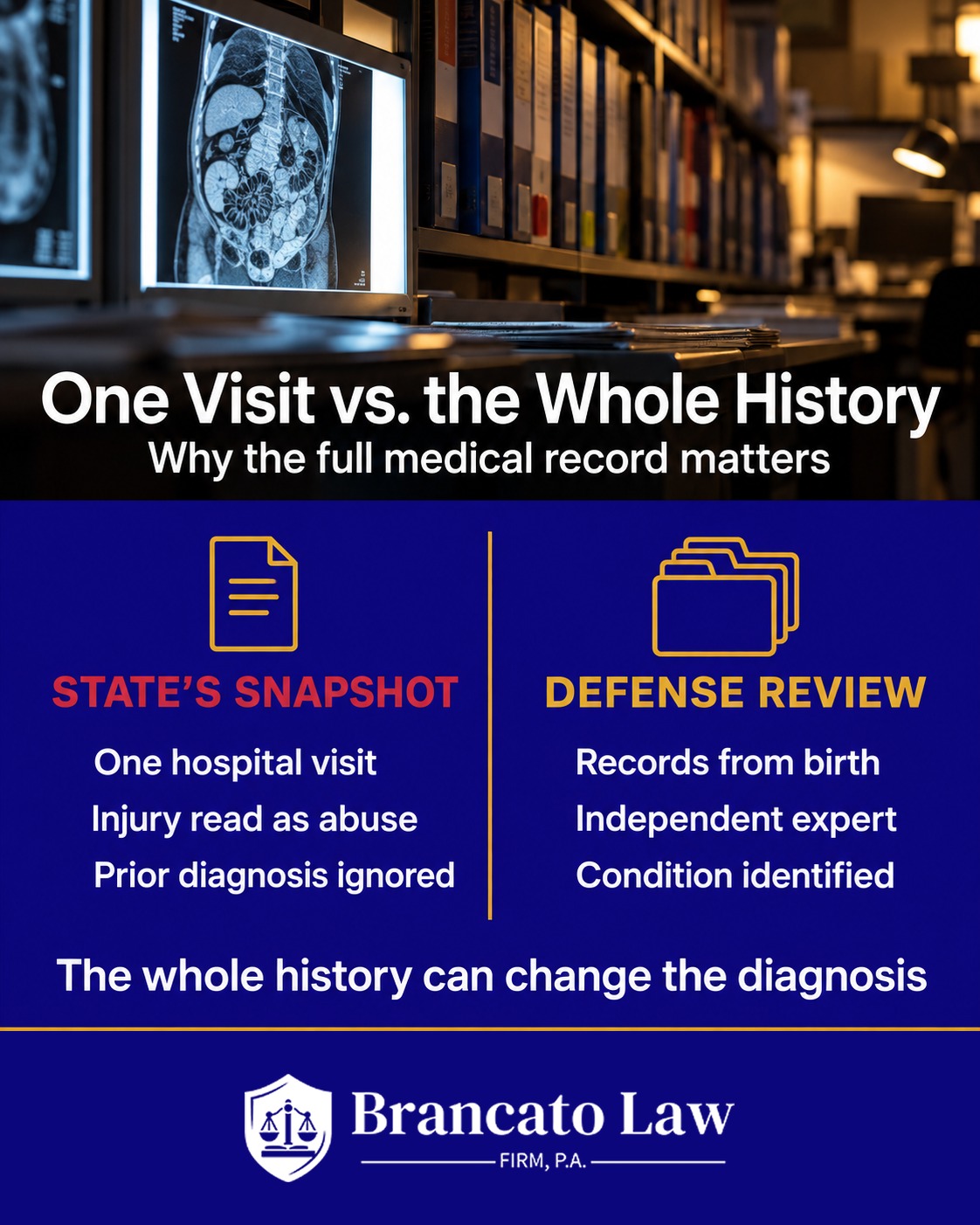
In our experience with Hillsborough County cases, the State’s discovery usually includes the records from the most recent hospital visit and little else, and the CPT opinion is often built on that single visit. So I reviewed every record that existed for this child, from birth to the present: specialist visits, test results, surgical notes, and radiology reports. That review took months. I then retained a forensic pathologist with experience testifying in complex abuse cases, someone who could separate inflicted trauma from natural disease.
What did the defense expert find?
The forensic pathologist identified a congenital choledochal cyst, a rare malformation of the bile duct that is present from birth. The CPT doctor had missed it. Our expert determined that the cyst played a direct role in the child’s injury. The family already knew about the condition, and the State’s doctors had ignored it as a possible cause.
Published research confirms that this condition reaches the pancreas. In a 2017 multicenter study in the Journal of Paediatrics and Child Health, Acute Pancreatitis Complicating Choledochal Cysts in Children by S. King and colleagues, 17 of 49 children with a choledochal cyst (35%) presented with acute pancreatitis. The authors concluded that “pancreatitis was a common presentation in children with a choledochal cyst.”
Florida law singles out only a few conditions for a mandatory specialist consult. Section 39.303(4) requires a CPT to consult a physician or advanced practice registered nurse experienced with rickets, Ehlers-Danlos syndrome, osteogenesis imperfecta, or vitamin D deficiency when a child has a reported preexisting diagnosis of one of them. A bile duct malformation is not on that list, so in a case like this one the defense has to bring the specialist knowledge itself.
How did the defense work lead to a dismissal?
The dismissal came from building the medical record the State never built. Our defense work in this case included:
- Deposing nearly every treating physician across multiple Florida hospitals.
- Traveling to a specialized hospital in Pennsylvania to obtain additional records.
- Working with the forensic pathologist, who prepared me for depositions, reviewed the transcripts, and helped develop the trial strategy.
After one deposition, the State’s lead doctor contacted the State Attorney’s Office and told them they should hire me. It was an unusual call for the State’s own witness to make, and it told me the medical case against my client had come apart. All aggravated child abuse charges were dismissed, and my client was no longer facing 30 years in prison.
| Case detail | Result |
|---|---|
| Charge investigated | Aggravated child abuse, s. 827.03, first-degree felony (up to 30 years) |
| State’s theory | A Child Protection Team doctor concluded the father caused his toddler’s fractured pancreas |
| Defense finding | A congenital choledochal cyst, present from birth, played a direct role in the injury |
| Defense work | Records from birth reviewed, forensic pathologist retained, treating physicians deposed across multiple Florida hospitals, additional records obtained from a specialized hospital in Pennsylvania |
| Outcome | All aggravated child abuse charges dismissed |
Past results do not guarantee future outcomes.
Which medical conditions can be mistaken for child abuse?
Bone, collagen, and bleeding disorders are the conditions most often confused with abuse, and rare congenital malformations like a choledochal cyst belong on the same list. The American Academy of Pediatrics clinical report The Evaluation of Suspected Child Physical Abuse, by Cindy W. Christian and the AAP Committee on Child Abuse and Neglect, Pediatrics, Volume 135, Number 5 (2015), tells physicians that “there are diseases that can be mistaken for child abuse.” The same report says that identifying conditions affecting collagen or bone mineralization “reduces false accusations of abuse.”
| Condition | Why it can look like abuse | Source |
|---|---|---|
| Osteogenesis imperfecta | Fragile bones that fracture with ordinary handling | s. 39.303(4); AAP report (2015) |
| Rickets or vitamin D deficiency | Weak bone mineralization and fractures | s. 39.303(4); AAP report (2015) |
| Ehlers-Danlos syndrome | A collagen disorder linked to easy bruising | s. 39.303(4) |
| Bleeding disorders | Bruising or bleeding after minor contact | AAP report (2015) |
| Choledochal cyst | A bile duct malformation present from birth that can involve the pancreas | King et al. (2017); this case |
Our firm’s Tampa criminal forensic science attorney page describes the experts we work with on medical causation, and our post on medical opinion in Tampa child abuse cases covers the problems that recur in CPT testimony.
What do Florida courts say about defense medical experts in child abuse cases?
Florida appellate courts have ordered new trials in child injury and death cases when the jury never heard a qualified defense expert on causation. Two decisions show how.
In Council v. State, 98 So. 3d 115 (Fla. 1st DCA 2012), a man convicted of aggravated child abuse argued that the trial judge wrongly excluded his biomechanics expert, who would have testified that a fall from a day bed could cause the child’s brain injury and that shaking alone could not. The First District held that excluding the expert was an abuse of discretion because the testimony rebutted the State’s medical opinion that the injuries were consistent only with non-accidental trauma, and it ordered a new trial. The lesson: when the State’s case rests on a medical opinion, the defense is entitled to put a qualified causation expert in front of the jury.
In Spurgeon v. State, 298 So. 3d 726 (Fla. 2d DCA 2020), a licensed home daycare provider in Pinellas County was convicted of manslaughter after a one-year-old in her care suffered fatal brain injuries. Her trial lawyer’s experts answered a shaking theory the State never argued, and no expert told the jury that the State’s actual theory, repeated soft impacts, was not feasible. The Second District held that this was ineffective assistance of counsel and ordered a new trial. The lesson: the defense expert has to answer the State’s actual medical theory.
Florida admits expert opinions under section 90.702, Florida Statutes, only when the testimony rests on sufficient facts or data and reliable methods, reliably applied. Our attorneys use that standard in both directions: to qualify our experts and to challenge a CPT opinion that was formed without the child’s full history. Our article on why expert witnesses are not optional in major crimes cases explains how we choose and prepare them.
How do you challenge a Child Protection Team finding in Florida?
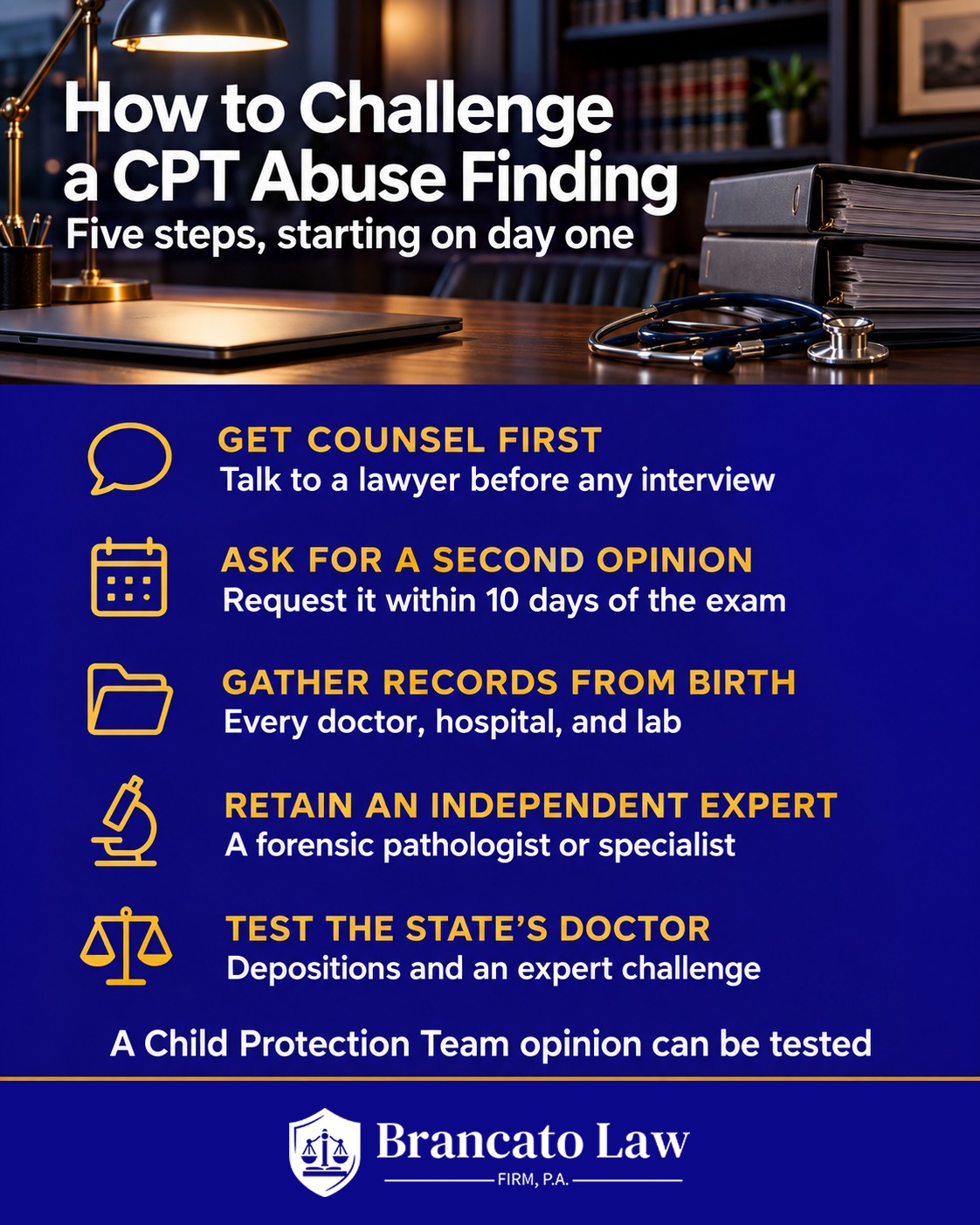
A Child Protection Team finding is challenged with medicine, on a deadline. These are the steps our firm takes, and the steps a parent can start on the first day:
- Talk to a criminal defense lawyer before any interview. Under section 39.204, Florida Statutes, spousal, doctor-patient, and therapist privileges do not protect communications involving the person accused of child abuse, and the attorney-client privilege still does. Our post on privileged communication in Florida child abuse cases explains what that means for what you say and to whom.
- Request a second medical opinion within 10 days. Since July 1, 2026, section 39.304, Florida Statutes, lets the parent or legal custodian of a child in a protective investigation or under a shelter order ask DCF, within 10 days after the medical examination, for another exam. If a CPT did not perform the first exam, the parent can ask for a CPT exam. If a CPT did perform it, the parent can choose a physician or advanced practice registered nurse who routinely treats children. A parent can also choose a specialist in the four conditions listed in section 39.303(4) to consider a differential diagnosis. The parent pays, including through insurance. The right does not cover exams for alleged sexual abuse.
- Collect the child’s records from birth. Every pediatrician, specialist, hospital, and lab, in Florida and out of state.
- Retain an independent expert. A forensic pathologist or the right pediatric subspecialist reviews the records, the imaging, and the CPT report.
- Depose the treating physicians and the CPT doctor. Treating doctors often know the child’s history better than the CPT physician who saw the child once.
- Test the State’s expert under section 90.702. An opinion formed without the child’s history is open to challenge on sufficient facts or data and reliable application.
Under section 39.304, the second examiner must deliver a written report within 10 days, and if the medical opinions conflict, DCF must convene a case staffing to resolve the differences. A parent who uses this right early gives the defense a second medical opinion before the State’s theory hardens.
How fast does a Florida child abuse case move?
A Florida child abuse case moves in hours and days, and the earliest deadlines arrive before most families have hired a lawyer. In this case, DCF removed the child within hours and prosecutors opened a criminal investigation within days.
| When | What happens | Florida law |
|---|---|---|
| Within hours | A child protective investigator can place the child in shelter | s. 39.402 |
| Within 24 hours | The child cannot stay in shelter longer than 24 hours without a court order entered after a shelter hearing | s. 39.402(8)(a) |
| At the shelter hearing | Parents have the right to counsel and can ask for a continuance of up to 72 hours to consult a lawyer | s. 39.402 |
| Within 10 days of the medical exam | Deadline for a parent to request a second examination | s. 39.304(1)(c) |
| Within 10 days of the second exam | The second examiner’s written report is due | s. 39.304 |
| Days to weeks | Police and the State Attorney’s Office decide whether to file criminal charges | Chapter 827 |
Our firm defends the criminal case. The dependency case is a separate civil proceeding in which the parent needs dependency counsel, and both defenses should be built on the same medical evidence. Call us at any hour if a CPT exam or a DCF interview is scheduled.
What did this case teach me?
This case confirmed that a single medical opinion, formed early, can drive an entire prosecution. Even with every charge dismissed, my client will likely always remember being labeled a child abuser, losing custody of his daughter for a time, and facing doubt from family, friends, and strangers. Without the right expert asking the right questions, an innocent father could have gone to prison. Our firm defends every child abuse case with that in mind.
Frequently asked questions
Can aggravated child abuse charges be dropped in Florida if the injury had a medical cause?
Yes. Aggravated child abuse charges can be dropped or dismissed when the medical evidence shows a natural or congenital cause, as happened in this case. The Brancato Law Firm builds that evidence through records from birth, depositions, and an independent expert, the approach described in our guide to defending child abuse charges in Tampa.
What is a choledochal cyst, and can it affect a child’s pancreas?
A choledochal cyst is a rare malformation of the bile duct that is present from birth, and published research links it to pancreatitis in children. In the case described here, our attorneys at The Brancato Law Firm relied on a forensic pathologist who found that the cyst played a direct role in the child’s injury. In a 2017 study, 35% of children with a choledochal cyst presented with acute pancreatitis, according to Acute Pancreatitis Complicating Choledochal Cysts in Children.
Can I get a second medical opinion after a Child Protection Team exam in Florida?
Yes. Since July 1, 2026, a parent of a child in a protective investigation or under a shelter order can ask DCF, within 10 days after the exam, for a second examination by a pediatric physician or nurse practitioner of the parent’s choosing, at the parent’s expense, under section 39.304, Florida Statutes. When a family calls The Brancato Law Firm inside that window, we help identify the right specialist before the deadline passes.
Should I talk to DCF or a Child Protection Team doctor before hiring a lawyer?
You should speak with a criminal defense lawyer first, because what you say to a child protective investigator or a CPT can be used in a criminal case. The Brancato Law Firm advises parents before those interviews as part of our pre-file advocacy work.
Does a Child Protection Team doctor testify for the prosecution in Florida?
Often, yes: section 39.303 lists expert medical testimony in court cases among the services a Child Protection Team provides, so the CPT physician who examined the child is frequently the State’s key medical witness. Our attorneys at The Brancato Law Firm depose that physician and the child’s treating doctors well before trial.
What is the penalty for aggravated child abuse in Florida?
Aggravated child abuse is a first-degree felony in Florida, punishable by up to 30 years in prison under section 827.03, Florida Statutes, and section 775.082. The Brancato Law Firm treats every aggravated child abuse investigation as a potential 30-year case and starts the medical review accordingly.
More case studies from our forensic series
- DNA Evidence Defense
- Case Study: Forensic Pathologist Expert Witness
- Fingerprint Evidence Is Not as Reliable as You Think
- Cell Phone Location Data Can Prove You Were Not There
- When Brain Damage Explains Criminal Conduct
- Your BAC at the Station Is Not Your BAC Behind the Wheel
- When Police Destroy Evidence They Do Not Get the Benefit of the Doubt
- When a Confession Is Not a Confession
- When the Car, Not the Driver, Caused the Crash
- The Injuries Were Real, But They Were Not From the Alleged Rape
- Similar Is Not the Same: How a Firearms Expert Kept Out Prejudicial Evidence
Related practice pages: Tampa Murder Attorney and Tampa Sex Crimes Attorney.
Talk to a lawyer before the next interview
Before you answer more questions from a child protective investigator or bring your child back for a Child Protection Team exam, call a criminal defense lawyer. The Brancato Law Firm, P.A. was founded by Tampa Criminal Defense Attorney Rocky Brancato, and our attorneys start with the child’s medical history, the CPT report, and the 10-day window to request a second opinion. Call (813) 727-7159; we are available 24/7. For more about our defense strategies, visit our Child Abuse Defense practice area page.
The Brancato Law Firm, P.A.
620 E. Twiggs Street, Suite 205, Tampa, FL 33602
(813) 727-7159
Serving Hillsborough, Pinellas, and Pasco Counties
The Brancato Law Firm, P.A. is a Tampa-based criminal defense practice. We are not affiliated with any other Brancato-named law firms.
Visit Us

Tampa, FL 33602
Contact Us Now
Free Legal Consultation (813) 727-7159