- Free Consultation 24/7: (813) 727-7159 Tap Here To Call Us


From First DUI to Death Penalty



How Does the Entrapment Defense Work in Florida? (2026)


Rewrite/update date: November 3, 2026. Originally published in January 2025.
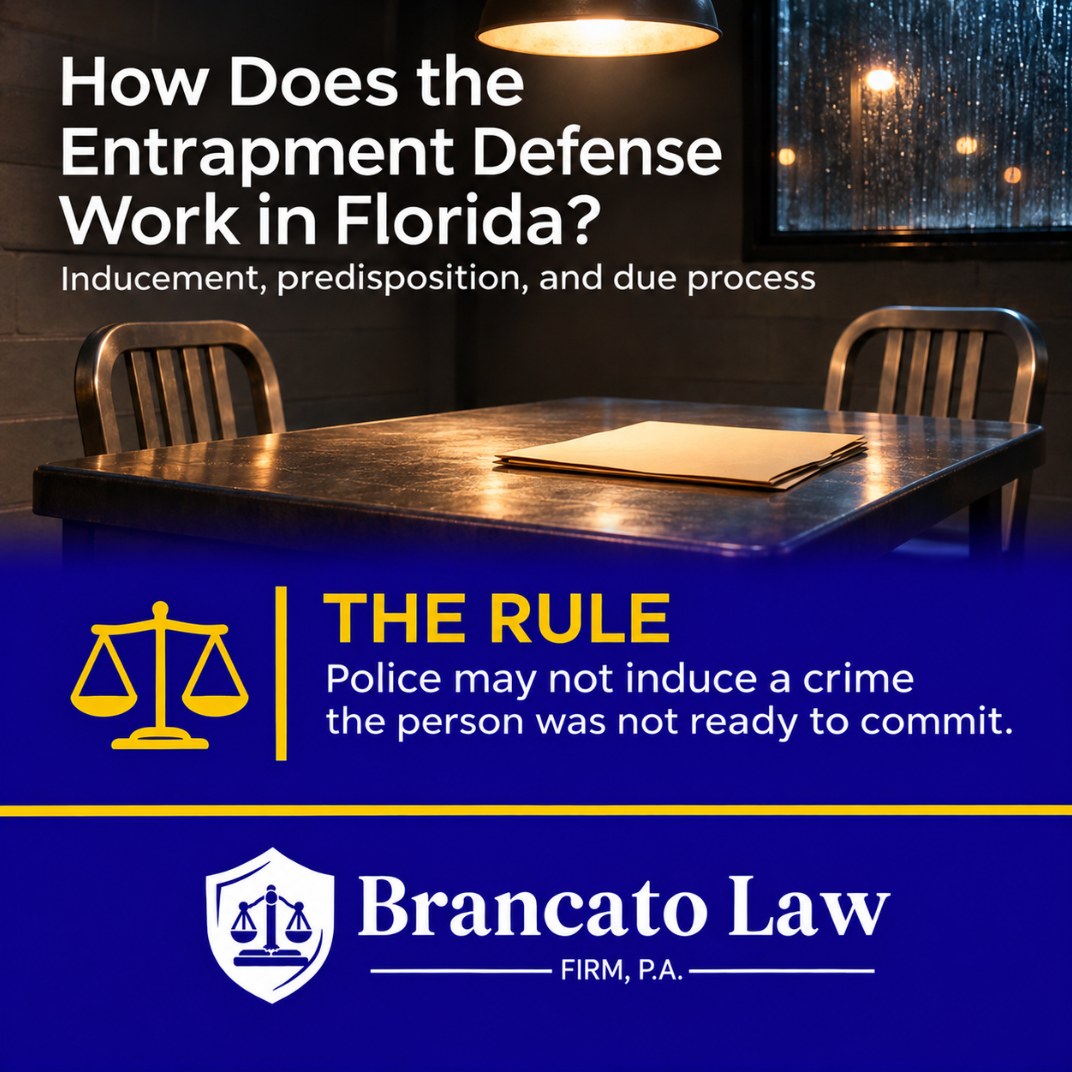
| The entrapment defense in Florida lets a jury acquit, or a judge dismiss, when police or their agents persuaded a person to commit a crime that person was not already ready to commit. Under section 777.201, Florida Statutes, the accused must first show that law enforcement induced the crime; the State then must prove beyond a reasonable doubt that the person was predisposed to commit it before police got involved. Separately, police conduct so outrageous that it violates due process can bar a prosecution no matter what the defendant was inclined to do. |
If you were arrested after days of messages with someone who turned out to be an undercover deputy, the first thing our attorneys look at is who pushed the conversation toward a crime. I’m Rocky Brancato, founder of The Brancato Law Firm, P.A., a Tampa criminal defense firm, and a former police academy instructor who taught officers how investigations are supposed to be run. I have tried more than 150 jury trials to verdict, and our attorneys use that experience to take sting operations apart message by message, from the first contact to the arrest.
What is entrapment under Florida law?
Entrapment happens when a law enforcement officer, or someone working with or for one, induces or encourages a person to commit a crime using methods that create “a substantial risk that such crime will be committed by a person other than one who is ready to commit it.” That is the definition in section 777.201, Florida Statutes. The statute covers informants and civilians acting as police agents, not only sworn officers.
Under the same statute, a person “shall be acquitted” if he or she proves by a preponderance of the evidence that the criminal conduct occurred as a result of an entrapment. Preponderance means more likely than not, a lower bar than the State’s burden of proof beyond a reasonable doubt. The statute also says the issue “shall be tried by the trier of fact,” which is usually the jury. At The Brancato Law Firm, we treat entrapment as a defense to build from the first day, because the evidence that proves it, the messages and the officer’s choices, is fixed the moment the investigation ends.
What are the two kinds of entrapment in Florida?
Florida recognizes two separate entrapment defenses: subjective entrapment, which is the statutory defense, and objective entrapment, which comes from the due process clause of the Florida Constitution. The first asks about the defendant; the second asks only about the police. Our attorneys raise both whenever the facts support them, because they fail and succeed for different reasons.
| Subjective entrapment | Objective entrapment | |
|---|---|---|
| Source | Section 777.201, Florida Statutes | Due process clause, Article I, Section 9, Florida Constitution |
| Main question | Was the defendant ready to commit the crime before police got involved? | Was the police conduct so outrageous that no conviction should stand? |
| Defendant’s history matters? | Yes. The State may use prior conduct to prove predisposition. | No. The focus is on what law enforcement did. |
| Who decides | Usually the jury; the judge when the key facts are undisputed | The judge, as a question of law |
| Result if it succeeds | Acquittal, or dismissal before trial | Dismissal; the prosecution is barred |
How does a Florida court decide subjective entrapment?
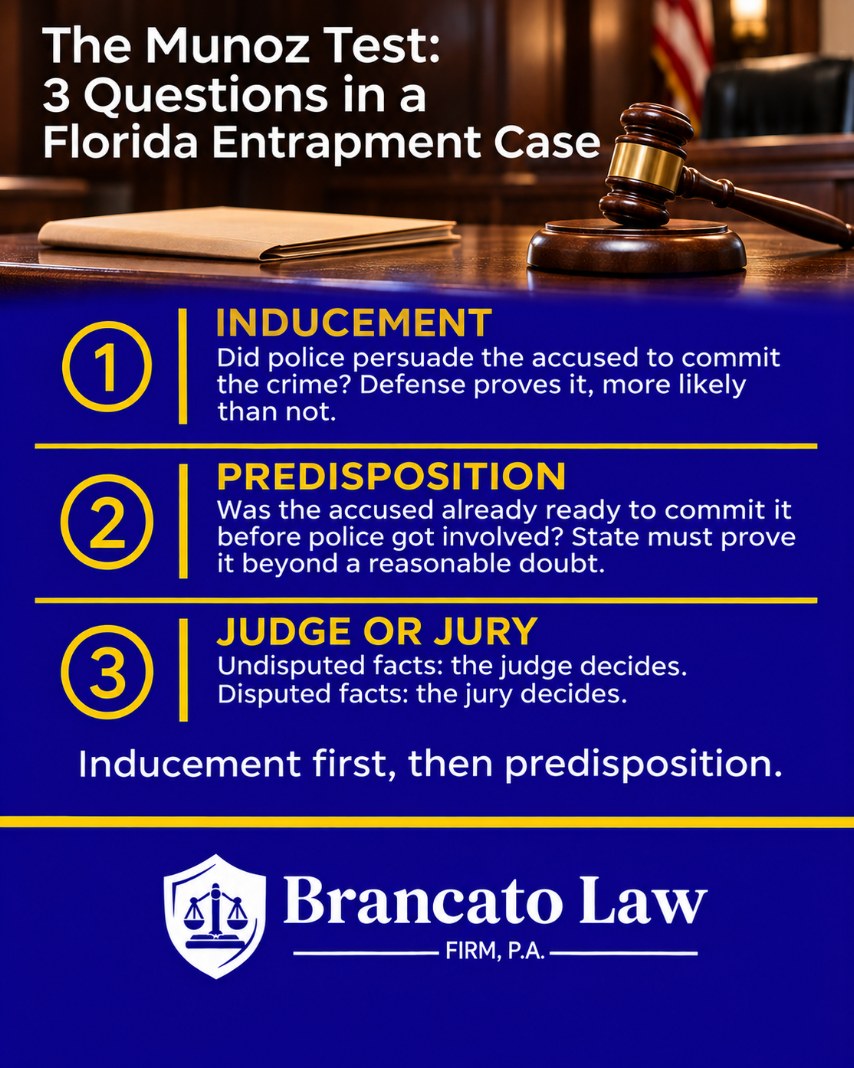
A Florida court decides subjective entrapment by asking three questions, set out by the Florida Supreme Court in Munoz v. State, 629 So. 2d 90 (Fla. 1993). In Munoz, the Court read section 777.201 as adopting the subjective test and set the order of proof that Florida trial judges still follow today.
- Inducement. Did a government agent induce the accused to commit the charged crime? The defense must prove this by a preponderance of the evidence.
- Predisposition. If there was inducement, was the accused already “awaiting any propitious opportunity or was ready and willing, without persuasion, to commit the offense”? Once the defense produces evidence of no predisposition, the burden shifts to the State to rebut it beyond a reasonable doubt.
- Judge or jury. If the facts are undisputed, inducement is shown, and the State lacks enough evidence of predisposition formed before and independent of the police conduct, the judge must rule for the defense as a matter of law. If the facts are disputed, or reasonable people could draw different conclusions, the jury decides.
The third question is where many sting cases are won or lost. When every message is preserved and the record shows the officer doing the persuading, our attorneys at The Brancato Law Firm ask the judge to decide entrapment before a jury is ever picked.
What counts as police inducement?
Police inducement means persuasion that goes beyond offering a chance to commit a crime: repeated pleading, pressure on a reluctant person, appeals to sympathy or friendship, promises of reward, or taking the lead in introducing the illegal idea. Florida courts draw a firm line between inducement and opportunity. In the words the Second District repeated in 2023, “creating nothing more than an opportunity to commit a crime is not prohibited.”
| Usually only an opportunity | Can be inducement |
|---|---|
| An undercover officer answers an ad the person posted | The officer starts the contact and steers an adult conversation toward a minor |
| A single offer that the person accepts right away | Repeated urging after the person says no or changes the subject |
| The person supplies the details and makes the plan | The officer supplies the plan, the place, and the specifics |
| Neutral replies to the person’s requests | Calling the person scared, guilt, flattery, or emotional appeals to overcome hesitation |
| A fair market price in a drug deal | Extraordinary rewards or favors the person could not get elsewhere |
These are the patterns our attorneys look for when we read a chat log or listen to an informant’s recorded calls. A single message where the person backs away can matter more than fifty messages of small talk. When an informant is involved, we also look at what the informant was promised, which our post on whether the State has to reveal a confidential informant explains in more detail.
How do prosecutors try to prove predisposition?
Prosecutors try to prove predisposition with evidence that the accused was ready to commit the crime before police ever got involved, such as prior similar conduct, earlier messages, or eagerness at the first opportunity. Under Munoz, the State may make “an appropriate and searching inquiry” into the accused’s conduct and may even use prior criminal history that would normally be kept from a jury. But that evidence counts only to the extent it shows predisposition “both prior to and independent of the government acts.”
That limit matters. Statements a person makes after an officer spent days wearing down his resistance are weak proof of what he was inclined to do before the officer appeared. Munoz also said a judge may rule entrapment as a matter of law even when the State presents prior convictions. Our attorneys at The Brancato Law Firm separate the record into what the client said before inducement and what he said after it, and we build the predisposition argument around that timeline.
When does police misconduct violate due process?
Police misconduct violates due process, and bars the prosecution entirely, when law enforcement’s methods are so outrageous that a court will not let the case go forward regardless of the defendant’s predisposition. Munoz held that section 777.201 replaced the older objective test, but it preserved this due process defense for “egregious law enforcement conduct.” Two Florida Supreme Court decisions show what that looks like.
In State v. Glosson, 462 So. 2d 1082 (Fla. 1985), an informant was promised 10 percent of the civil forfeitures from the cases he developed, and he had to testify and cooperate in the prosecutions to get paid. The Court held that a trial court may dismiss charges on due process grounds when an informant stands to gain a contingent fee conditioned on testimony that is critical to the prosecution.
In State v. Williams, 623 So. 2d 462 (Fla. 1993), the Broward County Sheriff’s Office turned seized powder cocaine into crack cocaine for reverse-sting operations, and some of it was lost into the community. The Court held that illegally manufacturing crack for a reverse sting within 1,000 feet of a school violated due process and reversed the conviction. Cases like these are rare, and our attorneys raise objective entrapment only when the record supports it, because judges take the claim seriously only when it is precise.
How does entrapment work in online sting cases?
Online sting cases are where Florida’s entrapment law is most often tested, because the entire conversation between the officer and the accused is usually preserved word for word. Charges in these cases typically include using a computer to solicit a minor and traveling to meet a minor under section 847.0135, Florida Statutes; the traveling charge is a second-degree felony. The statute applies even when the “child” is an adult officer, because it covers a person “believed by the person to be a child.”
The volume of these cases is large. In 2025, Internet Crimes Against Children task forces conducted nearly 347,000 investigations and arrested more than 17,000 people nationw
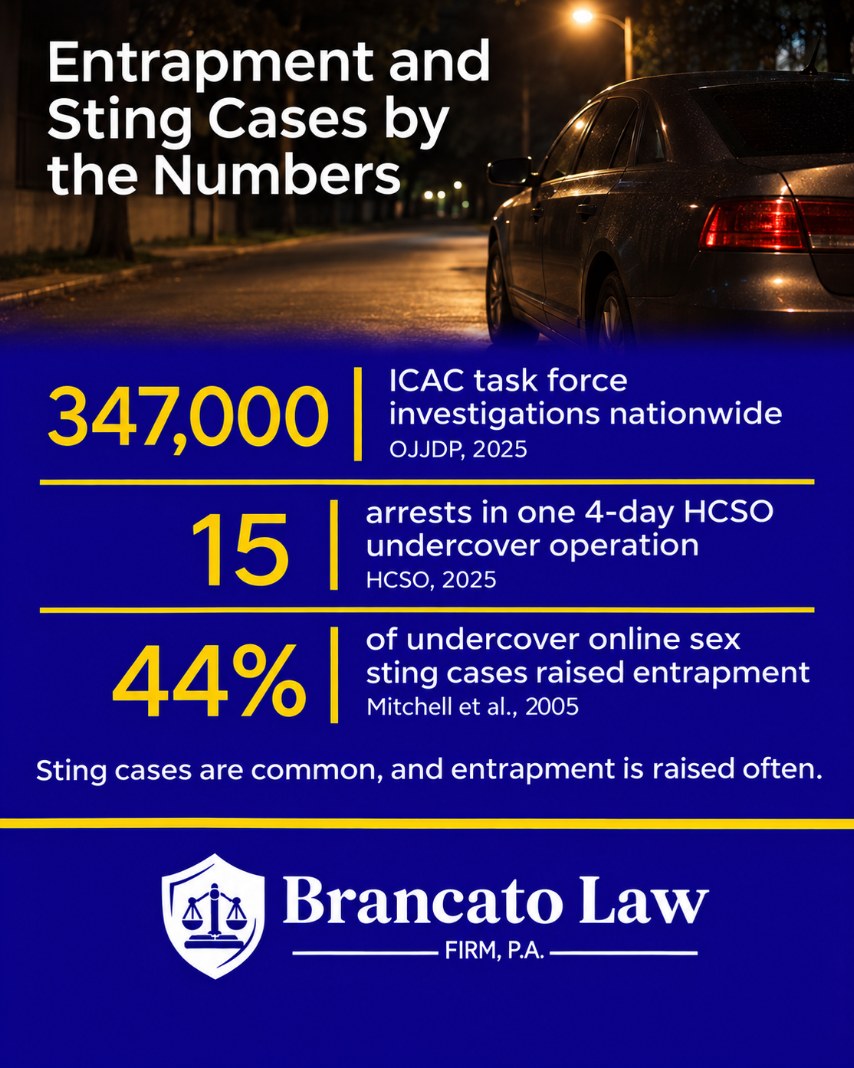
Entrapment is a common response to these charges, and research shows it rarely wins by itself. A national study published in 2005 in Sexual Abuse: A Journal of Research and Treatment, based on 2000 to 2001 case data, found that entrapment or police conduct was raised in 44 percent of undercover “proactive” cases, compared with 4 percent of cases involving real child victims. The same study found that 4 percent of offenders arrested in undercover cases had prior arrests for sexual offenses against minors, compared with 11 percent in real-victim cases, and the authors described the entrapment defenses they saw as common but not successful (Mitchell, Wolak, and Finkelhor, Crimes Against Children Research Center). That gap in prior records is why predisposition, not the raw fact of the sting, is usually the fight.
How DeMare v. State drew the line on adult-profile stings
In DeMare v. State, 298 So. 3d 1269 (Fla. 2d DCA 2020), a detective created a profile of an 18-year-old woman named “Amber” in the adult section of a dating site. Jason DeMare answered that adult profile. After four days of flirting as an adult, “Amber” said she was 14. DeMare immediately tried to end it and said sex would be illegal. The detective kept pressing: she said she liked older men, said her parents were out of town, accused him of being scared, and coaxed him for details. He had no record of offenses against minors.
The Second District Court of Appeal, which hears appeals from Hillsborough, Pinellas, and Pasco Counties, held that DeMare was entrapped as a matter of law, reversed his conviction for traveling to meet a minor, and ordered him discharged. The lesson is that an adult-profile start, a late age reveal, a clear refusal, and persistent police pressure can add up to entrapment that a judge must recognize without sending the case to a jury.
The same court has also shown the limits. In State v. Panebianco, 370 So. 3d 345 (Fla. 2d DCA 2023), a Sarasota County judge dismissed charges against a man who answered a 19-year-old’s profile but was told early and repeatedly that she was 14. The Second District reversed. It agreed he had shown a lack of predisposition, since he had no record of offenses against minors, but held that his own sexual messages created a question of predisposition for a jury, and that the operation was not outrageous enough to be objective entrapment. Our attorneys read every message with these two cases side by side. For more on the charges themselves, see our guides to solicitation of a child using a computer, what happens after a Tampa sex sting arrest, and what to do if you messaged a minor online.
Can entrapment get charges dismissed before trial?
Yes. Entrapment can end a case before trial through a sworn motion to dismiss under Florida Rule of Criminal Procedure 3.190(c)(4), which allows dismissal when “there are no material disputed facts and the undisputed facts do not establish a prima facie case of guilt.” The State can defeat that motion by showing a real factual dispute, and on the motion the judge reads the evidence in the light most favorable to the State.
In Hillsborough County, in our firm’s experience, prosecutors contest nearly every entrapment motion in a sting case, and the decision to file one can change the plea discussions already underway. That makes timing a strategic call, not a formality. Losing the motion also does not end the defense. Because the statute sends entrapment to the trier of fact, the same evidence can be argued to a jury at trial, and jurors may weigh the officer’s persistence differently than a judge reading a cold transcript. Our Hillsborough County criminal defense team plans for both stages from the start.
| Stage | What the defense does | Who decides |
|---|---|---|
| Investigation, before charges | Preserve the full message history; stop all contact; get counsel | Prosecutor decides whether to file |
| Motion to dismiss, Rule 3.190(c)(4) | Sworn motion setting out undisputed facts of inducement and lack of predisposition | Judge |
| State’s response (traverse) | State identifies disputed facts or predisposition evidence | Judge decides whether a factual dispute exists |
| Trial | Entrapment evidence and argument presented to the jury | Jury |
| Appeal | Argue entrapment as a matter of law on the undisputed record | Second District Court of Appeal |
What should you do if you think police entrapped you?
If you think police entrapped you, stop all contact, say nothing to investigators, and get a defense attorney before the case is charged or before your first court date. The steps below protect the evidence that an entrapment defense depends on.
- Do not answer more messages from the account, and do not try to explain yourself to it.
- Do not delete anything. Deleting messages can look like consciousness of guilt and can lead to a separate tampering charge; the full thread is often your best evidence.
- Write down, privately and for your lawyer only, how the contact started and when the other person first raised anything illegal.
- Decline any interview. Politely say you want a lawyer, then stop talking.
- Call a defense attorney right away. If you believe you are under investigation but have not been charged, our representation before charges are filed can sometimes shape what the prosecutor decides.
Frequently asked questions about the entrapment defense in Florida
Is it entrapment if the officer pretended to be an adult first?
It can be. In DeMare, the Second District found entrapment as a matter of law where the officer posed as an 18-year-old, revealed a younger age days later, and kept pushing after the man refused. The Brancato Law Firm compares the timing of the age reveal and the officer’s pressure in every sting case we take, as our guide to vigilante predator catchers also discusses for civilian stings.
Who has the burden of proof for entrapment in Florida?
The defense must first prove inducement by a preponderance of the evidence, and must offer some evidence of lack of predisposition. The burden then shifts to the State to prove predisposition beyond a reasonable doubt under Munoz and section 777.201. Our attorneys at The Brancato Law Firm gather the background evidence, such as a clean record and the client’s history, that triggers that shift.
Does a prior criminal record defeat an entrapment defense?
Not automatically. Prosecutors may use prior conduct to argue predisposition, but Munoz said a judge may still find entrapment as a matter of law even when the State presents prior convictions, and the evidence must show predisposition formed before and independent of the police conduct. At The Brancato Law Firm, we look at whether a prior record has anything to do with the crime the officer was pushing.
Can entrapment charges be dropped in Florida?
Yes. Prosecutors can drop charges when the evidence of inducement is strong, and a judge can dismiss them on a successful motion. Our Tampa internet crimes defense attorneys present the inducement record to the prosecutor early when that gives the client the best chance at a dismissal or a reduced charge.
Is it entrapment if police only gave me the chance to commit a crime?
No. Florida courts hold that creating an opportunity to commit a crime is not entrapment; there must be persuasion or pressure that overcame a person who was not ready to commit it. The Brancato Law Firm looks for the moment the conversation turned and who turned it, because that is usually where the defense lives.
Can I raise entrapment if I have not been charged yet?
Entrapment is a defense raised in court, but the groundwork starts during the investigation, when the messages can be preserved and the prosecutor has not committed to a charge. Our attorneys at The Brancato Law Firm offer pre-file advocacy for people who believe a chat or a meeting is under investigation.
For how this fits into the rest of a case, see our overview of how a Florida criminal case moves from investigation to appeal.
Talk to a Tampa defense attorney about entrapment
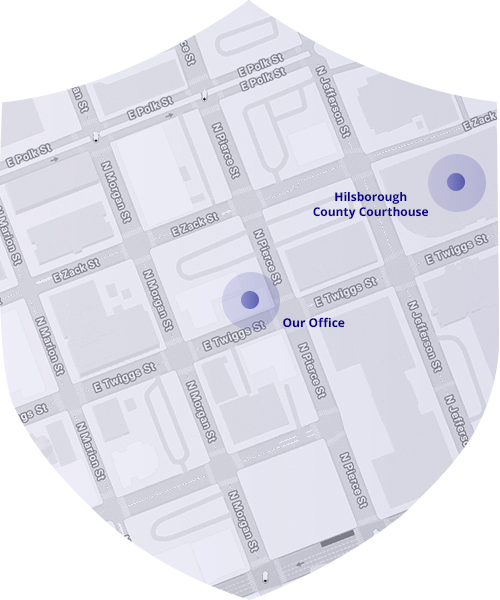
The window to preserve a sting case’s best evidence closes quickly, often within days of the arrest. Call The Brancato Law Firm, P.A., founded by Tampa Criminal Defense Attorney Rocky Brancato, at (813) 727-7159 at any hour, and our attorneys will review how the contact started, who raised the crime, and whether an entrapment motion fits your case. Our office is two blocks from the courthouse, and we defend clients in Hillsborough, Pinellas, and Pasco Counties. Our firm has Spanish-speaking staff, and attorney Jean-Luc Adrien speaks Spanish, Haitian Creole, and French. Read our guide for Spanish-speaking criminal defense clients in Tampa.

For more about our defense strategies, visit our Internet Crimes page.
The Brancato Law Firm, P.A.
620 E. Twiggs Street, Suite 205, Tampa, FL 33602
(813) 727-7159
Serving Hillsborough, Pinellas, and Pasco Counties
The Brancato Law Firm, P.A. is a Tampa-based criminal defense practice. We are not affiliated with any other Brancato-named law firms.
Visit Us

Tampa, FL 33602
Contact Us Now
Free Legal Consultation (813) 727-7159