- Free Consultation 24/7: (813) 727-7159 Tap Here To Call Us


From First DUI to Death Penalty



Juvenile Sex Offender Registration in Florida: When Does a Child Have to Register? (2026)


Updated November 8, 2026
Short answer: A child in Florida has to register as a sex offender only if the child was 14 or older at the time of the offense and was adjudicated delinquent of one of the specific offenses listed in section 943.0435(1)(h)1.d., Florida Statutes, with the written findings that statute requires. Most juvenile sex cases do not meet that test. Whether a case does depends on the charge the State files, the plea or verdict, and the findings the judge makes at disposition, which is why the defense work in the first weeks matters so much.
If your son or daughter has been charged with a sex offense in juvenile court, the question that keeps you up at night is usually the registry. The answer is often no, but it turns on details most families never hear about until disposition. I’m the founder of The Brancato Law Firm, P.A., a Tampa criminal defense firm, and I spent years in the Major Crimes Unit handling sex crimes and child abuse cases before leading the Hillsborough County Public Defender’s Office as its former Chief Operations Officer, where I oversaw a staff of over 100 attorneys. Our attorneys defend juvenile sex cases with one goal set from day one: keep the case off the list of offenses that trigger registration.
When does a juvenile have to register as a sex offender in Florida?
A juvenile must register only when three things are true: the child was 14 or older when the offense happened, the court adjudicated the child delinquent (rather than withholding adjudication or diverting the case), and the offense is one of the qualifying offenses in section 943.0435(1)(h)1.d., Florida Statutes. If any one of those is missing, Florida law does not require juvenile registration. Our Tampa sex crimes lawyer team starts every juvenile case by mapping the charge against that statute.
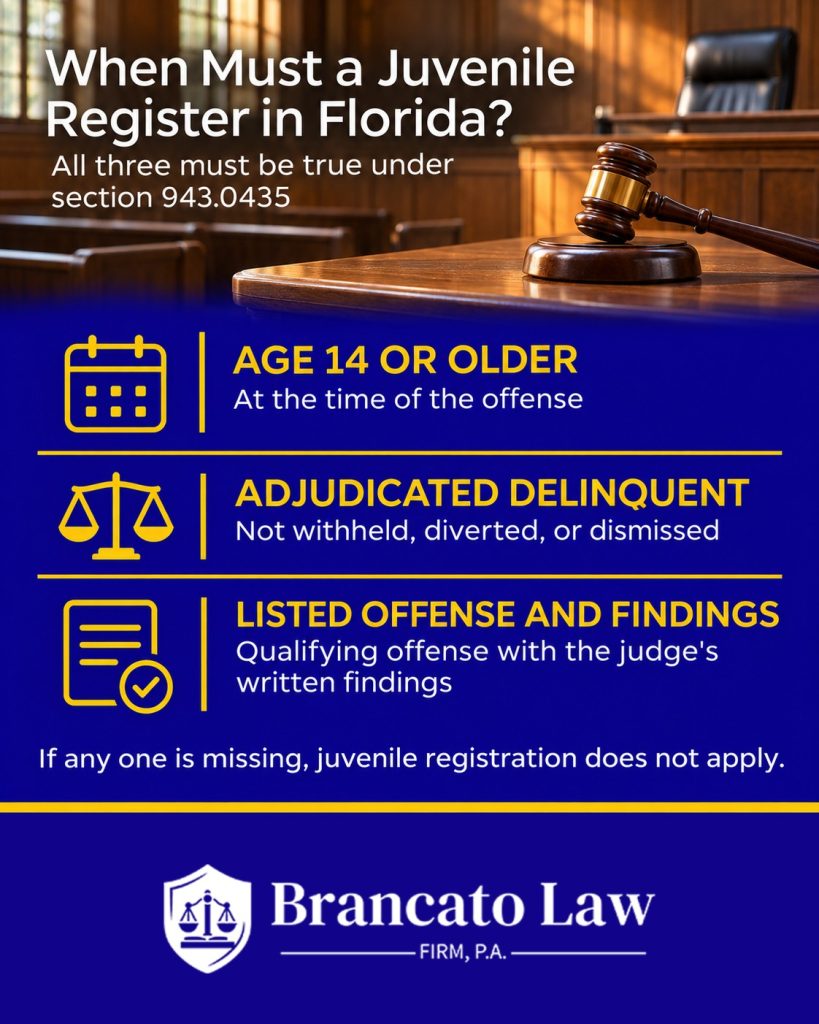
The judge must also make written findings. For every qualifying offense the court records the child’s age at the time of the offense. For lewd or lascivious offenses, the court must also record the alleged victim’s age and whether the conduct involved sexual activity, force or coercion, or unclothed genitals. Those written findings, not the label on the charge, decide registration.
| Juvenile adjudication | Registration required only if the court finds |
|---|---|
| Sexual battery, section 794.011 (except subsection (10)) | The child was 14 or older at the time of the offense |
| Lewd or lascivious battery, section 800.04(4)(a)2. | The alleged victim was under 12, or the sexual activity involved force or coercion |
| Lewd or lascivious molestation, section 800.04(5)(c)1. | The molestation involved unclothed genitals or genital area |
| Lewd or lascivious molestation, section 800.04(5)(d) | Force or coercion and unclothed genitals or genital area |
| Most other juvenile sex offenses (for example, lewd exhibition or lewd conduct) | Not on the juvenile registration list |
Do the judge’s written findings really decide registration?
Yes. Florida appellate courts reverse registration orders when the findings do not match the statute. In M.B. v. State, 159 So. 3d 960 (Fla. 5th DCA 2015), a 14-year-old was adjudicated delinquent of four counts of lewd or lascivious molestation of children under 12, and the trial court ordered him to register anyway. The trial judge had expressly found that the touching was over clothing. The Fifth District reversed, holding that registration for that offense requires a finding of unclothed genitals, and the State conceded the error.
The same findings can be made later, which is the trap families miss. In D.S. v. State, 267 So. 3d 414 (Fla. 4th DCA 2019), a 15-year-old from Indian River County was on juvenile probation for lewd or lascivious molestation. After he violated probation, a second judge found that the molestation involved unclothed genitals and imposed registration. The Fourth District affirmed, holding that nothing in the statute limits those findings to the original disposition judge. The lesson for parents: a probation violation can reopen the registration question, so compliance with juvenile probation protects more than just the probation itself.
How many juvenile cases does the 13th Judicial Circuit handle?
The 13th Judicial Circuit, which covers Hillsborough County, had 2,472 juvenile delinquency complaints filed in fiscal year 2024-25, according to the Florida Legislature’s Office of Economic and Demographic Research Circuit 13 profile. The same report shows that 43 juveniles in the circuit were direct filed to adult court that year. Direct filing matters for registration: a teenager prosecuted as an adult faces a criminal conviction rather than a juvenile adjudication, and adult sex offense convictions carry broader registration rules.
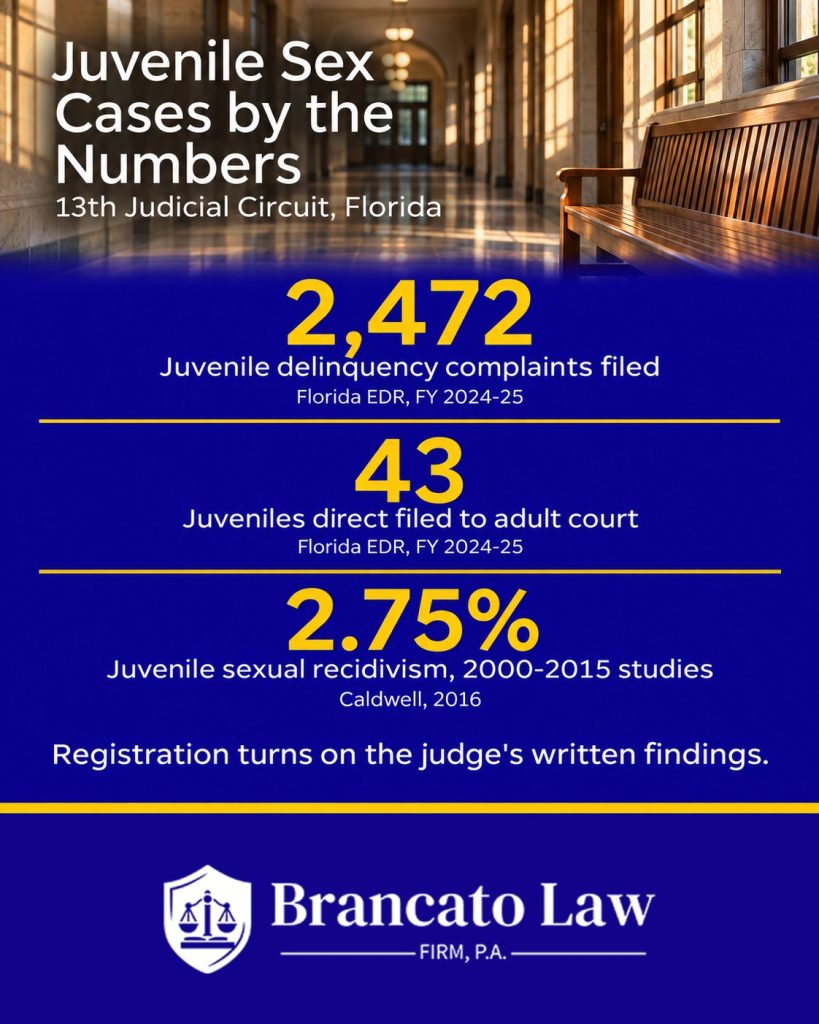
Research also cuts against the idea that most teenagers who commit a sex offense will do it again. A meta-analysis by Michael Caldwell, “Quantifying the Decline in Juvenile Sexual Recidivism Rates,” published in Psychology, Public Policy, and Law in 2016, pooled 106 studies covering 33,783 youths and found a weighted average sexual recidivism rate of 2.75% in studies conducted from 2000 to 2015. Our attorneys use findings like these, together with a credible treatment provider, when we argue for a disposition that avoids adjudication on a qualifying offense.
What should parents do first after a juvenile sex charge?
Parents should stop all contact with investigators and call a defense lawyer before the child gives any statement. Many juvenile sex cases begin with a Child Protection Team interview, a school report, or a detective’s call to the home, before any charge is filed. Our representation before charges are filed focuses on that window, when the State has not yet chosen which statute to charge.
- Do not let your child talk to police or school investigators without a lawyer. Statements often supply the “force” or “unclothed” facts that turn a non-registrable charge into a registrable one.
- Save the digital record. Phones, messages, and social media accounts can show ages, timelines, and context. Do not delete anything.
- Ask about the exact statute subsection. The difference between section 800.04(5)(c)1. and 800.04(5)(c)2. can decide registration.
- Choose a treatment evaluator with your lawyer. A credible provider helps at disposition, but an evaluation done without counsel can create admissions.
- Plan for disposition early. Withheld adjudication, diversion, or a plea to a non-qualifying offense all avoid juvenile registration, and each has to be negotiated before the disposition hearing.
Can a juvenile avoid registration through the Romeo and Juliet law?
Sometimes. Section 943.04354, Florida Statutes, lets a person convicted or adjudicated delinquent of a lewd or lascivious offense under section 800.04 move the court to remove the registration requirement if the alleged victim was 13 to 17 and the accused was not more than 4 years older. The person cannot have any other conviction or adjudication for sexual battery or the other listed offenses, and the State Attorney and FDLE must get notice at least 21 days before the hearing.
The court can rule on the motion at sentencing or disposition. That timing matters: if the motion is denied, the statute does not allow a second motion. Our attorneys build the record for that hearing, including the ages and the nature of the relationship, before the child ever enters a plea. Sexual battery adjudications under section 794.011 do not qualify for this relief.
What does a registered juvenile have to do?
A juvenile who must register faces the same core duties as an adult registrant, plus reporting to the Department of Juvenile Justice. A child on DJJ supervision who is not committed must register with DJJ within 3 business days after adjudication and disposition under section 985.4815, Florida Statutes, and must also register with the sheriff under section 943.0435. Our guide to what sex offender registration in Florida requires covers the 48-hour reporting deadlines, the driver license step, and re-registration in detail.
Families should treat every deadline as a criminal deadline. A missed address update or re-registration is a new felony under section 943.0435(9), and a teenager who moves between parents’ homes is especially at risk of missing one. The Brancato Law Firm helps families build a written compliance calendar the day registration is ordered.
How long does juvenile sex offender registration last in Florida?
Registration under section 943.0435 lasts for life unless the person qualifies for removal. The statute lists three exits: a full pardon or an adjudication set aside in postconviction proceedings, the Romeo and Juliet motion, or a petition after 25 years.
| Removal path | Who can use it | Key limits |
|---|---|---|
| Romeo and Juliet motion, section 943.04354 | Adjudication under section 800.04 with an alleged victim 13 to 17 and the accused not more than 4 years older | One motion only; no other qualifying sex adjudication |
| 25-year petition, section 943.0435(11) | A registrant released from all sanctions for at least 25 years with no arrest since release | The court must find the person is not a threat to public safety and that removal complies with federal law |
| Pardon or set-aside | A full pardon, or a qualifying adjudication vacated in a postconviction proceeding | Requires a separate legal proceeding |
The 25-year petition excludes people whose registration rests on an adult conviction for sexual battery and several other offenses, but the statute words that exclusion in terms of adult convictions. How that applies to a juvenile adjudication is a question for counsel when the time comes. Our posts on getting off the Florida sex offender registry, whether a withhold of adjudication avoids the registry, and moving to Florida after registry removal in another state explain each path.
Frequently asked questions
Does a juvenile have to register for lewd or lascivious molestation over clothing?
No. Florida’s juvenile registration rule for lewd or lascivious molestation under section 800.04(5)(c)1. applies only when the court finds the molestation involved unclothed genitals, as the court held in M.B. v. State. The Brancato Law Firm contests that finding at disposition because it alone can decide whether a child registers.
Is a 13-year-old ever required to register as a sex offender in Florida?
No, not through a juvenile adjudication. Section 943.0435 requires juvenile registration only when the child was 14 or older at the time of the offense. Our attorneys at The Brancato Law Firm still treat these cases seriously because DCF involvement, school discipline, and treatment orders can follow a younger child.
Can a juvenile sex case in Hillsborough County be moved to adult court?
Yes. Prosecutors can direct file some teenagers in adult court, and 43 juveniles in the 13th Judicial Circuit were direct filed in fiscal year 2024-25. The Brancato Law Firm works to keep a child’s case in juvenile court, where a defense team experienced in sex crimes can pursue outcomes that do not carry adult registration rules.
Can juvenile sex offense charges be dropped in Florida?
Yes. Charges can be dropped or reduced when the evidence does not support the statute charged, the statement was improperly obtained, or the facts fit a non-registrable offense. Before a petition is filed, The Brancato Law Firm presents the State Attorney’s Office with evidence through pre-file advocacy to change the charging decision.
Does a juvenile sex offender registration show up on the public registry?
Yes. A juvenile who meets the registration criteria is listed with FDLE like any other registrant, which is why preventing a qualifying adjudication matters so much. The Brancato Law Firm explains the public consequences to families before any plea so the decision is an informed one.
What happens if my child violates juvenile probation in a sex case?
A violation can lead to a new disposition, and the judge at that hearing can make the findings that trigger registration, as happened in D.S. v. State. Our attorneys at The Brancato Law Firm defend probation violations with that risk in mind and push for alternatives to a new adjudication.
Talk to a Tampa juvenile sex crimes defense attorney
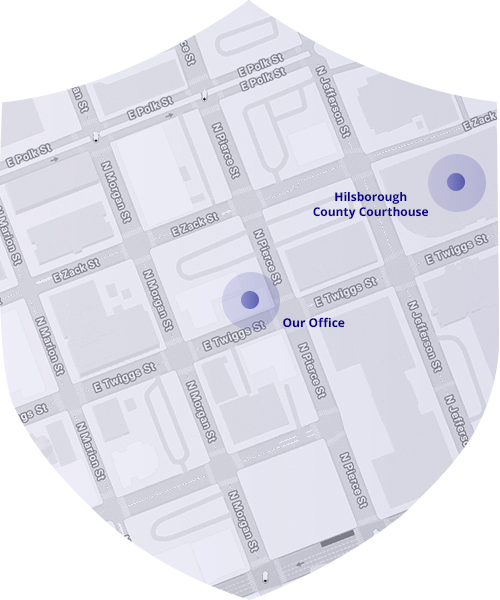
The disposition hearing is where registration is decided, and the work to prepare for it begins weeks earlier. Call The Brancato Law Firm, P.A., founded by Tampa Criminal Defense Attorney Rocky Brancato, at (813) 727-7159 before your child speaks with investigators or enters a plea. You can call us at any hour, and our office is two blocks from the courthouse. Our firm has Spanish-speaking staff, and attorney Jean-Luc Adrien speaks Spanish, Haitian Creole, and French. Read our guide for Spanish-speaking and Haitian Creole-speaking clients. For more about our defense strategies, visit our Sex Crimes page.
The Brancato Law Firm, P.A.
620 E. Twiggs Street, Suite 205, Tampa, FL 33602
(813) 727-7159
Serving Hillsborough, Pinellas, and Pasco Counties
The Brancato Law Firm, P.A. is a Tampa-based criminal defense practice. We are not affiliated with any other Brancato-named law firms.
Visit Us
Tampa, FL 33602
Contact Us Now
Free Legal Consultation (813) 727-7159