- Free Consultation 24/7: (813) 727-7159 Tap Here To Call Us


From First DUI to Death Penalty



What Is Youthful Offender Sentencing in Florida? (2026)


Fully rewritten and updated October 27, 2026.
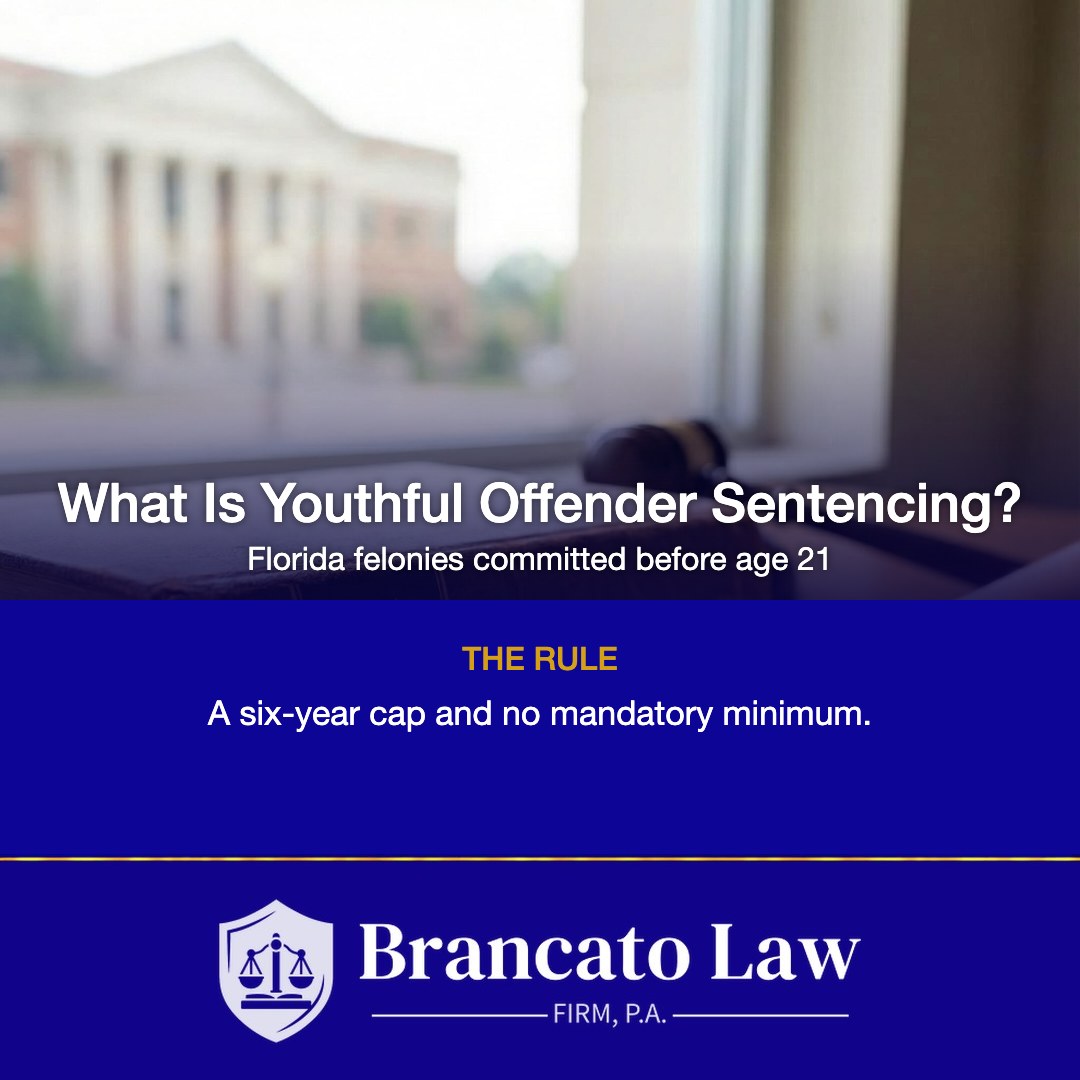
Youthful offender sentencing is a Florida sentencing option, under section 958.04, Florida Statutes, that lets a judge sentence a person who committed a felony before turning 21 to no more than six years of combined prison and supervision, even when the charge carries a 15-year, 30-year, or life maximum. A youthful offender sentence cannot include a 10-20-Life or drug trafficking mandatory minimum, and the judge can withhold adjudication. It is discretionary, it is available only once, and it is never available for a capital or life felony.
If your son or daughter was arrested on a felony in Hillsborough County before turning 21, the sentencing law that matters most may be one the prosecutor never mentions. Youthful offender sentencing can turn a mandatory 10-year gun case into a sentence measured in months, but only if the defense asks for it and builds the record to earn it. I’m Rocky Brancato, founder of The Brancato Law Firm, P.A., a Tampa criminal defense firm, and I spent more than 25 years in Hillsborough County courtrooms, including as former Chief Operations Officer of the Hillsborough County Public Defender’s Office, where I oversaw a staff of over 100 attorneys. Our attorneys raise youthful offender sentencing early and back it with a mitigation packet the judge can rely on.
What is youthful offender sentencing in Florida?
Youthful offender sentencing is an alternative to an adult sentence for young people convicted of felonies. The Florida Youthful Offender Act, found in section 958.04, Florida Statutes, tells the judge to dispose of the case “in lieu of other criminal penalties authorized by law,” which is why the usual penalty structure, including most mandatory minimums, falls away.
The Act caps the sentence at six years. Under section 958.04(2), the judge can choose probation or community control for up to six years, with or without an adjudication of guilt; a split sentence of one to four years in a Department of Corrections facility followed by supervision, with the total capped at six years; or a commitment to the Department of Corrections for up to six years. None of these can exceed the maximum sentence for the offense itself.
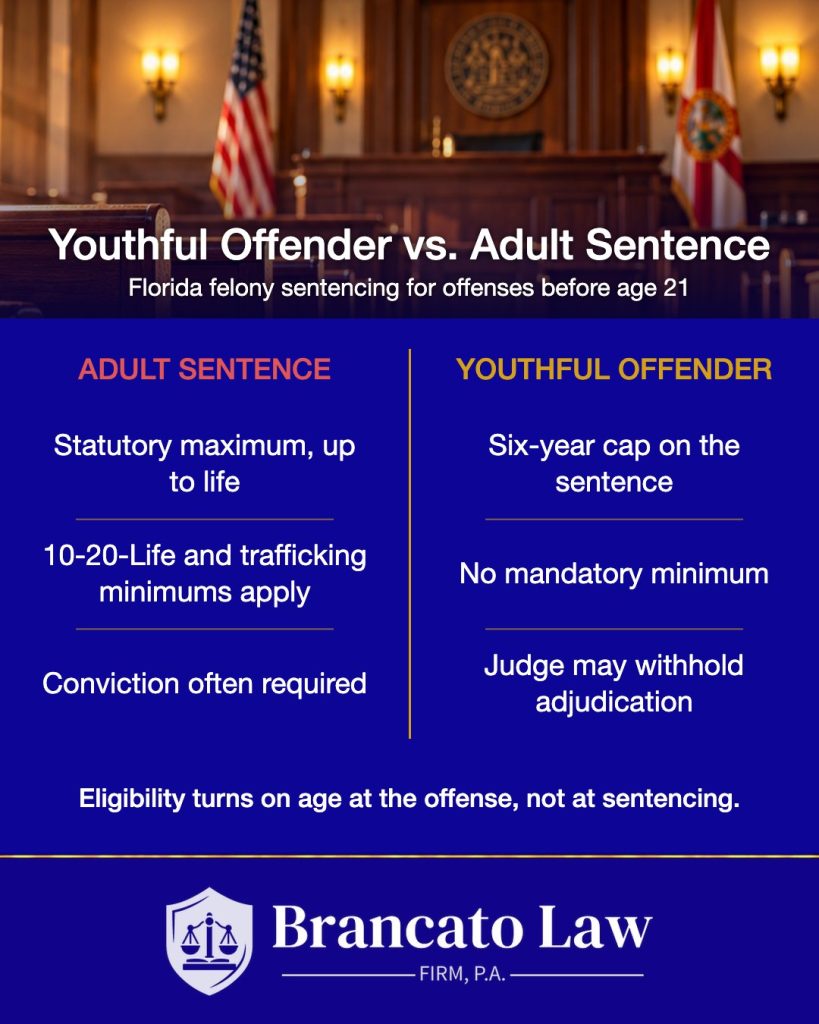
| Feature | Standard adult sentence | Youthful offender sentence |
|---|---|---|
| Maximum sentence | The statutory maximum, such as 15 or 30 years, or life for some first-degree felonies | Six years of incarceration and supervision combined |
| Mandatory minimums (10-20-Life, trafficking) | Required when the facts are proved | Not imposed |
| Adjudication of guilt | Often required, and mandatory for DUI manslaughter | The judge may withhold adjudication |
| Incarceration in a DOC facility as part of a split sentence | Any length within the guidelines | One to four years, followed by supervision |
| Number of times available | Not applicable | Once in a lifetime |
Who is eligible for youthful offender sentencing in Florida?
A person is eligible when three conditions are met. Under section 958.04(1), the court may sentence as a youthful offender someone who is at least 18 or was transferred to adult court as a juvenile, who was found guilty of or pled to a felony committed before turning 21, and who has never been classified as a youthful offender before.
- Age at the offense, not at sentencing. The crime must have been committed before the defendant’s 21st birthday. A defendant who turns 21 or 22 while the case is pending is still eligible.
- A felony charge. The Act applies to felonies. A person “found guilty of a capital or life felony” cannot be sentenced as a youthful offender.
- One time only. A prior youthful offender classification disqualifies the defendant.
- The judge’s choice. The statute says the court “may” sentence as a youthful offender. No one is entitled to it, which is why the defense has to make the case for it.
The life felony exclusion is narrower than many people assume. Robbery while carrying a firearm is a first-degree felony punishable by a term of years not exceeding life, which is not the same thing as a life felony, so a defendant convicted of armed robbery can still qualify, as our guide on how to defend against an armed robbery charge in Florida explains.
Can a youthful offender sentence avoid a 10-20-Life mandatory minimum?
Yes. Florida’s Second District Court of Appeal, which hears appeals from Hillsborough, Pasco, and Pinellas Counties, decided this question in State v. Wooten, 782 So. 2d 408 (Fla. 2d DCA 2001). Derek Wooten was charged with aggravated assault with a firearm and carrying a concealed firearm, and the trial judge withheld adjudication and sentenced him as a youthful offender to two years of community control followed by four years of probation. The State appealed, arguing the 10-20-Life minimum mandatory had to be imposed. The Second District affirmed, holding that the 10-20-Life statute “contains no language to supersede the youthful offender sentence” and that minimum mandatory sentencing “is not applicable when one is sentenced as a youthful offender.”
The same rule protects young people facing drug trafficking minimums. The practical lesson is simple: a gun or trafficking charge that looks like a guaranteed prison term may not be one for a client under 21. Our guide to Florida’s 10-20-Life law explains those minimums, and our Tampa gun crimes lawyer page describes how we defend firearm cases.
Can the judge withhold adjudication in a youthful offender case?
Yes, and that includes charges where Florida law normally forbids a withhold. In Sloan v. State, 884 So. 2d 378 (Fla. 2d DCA 2004), Joshua Sloan was adjudicated guilty of DUI manslaughter because the trial judge believed section 316.656(1), which bars withholding adjudication for DUI and vehicular homicide, controlled. The Second District reversed, holding that if the court classifies a defendant as a youthful offender, “section 316.656(1) is inapplicable,” and sent the case back for the judge to decide whether a withhold was appropriate.
A withhold of adjudication means the client is not formally convicted of the felony, which protects civil rights and can make the record eligible for sealing later. That is often worth as much to a 19-year-old as the shorter sentence.
How many young people face felony sentencing in Hillsborough County?
Hundreds every year. According to the Florida Department of Corrections’ Criminal Punishment Code report for FY 2023-24, the 13th Judicial Circuit in Hillsborough County sentenced 77 felony scoresheets for offenses committed at age 17 or younger and 1,089 for offenses committed between ages 18 and 24. Statewide, 1,024 felony scoresheets that year were for offenses committed at 17 or younger.
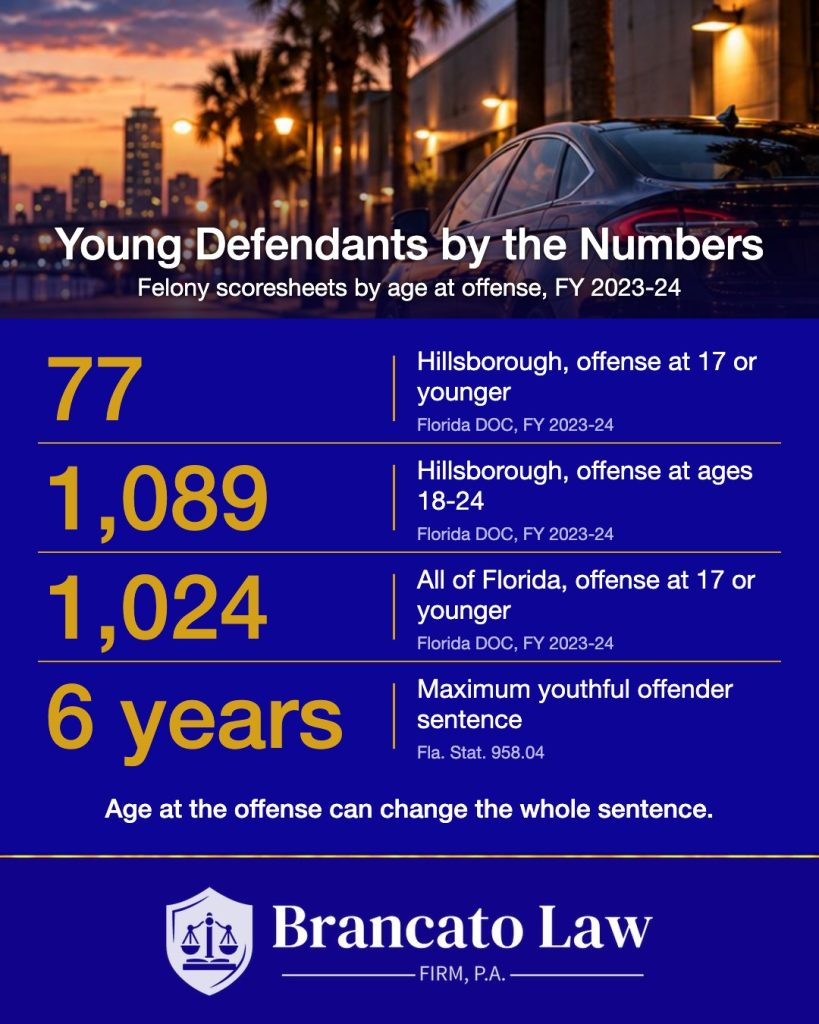
The report does not say how many of those defendants received youthful offender sentences. What the numbers do show is that a young defendant in Tampa is one of many, and the judge will look for something in the record that sets this case apart. More information about how our firm handles cases in this county is on our Hillsborough County criminal defense attorney page.
What are juvenile sanctions, and when are they better than youthful offender?
Juvenile sanctions are the better outcome when they are available, because they produce no adult conviction at all. Under section 985.565, Florida Statutes, when a child is transferred to adult court, the judge can sentence the child as an adult, as a youthful offender under chapter 958, or as a juvenile. If the judge imposes juvenile sanctions, the court adjudicates the child delinquent, and that adjudication “may not be deemed a conviction.”
The statute lists the factors the judge must weigh, including the seriousness of the offense, whether it was violent or premeditated, the child’s sophistication and maturity, the child’s record, and whether the Department of Juvenile Justice has an appropriate program available. Two limits matter. A child indicted for an offense punishable by death or life and convicted of it must be sentenced as an adult, and the judge cannot combine adult and juvenile punishments.
Research supports keeping young people out of the adult system when possible. In a 2010 Office of Juvenile Justice and Delinquency Prevention bulletin, Juvenile Transfer Laws: An Effective Deterrent to Delinquency? (NCJ 220595), Professor Richard E. Redding reviewed the research and concluded that transfer laws have increased recidivism among the youths transferred to adult court. Our attorneys bring that research to the judge when we ask for juvenile sanctions or a youthful offender sentence.
| Option | Who can receive it | Maximum consequence | Record |
|---|---|---|---|
| Juvenile sanctions (section 985.565) | A child transferred to adult court, unless an exception applies | Juvenile probation until 19 or commitment until 21 | Adjudication of delinquency, not a conviction |
| Youthful offender (section 958.04) | A person under 21 at the offense, at least 18 or transferred | Six years combined | The judge may withhold adjudication |
| Adult sentence | Anyone convicted | The statutory maximum, plus any mandatory minimum | Conviction unless adjudication is withheld |
What happens if a youthful offender violates probation?
A violation can cost the client the six-year cap, depending on what kind of violation it is. Under section 958.14, Florida Statutes, a youthful offender who commits a technical violation, such as a missed appointment or a failed drug test, cannot be committed for longer than six years or the maximum for the offense, whichever is less. For a substantive violation, meaning a new crime, the limit becomes the maximum sentence for the original offense.
The Florida Supreme Court explained what that means in Eustache v. State, 248 So. 3d 1097 (Fla. 2018). Robin Eustache was a youthful offender on probation for robbery with a firearm when he committed two new drug offenses. Both lawyers told the judge he had to impose the 10-year minimum mandatory, and the judge sentenced him to 15 years. The Supreme Court held that after a substantive violation, the judge may either impose another youthful offender sentence, “with no minimum mandatory,” or impose an adult sentence that must include any minimum mandatory. Because the judge was never told he had the first option, the court ordered a new sentencing hearing.
Eustache is the reason our attorneys fight a youthful offender violation on two fronts: whether the violation was willful and substantial, and whether the judge should reimpose youthful offender status rather than an adult sentence. Our post on violation of probation in Tampa covers the hearing process.
How do our attorneys build the case for youthful offender sentencing?
Our attorneys build the case the same way we build any request for leniency: with evidence the judge can put in the order. A youthful offender sentence is discretionary, so the question at sentencing is always why this young person deserves it.
- Confirm eligibility early. We check the offense date against the client’s birthday, the degree of the charge, and any prior classification before the first plea conversation.
- Build a mitigation packet. We gather school records, psychological evaluations, treatment records, and character letters into a mitigation report that shows who the client is beyond the arrest.
- Get the client into school, work, or treatment. A judge weighs what the young person has done since the arrest more heavily than promises about the future.
- Negotiate with the State. Prosecutors often agree to a youthful offender plea when the record supports it, and an agreed sentence removes the risk of a hearing.
- Make the record at sentencing. If the State objects, we present the evidence and make sure the judge knows the full range of options, including Wooten and Eustache.
When the client was under 18 at the offense and was charged as an adult, we ask first for juvenile sanctions and treat youthful offender as the fallback. Families with a college student facing charges can also read our post on college students charged as adults.
Frequently asked questions
Can you get youthful offender for armed robbery with a firearm in Florida?
Yes, in many cases. Armed robbery with a firearm is a first-degree felony punishable by up to life, not a life felony, so it qualifies, and a youthful offender sentence avoids the 10-20-Life minimum mandatory under State v. Wooten. The Brancato Law Firm reviews the charging document closely in every gun case, because the exact charge decides whether youthful offender is on the table, as explained on our gun crimes defense page.
Does a youthful offender sentence stay on your record in Florida?
The arrest and the case stay on the record, but if the judge withholds adjudication, the client is not convicted of a felony and may be able to seal the record later. The Brancato Law Firm asks for a withhold whenever the facts support it and tells families up front which sealing options will follow.
Can someone who is 22 at sentencing still get youthful offender?
Yes, if the crime was committed before the defendant turned 21. The age at the offense controls under section 958.04(1)(b), and The Brancato Law Firm checks the offense date first in every case involving a young client.
Is youthful offender available for a DUI manslaughter charge?
Yes. DUI manslaughter is a second-degree felony, and under Sloan v. State the mandatory adjudication rule for DUI offenses does not apply once the court classifies the defendant as a youthful offender. Our attorneys at The Brancato Law Firm present treatment, remorse, and restitution evidence in these cases because the judge’s discretion is the whole case.
What happens to a youthful offender who commits a new crime on probation?
The judge can revoke probation and choose either another youthful offender sentence with no minimum mandatory or an adult sentence up to the original maximum, as the Florida Supreme Court held in Eustache v. State. The Brancato Law Firm makes sure the judge hears both options and the reasons to keep the client in the youthful offender system.
Can a juvenile charged as an adult in Tampa be sentenced as a juvenile?
Often, yes. Under section 985.565, a judge can impose juvenile sanctions on a child transferred to adult court unless an exception applies, and the result is a delinquency adjudication rather than a conviction. The Brancato Law Firm prepares the evidence on each statutory factor, and our post on juvenile expungement in Florida explains what happens to the record afterward.
For how this fits into the rest of a case, see our guide to each stage of a Florida criminal case.
Protect your child’s future now
The decisions that make youthful offender sentencing possible, from the plea offer to the evidence the judge sees, are made in the first weeks of the case. Call The Brancato Law Firm, P.A., founded by Tampa Criminal Defense Attorney Rocky Brancato, at (813) 727-7159, and our attorneys will review the charge, the offense date, and the options before the State’s first offer. You can call us at any hour. Our firm has Spanish-speaking staff, and attorney Jean-Luc Adrien speaks Spanish, Haitian Creole, and French. Read our guide for criminal defense in Spanish and Haitian Creole in Tampa.
For more about our defense strategies, visit our Gun Crimes page.
The Brancato Law Firm, P.A.
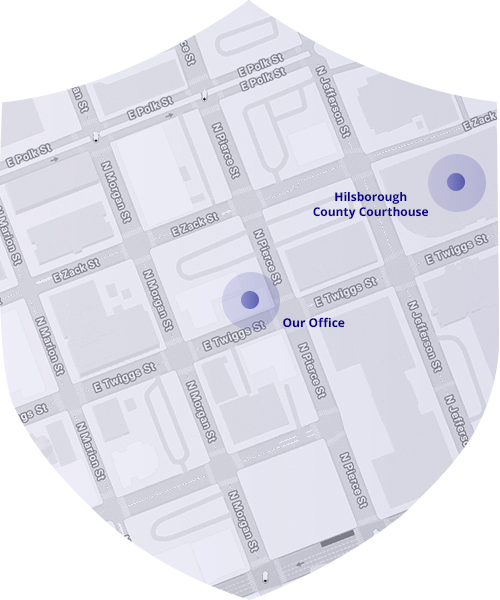
620 E. Twiggs Street, Suite 205, Tampa, FL 33602
(813) 727-7159
Serving Hillsborough, Pinellas, and Pasco Counties
The Brancato Law Firm, P.A. is a Tampa-based criminal defense practice. We are not affiliated with any other Brancato-named law firms.
Visit Us

Tampa, FL 33602
Contact Us Now
Free Legal Consultation (813) 727-7159