- Free Consultation 24/7: (813) 727-7159 Tap Here To Call Us


From First DUI to Death Penalty



Is Circumstantial Evidence Enough to Convict in Florida? (2026)


Rewrite/update date: November 2, 2026. Originally published in January 2025.
| Yes. In Florida, circumstantial evidence alone can support a conviction if it convinces a jury of guilt beyond a reasonable doubt. Since Bush v. State, 295 So. 3d 179 (Fla. 2020), Florida courts review circumstantial cases under the same test as any other case: whether a rational jury, viewing the evidence in the light most favorable to the State, could find every element proven. The State no longer has to disprove every reasonable hypothesis of innocence on appeal. But Florida courts still forbid a conviction built by stacking one inference on another, and that rule is where many circumstantial cases can be beaten. |
A Florida judge deciding a motion for judgment of acquittal looks at one thing: whether the State’s evidence, taken at its strongest, proves each element of the crime, or only suggests it. I have made and answered that argument for more than 25 years in Hillsborough County courtrooms, in more than 150 jury trials to verdict. I’m Rocky Brancato, founder of The Brancato Law Firm, P.A., a Tampa criminal defense firm, and our attorneys build circumstantial-evidence defenses around the gaps between the facts the State can prove and the conclusions it wants a jury to draw.
What is circumstantial evidence in Florida?
Circumstantial evidence is proof of facts from which a jury can infer another fact, such as guilt. Direct evidence proves the fact itself, without an inference. A witness who says “I saw him take the wallet” gives direct evidence. A fingerprint on the wallet is circumstantial, because the jury must infer when and how it got there. Florida’s evidence code admits both kinds if they are relevant under section 90.401, Florida Statutes.
| Direct evidence | Circumstantial evidence |
|---|---|
| Eyewitness: “I saw him do it” | Fingerprints or DNA at the scene |
| Confession: “I did it” | Running from police |
| Video of the act | Cell phone location data near the scene |
| Victim testimony describing the act | Possession of stolen property days later |
| Undercover officer’s account of a sale | Financial records, search history, or motive |
Is circumstantial evidence weaker than direct evidence?
No. Florida law treats the two as equally capable of proving guilt, and the jury decides what weight each deserves. In Bush, the Florida Supreme Court quoted the U.S. Supreme Court’s view that circumstantial evidence is “intrinsically no different from testimonial evidence.” Direct evidence can be wrong too. Of the 147 exonerations recorded nationwide in 2024, 38, or 26%, involved convictions based at least in part on mistaken witness identification, and 42, or 29%, involved false or misleading forensic evidence, according to the National Registry of Exonerations 2024 Annual Report.
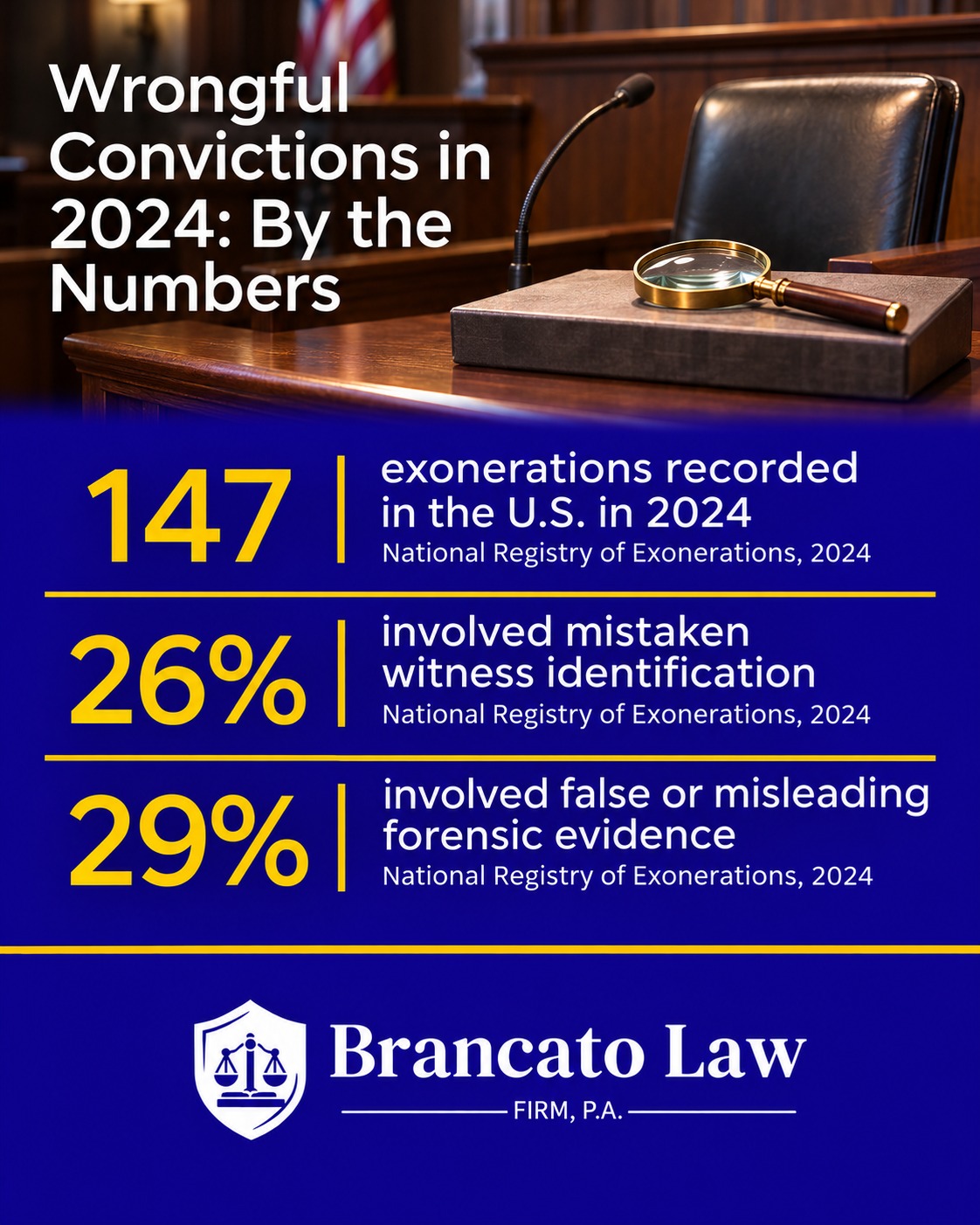
Both halves of that statistic matter to a defense. A circumstantial case often rests on forensic conclusions, and the 2009 National Research Council report Strengthening Forensic Science in the United States found that, apart from nuclear DNA analysis, no forensic method had been rigorously shown to consistently connect evidence to a specific person or source with a high degree of certainty. Our attorneys test the science behind each inference rather than accepting the label on a lab report.
How did Bush v. State change circumstantial evidence cases?
Bush ended Florida’s special standard of review for cases built entirely on circumstantial evidence. Bush was convicted in St. Johns County of murdering his estranged wife on a wholly circumstantial record and sentenced to death. On appeal, he asked the Court to apply the old rule that such a conviction cannot stand unless the evidence is inconsistent with every reasonable hypothesis of innocence. The Court refused, held that the special standard was confusing and out of step with Florida’s jury instructions, and affirmed.
| Question | Before Bush (2020) | After Bush |
|---|---|---|
| Standard on a motion for judgment of acquittal or appeal in a wholly circumstantial case | Evidence had to be inconsistent with every reasonable hypothesis of innocence | Could a rational jury, viewing the evidence most favorably to the State, find every element beyond a reasonable doubt? |
| Does the jury get a special circumstantial-evidence instruction? | No; the Court removed it in 1981 | No |
| Can the defense still argue innocent explanations to the jury? | Yes | Yes, through reasonable doubt |
| Can the State stack inferences to prove guilt? | No | No, under the Second District’s 2026 decisions |
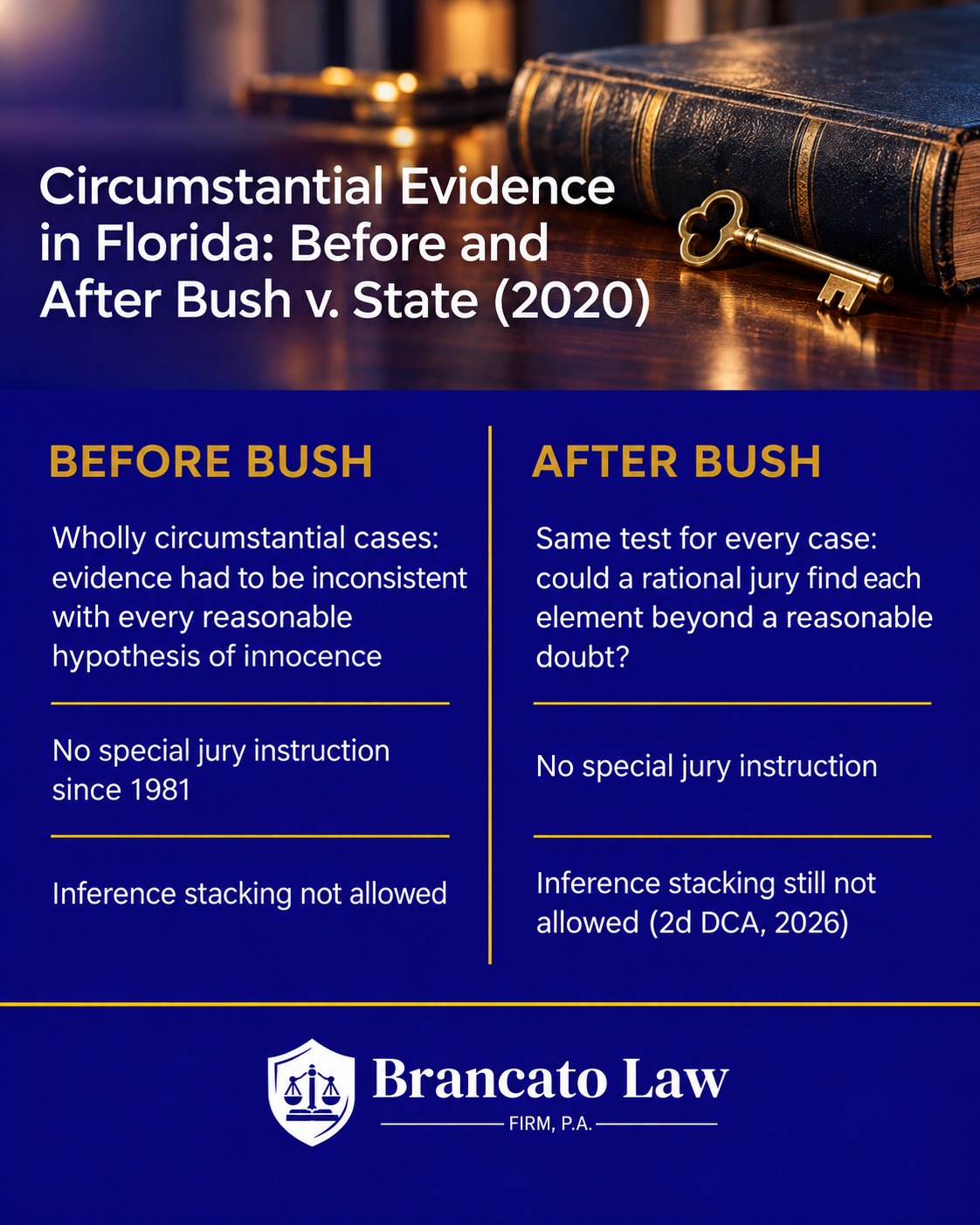
One correction to a common belief: Florida juries were not told to apply the “reasonable hypothesis of innocence” rule even before Bush. The Florida Supreme Court explained in Bush that it eliminated the special circumstantial-evidence jury instruction in 1981. Florida’s standard jury instructions do not include it, so the defense argues innocent explanations to the jury under the ordinary reasonable doubt standard instead.
Can the State stack inferences after Bush?
No. The Second District Court of Appeal, which hears appeals from Hillsborough, Pinellas, and Pasco Counties, held in 2026 that Bush did not permit the State to prove guilt by pyramiding inferences. In Young v. State, No. 2D2025-0042 (Fla. 2d DCA July 10, 2026), a Hillsborough County felony murder appeal, the State argued that Bush made inference stacking a permissible way to convict. The court rejected that argument, explaining that each inference must rest on an evidentiary fact and a jury may not draw an inference from an inference to fill a hole in the proof. The court found no improper stacking in Young’s case and affirmed his conviction, but the rule it reaffirmed applies in every case in our district.
Two months later, the same court applied the rule to reverse. In Smith v. State, No. 2D2025-1715 (Fla. 2d DCA Sept. 18, 2026), a Sarasota County probationer was accused of violating curfew because officers knocked at night and got no answer. The officers did not say how long they knocked, how loudly, or where his room was. The Second District held there was no basis to infer he would have heard the knock, and no basis to infer from his silence that he was gone, and it ordered his probation reinstated. Chief Judge Lucas dissented and questioned whether the stacking rule survives Bush, so the issue may reach the Florida Supreme Court. For now, it is binding law in the 13th Judicial Circuit and a key tool in our Hillsborough County criminal defense work. Our guide to fighting a probation violation in Florida covers how this plays out at violation hearings.
How do our attorneys fight a circumstantial evidence case?
Our attorneys attack the chain of inferences link by link, at every stage where the law allows it. These are the five moves we use most:
- Map the inference chain. We write out each fact the State can prove and each conclusion it needs, and mark every place where one inference rests on another.
- Exclude unfair evidence before trial. Under section 90.403, Florida Statutes, relevant evidence can be excluded if unfair prejudice, confusion, or misleading the jury substantially outweighs its value. We file motions in limine on flight, motive, and other evidence that invites guessing.
- Challenge the forensic science. Fingerprints, DNA mixtures, cell phone location, and digital records are circumstantial. We retain experts and cross-examine the State’s analysts on method and limits. See our guides to challenging fingerprint evidence and cell phone location evidence.
- Move for judgment of acquittal. At the close of the State’s case we argue that the evidence, even viewed favorably to the State, requires stacked inferences or leaves an element unproven.
- Give the jury the innocent explanation. We present the alternative account through witnesses, records, and cross-examination, and argue that it creates reasonable doubt.
Doctrine survives procedure here. If a judge denies the motion for judgment of acquittal, the stacking argument is not lost: it is preserved for appeal and still frames the reasonable doubt argument to the jury. Possession cases are a common example, because the State often must infer knowledge from proximity; our article on constructive possession in Florida explains that issue.
Has our firm won cases where the State relied on one key piece of evidence?
Yes. In one trial, our client was charged with robbery with a firearm based on an identification. Rocky Brancato presented a mistaken identity defense, pointing out that the client had a very noticeable rosary tattoo covering his arm that the victim never mentioned in her description to police. The jury found the client not guilty. In a cold-case sexual battery prosecution, a DNA expert’s full review of the evidence led to a complete dismissal based on mistaken identity. Past results do not guarantee future outcomes.
Frequently asked questions about circumstantial evidence in Florida
Can you be convicted of murder on circumstantial evidence alone in Florida?
Yes. Bush v. State itself affirmed a first-degree murder conviction and death sentence on a wholly circumstantial record. The Brancato Law Firm defends these cases by testing each forensic link and holding the State to proof that does not depend on stacked inferences; see our Tampa homicide defense page.
Does Florida still use the reasonable hypothesis of innocence standard?
No. The Florida Supreme Court discontinued that standard for judgments of acquittal and appeals in Bush in 2020. Our attorneys at The Brancato Law Firm now frame the same facts under reasonable doubt and the prohibition on pyramiding inferences, which the Second District reaffirmed in 2026.
What is inference stacking in a Florida criminal case?
Inference stacking means drawing one inference from another inference rather than from a proven fact, and Florida courts do not allow a conviction built that way. The Brancato Law Firm raises the issue in motions for judgment of acquittal, relying on Young v. State, No. 2D2025-0042 (Fla. 2d DCA July 10, 2026).
Is fleeing from police evidence of guilt in Florida?
Flight can be admitted as circumstantial evidence of consciousness of guilt, but people run for many reasons, and the jury decides its weight. Our attorneys at The Brancato Law Firm move to limit flight evidence when its link to the charged crime is weak.
Can circumstantial evidence be used at a probation violation hearing?
Yes, but the State still must present competent evidence of a willful and substantial violation, and stacked inferences fail there too. The Second District reversed a curfew violation on that basis in Smith v. State, No. 2D2025-1715 (Fla. 2d DCA Sept. 18, 2026). The Brancato Law Firm uses the same analysis at violation hearings in Hillsborough County.
How do I know if the evidence against me is only circumstantial?
Ask whether any witness or recording shows you committing the act itself; if not, the case is likely circumstantial. Our attorneys at The Brancato Law Firm review the discovery to separate the facts the State can prove from the conclusions it is asking the jury to draw, and our Tampa criminal forensic science attorney page explains how we use experts in that review.
For how this fits into the rest of a case, see our step-by-step guide to what happens in a Florida criminal case.
Find the weak link before the State builds the chain
A circumstantial case is only as strong as its weakest inference, and finding it early gives our attorneys time to retain experts and file the right motions. The Brancato Law Firm, P.A. was founded by Tampa Criminal Defense Attorney Rocky Brancato. Call (813) 727-7159 at any hour to have our attorneys review the evidence in your case. Our firm has Spanish-speaking staff, and attorney Jean-Luc Adrien speaks Spanish, Haitian Creole, and French. Read our guide for criminal defense in Spanish and Haitian Creole in Tampa.

For more about our defense strategies, visit our Forensic Science Defense page.
The Brancato Law Firm, P.A.
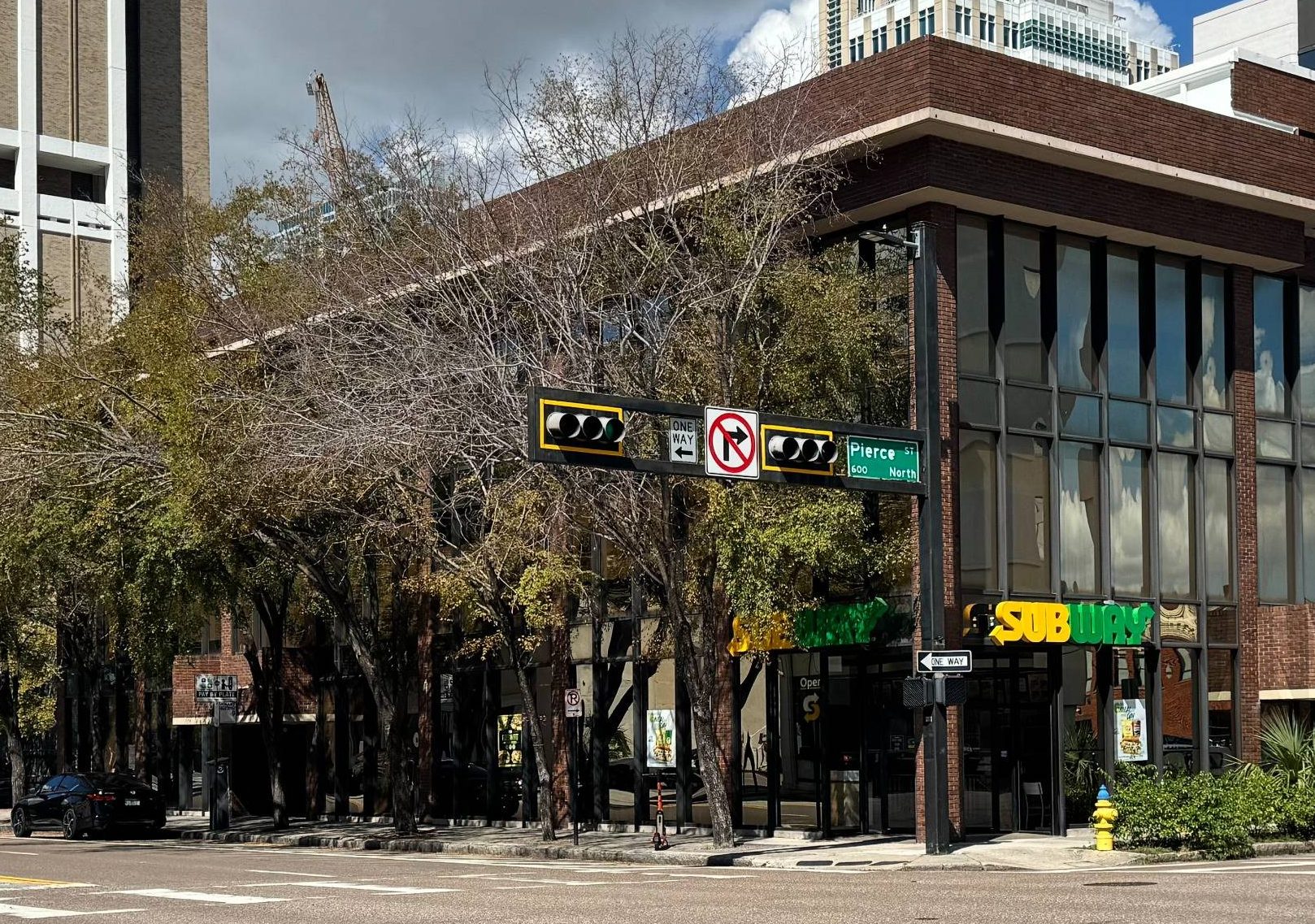
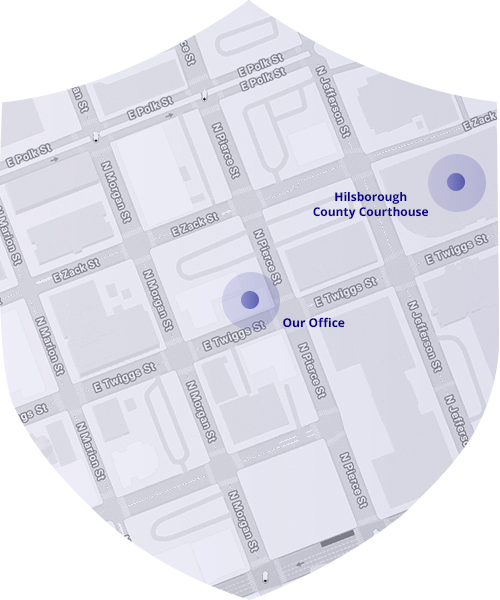
620 E. Twiggs Street, Suite 205, Tampa, FL 33602
(813) 727-7159
Serving Hillsborough, Pinellas, and Pasco Counties
The Brancato Law Firm, P.A. is a Tampa-based criminal defense practice. We are not affiliated with any other Brancato-named law firms.
Visit Us
Tampa, FL 33602
Contact Us Now
Free Legal Consultation (813) 727-7159