Strategic Defense,
From First DUI to Death Penalty
From First DUI to Death Penalty






| Short answer: A Tampa criminal traffic lawyer defends traffic charges that can bring jail and a criminal record, such as driving while license suspended, reckless driving, leaving the scene of a crash, fleeing and eluding, and dangerous excessive speeding. These are crimes, not tickets: a conviction can mean jail, probation, a license revocation, and a record that shows up on background checks. The Brancato Law Firm, P.A. challenges whether the State can prove knowledge, driving, and identity, and works to get the license fixed early so the charge can be reduced or dismissed. |
Most people charged with a criminal traffic offense have never been in a courtroom before, and many assume they can pay the citation like a speeding ticket. Rocky Brancato, founder of The Brancato Law Firm, P.A., has tried more than 150 jury trials to verdict, including a not guilty verdict on a felony charge of driving while a habitual traffic offender. Our attorneys at this Tampa criminal defense firm handle criminal traffic cases in Hillsborough, Pinellas, and Pasco Counties. For DUI charges, see our Tampa DUI lawyer page; for crashes involving a death, see our homicide defense page.
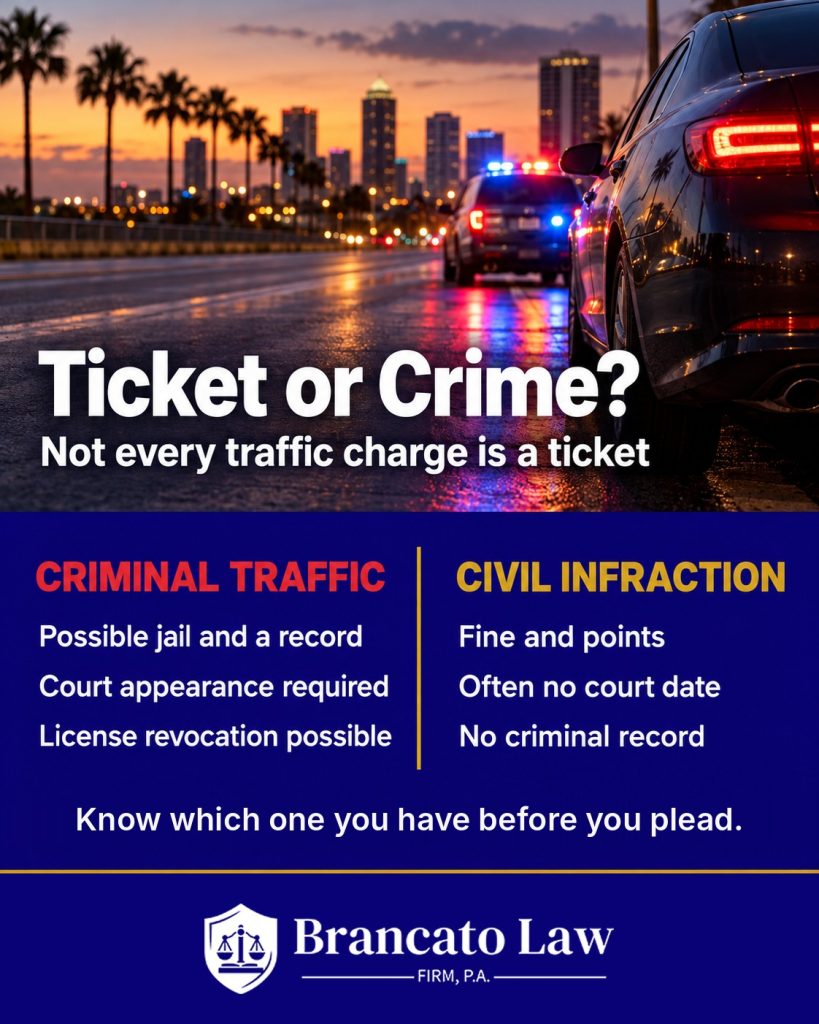
A criminal traffic offense is a crime that can be punished with jail and leaves a criminal record, while a civil traffic infraction is punished with a fine and points on your license. Speeding, running a red light, and most moving violations are civil infractions. Driving while license suspended with knowledge, reckless driving, leaving the scene of a crash, and fleeing a law enforcement officer are crimes. A criminal traffic charge requires a court appearance or a lawyer appearing for you, and pleading to it without advice can trigger a license revocation you did not expect.
The table below lists common criminal traffic charges in Florida and their levels. Maximum penalties for each level are set by § 775.082 and § 775.083: 60 days for a second-degree misdemeanor, 1 year for a first-degree misdemeanor, and 5 years for a third-degree felony.
| Charge | Florida law | Level |
|---|---|---|
| Driving while license suspended, without knowledge | § 322.34(1) | Noncriminal moving violation |
| Driving while license suspended, with knowledge, first offense | § 322.34(2)(a) | Second-degree misdemeanor |
| Driving while license suspended, second offense | § 322.34(2)(b) | First-degree misdemeanor |
| Driving while license suspended, third or later offense | § 322.34(2) | First-degree misdemeanor with a 10-day minimum jail term, or a third-degree felony when the suspension relates to DUI, a refusal, a crash causing death or serious injury, or fleeing |
| Driving while a habitual traffic offender | § 322.34(5) | Third-degree felony |
| Driving while suspended and causing death or serious bodily injury | § 322.34(6) | Third-degree felony |
| No valid driver’s license | § 322.03 | Second-degree misdemeanor (higher for repeat offenses) |
| Reckless driving, first offense | § 316.192 | Up to 90 days in jail and a $25 to $500 fine |
| Reckless driving causing property damage or injury | § 316.192(3) | First-degree misdemeanor |
| Reckless driving causing serious bodily injury | § 316.192(3) | Third-degree felony |
| Dangerous excessive speeding, first offense | § 316.1922 | Up to 30 days in jail and/or a $500 fine |
| Leaving the scene of a crash with property damage only | § 316.061 | Second-degree misdemeanor |
| Leaving the scene of a crash with injury | § 316.027(2)(a) | Third-degree felony |
| Leaving the scene of a crash with serious bodily injury | § 316.027(2)(b) | Second-degree felony |
| Leaving the scene of a crash involving death | § 316.027(2)(c) | First-degree felony with a 4-year minimum prison term |
| Fleeing or attempting to elude a law enforcement officer | § 316.1935 | Third-degree felony; second-degree for high speed or wanton disregard; first-degree with a 3-year minimum for serious bodily injury or death |
You fight a driving while license suspended charge by testing whether the State can prove you knew the license was suspended, and by fixing the license as fast as possible. Under § 322.34, knowledge is what separates a crime from a noncriminal citation. The State can prove knowledge with a prior citation for driving while suspended, an admission, or proof that notice was mailed, and there is a presumption of knowledge in many cases. Courts still require real proof. In Robinson v. State, 348 So. 3d 1146 (Fla. 4th DCA 2022), the appeals court reversed a conviction because the State did not prove the driver knew his license was suspended.
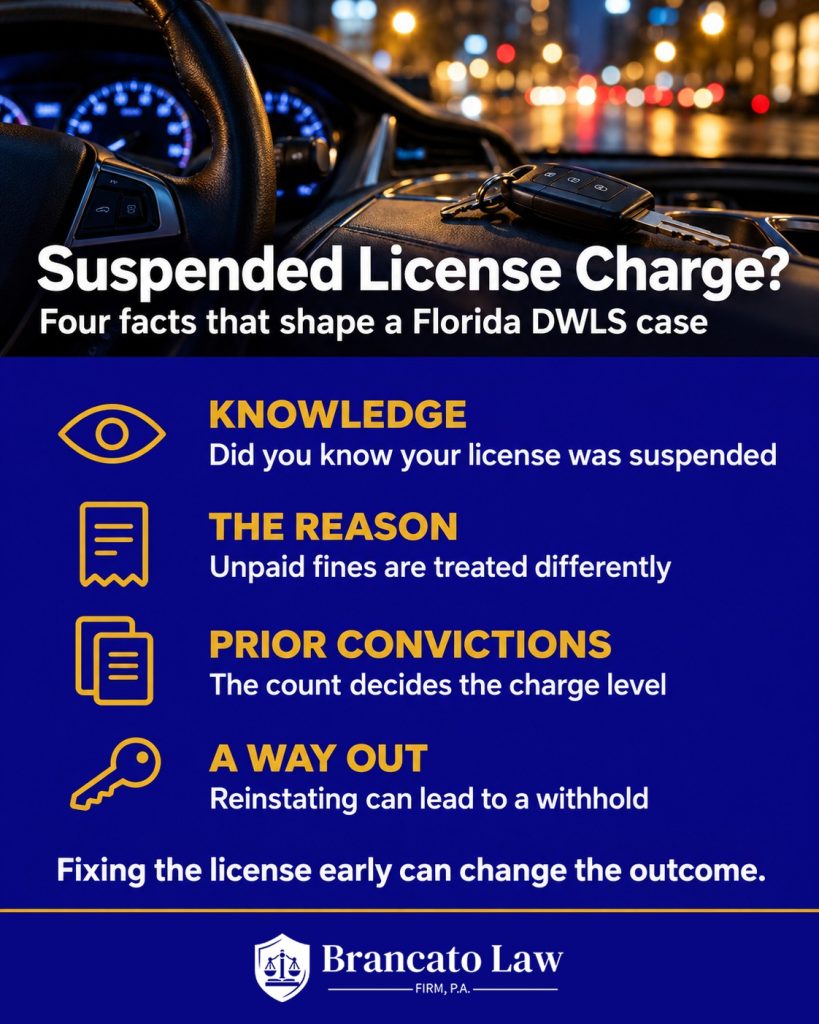
Suspended licenses are common in Florida, and many are about money. A 2019 report by the Fines and Fees Justice Center, an advocacy group, Driving on Empty, found that most Florida license suspensions were for failing to pay fines and fees rather than for unsafe driving. In our experience, getting the license reinstated before the first court date often changes what the prosecutor is willing to offer. Read more about driving while license suspended in Florida, driving without a license, and habitual traffic offender defense.
Reckless driving in Florida is driving with willful or wanton disregard for the safety of people or property, under § 316.192. A first offense carries up to 90 days in jail and a fine of $25 to $500, and a second offense carries up to 6 months and $50 to $1,000. Reckless driving that damages property or injures someone is a first-degree misdemeanor, and reckless driving that causes serious bodily injury is a third-degree felony. Reckless driving is also the most common reduced charge in a DUI case. A conviction adds 4 points to the driver’s license. Our guide to defending a reckless driving charge in Tampa covers the defenses.
Dangerous excessive speeding is a criminal offense that took effect July 1, 2025, under § 316.1922. It covers driving 50 miles per hour or more over the speed limit in a way that threatens people or property, or driving 100 miles per hour or more in a way that threatens people or property. A first conviction carries up to 30 days in jail and/or a $500 fine. A second conviction carries up to 90 days and a $1,000 fine, and a second conviction within 5 years brings a license revocation of 180 days to 1 year. Racing and organizing a street takeover are separate crimes under § 316.191. See Florida’s dangerous excessive speeding law and teen takeover arrests.
Leaving the scene of a crash in Florida is a crime that ranges from a second-degree misdemeanor for property damage to a first-degree felony for a crash involving a death. Under § 316.027, leaving a crash with a death carries a 4-year minimum prison term and a license revocation of at least 3 years. The State must prove the driver knew the crash happened. In State v. Dorsett, 158 So. 3d 557 (Fla. 2015), the Florida Supreme Court held that the jury must be told the State has to prove the driver actually knew of the crash. In 2023, Florida recorded 104,273 hit-and-run crashes and 271 hit-and-run deaths, according to the Florida Department of Highway Safety and Motor Vehicles.
What you say after a crash also matters. Under § 316.066(4), statements a driver makes to police for the crash report generally cannot be used against the driver at a criminal trial, but statements made once a criminal investigation begins can be. Read our guides to leaving the scene of an accident and the accident report privilege.
Fleeing and eluding is willfully refusing to stop a vehicle after a law enforcement officer orders you to stop, and it is a felony in every form under § 316.1935. Fleeing a marked patrol vehicle with lights and siren activated is a third-degree felony. Fleeing at high speed or with wanton disregard for safety is a second-degree felony, and fleeing that causes serious bodily injury or death is a first-degree felony with a 3-year minimum prison term. A conviction also brings a license revocation of 1 to 5 years. These cases often turn on whether the officer’s signal was clear and whether the driver knew an officer was ordering the stop. See fleeing and eluding in Florida and the 2025 changes to the fleeing law.
These are results our firm has obtained. Every case is different, and past results do not guarantee future outcomes.
See more on our case results page.
Yes. Prosecutors often drop or reduce a suspended license charge when the State cannot prove knowledge or when the driver gets the license reinstated before the case ends. The Brancato Law Firm has had suspended license charges dismissed and closed through diversion, including a case where body camera footage showed police stopped the wrong person.
Usually not. A first offense with knowledge is a second-degree misdemeanor, and a third or later offense is a felony only when the suspension relates to DUI, a refusal, a crash causing death or serious injury, or fleeing, or when the driver is a habitual traffic offender. Our attorneys at The Brancato Law Firm review the driving record to see whether a felony charge truly applies.
Yes, a criminal traffic charge requires a court appearance, but in many misdemeanor cases a lawyer can appear for you and you may not need to attend every hearing. The Brancato Law Firm handles criminal traffic cases in Hillsborough, Pinellas, and Pasco County courts.
Yes. Reckless driving is a crime under § 316.192 with up to 90 days in jail for a first offense, and it becomes a felony if it causes serious bodily injury. The Brancato Law Firm defends reckless driving charges and often negotiates them when the evidence of willful or wanton driving is thin.
A habitual traffic offender is a driver with three qualifying convictions, such as DUI or driving while suspended, within 5 years, or 15 moving violations within 5 years, under § 322.264. The license is revoked for 5 years and driving during that time is a felony. Our attorneys at The Brancato Law Firm look at whether each prior conviction can be challenged; read about reopening old convictions.
Florida law requires the State to prove you knew the crash happened, as the Florida Supreme Court held in State v. Dorsett. The Brancato Law Firm investigates what the driver could see and hear, including vehicle damage and any video, to test the knowledge element.
A criminal traffic charge can cost you your license, your job, and your clean record, and the first court date comes quickly. Our attorneys at The Brancato Law Firm, P.A., founded by Tampa Criminal Defense Attorney Rocky Brancato, can review your citation and driving record today. Call (813) 727-7159 for a confidential consultation. We defend traffic cases in Hillsborough, Pinellas, and Pasco Counties.
Trial attorney Jean-Luc Adrien speaks Spanish, Haitian Creole, and French, and our office has Spanish-speaking staff, so you can go over your citation and your options in your own language. Read more about criminal defense in Spanish and Haitian Creole in Tampa.
The Brancato Law Firm, P.A.
620 E. Twiggs Street, Suite 205, Tampa, FL 33602
(813) 727-7159
Serving Hillsborough, Pinellas, and Pasco Counties
The Brancato Law Firm, P.A. is a Tampa-based criminal defense practice. We are not affiliated with any other Brancato-named law firms.
This page is for informational purposes only and does not constitute legal advice. Each case is unique, and outcomes depend on the individual facts and circumstances involved. Past results do not guarantee future outcomes.
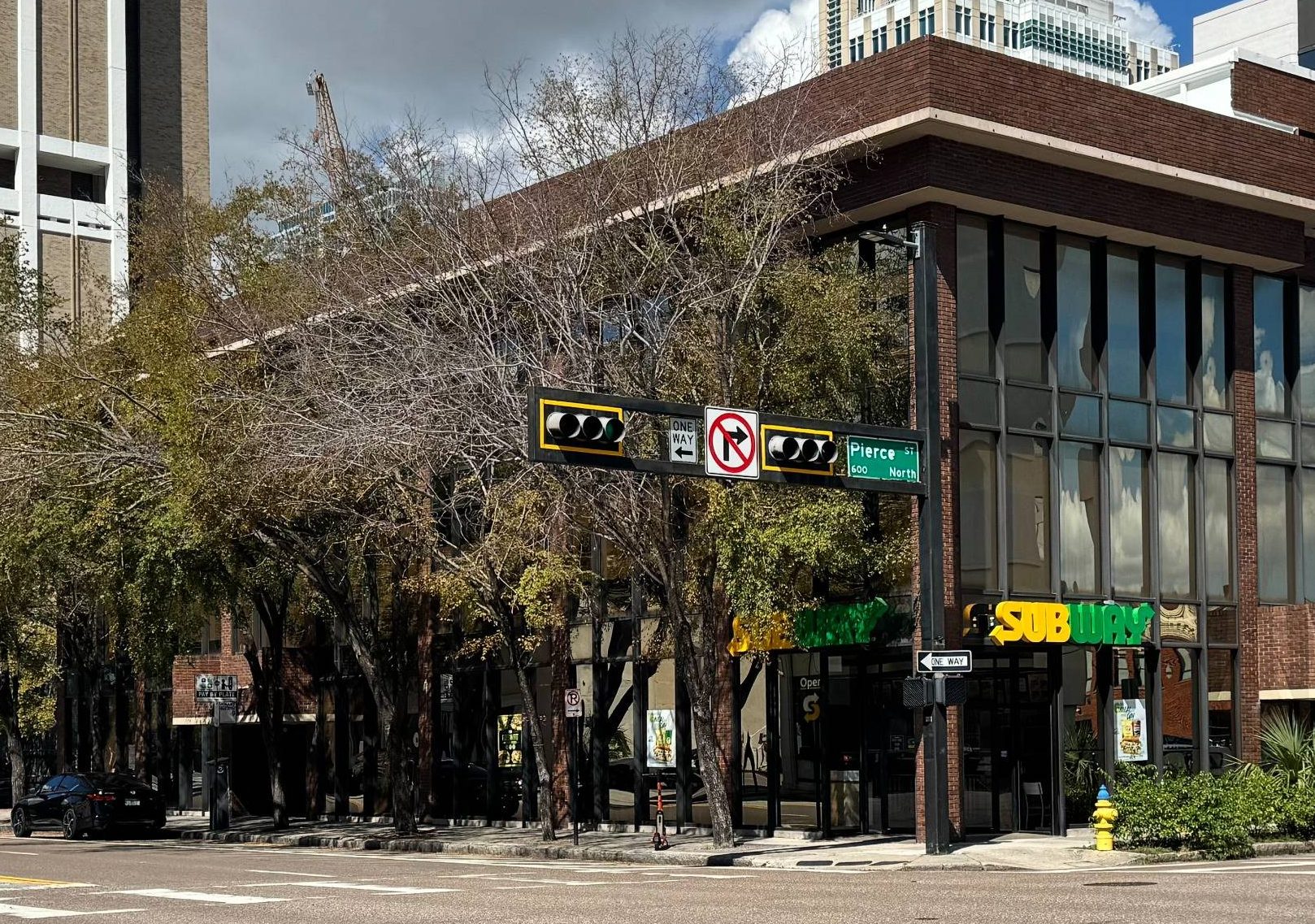
Tampa, FL 33602
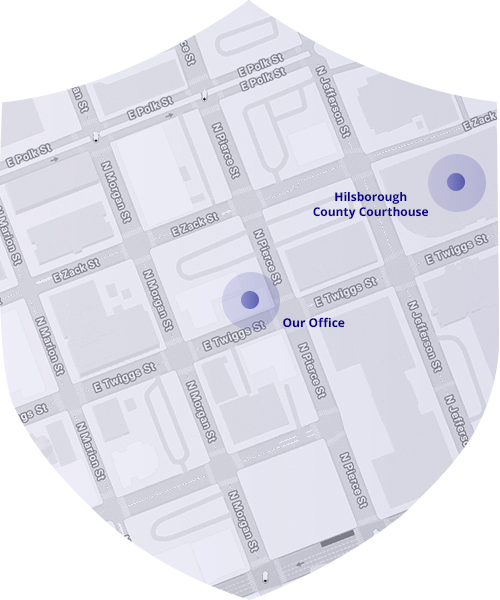
Free Legal Consultation (813) 727-7159