- Free Consultation 24/7: (813) 727-7159 Tap Here To Call Us


From First DUI to Death Penalty



Is Your License Plate Frame Illegal in Florida? (2026)


Fully rewritten and updated October 26, 2026.
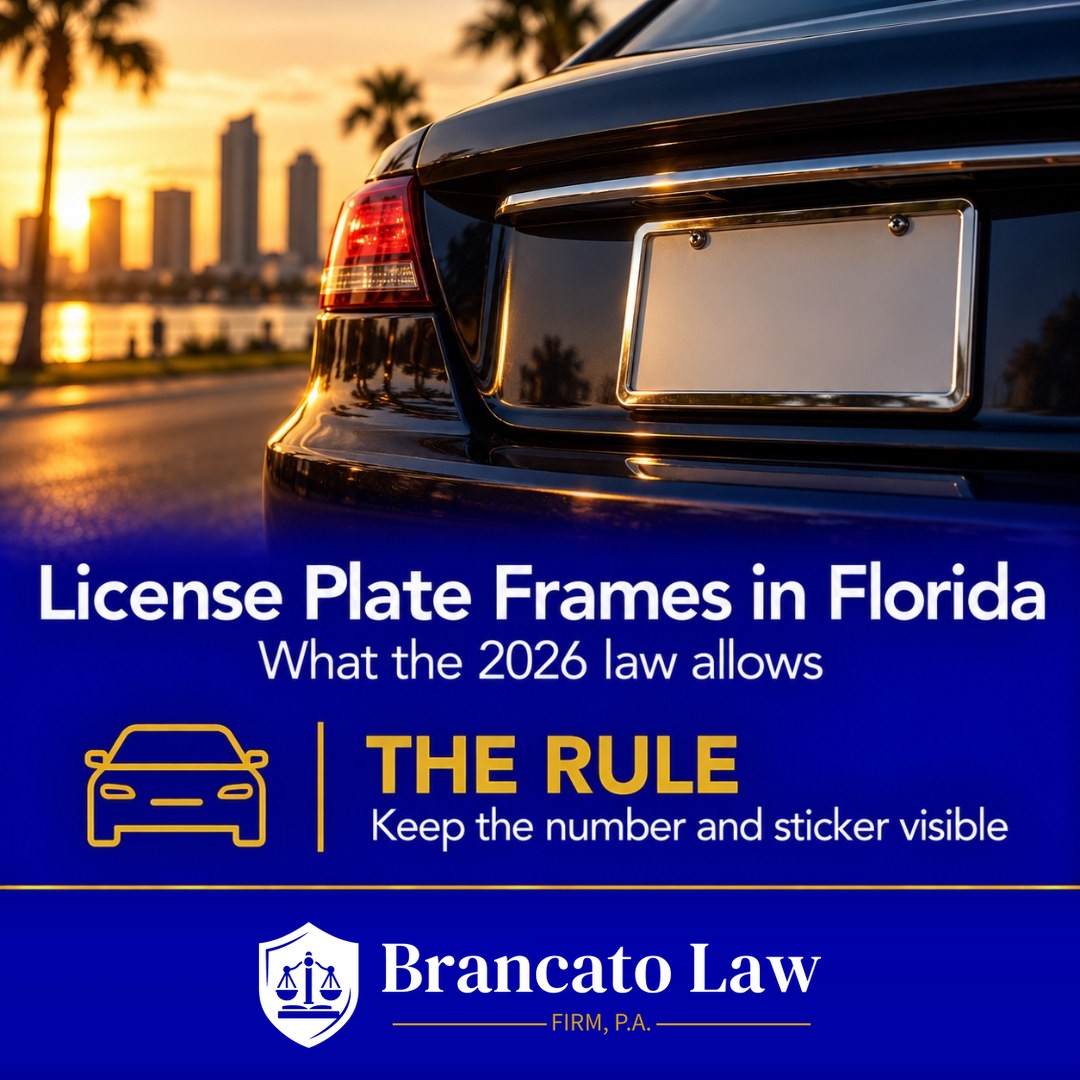
No. A license plate frame is legal in Florida as long as it does not cover the plate number or the registration decal (validation sticker) in the upper right corner. The 2025 law that caused the confusion, section 320.262, targets license plate obscuring devices such as plate flippers and switchers, and the 2026 Legislature added language to sections 320.061 and 320.262 stating that a frame or decorative border “is not an offense” when the number and sticker stay visible. Dealer, team, and college frames that cover “Florida,” “Sunshine State,” or the county name are allowed. Tinted covers, sprays, and flip devices can still lead to a stop or a criminal charge.
Many Tampa drivers pulled their dealer frames off in the fall of 2025 after a viral video claimed any frame was now a crime. We said at the time that standard frames remained legal, and the Florida Department of Highway Safety and Motor Vehicles and then the Legislature agreed. I’m Rocky Brancato, founder of The Brancato Law Firm, P.A., a Tampa criminal defense firm, and a former police academy instructor who taught officers the law of traffic stops. In more than 25 years in Hillsborough County courtrooms I have seen minor equipment stops turn into drug, gun, and DUI cases. Our attorneys challenge those stops when the officer had no lawful reason to make them.
What Does Florida’s License Plate Frame Law Say Now?
Florida now states expressly that frames are lawful if they leave the plate number and sticker visible. Two statutes govern, and both were amended in 2026 by SB 488 (chapter 2026-39, Laws of Florida), which Governor DeSantis signed in April 2026:
| Statute | What it prohibits | Penalty | What it says about frames |
|---|---|---|---|
| s. 316.605(1) | Plate letters, numerals, printing, decal, and number not “plainly visible and legible at all times 100 feet from the rear or front” | Noncriminal nonmoving traffic infraction | No frame language; the 100-foot visibility test applies |
| s. 320.061 | Applying or attaching a substance, reflective matter, spray, coating, covering, or other material that interferes with the legibility of the plate number or validation sticker | Second-degree misdemeanor if done knowingly | A frame or decorative border is not an offense if the number and the upper-right decal stay visible |
| s. 320.262(2) | Buying or possessing a license plate obscuring device | Second-degree misdemeanor | Same frame safe harbor in subsection (5) |
| s. 320.262(3) | Making, selling, or distributing an obscuring device | First-degree misdemeanor | Same |
| s. 320.262(4) | Using an obscuring device to commit a crime or avoid detection or arrest | Third-degree felony | Same |
Section 320.262(5), Florida Statutes, now reads that “the use of a license plate frame or decorative border device is not an offense under this section, provided that the device does not obscure the visibility” of “the alphanumeric designation or license plate number” and “the registration decal or validation sticker located in the upper right corner.” Section 320.061(2) contains the same rule for frames and borders. The 2026 amendment also removed the phrase “primary features or details” from the definition of an obscuring device, which was the language that fueled the 2025 confusion.
What Does Section 320.262 Actually Target?
Section 320.262 targets devices built to hide or swap a plate, not decorative frames. The statute defines a “license plate obscuring device” as a manual, electronic, or mechanical device designed or adapted to switch between plates, flip a plate so the number is not visible, cover or interfere with the legibility of the plate number or validation sticker, or interfere with the ability to record them. Those are the tools used to beat toll readers, red-light cameras, and license plate reader cameras.
The penalties are real for those devices. Simply buying or possessing one is a second-degree misdemeanor, punishable by up to 60 days in jail and a $500 fine, and using one to commit a crime or avoid arrest is a third-degree felony punishable by up to five years in prison. License plate reader cameras such as Flock are now common across Tampa Bay, and our post on Flock cameras and license plate readers in Tampa explains how those systems use your plate.
How Did the License Plate Frame Confusion Start?
It started with a misreading of the 2025 law. Chapter 2025-36 created section 320.262 effective October 1, 2025, and its definition referred to the plate’s “primary features or details, including the license plate number or validation sticker.” A viral video read that phrase to cover every word on the plate, some law enforcement agencies repeated it, and drivers across the state removed their frames.
On December 12, 2025, FLHSMV Executive Director Dave Kerner sent a memo to all Florida law enforcement agencies stating that the act “does not prohibit the use of a license plate frame” as long as it does not obscure the plate number or the decal in the top right corner. The memo added that the department “does not consider the information on the bottom of the plate to be a primary feature of the plate,” and that a frame touching the top of the plate is permissible if officers can still identify the issuing state. The 2026 Legislature then wrote the frame rule into both statutes.
Can Police Still Stop You Because of a License Plate Frame?
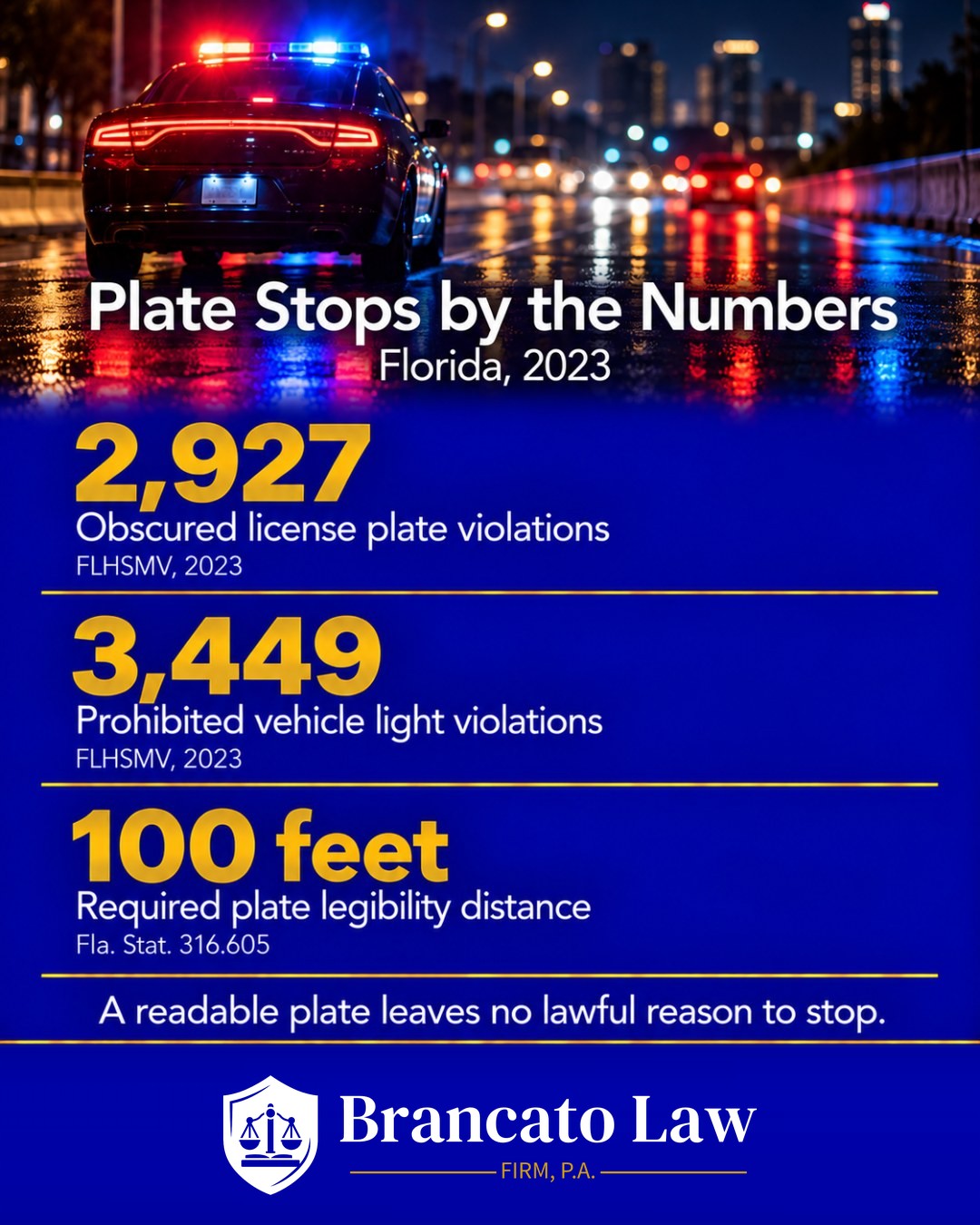
Only if the frame actually makes the plate number, the decal, or other required lettering unreadable from 100 feet. Under section 316.605(1), all “letters, numerals, printing, writing, the registration decal, and the alphanumeric designation” must be “plainly visible and legible at all times 100 feet from the rear or front.” A violation is a noncriminal traffic infraction, but it is still a legal basis for a stop when it truly exists.
Florida courts have refused to let a typical dealer frame justify a stop. In State v. Morris, 270 So. 3d 436 (Fla. 4th DCA 2019), a Broward County officer stopped a car whose Drive Pink AutoNation frame partially covered letters in “Sunshine State” and “MyFlorida.com.” The officer admitted he “didn’t have any trouble” reading the word “Florida,” and the trial judge found that “everything that needs to be identified is identifiable.” The Fourth District affirmed the suppression of the evidence from the stop, holding that “all the letters and words on the license plate were visible within 100 feet.”
The officer’s testimony decides close cases. In Williams v. State, No. 4D19-1578 (Fla. 4th DCA May 13, 2020), the court affirmed the denial of a motion to suppress because the officer testified the tag “was obscured” and “you can barely see it.” In a concurring opinion, Judge Melanie May wrote that “there is nothing about those words that helps law enforcement identify the vehicle’s owner” and that treating frames over “MyFlorida.com” and “Sunshine State” as grounds for a stop “leads to an absurd result,” a view the Legislature effectively adopted in 2026.
| Item | Legal status in Florida | Why |
|---|---|---|
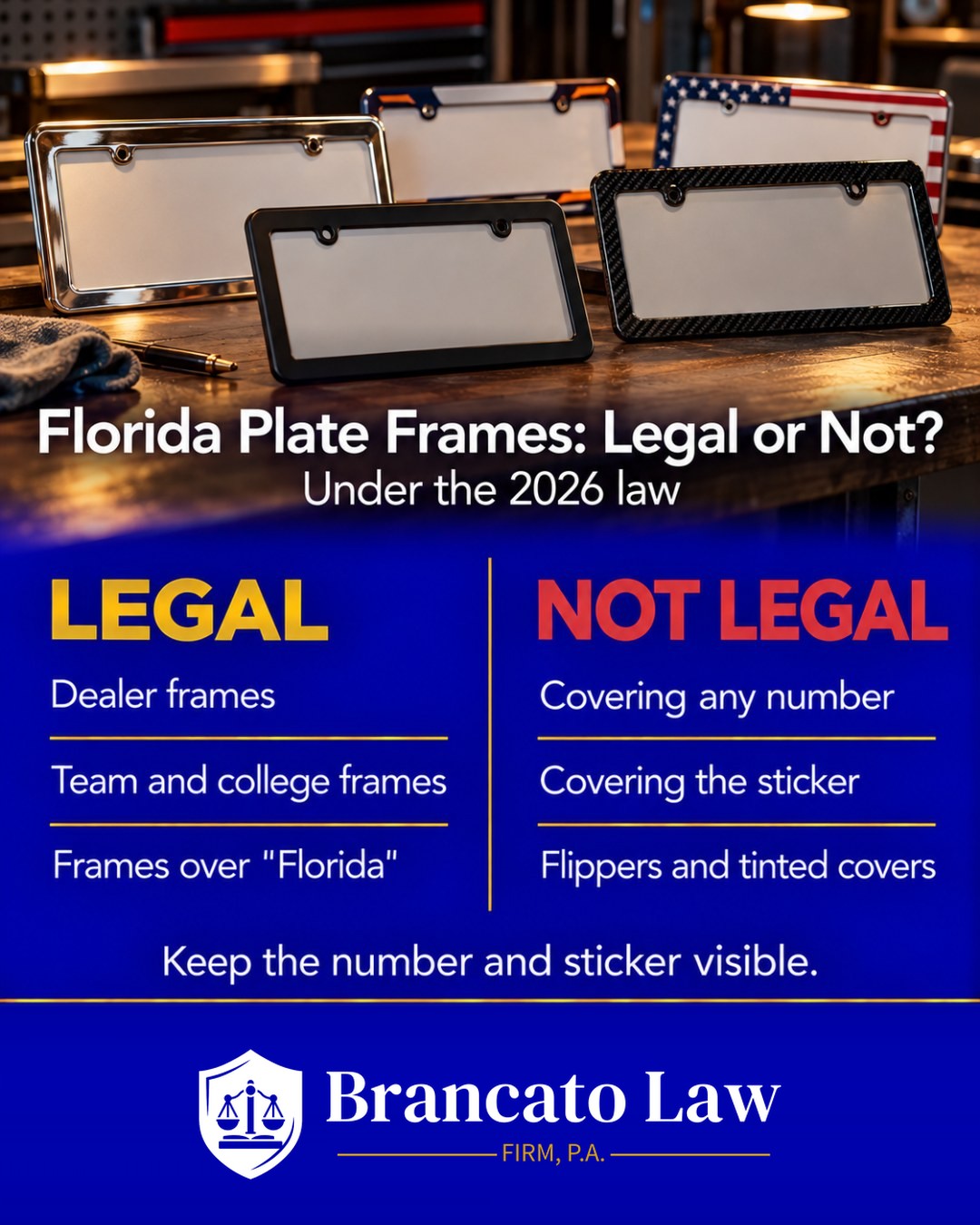
| Dealer, team, or college frame | Legal | Allowed if the plate number and upper-right decal are visible |
| Frame covering “Florida,” “Sunshine State,” or the county name | Legal | Those words are not the number or decal; FLHSMV says officers must still be able to identify the issuing state |
| Frame covering the decal or any character of the number | Illegal | Fails sections 316.605, 320.061, and 320.262(5) |
| Clear plate cover | Risky | Legal if it does not interfere with legibility; glare or condensation can create a stop |
| Tinted or smoked cover | Likely illegal | A covering that interferes with legibility violates section 320.061 |
| Reflective spray or coating | Illegal | Listed in section 320.061; can also defeat cameras |
| Plate flipper, switcher, or remote shutter | Criminal | Possession is a second-degree misdemeanor under section 320.262(2) |
How Often Are Florida Drivers Cited for Obscured Plates?
Thousands of times a year. The Department of Highway Safety and Motor Vehicles’ Uniform Traffic Citation database recorded 2,927 violations related to obscuring a license plate in 2023, and 3,449 violations related to prohibited vehicle lights, according to the Florida Senate Rules Committee analysis of the 2025 bill. Each of those citations began as a traffic stop.
Minor equipment stops matter because of what can follow them. A study published in Nature Human Behaviour in 2020, A Large-Scale Analysis of Racial Disparities in Police Stops Across the United States by Emma Pierson and colleagues at the Stanford Open Policing Project, examined nearly 100 million traffic stops and found that “the bar for searching black and Hispanic drivers was lower than that for searching white drivers.” For drivers, the practical lesson is that the legal basis for the stop is often the most important issue in the case.
Can Evidence Be Suppressed If the Plate Frame Stop Was Illegal?
Yes. If the frame did not violate any statute, the officer had no lawful basis for the stop, and drugs, weapons, or DUI evidence found afterward can be suppressed, as happened in Morris. The flip side is Whren v. United States, 517 U.S. 806 (1996), in which the U.S. Supreme Court held that “the decision to stop an automobile is reasonable where the police have probable cause to believe that a traffic violation has occurred,” whatever the officer’s real motive. Because a real violation makes even a pretextual stop lawful, our attorneys focus on whether the violation existed at all.
Our approach in these cases follows three steps:
- Get the video. Body camera and dash camera footage often shows the plate clearly, contradicting a report that it was unreadable.
- Photograph the plate and frame. A photo taken from the officer’s position and distance tests the 100-foot standard.
- Hold the State to the statute. Under the 2026 amendments, the question is whether the frame covered the number or the upper-right decal, not whether it touched any other word.
Our motion to suppress guide explains how these challenges are filed, and our Tampa criminal traffic lawyer page covers the traffic charges that often follow a stop. Our Hillsborough County criminal defense attorney page explains how a case moves through the local courts after an arrest.
What Should You Do If You Are Stopped for a License Plate Frame?
Stay calm, accept the citation if one is issued, and document the plate before you change anything:
- Do not argue the law at the roadside. Cooperate and save the challenge for court.
- Take photos of the plate and frame from about 100 feet behind the car and up close, as soon as it is safe.
- Do not consent to a search. A frame stop gives no right to search the car without consent or probable cause.
- Keep the frame. If the case involves an arrest, the frame itself may become evidence for the defense.
- Call a defense attorney if the stop led to an arrest, so the body camera footage is requested before it is purged.
Frequently Asked Questions About Florida License Plate Frames
Is my car dealership frame illegal in Florida?
No, a dealership frame is legal as long as it leaves the plate number and the upper-right decal visible, under sections 320.061(2) and 320.262(5). The Brancato Law Firm challenges stops based on dealer frames that met that standard, as the defense did in State v. Morris.
Can I be pulled over if my frame covers the word “Florida”?
A frame covering “Florida” alone does not violate the frame provisions, and FLHSMV told officers that frames at the top of the plate are allowed if the issuing state can still be identified. Our attorneys at The Brancato Law Firm compare the officer’s report with the body camera footage to test any claim that the plate was unreadable.
Are clear license plate covers legal in Florida?
A clear cover is not banned by name, but section 320.061 prohibits any covering that interferes with the legibility of the plate number or sticker, and glare or condensation can do that. The Brancato Law Firm advises drivers that removing the cover is the safest choice; see our criminal traffic defense page for related charges.
Is it a crime to own a license plate flipper in Florida?
Yes, buying or possessing a license plate obscuring device is a second-degree misdemeanor under section 320.262(2), even if it is never used. Our attorneys at The Brancato Law Firm look at whether the item actually meets the statute’s definition of a device designed to switch, flip, or hide a plate.
Can a frame stop lead to a search of my car?
Not by itself, because a traffic infraction allows a stop and a citation, not a search, unless the officer has consent or probable cause. The Brancato Law Firm moves to suppress evidence when a frame stop expanded into a search without a lawful basis; our suppression guide explains how.
Did the 2026 law change the penalty for an obscured plate?
No, the penalties stayed the same: a noncriminal infraction under section 316.605, a second-degree misdemeanor for knowingly obscuring the number or sticker under section 320.061, and the device offenses in section 320.262. The Brancato Law Firm reviews which statute was charged, because the defenses differ for each one.
Talk to a Tampa Defense Attorney About a License Plate Stop
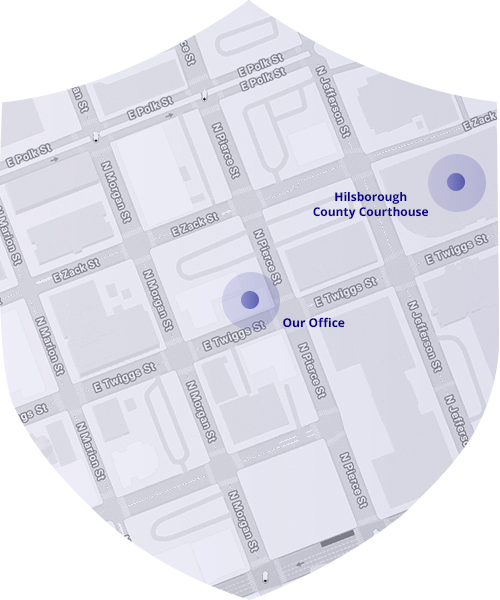
If a frame or plate stop led to an arrest, the body camera footage and a photo of your plate are the first evidence to secure. Our attorneys at The Brancato Law Firm, P.A., founded by Tampa Criminal Defense Attorney Rocky Brancato, will review whether the stop was lawful and what can be suppressed; call (813) 727-7159. You can call us at any hour, and our office is two blocks from the courthouse. Our firm has Spanish-speaking staff, and attorney Jean-Luc Adrien speaks Spanish, Haitian Creole, and French. Read our guide for criminal defense in Spanish and Haitian Creole in Tampa.
For more about our defense strategies, visit our Tampa Criminal Traffic Lawyer page.
The Brancato Law Firm, P.A.
620 E. Twiggs Street, Suite 205, Tampa, FL 33602
(813) 727-7159
Serving Hillsborough, Pinellas, and Pasco Counties
The Brancato Law Firm, P.A. is a Tampa-based criminal defense practice. We are not affiliated with any other Brancato-named law firms.
Visit Us
Tampa, FL 33602
Contact Us Now
Free Legal Consultation (813) 727-7159