- Free Consultation 24/7: (813) 727-7159 Tap Here To Call Us


From First DUI to Death Penalty



How to Fight a Reckless Driving Charge in Hillsborough County (2026)


Updated October 22, 2026
To fight a reckless driving charge in Florida, make the State prove the one element that separates a crime from a traffic ticket: that you drove with “willful or wanton disregard” for the safety of people or property. Speed alone often is not enough. Florida’s Second District Court of Appeal, whose decisions bind Hillsborough County courts, reversed a finding of reckless driving against a man clocked at 94 mph in a 40 mph zone because nothing else showed willful or wanton driving. When the evidence is thin, the case can be dismissed, reduced to noncriminal careless driving, or resolved without a conviction.
Reckless driving is usually won or lost on video and on the gap between “fast” and “willful or wanton.” That gap is where our attorneys work. I’m Rocky Brancato, founder of The Brancato Law Firm, P.A., a Tampa criminal defense firm, and I have spent more than 25 years in Hillsborough County courtrooms, including more than 150 jury trials to verdict. Our attorneys defend reckless driving charges that start as a single traffic stop and ones that come out of crashes, DUI arrests, and street takeovers.
This guide explains what the State has to prove, the penalties under section 316.192, Florida Statutes, and the defenses that work in Tampa courtrooms. If you want the basic definition first, start with our explainer, What Is Reckless Driving in Florida?
What does the State have to prove in a Florida reckless driving case?
The State has to prove that you drove a vehicle “in willful or wanton disregard for the safety of persons or property.” That is the exact language of section 316.192(1)(a). Florida’s standard jury instruction for reckless driving defines both words. “Willful” means intentionally, knowingly, and purposely. “Wanton” means with a conscious and intentional indifference to consequences and with knowledge that damage is likely to be done to persons or property. Those definitions trace back to In the Interest of W.E.B., III v. State, 553 So. 2d 323 (Fla. 1st DCA 1989), a vehicular homicide appeal in which the court held that drinking beer, modest speeding, and overcorrecting showed at most negligence.
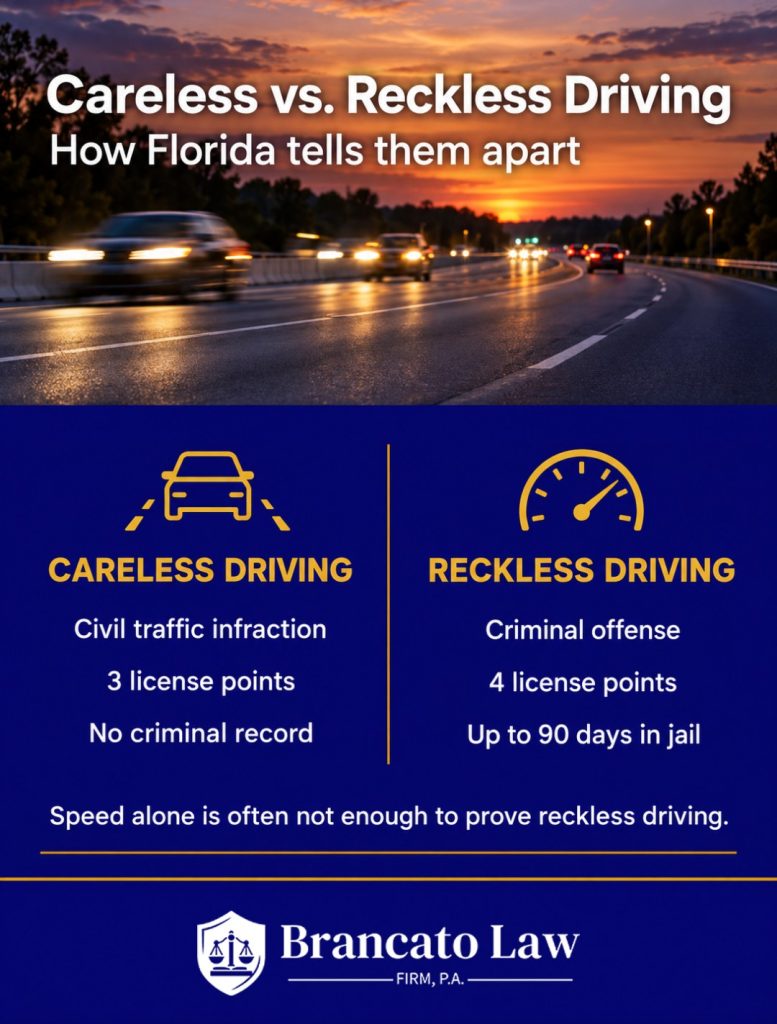
That standard is much higher than ordinary carelessness. Careless driving under section 316.1925, Florida Statutes only requires that a driver failed to drive “in a careful and prudent manner,” and it is a noncriminal moving violation. Reckless driving is a crime. The difference between the two is the difference between paying a fine and carrying a criminal record.
One exception skips the willful-or-wanton question. Under section 316.192(1)(b), “Fleeing a law enforcement officer in a motor vehicle is reckless driving per se.” If the charge is based on fleeing, the defense focuses on whether the driver knew an officer was signaling a stop and whether the stop signal was lawful.
What are the penalties for reckless driving in Florida?
A first reckless driving conviction in Florida carries up to 90 days in jail and a fine of $25 to $500. The penalties climb with prior convictions and with harm caused, as the table below shows.
| Situation | Classification | Maximum penalty |
|---|---|---|
| First conviction, no damage or injury | Criminal traffic offense under § 316.192(2)(a) | Up to 90 days in jail, fine of $25 to $500 |
| Second or later conviction | Criminal traffic offense under § 316.192(2)(b) | Up to 6 months in jail, fine of $50 to $1,000 |
| Damage to the property or person of another | First-degree misdemeanor under § 316.192(3)(c)1. | Up to 1 year in jail and a $1,000 fine |
| Serious bodily injury to another person | Third-degree felony under § 316.192(3)(c)2. | Up to 5 years in prison and a $5,000 fine |
The misdemeanor and felony maximums come from section 775.082, Florida Statutes and section 775.083, Florida Statutes. The statute defines “serious bodily injury” as a physical condition that creates a substantial risk of death, serious personal disfigurement, or protracted loss or impairment of the function of any bodily member or organ.
Two add-ons surprise people. First, if alcohol or drugs contributed to the violation, section 316.192(5) requires the court to order a DUI program substance abuse education course and evaluation. Second, a reckless driving conviction adds 4 points to a Florida license under section 322.27, Florida Statutes, compared with 3 points for careless driving. Twelve points within 12 months brings a suspension of up to 30 days.
Is speeding alone enough for a reckless driving conviction?
Often it is not. In Harris v. State, 318 So. 3d 645 (Fla. 2d DCA 2021), a man on probation was found to have committed reckless driving for driving 94 mph in a 40 mph zone. The Second District reversed. The court held that “his excessive speed alone was insufficient to prove recklessness” because there was no weaving, no endangered traffic or pedestrians, and he stopped safely. Because the Second District hears appeals from Hillsborough, Pinellas, and Pasco Counties, Harris is binding authority in every courtroom where our attorneys practice.
The same court reached a similar result in Smith v. State, 218 So. 3d 996 (Fla. 2d DCA 2017). A driver left the road and struck a bicyclist, and the defense showed a steering defect. The court held the evidence showed at most carelessness or negligence and reversed the reckless driving with serious bodily injury conviction. Cases like these are why our first question in every reckless driving case is what the driver did besides drive fast.
Very high speed now has its own statute. Since July 1, 2025, section 316.1922, Florida Statutes makes it a crime called dangerous excessive speeding to drive 50 mph or more over the limit, or 100 mph or more in a manner that threatens other people or property. A first conviction carries up to 30 days in jail or a $500 fine, and a second conviction within 5 years brings a license revocation of 180 days to 1 year. We explain that law in more detail in our post on Florida’s new dangerous excessive speeding crime.
How do our attorneys fight a reckless driving charge in Tampa?
Our attorneys fight a reckless driving charge by rebuilding the drive itself, second by second, and comparing it with what the officer wrote. You can read more about our approach on our Tampa criminal traffic lawyer page. The work usually follows these steps:
- Get every video before it is overwritten. Body camera and dash camera footage from Tampa Police, the Hillsborough County Sheriff’s Office, or the Florida Highway Patrol, plus business and traffic cameras along the route. Private systems often record over themselves within days.
- Test how speed was measured. Radar, laser, pacing, and aircraft timing each have their own error sources and calibration records.
- Map the road and the traffic. Willful or wanton driving depends on circumstances. Light traffic on an empty stretch of the Selmon Expressway at 2 a.m. is different from a school zone at 3 p.m.
- Find the mechanical or medical explanation. A steering defect won the Smith appeal. In one of our own cases, an accident reconstruction and a brake-system defense turned a vehicular homicide charge into a reckless driving plea and probation instead of prison.
- Challenge the stop and any statements. If the stop was unlawful, or the driver was questioned in custody without Miranda warnings, a motion to suppress can remove the State’s best evidence.
- Negotiate from the weak points. Once the prosecutor sees the gaps, the realistic outcomes widen: dismissal, a reduction to careless driving, or a disposition that protects the client’s license and record.
That case and others are on our case results page. Past results do not guarantee future outcomes.
Can a reckless driving charge be reduced to careless driving?
Yes. A reduction to careless driving is one of the most common good outcomes in a Florida reckless driving case. Careless driving is a noncriminal moving violation under section 316.1925, punished under chapter 318 as a civil infraction. It carries 3 points instead of 4 and creates no criminal record.
Whether a prosecutor will agree depends on the evidence and the driver’s history. A clean driving record, proof of a defensive driving course, and a video that does not match the arrest report all move the needle. Our attorneys make those arguments directly to the assigned prosecutor at the Hillsborough County State Attorney’s Office.
How does reckless driving show up in a DUI case?
In Hillsborough County, reckless driving is also the most common reduced charge in a DUI case. When the DUI evidence is weak, prosecutors will often agree to amend the charge to reckless driving. Our firm has obtained that result for an airline pilot whose career depended on avoiding a DUI conviction, for a marijuana DUI, and for a DUI with open containers but no real sign of impairment.
There are limits. Under section 316.656, Florida Statutes, a judge may not accept a plea to a lesser offense from a driver whose breath or blood test showed 0.15 or higher. The Hillsborough State Attorney’s Office also runs a program called RIDR, Reducing Impaired Driving Recidivism, for first-time, non-aggravated DUI offenders, described on the State Attorney’s programs page. A crash can make a driver ineligible. In one July 2026 case, our client was not eligible for RIDR because of a crash, and a mitigation report and treatment plan still produced a reckless driving plea with adjudication withheld. For the DUI side of these cases, see How to Fight a DUI Charge in Hillsborough County.
How common is reckless and aggressive driving in Florida?
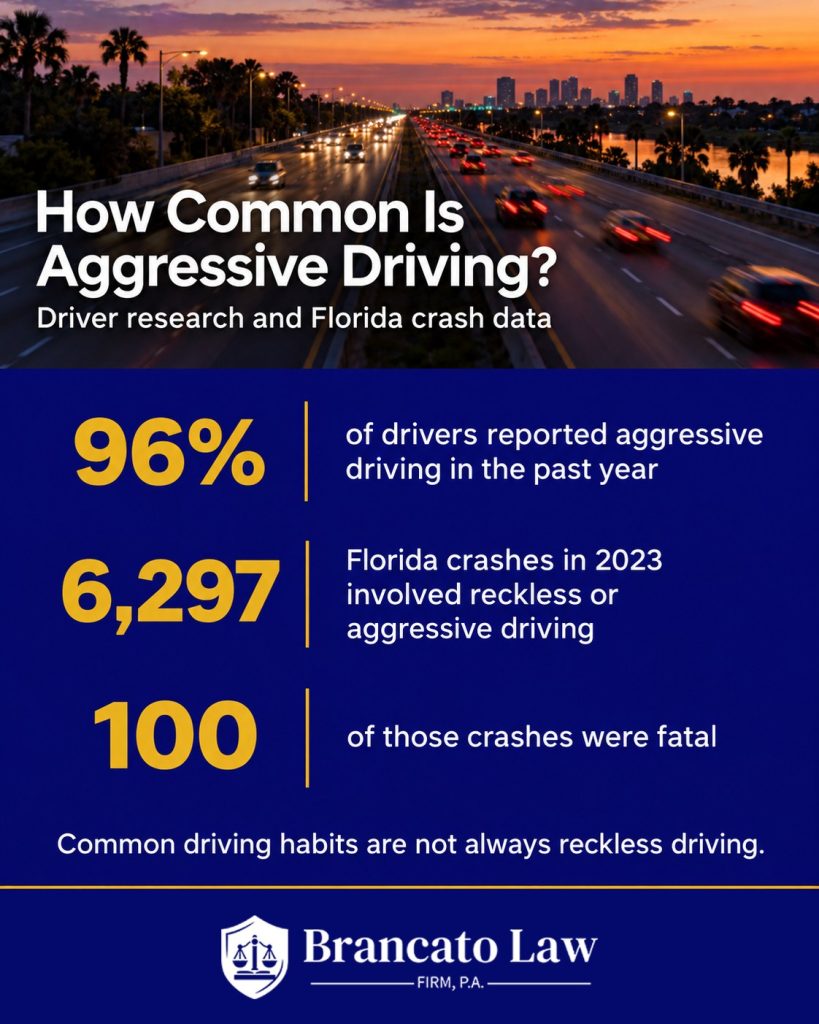
It is very common, which is one reason prosecutors see so many of these cases. FLHSMV’s Traffic Crash Facts Annual Report 2023, the most recent final report, coded 6,297 crashes statewide in 2023 in which the first driver “operated MV in erratic, reckless or aggressive manner,” including 100 fatal crashes.
Research suggests most drivers do some of this. The AAA Foundation for Traffic Safety’s 2025 study, Aggressive Driving and Road Rage, found that 96% of drivers reported at least one aggressive driving or road rage behavior in the previous year. That matters in court. Tailgating, speeding, or a hard lane change is behavior most jurors have seen and done, and it is usually not the conscious indifference to danger that section 316.192 requires.
The table below shows how the charges compare.
| Charge | Statute | Criminal? | License points |
|---|---|---|---|
| Careless driving | § 316.1925 | No, civil infraction | 3 |
| Reckless driving | § 316.192 | Yes | 4 |
| Dangerous excessive speeding | § 316.1922 | Yes | Revocation of 180 days to 1 year on a second conviction within 5 years |
| Racing, street takeover, stunt driving | § 316.191 | Yes, first-degree misdemeanor on a first violation | 1-year revocation on a first violation |
Racing and street takeovers are charged under section 316.191, Florida Statutes. A first violation carries a fine of $500 to $2,000 and a 1-year revocation. Our post on teen takeover arrests covers those cases.
What should you do after a reckless driving citation or arrest?
Act within days, not weeks. Reckless driving is a criminal charge, so it cannot be resolved by paying the ticket, and the case will be set in Hillsborough County Court.
- Do not pay the citation or plead guilty at arraignment. A plea creates the conviction and the 4 points.
- Write down the drive while you remember it. Traffic, weather, lighting, why you were going the speed you were, and anything the officer said.
- List every camera you passed. Gas stations, businesses, apartment complexes, and doorbell cameras.
- Keep your mouth closed about the case. Do not post about it, text about it, or explain it to the officer’s supervisor.
- Talk to a lawyer before arraignment. Early representation is how video gets preserved and how a reduction to careless driving gets negotiated before the State hardens its position.
Frequently asked questions about reckless driving in Hillsborough County
Can a reckless driving charge be dropped in Florida?
Yes. Prosecutors drop reckless driving charges when the evidence does not show willful or wanton driving, when video contradicts the report, or when the stop itself was unlawful. The Brancato Law Firm builds that record early, with the video and the road conditions, and presents it to the prosecutor before the case is set for trial.
Is reckless driving a misdemeanor or a felony in Florida?
A reckless driving charge with no damage or injury is a criminal misdemeanor-level offense, and it becomes a third-degree felony when it causes serious bodily injury under section 316.192(3). Our attorneys at The Brancato Law Firm defend both levels, including felony cases where an accident reconstruction can show the driver did not cause the crash.
Is going 100 mph automatically reckless driving in Florida?
No. Under Harris v. State, 318 So. 3d 645 (Fla. 2d DCA 2021), excessive speed alone did not prove reckless driving, although 100 mph or more in a dangerous manner can now be charged as dangerous excessive speeding under section 316.1922. The Brancato Law Firm looks at what the State can show besides speed, because that is usually where these cases are won.
How many points is reckless driving in Florida?
Reckless driving adds 4 points to a Florida driver’s license, and careless driving adds 3, under section 322.27(3). The Brancato Law Firm keeps the license consequences in view from the start, because a reduction that saves one point can be the difference between keeping and losing a license.
Can I take a driving course instead of going to court for reckless driving?
No. The basic driver improvement election is for noncriminal infractions, and reckless driving is a crime that must go through county court. Our attorneys at The Brancato Law Firm often recommend a defensive driving course anyway, because completing one before the plea discussion can help persuade a prosecutor to reduce the charge to careless driving. See our Tampa criminal traffic defense page for more.
Does a DUI reduced to reckless driving still count as a DUI?
No. A plea to reckless driving is not a DUI conviction, although the court may order the DUI program course and evaluation under section 316.192(5) when alcohol contributed. The Brancato Law Firm has negotiated these reductions in Hillsborough County for clients including a commercial airline pilot, and our post on what happens after a DUI arrest in Hillsborough County explains the timeline.
Talk to a Tampa reckless driving lawyer this week
Video is the evidence that wins most reckless driving cases, and much of it disappears within days of the stop. The Brancato Law Firm, P.A., founded by Tampa Criminal Defense Attorney Rocky Brancato, will request the body camera footage, track down private video, and start the conversation with the prosecutor before your arraignment. Call (813) 727-7159. You can call us at any hour. Our firm has Spanish-speaking staff, and attorney Jean-Luc Adrien speaks Spanish, Haitian Creole, and French. Learn more about our Spanish and Haitian Creole criminal defense services.
For more about our defense strategies, visit our Tampa Criminal Traffic Defense page.
The Brancato Law Firm, P.A.
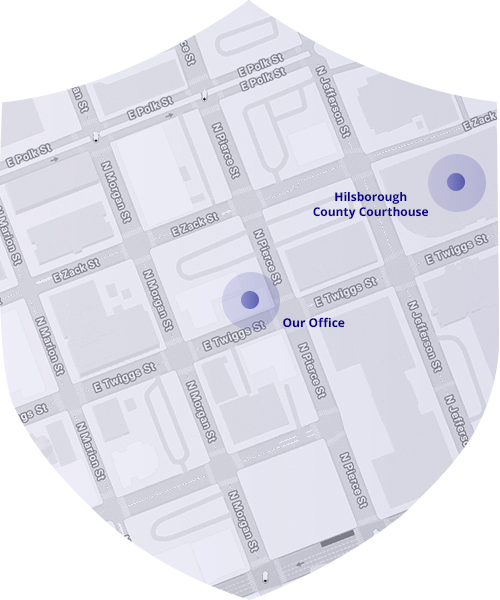
620 E. Twiggs Street, Suite 205, Tampa, FL 33602
(813) 727-7159
Serving Hillsborough, Pinellas, and Pasco Counties
The Brancato Law Firm, P.A. is a Tampa-based criminal defense practice. We are not affiliated with any other Brancato-named law firms.
Each case is unique, and past results do not guarantee future outcomes. This article is general information, not legal advice.
Visit Us
Tampa, FL 33602
Contact Us Now
Free Legal Consultation (813) 727-7159