- Free Consultation 24/7: (813) 727-7159 Tap Here To Call Us


From First DUI to Death Penalty



What to Do After Being Arrested in Tampa: The First 48 Hours and First 30 Days (2026)


Updated November 4, 2026
After an arrest in Tampa, say clearly that you want a lawyer and then stop talking about the case, including on jail phone calls, which are recorded. Florida requires a first appearance before a judge within 24 hours of arrest, and in Hillsborough County the arrested person appears by video from the jail while the judge, who sets bond and release conditions, sits downtown. The State Attorney’s Office then generally has 30 days to file formal charges if you are in custody and 60 days if you are out, and that window is when a defense lawyer can argue for no charges, reduced charges, or diversion.
Much of the evidence that damages a first arrest case in Tampa is created after the handcuffs go on: in the back of the patrol car, on recorded jail calls, and on social media. I’m Rocky Brancato, founder of The Brancato Law Firm, P.A., a Tampa criminal defense firm, and I have watched that pattern for more than 25 years in Hillsborough County, including as former Chief Operations Officer of the Hillsborough County Public Defender’s Office, overseeing a staff of over 100 attorneys. Our attorneys step in at first appearance, argue bond, and contact the State Attorney’s Office before charges are filed, while the outcome is still open.
What should you do in the first 48 hours after an arrest in Tampa?
In the first 48 hours, your job is to protect your rights, get released, and get a lawyer working before first appearance. These six steps cover most first arrests in Hillsborough County.
- Ask for a lawyer out loud, then stop talking. In Miranda v. Arizona, 384 U.S. 436 (1966), the U.S. Supreme Court held that police must warn a person in custody of the right to remain silent and the right to a lawyer, and that questioning must stop once the person asks for one. Silence alone is not always enough. In Salinas v. Texas, 570 U.S. 178 (2013), a man who simply went quiet during a voluntary police interview could not keep prosecutors from using that silence, because he never said he was invoking his rights. Say the words: “I want a lawyer, and I am not answering questions.”
- Do not resist, argue, or explain. Explaining your side to an officer gives the State a recorded statement and rarely ends the arrest. Body cameras and patrol-car cameras keep recording.
- Treat every jail call as a call with the prosecutor listening. Hillsborough County jail calls are recorded, and prosecutors listen to them. In Jackson v. State, 18 So. 3d 1016 (Fla. 2009), the Florida Supreme Court upheld the use of a recorded jail call because the automated warning told the inmate the call was monitored, so he had no protected expectation of privacy.
- Have family call a defense lawyer right away. A lawyer who is retained before first appearance can argue bond and release conditions at that hearing. Family can find you through the Hillsborough County jail inmate search, which shows booking number, charges, and bond.
- Stay off social media, and do not delete anything. Posts, messages, and photos are evidence. Deleting them after an arrest can create a new felony charge for tampering with evidence under section 918.13, Florida Statutes.
- Write down what happened, for your lawyer only. Note times, names, witnesses, and where cameras were. Give the notes to your attorney and to no one else.
Our firm’s practice is devoted entirely to criminal defense, and you can call us at any hour at (813) 727-7159.
Which mistakes after an arrest hurt a Tampa case the most?
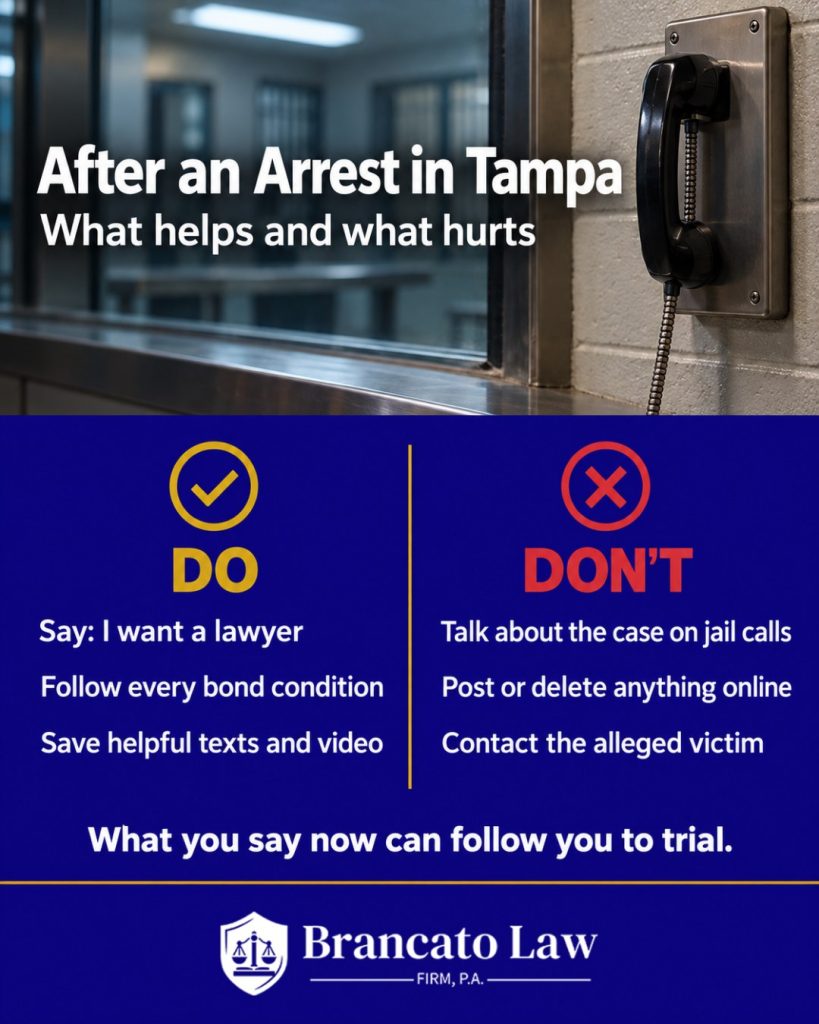
The mistakes that hurt most are talking, contacting the alleged victim, and missing court. The table below sums up what our attorneys tell clients after a first arrest.
| Do | Don’t |
|---|---|
| Say “I want a lawyer” and stop answering questions | Explain your side to officers, cellmates, or detectives |
| Call family to arrange a lawyer and bond | Discuss the facts on a jail phone call or video visit |
| Follow every bond condition exactly | Contact the alleged victim, even to apologize, if a no-contact order is in place |
| Keep copies of your bond paperwork and court notices | Post, comment, or message about the arrest on social media |
| Save receipts, texts, and video that help you, and give them to your lawyer | Delete texts, photos, or posts (that can be tampering with evidence) |
| Tell your lawyer about prior arrests, probation, or immigration status | Miss a court date (the judge can issue a capias, an arrest warrant for failing to appear) |
| Let your lawyer contact the State Attorney’s Office | Talk to the prosecutor or detective yourself to “clear things up” |
What happens at first appearance in Hillsborough County?
First appearance is a short hearing, held within 24 hours of arrest, where a judge reviews the charges and sets bond and release conditions. Under Florida Rule of Criminal Procedure 3.130, every arrested person who has not already been lawfully released must be taken before a judge within 24 hours, in person or by audio-video technology. For people arrested in Hillsborough County, the arrested person is booked at the Orient Road Jail and appears by video from the jail, while the judge and the lawyers appear from downtown.
At the hearing, the judge must tell you the charges, advise you that you do not have to speak, and set pretrial release or detention. A prosecutor and an assistant public defender are usually present. If you have hired a private lawyer, the judge must give reasonable time to reach that lawyer. You can read the current rules on The Florida Bar’s rules page.
A separate federal deadline applies to warrantless arrests. In County of Riverside v. McLaughlin, 500 U.S. 44 (1991), the Supreme Court held that a person arrested without a warrant generally must receive a judicial probable cause determination within 48 hours. Florida’s Rule 3.133(a) requires a judge’s probable cause review within 48 hours for anyone held in custody, unless a judge already found probable cause when issuing an arrest warrant.
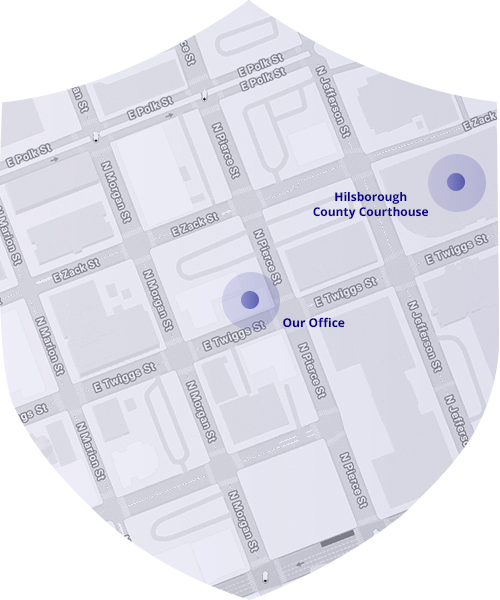
First appearance moves fast. A lawyer who has already talked with the family can tell the judge about your job, your ties to Tampa, and your lack of a record before bond is set. In one of our firm’s August 2026 cases, a domestic violence battery by strangulation count was dismissed at first appearance, and the State later declined to file charges at all. Our office at 620 E. Twiggs Street is two blocks from the courthouse, and our Hillsborough County criminal defense lawyers handle first appearance and bond hearings as a routine part of the practice.
How do bond and pretrial release work in Hillsborough County?
In Hillsborough County, release usually comes through a cash bond, a surety bond posted through a bail bond agent, or release on recognizance, meaning release on your promise to return. Hillsborough County does not offer pretrial services supervision as a release option, though some neighboring counties do. That makes the first bond argument more important here, because there is no supervised-release middle ground for the judge to fall back on.
Some people can bond out before first appearance using the statewide bond schedule. Since January 1, 2024, section 903.011, Florida Statutes has required the Florida Supreme Court to adopt a uniform statewide bond schedule. The same statute bars release before first appearance for people arrested on capital, life, first-degree, or second-degree felonies and certain other listed offenses, so those defendants wait for a judge.
When the judge sets bond, section 903.046, Florida Statutes lists what the court considers: the charge, the strength of the evidence, family ties, length of residence, employment, past record, and danger to the community. For charges the law defines as “dangerous crimes,” section 907.041, Florida Statutes bars nonmonetary release at first appearance and lets the State move to hold the person without bond.
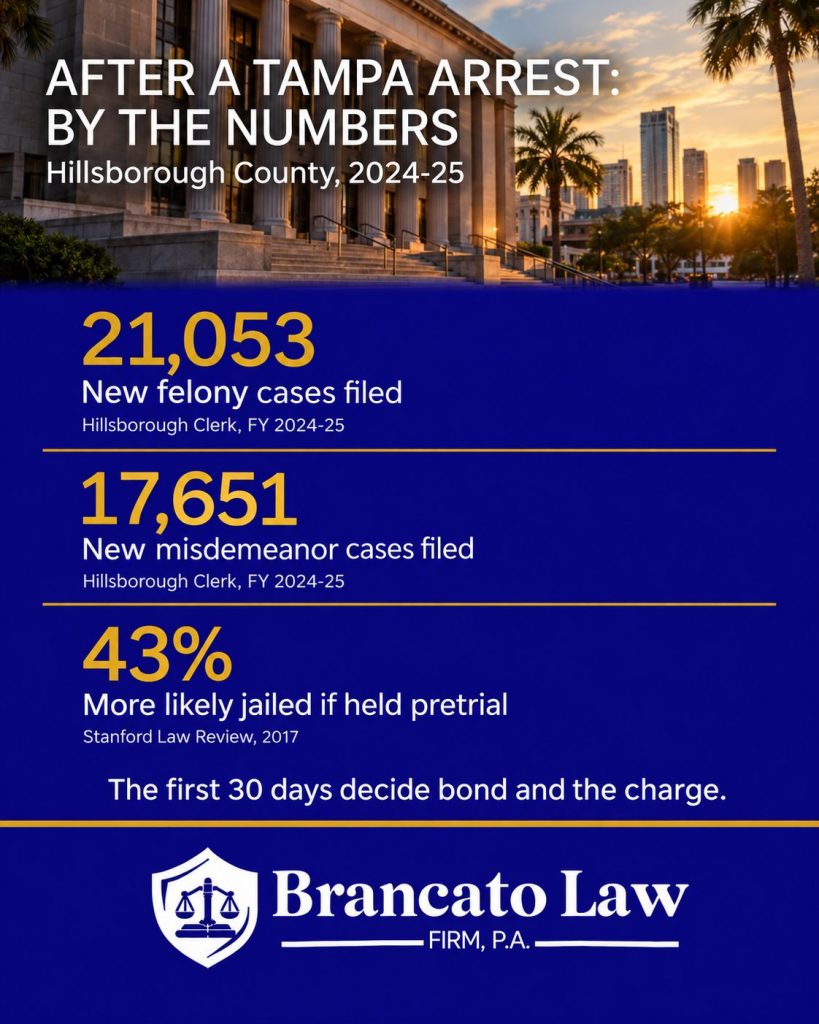
Getting out early matters for the whole case, and research backs that up. In a 2017 study of misdemeanor cases in Harris County, Texas, published as The Downstream Consequences of Misdemeanor Pretrial Detention, 69 Stan. L. Rev. 711, Paul Heaton, Sandra Mayson, and Megan Stevenson found that detained defendants were 25% more likely to plead guilty and 43% more likely to be sentenced to jail than similar defendants who were released. Our firm’s walkthrough of the Hillsborough County bond process explains self-surrender on a warrant that already has a bond set.
What happens in the first 30 days while the State Attorney decides on charges?
During the first 30 days, a prosecutor at the State Attorney’s Office for the 13th Judicial Circuit reviews the arrest report and decides whether to file formal charges, file reduced charges, or decline the case. The arrest itself is the officer’s decision. The charge is the prosecutor’s.
Florida Rule of Criminal Procedure 3.134 sets the clock. If you are in custody, the State must file formal charges within 30 days of arrest. If it has not, the court on day 30 orders release on your own recognizance on day 33, or on day 40 if the State shows good cause, and no one may be held more than 40 days without a formal charge. If you are out on bond, the State has 60 days, and the court can release you from all bond conditions on day 63 unless charges are filed or the State shows good cause for up to 30 more days. For felony arrests, Rule 3.133(b) also gives a right to an adversary preliminary hearing if no information or indictment is filed within 21 days.
The filing window is busy. From October 2024 through September 2025, the Hillsborough County Clerk of Court opened 21,053 new circuit criminal (felony) cases and 17,651 new county criminal (misdemeanor) cases, according to the Clerk’s monthly outputs report for county fiscal year 2024-25. In our experience, an intake prosecutor working that volume decides most cases on the police report unless the defense supplies more.
That is what pre-file advocacy is. Our attorneys contact the assigned prosecutor, send video, witness statements, receipts, or a signed affidavit from the alleged victim, and explain the legal problems in the case before a decision is made. When it works, the State files a “no information,” meaning it declines to prosecute, or files a lesser charge, or offers diversion. The next section walks through what that early work looks like.
What does a defense lawyer do in the first two weeks after an arrest?
In the first two weeks, a defense lawyer preserves evidence that is about to disappear, finds witnesses, and looks for legal problems with the stop, search, or arrest. That work happens while the State Attorney is still deciding what to file, so it can change the charge as well as the trial.
- Preserve video before it is recorded over. Many businesses and homes keep surveillance footage for only days or weeks before the system writes over it. Our attorneys send preservation letters, request body camera and patrol-car video from the arresting agency, and subpoena records once a case number exists.
- Interview witnesses while memories are fresh. Witnesses forget details, move, and change phone numbers. Our firm finds and interviews the people police never spoke to and records what they saw.
- Review the stop and search for a motion to suppress. The Fourth Amendment bars unreasonable searches and seizures. In Mapp v. Ohio, 367 U.S. 643 (1961), the U.S. Supreme Court held that evidence police obtain through an unconstitutional search cannot be used in a state criminal trial. In Florida, the defense raises that issue with a motion to suppress under Florida Rule of Criminal Procedure 3.190(g).
- Bring in experts early. Toxicology, fingerprint, and digital evidence experts need time, and an early review often decides whether a lab result or phone extraction will hold up.
Fast action has changed outcomes for our clients. In one Hillsborough County case, a client was arrested for cocaine possession and possession of a firearm during a felony. Our firm argued for low bonds at first appearance and then contacted the intake prosecutor, and within days the State decided not to file any charges. In a driving while license suspended case, our firm requested the body camera video the same day we met the client in jail; the video showed that the actual driver had given police false identification, and the prosecutor dismissed the charge the next day in court. Past results do not guarantee future outcomes.
How long does each step take after a Tampa arrest?
Most first arrests in Hillsborough County follow the timeline below. The deadlines come from the Florida Rules of Criminal Procedure. The local details come from our firm’s daily practice in the 13th Circuit.
| When | What happens | What our attorneys do |
|---|---|---|
| Hour 0 | Arrest, booking at the Orient Road Jail | Take the family’s call at any hour, confirm charges and bond through the inmate search |
| Before first appearance | Release on the bond schedule for eligible charges | Advise whether to post the scheduled bond or wait for a lower amount |
| Within 24 hours | First appearance before a judge (Rule 3.130) | Argue bond and release conditions, challenge probable cause |
| Within 48 hours | Probable cause review for people held in custody (Rule 3.133(a)) | Check that the deadline was met |
| Days 1 to 30 | State Attorney reviews the case for filing | Pre-file advocacy: evidence and argument to the assigned prosecutor |
| Day 21 (felony) | Adversary preliminary hearing available if no charge filed (Rule 3.133(b)) | Demand the hearing when it helps the client |
| Day 30, 33, 40 (in custody) | Filing deadline, then release on recognizance if no charge (Rule 3.134) | Move for release if the State misses the deadline |
| Day 60, 63 (out of custody) | Filing deadline, then release from bond conditions if no charge (Rule 3.134) | Move to end bond conditions if no charge is filed |
| After charges are filed | Arraignment (Rule 3.160) | File a written plea of not guilty, demand discovery |
| Weeks to months later | Pretrial hearings, motions, plea talks, or trial | Depositions, motions to suppress or dismiss, trial preparation |
What happens at arraignment in Hillsborough County?
Arraignment is the hearing where you are formally told the charge and enter a plea. Under Florida Rule of Criminal Procedure 3.160, it follows the filing of formal charges. When you have a lawyer, the lawyer usually files a written plea of not guilty before the arraignment date, which waives your appearance at that hearing.
After arraignment, the case moves into discovery, depositions, motions, and pretrial hearings. Our firm’s guide to the steps in a Hillsborough County criminal case covers that stage in detail. Felony cases are heard at the George Edgecomb Courthouse at 800 E. Twiggs Street, two blocks from our office.
Is a first arrest in Tampa a misdemeanor or felony case?
The answer depends on the charge, and the track matters because it decides the court, the maximum penalty, and which diversion programs are open. Misdemeanors are heard in county court and felonies in circuit court. The maximums below come from section 775.082, Florida Statutes and section 775.083, Florida Statutes.
| Level | Court | Maximum jail or prison | Maximum fine |
|---|---|---|---|
| Second-degree misdemeanor | County court | 60 days | $500 |
| First-degree misdemeanor | County court | 1 year | $1,000 |
| Third-degree felony | Circuit court | 5 years | $5,000 |
| Second-degree felony | Circuit court | 15 years | $10,000 |
| First-degree felony | Circuit court | 30 years | $10,000 |
If you need a lawyer for a felony charge in Tampa, the stakes run beyond the sentence. A felony conviction can affect gun rights, professional licenses, and immigration status. Felony sentencing runs through a Criminal Punishment Code scoresheet, the point system that sets the lowest permissible sentence, so the charge the State files in the first 30 days often sets the range for the whole case. Our attorneys defend everything from first-time misdemeanors to capital cases, and I meet the Florida Rule of Criminal Procedure 3.112 qualifications for death penalty cases.
Are there diversion programs for first offenders in Hillsborough County?
Yes. The State Attorney’s Office for the 13th Judicial Circuit runs several diversion programs, and most require the prosecutor’s consent. The programs below are listed on the office’s programs page.
| Program | Who it is for, per the State Attorney’s Office |
|---|---|
| Adult Pre-Arrest Diversion (APAD) | People with minimal or no criminal history who commit an eligible misdemeanor (listed as pre-arrest diversion) |
| Misdemeanor Intervention Program (MIP) | First-time offenders, with the State Attorney’s consent |
| Pretrial Intervention (PTI) | Certain first-time felony offenders, supervised by the Department of Corrections |
| Drug Education and Treatment Reducing Recidivism (DETRR) | Low-risk, nonviolent drug possession cases; charge dismissed after treatment or education and six months arrest-free |
| Reducing Impaired Driving Recidivism (RIDR) | First-time, non-aggravated DUI cases |
| Domestic Violence Intervention Program (DVIP) | Misdemeanor domestic violence charges, with the State Attorney’s consent and a certified batterers’ intervention program |
| Traffic Diversion | Certain criminal traffic charges tied to licensing and registration, at the office’s discretion |
Felony pretrial intervention is governed by section 948.08, Florida Statutes. It is open to first offenders, or people with no more than one prior nonviolent misdemeanor, charged with a misdemeanor or third-degree felony, and it requires consent from the program administrator, the victim, the State Attorney, and the judge. Misdemeanor drug court, veterans court, and mental health court programs are governed by section 948.16, Florida Statutes, and successful completion requires the court to dismiss the charges.
Eligibility is not automatic. A prosecutor decides whether to offer diversion, and the best time to ask is before the charging decision, with the reasons laid out in writing. Our firm has closed drug possession and driving while license suspended cases through diversion with no conviction. For a DUI arrest, our post on what happens after a DUI arrest in Hillsborough County explains RIDR and the separate 10-day license deadline.
How do I choose a criminal defense lawyer after a first arrest in Tampa?
Choose a lawyer who handles criminal cases every day in the county where you were charged, who can start before first appearance, and who will tell you plainly what the case is worth. Our complete guide to choosing a criminal defense attorney in Tampa and our list of six red flags to avoid go deeper. These are the questions to ask, with our firm’s answers.
- How much trial experience does the firm have? I have tried more than 150 jury trials to verdict. I came out of the Major Crimes Unit, handling homicide, sex crime, and child abuse cases, and I am a former police academy instructor and a member of the National College for DUI Defense and the DUI Defense Lawyers Association. I hold an AV Preeminent rating from Martindale-Hubbell, have been selected to Super Lawyers, and have been named to The National Trial Lawyers Top 100. I also wrote How to Choose a Major Crimes Attorney – or Any Criminal Defense Attorney for That Matter.
- Does the firm only do criminal defense? Yes. Our practice is devoted entirely to criminal defense, from first-offense misdemeanors to homicide. See our full list of practice areas.
- Where does the firm practice? We serve Hillsborough, Pinellas, and Pasco Counties, including Pinellas County criminal cases and Pasco County criminal cases.
- Can I reach the firm? Call us at any hour. Clients get case updates through a client portal, and we return calls within 24 hours. Our firm has Spanish-speaking staff, and attorney Jean-Luc Adrien speaks Spanish, Haitian Creole, and French.
- What will it cost? Our firm charges a flat fee that covers the whole case, including trial, quoted on the facts and the intricacy of the case. At least half is due up front, with a payment plan for the balance while the case is pending. We are neither the most nor the least expensive firm in Tampa, and the consultation is free. A flat fee that includes trial matters because a separate trial fee gives a lawyer a financial incentive to settle before trial preparation begins. Our article on what a criminal defense attorney costs in Tampa explains the fee factors.
What results has our firm obtained early in a case?
Some of our firm’s best outcomes came in the first weeks after arrest, before a charge was filed or soon after. These are published results from our firm’s case results page.
| Charge | Result | Date |
|---|---|---|
| Aggravated assault | Charges never filed; letter of release issued after a signed victim affidavit | February 2026 |
| Felony drug possession (husband and wife) | Charges never filed after a constructive possession argument | March 2026 |
| Fentanyl trafficking | Detention challenged, bond secured, case dismissed within three weeks | March 2025 |
| Disorderly intoxication and harassing a first responder | No charges filed after 10 hours of community service | January 2026 |
| Driving while license suspended | Released from jail after a long hold; case closed through diversion with no conviction | June 2026 |
| Drug possession (multiple counts) | Diversion completed; charges dismissed and eligible for expungement | October 2026 |
Past results do not guarantee future outcomes.
Why should you call a lawyer before first appearance and the filing decision?
Call before first appearance because bond is set at that hearing, and call before the filing decision because that is the fastest point to change the charge. Once the State files an information, the prosecutor has committed to a charge, and changing it takes motions, depositions, and months of court dates. Before filing, a phone call and a packet of evidence can end the case.
The first 30 days also shape your record. A case that is never filed, or that ends through diversion, leaves you in a far better position to seal or expunge the arrest than a case that ends in a plea. For more about our defense strategies, visit our Hillsborough County criminal defense page.
Frequently asked questions
I was arrested in Tampa for the first time and I’m terrified. Can a defense attorney help with a first-offense case?
Yes, and a first offense is often the case where a lawyer can do the most, because first offenders are the main candidates for no-file decisions and diversion. The Brancato Law Firm handles first-offense cases from first appearance through the State Attorney’s filing decision, presenting evidence and mitigation before a charge is set. Our Hillsborough County defense team has closed cases with no charges filed and through diversion.
I need a lawyer for a felony charge in Tampa. What should I look for?
Look for felony trial experience in the 13th Circuit and a firm that will act before the State files its information. At The Brancato Law Firm, felony clients get attorneys who have tried felony cases to verdict in Hillsborough County, led by a founder with more than 150 jury trials. If the State has not filed yet, representation before charges are filed can shape the charge itself.
Can you recommend a good criminal defense attorney in Tampa, Florida?
A good Tampa criminal defense attorney practices criminal law full time, has real trial experience, appears in Hillsborough County courtrooms regularly, and explains fees in writing. The Brancato Law Firm, P.A. meets each of those tests: our practice is devoted entirely to criminal defense, our founder has tried more than 150 jury trials to verdict, and we quote a flat fee that includes trial. Our breakdown of criminal defense fees in Tampa shows how that fee is set.
I need a criminal defense lawyer in Tampa Bay. Do you handle cases outside Hillsborough County?
Yes. The Brancato Law Firm represents clients in Hillsborough, Pinellas, and Pasco Counties, and our attorneys know the first appearance and bond practices that differ among those courthouses. For a St. Petersburg or Clearwater arrest, see our Pinellas County criminal defense page.
I was charged with a crime in Tampa and my previous attorney didn’t do anything. Can I switch lawyers?
Yes, you can hire a new lawyer at any stage, and the new lawyer enters the case by filing a notice with the court. Our attorneys at The Brancato Law Firm take over cases mid-stream, review the discovery that has been produced, and look for missed motions, deadlines, and depositions. Our comparison of a public defender and a private attorney in Tampa covers what to expect from each.
Can I get out of jail before first appearance in Hillsborough County?
Often yes, if the charge is eligible for release on the statewide bond schedule and you can post the scheduled amount. The Brancato Law Firm advises families whether to post the scheduled bond or wait for first appearance, where our attorneys can argue for a lower amount or release on recognizance. People arrested on first- or second-degree felonies and other offenses listed in section 903.011, Florida Statutes must wait for a judge.
Are Hillsborough County jail calls really recorded, and can they be used against me?
Yes. The Brancato Law Firm sees recorded jail calls offered as evidence in Hillsborough cases regularly, and we tell every client in custody to discuss nothing about the facts on the phone. Under Jackson v. State, 18 So. 3d 1016 (Fla. 2009), the automated warning that the call is monitored defeats any claim of privacy.
For how this fits into the rest of a case, see our stage-by-stage guide to the Florida criminal case process.
Call us before your first court date
Call us before your first appearance if you can, and before the State Attorney’s filing decision if you cannot, because those two deadlines decide bond and the charge. The Brancato Law Firm, P.A. was founded by Tampa Criminal Defense Attorney Rocky Brancato, and our attorneys can start on your case today. Call (813) 727-7159 at any hour for a free consultation.
The Brancato Law Firm, P.A.
620 E. Twiggs Street, Suite 205, Tampa, FL 33602
(813) 727-7159
Serving Hillsborough, Pinellas, and Pasco Counties
The Brancato Law Firm, P.A. is a Tampa-based criminal defense practice. We are not affiliated with any other Brancato-named law firms.
Visit Us
Tampa, FL 33602
Contact Us Now
Free Legal Consultation (813) 727-7159