- Free Consultation 24/7: (813) 727-7159 Tap Here To Call Us


From First DUI to Death Penalty



How to Switch Criminal Defense Lawyers in Florida: 6 Red Flags (2026)



Updated October 22, 2026
You can switch criminal defense lawyers in Florida at any time. The comment to Rule 4-1.16 of the Rules Regulating The Florida Bar says a client “has a right to discharge a lawyer at any time, with or without cause,” subject to paying for work already done. The new lawyer files an appearance, and the court enters an order substituting counsel with the client’s written consent under Rule 2.505(e)(3). Unearned fees must generally be refunded. The main risk is timing: close to trial, a judge may refuse to delay the case, so the best time to switch is as soon as the warning signs appear.
If your lawyer has not returned your calls in weeks, has not shown you the evidence, or is pushing a plea you do not understand, you are not stuck. Changing lawyers in the middle of a case is common, and the rules make it simpler than most people expect. I’m Rocky Brancato, founder of The Brancato Law Firm, P.A., a Tampa criminal defense firm. As former Chief Operations Officer of the Hillsborough County Public Defender’s Office, where I oversaw a staff of over 100 attorneys, I evaluated lawyers’ work for a living. Our attorneys review pending cases, tell clients honestly whether the current lawyer is doing the job, and take over the case when a change is needed.
Can I fire my criminal defense lawyer in Florida?
Yes. A client in Florida can discharge a lawyer at any time, for any reason. The comment to Rule 4-1.16 of the Rules Regulating The Florida Bar states that “A client has a right to discharge a lawyer at any time, with or without cause, subject to liability for payment for the lawyer’s services.” Once discharged, the lawyer must withdraw under Rule 4-1.16(a)(3).
Florida courts enforce that right without formalities. In Virgin v. Frexes, 435 So. 3d 157 (Fla. 3d DCA 2026), the court held that a client may discharge a lawyer simply by giving notice, and that “No magic words are required.” The client remains responsible for the reasonable value of the work the lawyer already did.
The constitutional right behind this is the right to counsel of choice. In United States v. Gonzalez-Lopez, 548 U.S. 140 (2006), the U.S. Supreme Court held that wrongly denying a defendant the lawyer he chose is a structural error that requires reversal without any showing of prejudice. The Court also recognized that trial judges have “wide latitude in balancing the right to counsel of choice against the needs of fairness” and “the demands of its calendar.” That balance is why timing matters.
What are the warning signs your lawyer is not doing the job?
The warning signs line up with the duties every Florida lawyer owes a client. Rule 4-1.3 requires a lawyer to “act with reasonable diligence and promptness.” Rule 4-1.4 requires a lawyer to “keep the client reasonably informed about the status of the matter,” “promptly comply with reasonable requests for information,” and explain a matter “to the extent reasonably necessary to permit the client to make informed decisions.” Measured against those rules, here are the six red flags we see most.
| Red flag | What it looks like | Why it matters |
|---|---|---|
| 1. Silence | Calls and messages go unanswered for weeks | Prompt response to reasonable requests for information (Rule 4-1.4) |
| 2. No look at the evidence | You have never seen the police report, video, or discovery, and no depositions are scheduled | Reasonable diligence and promptness (Rule 4-1.3) |
| 3. A plea with no explanation | You are told to take a deal without a review of the evidence, the defenses, or the scoresheet | Explanation sufficient for an informed decision (Rule 4-1.4(b)) |
| 4. The bait-and-switch | The lawyer who signed you up never appears, and someone you never met handles the case | You are entitled to know who is representing you |
| 5. Promises instead of work | A guaranteed result, or reliance on “knowing the judge” | Bar rules treat predictions or guarantees of results in advertising as misleading (Rule 4-7.13) |
| 6. A marketing brand, not a firm | The name you hired is not the firm that appears in court | Referral and fee-sharing arrangements must be disclosed |
These complaints are common. According to The Florida Bar’s report on 2024 discipline trends, the Bar receives about 14,000 inquiries a year and opened 3,659 files in 2024. Neglect ranked second and inadequate communication ranked fourth among complaint types.
How do you check who is actually representing you?
Check the court file and the state’s business records. Once a lawyer takes a criminal case, a notice of appearance is filed with the court. In Hillsborough County, you can see who has appeared in your case on the Clerk’s online court records. If the name on the court record is a different firm from the one you hired, ask why.
You can also search the lawyer and the firm on Sunbiz.org, the Florida Division of Corporations site, to see whether the lawyer is an officer of a separate firm. Some statewide brands are marketing operations that refer cases to independent local lawyers. Referral arrangements are not automatically improper, but they must be disclosed in writing, and you are entitled to know who will stand next to you in court.
How does switching lawyers work, step by step?
Switching lawyers follows a short, predictable process. The table below shows the order our attorneys follow when we take over a pending case.
| Step | What happens | Rule |
|---|---|---|
| 1. Consult a new lawyer | The new lawyer reviews the charges, the court dates, and what has been done | None |
| 2. Retain the new lawyer | Sign a written fee agreement and set a payment plan | Rule 4-1.5 |
| 3. Notify the old lawyer | A simple written notice is enough | Rule 4-1.16 comment; Virgin v. Frexes |
| 4. Substitute counsel | The court enters an order substituting counsel that reflects the client’s written consent | Fla. R. Gen. Prac. & Jud. Admin. 2.505(e)(3) |
| 5. Transfer the file | The old lawyer surrenders papers and property the client is entitled to and refunds unearned fees | Rule 4-1.16(d) |
| 6. Catch up | The new lawyer obtains discovery, reviews deadlines, and asks for time if needed | Court’s discretion |
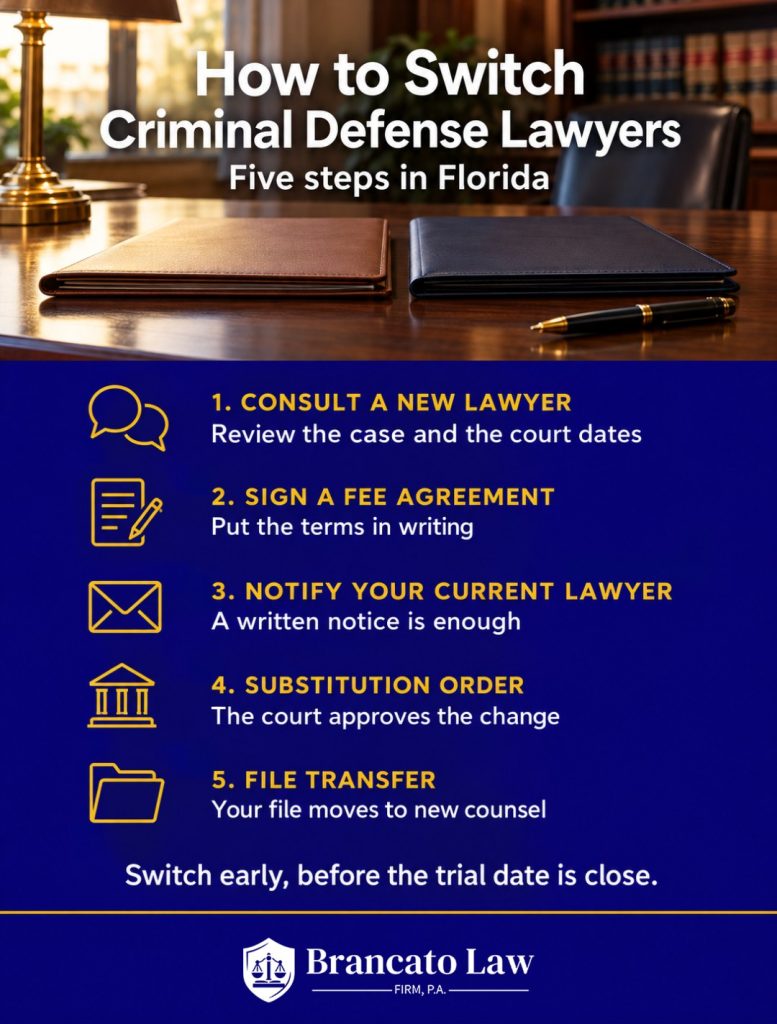
Under Rule 2.505 of the Florida Rules of General Practice and Judicial Administration, substitution of counsel is accomplished by “a written order by the court, that reflects written consent of the client.” When a client moves from a public defender to private counsel, the private lawyer appears in the case and the public defender is discharged. Our post on public defender vs. private attorney in Tampa explains that choice in detail.
Will switching lawyers delay my case?
It can, and that is the main risk of waiting too long. A new lawyer often needs time to obtain discovery and prepare, and the court decides whether to grant a continuance. Courts take the right to counsel of choice seriously, but they also manage busy calendars.
The Second District, which hears appeals from Hillsborough, Pinellas, and Pasco Counties, addressed this in Jordan v. State, No. 2D2024-1440 (Fla. 2d DCA Mar. 25, 2026). The trial court denied a continuance after the defendant retained private counsel. The Second District reversed, holding the denial was an abuse of discretion because the court relied on an inaccurate case history and did not weigh factors such as the time new counsel needed to prepare, prejudice, the defendant’s role in any delay, and the complexity of the case. An earlier Second District case, Hill v. State, 157 So. 3d 481 (Fla. 2d DCA 2015), also reversed a denial of a continuance to retain private counsel where the case was only a month old and there was no sign of stalling.
The lesson is practical. A switch made early in a case rarely causes a problem. A switch made the week of trial may be denied, and the defendant may have to go forward with the lawyer they wanted to replace.
Will I get my money back if I fire my lawyer?
Possibly, depending on the fee agreement and how much work was done. Under Rule 4-1.16(d), a lawyer whose representation ends must refund “any advance payment of fee or expense that has not been earned or incurred.” Florida’s fee rule, Rule 4-1.5, defines three kinds of fees:
- A retainer guarantees the lawyer’s availability and is not payment for services.
- A flat fee is paid for all the legal services in the representation and “may be termed ‘non-refundable.'”
- An advance fee is billed against as the lawyer works.
A fee that is nonrefundable in any part must be confirmed in writing and must explain the parties’ intent. Even then, every fee is subject to the rule against “clearly excessive” fees. If a lawyer was paid a large flat fee and did little or nothing before being discharged, the fee can be challenged, and The Florida Bar’s Attorney Consumer Assistance Program takes those inquiries.
Most criminal defense firms, including ours, charge flat fees that cover the whole case. Our firm typically requires half up front and works out a plan for the balance while the case is pending. Fees are quoted on the facts and complexity of each case. Our guide to how much a criminal defense attorney costs in Tampa explains how fees are set.
Why do overloaded lawyers miss things?
Time is the scarcest resource in criminal defense. RAND’s National Public Defense Workload Study (2023) estimated the attorney hours a case needs to be defended competently: about 13.8 hours for a low-level misdemeanor, 19 for a low-severity DUI, 57 for a mid-level felony, and 248 for a murder case. The authors concluded that “Excessive caseloads violate ethics rules and inevitably cause harm.”
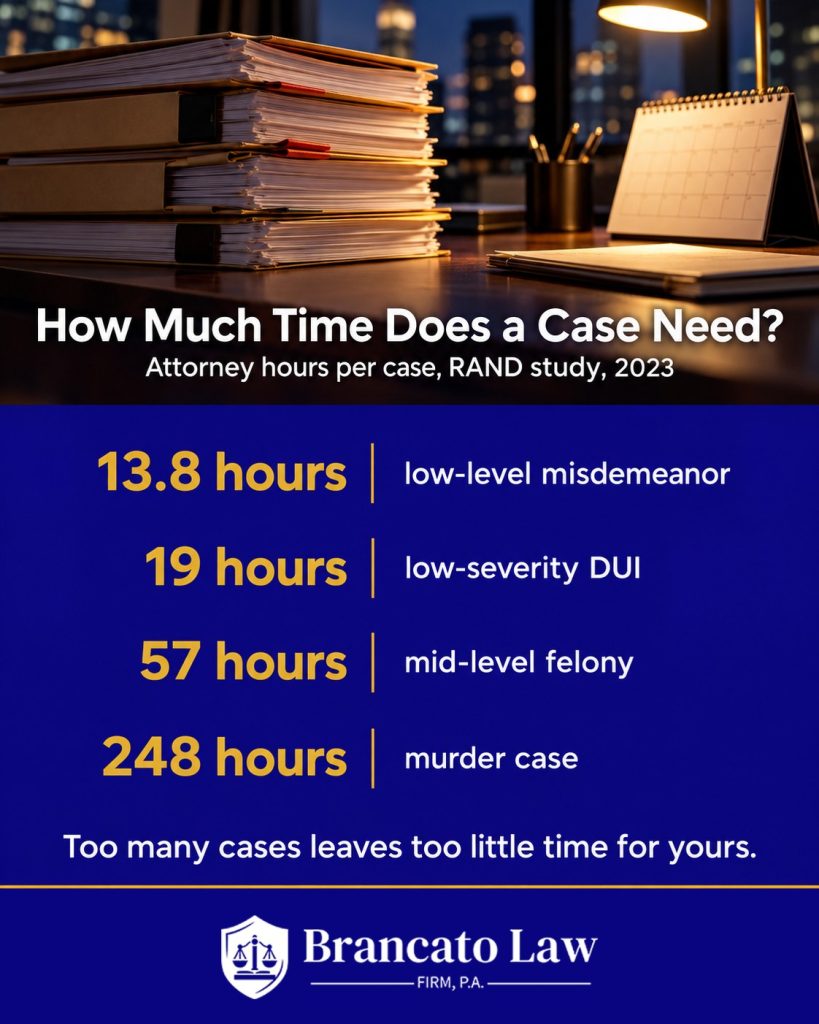
The same math applies to private practice. A lawyer who takes more cases than the hours in a week allow cannot return calls, review discovery, or prepare for depositions. When we evaluate a case for a client who wants a second opinion, the first thing we look at is whether the work that should have been done by that point actually was.
How do our attorneys take over a pending case?
Our attorneys take over a pending case by auditing what has been done, filling the gaps, and telling the client plainly where the case stands. You can learn more on our Hillsborough County criminal defense attorney page.
- Read everything. The charging document, the discovery, the docket, and every deadline.
- Identify missed opportunities. Unfiled motions to suppress, witnesses never deposed, experts never consulted, and mitigation never prepared.
- Talk to the prosecutor. A new lawyer is a new opportunity to present the defense’s view of the case.
- Communicate. Clients receive case updates through our client portal and can send confidential messages there, and our attorneys return client calls within 24 hours.
Fresh eyes change outcomes. In February 2025, our firm had a felony warrant that had been pending for more than four years quashed and the case dismissed. Other results are on our case results page. Past results do not guarantee future outcomes.
For more on choosing well the first time, read How to Choose a Criminal Defense Attorney in Tampa and Rocky Brancato’s book, “How to Choose a Major Crimes Attorney, or Any Criminal Defense Attorney for That Matter,” available on Amazon.
Frequently asked questions about switching criminal defense lawyers
Can I fire my lawyer right before trial in Florida?
You can discharge your lawyer at any time, but the judge does not have to delay a trial to accommodate the change. The Brancato Law Firm advises clients to act as soon as the warning signs appear, because courts weigh the timing of the request when deciding whether to grant a continuance.
Can my old lawyer keep my file if I switch?
Generally no. Rule 4-1.16(d) requires a lawyer to surrender papers and property the client is entitled to, although the lawyer may keep some materials to the extent the law allows. Our attorneys at The Brancato Law Firm request the file directly from prior counsel as part of taking over a case.
Can I switch from a public defender to a private lawyer?
Yes. Once you retain private counsel, the court substitutes the private lawyer for the public defender. The Brancato Law Firm explains the tradeoffs, including when keeping an experienced public defender makes sense, in our public defender vs. private attorney guide.
Is a nonrefundable flat fee really nonrefundable in Florida?
Not always. A flat fee may be called nonrefundable if that is confirmed in writing, but every fee remains subject to Rule 4-1.5’s ban on clearly excessive fees. The Brancato Law Firm puts the fee terms in a written agreement before any work begins, so clients know exactly what they are paying for.
What should I bring to a second-opinion consultation?
Bring the charging document, any bond paperwork, the court dates, your fee agreement with the current lawyer, and any discovery you have been given. Our attorneys at The Brancato Law Firm can usually tell in one meeting whether the case has been worked or neglected. Learn more on our Hillsborough County criminal defense page.
Will the judge be upset if I change lawyers?
No. Changing lawyers is common, and judges see substitutions every week. The Brancato Law Firm handles the substitution so the court has what it needs and the case keeps moving.
For how this fits into the rest of a case, see our step-by-step guide to what happens in a Florida criminal case.
Get a second opinion on your criminal case
The sooner you switch, the more options remain. Motions have deadlines, witnesses become harder to find, and trial dates get closer. The Brancato Law Firm, P.A., founded by Tampa Criminal Defense Attorney Rocky Brancato, will review your case, tell you honestly whether a change is needed, and handle the substitution if you decide to move forward. Call (813) 727-7159. You can call us at any hour. Our firm has Spanish-speaking staff, and attorney Jean-Luc Adrien speaks Spanish, Haitian Creole, and French. See our Spanish and Haitian Creole criminal defense page.
For more about our defense strategies, visit our Hillsborough County Criminal Defense page.
The Brancato Law Firm, P.A.
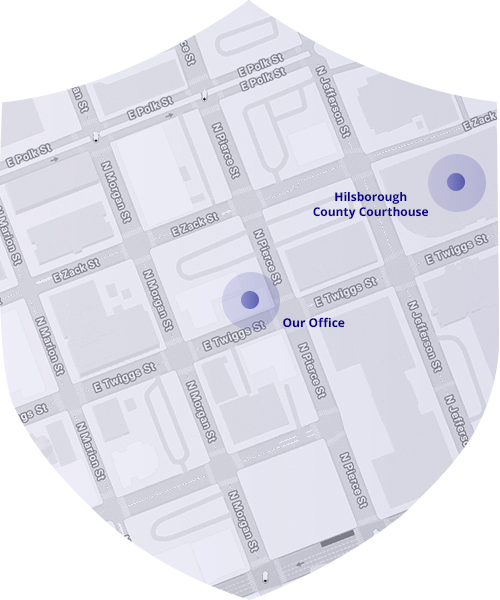
620 E. Twiggs Street, Suite 205, Tampa, FL 33602
(813) 727-7159
Serving Hillsborough, Pinellas, and Pasco Counties
The Brancato Law Firm, P.A. is a Tampa-based criminal defense practice. We are not affiliated with any other Brancato-named law firms.
Each case is unique, and past results do not guarantee future outcomes. This article is general information, not legal advice.
Visit Us

Tampa, FL 33602
Contact Us Now
Free Legal Consultation (813) 727-7159