- Free Consultation 24/7: (813) 727-7159 Tap Here To Call Us


From First DUI to Death Penalty



What Are the Steps in a Hillsborough County Criminal Case?


Updated October 2026
| A Hillsborough County criminal case moves through ten steps: arrest and booking, first appearance within 24 hours, an adversary preliminary hearing on any felony not formally charged within 21 days, the State Attorney’s filing decision, arraignment, discovery, pretrial motions and hearings, plea negotiations, trial, and sentencing. Felonies are heard in circuit court and misdemeanors in county court, and both courts belong to Florida’s 13th Judicial Circuit. Since July 1, 2025, the speedy trial clock under Florida Rule of Criminal Procedure 3.191 starts when the State formally charges the case, which gives the State 175 days to try a felony and 90 days to try a misdemeanor. |
Florida gives the State 30 days to file formal charges against a person held in jail. If nothing is filed, the court must order the person released on his or her own recognizance on the 33rd day, or on the 40th day if the State shows good cause, under Florida Rule of Criminal Procedure 3.134. I’m Rocky Brancato, founder of The Brancato Law Firm, P.A., a Tampa criminal defense firm, and I have worked inside these deadlines for more than 25 years in Hillsborough County, including as Chief Operations Officer of the Hillsborough County Public Defender’s Office, where I oversaw a staff of over 100 attorneys. In the first week of every case, our attorneys put each deadline below on the calendar and use each stage to press for a decision not to file, a dismissal, a reduced charge, or a trial date the State has to meet.
What are the stages of a criminal case in Hillsborough County?
A criminal case in Hillsborough County follows ten stages set by the Florida Rules of Criminal Procedure, from arrest through sentencing. Felony and misdemeanor cases share the same basic path. The timing, the charging documents, and the penalties differ, and local practices in the 13th Judicial Circuit shape how each stage plays out. The table below shows the order, the usual timing, and the rule that controls each step.
| Stage | Usual timing | Controlling rule or statute | What happens |
|---|---|---|---|
| 1. Arrest and booking | Day of arrest | Rule 3.132(a); s. 907.041 | Booking at the Orient Road Jail; some charges allow release on the bond schedule |
| 2. First appearance | Within 24 hours of arrest | Rule 3.130; Rule 3.133(a) | A judge reviews probable cause, appoints counsel if needed, and sets bond or release conditions |
| 3. Adversary preliminary hearing (felonies) | Available if no information or indictment is filed within 21 days of arrest | Rule 3.133(b) | The State must show probable cause through live witnesses the defense can cross-examine; if it cannot, the judge must release the defendant |
| 4. Filing decision | Within 30 days if in jail; 60 days if released | Rule 3.134 | The State files an information, seeks an indictment, or declines to file |
| 5. Arraignment | After formal charges are filed | Rule 3.160 | A plea of not guilty is entered; counsel can file it in writing in advance |
| 6. Discovery | State discloses within 15 days of the defense notice | Rule 3.220 | Police reports, recordings, witness lists, and depositions |
| 7. Pretrial motions and hearings | Weeks to months | Rule 3.190 | Motions to suppress or dismiss; pretrial conferences; dispo dates in some divisions |
| 8. Plea negotiations | Any time before verdict | Sixth Amendment right to counsel | Every formal offer must be communicated to the client |
| 9. Trial | 175 days (felony) or 90 days (misdemeanor) from formal charge, unless waived | Rule 3.191; s. 913.10 | Six-person jury, or 12 in a capital case |
| 10. Sentencing | After a plea or verdict | ss. 921.0024, 921.0026, 775.082 | The scoresheet sets the lowest permissible felony sentence |
Where is a Hillsborough County criminal case heard?
Felony cases in Hillsborough County are heard in circuit court and misdemeanor cases are heard in county court, and both courts are part of Florida’s 13th Judicial Circuit. Felony matters, bond hearings, and jury trials are handled in downtown Tampa, mainly at the George Edgecomb Courthouse at 800 E. Twiggs Street. Some misdemeanor and criminal traffic cases are set at the Plant City Courthouse, depending on where the arrest happened. Our Hillsborough County criminal defense attorney page covers the local courts, jails, and diversion programs in more detail.
The volume is large. In fiscal year 2024-25 (July 2024 through June 2025), 12,317 felony cases were filed in the 13th Judicial Circuit, according to the Florida Office of the State Courts Administrator’s FY 2024-25 Statistical Reference Guide. In the same year, Hillsborough County recorded 35,951 county criminal filings, made up of 13,004 misdemeanors, 16,970 non-DUI criminal traffic cases, 4,008 DUI cases, and 1,969 ordinance violations, per the OSCA county criminal chapter. With that many cases on the docket, our attorneys file discovery and motions early so a client’s case gets the court’s attention.
How is a felony case different from a misdemeanor case?
A felony carries more than one year of possible incarceration and moves through circuit court, while a misdemeanor carries up to one year in the county jail and moves through county court. The differences show up at almost every stage.
| Issue | Felony (circuit court) | Misdemeanor (county court) |
|---|---|---|
| Maximum incarceration under s. 775.082 | 5 years (third degree), 15 years (second degree), 30 years (first degree) | 1 year (first degree), 60 days (second degree) |
| Charging document | Information under oath, or grand jury indictment (required for a capital crime) | Information or other formal charging document |
| Filing deadline under Rule 3.134 | 30 days in custody; 60 days on release | 30 days in custody; 60 days on release |
| Speedy trial without a demand | 175 days from formal charge | 90 days from formal charge |
| Depositions of witnesses | Allowed under Rule 3.220(h) | Only when good cause is shown |
| Jury size under s. 913.10 | 6 jurors (12 in a capital case) | 6 jurors |
The penalty ranges come from section 775.082, Florida Statutes, and jury size comes from section 913.10. Under Article I, Section 15 of the Florida Constitution, no one can be tried for a capital crime without a grand jury indictment. Every other felony can be charged by an information filed under oath by the prosecutor.
What happens after an arrest in Tampa?
After an arrest anywhere in Hillsborough County, the arresting agency takes the person to the Orient Road Jail for booking, which includes fingerprints, photographs, and personal information. Some people are later housed at the Falkenburg Road Jail. For many charges, a person can post the amount listed on the bond schedule and leave before seeing a judge.
Some arrests do not allow that. Under Rule 3.132(a), a person arrested for one of the dangerous crimes listed in section 907.041, Florida Statutes must not be released from jail before first appearance.
Every phone call from the Orient Road and Falkenburg Road jails is recorded and monitored by prosecutors. Our attorneys tell families on the first call to keep the facts of the case off jail phones. Our guide on what to do after being arrested in Tampa walks through the first 48 hours step by step.
What happens at first appearance in Hillsborough County?
First appearance is a short hearing before a judge within 24 hours of arrest, required by Rule 3.130 for every arrested person who has not already been lawfully released. In Hillsborough County, the person appears by video from the jail while the judge and the lawyers appear from downtown. The judge tells the person the charge, advises of the right to remain silent and the right to counsel, appoints the Public Defender when the person cannot afford a lawyer, and sets bond or release conditions. The State may also ask for pretrial detention, which means holding the person with no bond until trial.
For a warrantless arrest, a judge must also find probable cause, and Rule 3.133(a) requires that finding within 48 hours of arrest for a person in custody. The 48-hour line traces to County of Riverside v. McLaughlin, 500 U.S. 44 (1991). In that case, a California county held people arrested without a warrant for up to two days, not counting weekends and holidays, before any judge reviewed the arrest. The U.S. Supreme Court held that a probable cause determination within 48 hours of a warrantless arrest is generally prompt enough, and that a longer delay puts the burden on the government to show an emergency or other extraordinary circumstance.
Bond decisions shape the rest of the case. In our Hillsborough County practice, we regularly see bonds set high, and pretrial services supervision is not an available option in Hillsborough County, though nearby counties offer it. Research supports the concern. In “The Downstream Consequences of Misdemeanor Pretrial Detention,” 69 Stan. L. Rev. 711 (2017), Paul Heaton, Sandra Mayson, and Megan Stevenson studied misdemeanor cases in Harris County, Texas, and found that detained defendants were 25 percent more likely to plead guilty and 43 percent more likely to be sentenced to jail than similar defendants who were released. Our attorneys prepare the bond argument before first appearance whenever a family calls in time, and our post on how a bond hearing works in Tampa explains the next step when the first bond is too high.
How does the State Attorney decide whether to file charges?
After an arrest, an assistant state attorney in the Office of the State Attorney for the 13th Judicial Circuit reviews the police report, witness statements, and other evidence, then decides whether to file an information, present the case to a grand jury, or decline to file. The charges listed on the arrest affidavit are only the officer’s charges. The State can file the same charges, different charges, fewer charges, or none at all.
Rule 3.134 sets the deadlines for that decision. For a person in custody, the State must file formal charges within 30 days of arrest; if it has not, the court must order release on the person’s own recognizance on the 33rd day, or on the 40th day if the State shows good cause, and no one may stay in custody past 40 days without formal charges. For a person on pretrial release, the State has 60 days; if no charge is filed, the court must order release on recognizance on the 63rd day, or may continue pretrial release for up to 30 more days on a showing of good cause. Separately, under Rule 3.133(b), a person not charged by information or indictment within 21 days of arrest has a right to an adversary preliminary hearing on any pending felony charge. At that hearing the State must prove probable cause through witnesses who testify in person and face cross-examination, and filing an information afterward does not take the right away. If the judge finds no probable cause, the defendant must be released, on his or her own recognizance if charges have since been filed.
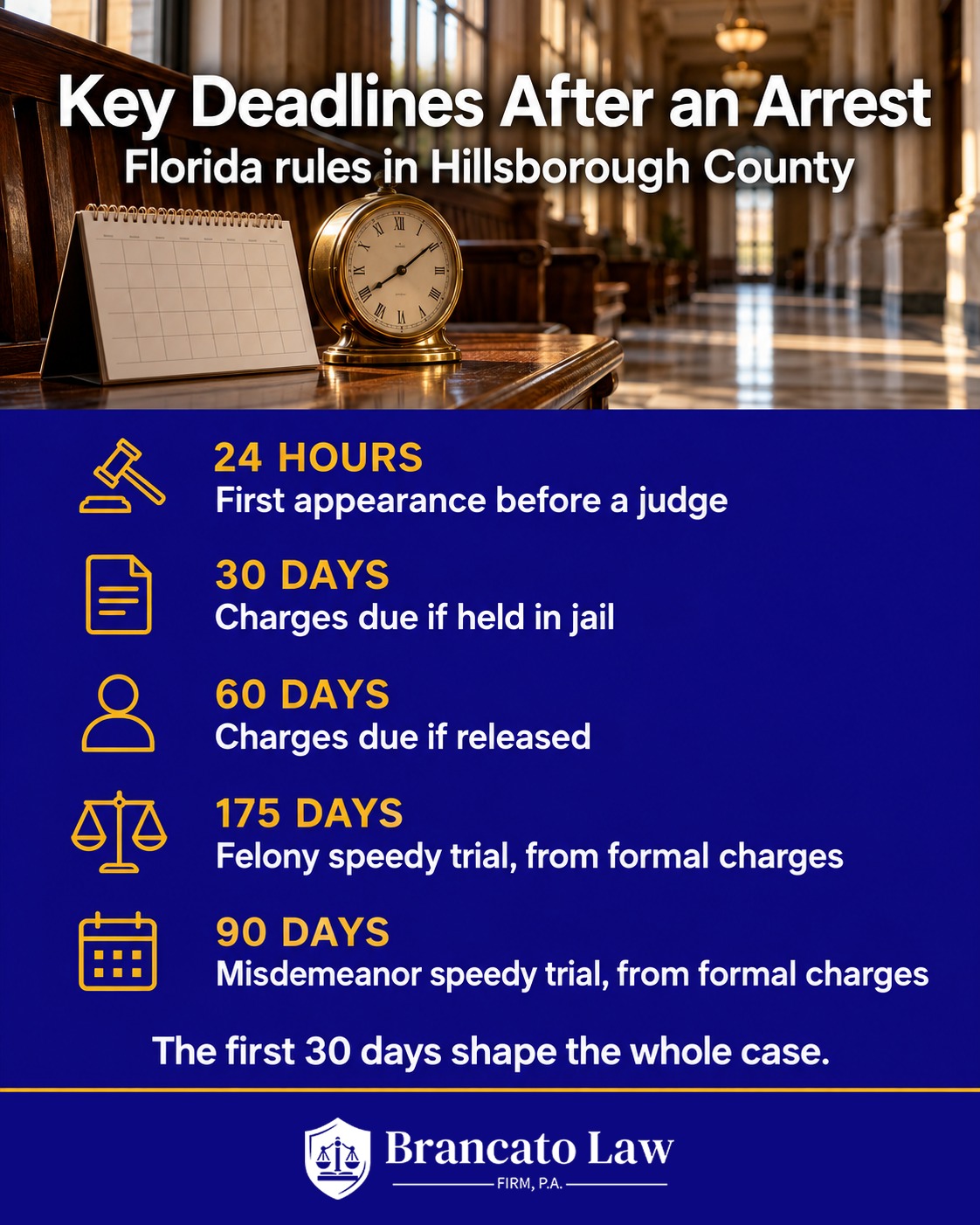
This window is where defense work changes outcomes. Through our representation before charges are filed, our attorneys investigate the facts, preserve video and other evidence, and present the assigned prosecutor with the information that supports a decision not to file or a lesser charge. The filing decision is often made within days of the arrest, so this work has to start in the first week.
What changed in Florida’s speedy trial rule in 2025?
Florida’s speedy trial clock now starts when the State formally charges a person, under amendments to Rule 3.191 that took effect July 1, 2025. Before that date, the clock started at arrest.
The change came in In re Amendments to Florida Rule of Criminal Procedure 3.191, 411 So. 3d 385 (Fla. 2025), a rules decision the Florida Supreme Court issued on March 13, 2025, after taking comments and hearing oral argument on its own proposal. The Court made four changes. First, the 175-day felony period and the 90-day misdemeanor period now begin when the person is formally charged by information, by indictment, or for a misdemeanor by whatever documents constitute a formal charge. Second, the recapture period is now mandatory in every case. Third, the recapture period grew from 10 days to 30 days: after the defense files a notice that speedy trial time has expired, the court holds a hearing within 5 days and must order trial within 30 days. Fourth, a discharge under the rule is now without prejudice unless the defendant’s constitutional right to a speedy trial was violated, which means the State can usually refile. Justice Labarga dissented.
The demand procedure still exists. A person charged by information or indictment can file a Demand for Speedy Trial, and the court must set trial no less than 5 and no more than 60 days from the filing of the demand. A demand is a serious step, because it tells the court the defense is ready for trial within that window.
The lesson for anyone charged today is that the speedy trial rule rarely ends a case for good. The constitutional right to a speedy trial still exists under the Sixth Amendment and Article I, Section 16 of the Florida Constitution, and the amended rule provides that a discharge is with prejudice when that constitutional right was violated. Delays the defense asks for count against the defense: in State v. Nelson, 26 So. 3d 570 (Fla. 2010), a defendant asked for a continuance to conduct discovery after the speedy trial period had expired but before he filed a notice of expiration, and the Florida Supreme Court held that the defense continuance waived his rights under the rule’s default period. Our attorneys decide early whether a case is better served by time for depositions and experts or by pressure on the State’s calendar, and we explain that choice to the client before any continuance is requested.
What happens at arraignment?
Arraignment is the hearing where the court formally reads the charge and the defendant enters a plea, which is almost always not guilty at this stage. Under Rule 3.160(a), arraignment is held in open court or by audio-video technology, and a defendant who has a lawyer can have counsel file a written plea of not guilty at or before arraignment, which waives the arraignment hearing.
When the rule allows it, our attorneys file a written plea of not guilty before arraignment so the client does not have to miss work for a hearing that does not change the case. A missed court date is different. When a defendant fails to appear for a required hearing, the judge can issue a capias, which is a bench warrant for arrest. Our post on what to do after missing a court date in Tampa explains how our attorneys move to withdraw a capias before it leads to a new arrest.
How does discovery work in a Florida criminal case?
Discovery is the exchange of evidence between the State and the defense, and it starts when the defense files a notice of discovery under Rule 3.220. Within 15 days after that notice, the prosecutor must serve a discovery exhibit listing the State’s witnesses and disclosing police and investigative reports, the defendant’s written, recorded, and oral statements, tangible evidence, expert reports, and any electronic surveillance. Filing the notice also binds the defense to reciprocal discovery obligations, so the timing of the notice is a strategic decision.
In a felony case, the defense can depose the State’s witnesses under oath, including the arresting officers. In a misdemeanor or criminal traffic case, depositions require a showing of good cause. Separate from the rule, the Constitution requires the State to disclose evidence favorable to the accused. In Brady v. Maryland, 373 U.S. 83 (1963), John Brady was sentenced to death after prosecutors withheld his companion’s statement admitting that the companion did the actual killing. The U.S. Supreme Court held that suppressing evidence favorable to the accused violates due process when the evidence is material to guilt or punishment, whatever the prosecutor’s good or bad faith. Our attorneys review body camera video, 911 recordings, and lab reports line by line, and depose the officers before deciding which motions to file.
What are pretrial hearings and dispo dates in Hillsborough County?
Pretrial hearings are the court dates between arraignment and trial where the judge checks the status of discovery, hears motions, and sets the case for trial. The defense files its key motions in this stretch, including a motion to suppress evidence taken in an illegal stop or search and a motion to dismiss when the undisputed facts do not make out a crime. Rule 3.190 governs those motions.
Some Hillsborough County judges also set dispo dates, short for disposition dates. A dispo date is a status hearing where the judge asks whether discovery is complete, whether motions are pending, and whether the case is ready to resolve or go to trial. Not every judge uses them, so the calendar for the same charge can look different from one division to the next. A pretrial conference usually comes shortly before trial and covers witnesses, exhibits, and any final plea discussions. Our attorneys treat each dispo date and pretrial as a checkpoint: discovery reviewed, motions filed or ready, and the client’s decision about any offer made in advance.
How do most felony cases end in the 13th Judicial Circuit?
Most felony cases in the 13th Judicial Circuit end without a jury trial. In fiscal year 2024-25, the circuit disposed of 10,862 felony cases, and 108 of them, or 1.0 percent, were resolved after a jury trial, compared with 1.3 percent statewide, according to OSCA’s FY 2024-25 Statistical Reference Guide. Of the 9,680 dispositions OSCA counts for its guilty-disposition rate, 8,119, or 83.9 percent, ended in a guilty plea or conviction. The other 16.1 percent ended in a dismissal, a nolle prosequi (the State dropping the charge), or an acquittal. OSCA notes that these rates are not intended as a measure of the efficiency of judges, prosecutors, or public defenders.
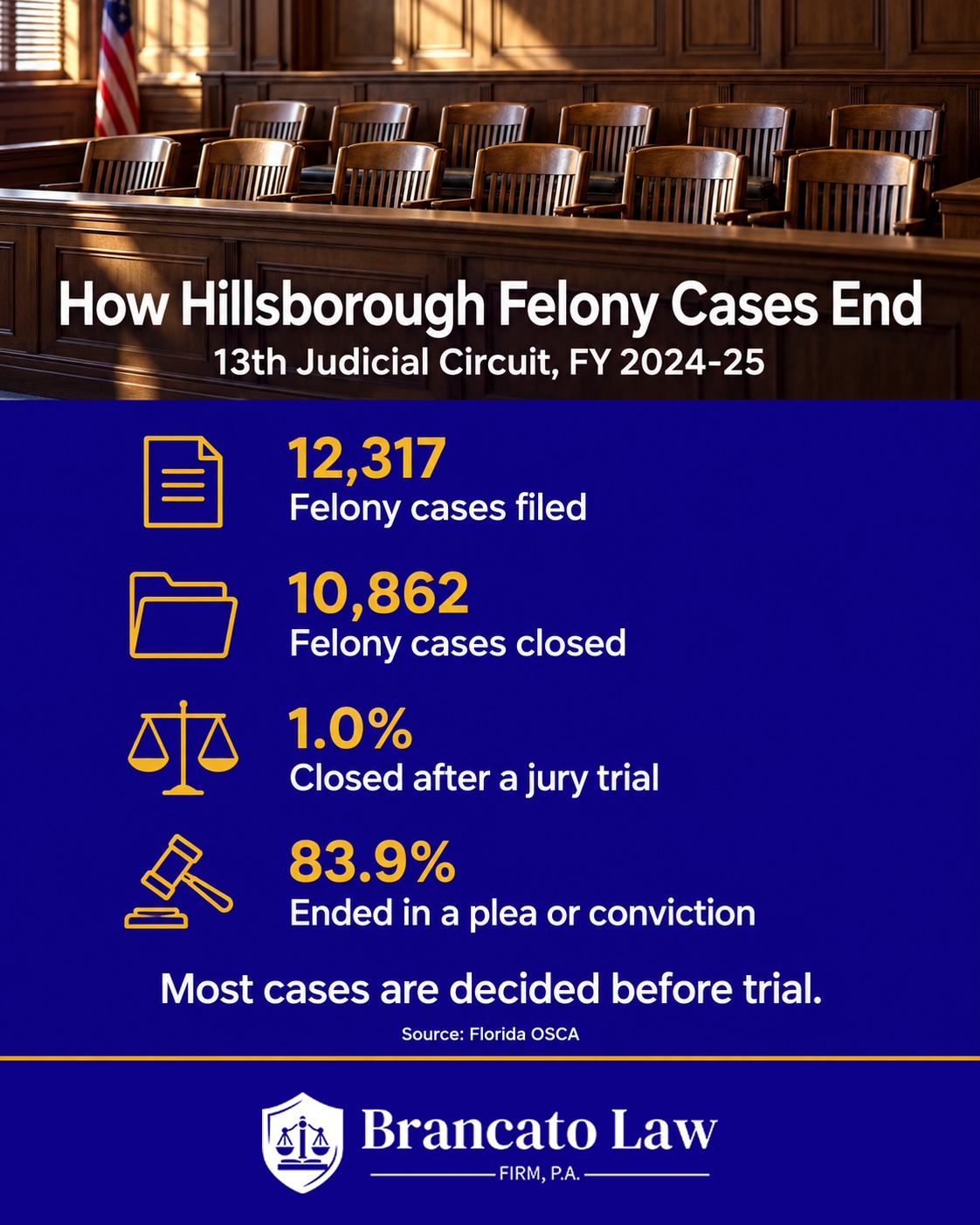
Because most cases resolve by plea, the plea stage gets the same preparation as trial. In Missouri v. Frye, 566 U.S. 134 (2012), Galin Frye’s lawyer never told him about a written offer that would have reduced his felony charge to a misdemeanor, the offer expired, and Frye later pleaded guilty to the felony with no agreement. The U.S. Supreme Court held that defense counsel generally must communicate formal plea offers to the client. In my experience trying more than 150 jury trials to verdict, the State’s offers improve when the prosecutor knows the defense is ready to try the case. Our post on how to decide whether to accept a plea bargain in Florida walks through the factors our attorneys review with clients.
What happens at a criminal trial in Hillsborough County?
A criminal trial in Hillsborough County is decided by a jury of six people, or 12 in a capital case, and the State must prove every element of the charge beyond a reasonable doubt. The defendant has the right to confront and cross-examine the State’s witnesses, to call witnesses, and to remain silent without that silence being used against him or her. A trial runs through jury selection, opening statements, the State’s case, the defense case, closing arguments, and jury instructions before the jury deliberates. Our attorneys prepare every case for trial from the start, because the trial file is also the strongest negotiating file.
How does sentencing work after a plea or verdict?
Felony sentencing in Florida starts with a Criminal Punishment Code scoresheet, which totals points for the offense, any victim injury, and prior record. Under section 921.0024, Florida Statutes, a total of 44 points or fewer means the lowest permissible sentence is any nonstate prison sanction, such as probation or county jail, unless the judge decides prison is appropriate. Above 44 points, the lowest permissible sentence in prison months is the total minus 28, multiplied by 0.75. A score of 60 points, for example, produces a lowest permissible sentence of 24 months in prison. The judge can sentence anywhere from that floor up to the statutory maximum.
A judge can go below the scoresheet floor only with a legal reason for a downward departure under section 921.0026. The statute lists mitigating circumstances such as a legitimate, uncoerced plea bargain, a defendant who was a relatively minor participant, a defendant whose capacity to appreciate the criminal nature of the conduct was substantially impaired, and a case where the need for restitution outweighs the need for prison. Misdemeanor sentences are capped at one year in the county jail for a first-degree misdemeanor and 60 days for a second-degree misdemeanor. Hillsborough County also offers Pretrial Intervention, misdemeanor diversion, Drug Court, Veterans Treatment Court, and Mental Health Court for eligible cases. Our attorneys start the mitigation record and the scoresheet review months before the sentencing date.
Why do the first 30 days after an arrest matter most?
The first 30 days after an arrest decide bond, the filing decision, and often the charge the case will carry to the end. Each of these deadlines runs from the date of arrest.
| Deadline | Day | Rule |
|---|---|---|
| First appearance before a judge | Within 24 hours | Rule 3.130(a) |
| Probable cause finding for a warrantless arrest, if in custody | Within 48 hours | Rule 3.133(a) |
| Right to an adversary preliminary hearing on a pending felony if no information or indictment | After 21 days | Rule 3.133(b) |
| Formal charges due, defendant in custody | 30 days (release on day 33, or day 40 with good cause) | Rule 3.134(a) |
| Formal charges due, defendant on release | 60 days (release on recognizance on day 63, or up to 30 more days with good cause) | Rule 3.134(b) |
Once formal charges are filed, the speedy trial periods of 175 days for a felony and 90 days for a misdemeanor begin. By that point, the bond is set, the charge is chosen, and the State’s file has taken shape. The work our attorneys do in the first week, before those decisions are locked in, is the work most likely to change them.
For how this fits into the rest of a case, see our guide to each stage of a Florida criminal case.
Frequently asked questions
How long does a felony case take in Hillsborough County?
A felony case in Hillsborough County has no fixed length, but the speedy trial rule gives the State 175 days from formal charging to try the case unless the defense waives that time. Our attorneys at The Brancato Law Firm often ask for more time when depositions or expert review will help the client, and we tell the client first that a defense continuance usually waives the rule’s deadline, as the Florida Supreme Court held in State v. Nelson.
Can charges be dropped before arraignment in Hillsborough County?
Yes, the State Attorney’s Office can decline to file charges after an arrest, and it can drop filed charges at any time by entering a nolle prosequi. The Brancato Law Firm presents evidence to the assigned prosecutor during the filing window through our pre-file advocacy work, because that is the point where a decision not to file is most realistic.
Do I have to go to arraignment if I have a lawyer in Hillsborough County?
Usually not, because under Rule 3.160(a) a defendant represented by counsel can have the lawyer file a written plea of not guilty at or before arraignment, which waives the hearing. At The Brancato Law Firm, we file that written plea whenever the rule allows and confirm every future court date with the client in writing.
What happens if I miss a court date in Hillsborough County?
A judge can issue a capias, a bench warrant for arrest, when a defendant misses a required court date. The Brancato Law Firm moves to withdraw the capias and sets a hearing as quickly as possible, often before the client is picked up, as our guide to handling a missed court date in Tampa explains.
What happens if the State has not filed charges 30 days after a jail arrest?
The court must order release on the person’s own recognizance on the 33rd day unless the State files formal charges, or on the 40th day if the State shows good cause, under Rule 3.134. Our attorneys at The Brancato Law Firm track that deadline from the day of arrest and raise it with the court on time; our Hillsborough County defense lawyers page lists the courts and jails where these hearings happen.
Is first appearance the same as a bond hearing in Tampa?
No, first appearance is the hearing within 24 hours where a judge first sets bond, and a bond hearing is a later hearing where the defense asks the court to lower bond or change the conditions. The Brancato Law Firm files the motion for a bond hearing when the first-appearance bond is out of reach for the family, as described in our post on bond hearings in Tampa.
Will my felony case go to trial in Hillsborough County?
Probably not, since in fiscal year 2024-25 only 1.0 percent of felony dispositions in the 13th Judicial Circuit came after a jury trial, according to OSCA. The Brancato Law Firm still prepares each case as if it will be tried, because that preparation is what moves a prosecutor’s offer, and our guide to weighing a Florida plea offer explains how we evaluate one.
For more about our defense strategies, visit our Hillsborough County criminal defense page.
In the first week, our attorneys pull the arrest report and the booking record, contact the assigned prosecutor before the filing decision is made, and prepare the bond argument or the motion to reduce bond. The Brancato Law Firm, P.A. was founded by Tampa Criminal Defense Attorney Rocky Brancato and defends people charged in Hillsborough, Pinellas, and Pasco Counties. The State has 30 days to charge a jail case, and the time to shape that decision is now. Call us at any hour at (813) 727-7159.
The Brancato Law Firm, P.A.
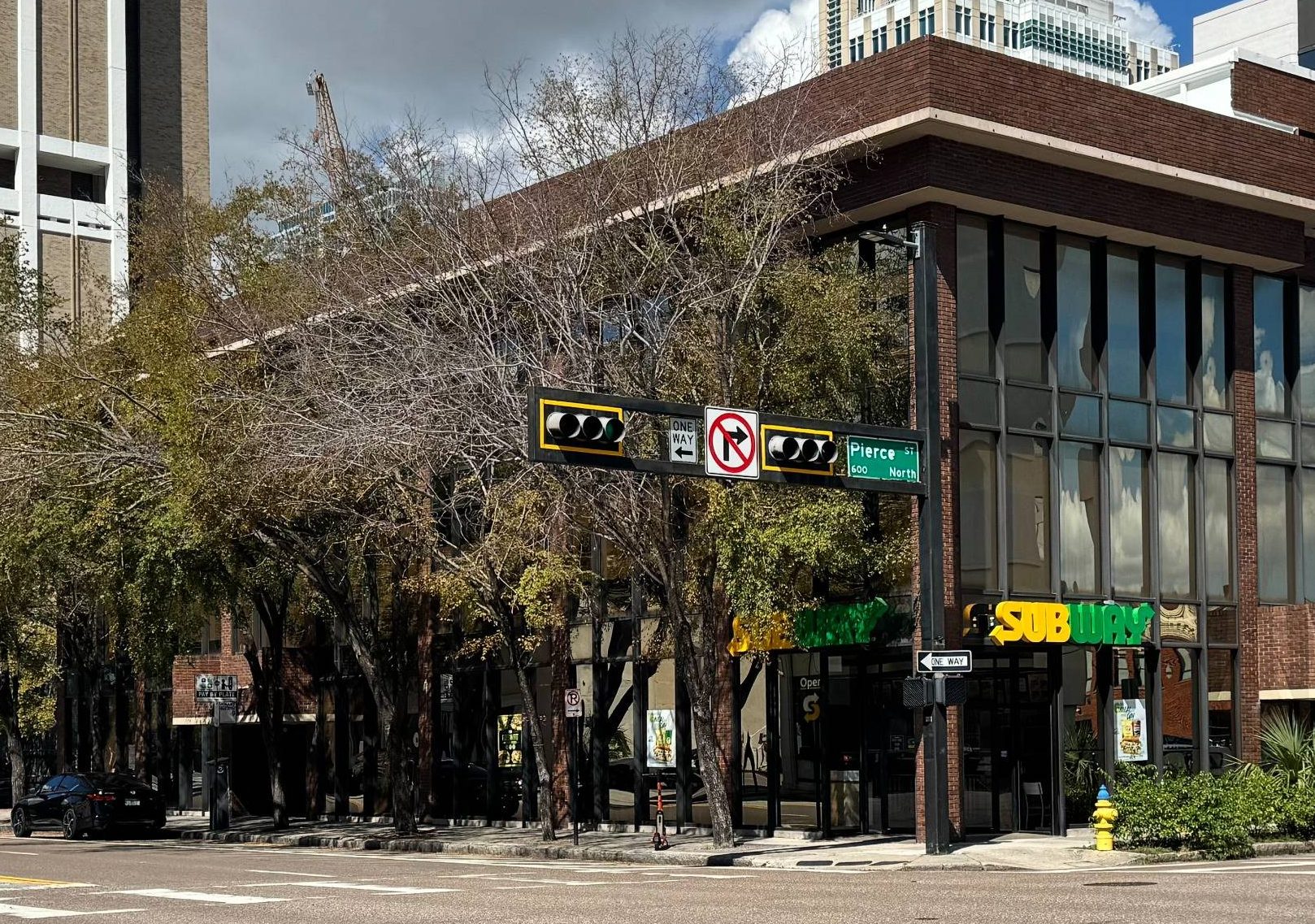
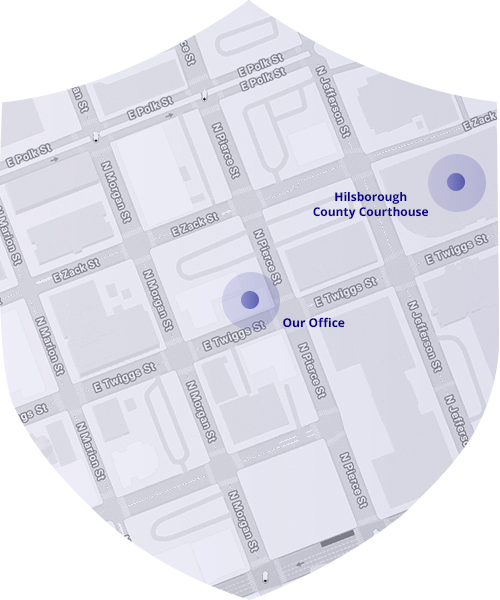
620 E. Twiggs Street, Suite 205, Tampa, FL 33602
(813) 727-7159
Serving Hillsborough, Pinellas, and Pasco Counties
The Brancato Law Firm, P.A. is a Tampa-based criminal defense practice. We are not affiliated with any other Brancato-named law firms.
Visit Us
Tampa, FL 33602
Contact Us Now
Free Legal Consultation (813) 727-7159