- Free Consultation 24/7: (813) 727-7159 Tap Here To Call Us


From First DUI to Death Penalty



Public Defender or Private Attorney in Tampa? (2026)



Updated October 21, 2026
A public defender is a salaried government lawyer appointed only to people the clerk finds indigent under section 27.52, Florida Statutes. A private attorney is a lawyer you choose and pay. Many public defenders are skilled trial lawyers, but they often carry more cases than the 2023 national workload standards recommend, and they pay for experts out of a fixed state budget. A private flat fee buys time, an earlier start (even before charges are filed), and experts chosen for your case, so if you can afford one, that time is what you are paying for.
Every public defender’s office in Florida runs on a chain of command, with an elected Public Defender at the top and assistant public defenders carrying the cases at the bottom. I know that structure from the inside. Before founding The Brancato Law Firm, P.A., a Tampa criminal defense firm, I served as Chief Operations Officer of the Hillsborough County Public Defender’s Office, overseeing a staff of over 100 attorneys. Today our attorneys use that knowledge to give people an honest read on whether they need private counsel, and our practice is devoted entirely to criminal defense, from misdemeanors to capital cases, backed by more than 150 jury trials to verdict.
Is a public defender as good as a private attorney in Tampa?
A public defender can be every bit as skilled as a private attorney, and many are. The differences that matter are caseload, money for experts, timing, and whether you get to choose your lawyer. Public defenders work inside a system that assigns them more cases than any one lawyer can fully prepare. That pressure comes from case volume and state funding.
Public defenders exist because of Gideon v. Wainwright, 372 U.S. 335 (1963), the U.S. Supreme Court case that began with a burglary charge in Panama City, Florida. The Court held that a state must provide a lawyer to a person charged with a felony who cannot afford one. Our firm respects that work. The question for you is practical: given your charge, your budget and your timeline, which option gives your case the most attention?
How is the Hillsborough County Public Defender’s Office organized?
The Hillsborough County Public Defender’s Office has six levels of rank, from the elected Public Defender at the top to line attorneys at the bottom. Voters in each judicial circuit elect a public defender to a four-year term under Article V, Section 18 of the Florida Constitution, and the office’s attorneys work under that officer.
| Rank | Position | What the role does |
|---|---|---|
| 1 (highest) | Elected Public Defender | Heads the office, sets its policies and appoints the assistant public defenders. |
| 2 | Chief Assistant Public Defender (or Chief Operations Officer) | Second in command. Runs the day-to-day operations of the whole office. |
| 3 | Bureau Chief (Felony Bureau; Misdemeanor/Juvenile Bureau) | Supervises one of the office’s major bureaus and the divisions inside it. |
| 4 | Training Director | Directs training for the office’s attorneys. |
| 5 | Division Chief | Supervises the attorneys assigned to one courtroom division. |
| 6 (lowest) | Line attorney (Assistant Public Defender) | Represents individual clients and carries the day-to-day caseload in court. |
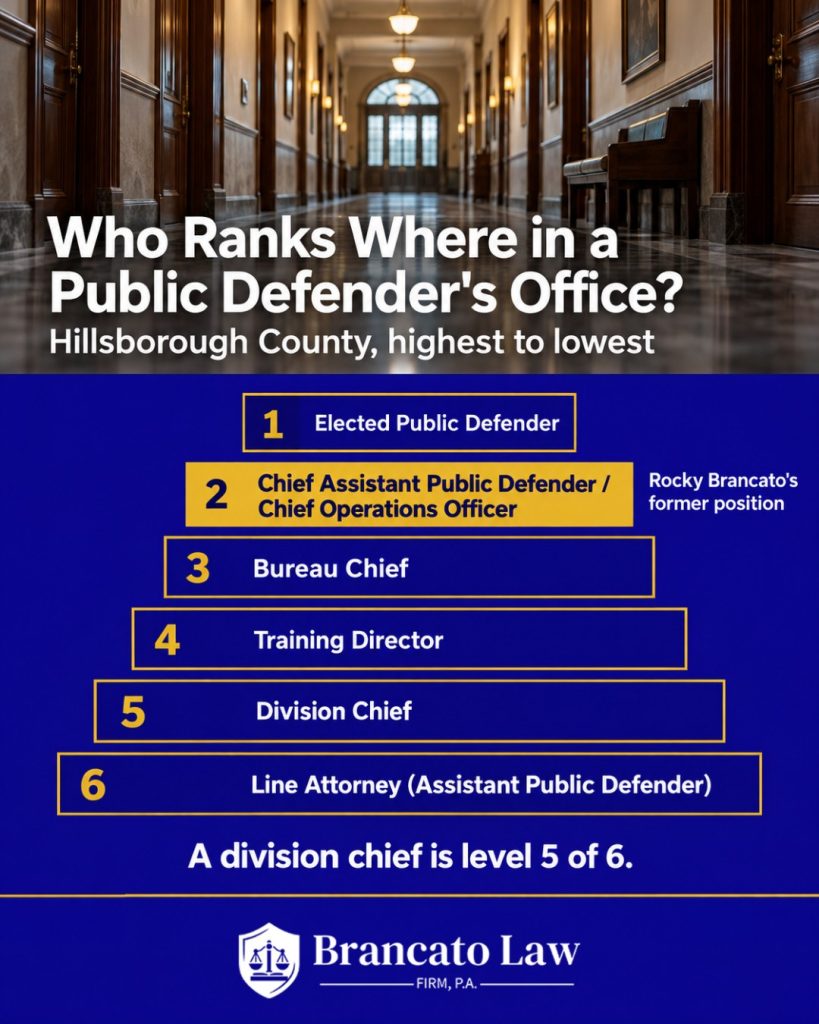
A division chief is the fifth of six levels in the Hillsborough County Public Defender’s Office, one step above a line attorney. Rocky Brancato served at the second level, as Chief Operations Officer, overseeing a staff of over 100 attorneys.
A “division” is a courtroom. Hillsborough’s criminal courts are organized into divisions, each assigned to a judge, and the public defender assigns attorneys to those courtrooms. As Chief Operations Officer I oversaw the felony and major crimes divisions and mentored senior trial lawyers, and I kept trying homicide and sex crime cases myself. You can read more about that background on Rocky Brancato’s attorney profile and in our post on whether to hire a former public defender in Tampa.
How does Florida decide whether you get a public defender?
The clerk of court decides whether you qualify for a public defender, using the financial test in section 27.52, Florida Statutes. You qualify if your household income is at or below 200 percent of the federal poverty guidelines, or if you receive certain public benefits. The statute presumes you are not indigent if you have $2,500 or more in net assets, not counting your homestead and one vehicle worth $5,000 or less.
You apply on a sworn form and pay a $50 application fee within 7 days. The law says no one found indigent can be refused a lawyer for failing to pay that fee. The clerk’s decision is ministerial, so if the clerk finds you do not qualify, you can ask the judge to review it at your next hearing.
A public defender represents a person who is “under arrest for, or charged with” a crime, under section 27.51, Florida Statutes. That means no public defender is available to someone who is only under investigation. Our firm’s representation before charges are filed covers that gap.
Is a public defender really free in Florida?
A public defender is not free if you are convicted. Under section 938.29, Florida Statutes, a person who used the public defender and is convicted owes the application fee plus attorney’s fees and costs, and the court must include them in the judgment. Our firm includes these costs when we help someone compare a public defender with a private fee.
| What you may owe | What Florida law says |
|---|---|
| Application fee | $50 per application, due within 7 days (s. 27.52) |
| Attorney’s fees after a misdemeanor or criminal traffic conviction | At least $50 per case (s. 938.29) |
| Attorney’s fees after a felony conviction | At least $100 per case, and the court may set a higher amount on proof of higher fees or costs |
| What counts as a conviction | A finding of guilt by plea, trial or violation hearing, even if adjudication is withheld |
| Lien | A lien in the state’s name attaches to your real and personal property, and the clerk records the judgment in every county where you own property |
| Limits | The lien cannot be foreclosed on your homestead, and a person not in willful default can ask to defer payment |
The fees are imposed regardless of your present ability to pay. For many clients the dollar amount is small next to a private fee, but the lien and recorded judgment surprise people years later when they sell or refinance property.
How many cases does a public defender carry?
Public defenders often carry far more cases than national standards say one lawyer can handle. The National Public Defense Workload Study (RAND Corporation, 2023) estimated that a mid-level felony needs an average of 57 hours of attorney time, which works out to 36 such cases per lawyer per year. A murder case needs 248 hours, or 8 cases a year.
The older 1973 national standard allowed up to 150 felonies per attorney per year, and the 2023 RAND study calculated that this left only 13.9 hours per felony. Florida’s Supreme Court reviewed what that looks like in practice in Public Defender, Eleventh Judicial Circuit of Florida v. State, 115 So. 3d 261 (Fla. 2013). In that Miami-Dade case, the noncapital felony caseload had been “in the range of 400 cases per attorney for a number of years,” and the court held that a public defender may ask to withdraw from cases across the office when caseloads prevent effective representation.
The volume in Hillsborough County is heavy. From October 2024 through January 2025, the Hillsborough County Clerk of Court opened 6,144 new circuit criminal (felony) cases and 5,198 new county criminal (misdemeanor) cases, according to the Clerk’s monthly outputs report for county fiscal year 2024-2025. The Public Defender’s Office for the Thirteenth Judicial Circuit reports more than 120 attorneys. At The Brancato Law Firm, the flat fee is what pays for the hours a serious case needs.
How do public defenders pay for investigators and experts?
A public defender’s office pays for investigators and experts out of a fixed annual state budget. Section 29.006, Florida Statutes, lists the indigent defense costs the state funds, including expert witnesses, court reporting and certain mental health professionals. Every request for an expert competes with every other case in the office.
The same limits follow a private client who asks the court to be declared “indigent for costs” under section 27.52(5), Florida Statutes. In those cases, section 27.425, Florida Statutes, says the Legislature sets maximum rates for state-paid experts each year. The Justice Administrative Commission’s Circuit 13 expert rate schedule lists a maximum of $2,500 per case for a forensic professional expert and $400 for a competency evaluation.
Our firm rarely asks the court to declare a private client indigent for costs. State-paid experts must work for a much lower fee, and that limits which experts will take the case. When we hire a DNA analyst, toxicologist or reconstruction expert, we choose the person best suited to the evidence and discuss the cost with the client before it is incurred.
Do you get to choose your public defender?
You do not choose your public defender. The office assigns your case, usually to the attorney who covers the courtroom division where your case is filed. Public defender offices commonly move attorneys between divisions as they gain experience and are promoted, so a case that lasts many months can pass from one assistant public defender to another.
Turnover adds to the problem. A March 2023 Florida TaxWatch report, Why Taxpayers Should Care about Workforce Instability with Florida’s Public Defenders and State Attorneys, described assistant public defenders as facing “low salaries and punishing caseloads, which contribute to high rates of employee turnover.” When you hire The Brancato Law Firm, you know which attorneys are assigned to your case from the start.
What does a private attorney’s flat fee pay for?
A private flat fee pays for time, an earlier start, and the freedom to build the defense the evidence calls for. The Brancato Law Firm charges one flat fee that covers the whole case, including trial. We quote it on the facts and intricacy of the case and try to be realistic and fair. At least half is due up front, and the balance can be paid on a plan while the case is pending.
We are not the most expensive firm in Tampa, and we are not the least expensive. Ask any lawyer you consult whether trial is included. A separate trial fee gives a lawyer a financial incentive to settle before trial preparation begins. Our post on how much a criminal defense attorney costs in Tampa walks through market ranges and what drives them.
Here is what the fee buys at our firm:
- An earlier start. We can contact the prosecutor before the filing decision, sometimes before an arrest.
- Experts chosen on merit. We hire the expert the evidence calls for, at that expert’s normal rate.
- Trial preparation. Depositions, investigation and motion practice are part of the fee, and trial is included.
- A mitigation report, offered to every client, that presents you as a person to the prosecutor and the judge.
- Communication. Clients get case updates through our client portal, and our attorneys return calls within 24 hours.
| Issue | Public defender | Private attorney (flat fee) |
|---|---|---|
| Who qualifies | Only people the clerk finds indigent | Anyone |
| When it starts | After arrest or formal charge | As early as the investigation stage |
| Choosing your lawyer | Assigned by the office | You choose |
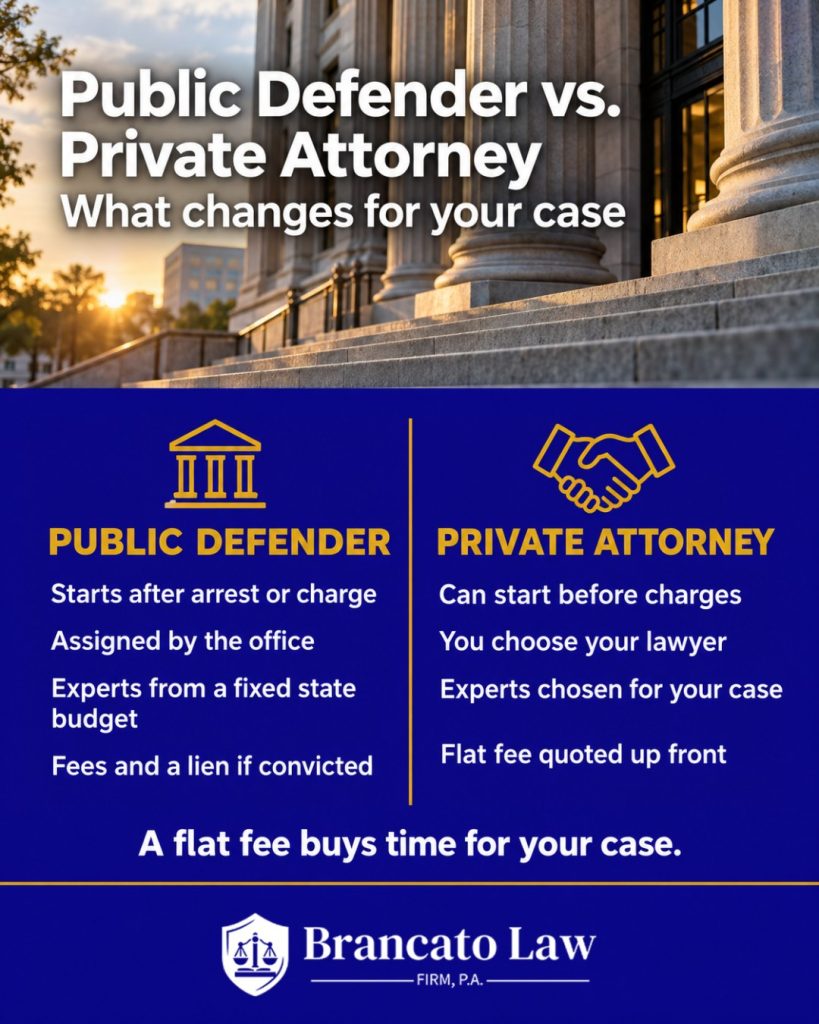
| Time on your case | Limited by office volume and funding | Paid for by the flat fee |
| Experts | Paid from a fixed state budget | Chosen for the case, paid as a case cost |
| Cost to you | $50 application fee, plus fees and a lien if convicted | Flat fee quoted up front, payment plan available |
| Continuity | Can change as attorneys rotate | Same firm throughout the case |
I was arrested for the first time in Tampa and I’m terrified. Do I need a private lawyer?
If this is your first arrest, you need a lawyer before you talk about the case with anyone, and a public defender is a real option if you qualify. In Hillsborough County, first appearance happens within 24 hours of arrest, with the arrested person appearing by video from the jail. If you have not hired a lawyer, an assistant public defender will usually speak for you on bond at that hearing.
A first arrest is also when private counsel can do the most. Many first-time cases can be resolved through diversion, a reduced charge, or a decision by the State Attorney’s Office not to file at all, and those outcomes are often won in the weeks right after the arrest. Our firm’s Hillsborough County criminal defense attorneys work those early weeks, and our guide on what to do after being arrested in Tampa covers the first steps. Hillsborough County does not offer pretrial services supervision as a release option, so the bond argument at first appearance matters.
Can I switch from a public defender to a private attorney?
Yes. You can hire a private attorney at any point in your case, and the public defender steps aside. Under section 27.51(2), Florida Statutes, a court may not appoint the public defender to represent a defendant who has retained private counsel on the same case.
When The Brancato Law Firm takes over a case from the public defender, our attorneys file the paperwork to appear in the case, coordinate with the assistant public defender, and obtain the discovery already exchanged. The judge may ask whether the change will affect the trial date, so it helps to switch early.
Switching to a different public defender is harder. If you ask the judge to discharge appointed counsel, Florida courts follow Nelson v. State, 274 So. 2d 256 (Fla. 4th DCA 1973). In that case, a defendant’s court-appointed lawyer was discharged before trial and no replacement was appointed, so he was tried without a lawyer. The court held that the judge must first ask why the defendant wants a new lawyer. Under Nelson v. State, 274 So. 2d 256 (Fla. 4th DCA 1973), a substitute is appointed only if there is reasonable cause to believe counsel is not providing effective help. Otherwise, the defendant may have to keep that lawyer or go forward without one.
What if my lawyer isn’t doing anything on my criminal case?
If you were charged with a crime in Tampa and your attorney does not seem to be doing anything, get a second opinion before you decide to switch. Much of a defense lawyer’s work happens out of the client’s sight, so silence does not always mean neglect. Our firm reviews cases handled by other lawyers, public and private, and tells clients plainly what we find.
Here is how a second-opinion review works at our firm:
- Bring what you have. The arrest report, charging document, any discovery, any plea offer, and your next court date.
- We check the court record. In Hillsborough County, we pull the docket from the Clerk’s HOVER system to see what has been filed, noticed and set for hearing.
- We check the deadlines. Speedy trial periods, motion deadlines and plea offer deadlines cannot always be recovered once they pass.
- We give you a straight answer. Sometimes the current lawyer is doing the right things, and we will tell you so.
- If you switch, we handle the transition. Our attorneys file the paperwork, request the prior file, and get the case moving.
Our posts on how to choose the right criminal defense attorney and red flags to avoid when choosing a Tampa criminal defense attorney list warning signs worth checking.
What makes a good criminal defense attorney in Tampa, public or private?
A good criminal defense attorney in Tampa has tried cases to verdict, has the time to work yours, and tells you the truth about your case. Ask how many jury trials the lawyer has taken to verdict, who will actually handle your case, and how you will get updates. Our complete guide to choosing a criminal defense attorney in Tampa covers the full checklist.
At The Brancato Law Firm, the answers are specific. Rocky Brancato has tried more than 150 jury trials to verdict over more than 25 years in Hillsborough County. He is a former Major Crimes Unit trial attorney and former police academy instructor, meets the Florida Rule of Criminal Procedure 3.112 qualifications for capital cases, holds an AV Preeminent rating, has been selected to Super Lawyers and the National Trial Lawyers Top 100, and wrote How to Choose a Major Crimes Attorney – or Any Criminal Defense Attorney for That Matter. Our firm serves Hillsborough, Pinellas and Pasco counties, and you can call us at any hour.
What results has our firm gotten for clients?
Real results show what time and preparation can do. These are published results from The Brancato Law Firm’s cases.
| Result | Original charge |
|---|---|
| Death penalty withdrawn after a Daubert motion on the DNA evidence | First-degree murder |
| Reduced to manslaughter on imperfect self-defense | Second-degree murder |
| Homicide charge dropped; aggravated child abuse reduced, plea to child neglect | Homicide and aggravated child abuse |
| Not guilty (self-defense) | Second-degree murder |
| Full exoneration in a cold-hit DNA case | Sexual battery |
| Dismissed in three weeks (March 2025) | Fentanyl trafficking |
| Charges not filed (August 2026) | Lewd or lascivious molestation |
Past results do not guarantee future outcomes. Every case is different.
When should you talk to a private attorney after an arrest in Tampa?
Talk to a private attorney before first appearance if you can, and in any event before the State Attorney’s Office decides what charges to file. Those first days and weeks set the bond, the charges and the plea offers that follow. For more about how our firm defends cases in local courts, visit our Hillsborough County criminal defense attorney page.
Frequently asked questions
Where does a division chief rank in the Hillsborough County Public Defender’s Office?
A division chief ranks fifth of six levels, one step above a line attorney (assistant public defender) and below the training director, bureau chiefs, the chief assistant and the elected Public Defender. The Brancato Law Firm was founded by Rocky Brancato, who served at the second level as Chief Operations Officer, overseeing a staff of over 100 attorneys. His attorney profile describes that role.
Can I get a public defender before I am charged in Florida?
No. Florida law provides a public defender only to an indigent person who is under arrest for or charged with a crime. Our attorneys at The Brancato Law Firm represent people under investigation and contact the prosecutor before the filing decision through pre-file advocacy.
Do I have to repay the public defender if I am found guilty in Florida?
Yes. A conviction, including a plea where adjudication is withheld, makes you liable for the $50 application fee plus at least $50 for a misdemeanor or $100 for a felony, and a lien attaches to your property under section 938.29, Florida Statutes. When The Brancato Law Firm quotes a flat fee, we compare it honestly with these costs so you can decide with real numbers.
Can a private client be declared indigent for costs in Florida?
Yes. A person represented by private counsel can ask the court to be declared indigent for costs under section 27.52(5), so the state pays approved case costs. The Brancato Law Firm rarely recommends it, because state-paid experts work at much lower rates, which limits which experts will take the case.
Will switching from a public defender to a private lawyer delay my case?
Not necessarily. The new lawyer needs time to review discovery, and the judge decides whether to move any trial date. The Brancato Law Firm asks the public defender for the file right away so the case keeps moving, and our Tampa criminal defense attorneys can explain the timing at a free consultation.
Does a second opinion on my criminal case cost anything?
No. Consultations are free, including a review of a case another lawyer is handling. The Brancato Law Firm will check the docket and deadlines and tell you plainly whether your case appears to be on track.
Talk to our firm about your case
A second opinion costs nothing, and the filing decision and court deadlines in your case will not wait. Call The Brancato Law Firm, P.A., founded by Tampa Criminal Defense Attorney Rocky Brancato, at (813) 727-7159. Our attorneys will tell you whether a public defender is the right choice for you or what a private defense would add, and you can call us at any hour.
The Brancato Law Firm, P.A.
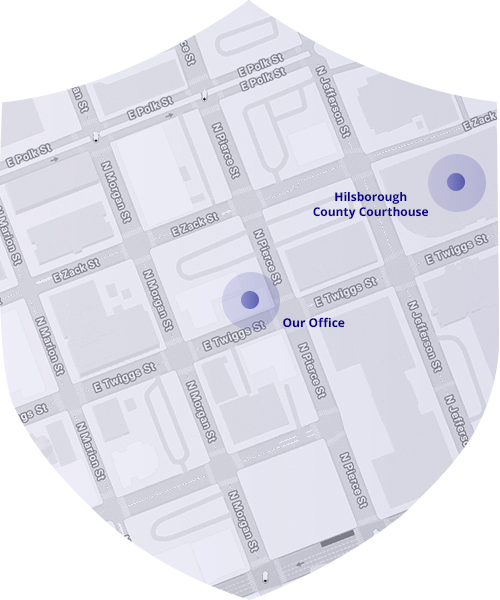
620 E. Twiggs Street, Suite 205, Tampa, FL 33602
(813) 727-7159
Serving Hillsborough, Pinellas, and Pasco Counties
The Brancato Law Firm, P.A. is a Tampa-based criminal defense practice. We are not affiliated with any other Brancato-named law firms.
For how this fits into the rest of a case, see our overview of how a Florida criminal case moves from investigation to appeal.
Visit Us
Tampa, FL 33602
Contact Us Now
Free Legal Consultation (813) 727-7159