- Free Consultation 24/7: (813) 727-7159 Tap Here To Call Us


From First DUI to Death Penalty



Is Consent a Defense to Sexual Battery in Florida? (2026)



Updated November 8, 2026
Short answer: Yes. Consent is a defense to sexual battery between adults in Florida, because the State must prove beyond a reasonable doubt that the act happened without consent. Florida defines consent in section 794.011(1)(a) as “intelligent, knowing, and voluntary consent,” which does not include coerced submission and is not shown by a lack of physical resistance. Consent is never a defense when the alleged victim is under the legal age, and it can be defeated by proof the person was asleep, unconscious, or incapacitated by a substance given without their knowledge.
Most adult sexual battery trials are not about whether sex happened. They are about whether it was consensual, and the jury decides that from texts, timelines, witnesses, and the two people’s accounts. I learned how those trials are won in the Major Crimes Unit, defending sex crimes and homicide cases, and I have tried more than 150 jury trials to verdict since. I’m Rocky Brancato, founder of The Brancato Law Firm, P.A., a Tampa criminal defense firm, and our attorneys build consent defenses the way juries actually evaluate them: from the evidence of what happened before, during, and after the encounter.
Is consent a defense to sexual battery in Florida?
Yes, for adults. Under section 794.011, Florida Statutes, sexual battery on a person 18 or older requires proof that the act was “without that person’s consent.” When the defense is consent, the State carries the burden of proving lack of consent beyond a reasonable doubt; the accused does not have to prove consent. Our Tampa sex crimes lawyer team builds that reasonable doubt from the evidence.
The statute defines consent as “intelligent, knowing, and voluntary consent” that “does not include coerced submission,” and it adds that consent shall not be construed to mean “the failure by the alleged victim to offer physical resistance.” In plain English: silence or no struggle is not proof of consent, but it is not proof of non-consent either. The jury looks at the whole picture.
Is believing the other person consented a defense in Florida?
No, not by itself. In Statler v. State, 349 So. 3d 873 (Fla. 2022), an Alachua County man convicted of sexual battery argued the State should have to prove he knew or should have known the woman did not consent. The Florida Supreme Court disagreed. It held that sexual battery is a general intent crime: the State must prove beyond a reasonable doubt that the complainant did not in fact consent, but not what the accused knew about her state of mind.
The same opinion explains why consent defenses still work. The Court said consent is an objective question decided from “what the complainant said and did,” so the jury asks whether the evidence proves the accused “did not have a willing partner.” That is where our attorneys focus: on the words, messages, and conduct a reasonable person would read as agreement.
When is consent not a defense?
Consent is legally impossible or irrelevant in several situations, and a consent defense will not work in them.
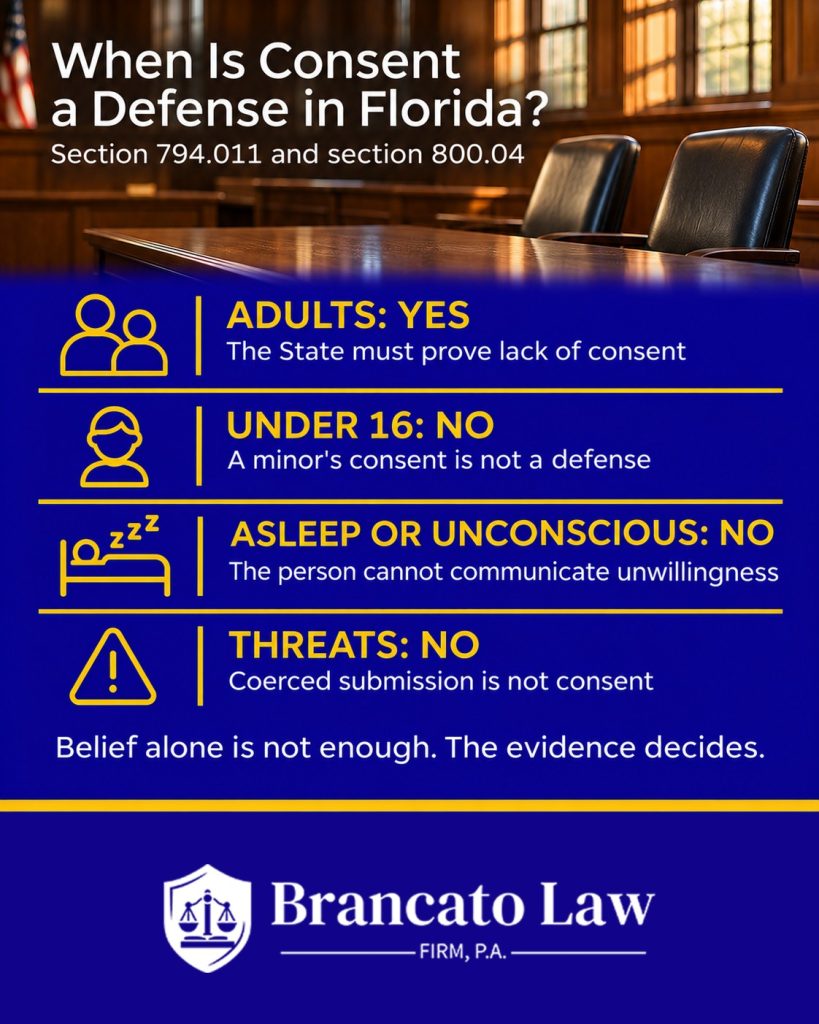
| Situation | Why consent does not apply | Statute |
|---|---|---|
| Alleged victim under 16 in a lewd or lascivious case | A minor’s consent is expressly not a defense | Section 800.04(2) |
| Alleged victim 16 or 17 and accused 24 or older | The offense does not require lack of consent | Section 794.05 |
| Alleged victim asleep, unconscious, or otherwise physically helpless | The person cannot communicate unwillingness, so the State charges a first-degree felony | Section 794.011(4) |
| Substance given without the person’s knowledge | Defined as mental incapacity, which supports a first-degree felony | Section 794.011(1)(d), (4) |
| Submission obtained by threats | Coerced submission is excluded from the definition of consent | Section 794.011(1)(a), (4) |
For age-based charges, see our posts on the age of consent in Florida and on why not knowing someone’s age is not a defense. The degrees and penalties for each form of the offense are set out in our guide to what sexual battery is in Florida.
What happens when alcohol is involved?
Alcohol is present in a large share of these cases. Antonia Abbey’s review in the Journal of Studies on Alcohol (Supplement No. 14, 2002) found that at least half of sexual assaults among college students involve alcohol consumption by the perpetrator, the alleged victim, or both. Drinking does not by itself erase consent under Florida law, but heavy intoxication is often the center of the State’s case.
Florida’s statute treats voluntary and involuntary intoxication differently. In Amelio v. State, 253 So. 3d 1150 (Fla. 4th DCA 2018), a Broward County jury heard an instruction on “mental incapacity” even though the woman had voluntarily drunk at several bars and nothing showed a substance was given to her without her consent. The Fourth District reversed the conviction and ordered a new trial, holding that the statutory definition of mental incapacity covers involuntary intoxication, not voluntary drinking.
Heavy voluntary intoxication can still support a conviction on other grounds. In Fogarty v. State, 403 So. 3d 1026 (Fla. 1st DCA 2024), a Bay County case, neither the defendant nor the woman remembered sex, but the defendant admitted carrying her to a couch after she passed out, and DNA was found later. The First District held a jury could infer she was too drunk to give “intelligent, knowing, and voluntary consent” and was unconscious, and it affirmed. Together the two cases show where the fight is: the defense contests whether the State has proof of incapacity or helplessness at the moment of the act, not just proof of drinking.
How often are these cases reported and prosecuted?
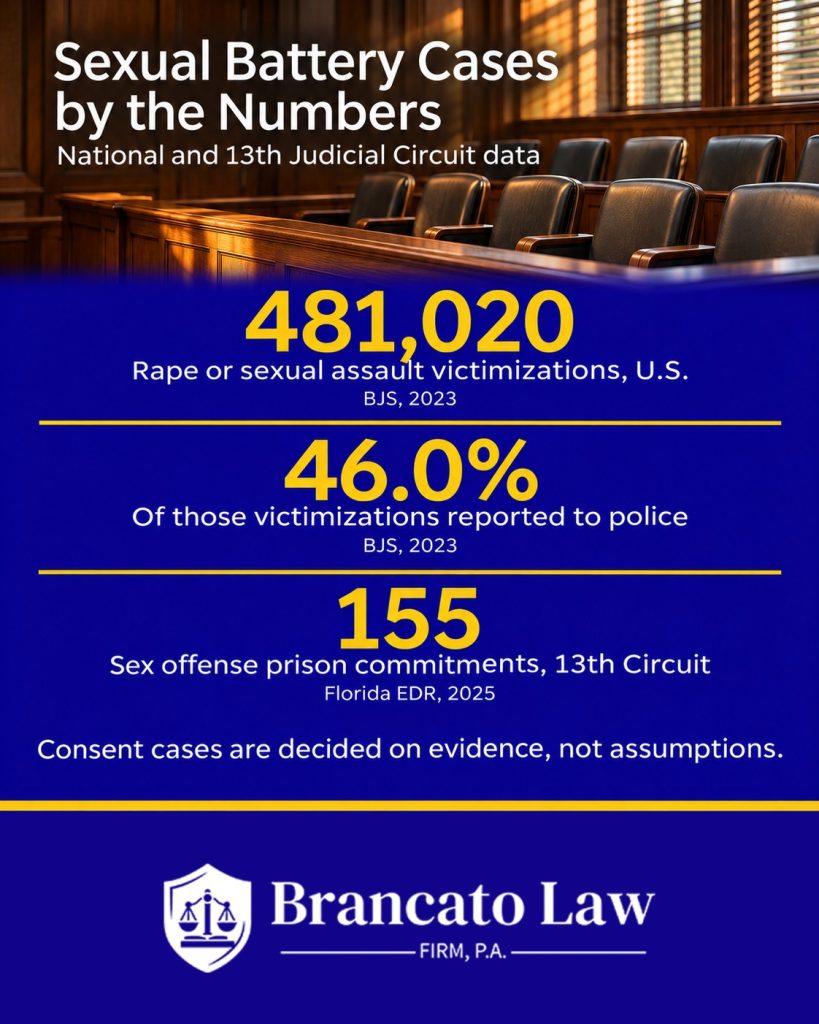
The Bureau of Justice Statistics report Criminal Victimization, 2023 estimated 481,020 rape or sexual assault victimizations nationwide in 2023 and found that 46.0% were reported to police. Locally, the Florida Legislature’s Office of Economic and Demographic Research Circuit 13 profile reports 155 new prison commitments for sexual or lewd behavior from the 13th Judicial Circuit in 2025. Our attorneys treat every sexual battery accusation as a case that can end in prison and lifetime registration, because many do.
What evidence supports a consent defense?
A consent defense is built from evidence, not from the accused’s word alone. These are the sources our attorneys collect first:
- Messages before and after the encounter. Texts, dating-app chats, and social media messages often show planning, mutual interest, or a friendly tone afterward.
- Timeline evidence. Ride-share receipts, door cameras, bar tabs, and phone location data show how much time passed and how each person was acting.
- Witnesses. Friends, bartenders, and roommates can describe the alleged victim’s condition and conduct, which bears on capacity.
- Forensic findings. A SANE exam that shows no injury does not prove consent, but it can rebut a claim of force.
- Motive and prior statements. Changed accounts and reasons to fabricate are proper subjects of cross-examination, within the limits of Florida’s rape shield law.
Consent defenses do win at trial. In one sexual battery case, Rocky Brancato persuaded a jury that an encounter between a man and a woman in a van in Ybor City was consensual; the defense showed the two were interrupted and that the woman was embarrassed, and the jury returned a verdict of not guilty of sexual battery. Past results do not guarantee future outcomes.
What should you do if you are accused?
Do not contact the accuser and do not agree to a recorded “controlled call,” which detectives often arrange through the accuser before an arrest. Do not delete messages; deleted messages look like consciousness of guilt and they are often the best consent evidence. Call a lawyer who offers representation before charges are filed, because many sexual battery cases are investigated for weeks before a warrant issues.
Frequently asked questions
Can you consent to sex while drunk in Florida?
Yes, a person who has been drinking can still consent, because Florida’s definition of mental incapacity covers substances given without the person’s consent, as the court held in Amelio v. State. The Brancato Law Firm focuses these cases on whether the State can prove the person was helpless or unable to give intelligent, knowing, and voluntary consent at the time.
Is an honest belief in consent a defense to sexual battery in Florida?
No. Under Statler v. State, the State does not have to prove the accused knew there was no consent, so a belief alone is not a defense. The Brancato Law Firm instead puts the complainant’s own words and conduct in front of the jury, because that evidence decides whether the State has proved lack of consent.
Is a lack of resistance proof of consent in Florida?
No. Section 794.011(1)(a) states that consent shall not be construed to mean the alleged victim’s failure to physically resist. Our attorneys at The Brancato Law Firm build consent defenses from affirmative evidence such as messages, conduct, and timeline records rather than from the absence of a struggle.
Can a sexual battery charge be dropped if the accuser recants in Florida?
A recantation does not automatically end the case, because the State Attorney’s Office decides whether to prosecute and can proceed with other evidence. The Brancato Law Firm presents recantations and supporting evidence to prosecutors through pre-file advocacy or a motion to dismiss when the facts support it.
Can my past relationship with the accuser be used to show consent?
Sometimes. Florida’s rape shield law generally bars evidence of the accuser’s sexual history, but it allows evidence of prior consensual activity with the accused when it is relevant to consent. The Brancato Law Firm litigates that evidence before trial so the jury can hear it; our sex crimes defense practice handles these motions regularly.
Is consent a defense if the other person was 16 or 17?
No, if the accused was 24 or older, because section 794.05 does not require proof of non-consent. Our attorneys at The Brancato Law Firm explain the age bands in our post on unlawful sexual activity with a minor.
Talk to a Tampa sexual battery defense attorney
Messages get deleted, cameras overwrite footage, and witnesses forget within weeks, so the first move is to lock down the evidence of consent. Call The Brancato Law Firm, P.A., founded by Tampa Criminal Defense Attorney Rocky Brancato, at (813) 727-7159, and call us at any hour if a detective has contacted you. Our firm has Spanish-speaking staff, and attorney Jean-Luc Adrien speaks Spanish, Haitian Creole, and French. Read our guide for Spanish and Haitian Creole speakers facing criminal charges. For more about our defense strategies, visit our Sex Crimes page.
The Brancato Law Firm, P.A.
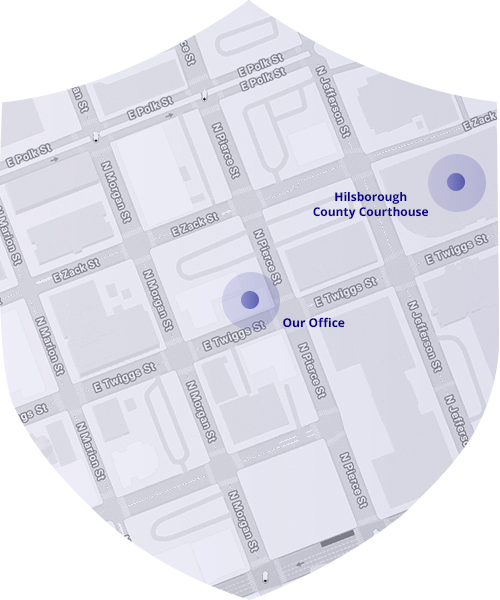
620 E. Twiggs Street, Suite 205, Tampa, FL 33602
(813) 727-7159
Serving Hillsborough, Pinellas, and Pasco Counties
The Brancato Law Firm, P.A. is a Tampa-based criminal defense practice. We are not affiliated with any other Brancato-named law firms.
Visit Us
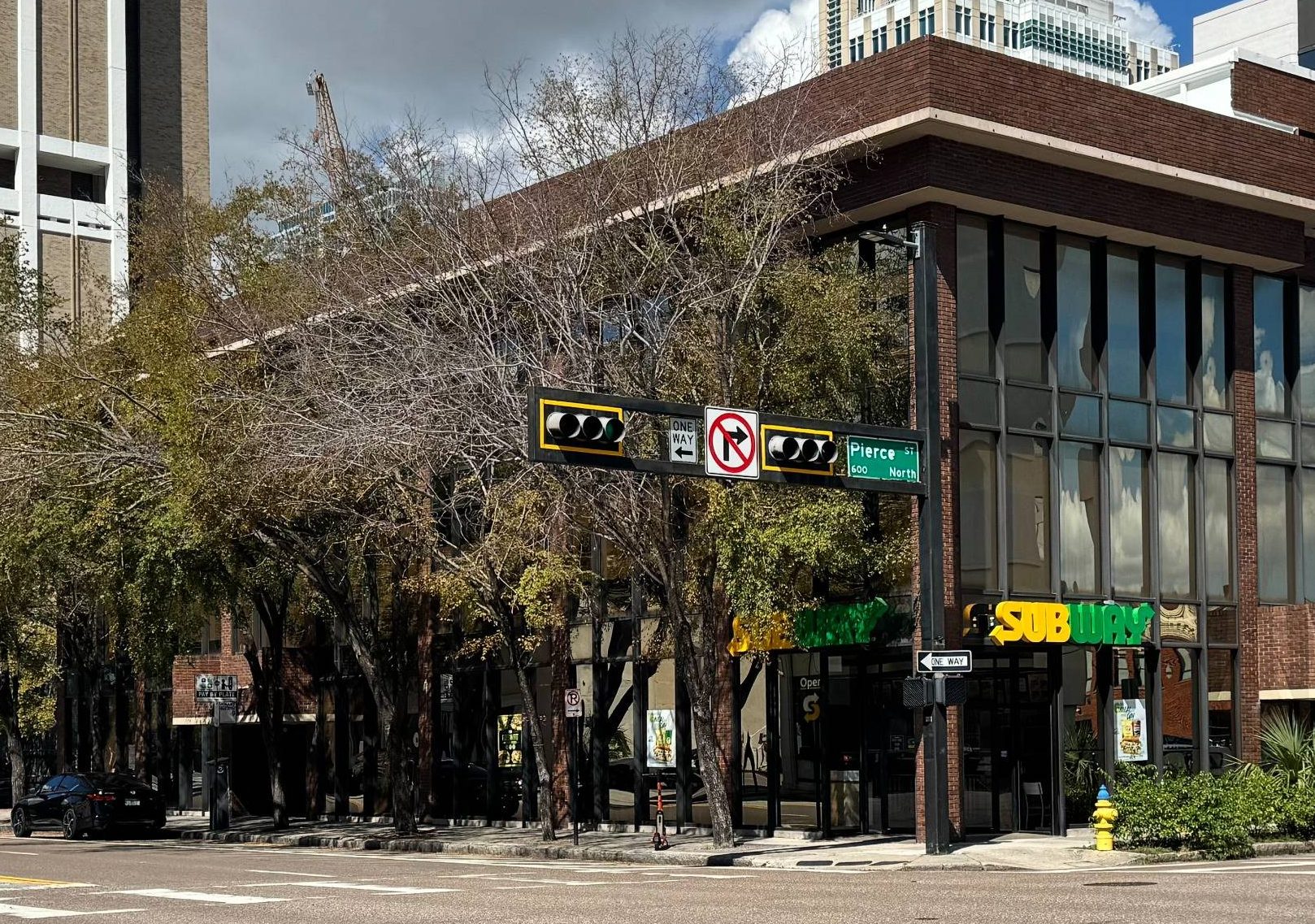
Tampa, FL 33602
Contact Us Now
Free Legal Consultation (813) 727-7159