- Free Consultation 24/7: (813) 727-7159 Tap Here To Call Us


From First DUI to Death Penalty


What Are the Exceptions to Florida’s Rape Shield Law? (2026)


Rewrite/update date: November 3, 2026. Originally published in February 2025.
| Florida’s rape shield law, section 794.022, Florida Statutes, bars evidence of specific instances of an accuser’s prior consensual sexual activity with anyone other than the defendant, and it always bars reputation evidence and evidence about the accuser’s clothing. There are two written exceptions, each decided by the judge at a private in camera hearing first: evidence showing the defendant was not the source of semen, pregnancy, injury, or disease, and evidence of a pattern of conduct so similar to the case that it is relevant to consent. The statute also yields when excluding evidence would deny the defendant a full and fair defense, and it does not reach prior activity with the defendant or allegations of nonconsensual acts by others. |
In a sexual battery case that comes down to one person’s word against another’s, some of the most important rulings happen before a jury is seated, when the judge decides what the jury will be allowed to hear about the accuser. I learned how those cases are built as a Major Crimes Unit attorney handling sex crime and child abuse cases. I’m Rocky Brancato, founder of The Brancato Law Firm, P.A., a Tampa criminal defense firm, and I have tried more than 150 jury trials to verdict. Our attorneys prepare rape shield motions early because the evidence the statute allows must be proven to the judge before trial, in writing and with witnesses ready.
What does Florida’s rape shield law say?
Florida’s rape shield law says that “specific instances of prior consensual sexual activity between the victim and any person other than the offender may not be admitted into evidence” in prosecutions for sexual battery, lewd and lascivious offenses, and human trafficking. That rule appears in section 794.022(2), Florida Statutes, and it covers cases charged under section 787.06, section 800.04, and section 794.011, Florida’s sexual battery statute.
The same statute contains other rules that shape every sex crime trial. The accuser’s testimony “need not be corroborated,” so a case can go to a jury on testimony alone. Reputation evidence about the accuser’s sexual conduct, and evidence offered to show that the accuser’s manner of dress “incited the sexual battery,” may never be admitted. And a defendant’s use of a condom, or an accuser’s request that one be used, is not by itself relevant to whether a crime happened or whether there was consent. At The Brancato Law Firm, we walk clients through these rules at the first meeting so they understand which arguments are available and which are off the table.
| Type of evidence | Rule under section 794.022 | How the defense can use it |
|---|---|---|
| Accuser’s prior consensual activity with someone other than the defendant | Barred, unless an exception is proven in camera | Source of semen, pregnancy, injury, or disease; pattern relevant to consent; constitutional right to a full defense |
| Accuser’s prior activity with the defendant | Not covered by the statute | Admissible if relevant under ordinary evidence rules |
| Accuser’s allegations of nonconsensual acts by others | Not covered by the statute | Admissible if relevant, for example to show fabrication |
| Reputation for sexual conduct | Always barred | None |
| Accuser’s manner of dress | Always barred to show it incited the offense | None |
| Condom use or request | Not relevant by itself to the offense or consent | Only with other evidence that gives it meaning |
Why does the rape shield law matter in Florida sex crime cases?
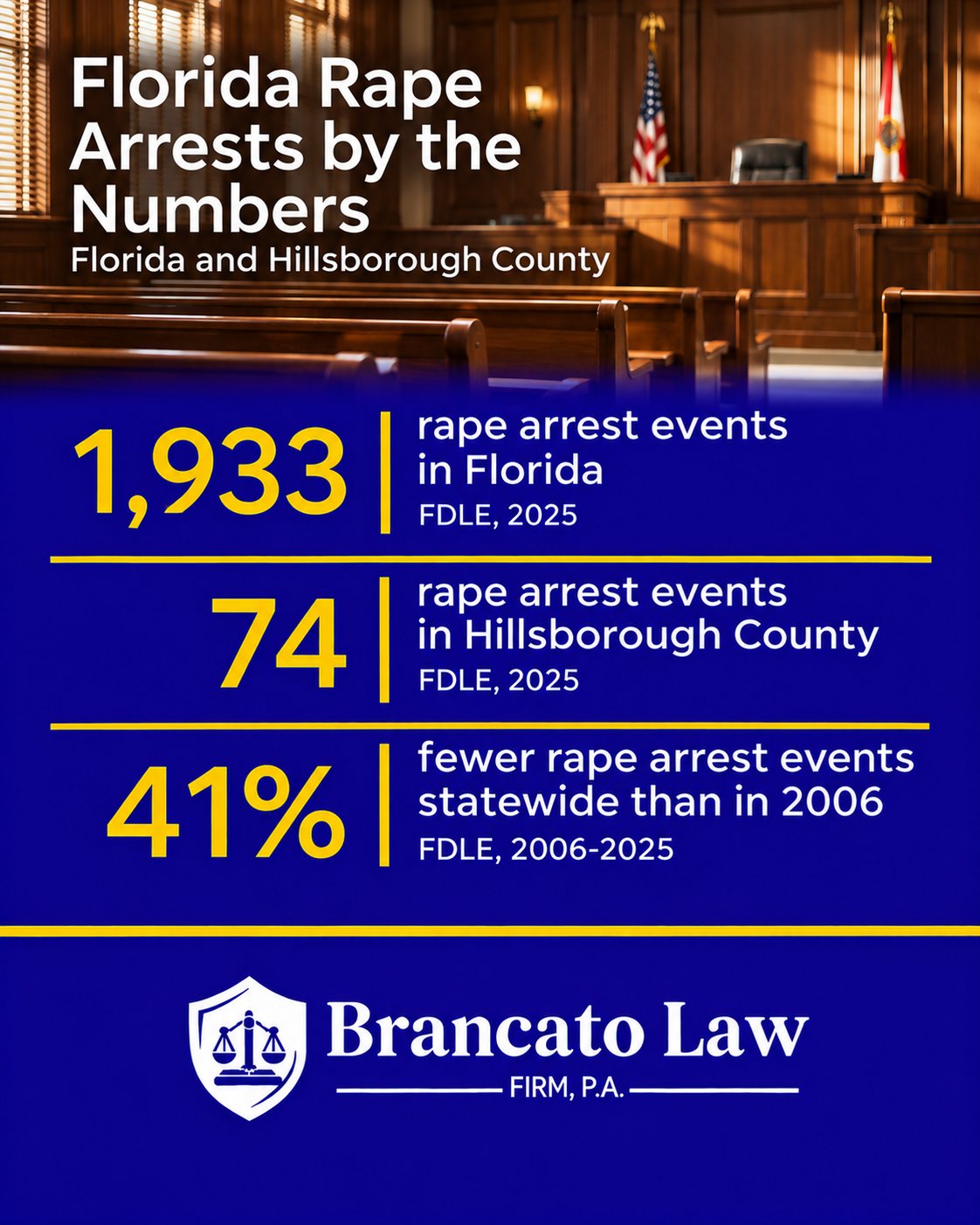
The rape shield law matters because many Florida sex crime cases rest almost entirely on the accuser’s credibility, and the statute decides which credibility evidence the jury hears. The number of these prosecutions is substantial. In 2025, Florida recorded 1,933 arrest events for rape, including 74 in Hillsborough County, according to Florida Department of Law Enforcement arrest data published on the Florida Department of Health’s FLHealthCHARTS. That statewide figure is about 41 percent lower than the 3,288 rape arrest events recorded in 2006 in the same data series. Each of those arrests can lead to a prosecution in which section 794.022 controls the evidence.
Legal scholars disagree about where the line should sit. Law professor Michelle J. Anderson argued in a 2002 analysis of rape shield laws that the exceptions in most state statutes weaken the protection the laws promise accusers. For a person accused in Florida, the practical lesson runs the other way: the exceptions are real, but they are narrow, and a judge will apply them only when the defense proves the specific facts. Our attorneys at The Brancato Law Firm build each exception on documents and witnesses, not on general claims about the accuser.
What are the exceptions to Florida’s rape shield law?
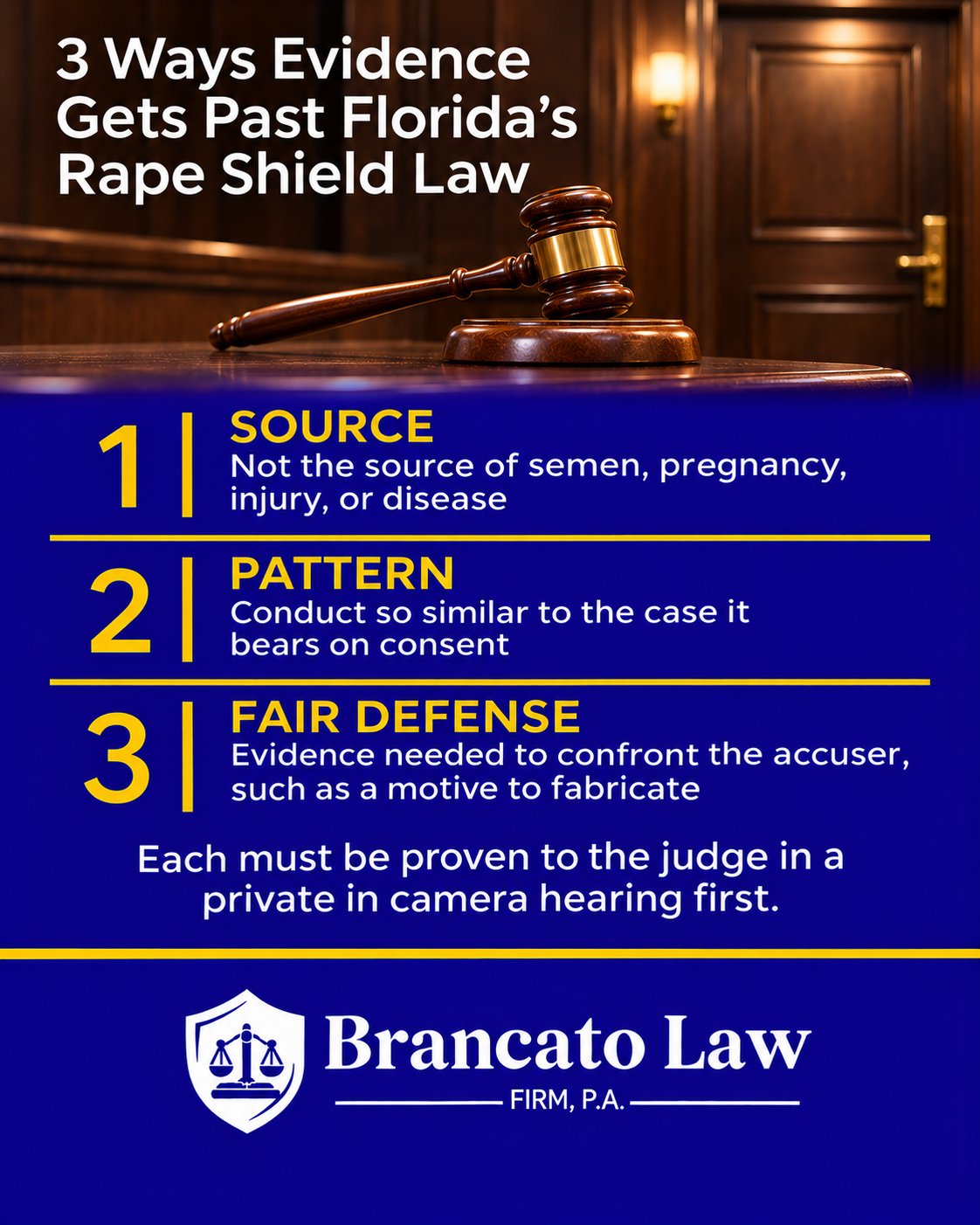
Florida’s rape shield law has two written exceptions in the statute and one constitutional exception created by the courts. Each one requires the defense to show the judge, outside the jury’s presence, exactly why the evidence matters to the case.
Exception 1: Proof the defendant was not the source of semen, pregnancy, injury, or disease
Evidence of the accuser’s activity with someone else is admissible if it may prove that the defendant “was not the source of the semen, pregnancy, injury, or disease.” In Audano v. State, 641 So. 2d 1356 (Fla. 2d DCA 1994), a Second District case, a nurse testified that a child’s physical findings showed intercourse that could have happened at any time in the prior three years. The defense was barred from showing that someone else had abused the child during that period. The court held the exclusion was error, explaining that when the State offers medical evidence of intercourse, the defendant is entitled to show prior intercourse with someone else, and it reversed for a new trial. Our post on how to challenge SANE exam evidence explains how this exception works with the medical file.
Exception 2: A pattern of conduct so similar that it is relevant to consent
When consent is the defense, the statute allows evidence of “a pattern of conduct or behavior” by the accuser “so similar to the conduct or behavior in the case that it is relevant to the issue of consent.” Courts read this narrowly. In Carlyle v. State, 945 So. 2d 540 (Fla. 2d DCA 2006), the defense argued that an accuser’s past prostitution showed a pattern, and the Second District called the argument that “prostitution is prostitution” insufficient. A pattern means repetitive conduct that closely resembles the defendant’s version of the encounter. Our attorneys look for specific, repeated, documented conduct before we rely on this exception.
Exception 3: The defendant’s right to a full and fair defense
The rape shield rule gives way when applying it would deny the accused a fair trial. In Lewis v. State, 591 So. 2d 922 (Fla. 1991), a stepfather argued that his stepdaughter invented the accusation to keep a scheduled gynecological exam from revealing her sexual relationship with her boyfriend. The trial court kept that evidence out. The Florida Supreme Court held that when the rule “interferes with confrontation rights, or otherwise precludes a defendant from presenting a full and fair defense, the rule must give way to the defendant’s constitutional rights,” and it sent the case back.
The Second District applied Lewis a year later in Dixon v. State, 605 So. 2d 960 (Fla. 2d DCA 1992). The prosecutor asked jurors how a five-year-old could describe sexual acts unless the accusation were true, while the defense had been barred from calling a witness who said he had seen the child engage in sexual play weeks earlier. The court held that the testimony was relevant and “critical” to the fabrication defense, and it reversed. Motive to fabricate and the source of a child’s sexual knowledge are two of the most common ways our attorneys at The Brancato Law Firm raise this exception.
What evidence is not covered by the rape shield law?
The rape shield law does not cover prior sexual activity between the accuser and the defendant, or accusations of nonconsensual acts by other people. Florida appellate courts have said the statute “only relates to consensual sexual activity with a person other than the accused,” a phrase from Gomez v. State, 245 So. 3d 950 (Fla. 4th DCA 2018) that the First District repeated in Thorne v. State, 271 So. 3d 177 (Fla. 1st DCA 2019). That evidence is still subject to the ordinary rules of relevance, and the judge can exclude it if its value is outweighed by unfair prejudice.
- Prior relationship with the defendant. Gomez held that “the statute does not prohibit admission of sexual incidents between the victim and offender.” A prior relationship can matter to consent and to motive.
- Accusations against other people. In Thorne, the accuser named three other men in an advocacy center interview but did not name the defendant. The First District held the rape shield law did not apply and that excluding the evidence was error, though it found the error harmless on that record.
- Another person as the attacker. In Vincent v. State, 368 So. 3d 993 (Fla. 4th DCA 2023), the trial court used the rape shield law to stop the defense from suggesting someone else raped the accuser. The Fourth District agreed that was error, but affirmed because DNA proved the defendant fathered the child.
- Prior false accusations. A prior accusation that was false is not “consensual sexual activity,” so the statute does not bar it. Gomez explained that admissibility turns on relevance, such as similarity to the current accusation. Our post on whether prior accusations can be used against you covers the other side of that issue.
What did the Second District decide in Johnson v. State in 2026?
In Johnson v. State, No. 2D2024-0982 (Fla. 2d DCA Sept. 25, 2026), the Second District Court of Appeal reversed two sexual battery convictions because the jury was not allowed to hear that, during a 2013 Department of Children and Families investigation, the accuser described sexual abuse by her stepfather while denying any sexual abuse by the defendant, her stepuncle. The trial judge in Sarasota County let the defense mention “abuse” in general terms but barred any reference to its sexual nature. The jury convicted on two counts and acquitted on three.
The Second District held that the sexual nature of the earlier allegation was “necessary to adequately draw a comparison” with the abuse she did not report against the defendant during the same interview, and that it supported the defense theory that the later accusation was fabricated. Because the case was “he said, she said,” the error was not harmless, and the court ordered a new trial on the two counts. The lesson for defendants is that a statement an accuser made years earlier to DCF or a Child Protection Team can be powerful evidence, and the defense should fight to present it in full rather than accept a watered-down version. Johnson binds trial judges in Hillsborough, Pinellas, and Pasco Counties, which sit in the Second District.
How does the in camera hearing work?
An in camera hearing is a private hearing, outside the jury’s presence, where the judge decides whether evidence of the accuser’s sexual history fits an exception before anyone mentions it at trial. The statute requires that the evidence be “first established to the court in a proceeding in camera,” so the defense carries the burden of showing the judge exactly what the evidence is and why it matters.
| Step | What happens | What the defense should have ready |
|---|---|---|
| Written motion | Defense files a motion identifying the evidence and the exception | Specific facts, dates, and the legal basis |
| Proffer | Defense presents the evidence privately: testimony, records, or a summary | Witnesses, medical records, DCF or CPT reports, messages |
| State’s response | Prosecutor argues the evidence is barred or unfairly prejudicial | Answers to the prejudice argument and case law |
| Ruling | Judge admits, limits, or excludes the evidence | A record clear enough to preserve the issue for appeal |
| Trial | Admitted evidence is presented within the limits the judge set | Questions written to stay inside the ruling |
In our experience in Hillsborough County courtrooms, the defense that wins an in camera hearing is the one that arrives with the specific witnesses and documents, not a general argument about the accuser. Judges in the 13th Judicial Circuit rule on the record in front of them, and a vague proffer usually means the evidence stays out and the issue is weaker on appeal. Our Hillsborough County criminal defense attorneys prepare these motions alongside depositions so the proffer is complete.
What should you do if you are accused of a sex crime in Florida?
If you are accused of a sex crime in Florida, do not speak with investigators, do not contact the accuser, and preserve every message and record that shows your relationship and the accuser’s statements. The evidence that supports a rape shield exception, such as prior messages, earlier reports, or medical records, can disappear if no one asks for it early. If you think you are under investigation but have not been charged, our representation before charges are filed can address the case before the State decides what to file. For the charges themselves, see our guide to what sexual battery is in Florida, and for cases involving children, our guide to child hearsay in sex cases.
Frequently asked questions about Florida’s rape shield law
Can my lawyer ask about the accuser’s past relationships at trial?
Usually not about specific sexual activity with other people, unless the judge first finds an exception applies at an in camera hearing. The Brancato Law Firm files those motions before trial so the judge rules on a full record rather than an objection in front of the jury, as our Tampa sex crimes defense lawyers do in every contested case.
Does the rape shield law apply to a prior relationship between me and the accuser?
No. The statute covers only activity with people other than the defendant, so a prior relationship between the accuser and the accused is judged by ordinary relevance rules. Our attorneys at The Brancato Law Firm use that history when it bears on consent or on a motive to accuse.
Can the defense show the accuser made a false accusation before?
It can, if the earlier accusation is relevant, such as being similar to the current one or showing a motive. A prior false accusation is not consensual sexual activity, so section 794.022 does not bar it, and The Brancato Law Firm investigates earlier reports to DCF, police, and schools to find them. The leading appellate discussion is in Gomez.
Does the rape shield law apply in child sex abuse cases?
Yes. The statute applies to prosecutions under section 800.04, which covers lewd and lascivious offenses against children, as well as sexual battery. Our attorneys at The Brancato Law Firm often rely on Dixon and Audano in child cases, where the source of a child’s knowledge or injury is the central question; our guide to Florida’s age of consent explains the underlying charges.
Can the prosecutor bring up my sexual history?
The rape shield statute protects the accuser, not the defendant. Evidence of a defendant’s other sexual conduct is governed by the Williams rule and related statutes instead, and The Brancato Law Firm challenges that evidence through pretrial motions to exclude or limit it.
Can sexual battery charges be dropped in Florida?
Yes. Prosecutors can drop or reduce charges when the evidence, including evidence a rape shield ruling lets in, undermines the accuser’s account. Our attorneys at The Brancato Law Firm present that evidence to the State Attorney’s Office early when it gives the client the best chance at a dismissal.
For how this fits into the rest of a case, see our guide to each stage of a Florida criminal case.
Talk to a Tampa sex crimes defense attorney
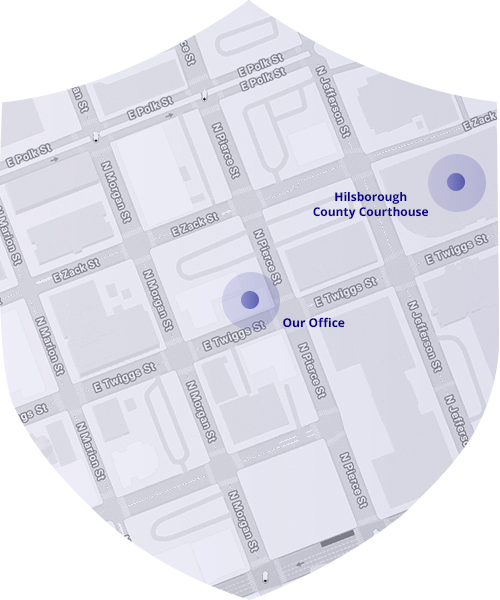
Rape shield issues are decided before trial, so the time to prepare them is now, not the week before jury selection. Our attorneys will review the discovery, identify the evidence an exception may allow, and prepare the motion and witnesses the judge will expect. Call The Brancato Law Firm, P.A., founded by Tampa Criminal Defense Attorney Rocky Brancato, at (813) 727-7159 at any hour; we defend clients in Hillsborough, Pinellas, and Pasco Counties from an office two blocks from the courthouse. Our firm has Spanish-speaking staff, and attorney Jean-Luc Adrien speaks Spanish, Haitian Creole, and French. Read our guide for Spanish and Haitian Creole speakers facing criminal charges.

For more about our defense strategies, visit our Sex Crimes page.
The Brancato Law Firm, P.A.
620 E. Twiggs Street, Suite 205, Tampa, FL 33602
(813) 727-7159
Serving Hillsborough, Pinellas, and Pasco Counties
The Brancato Law Firm, P.A. is a Tampa-based criminal defense practice. We are not affiliated with any other Brancato-named law firms.
Visit Us
Tampa, FL 33602
Contact Us Now
Free Legal Consultation (813) 727-7159