- Free Consultation 24/7: (813) 727-7159 Tap Here To Call Us


From First DUI to Death Penalty



Is Not Knowing Someone’s Age a Defense to a Sex Crime in Florida? (2026)



Updated November 8, 2026
Short answer: No. In Florida, not knowing the other person was under the legal age is not a defense to a sex offense that depends on age. Section 794.021, Florida Statutes, says ignorance of age, a minor’s lie about age, and an honest belief that the person was older are all not defenses, and section 800.04(3) says the same for lewd or lascivious offenses. A mistaken belief about age can still matter at the charging and plea stages, and in online sting cases the State has to prove what the accused believed.
A prosecutor in an underage sex case does not have to prove the accused knew the other person’s age. The State proves the act and the birth date, and the case is largely made. That is why the defense has to start somewhere else. As founder of The Brancato Law Firm, P.A., a Tampa criminal defense firm, I defended these cases in the Major Crimes Unit, which handled sex crimes and child abuse, and I have spent more than 25 years in Hillsborough County courtrooms. Our attorneys focus on what still moves a case when mistake of age is off the table: the charge, the evidence of the act, the ages, and the facts a prosecutor weighs before filing.
Is “I didn’t know their age” a defense to a sex crime in Florida?
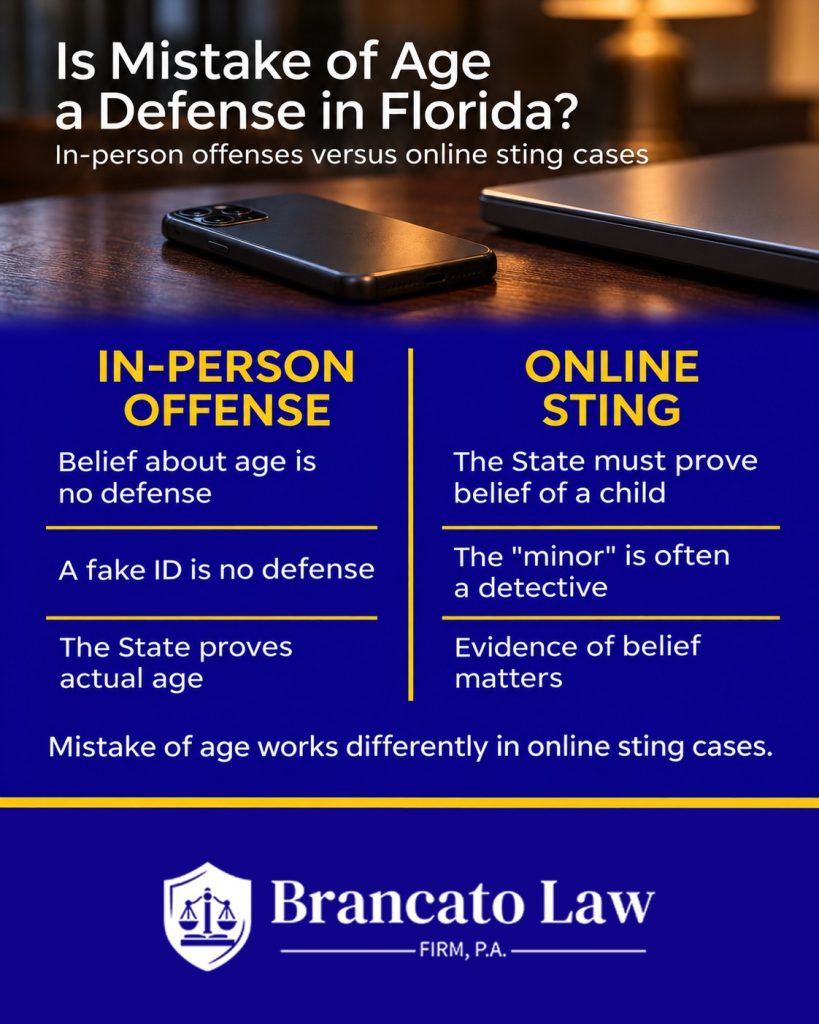
No. Section 794.021, Florida Statutes, provides that when a crime in chapter 794 depends on the alleged victim being under a certain age, “ignorance of the age is no defense,” and neither is the minor’s misrepresentation of age or the accused’s good-faith belief that the person was older. Section 800.04(3), Florida Statutes, applies the same rule to lewd or lascivious offenses involving a person under 16. Florida law treats these as strict liability offenses as to age.
A fake ID, an adult dating profile, a bar wristband, or a direct statement such as “I’m 19” does not change the legal result at trial. The jury will be instructed that the defendant’s belief about age is not a defense.
| Charge | Age element | Is mistake of age a defense? |
|---|---|---|
| Unlawful sexual activity with a minor, section 794.05 | Accused 24 or older; other person 16 or 17 | No (section 794.021) |
| Sexual battery on a person under 12 or under 18, section 794.011 | Age of the alleged victim and of the accused | No (section 794.021) |
| Lewd or lascivious battery or molestation, section 800.04 | Alleged victim under 16 | No (section 800.04(3)) |
| Online solicitation or traveling to meet a minor, section 847.0135(3)-(4) | A child, or a person the accused believed to be a child | The State must prove what the accused believed |
What have Florida courts said about mistake of age?
Florida courts have enforced the rule as written. In Hodge v. State, 866 So. 2d 1270 (Fla. 4th DCA 2004), a man convicted of sexual activity with a 17-year-old under section 794.05 asked the judge to instruct the jury that the State had to prove he knew she was underage. The Fourth District held the offense is strict liability, that he “could not defend on his lack of criminal intent or mistake of age,” and affirmed.
Two years later, in Feliciano v. State, 937 So. 2d 818 (Fla. 1st DCA 2006), a 26-year-old convicted under the same statute argued that punishing him without proof he knew the girl’s age violated due process. The First District rejected the challenge, holding that Florida has long treated statutory rape as a strict liability crime and that the Legislature “left no doubt” about it. The takeaway is plain: a constitutional attack on section 794.021 is not a realistic defense in a Florida trial court.
Not everyone agrees the rule is wise. Professor Catherine L. Carpenter argued in “On Statutory Rape, Strict Liability, and the Public Welfare Offense Model,” 53 American University Law Review 313 (2003), that courts should allow a reasonable mistake-of-age defense. That debate has not changed Florida law, but it explains why prosecutors and judges sometimes treat a well-documented, reasonable mistake as a reason for leniency.
How common are these cases, and who are the accused?
Most statutory rape cases involve people who know each other. An Office of Juvenile Justice and Delinquency Prevention study of 2000 FBI NIBRS data (Troup-Leasure and Snyder, published 2005) found that 29% of statutory rape offenders were boyfriends or girlfriends and 62% were acquaintances. Those are exactly the relationships where a person may honestly misjudge an age, and exactly the cases where section 794.021 removes that argument.
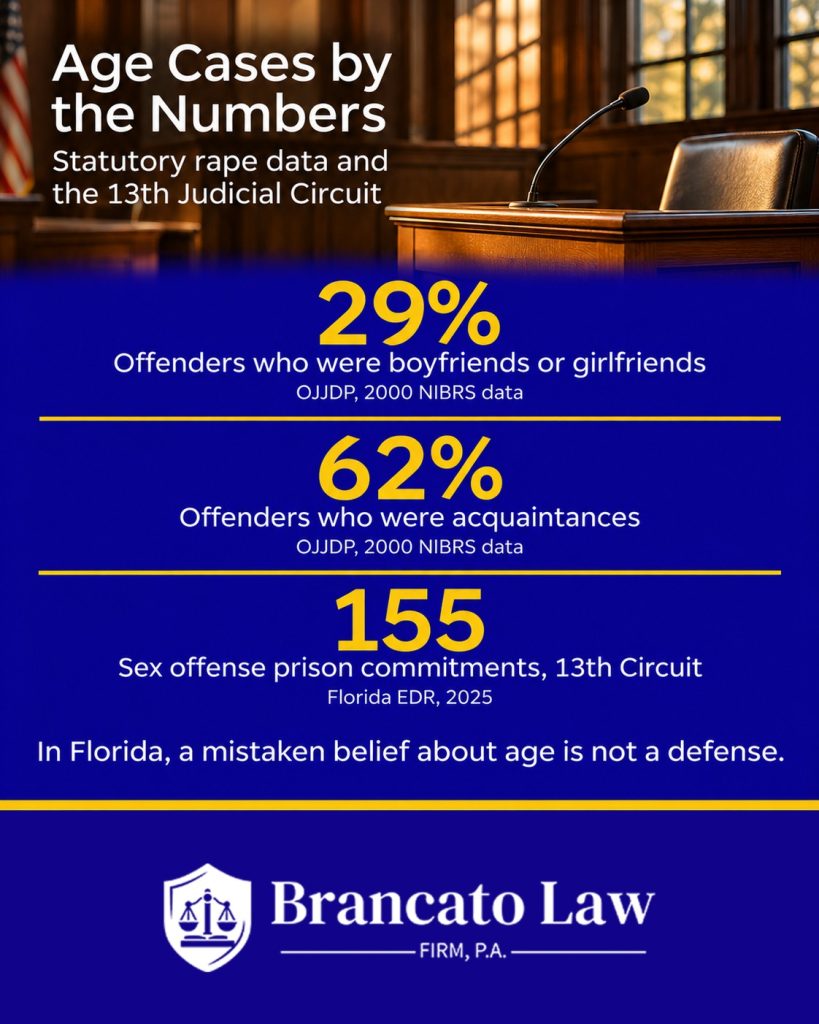
The stakes are high in our circuit. The Florida Legislature’s Office of Economic and Demographic Research Circuit 13 profile reports 155 new prison commitments for sexual or lewd behavior from the 13th Judicial Circuit in 2025, a 23.9% increase over 2024. Our Tampa sex crimes lawyer team uses every tool before trial because a conviction in these cases so often means prison and registration.
If mistake of age is not a defense, how do our attorneys fight these charges?
We challenge the elements the State still has to prove and we work the charging decision. Mistake of age removes one argument; it does not relieve the State of proving every other element beyond a reasonable doubt.
- Proof the act happened. Many cases rest on one person’s account. We test it against phone records, location data, messages, and prior statements.
- Proof of age. The State must prove the actual age with competent evidence, and the exact age decides which statute applies and which degree of felony.
- The right statute. A 23-year-old with a 17-year-old does not violate section 794.05 at all, because that statute starts at age 24. Our post on the unlawful sexual activity with a minor statute explains the age bands.
- Suppression issues. Statements taken without proper warnings and phone searches without a valid warrant or consent can be challenged with a motion to suppress.
- Pre-file advocacy. Before charges are filed, we can present the prosecutor with evidence of the circumstances, including the minor’s own representations.
Evidence of a minor’s misrepresentation does not win at trial, but it can change outcomes before trial. In one case, Rocky Brancato uncovered the complainant’s extensive online presence showing that she consistently misrepresented her age and had given different accounts of her story; when that evidence was presented to the prosecution, the charges were dismissed. Past results do not guarantee future outcomes.
How is this different from Florida’s age of consent?
The age of consent sets who can legally agree to sex; section 794.021 says what happens when someone gets that age wrong. Florida’s general age of consent is 18, with exceptions for 16- and 17-year-olds whose partner is under 24. Our guide to the age of consent in Florida walks through those age bands, and our post on the consent defense in Florida sex crimes cases explains why a minor’s agreement is never a defense under section 800.04(2).
Does the rule work differently in online sting cases?
Yes. Online solicitation and traveling to meet a minor under section 847.0135, Florida Statutes, cover contact with “a child or another person believed by the person to be a child.” In a sting, the “minor” is usually an adult detective, so the case turns on what the accused believed. Evidence that the accused thought he was talking to an adult can be a real defense in those cases, along with the way the sting was run. That is the opposite of the rule for in-person offenses.
What should you do if you are under investigation?
Do not contact the alleged victim, the family, or the detective, and do not explain what you believed about the person’s age. Those explanations admit the act, which is often the harder element for the State to prove. Call a lawyer who offers representation before charges are filed, preserve your phone and accounts without deleting anything, and let counsel decide what, if anything, goes to the State Attorney’s Office.
Frequently asked questions
What if the minor showed me a fake ID in Florida?
A fake ID is not a defense at trial under section 794.021, which expressly rejects a minor’s misrepresentation of age as a defense. The Brancato Law Firm can still use that evidence with prosecutors when it is documented and credible, which can affect the charge or the plea offer.
Can a reasonable belief that someone was 18 reduce my sentence in Florida?
It can be part of the mitigation picture, but it does not create a legal defense. Our attorneys at The Brancato Law Firm present the circumstances, the age gap, and the client’s background through our sex crimes defense practice when arguing for a lower sentence or a downward departure.
Is mistake of age a defense to lewd or lascivious battery in Florida?
No. Section 800.04(3) bars the defendant’s ignorance of the alleged victim’s age, the alleged victim’s misrepresentation, and a bona fide belief about age as defenses. The Brancato Law Firm focuses these defenses on whether the act occurred and whether the State can prove the specific elements charged.
Can statutory rape charges be dropped in Florida?
Yes. Charges can be dropped when the evidence of the act is weak, the ages do not fit the statute charged, or the complainant’s account changes. Before a case is filed, The Brancato Law Firm presents evidence to the State Attorney’s Office through pre-file advocacy in an effort to stop the charge.
Does Florida have a close-in-age exception?
Florida has no general close-in-age defense, but age gaps matter in two ways: section 794.05 applies only to accused persons 24 or older with a 16- or 17-year-old, and section 943.04354 allows some young people to seek removal from registration. Our attorneys at The Brancato Law Firm explain both in our guide to registry removal.
Talk to a Tampa sex crimes defense attorney
What you say in the first days of an investigation can decide whether a mistaken belief about age ever gets heard by a prosecutor. Our attorneys will review the evidence, the ages, and the statute before anyone speaks to the detective. Call The Brancato Law Firm, P.A., founded by Tampa Criminal Defense Attorney Rocky Brancato, at (813) 727-7159; you can call us at any hour. Our firm has Spanish-speaking staff, and attorney Jean-Luc Adrien speaks Spanish, Haitian Creole, and French. Read our guide for criminal defense in Spanish and Haitian Creole in Tampa. For more about our defense strategies, visit our Sex Crimes page.
The Brancato Law Firm, P.A.
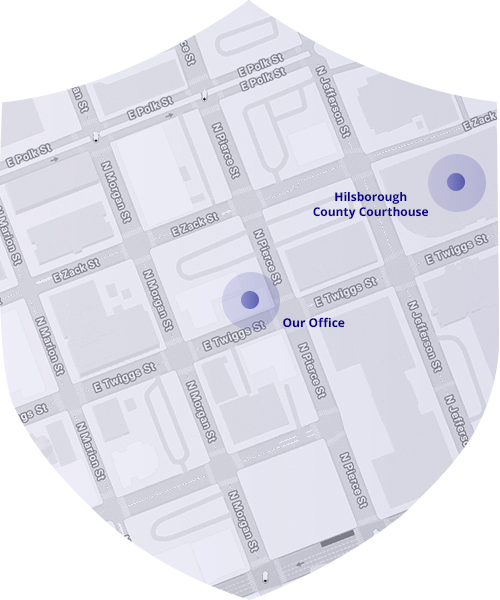
620 E. Twiggs Street, Suite 205, Tampa, FL 33602
(813) 727-7159
Serving Hillsborough, Pinellas, and Pasco Counties
The Brancato Law Firm, P.A. is a Tampa-based criminal defense practice. We are not affiliated with any other Brancato-named law firms.
Visit Us
Tampa, FL 33602
Contact Us Now
Free Legal Consultation (813) 727-7159