- Free Consultation 24/7: (813) 727-7159 Tap Here To Call Us


From First DUI to Death Penalty



Case v. Montana: When Can Police Enter Your Home for a Welfare Check? (2026)


Fully rewritten and updated October 24, 2026.
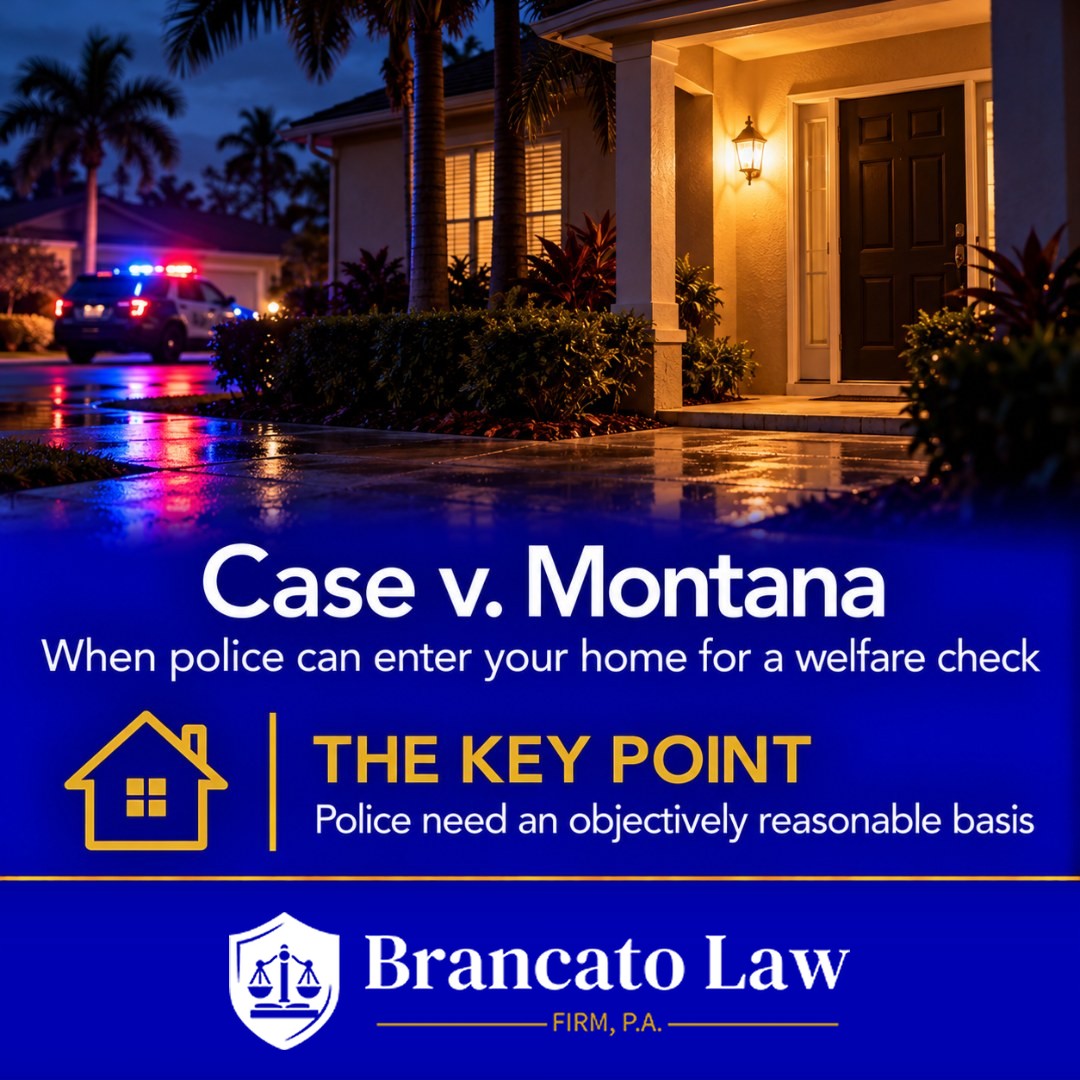
In Case v. Montana, 607 U.S. 107 (2026), the U.S. Supreme Court unanimously held that police may enter a home without a warrant to give emergency aid when they have “an objectively reasonable basis for believing” that someone inside is seriously injured or imminently threatened with serious injury. Officers do not need probable cause, but a hunch or a vague report is not enough. Once inside, they may do only what the emergency requires, so evidence found beyond that limit can still be challenged with a motion to suppress in Florida courts.
When a judge rules on a suppression motion after a welfare check, the question is what the officers knew at the moment they crossed the threshold, and what they did after. I taught officers those rules as a former police academy instructor, and I have argued them for more than 25 years in Hillsborough County courtrooms. I’m Rocky Brancato, founder of The Brancato Law Firm, P.A., a Tampa criminal defense firm, and our attorneys challenge warrantless home entries in criminal cases across Hillsborough, Pinellas, and Pasco Counties.
What Happened in Case v. Montana?
William Case told his ex-girlfriend on the phone that he was going to kill himself. She heard a clicking sound like a gun being cocked, then “a pop” and silence, and she called 911. Three officers were sent to do “a welfare check on a suicidal male.” They knew Case had alcohol and mental health problems, had threatened suicide before, and had once appeared to try “suicide by cop.”
At the house, nobody answered their knocks or calls. Through the windows the officers saw empty beer cans, an empty handgun holster, and a notepad they believed was a suicide note. About 40 minutes after arriving, they went in. Case stepped out of a bedroom closet holding what looked like a gun, and an officer shot and injured him. Officers found a handgun nearby, and Case was charged with assaulting a police officer.
Case moved to suppress all evidence from the entry. The trial court denied the motion, a Montana jury convicted him, and a divided Montana Supreme Court upheld the entry. The U.S. Supreme Court took the case because federal appeals courts disagreed about whether emergency entries require probable cause.
What Did the Supreme Court Hold in Case v. Montana?
The Court held that an officer may enter a home without a warrant to render emergency aid if the officer has “an objectively reasonable basis for believing” that an occupant is seriously injured or imminently threatened with such injury. Justice Kagan’s opinion for a unanimous Court in Case v. Montana, 607 U.S. 107 (2026) reaffirmed the test from Brigham City v. Stuart, 547 U.S. 398 (2006), where officers entered after seeing a fight through a window, and said that test applies “with no further gloss.”
| Proposed standard | Who argued for it | What the Court did |
|---|---|---|
| Probable cause | William Case | Rejected: probable cause “is peculiarly related to criminal investigations” and fits “awkwardly, if at all” in emergency aid |
| “Specific and articulable facts” to “suspect” someone needs help | Montana courts | Rejected: it evokes the reasonable-suspicion test for brief street stops, which Brigham City did not adopt for homes |
| Objectively reasonable basis for believing someone inside needs emergency aid | Brigham City (2006) | Reaffirmed as the only test |
The Court also repeated a limit that matters in criminal cases: “an emergency-aid entry provides no basis to search the premises beyond what is reasonably needed to deal with the emergency while maintaining the officers’ safety.” Applying the standard, the Court found the officers had a reasonable basis to believe Case had shot himself or was about to, and it affirmed his conviction.
How Did Case v. Montana Change the Law in Florida?
Case v. Montana changed the federal rule that applied in Florida. The Court listed the Eleventh Circuit, the federal appeals court that covers Florida, among the courts that had required probable cause for emergency entries, citing United States v. Cooks, 920 F.3d 735 (11th Cir. 2019). That probable-cause gloss is gone; federal courts in Florida now apply the Brigham City standard as written.
| Federal circuit | Position before Case v. Montana (case the Court cited) |
|---|---|
| Second Circuit | Required probable cause (Estate of Chamberlain v. White Plains, 2020) |
| Eleventh Circuit (Florida) | Required probable cause (United States v. Cooks, 2019) |
| D.C. Circuit | Required probable cause (Corrigan v. District of Columbia, 2016) |
| First Circuit | Did not require probable cause (Hill v. Walsh, 2018) |
| Eighth Circuit | Did not require probable cause (United States v. Quarterman, 2017) |
| Tenth Circuit | Did not require probable cause (United States v. Gambino-Zavala, 2008) |
Florida’s state courts were already close to the Brigham City test. In Seibert v. State, 923 So. 2d 460 (Fla. 2006), a roommate called 911 to report that Michael Seibert was suicidal. Seibert took several minutes to answer the door, opened it only partway, and slammed it shut. The Florida Supreme Court upheld the entry because “an objectively reasonable basis” existed to believe there was “an immediate need for police assistance for the protection of life.” The court also held that the search must be “strictly circumscribed by the exigencies which justify its initiation,” and that once officers determine no emergency exists, “any subsequent search is illegal.”
That scope rule is where many Florida welfare-check cases are won. Under Seibert, officers may seize contraband in plain view while the emergency is still being resolved, but not after it ends. Our attorneys build the timeline from body camera footage, dispatch records, and CAD logs to show the moment the emergency ended and what the officers did next.
What Did Justice Sotomayor Say About Mental Health Welfare Checks?
Justice Sotomayor joined the Court’s opinion but wrote separately to warn that entering a home is not always the reasonable response to a person in a mental health crisis, because “the presence of law enforcement at times can escalate the situation rather than ameliorate it, putting both the occupant and the officers in danger.” She cited research showing that people with serious mental health conditions are “seven times more likely to be killed during police interactions” than the general population, and a Washington Post review finding that over a 2-year period, “calls for help resulted in law enforcement officers shooting and killing the very people they were called on to assist” in 178 cases.
She also cited a 2024 American Journal of Public Health study by Ward and colleagues finding that police shootings involving behavioral health concerns were 2.1 times more likely to be fatal than other police shootings, and a 2018 International Journal of Law and Psychiatry study by Saleh and colleagues finding that people with mental illness were “2.8 times more likely” to “be killed in their own homes.” She suggested officers may sometimes do better to call from a distance, contact family, or bring in crisis-trained officers or mental health professionals before entering, and she wrote that once officers decide to go in, the “manner” of the entry and their conduct inside must also be “reasonable.”
A concurrence is not the holding, but it is persuasive authority a Florida judge can consider. The majority noted that Case never challenged how the officers entered or what they did inside, so those questions remain open for future cases.
How Often Do Florida Police Respond to Mental Health Crises?
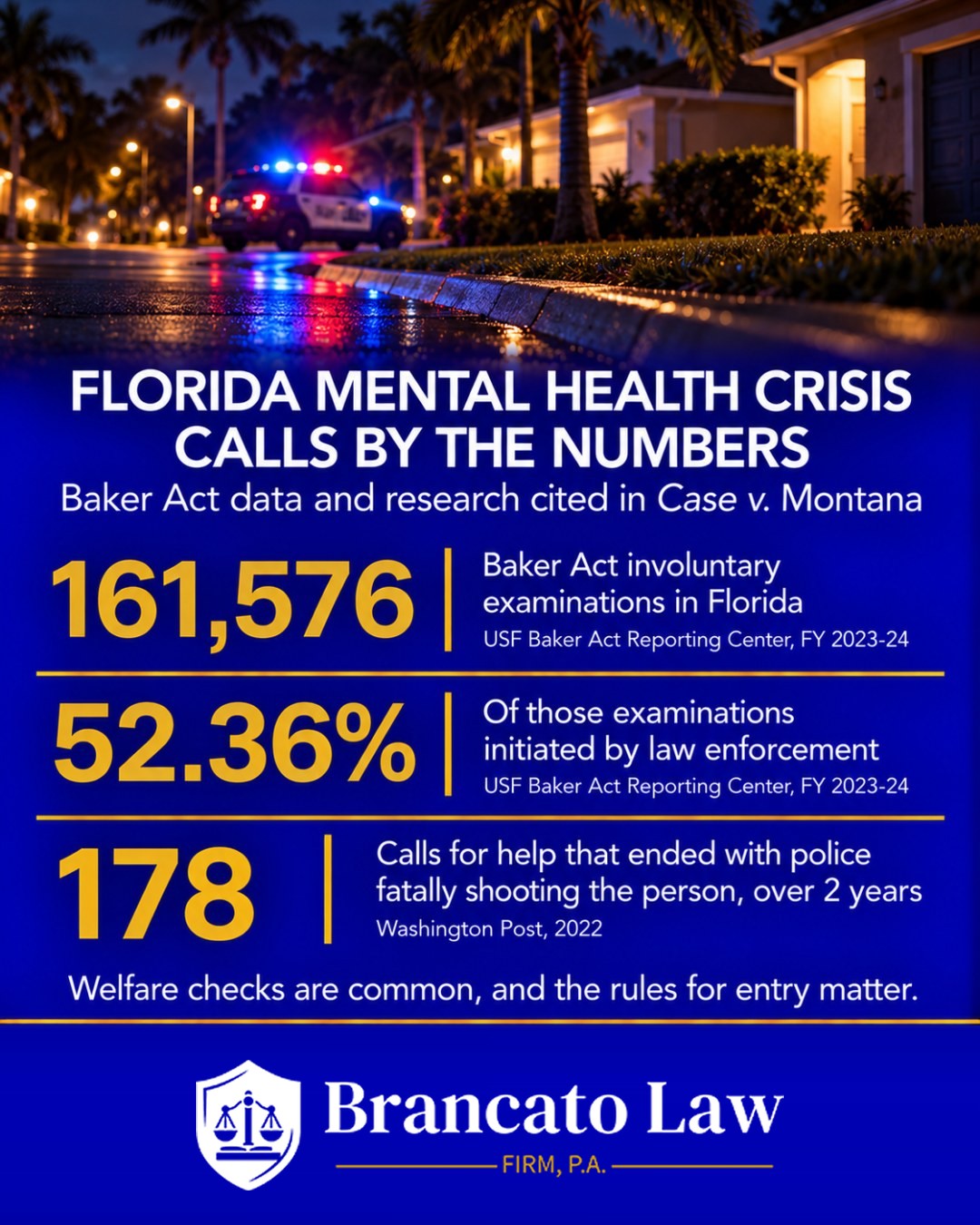
Constantly. In fiscal year 2023-2024, Florida conducted 161,576 involuntary examinations under the Baker Act, and 52.36% of them were initiated by law enforcement, according to the Baker Act Reporting Center at the University of South Florida. Involuntary examinations fell 20% from fiscal year 2019-2020, when there were 202,598.
Under section 394.463, Florida Statutes, an officer “may take a person who appears to meet the criteria for involuntary examination into custody.” Many welfare checks end that way. Some end with a criminal charge instead, based on what officers saw inside the home or on how the encounter went. When the person in crisis is also charged with a crime, our Tampa criminal mental health lawyer team handles both the Fourth Amendment issues and the mental health defense.
Can You Challenge Evidence Found During a Welfare Check in Florida?
Yes. A motion to suppress can challenge a welfare-check entry on several grounds, even after Case v. Montana. These are the questions our attorneys ask in every case:
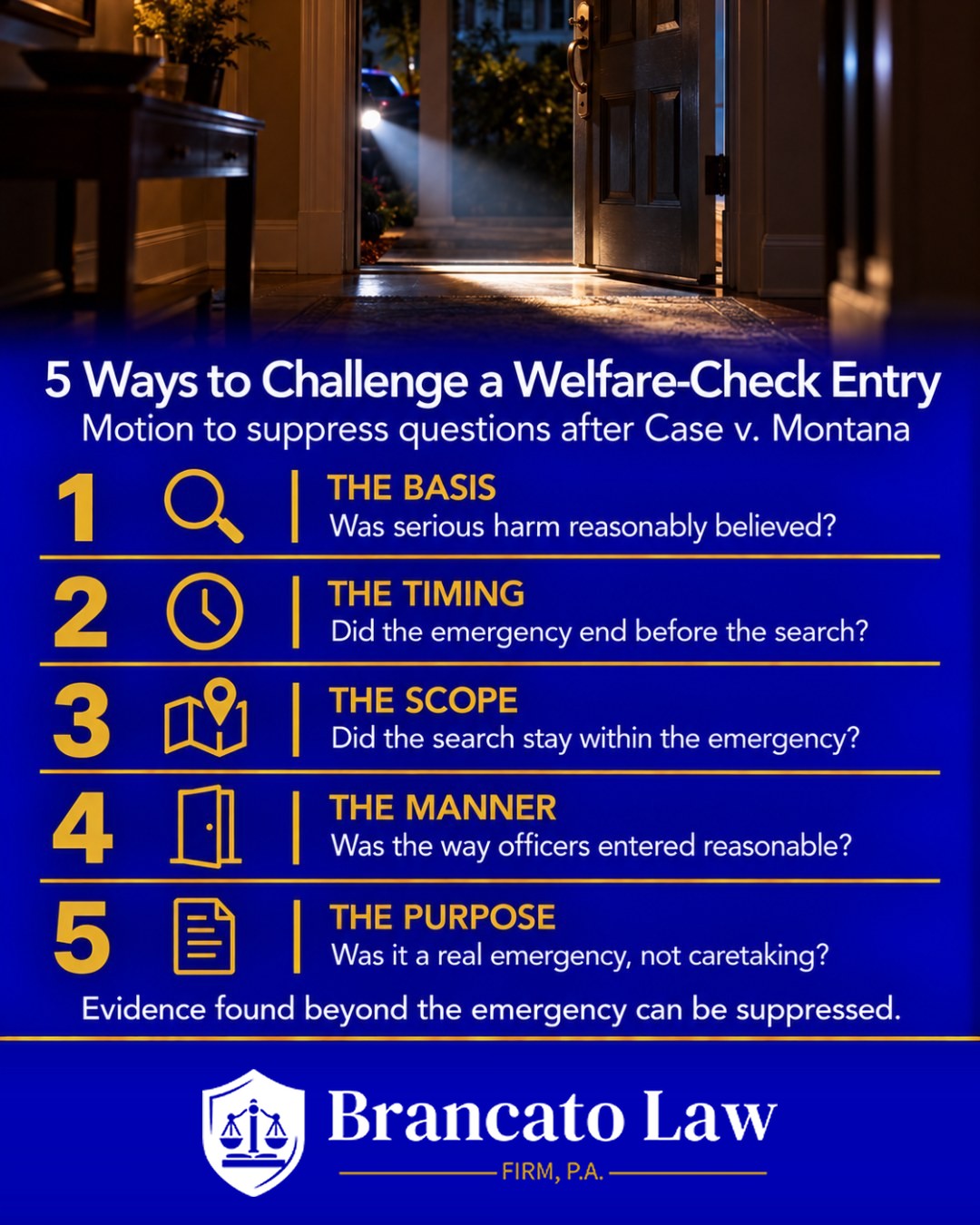
- Did officers have an objectively reasonable basis to believe someone inside was seriously hurt or in imminent danger? A stale tip, an anonymous call with no detail, or a report contradicted by what officers saw at the door may fall short.
- Did the emergency end before the search? Once officers found the person and saw no one needed aid, further searching required a warrant or another exception, under both Case v. Montana and Seibert.
- Did the search stay within the emergency? Opening drawers, containers, or rooms where no person could be is beyond “what is reasonably needed to deal with the emergency.”
- Was the manner of entry reasonable? Justice Sotomayor’s concurrence supports arguments about forced entry, weapons drawn, and refusal to try de-escalation first.
- Was this really community caretaking? In Caniglia v. Strom, 593 U.S. 194 (2021), the Court refused to let a general “community caretaking” rationale justify warrantless home entries. A check on someone’s general well-being, without a real emergency, does not qualify.
Our motion to suppress guide explains how these hearings work in Florida, and our post on when police can enter your home without a warrant in Florida covers the other exceptions, including consent, hot pursuit, and destruction of evidence.
What Charges Come Out of Welfare Checks in Tampa?
Welfare checks can lead to several kinds of charges: drug or weapons charges based on items officers saw inside, domestic violence charges based on what a family member reported, and charges against the person in crisis for how the encounter ended. In Case itself, the charge was assaulting an officer. In Florida, section 784.07, Florida Statutes, reclassifies an assault on a law enforcement officer “engaged in the performance of his or her official duties” from a second-degree to a first-degree misdemeanor, and a battery from a first-degree misdemeanor to a third-degree felony.
Because the suppression ruling and the trial defense often turn on the same facts about the entry, our attorneys prepare them together. Drug cases often turn on the scope of the search; our Tampa drug crimes attorney page explains how we defend them. Charges for battery on an officer are covered on our violent crimes defense page.
Why Does Police Training Matter in Welfare-Check Cases?
Police training matters because the officer’s account of what he knew and why he went in is the heart of the suppression hearing. As Rocky Brancato puts it: “As a former police academy instructor in criminal procedure and courtroom testimony, I taught officers the constitutional requirements they must follow, including when they can and cannot enter a home without a warrant. When I cross-examine an officer about a welfare check entry, I know what they were taught about the emergency aid exception, and I know when their actions deviate from proper constitutional standards.”
In Hillsborough County, suppression motions in felony cases are heard in circuit court in the 13th Judicial Circuit before trial. Our Hillsborough County criminal defense attorney page explains how those cases move, and our post on how Tampa police mistakes can lead to a dismissal shows what a successful challenge can mean for the case.
Frequently Asked Questions About Case v. Montana and Welfare Checks
Do Florida police need a warrant to do a welfare check inside my home?
No, not if they have an objectively reasonable basis to believe someone inside is seriously injured or in imminent danger. The Brancato Law Firm tests that basis against the 911 call, the dispatch notes, and the body camera footage; see our guide on warrantless home entry in Florida.
Can police search my whole house during a welfare check in Florida?
No. Case v. Montana says an emergency entry gives “no basis to search the premises beyond what is reasonably needed to deal with the emergency,” and Seibert makes any search after the emergency ends illegal. Our attorneys at The Brancato Law Firm use that limit to suppress evidence found in drawers, closets, and containers.
What if the welfare check was based on a false or mistaken report?
The entry can still be lawful if the report reasonably appeared true when officers acted, because Florida courts judge the officer’s belief at the time of entry. The Brancato Law Firm looks for facts at the scene that should have dispelled the report, since they can undercut the officers’ basis.
Does Case v. Montana apply if I told police I was fine?
Your statement is part of the totality of circumstances, but officers may weigh it against other facts such as a weapon or a third-party report. Our attorneys at The Brancato Law Firm rely on Justice Sotomayor’s concurrence, which cited cases where officers forced entry after the occupant said he was okay.
Can I be Baker Acted after a welfare check in Florida?
Yes, an officer may take a person who appears to meet the criteria into custody for an involuntary examination under section 394.463. The Brancato Law Firm represents clients whose crisis also led to criminal charges; see our criminal mental health defense page.
Is a welfare check the same as community caretaking?
No. After Caniglia v. Strom, a general community caretaking purpose does not justify entering a home; officers need a real emergency under the Brigham City standard. The Brancato Law Firm challenges entries where the facts show only a general concern for someone’s well-being.
For how this fits into the rest of a case, see our stage-by-stage guide to the Florida criminal case process.
Talk to a Tampa Defense Attorney About an Unlawful Home Entry
The best time to challenge a welfare-check entry is before the State finalizes its case, while body camera footage, 911 audio, and dispatch logs are still easy to obtain. Call The Brancato Law Firm, P.A., founded by Tampa Criminal Defense Attorney Rocky Brancato, at (813) 727-7159, and our attorneys will review how the officers got in and what they did inside. You can call us at any hour. Our firm has Spanish-speaking staff, and attorney Jean-Luc Adrien speaks Spanish, Haitian Creole, and French. Read our guide for criminal defense in Spanish and Haitian Creole in Tampa.
For more about our defense strategies, visit our Tampa Criminal Mental Health Lawyer page.
The Brancato Law Firm, P.A.
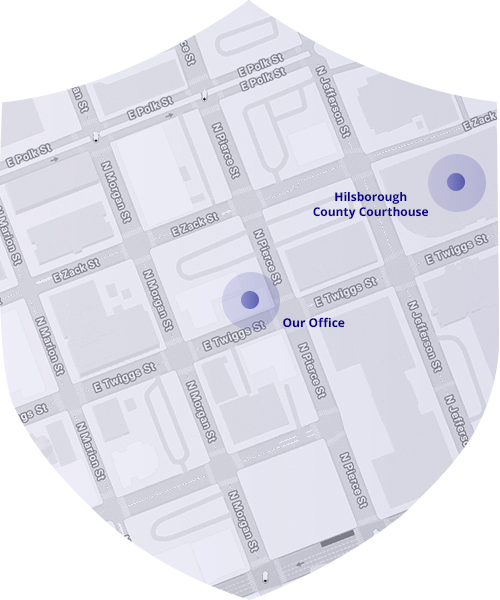
620 E. Twiggs Street, Suite 205, Tampa, FL 33602
(813) 727-7159
Serving Hillsborough, Pinellas, and Pasco Counties
The Brancato Law Firm, P.A. is a Tampa-based criminal defense practice. We are not affiliated with any other Brancato-named law firms.
Visit Us
Tampa, FL 33602
Contact Us Now
Free Legal Consultation (813) 727-7159