- Free Consultation 24/7: (813) 727-7159 Tap Here To Call Us


From First DUI to Death Penalty



Felony vs. Misdemeanor in Florida: What Is the Difference? (2026)


Updated October 22, 2026
In Florida, a felony is a crime punishable by death or by imprisonment in state prison, and a misdemeanor is punishable by up to 1 year in county jail. Felonies are capital, life, first-degree (up to 30 years and a $10,000 fine), second-degree (up to 15 years), and third-degree (up to 5 years). Misdemeanors are first-degree (up to 1 year and $1,000) and second-degree (up to 60 days and $500). The degree sets the maximum, but the Criminal Punishment Code scoresheet sets the minimum: at 44 points or fewer, prison is not required.
A Florida prosecutor deciding what to offer, and a judge deciding what to impose, look at two numbers before anything else: the degree of the charge and the score on the sentencing scoresheet. Knowing both is the starting point for any defense. As founder of The Brancato Law Firm, P.A., a Tampa criminal defense firm, and former Chief Operations Officer of the Hillsborough County Public Defender’s Office, where I oversaw a staff of over 100 attorneys, I have worked with those numbers for more than 25 years in Hillsborough County courtrooms. Our attorneys use them to negotiate reductions from felony to misdemeanor across Hillsborough, Pinellas, and Pasco Counties.
This guide explains how Florida classifies crimes, the maximum penalty for each degree, what a first-degree felony is, how the scoresheet works, and how felony charges get reduced.
What is the difference between a felony and a misdemeanor in Florida?
The difference is where the sentence can be served and for how long. Section 775.08, Florida Statutes defines a felony as an offense punishable “by death or imprisonment in a state penitentiary,” and a misdemeanor as an offense punishable “by a term of imprisonment in a county correctional facility… not in excess of 1 year.” A noncriminal violation, such as many traffic infractions, is punishable only by a fine or civil penalty and “does not constitute a crime.”
The label matters beyond the sentence. A felony conviction can affect voting, firearm rights, professional licenses, and immigration status, and a felony record is harder to seal. Our attorneys at The Brancato Law Firm treat the degree of the charge as the first thing to negotiate.
What are the degrees of crimes in Florida and their maximum penalties?
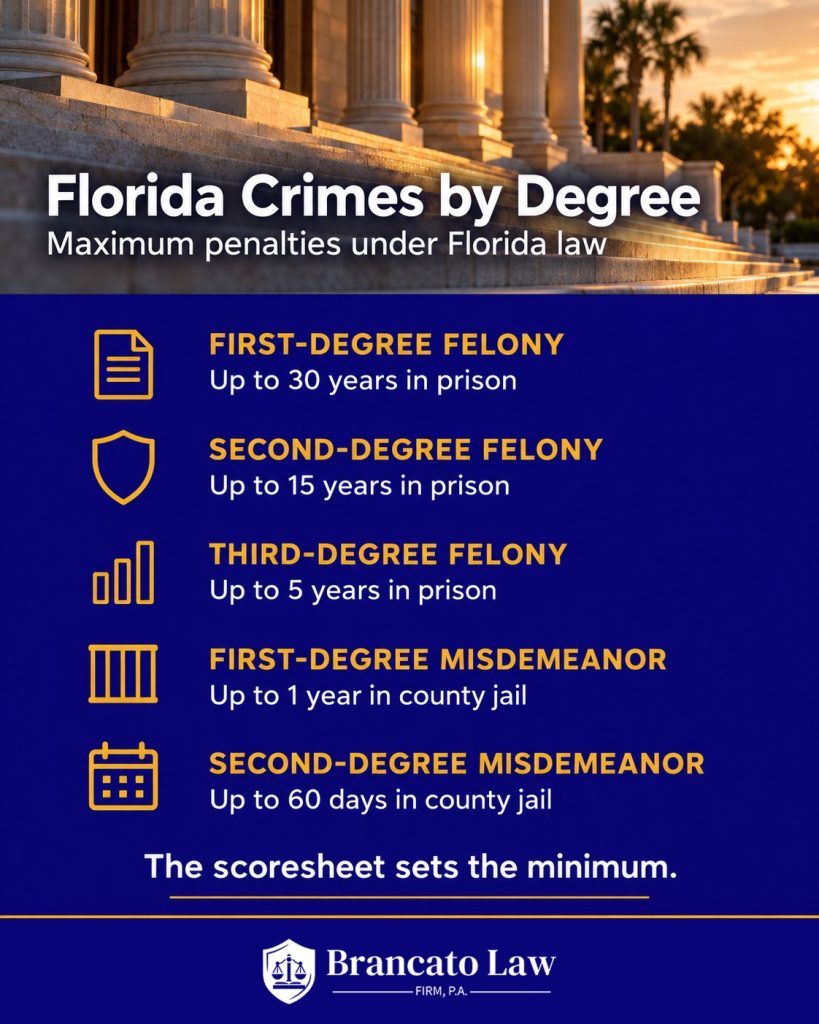
Section 775.081, Florida Statutes sets five felony degrees and two misdemeanor degrees. A felony with no degree stated is a third-degree felony, and a misdemeanor with no degree stated is second-degree.
| Classification | Maximum imprisonment (§ 775.082) | Maximum fine (§ 775.083) |
|---|---|---|
| Capital felony | Death or life without parole | Not applicable |
| Life felony | Life, or a term of years not exceeding life | $15,000 |
| First-degree felony, punishable by life | Life | $10,000 |
| First-degree felony | 30 years | $10,000 |
| Second-degree felony | 15 years | $10,000 |
| Third-degree felony | 5 years | $5,000 |
| First-degree misdemeanor | 1 year in county jail | $1,000 |
| Second-degree misdemeanor | 60 days in county jail | $500 |
| Noncriminal violation | No jail | $500 |
The prison terms come from section 775.082, Florida Statutes and the fines from section 775.083, Florida Statutes. A court may also impose a fine of up to double the gain or loss caused by the offense. Common misdemeanors include simple assault and petit theft under $100, both second-degree misdemeanors, and battery, a first-degree misdemeanor. A first DUI is also a misdemeanor, with its own penalties under section 316.193.
What is a first-degree felony in Florida?
A first-degree felony is the most serious felony below a life or capital felony, punishable by up to 30 years in prison and a $10,000 fine. Some first-degree felonies are “punishable by life,” which raises the maximum to life in prison. Examples from Florida’s offense severity chart include leaving the scene of a crash involving death and attempted premeditated murder (first-degree felonies) and second-degree murder (a first-degree felony punishable by life).
A first-degree felony also closes off one common outcome. Under section 775.08435, Florida Statutes, a court “may not withhold adjudication of guilt” for “Any capital, life, or first degree felony offense,” and may withhold on a second-degree felony only in limited situations, such as when the State Attorney requests it in writing. A withhold is available on third-degree felonies and misdemeanors in most cases. That is why negotiating a first-degree charge down to a second- or third-degree charge is often the most important step in the case. Our attorneys at The Brancato Law Firm build that negotiation around the evidence and a mitigation report.
How does Florida decide the actual sentence for a felony?
The Criminal Punishment Code scoresheet decides the minimum. Under section 921.0022, Florida Statutes, every felony is ranked on 10 levels, “from least severe, which are level 1 offenses, to most severe, which are level 10.” The level, the prior record, and other factors produce a point total under section 921.0024, Florida Statutes.
| Severity level | Primary offense points | Example from § 921.0022 |
|---|---|---|
| Level 2 | 10 | Grand theft, third degree, $750 to under $5,000 |
| Level 3 | 16 | Possession of a controlled substance (third degree) |
| Level 5 | 28 | Sale of cocaine (second degree) |
| Level 6 | 36 | Aggravated assault with a deadly weapon (third degree) |
| Level 8 | 74 | DUI manslaughter (second degree) |
| Level 10 | 116 | Second-degree murder (first degree, punishable by life) |
The math is fixed. At 44 points or fewer, the lowest permissible sentence is “any nonstate prison sanction,” which means probation or county jail is allowed. Above 44 points, the lowest permissible prison sentence is calculated by “subtracting 28 points from the total sentence points and decreasing the remaining total by 25 percent,” expressed in months. A score of 60 points, for example, produces (60 minus 28) times 0.75, or 24 months. The judge can sentence anywhere from that minimum up to the statutory maximum, and any state prison sentence must exceed 1 year.
One more rule protects lower-level defendants. Under section 775.082(10), when a third-degree felony is not a forcible felony and the scoresheet totals 22 points or fewer, the court “must sentence the offender to a nonstate prison sanction” unless it makes written findings that a nonstate sanction could present a danger to the public. Our attorneys at The Brancato Law Firm prepare the scoresheet ourselves and check every point the State assigns.
What enhancements can raise a felony sentence?
Several statutes raise the maximum or impose a minimum:
- Habitual felony offender. Under section 775.084, Florida Statutes, a person with two or more prior felonies who commits a new felony within 5 years can face up to 10 years on a third-degree felony, 30 years on a second-degree felony, and life on a first-degree felony.
- Prison releasee reoffender. Section 775.082(9) requires mandatory terms served at 100% for listed offenses committed within 3 years of release from prison. Our post on prison releasee reoffender sentencing explains it.
- 10-20-Life. Section 775.087 sets firearm minimums for listed felonies such as robbery, burglary, and aggravated battery. Aggravated assault was removed from that list in 2016.
When an enhancement is filed, the question is whether the State can prove each prior conviction and each date. The Brancato Law Firm pulls the court records and checks them against the statute’s requirements.
Can a felony be reduced to a misdemeanor in Florida?
Yes, through negotiation or a successful defense. Prosecutors reduce charges when the evidence does not support the felony, when an element such as a weapon or the value of property is in doubt, or when mitigation shows the case belongs at a lower level. Recent results from our firm:
| Original charge | Result |
|---|---|
| Burglary with battery, a life felony (April 2026) | Reduced to misdemeanor trespass and time served after body camera showed our client broke up the fight |
| Robbery with a firearm (January 2026) | Reduced to grand theft and misdemeanor battery, with no felony conviction and a life sentence avoided |
| Gang beating and kidnapping (September 2025) | Reduced to a misdemeanor battery plea and probation after we held the State to speedy trial |
Past results do not guarantee future outcomes. More results are on our case results page.
How many felony and misdemeanor cases does Hillsborough County handle?
Roughly as many of each. The Florida courts’ FY 2024-25 Statistical Reference Guide shows 12,317 felony cases filed in the 13th Judicial Circuit, which covers Hillsborough County. Drug cases were the largest category at 3,780, followed by theft, forgery, and fraud at 2,464. The county criminal chapter shows 13,002 misdemeanor filings in Hillsborough the same year, plus 4,008 DUI and 16,970 criminal traffic cases.
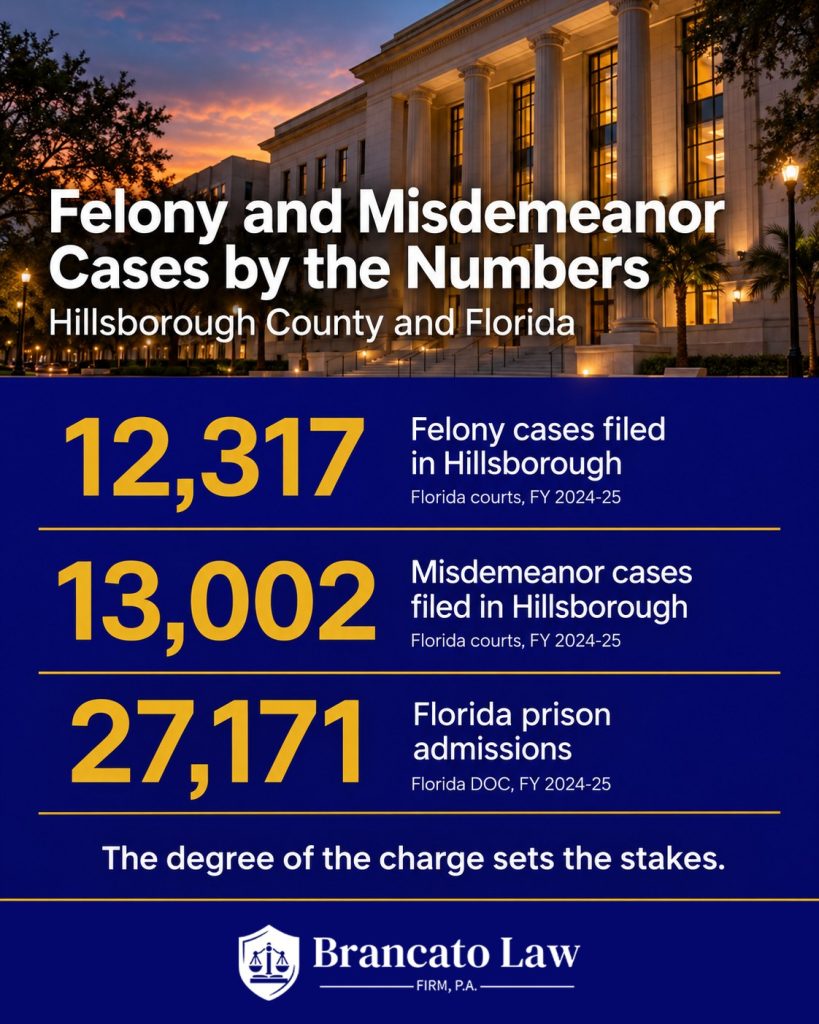
Florida’s prisons take in tens of thousands of people a year. The Florida Department of Corrections’ Annual Report FY 2024-25 counted 27,171 prison admissions statewide and a prison population of 89,087 on June 30, 2025. Drug offenses were the largest admission category at 25.2%. A state research report helps explain why sentences vary so much: the Office of Program Policy Analysis and Government Accountability found in Diverting Low-Risk Offenders From Florida Prisons (Report No. 19-01, 2019) that about 96% of felony sentences result from pleas and that 59% of offenders who scored above 44 points received prison.
What happens after a felony arrest in Hillsborough County?
The case moves through a set sequence. The arrested person sees a judge at first appearance within 24 hours, where bond is set; our guide on how a bond hearing works in Tampa explains that hearing. The State then has 30 days to file formal charges if the person is in custody, or 60 days if released, under Rule 3.134. After the charge is filed, the case is set for arraignment, discovery, motions, and pretrial conferences.
The period before the charge is filed is often the best chance to influence the degree. Our attorneys provide representation before charges are filed by presenting evidence and mitigation to the prosecutor making the filing decision. Our post on the steps in a Hillsborough County criminal case covers the rest of the process.
Frequently asked questions about felonies and misdemeanors in Florida
Can a felony charge be dropped in Florida?
Yes. A felony can be dropped before or after filing when the evidence does not support it, and it can also be reduced to a misdemeanor through negotiation. The Brancato Law Firm works the filing decision first, then moves to motions if the case is filed, as explained in our guide on whether criminal charges can be dropped or dismissed in Florida.
Can you get probation for a felony in Florida?
Often, yes. When the scoresheet totals 44 points or fewer, the lowest permissible sentence is a nonstate prison sanction such as probation, and a judge can also depart downward for a valid legal reason. Our attorneys at The Brancato Law Firm prepare the scoresheet and the mitigation that supports a probationary sentence.
Can you get a withhold of adjudication for a first-degree felony?
No. Section 775.08435 prohibits a withhold for any capital, life, or first-degree felony, and limits withholds on second-degree felonies. The Brancato Law Firm negotiates the charge down to a degree that allows a withhold when the facts support it.
Is a third-degree felony serious in Florida?
Yes. A third-degree felony carries up to 5 years in prison and a $5,000 fine, and a conviction is still a felony record. Our attorneys at The Brancato Law Firm look first at whether the case qualifies for pretrial intervention or a reduction to a misdemeanor, and you can learn more on our Hillsborough County criminal defense page.
What is the difference between a first-degree and second-degree misdemeanor?
A first-degree misdemeanor carries up to 1 year in county jail and a $1,000 fine, while a second-degree misdemeanor carries up to 60 days and a $500 fine. The Brancato Law Firm often seeks diversion for first-time misdemeanor charges, which can end in a dismissal.
How many points do you need to go to prison in Florida?
Prison becomes the minimum sentence when the scoresheet totals more than 44 points. At 44 points or fewer, prison is not required, so our attorneys at The Brancato Law Firm challenge any points the State cannot support.
For how this fits into the rest of a case, see our guide to each stage of a Florida criminal case.
Call our Tampa criminal defense attorneys about the degree of your charge
The degree on the charging document can often be changed. The Brancato Law Firm, P.A., founded by Tampa Criminal Defense Attorney Rocky Brancato, will check the scoresheet, test the elements that raise the degree, and negotiate for a reduction or dismissal. Call (813) 727-7159 for a free, confidential consultation. You can call us at any hour. Our firm has Spanish-speaking staff, and attorney Jean-Luc Adrien speaks Spanish, Haitian Creole, and French. Read about our Spanish and Haitian Creole criminal defense services.
For more about our defense strategies, visit our Hillsborough County Criminal Defense page.
The Brancato Law Firm, P.A.
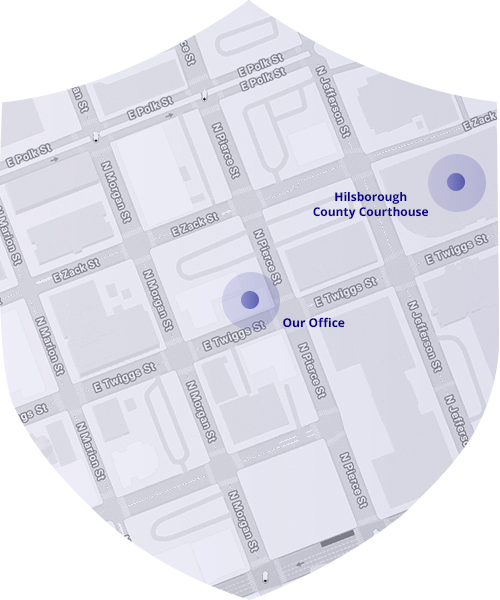
620 E. Twiggs Street, Suite 205, Tampa, FL 33602
(813) 727-7159
Serving Hillsborough, Pinellas, and Pasco Counties
The Brancato Law Firm, P.A. is a Tampa-based criminal defense practice. We are not affiliated with any other Brancato-named law firms.
Visit Us
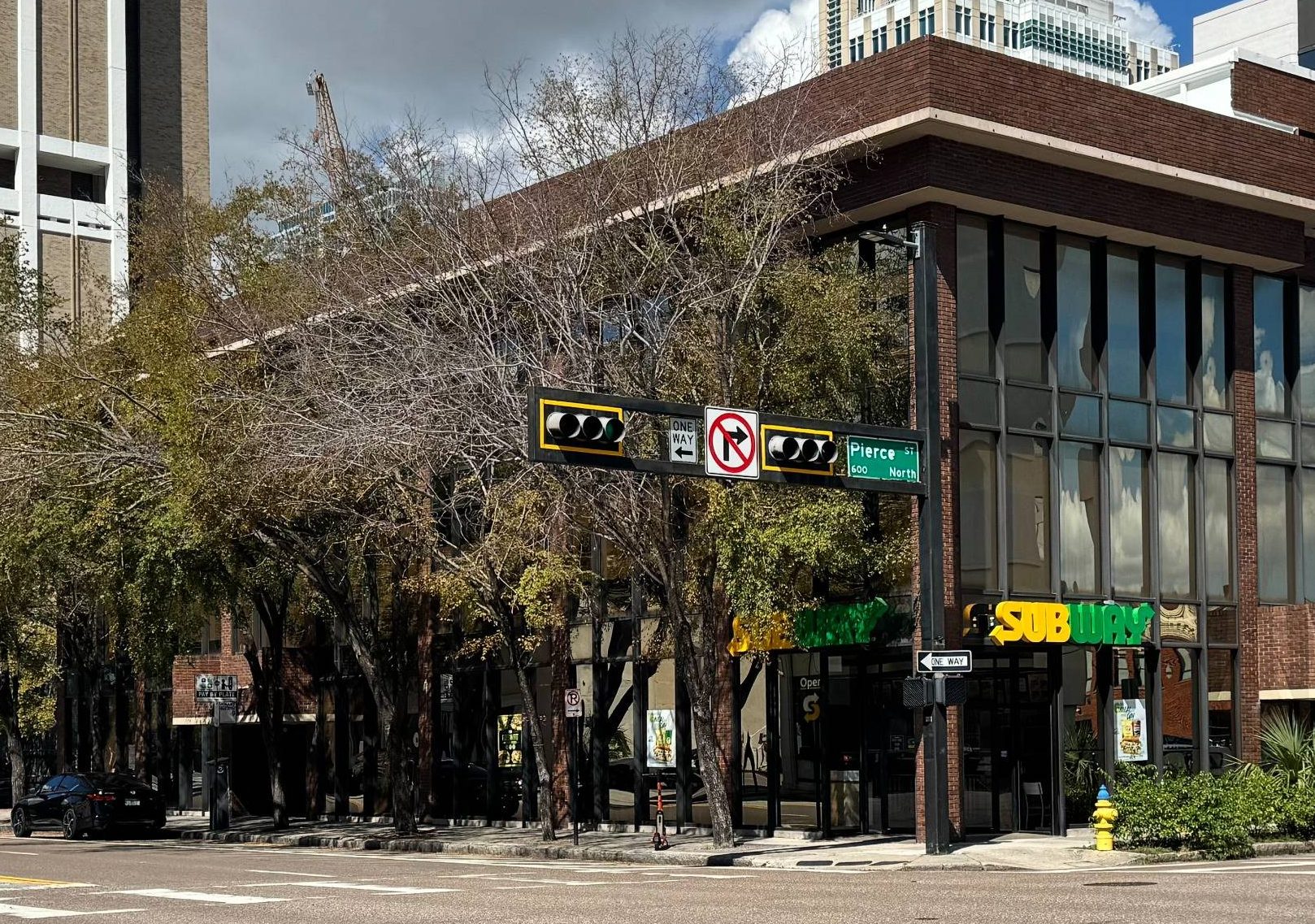
Tampa, FL 33602
Contact Us Now
Free Legal Consultation (813) 727-7159