- Free Consultation 24/7: (813) 727-7159 Tap Here To Call Us


From First DUI to Death Penalty



How to Fight a Lewd and Lascivious Charge in Florida (2026)


Updated October 22, 2026
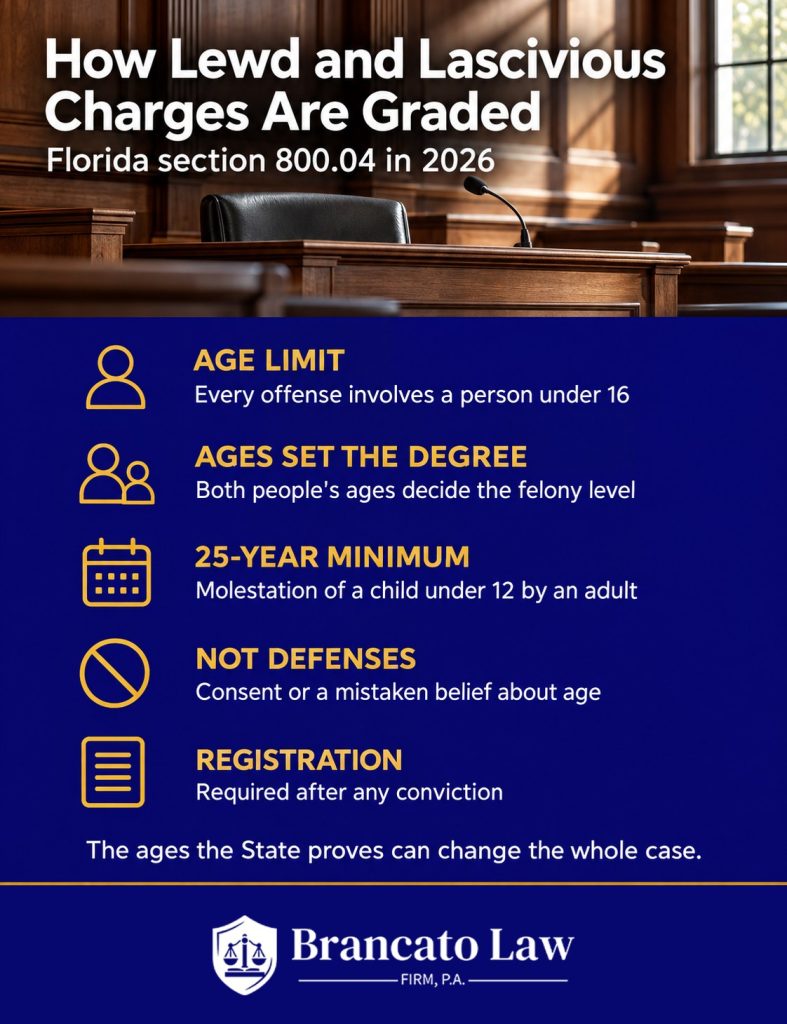
A lewd and lascivious charge in Florida is a felony under section 800.04 that covers four offenses involving a person under 16: lewd battery, lewd molestation, lewd conduct, and lewd exhibition. The child’s consent and a mistaken belief about the child’s age are not defenses. The degree depends on the ages of both people, from a third-degree felony up to a life felony with a 25-year mandatory minimum when an adult is accused of molesting a child under 12. Most defenses focus on the reliability of the child’s account, the dates and ages the State must prove, and how the accusation first came out.
A Florida jury can convict on a lewd and lascivious charge with no physical evidence at all, because section 794.022(1), Florida Statutes says the child’s testimony “need not be corroborated.” I learned how these cases are built, and where they break, in the Major Crimes Unit of the Hillsborough County Public Defender’s Office, which handled homicide, sex crimes, and child abuse cases. I’m Rocky Brancato, founder of The Brancato Law Firm, P.A., a Tampa criminal defense firm, and I have tried more than 150 jury trials to verdict. Our attorneys defend lewd and lascivious charges across Hillsborough, Pinellas, and Pasco Counties, from the first call from a detective through trial and, when needed, after conviction.
What are the four lewd and lascivious offenses in Florida?
Section 800.04, Florida Statutes creates four separate crimes, and each one requires that the alleged victim was under 16. The statute has not been amended since 2022.
| Offense | What the State must prove | Subsection |
|---|---|---|
| Lewd battery | Sexual activity with a person 12 or older but under 16, or encouraging, forcing, or enticing a person under 16 into sexual activity | 800.04(4) |
| Lewd molestation | Intentionally touching “in a lewd or lascivious manner the breasts, genitals, genital area, or buttocks, or the clothing covering them,” of a person under 16, or forcing or enticing the child to touch the accused | 800.04(5) |
| Lewd conduct | Intentionally touching a person under 16 in a lewd or lascivious manner, or soliciting a person under 16 to commit a lewd or lascivious act | 800.04(6) |
| Lewd exhibition | Intentionally masturbating, exposing the genitals in a lewd or lascivious manner, or committing another non-contact sexual act “in the presence of a victim who is less than 16 years of age” | 800.04(7) |
Choosing the right category matters because the penalties differ sharply. A touch the State calls molestation may legally be conduct, and a case charged as battery may lack proof of “sexual activity” as the statute defines it. Our Tampa sex crimes lawyer team at The Brancato Law Firm checks the charging document against the evidence before anything else.
What are the penalties for a lewd and lascivious charge in Florida?
The penalty turns on the ages of the accused and the child, and on any prior record. Maximum terms come from section 775.082, Florida Statutes.
| Offense | Ages | Degree | Maximum |
|---|---|---|---|
| Lewd molestation | Accused 18 or older, child under 12 | Life felony | Life, or a split sentence of at least 25 years followed by lifetime probation |
| Lewd molestation | Accused under 18, child under 12 | Second-degree felony | 15 years |
| Lewd molestation | Accused 18 or older, child 12 to 15 | Second-degree felony | 15 years |
| Lewd molestation | Accused under 18, child 12 to 15 | Third-degree felony | 5 years |
| Lewd molestation | Accused 18 or older, child 12 to 15, listed prior conviction | First-degree felony | 30 years |
| Lewd battery | Any accused, child under 16 | Second-degree felony | 15 years |
| Lewd battery | Accused 18 or older with a listed prior | First-degree felony | 30 years |
| Lewd conduct or exhibition | Accused 18 or older | Second-degree felony | 15 years |
| Lewd conduct or exhibition | Accused under 18 | Third-degree felony | 5 years |
The most serious tier carries a mandatory minimum. For lewd molestation of a child under 12 by an adult, committed on or after September 1, 2005, section 775.082(3)(a)4.a. requires either life or “a split sentence that is a term of at least 25 years’ imprisonment and not exceeding life imprisonment, followed by probation or community control for the remainder of the person’s natural life.” In Rochester v. State, 140 So. 3d 973 (Fla. 2014), the Florida Supreme Court held that “the trial court does not have the discretion to impose a sentence below the twenty-five year minimum.” A second such conviction for an offense on or after July 1, 2008 requires life.
The child’s age is often the whole case. In Lincoln v. State, No. 6D2023-0235 (Fla. 6th DCA Dec. 30, 2024), a Highlands County defendant received a life sentence, but the jury had been instructed on and found only the 12-to-15 offense, and the evidence showed the child had turned 12. The court held that “[t]he sole distinction” between the life felony and the second-degree felony “is the age of the victim,” and ordered resentencing on the lower offense. Our attorneys at The Brancato Law Firm pin down the child’s age on every date the State alleges.
Are consent or a mistaken belief about age defenses?
No. Section 800.04(2) states that “[n]either the victim’s lack of chastity nor the victim’s consent is a defense to the crimes proscribed by this section.” Section 800.04(3) adds that “[t]he perpetrator’s ignorance of the victim’s age, the victim’s misrepresentation of his or her age, or the perpetrator’s bona fide belief of the victim’s age cannot be raised as a defense.”
That rule surprises many people charged after a relationship with a 14- or 15-year-old who claimed to be older. A fake ID or a dating-app profile does not change the charge. The statute does carve out one act: “A mother’s breastfeeding of her baby does not under any circumstance constitute a violation of this section.”
What changed in Florida’s lewd and lascivious laws in 2026?
Florida repealed its misdemeanor “unnatural and lascivious act” law, section 800.02, effective October 1, 2026, and created a new felony for indecent exposure while observing a child. Both changes came from chapter 2026-159, Laws of Florida, approved June 16, 2026. Some websites still describe section 800.02 as current law; it no longer applies to conduct on or after October 1, 2026.
The new section 800.035, Florida Statutes, “Indecent exposure of sexual organs while observing a child,” is a third-degree felony. It covers a person who, while observing a child under 16 for sexual gratification, intentionally exposes his or her sexual organs in a lewd or lascivious manner or performs a non-contact sexual act. “Observing” means intentionally viewing a person who can reasonably see the offender, and it is not a defense that the child was unaware or did not see. Breastfeeding mothers and nudity in a place set apart for it are excluded.
Exhibition over the internet is a different crime. Section 800.04(7) does not mention electronic devices. Live exhibition “over a computer online service, Internet service, or local bulletin board service” to a child under 16 is charged under section 847.0135(5), Florida Statutes, a second-degree felony for an adult and a third-degree felony for a person under 18.
How does the State use other accusations against the accused?
In a child molestation case, the State can ask to introduce evidence that the accused molested other children. Section 90.404(2)(b), Florida Statutes provides that this evidence “is admissible and may be considered for its bearing on any matter to which it is relevant.” The State must give notice no fewer than 10 days before trial.
The limits come from McLean v. State, 934 So. 2d 1248 (Fla. 2006), a case that began in the Second District. The Florida Supreme Court upheld the statute but required the trial judge to “find that the prior acts were proved by clear and convincing evidence” and then weigh “(1) the similarity of the prior acts to the act charged regarding the location of where the acts occurred, the age and gender of the victims, and the manner in which the acts were committed; (2) the closeness in time of the prior acts to the act charged; (3) the frequency of the prior acts; and (4) the presence or lack of intervening circumstances.” The evidence must not “become a feature of trial,” and the jury receives a cautionary instruction on request.
Those findings are where the fight happens. In State v. Riggleman, 397 So. 3d 1152 (Fla. 2d DCA 2024), a Sarasota County case, the Second District quashed an order excluding collateral-act evidence because the trial court had not made the required relevance and McLean findings. Our attorneys at The Brancato Law Firm build the record on each McLean factor so an exclusion holds up. Our post on the Williams rule in sex crimes cases explains these motions in more depth.
How are a child’s interviews and statements used at trial?
Most lewd and lascivious cases rest on the child’s recorded forensic interview, the child’s trial testimony, and adults who repeat what the child told them. Each piece can be tested. Our post on child hearsay in Tampa sex cases explains when a child’s out-of-court statements may be admitted.
The State must still prove each count, including where, when, and how old the child was. In Crenshaw v. State, No. 5D2023-3159 (Fla. 5th DCA Sept. 19, 2025), a Putnam County case, the court ordered a judgment of acquittal on one molestation count because the child never testified to that touching in Putnam County and the child hearsay witnesses “acknowledged that the victim provided no timeline or dates.” Another count was affirmed only because the defense had not preserved its objection. Our attorneys move for acquittal count by count, on every element.
Confessions get special treatment in these cases. Section 92.565, Florida Statutes lets the State use a confession without independent proof of each element when, among other factors, the child was under 12. The judge must first hold a hearing, find the confession “trustworthy” with corroboration shown by a preponderance of the evidence, and “make specific findings of fact, on the record.”
Is there a statute of limitations for lewd and lascivious charges?
For lewd battery and lewd molestation of a child under 16, there is usually no time limit. Section 775.15(18), Florida Statutes allows prosecution “at any time, unless, at the time of the offense, the offender is less than 18 years of age and is no more than 4 years older than the victim.”
Lewd conduct and lewd exhibition are not covered by subsection (18). For those charges, subsection (13)(a) delays the clock until the child turns 18 or the offense is reported to law enforcement or another government agency, whichever comes first, and the ordinary felony periods then apply. Subsection (16) extends the time when the accused is identified through DNA, as long as preserved evidence is available for the defense to test.
What happens after a lewd and lascivious conviction in Florida?
A conviction under section 800.04 requires registration as a sexual offender, and the most serious versions make the person a sexual predator on a single conviction. Under section 943.0435, Florida Statutes, a registrant must report in person to the sheriff within 48 hours after establishing a residence, release, or conviction. The 25-year removal petition is not available for adult convictions under section 800.04(5)(b) and for certain lewd battery and molestation convictions. Under section 775.21, Florida Statutes, a “capital, life, or first degree felony violation” of section 800.04 triggers the sexual predator designation.
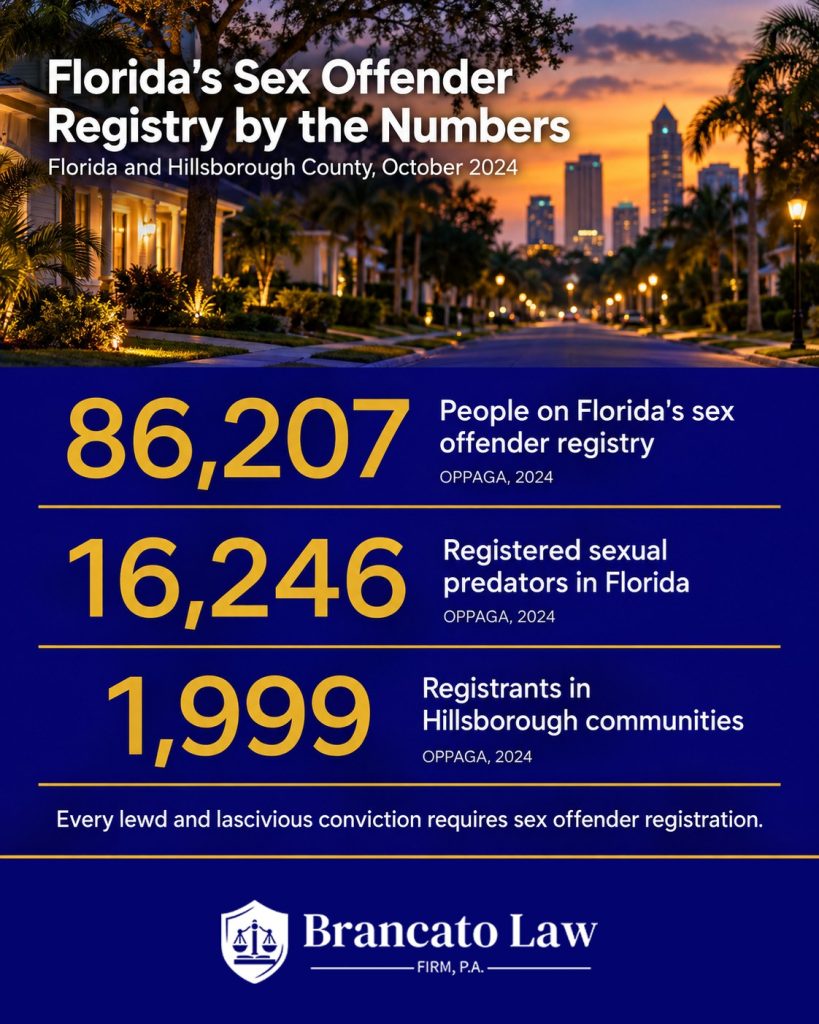
The registry is large. As of October 2024, Florida’s sex offender registry listed 86,207 people, including 16,246 sexual predators, according to the Florida Legislature’s Office of Program Policy Analysis and Government Accountability (OPPAGA) in Report 24-11. The same report counted 1,999 registrants living in Hillsborough County communities in October 2024, up from 1,969 in 2021.
Research on re-offense cuts both ways. The Bureau of Justice Statistics study Recidivism of Sex Offenders Released from State Prison: A 9-Year Follow-Up (2005-14) (2019) found that 7.7% of released sex offenders were arrested for rape or sexual assault within nine years, compared with 2.3% of other released prisoners, while about 67% were arrested for any crime, compared with 84% of other released prisoners. Our posts on sex offender registration in Florida and getting off the Florida sex offender registry explain the duties and the limited ways out.
How do our attorneys fight a lewd and lascivious charge?
Our attorneys fight these charges by testing the account, the dates, and the ages the State must prove, and by excluding evidence the law does not allow. The approaches that most often matter:
- The origin of the accusation. We examine when and how the allegation first came out, including divorce and custody disputes, family conflict, and who spoke to the child before the forensic interview.
- Interview quality. We review the recorded interview for leading questions and for details that came from adults.
- Physical and digital facts. Home layouts, schedules, school records, and social media can show an act could not have happened as described.
- Ages and dates. We hold the State to proof of the child’s age and the date range on every count, as Lincoln and Crenshaw show.
- Collateral evidence. We oppose other-act evidence under McLean and demand a section 92.565 hearing on any confession.
- Sentencing exposure. When the facts support it, we push to move a case out of the life-felony tier, which is the only one with the 25-year minimum.
For sexual battery charges, which carry their own penalties and defenses, see our guide on how to fight a sexual battery charge in Florida.
Real results in lewd and lascivious cases
| Allegation | Result |
|---|---|
| Molestation accusation during a divorce: a military retiree accused of touching his grandson | Not guilty; the child had been coached |
| Accusation by a niece with a grudge | Not guilty; the layout of the home made the alleged act implausible |
| Sexual predator designation | Removed after conviction |
| Accusation by a teenager | Dismissed; the accuser’s social media posts contradicted the story |
| Cold case | Dismissed; DNA excluded our client |
Past results do not guarantee future outcomes. More results are on our case results page.
What should you do if you are accused or under investigation?
Do not talk to the detective, the child, or the family about the allegation, and call a defense lawyer first. Detectives often try to interview the accused before an arrest, and a statement explaining “what really happened” often becomes the State’s best evidence. Save texts, calendars, and records that show where you were on the dates in question.
Early counsel can change the outcome. Our pre-file advocacy can include presenting evidence to the State Attorney’s Office for the 13th Judicial Circuit before it files the charging information. If an arrest has already happened in Hillsborough County, first appearance takes place within 24 hours at the Orient Road Jail, where bond and no-contact conditions are set. Our Hillsborough County criminal defense attorney page explains what comes next.
Frequently Asked Questions About Lewd and Lascivious Charges in Florida
Can lewd and lascivious charges be dropped in Florida?
Yes, when the evidence shows the account is unreliable, the dates or ages cannot be proven, or DNA excludes the accused. The Brancato Law Firm has had lewd and lascivious accusations dismissed after an accuser’s social media contradicted the story and after DNA excluded our client.
Is lewd molestation always a life felony in Florida?
No, it is a life felony only when the accused is 18 or older and the child is under 12. The Brancato Law Firm checks the child’s age on each alleged date, because in Lincoln v. State a life sentence was reversed when the jury had found only the 12-to-15 offense.
Can a judge go below 25 years for lewd molestation of a child under 12?
No, under Rochester v. State (Fla. 2014) the judge has no discretion to go below the 25-year minimum for an adult convicted under section 800.04(5)(b). Our attorneys at The Brancato Law Firm focus on whether the charge belongs in that tier at all, as explained on our sex crimes defense page.
Is touching over clothing lewd and lascivious in Florida?
It can be, because the molestation statute covers touching of “the clothing covering” the listed body parts in a lewd or lascivious manner. The Brancato Law Firm challenges the intent element, which the State must prove from the circumstances, and whether an accidental or innocent touch is being recast.
What happened to Florida’s unnatural and lascivious act law?
Section 800.02 was repealed effective October 1, 2026 by chapter 2026-159, which also created the new felony in section 800.035. Our attorneys at The Brancato Law Firm check the date of the alleged conduct against that effective date; you can read the new law in section 800.035.
Should I talk to police if I am accused of lewd and lascivious conduct?
No, not without a lawyer present. The Brancato Law Firm can speak with the detective for you and pursue representation before charges are filed.
Protect your future before the State builds its case
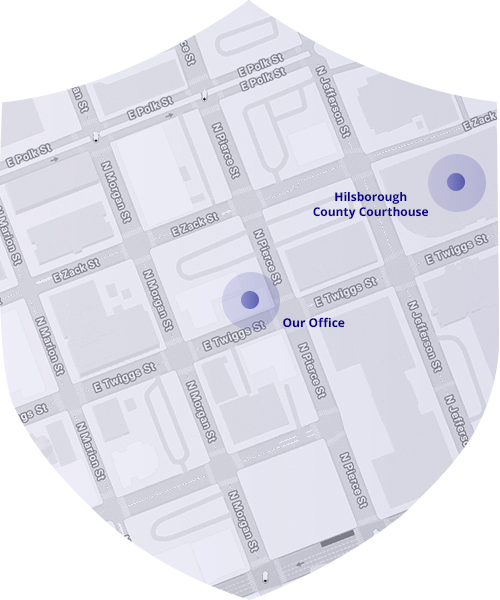
A lewd and lascivious investigation often moves quietly for weeks before an arrest, and that time is the best chance to shape the outcome. The Brancato Law Firm, P.A., founded by Tampa Criminal Defense Attorney Rocky Brancato, will handle contact with detectives, preserve the records that matter, and start testing the accusation right away. Call (813) 727-7159 for a free, confidential consultation. You can call us at any hour, and our office is two blocks from the courthouse. Our firm has Spanish-speaking staff, and attorney Jean-Luc Adrien speaks Spanish, Haitian Creole, and French. Read about our Spanish and Haitian Creole criminal defense services.
For more about our defense strategies, visit our Tampa Sex Crimes Lawyer page.
The Brancato Law Firm, P.A.
620 E. Twiggs Street, Suite 205, Tampa, FL 33602
(813) 727-7159
Serving Hillsborough, Pinellas, and Pasco Counties
The Brancato Law Firm, P.A. is a Tampa-based criminal defense practice. We are not affiliated with any other Brancato-named law firms.
Visit Us
Tampa, FL 33602
Contact Us Now
Free Legal Consultation (813) 727-7159