- Free Consultation 24/7: (813) 727-7159 Tap Here To Call Us


From First DUI to Death Penalty


How Do You Fight Child Hearsay in a Florida Sex Case? (2026)


Rewrite/update date: November 3, 2026. Originally published in June 2025.
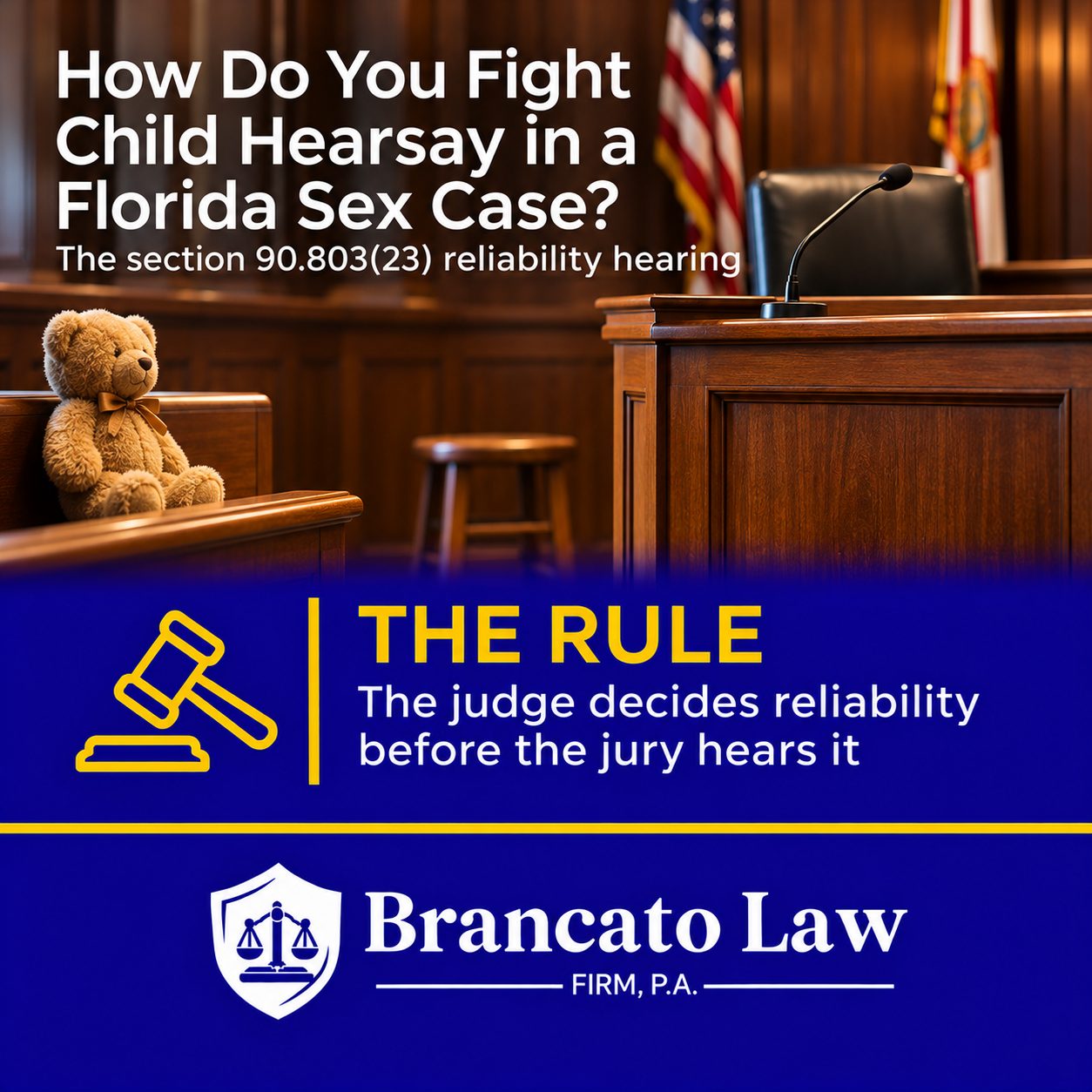
| You fight child hearsay in a Florida sex case at the pretrial reliability hearing required by section 90.803(23), Florida Statutes. A child’s out-of-court statement describing abuse can reach the jury only if the judge finds, in a hearing outside the jury’s presence and with specific findings on the record, that the time, content, and circumstances of the statement make it reliable, and, if the child does not testify, that other evidence corroborates the abuse. The defense attacks how the statement was obtained: who questioned the child first, whether the questions were leading, whether the story changed, and whether a custody fight or other motive shaped it. |
A Florida judge may let a jury hear what a child told a parent, a teacher, or an interviewer only after finding, on the record, that the statement is reliable enough to stand in for live testimony. I have argued that question many times since my years as a Major Crimes Unit attorney handling sex crime and child abuse cases. I’m Rocky Brancato, founder of The Brancato Law Firm, P.A., a Tampa criminal defense firm, and I have tried more than 150 jury trials to verdict. Our attorneys treat the child hearsay hearing as the trial before the trial, because it often decides whether the State has a case at all.
What is child hearsay under Florida law?
Child hearsay is an out-of-court statement by a child, offered to prove that what the child said is true, that Florida allows into evidence under a special exception. Under section 90.803(23), Florida Statutes, the exception covers statements by a child victim “with a physical, mental, emotional, or developmental age of 17 or less” describing child abuse or neglect, sexual abuse, or any unlawful sexual act, contact, intrusion, or penetration. Ordinary hearsay is excluded because the person who made the statement cannot be cross-examined; this exception lets the State use the child’s earlier words anyway, if strict conditions are met.
In practice, child hearsay includes what a child told a parent at bedtime, a teacher at school, a deputy at the scene, and a Child Protection Team interviewer on video. Prosecutors often present several of these statements in a row, so the jury hears the same accusation repeated by three or four adults before the child ever takes the stand. At The Brancato Law Firm, our first step is to list every statement the State intends to use and trace each one back to the first conversation.
When can a child’s statement be used as evidence in Florida?
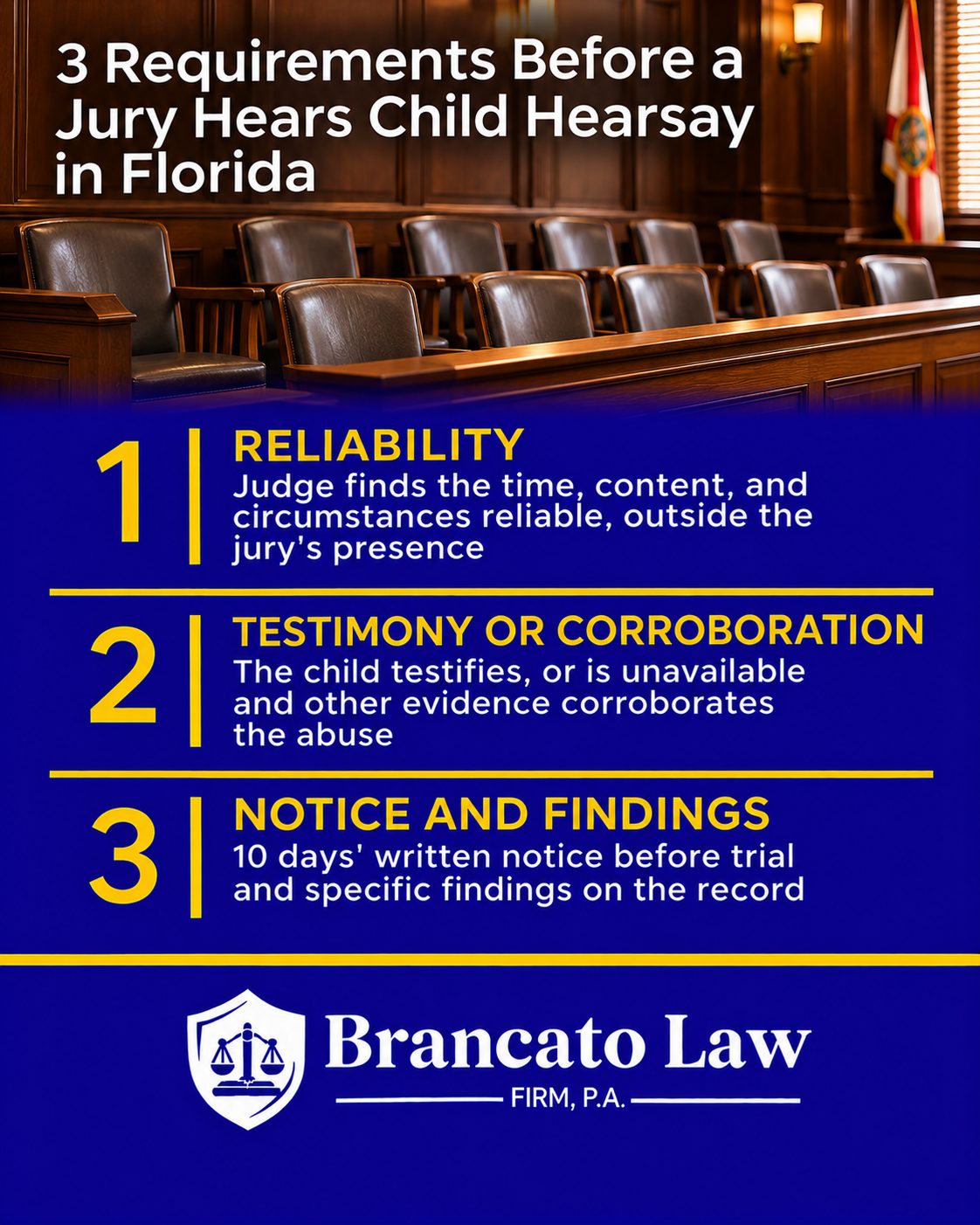
A child’s out-of-court statement can be used as evidence in Florida only when three requirements are met. The statute also says the statement is inadmissible if “the source of information or the method or circumstances by which the statement is reported indicates a lack of trustworthiness.”
- Reliability. The judge must find, “in a hearing conducted outside the presence of the jury,” that “the time, content, and circumstances of the statement provide sufficient safeguards of reliability.”
- Testimony or corroboration. The child must either testify, or be unavailable as a witness with “other corroborative evidence of the abuse or offense.” Unavailability can include a finding that testifying would cause the child “a substantial likelihood of severe emotional or mental harm.”
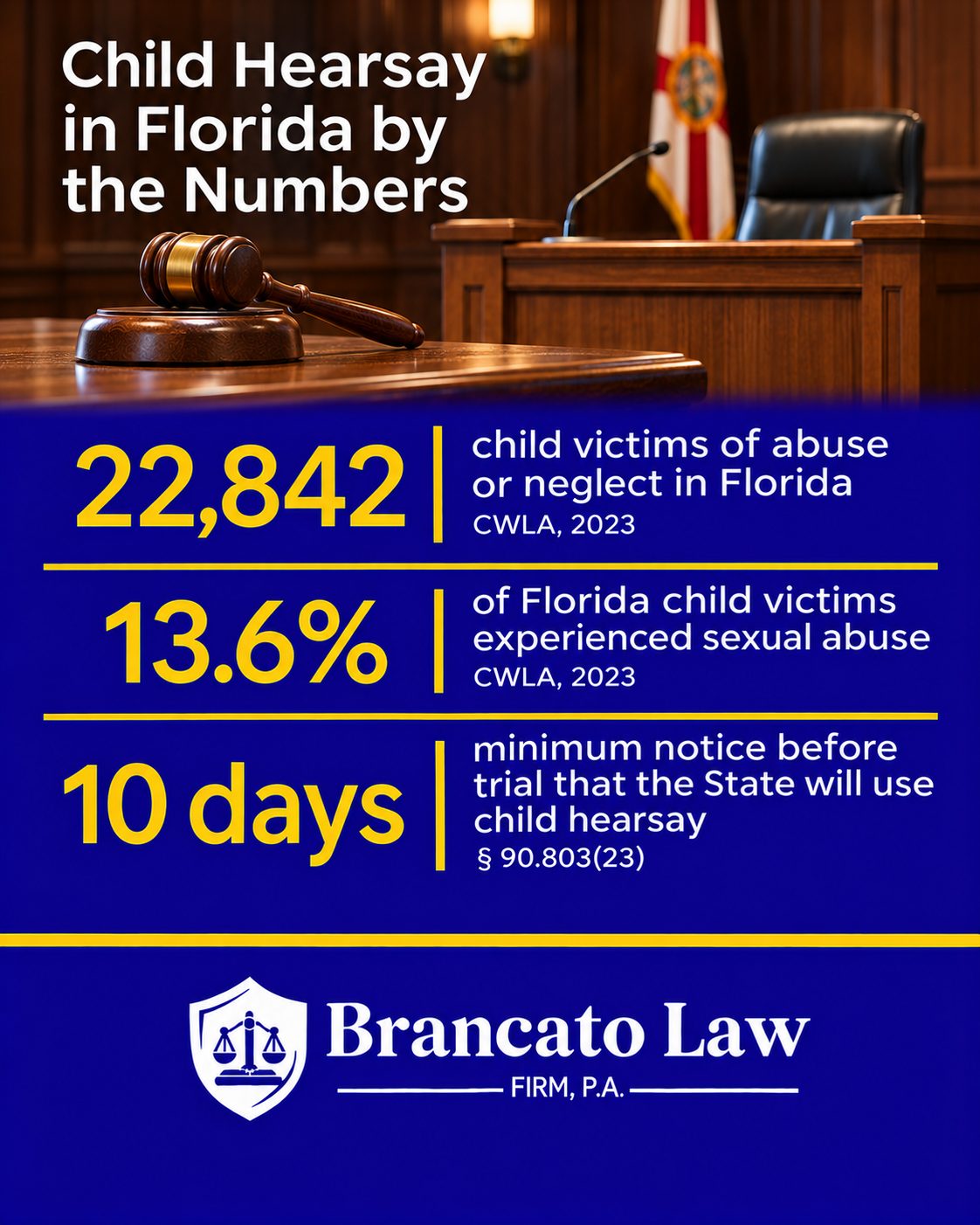
- Notice and findings. The State must notify the defense “no later than 10 days before trial,” with a written statement of what the child said, when, and the circumstances, and the court “shall make specific findings of fact, on the record.”
In State v. Townsend, 635 So. 2d 949 (Fla. 1994), the Florida Supreme Court set the order a trial judge must follow. The judge first decides whether the statement itself is reliable “without regard to corroborating evidence,” and only then asks whether corroboration exists. Corroboration cannot be used to prop up an unreliable statement. Our attorneys hold judges to that order, because prosecutors often argue reliability by pointing to other evidence.
What factors decide whether child hearsay is reliable?
Reliability is decided on the totality of the circumstances, and Townsend lists factors beyond the statute that judges still apply today. Each factor is a line of attack for the defense.
| Reliability factor | What our attorneys examine |
|---|---|
| Spontaneity and timing | Was the statement volunteered at the first opportunity, or drawn out days or weeks later? |
| Questioning by adults | Was the statement a response to leading or repeated questions from a parent, teacher, or officer? |
| Child-like description | Does the account sound like a child, or does it use adult terms the child would not know? |
| Motive to fabricate | Is there a custody dispute, divorce, or family conflict that could influence the child? |
| Reality and fantasy | Can the child tell the difference between something real and something imagined? |
| Vagueness and contradictions | Is the account specific, and did it change between tellings? |
| Improper influence | Did an adult in a domestic dispute talk to the child about the accused before the disclosure? |
Research supports these concerns. In a review published in Psychological Bulletin in 1993, researchers Stephen Ceci and Maggie Bruck found reliable age differences in children’s suggestibility, while also finding that even very young children can recall much that is forensically relevant (National Criminal Justice Reference Service abstract). That is why the questions asked before a formal interview matter as much as the interview itself. The Brancato Law Firm often works with forensic psychologists who can explain to the judge how suggestive questioning affects a young child’s account.
How many Florida child abuse cases involve sexual abuse?
Sexual abuse is a significant share of Florida’s child maltreatment cases. In 2023, Florida had 22,842 child victims of abuse or neglect, and 13.6 percent of victims experienced sexual abuse, according to the Child Welfare League of America’s 2025 Florida fact sheet. Many of those cases begin with a child’s statement to an adult, which is why section 90.803(23) comes up in so many sex crime and child abuse prosecutions.
Can child hearsay be used if the child does not testify?
Child hearsay can be used when the child does not testify only if the child is legally unavailable and there is corroborating evidence, and even then, a statement given to police or a Child Protection Team may be barred by the Sixth Amendment right to confront witnesses. In State v. Contreras, 979 So. 2d 896 (Fla. 2008), a Child Protection Team coordinator videotaped a child’s interview while a detective in another room fed her questions. The Florida Supreme Court held that the interview was “indistinguishable from an ordinary police interrogation,” so the statement was testimonial. Because the defendant never had a real chance to cross-examine the child, and discovery depositions taken without him present did not count, admitting the video violated his confrontation rights. The Court reversed the capital sexual battery conviction, where the video was the only evidence of penetration.
The lesson is that statements to a Child Protection Team are treated differently from a child’s words to a parent. When the child is not going to testify, our attorneys at The Brancato Law Firm challenge every interview conducted with law enforcement involvement on confrontation grounds, separate from the reliability hearing.
What happens when a child’s interview is not recorded?
When a child’s interview is not recorded, the defense loses the best evidence of how the questions were asked, but the State still must prove reliability through the interviewers’ testimony. In Oliver v. State, 397 So. 3d 104 (Fla. 2d DCA 2024), a Pasco County case, the Pasco County Sheriff’s Office had a standard policy that prohibited recording interviews of child sexual abuse victims. The Second District held there is no statutory or common law duty to record these interviews, and it affirmed because the trial judge made specific findings that the interviewers used open-ended, nonleading questions and that there was no evidence of coaching.
The court also noted that the facts “in another case may not present with safeguards sufficient to mitigate the need for audio or video recording.” That is a local fact that matters to anyone charged in Pasco County. When there is no recording, our attorneys depose every interviewer, request their notes, and press for details the interviewer cannot remember, because a judge cannot make specific reliability findings from a memory that has gaps. In Hillsborough County cases, we compare the interview against the Child Protection Team’s own protocols and the questioning that came before it.
How does our firm challenge child hearsay?
Our firm challenges child hearsay by reconstructing the path of the accusation from the first conversation to the courtroom and showing the judge where it was shaped by adults. Each step below is aimed at the statutory requirement it attacks.
| Defense step | What we look for | Requirement it attacks |
|---|---|---|
| Trace the first disclosure | Who asked first, what words they used, and how many times | Reliability; trustworthiness of the source |
| Review the interview recording or notes | Leading questions, repeated questions, praise or pressure | Reliability; method of reporting |
| Compare every version | Details added, dropped, or changed between tellings | Contradictions; reliability of the assertion |
| Investigate family dynamics | Custody filings, divorce timing, threats, prior allegations | Motive to fabricate; improper influence |
| Test the corroboration | Whether “corroboration” is just the same accusation repeated | Corroboration when the child is unavailable |
| Check confrontation rights | Law enforcement involvement and any prior chance to cross-examine | Sixth Amendment, under Contreras |
Losing the reliability hearing does not end these arguments. The same inconsistencies, suggestive questions, and motives can be presented to the jury through cross-examination and defense experts, and a judge who admits a statement without the specific findings the statute requires creates an issue for appeal.
Our child hearsay defense results
In one case, a child said that “a rhino came out of Grandpa’s skin,” and the prosecution presented the statement as coded language for sexual abuse. Rocky Brancato’s cross-examination showed the child was describing a literal zoo animal, and evidence of coaching came out at the hearing. The judge excluded the hearsay as unreliable, and the State dismissed all charges.
| Outcome | Charge | How we won |
|---|---|---|
| Dismissed | Sexual molestation | Exposed coaching; judge excluded the “rhino” statement |
| Not guilty | Capital sexual battery | Proved a parent coached the child during divorce proceedings |
| Dismissed | Lewd molestation | Showed the statement evolved across interviews |
| Excluded | Child abuse | Identified Child Protection Team protocol violations; judge found the statement unreliable |
Past results do not guarantee future outcomes. Each case is unique.
Related evidence issues in child sex cases
Child hearsay rarely stands alone. Prosecutors often pair it with other-acts evidence, medical findings, and limits on what the defense can say about the child. Our guide to whether prior accusations can be used against you in a Florida sex crime case covers when other accusations can come in; our post on how to challenge SANE exam evidence covers the medical side; and our guide to the exceptions to Florida’s rape shield law explains when a child’s prior experiences can come in. Lewd and lascivious charges are defined in section 800.04, Florida Statutes.
What should you do if a child has made an accusation against you?
If a child has made an accusation against you, do not talk to the child, the family, or investigators about it, and contact a defense attorney before any interview. Do not try to get the child to “take it back,” which can lead to a witness tampering charge and will be used as evidence of guilt. If a Child Protection Team or detective has contacted you but no charge has been filed, our representation before charges are filed can put the defense in place while the investigation is still open.
Frequently asked questions about child hearsay in Florida
Can a child’s statement to a parent be used in court in Florida?
Yes, if the judge finds it reliable at a hearing and, when the child does not testify, there is corroborating evidence. The Brancato Law Firm asks the parent at deposition exactly what was said, in what order, and what questions came first, because a parent’s paraphrase is often where the account changed.
How much notice does the State have to give before using child hearsay?
At least 10 days before trial, with a written statement of the child’s statement, when it was made, and the circumstances that the State says show reliability. Our attorneys at The Brancato Law Firm use that notice to identify every statement and demand the hearing well before jury selection.
Is a Child Protection Team interview automatically admissible?
No. It must pass the same reliability hearing, and if the child does not testify, Contreras may bar it as testimonial. The Brancato Law Firm reviews every CPT recording frame by frame for leading questions and law enforcement involvement; our Tampa child abuse defense attorneys handle these hearings regularly.
What if the child is now an adult at trial?
The child’s age when the statement was made is what matters, not the age at trial. The Brancato Law Firm still challenges reliability in older cases, where the passage of time often makes it harder for the State to show how the original statement was obtained.
Can child hearsay be used in a custody dispute case?
Yes, the statute applies in civil and criminal cases, and courts treat a custody fight as a reason to look closely at possible influence on the child. Our attorneys at The Brancato Law Firm gather the family court record to show the judge when and why the accusation surfaced.
Can child sex abuse charges be dropped in Florida?
Yes. When a judge excludes unreliable child hearsay, the State may be left without enough evidence to proceed, and prosecutors can drop the charges. The Brancato Law Firm has obtained dismissals in exactly that situation, as described in our Tampa sex crimes lawyer case results.
Talk to a Tampa defense attorney about child hearsay
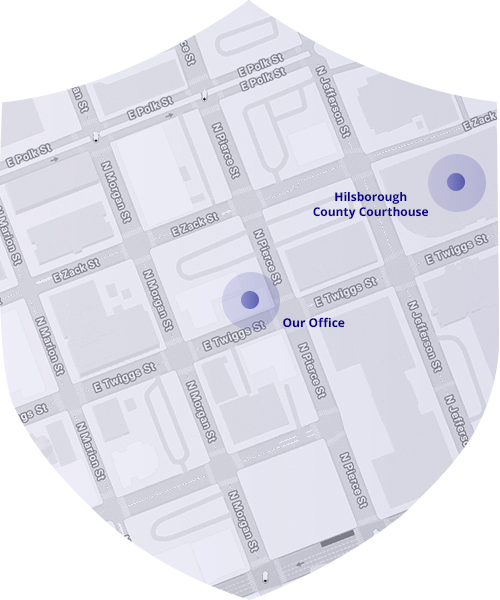
The reliability hearing is usually scheduled well before trial, and the work that wins it starts with the first discovery. Our attorneys will identify every statement the State plans to use and build the record to challenge it. Call The Brancato Law Firm, P.A., founded by Tampa Criminal Defense Attorney Rocky Brancato, at (813) 727-7159 at any hour; we defend clients in Hillsborough, Pinellas, and Pasco Counties from an office two blocks from the courthouse. Our firm has Spanish-speaking staff, and attorney Jean-Luc Adrien speaks Spanish, Haitian Creole, and French. Read our guide for Spanish-speaking and Haitian Creole-speaking clients.

For more about our defense strategies, visit our Sex Crimes page.
The Brancato Law Firm, P.A.
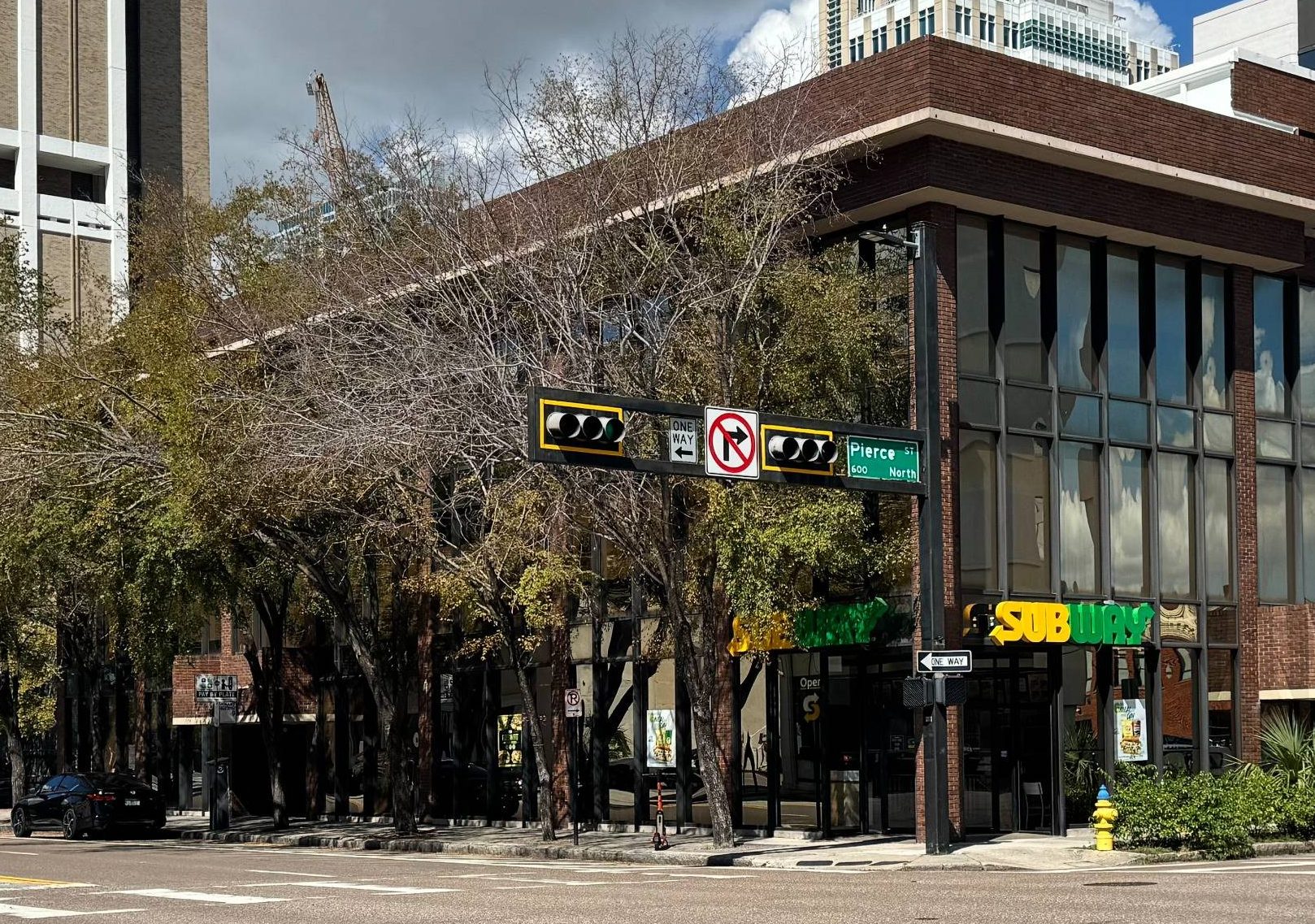
620 E. Twiggs Street, Suite 205, Tampa, FL 33602
(813) 727-7159
Serving Hillsborough, Pinellas, and Pasco Counties
The Brancato Law Firm, P.A. is a Tampa-based criminal defense practice. We are not affiliated with any other Brancato-named law firms.
Visit Us
Tampa, FL 33602
Contact Us Now
Free Legal Consultation (813) 727-7159