- Free Consultation 24/7: (813) 727-7159 Tap Here To Call Us


From First DUI to Death Penalty



What Is Contempt of Court in Florida? Jail, Fines, and Defenses (2026)


Fully rewritten and updated October 26, 2026.
Contempt of court in Florida is disobeying a court order or disrupting or disrespecting a court, and it comes in three forms: direct criminal contempt (in the judge’s presence), indirect criminal contempt (outside the courtroom, such as violating an injunction), and civil contempt (used to force compliance, such as paying child support). Criminal contempt is a common-law crime punishable by up to 12 months in jail and a $500 fine under section 775.02, Florida Statutes, and a sentence of six months or more requires a jury unless the defendant waives one. Civil contempt can mean jail, but only until the person complies, and only after the judge finds the person has the present ability to comply.
Most contempt cases are won or lost on procedure, because the rules a judge must follow before punishing someone are strict and appellate courts reverse when they are skipped. I learned how courtroom conduct is judged as a former police academy instructor who trained officers on testimony, and over more than 25 years in Hillsborough County courtrooms. I’m Rocky Brancato, founder of The Brancato Law Firm, P.A., a Tampa criminal defense firm, and our attorneys start every contempt case by checking whether the order to show cause, the notice, and the proof meet the rules before we argue the facts.
What Is Contempt of Court Under Florida Law?
Contempt of court is conduct that defies a court’s authority, either by refusing to obey a lawful order or by obstructing or disrespecting the court itself. Section 38.23, Florida Statutes, defines one core form: “A refusal to obey any legal order, mandate or decree, made or given by any judge relative to any of the business of the court, after due notice thereof, is a contempt.” Section 38.22 gives every court the power to punish contempts “whether such contempts be direct, indirect, or constructive.”
Florida courts sort contempt into three types, and the type controls the procedure, the penalty, and the defense:
| Type | Where it happens | Purpose | Common examples | Procedure rule |
|---|---|---|---|---|
| Direct criminal contempt | In the courtroom, in the judge’s presence | Punish | Profanity or an outburst at a hearing, refusing to answer after being ordered to | Fla. R. Crim. P. 3.830 |
| Indirect criminal contempt | Outside the judge’s presence | Punish | Violating an injunction or a no-contact order, ignoring a court order | Fla. R. Crim. P. 3.840 |
| Civil contempt | Usually family or civil court | Force compliance | Unpaid child support or alimony, refusing to turn over documents | Purge provision and ability-to-pay finding |
What Is Direct Criminal Contempt?
Direct criminal contempt is misconduct the judge personally sees or hears in the courtroom, and the judge can address it the same day. Under Florida Rule of Criminal Procedure 3.830, the judge must still tell the person what conduct is at issue, give the person a chance to explain or offer mitigation, and then enter a written judgment reciting the facts. The person must be allowed to present excusing or mitigating circumstances before sentencing.
Twine v. State, 188 So. 3d 44 (Fla. 3d DCA 2016) shows how fast this moves. Chakaris Twine said “This is a bunch of bullshit” after a judge refused to lower his bond in a cocaine case, then immediately apologized and explained that he was the sole caretaker for his mother, who was undergoing chemotherapy. The judge found him in direct criminal contempt and imposed 180 days in jail. The Third District said the sentence “appears to be excessive” but affirmed it, because the judge followed rule 3.830 and an appellate court has no authority to reduce a lawful sentence. The lesson is that the hearing in front of the trial judge is usually the only real chance to shape the sentence.
What Is Indirect Criminal Contempt?
Indirect criminal contempt is a violation of a court order that happens outside the courtroom, so the judge did not see it and the accused gets most of the protections of a criminal case. Under Florida Rule of Criminal Procedure 3.840, the process starts with a written order to show cause that states the essential facts, and when it is based on someone else’s report, that report must be sworn by a person with personal knowledge. The accused has the right to counsel, a reasonable time to prepare, and a hearing where the State must prove guilt beyond a reasonable doubt.
The most common source of indirect contempt in our practice is an alleged violation of a domestic violence injunction or a pretrial no-contact order. Under section 741.31, Florida Statutes, the State Attorney decides whether to file a new criminal charge for the violation, move for an order to show cause for criminal contempt, or both. A willful violation charged as a new crime is a first-degree misdemeanor, and it becomes a third-degree felony when the person has a prior conviction for domestic violence or an injunction violation against the same victim. Our Tampa domestic violence defense attorney page covers injunction cases in more detail.
Criminal vs. Civil Contempt: What Is the Difference?
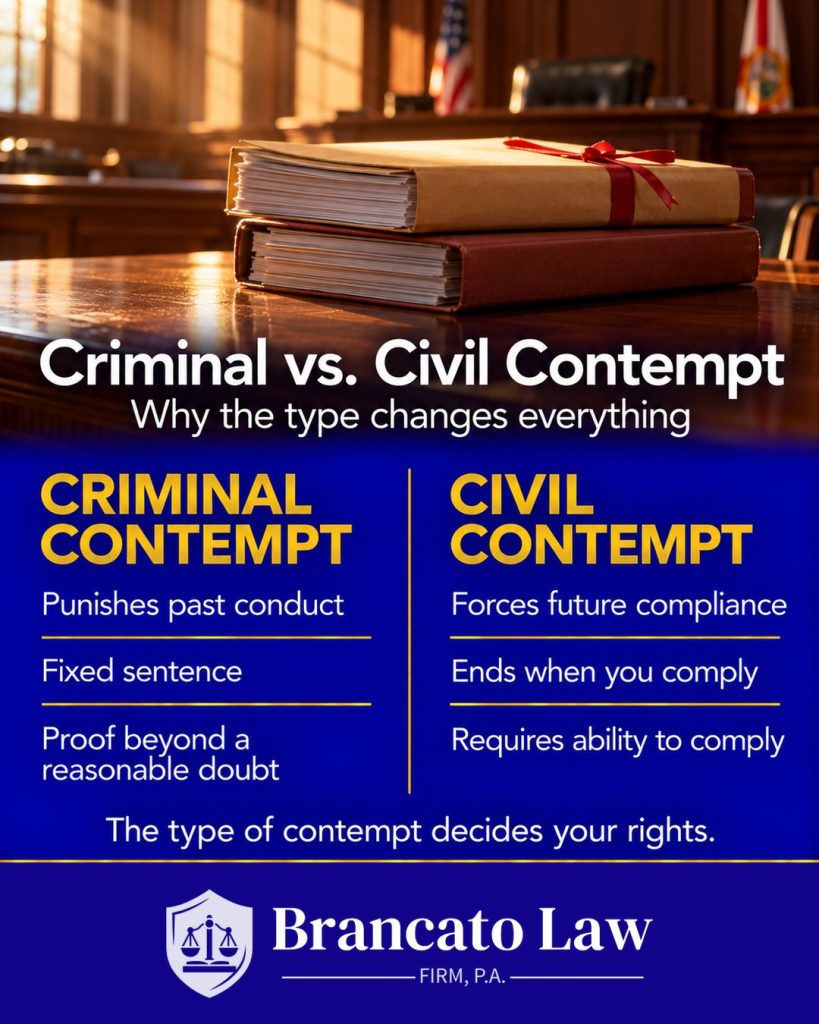
Criminal contempt punishes something that already happened, while civil contempt pressures a person to do something the court ordered. The difference decides whether jail time has a fixed end date or ends the moment the person complies.
| Factor | Criminal contempt | Civil contempt |
|---|---|---|
| Purpose | Punish past conduct | Compel future compliance |
| Burden of proof | Beyond a reasonable doubt | Lower civil standard for the underlying violation |
| Sentence | Fixed; stays in place even if the person later complies | Lasts only until the person complies (“purges” the contempt) |
| Key protection | Notice, counsel, and a jury for a sentence of six months or more | A purge amount the person can actually pay, with a finding of present ability to pay |
| Typical case | Courtroom outburst, injunction violation | Unpaid child support or alimony |
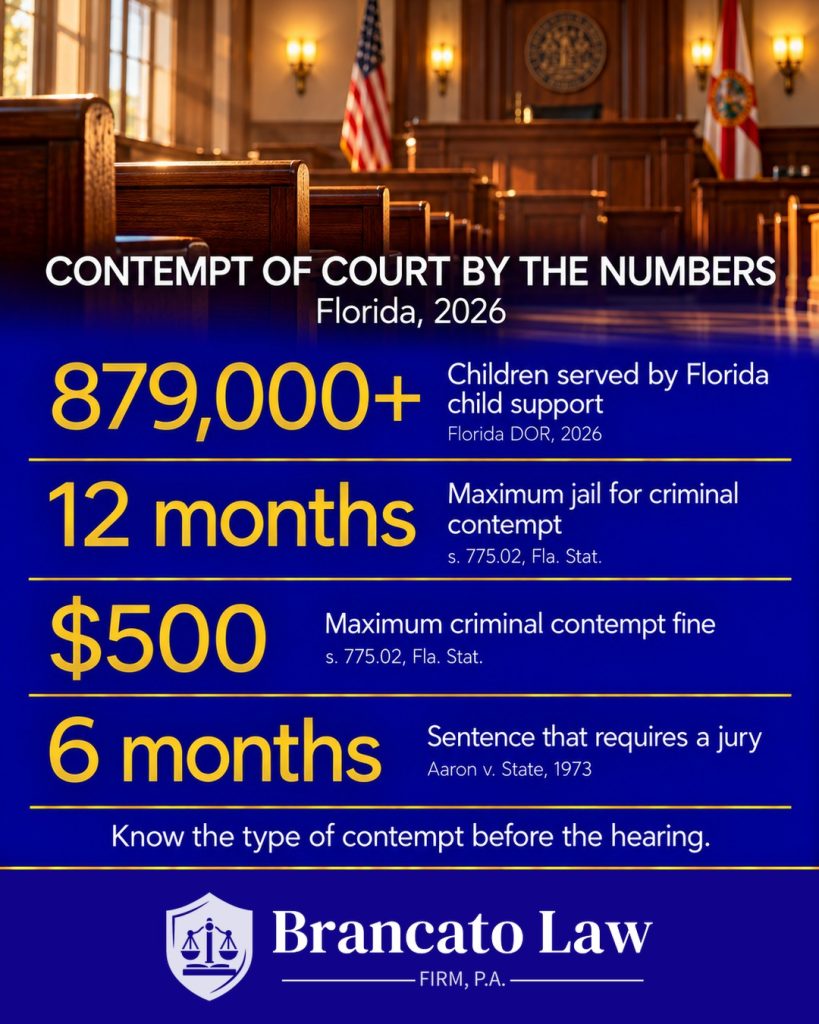
Civil contempt in Florida reaches a very large number of families through child support enforcement. The Florida Department of Revenue’s Child Support Program reports that, as of 2026, it provides child support services to over 879,000 children, and contempt is one of the tools courts use when a support order goes unpaid.
What Are the Penalties for Contempt of Court in Florida?
Criminal contempt in Florida carries up to 12 months in jail and a $500 fine, because contempt is a common-law crime and no statute sets a different maximum. In Aaron v. State, 284 So. 2d 673 (Fla. 1973), the Florida Supreme Court reviewed a man convicted of trying to influence a grand juror, held that “criminal contempt is a crime under Florida law,” and applied the limits in section 775.02, Florida Statutes: “the fine shall not exceed $500, nor the imprisonment 12 months.”
| Contempt type | Maximum jail | Maximum fine | Jury trial? |
|---|---|---|---|
| Direct or indirect criminal contempt, sentence under six months | Under 6 months | $500 | No; the judge decides |
| Indirect criminal contempt, sentence of six months or more | 12 months | $500 | Yes, unless waived |
| Civil contempt | Until the person complies | Coercive sanctions only | No |
| Injunction violation charged as a new crime under s. 741.31 | 1 year (first-degree misdemeanor); 5 years if a felony repeat violation | $1,000 to $5,000 | Yes |
Contempt also carries consequences outside the jail sentence. A criminal contempt conviction is a criminal record, and a contempt finding in a family case can affect custody and timesharing decisions.
When Do You Get a Jury Trial for Contempt in Florida?
You are entitled to a jury in a criminal contempt case when the judge intends to impose six months or more in jail. In Aaron (1973), the Florida Supreme Court held that a judge who denies a jury “cannot impose a sentence of six months’ imprisonment, or greater,” and that a judge who contemplates that sentence “must empanel a jury to try the facts, unless the defendant has made a waiver thereof.” The court reaffirmed the six-month line in Aaron v. State, 345 So. 2d 641 (Fla. 1977), the second appeal in the same grand juror case, and declined to extend the jury right to every criminal contempt.
Demanding a jury changes the case. It caps the sentence a judge can impose without one, and it gives the defense time, discovery, and twelve citizens instead of one judge who may also be the person whose order was violated.
Firm case result: jury trial demand leads to dismissal. A client faced indirect criminal contempt with exposure to more than six months in jail. Our firm demanded a jury trial, a right that neither the judge nor the opposing attorney expected in a contempt case. As the case moved toward the jury trial date, the contempt charge was dismissed. Past results do not guarantee future outcomes.
What Happens When the Rules Are Not Followed?
When a judge skips a required step, Florida appellate courts often reverse the contempt finding as fundamental error, even if no one objected at the hearing. The Second District Court of Appeal, which hears appeals from Hillsborough, Pinellas, and Pasco Counties, has done this repeatedly in cases where the order to show cause was not backed by a sworn statement from someone with personal knowledge.
In A.N.W. v. State, 386 So. 3d 621 (Fla. 2d DCA 2024), a Pasco County dependency judge held a teenager in indirect contempt based on an unsworn report from a care provider who admitted at the hearing that she had not seen any of the conduct. The Second District reversed, holding that the affidavit requirement in Florida Rule of Juvenile Procedure 8.150(c)(2) is substantively the same as rule 3.840(a) and that failing to follow it is fundamental error. A year later, in C.M.B. v. State, 406 So. 3d 361 (Fla. 2d DCA 2025), the same court reversed another Pasco County juvenile’s contempt judgment and secure detention order because none of the orders to show cause was supported by an affidavit, and the State conceded the error.
These cases arose in juvenile court, but the same rule applies to adults through rule 3.840. Our attorneys read the order to show cause and the supporting affidavit first, because a defect there can end the case before the facts are ever argued.
Can You Go to Jail for Civil Contempt in Florida?
Yes, but only if the judge finds you have the present ability to do what the order requires. In Bowen v. Bowen, 471 So. 2d 1274 (Fla. 1985), a father was jailed for failing to pay a $966 child support purge amount even though the record showed he was indigent. The Florida Supreme Court held that the trial court “must make a separate, affirmative finding that the contemnor possesses the present ability to comply with the purge conditions,” and explained that without that ability, “the contemnor holds no key to the jailhouse door.”
The U.S. Supreme Court set national minimums in Turner v. Rogers, 564 U.S. 431 (2011). Michael Turner was sentenced to 12 months for unpaid support in South Carolina at a hearing where no one told him his ability to pay was the central question. The Court held that due process does not always require appointed counsel in civil support contempt, but it does require safeguards: notice that ability to pay is critical, a way to gather financial information, a chance to respond, and an express finding of ability to pay. Because Turner received none of these, his jailing violated due process.
Legal scholars have long warned about what happens when those safeguards fail. In “Civil Contempt and the Indigent Child Support Obligor: The Silent Return of Debtor’s Prison,” published in the Cornell Journal of Law and Public Policy in 2008, Professor Elizabeth G. Patterson examined how civil contempt can become imprisonment for debt when courts jail parents who cannot pay. Bowen and Turner are the tools our attorneys use to keep that from happening to a client.
How Do Our Attorneys Defend a Contempt Charge?
Our attorneys defend contempt by attacking the procedure first, then the proof of willfulness, then the sentence. The strongest defenses we see in Hillsborough, Pinellas, and Pasco County courts are:
- A defective order to show cause. No sworn affidavit, an affiant without personal knowledge, or an order that does not state the essential facts.
- No proof of willfulness. Indirect criminal contempt requires proof beyond a reasonable doubt that the person intended to disobey the court. An unclear order, lack of notice, or an honest misunderstanding can defeat that element.
- No present ability to comply. In civil contempt, inability to pay or perform is a complete answer to jail under Bowen.
- The jury demand. If the court wants a sentence of six months or more, the defense can insist on a jury, which caps the judge’s sentencing power without one.
- Judicial disqualification. When the contempt involves criticism of the judge, the rules allow the defense to ask that a different judge hear it; our post on disqualifying a trial judge in Tampa explains that process.
- Mitigation and a compliance plan. Showing the court that the order is now being followed often resolves a civil contempt and can reduce a criminal contempt sentence.
What Should You Do If You Receive an Order to Show Cause?
Appear on the date in the order, bring a lawyer, and do not argue with the judge. An order to show cause is a court order, and missing the hearing can lead to a writ of bodily attachment or an arrest warrant. Read the order closely, gather proof of any payments or compliance, and stop any contact the order prohibits, even if the other person reaches out first.
Courtroom conduct matters at that hearing. Our guides on what to wear to court and bringing a child to court cover the practical details that keep a hearing from going wrong, and our Hillsborough County criminal defense attorney page explains how local cases move through the 13th Judicial Circuit.
Frequently Asked Questions About Contempt of Court in Florida
Can a judge put you in jail on the spot for contempt in Florida?
Yes, for direct criminal contempt a judge can find you guilty and sentence you at the same hearing, as long as the judge follows rule 3.830 and lets you explain first. The Brancato Law Firm uses that moment to present mitigation, because the appellate court in Twine could not reduce a 180-day sentence it called excessive.
Is violating a no-contact order contempt of court in Florida?
Yes, violating a pretrial no-contact order or an injunction can be prosecuted as indirect criminal contempt, and some injunction violations can also be charged as a separate crime under section 741.31. Our attorneys at The Brancato Law Firm check whether the client was properly served with the order and whether the contact was actually prohibited; see our domestic violence defense page.
Can contempt of court charges be dropped in Florida?
Yes, a contempt charge can be dismissed when the order to show cause is defective, when the State cannot prove willfulness, or when the accused comes into compliance. The Brancato Law Firm has seen a contempt charge dismissed after demanding a jury trial, though every case turns on its own facts.
Do you get a public defender for contempt of court?
An indigent person facing indirect criminal contempt with possible jail time is generally entitled to appointed counsel, while in civil support contempt counsel is not automatically required under Turner v. Rogers. The Brancato Law Firm represents clients in both kinds of contempt hearings and can step in before the show cause date; our Tampa criminal defense team can be reached at any hour.
How long can you be jailed for civil contempt of child support in Florida?
Civil contempt jail lasts until the parent pays the purge amount or otherwise complies, but the judge must first find the parent can actually pay it under Bowen v. Bowen. Our attorneys at The Brancato Law Firm bring pay records, job search evidence, and financial affidavits to prove inability to pay when that is the truth.
Does a contempt conviction go on your criminal record in Florida?
Yes, a criminal contempt conviction creates a criminal record, while a civil contempt finding is part of the family or civil court file. The Brancato Law Firm looks at whether a withhold of adjudication or a later sealing is possible when we negotiate the outcome of a criminal contempt charge.
For how this fits into the rest of a case, see our overview of how a Florida criminal case moves from investigation to appeal.
Talk to a Tampa Attorney Before Your Contempt Hearing
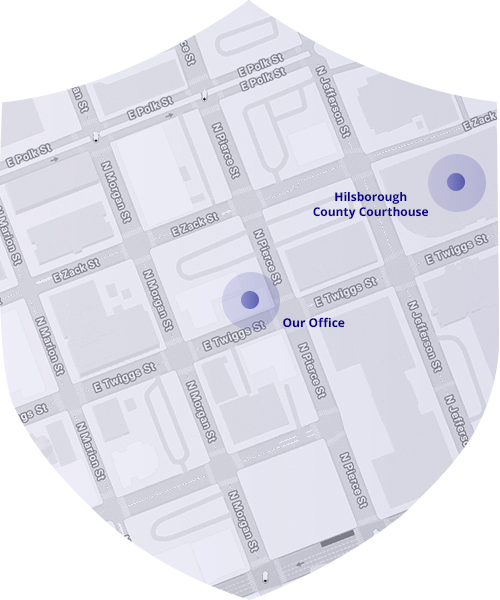
The show cause date is the deadline that matters, and the defenses described above have to be raised at or before that hearing. Our attorneys at The Brancato Law Firm, P.A., founded by Tampa Criminal Defense Attorney Rocky Brancato, will review the order, the affidavit, and your proof of compliance before you stand in front of the judge. Call (813) 727-7159; you can call us at any hour, and our office is two blocks from the courthouse. Our firm has Spanish-speaking staff, and attorney Jean-Luc Adrien speaks Spanish, Haitian Creole, and French. Read our guide for Spanish and Haitian Creole speakers facing criminal charges.
For more about our defense strategies, visit our Tampa Domestic Violence Defense Attorney page.
The Brancato Law Firm, P.A.
620 E. Twiggs Street, Suite 205, Tampa, FL 33602
(813) 727-7159
Serving Hillsborough, Pinellas, and Pasco Counties
The Brancato Law Firm, P.A. is a Tampa-based criminal defense practice. We are not affiliated with any other Brancato-named law firms.
Visit Us

Tampa, FL 33602
Contact Us Now
Free Legal Consultation (813) 727-7159